77) What is the principle monetary policy tool used by the Fed. Why?
78) If the required reserve ratio is 100 percent, could the Federal Reserve still change the money supply
with open market operations? Explain whether they could or could not.
79) Would the maximum loan that a bank can make be different when receiving a discount loan from
the Federal Reserve of $1 million versus receiving a checking account deposit of $1 million? Explain
why or why not.
80) How will the purchase of $100 million of government securities by the Federal Reserve change bank
reserves and total checking account deposits in the banking system as a whole? Assume that banks do
not hold any excess reserves, that households and firms do not change the amount of currency they
hold, and that the required reserve ratio is 20 percent.
14.5 The Quantity Theory of Money
1) The quantity equation states that the
A) money supply divided by the velocity of money equals the price level divided by real output.
B) money supply times the velocity of money equals the price level times real output.
C) money supply times the price level equals real output divided by the velocity of money.
D) money supply times the price level equals real output times the velocity of money.
2) Using the quantity equation, if the velocity of money grows at 5 percent, the money supply grows at
10 percent, and real GDP grows at 4 percent, then the inflation rate will be
A) 19 percent.
B) 15 percent.
C) 11 percent.
D) 6 percent.
3) The quantity theory of money predicts that, in the long run, inflation results from the
A) velocity of money growing at a faster rate than real GDP.
B) velocity of money growing at a lower rate than real GDP.
C) money supply growing at a lower rate than real GDP.
D) money supply growing at a faster rate than real GDP.
4) The quantity theory of money was derived from the quantity equation by asserting that
A) real output was fixed.
B) the money supply was fixed.
C) the velocity of money was fixed.
D) the velocity of money was zero.
5) According to the quantity theory of money, the inflation rate equals
A) the money supply minus real output.
B) the growth rate of the money supply minus the growth rate of real output.
C) real output minus the money supply.
D) the growth rate of real output minus the growth rate of the money supply.
6) According to the quantity theory of money, if the money supply grows at 20 percent and real GDP
grows at 5 percent, then the inflation rate will be
A) 15 percent.
B) 20 percent.
C) 25 percent.
D) 100 percent.
7) According to the quantity theory of money, deflation will occur if the
A) money supply is less than real GDP.
B) money supply is more than real GDP.
C) money supply grows at a slower rate than real GDP.
D) money supply grows at a faster rate than real GDP.
8) Hyperinflation can be caused by
A) the government selling bonds to the central bank.
B) the central bank selling bonds to the public.
C) the government selling bonds to the public.
D) the central bank selling bonds to the government.
9) In 1980, one Zimbabwean dollar was worth 1.47 U.S. dollars. By the end of 2008, the exchange rate
was one U.S. dollar to 2 billion Zimbabwean dollars. When an economy experiences rapid increases in
the price level such as what occurred in Zimbabwe, the economy is said to experience
A) stagflation.
B) deflation.
C) inflation.
D) hyperinflation.
10) Which of the following is not a consequence of hyperinflation?
A) Money’s function as a medium of exchange is enhanced.
B) Money loses value so rapidly that firms and individuals stop holding it.
C) It causes an economy to suffer slow growth.
D) The price level grows in excess of hundreds of percentage points per year.
11) The German Hyperinflation of the early 1920s was caused by
A) the German government raising funds for expenditures by selling bonds to the central bank.
B) an overly aggressive monetary policy implemented to combat a severe recession.
C) rising oil prices after World War I caused a severe stagflation and hyperinflation.
D) large deficits resulting from the high levels of war spending and falling taxes.
12) There is a strong link between changes in the money supply and inflation
A) in both the short run and the long run.
B) in neither the short run nor the long run.
C) in the short run, but not in the long run.
D) in the long run, but not in the short run.
13) The quantity theory of money seeks to explain the connection between money and
A) interest rates.
B) unemployment.
C) output.
D) prices.
14) The quantity equation states that
A) the money supply (M) divided by the velocity of money (V) equals the price level (P) divided by real
output (Y), i.e., M/V = P/Y.
B) M × V = P × Y.
C) M + V = P + Y.
D) M – V = P – Y.
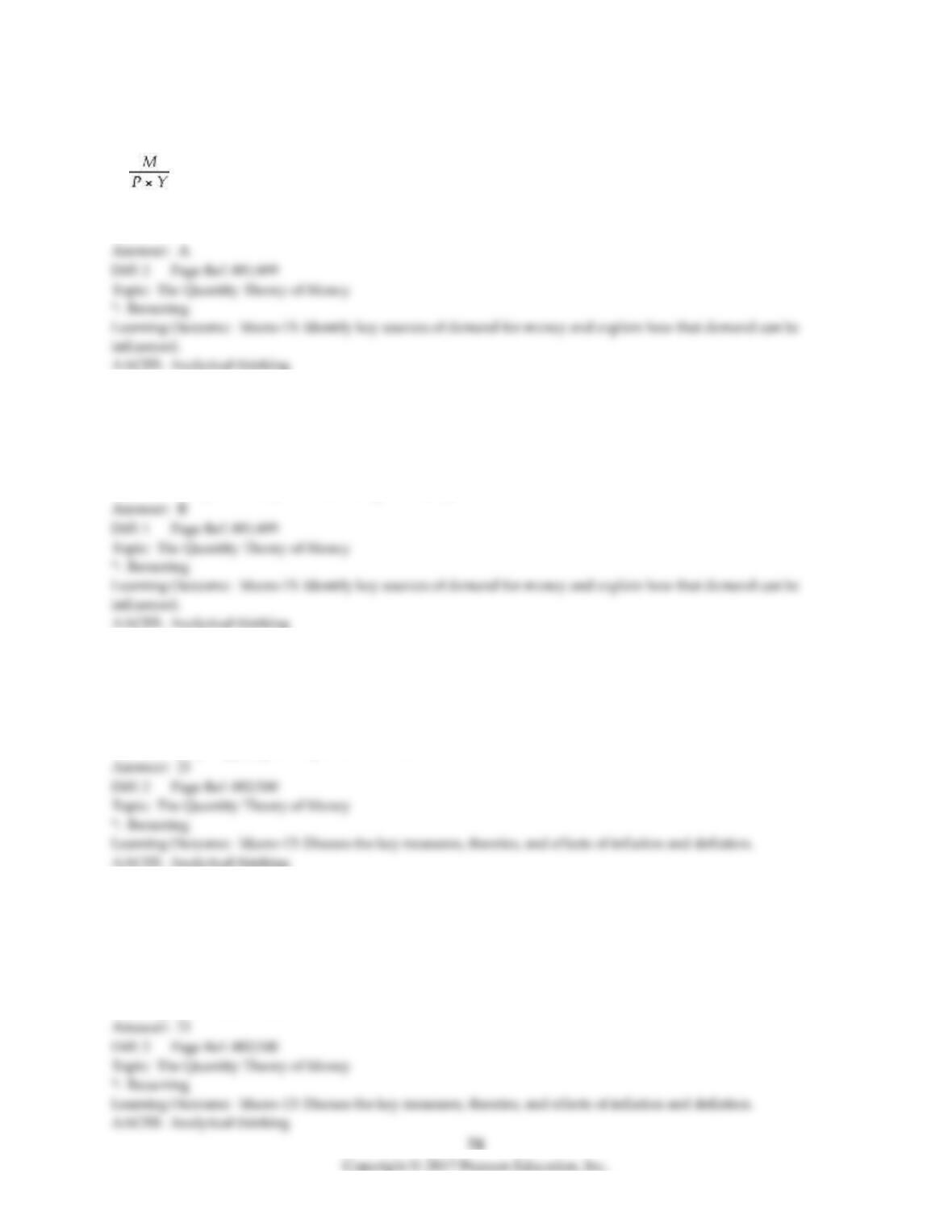
15) The velocity of money is defined as
A) the average number of times each dollar is used to purchase goods and services.
B) .
C) the total number of times each dollar is used to purchase goods and services.
D) P × Y.
16) The quantity theory of money assumes that
A) the velocity of money is negative.
B) the velocity of money is constant.
C) the velocity of money is zero.
D) the velocity of money fluctuates unpredictably.
17) According to the quantity theory of money, inflation is caused by
A) the money supply growing slower than real GDP.
B) GDP growing faster than the money supply.
C) GDP growing at the same rate as the money supply.
D) the money supply growing faster than real GDP.
18) The quantity theory of money implies that the price level will be stable (no inflation or deflation)
when the growth rate of the money supply equals
A) 0.
B) the growth rate of the price level.
C) the growth rate of the velocity of money.
D) the growth rate of real GDP.
19) According to the quantity theory of money, if the money supply grows at 6%, real GDP grows at 2%,
and the velocity of money is constant, then the inflation rate will be
A) 8%.
B) 6%.
C) 4%.
D) 2%.
20) Hyperinflation is caused by
A) a constant increase in the money supply.
B) a high rate of growth in the money supply.
C) Real GDP growing more rapidly than the money supply.
D) the money supply growing more slowly than GDP.
21) Which of the following is not one of the ways that the German government ended the hyperinflation
of the 1920s?
A) negotiating a new agreement with the Allies (the United States, Great Britain, France, and Italy) that
reduced its reparations payments
B) reducing government expenditures and raising taxes to balance its budget
C) raising the required reserve ratio to reduce bank loans
D) replacing the existing mark with a new mark
22) During the German hyperinflation of the 1920s, the large increases in the money supply were
generated by the German government
A) significantly lowering the required reserve ratio to enable German businesses to obtain loans.
B) significantly raising the required reserve ratio to reduce business loans.
C) printing large quantities of German marks.
D) selling large quantities of government bonds to the central bank, the Reichsbank.
23) In 2008, Zimbabwe ran out of locally produced Coca Cola and local Coke bottlers were not able to
import the concentrated syrup needed to make Coke from the United States because they could not
obtain U.S. dollars. A small amount of Coke was imported from South Africa, but a single bottle sold for
around 15 billion Zimbabwean dollars. Zimbabwe was experiencing rapid increases in the price level,
which is known as
A) stagflation.
B) deflation.
C) inflation.
D) hyperinflation.
24) An increase in the purchasing power of money would not, on average, result in an increase in the
purchasing power of people’s income because a ________ price level would likely mean ________ wages
and salaries.
A) rising; falling
B) rising; rising
C) falling; falling
D) falling; rising
25) If the rate of growth in real GDP exceeds the rate of growth in the money supply, the quantity
theory of money predicts a price deflation.
26) Hyperinflations occur because governments want to spend more than they raise in taxes, and they
pay for the extra purchases by printing money.
27) For the purchasing power of money to increase, the price level has to fall.
28) The quantity equation becomes the basis for a theory when we assume that velocity of money is
constant.
29) An increase in the purchasing power of money need not lead to an increase in the purchasing power
of income because the falling price level would likely mean falling wages and salaries.
30) How is the quantity theory of money different from the quantity equation and why must the
quantity equation always be true?
31) In countries that have experienced hyperinflation, what role have large government budget deficits
played in causing the very high inflation rates?
32) When a government has a budget deficit, it must issue (sell) government bonds to finance the
deficit. Does it matter for the rate of inflation if the government sells the government bonds to the
public or sells the government bonds to the central bank? Explain why it does or does not matter.
33) What are the implications of the quantity theory of money for monetary policy and price stability?
34) Suppose the velocity of money is not fixed, but stable at about two percent growth per year. How
could the quantity theory of money be modified to include a stable growth rate of the velocity of
money? In this modified quantity theory of money with velocity growing at two percent per year, what
would the growth rate of the other variables in the theory need to be to cause inflation?
35) According to monetary theory, if the money supply is growing at a rate of 5 percent, real GDP is
growing at a rate of 2 percent, and velocity is constant, what will the inflation rate be?