c.
allocate their resources equitably.
d.
exploit their resources.
DISC: Supply and demand
United States – BPROG: Analytic
Supply and demand
Efficient Resource Allocation and Pricing
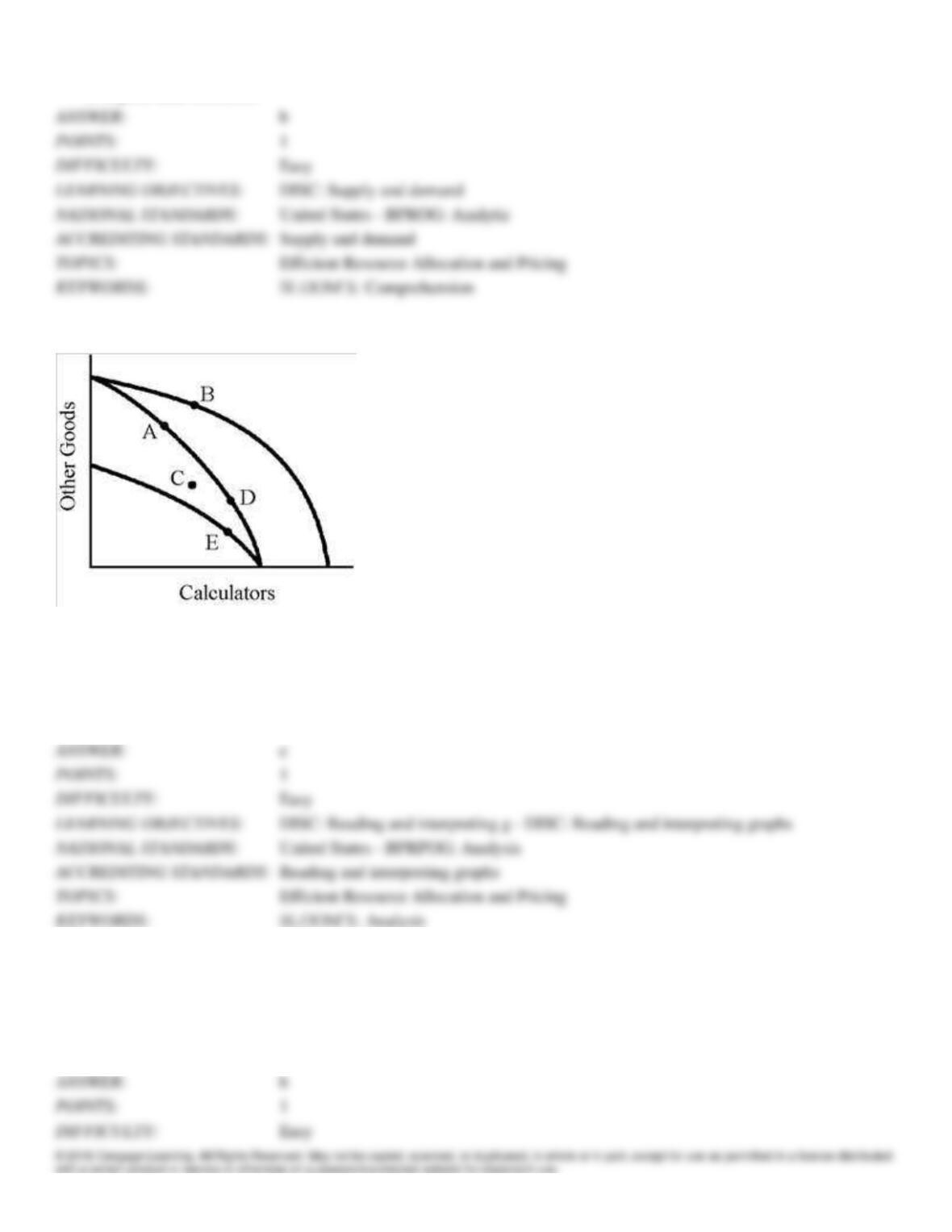
Figure 14-1
76. In Figure 14–1, a cost-reducing technological breakthrough in calculator production would cause which movement?
a.
A to D
b.
A to C
c.
A to B
d.
A to E
DISC: Reading and interpreting g – DISC: Reading and interpreting graphs
United States – BPRPOG: Analysis
Reading and interpreting graphs
Efficient Resource Allocation and Pricing
77. In Figure 14–1, a change in consumer tastes favoring calculators will lead to which movement?
a.
A to C
b.
A to D
c.
A to B
d.
A to E
DISC: Reading and interpreting g – DISC: Reading and interpreting graphs
United States – BPROG: Reflective Thinking – BPROG: Analysis
Reading and interpreting graphs
Efficient Resource Allocation and Pricing
78. In Figure 14–1, a technological breakdown in calculator production would cause which movement?
a.
B to E
b.
B to C
c.
B to D
d.
A to D
DISC: Reading and interpreting g – DISC: Reading and interpreting graphs
United States – BPROG: Reflective Thinking – BPROG: Analysis
Reading and interpreting graphs
Efficient Resource Allocation and Pricing
Figure 14-2
79. As we move down the production possibilities schedule in Figure 14–2, each successive point is
a.
less efficient.
b.
more efficient.
c.
equally efficient.
d.
more or less efficient; we cannot tell which.
DISC: Reading and interpreting g – DISC: Reading and interpreting graphs
United States – BPROG: Reflective Thinking – BPROG: Analysis
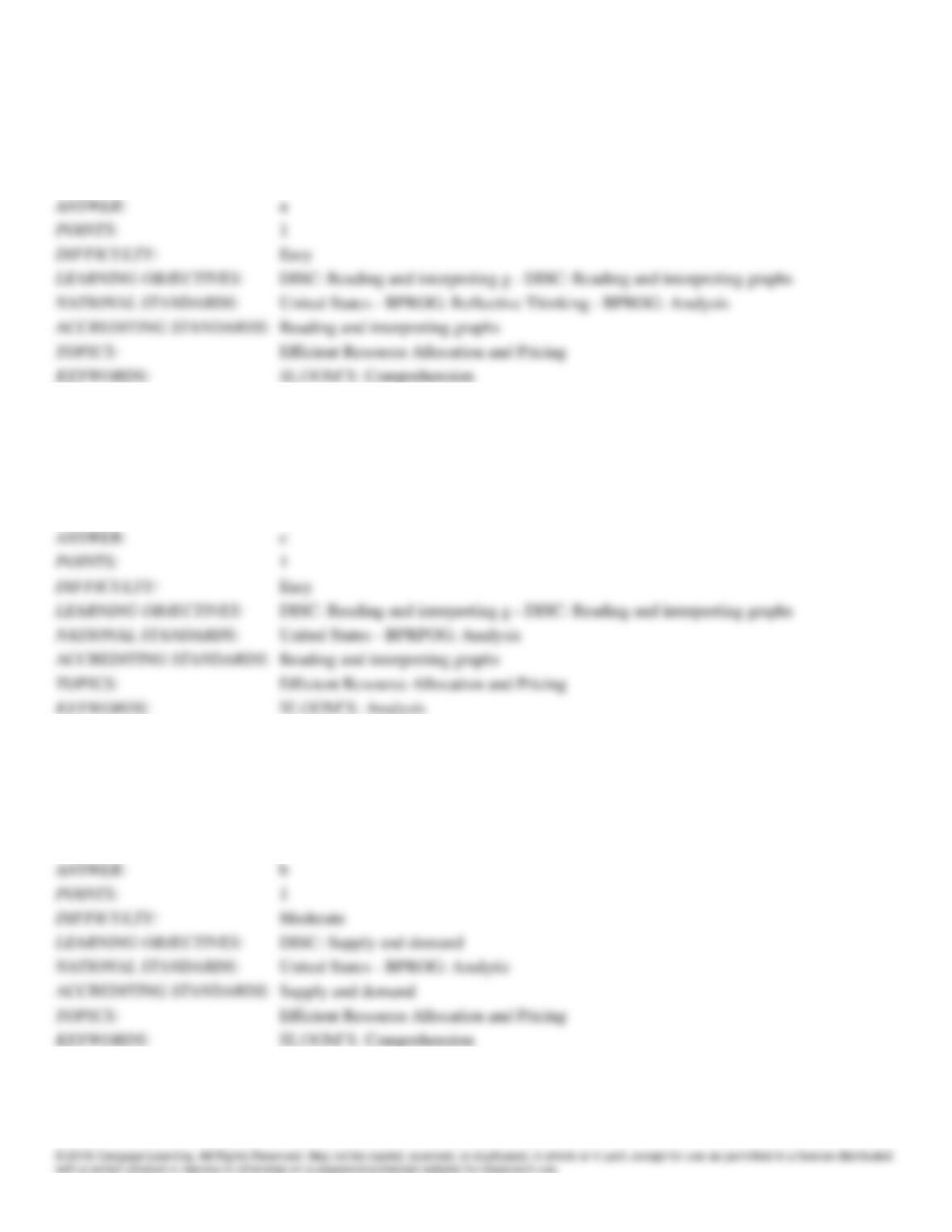
80. In Figure 14–2, which of the points are efficient allocations of resources?
a.
A, B, and C
b.
B and C only
c.
C and B and D
d.
B only
DISC: Reading and interpreting g – DISC: Reading and interpreting graphs
United States – BPROG: Reflective Thinking – BPROG: Analysis
Reading and interpreting graphs
Efficient Resource Allocation and Pricing
81. In Figure 14–2, which movement would represent an improvement for all individuals?
a.
A to B
b.
C to AC
c.
D to B
d.
A to D
DISC: Reading and interpreting g – DISC: Reading and interpreting graphs
United States – BPRPOG: Analysis
Reading and interpreting graphs
Efficient Resource Allocation and Pricing
82. An efficient allocation of resources exists if
a.
one group of people can get more of the things they want without someone else having to give up anything.
b.
no one can get more of the things he wants without someone else having to give up something.
c.
the economy operates at any point under the production possibilities frontier.
d.
the economy is operating at any point above the production possibilities frontier.
DISC: Supply and demand
United States – BPROG: Analytic
Supply and demand
Efficient Resource Allocation and Pricing
83. The graphical device that illustrates the concept of scarce resources being efficiently utilized in the economy is a(n)
a.
budget line.
b.
indifference curve.
c.
production possibilities frontier.
d.
marginal cost curve.
c
Moderate
DISC: Scarcity, tradeoffs, and o – DISC: Scarcity, tradeoffs, and opportunity cost
United States – BPROG: Analytic
Scarcity, tradeoffs, and opportu – Scarcity, tradeoffs, and opportunity cost
Efficient Resource Allocation and Pricing
84. The production possibilities frontier illustrates
a.
the fundamental fact of scarcity.
b.
the opportunity cost of acquiring more of one good.
c.
maximum output utilizing all resources efficiently.
d.
All of the above are correct.
Moderate
DISC: Scarcity, tradeoffs, and o – DISC: Scarcity, tradeoffs, and opportunity cost
United States – BPROG: Analytic
Scarcity, tradeoffs, and opportu – Scarcity, tradeoffs, and opportunity cost
Efficient Resource Allocation and Pricing
85. Inefficient allocation of resources occurs when
a.
no one can be made better off without having someone else give up something.
b.
it is possible to make some people better off without making others worse off.
c.
society is operating at a point high on the production possibilities frontier.
d.
society is operating at a point low on the production possibilities frontier.
Moderate
DISC: Supply and demand
United States – BPROG: Analytic
Supply and demand
Efficient Resource Allocation and Pricing
86. The price of a ride on the Washington, D.C. metro depends on the time of day you ride. This is an example of
a.
exploitation.
b.
inefficiency.
c.
political interference with a market.
d.
pricing to spread out demand.
DISC: Supply and demand
United States – BPROG: Analytic
Supply and demand
Efficient Resource Allocation and Pricing
87. For economic efficiency, which of the following conditions should be met?
a.
Scarcer goods should have lower prices.
b.
More abundant goods should have lower prices.
c.
More abundant goods should have higher prices.
d.
All goods should have equal prices.
b
1
DISC: Supply and demand
United States – BPROG: Analytic
Supply and demand
Efficient Resource Allocation and Pricing
88. Using prices to promote efficiency in the utilization of bridges,
a.
higher prices should be charged for the use of the most crowded bridges.
b.
lower prices should be charged for the use of the uncrowded bridges.
c.
traffic would be equalized among the bridges where space is a scarce resource.
d.
All of the above are correct.
d
1
DISC: Supply and demand
United States – BPROG: Reflective Thinking – BPROG: Analysis
Supply and demand
Efficient Resource Allocation and Pricing
89. Higher prices
a.
are always against the public interest.
b.
may sometimes serve the public interest.
c.
should never be allowed.
d.
occur automatically for abundant goods.
b
1
DISC: Supply and demand
United States – BPROG: Analytic
Supply and demand
Efficient Resource Allocation and Pricing
90. Which of the following statements concerning efficiency is correct?
a.
If a toll road is heavily used so that traffic movement is slowed, the price per vehicle should be reduced since
the road is generating more revenue.
b.
Economists advocate high prices for abundant resources and low prices for scarce resources.
c.
If a toll road is heavily used and traffic movement is difficult, the price per vehicle should be increased to shift
some traffic to less-crowded roads.
d.
None of the above is desirable in promoting efficient use of scarce road space.
DISC: Supply and demand
United States – BPROG: Analytic
Supply and demand
Efficient Resource Allocation and Pricing
91. When prices of products are set below equilibrium,
a.
society’s resources are inefficiently allocated.
b.
firms expand output to increase profits.
c.
firms earn excessively high profits.
d.
consumers benefit from surpluses of cheap goods.
DISC: Equilibrium
United States – BPROG: Analytic
Efficient Resource Allocation and Pricing
92. “Peak” pricing can best be defined as
a.
setting higher prices to reflect higher demand.
b.
pricing to obtain maximum profit.
c.
setting price higher when demand is more elastic.
d.
raising price to determine elasticity.
DISC: Supply and demand
United States – BPROG: Analytic
Supply and demand
Efficient Resource Allocation and Pricing
93. An example of peak pricing is charging
a.
more for long-distance phone calls in the daytime.
b.
less for electricity at night.
c.
more for public transportation in rush hours.
d.
All of the above are true.
DISC: Supply and demand
United States – BPROG: Analytic
Supply and demand
Efficient Resource Allocation and Pricing
94. Keeping landing fees low at airports during the “peak” hours
a.
perpetuates congestion during those hours.
b.
is politically unpopular.
c.
contributes to efficient allocation of airport facilities.
d.
would lessen the problem of delayed flight landings.
DISC: Supply and demand
United States – BPROG: Reflective Thinking – BPROG: Analysis
Supply and demand
Efficient Resource Allocation and Pricing
95. If parking spaces on a college campus are scarce, with quantity demanded during the “peak” hours, from 8 a.m. to 11
a.m., far greater than the number of spaces, an economist would propose as an efficient solution,
a.
lowering the parking fees during those hours to compensate students for the longer search time.
b.
charging the same parking fees during all hours of the school day.
c.
raising parking fees during the peak hours to encourage some students to schedule classes during other hours
when parking fees are lower.
d.
hiring more security guards to patrol for illegal parkers.
DISC: Supply and demand
United States – BPROG: Reflective Thinking – BPROG: Analysis
Supply and demand
Efficient Resource Allocation and Pricing
96. In an efficient market, a scarce good generally has a ____ than a less-scarce good.
a.
higher price
b.
higher total utility to consumers
c.
more even distribution across income classes
d.
lower price in off-peak periods
DISC: Supply and demand
United States – BPROG: Analytic
Supply and demand
Efficient Resource Allocation and Pricing
97. Most economists support the idea of peak-load pricing on the grounds of
a.
fairness in income distribution.
b.
efficiency in input usage.
c.
equality of opportunity.
d.
efficiency in output allocation.
DISC: Supply and demand
United States – BPROG: Analytic
Supply and demand
98. The saying “the lower the price, the better” may not always be correct for an economy’s public interest because
a.
people should have to pay for what they want.
b.
people will overuse something they perceive as being cheaper than the utility they receive for it.
c.
the government can no longer afford to provide all the goods and services it provides because it is slowly
going broke.
d.
cheaper prices will make people buy less of other things.
DISC: Supply and demand
United States – BPROG: Analytic
Supply and demand
Efficient Resource Allocation and Pricing
99. When a shortage occurs in the market for a good, quantity
a.
demanded exceeds quantity supplied and the market mechanism pushes the price up, which in turn encourages
more production and less consumption.
b.
supplied exceeds quantity demanded and the price falls, which encourages more production and less
consumption.
c.
demanded exceeds quantity supplied and the market mechanism pushes the price down, which encourages
more production and less consumption.
d.
supplied exceeds quantity demanded and the price rises, which encourages more production and less
consumption.
a
Difficult
DISC: Supply and demand
United States – BPROG: Analytic
Supply and demand
Efficient Resource Allocation and Pricing
100. Which of the following statements is correct?
a.
Low prices may not always be in the public interest.
b.
If prices on scarce resources are set “too low,” consumers will receive the “wrong” signals and be encouraged
to consume more, thus squandering resources.
c.
Raising prices on scarce resources is generally politically unpopular.
d.
All of the above are correct.
Easy
DISC: Supply and demand
United States – BPROG: Analytic
Supply and demand
Efficient Resource Allocation and Pricing
101. To promote economic efficiency, government should
a.
keep all prices as low as possible.
b.
keep all prices high so that people will save more money.
c.
allow the market to set low prices for abundant goods and high prices for scarce goods.
d.
never interfere with firms’ price setting powers.
c
Moderate
DISC: Supply and demand
United States – BPROG: Reflective Thinking – BPROG: Analysis
Supply and demand
Efficient Resource Allocation and Pricing
102. Government-imposed limits on price movements are likely to
a.
increase economic efficiency.
b.
decrease economic efficiency.
c.
leave economic efficiency unchanged.
d.
promote economic growth in the economy.
b
1
DISC: The role of government
United States – BPROG: Analytic
The role of government
Efficient Resource Allocation and Pricing
103. Prohibiting price increases in situations of true scarcity
a.
prevents the market mechanism from reallocating resources more efficiently.
b.
discourages production.
c.
may lead to extreme shortages of vitally needed products.
d.
All of the above are correct.
d
1
DISC: Scarcity, tradeoffs, and o – DISC: Scarcity, tradeoffs, and opportunity cost
United States – BPROG: Analytic
Scarcity, tradeoffs, and opportu – Scarcity, tradeoffs, and opportunity cost
Efficient Resource Allocation and Pricing
104. Prohibiting price increases in situations of true scarcity could best be described as
a.
interfering with the “law” of supply and demand.
b.
thwarting the “law” of increasing returns to scale.
c.
violating the “law” of increasing cost.
d.
interfering with the “law” of diminishing marginal utility.
1
DISC: Supply and demand
United States – BPROG: Analytic
Supply and demand
Efficient Resource Allocation and Pricing
105. Society might argue that there are cases in which it is appropriate to resist price increases in situations where scarcity
is serious. Included would be the case of
a.
unrestrained monopoly that would otherwise succeed in gouging the public.
b.
taxes imposed on products capriciously and inappropriately.
c.
rising prices falling so heavily on the poor that rationing becomes preferable.
d.
All of the above are correct.
d
DISC: Supply and demand
United States – BPROG: Reflective Thinking – BPROG: Analysis
Supply and demand
Efficient Resource Allocation and Pricing
106. The idea of the invisible hand was introduced by
a.
Wassily Leontief.
b.
Adam Smith.
c.
Thomas Jefferson.
d.
Mountifort Longfield.
United States – BPROG: Analytic
The study of economics, and defi – The study of economics, and definitions of economics
Scarcity and the Need to Coordinate Economic Decisions
107. What is the order in which an economy tries to solve the issue of resource allocation?
a.
Production planning, distribution, and output selection.
b.
Output selection, production planning, and distribution.
c.
Production planning, output selection, and distribution.
d.
Distribution, production planning, and output selection.
United States – BPROG: Analytic
The study of economics, and defi – The study of economics, and definitions of economics
Scarcity and the Need to Coordinate Economic Decisions
108. In a planned economy the concept of efficiency is
a.
more important than in a market economy.
b.
less important than in a market economy.
c.
not important at all.
d.
as important as in a market economy.
DISC: Efficiency and equity
United States – BPROG: Analytic
Efficiency and equity
Scarcity and the Need to Coordinate Economic Decisions
109. In a free market, economic activity is coordinated by
a.
central planners.
b.
prices.
c.
costs.
d.
majority rule.
Easy
DISC: Supply and demand
United States – BPROG: Analytic
Supply and demand
Scarcity and the Need to Coordinate Economic Decisions
110. Prices are useful in coordinating society’s economic planning because
a.
they convey information about which goods are scarce and which are plentiful.
b.
economies based on price systems are more flexible than centrally planned economies.
c.
economies based on price systems are more likely than centrally planned economies to minimize the cost of
producing society’s output.
d.
All of the above are correct.
Moderate
DISC: Scarcity, tradeoffs, and o – DISC: Scarcity, tradeoffs, and opportunity cost
United States – BPROG: Analytic
Scarcity, tradeoffs, and opportu – Scarcity, tradeoffs, and opportunity cost
Scarcity and the Need to Coordinate Economic Decisions
111. In a market system, the primary instruments used to coordinate economic activity are
a.
plans.
b.
prices.
c.
input-output analyses.
d.
quantities.
Easy
DISC: Markets, market failure, a – DISC: Markets, market failure, and externalities
United States – BPROG: Analytic
Markets, market failure, and ext – Markets, market failure, and externalities
Scarcity and the Need to Coordinate Economic Decisions
112. In a planned economy,
a.
prices are used to coordinate economic activity.
b.
central planners set production targets and tell producers how to produce.
c.
high prices discourage use of the most scarce resources.
d.
central planners allow the price to determine distribution of a product.
DISC: Productivity and growth
United States – BPROG: Analytic
Productivity and growth
Scarcity and the Need to Coordinate Economic Decisions
113. Under a laissez-faire system,
a.
government organizes production and distribution of goods.
b.
a small bureaucracy of central planners tells firms what to produce and how to produce it.
c.
costs of production and consumers’ demands determine the output mix.
d.
firms try to produce the goods that they think are good for consumers.
DISC: Costs of production
United States – BPROG: Analytic
Costs of production
Scarcity and the Need to Coordinate Economic Decisions
114. Central planners in command economies
a.
generally set production targets for firms.
b.
always consult consumers on the output of goods they want to consume.
c.
allow prices to organize the economy’s production.
d.
depend upon the invisible hand to coordinate economic activities.
DISC: Productivity and growth
United States – BPROG: Analytic
Productivity and growth
Scarcity and the Need to Coordinate Economic Decisions
115. Questions of what to produce, how much to produce, and who will get the output must be faced by
a.
market economies.
b.
centrally planned economies.
c.
the economies of underdeveloped countries.
d.
all economies.
DISC: Markets, market failure, a – DISC: Markets, market failure, and externalities
United States – BPROG: Analytic
Markets, market failure, and ext – Markets, market failure, and externalities
Scarcity and the Need to Coordinate Economic Decisions
116. The questions of what to produce, how to produce, and for whom are answered by
a.
free-market economies.
b.
economies that are a mixture of planning and markets.
c.
command economies.
d.
all economic systems in some manner.
DISC: Markets, market failure, a – DISC: Markets, market failure, and externalities
United States – BPROG: Reflective Thinking – BPROG: Analysis
Markets, market failure, and ext – Markets, market failure, and externalities
117. An unplanned economy operating under laissez faire
a.
allocates resources by market supply and demand.
b.
cannot respond to basic questions about production and distribution.
c.
shows breakdowns with frequent surpluses and shortages.
d.
allocates goods and services under government subsidy.
DISC: The role of government
United States – BPROG: Analytic
The role of government
Scarcity and the Need to Coordinate Economic Decisions
118. Under a pure system of laissez faire, the government would not do which of the following?
a.
prosecute criminals
b.
provide national defense
c.
punish those involved in conspiracies to fix prices
d.
establish minimum wages
Easy
DISC: The role of government
United States – BPROG: Analytic
The role of government
Scarcity and the Need to Coordinate Economic Decisions
119. In a free-market economy, prices coordinate society’s decisions about
a.
how and for whom to produce.
b.
what, how, and for whom to produce.
c.
how and for whom to produce but not how much to produce.
d.
how much and for whom to produce but not how to produce.
Easy
DISC: Markets, market failure, a – DISC: Markets, market failure, and externalities
United States – BPROG: Analytic
Markets, market failure, and ext – Markets, market failure, and externalities
Scarcity and the Need to Coordinate Economic Decisions
120. The term “laissez faire” was given to a system of free markets by
a.
twentieth-century American economists.
b.
a seventeenth-century Scottish economist.
c.
eighteenth-century French economists.
d.
nineteenth-century Italian economists.
c
Moderate
United States – BPROG: Analytic
The study of economics, and defi – The study of economics, and definitions of economics
Scarcity and the Need to Coordinate Economic Decisions
121. The coordination task of any economy that answers the question of how output shall be divided among consumers
may best be described as
a.
output selection.
b.
production planning.
c.
distribution.
d.
None of the above is correct.
c
Easy
DISC: Scarcity, tradeoffs, and o – DISC: Scarcity, tradeoffs, and opportunity cost
United States – BPROG: Analytic
Scarcity, tradeoffs, and opportu – Scarcity, tradeoffs, and opportunity cost
Scarcity and the Need to Coordinate Economic Decisions
122. Under laissez faire, society’s decisions about how much of every product to produce depend on
a.
consumer preferences only.
b.
production costs only.
c.
consumer preferences and production costs.
d.
neither consumer preferences nor production costs.
c
Moderate
DISC: The role of government
United States – BPROG: Analytic
The role of government
Scarcity and the Need to Coordinate Economic Decisions
123. Laissez-faire refers to a situation in which there is ____ with the workings of the market system.
a.
zero consumer involvement
b.
zero government interference
c.
minimal government interference
d.
complete government interference
c
Moderate
DISC: The role of government
United States – BPROG: Analytic
The role of government
Scarcity and the Need to Coordinate Economic Decisions
124. Under laissez faire, the force that drives the economy toward an efficient outcome is
a.
central planning.
b.
majority voting.
c.
the pursuit of self-interest.
d.
altruism.
c
Moderate
DISC: The role of government
United States – BPROG: Analytic
The role of government
Scarcity and the Need to Coordinate Economic Decisions
125. A factory in a centrally planned economy produces 1,000 left shoes and no right shoes. No corresponding factory
produces only right shoes. This outcome is an example of inefficiency in
a.
output selection.
b.
production planning.
c.
product distribution.
d.
market segmentation.
DISC: Costs of production
United States – BPROG: Analytic
Costs of production
Scarcity and the Need to Coordinate Economic Decisions
126. In a market economy, goods are allocated to
a.
all potential uses.
b.
all citizens on an equal basis.
c.
citizens with political power.
d.
citizens with both the desire and the willingness to pay for the goods.
DISC: Aggregate demand and aggre – DISC: Aggregate demand and aggregate supply
United States – BPROG: Analytic
Aggregate demand and aggregate s – Aggregate demand and aggregate supply
Scarcity and the Need to Coordinate Economic Decisions
127. Under laissez faire, the allocation of resources among different products depends on
a.
consumer preferences.
b.
production costs.
c.
Both a and b are correct.
d.
Neither a nor b is correct.
DISC: Utility and consumer choic – DISC: Utility and consumer choice
United States – BPROG: Analytic
Utility and consumer choice
Scarcity and the Need to Coordinate Economic Decisions
128. The free-market system coordinates output decisions by pushing
a.
up price when there is a shortage.
b.
down price when quantity demanded exceeds quantity supplied.
c.
up price when there is a surplus.
d.
up price when quantity supplied exceeds quantity demanded.
DISC: Markets, market failure, a – DISC: Markets, market failure, and externalities
United States – BPROG: Analytic
Markets, market failure, and ext – Markets, market failure, and externalities
Scarcity and the Need to Coordinate Economic Decisions
129. If a technological breakthrough reduces input quantities needed to produce some item,
a.
cost of production will be increased.
b.
the price of the product will rise.
c.
the price of the product will fall.
d.
quantity demanded of the product will fall.
DISC: Costs of production
United States – BPROG: Analytic
Costs of production
Scarcity and the Need to Coordinate Economic Decisions
130. Under laissez faire, output selection is determined by
a.
consumer preferences.
b.
production costs.
c.
firms’ desires to make profits.
d.
All of the above are correct.
DISC: Utility and consumer choic – DISC: Utility and consumer choice
United States – BPROG: Analytic
Utility and consumer choice
Scarcity and the Need to Coordinate Economic Decisions
131. In a classic administrative snafu, the Army assigns trained classical musicians to kitchen duty and places trained
cooks in the military band. This is an example of inefficiency in
a.
output selection.
b.
production planning.
c.
product distribution.
d.
market segmentation.
1
DISC: Labor markets
United States – BPROG: Analytic
Labor markets
Scarcity and the Need to Coordinate Economic Decisions
132. In the case of the production of electronic calculators, introduced in the United States in the 1960s,
a.
a technological breakthrough reduced the input quantities needed to produce them.
b.
quantity demanded increased significantly as prices fell.
c.
production costs fell with advances in technology.
d.
All of the above are correct.
d
1
DISC: Costs of production
United States – BPROG: Analytic
Costs of production
Scarcity and the Need to Coordinate Economic Decisions
133. In a free market, a given unit of an input will be used by the firm that
a.
earns the largest addition to total profit from the use of that unit of input.
b.
has the lowest marginal cost of producing another unit of output.
c.
sells its output for the highest price.
d.
earns the largest total profit.
1
DISC: Costs of production
United States – BPROG: Analytic
Costs of production
Scarcity and the Need to Coordinate Economic Decisions
134. In a competitive market economy, a resource in short supply will be allocated
a.
so that each firm gets enough to keep producing some portion of its output.
b.
according to how much each firm purchased before the shortage.
c.
to those firms that can make the most profitable use of it.
d.
by government fiat.
1
DISC: Markets, market failure, a – DISC: Markets, market failure, and externalities
United States – BPROG: Reflective Thinking – BPROG: Analysis
Markets, market failure, and ext – Markets, market failure, and externalities
Scarcity and the Need to Coordinate Economic Decisions
135. Under laissez faire, the allocation of scarce resources among the different industries
a.
is possible only with government tax and subsidy policies.
b.
is accomplished by the price system.
c.
requires a considerable amount of central planning.
d.
is the result of consumer planning.
DISC: Supply and demand
United States – BPROG: Analytic
Supply and demand
Scarcity and the Need to Coordinate Economic Decisions
136. The selection of particular products’ production processes
a.
determines the output of other products made with those inputs at the same time.
b.
is part of the distribution problem in an economy.
c.
is accomplished without regard to profit in a laissez-faire economy.
d.
depends upon plans for distribution of the products.
DISC: Supply and demand
United States – BPROG: Analytic
Supply and demand
Scarcity and the Need to Coordinate Economic Decisions
137. Division of iron ore between the production of bridge girders and tanker drums is an example of
a.
a distribution problem.
b.
production planning.
c.
input-output analysis.
d.
both output selection and distribution
DISC: Costs of production
United States – BPROG: Reflective Thinking – BPROG: Analysis
Costs of production