19) If the U.S. interest rate rises, the exchange rate ________ and net exports ________.
A) rises; increase
B) rises; decrease
C) falls; increase
D) falls; decrease
20) When the Fed lowers the federal funds rate, the U.S. dollar ________ on the foreign
exchange market and ________.
A) depreciates; aggregate demand decreases
B) appreciates; aggregate demand decreases
C) depreciates; the increase in imports is greater than the increase in exports
D) depreciates; aggregate demand increases
21) The ripple effects that occur when the Fed changes the federal funds rate do NOT include
________.
A) a change in government spending
B) a change in net exports
C) a change in investment
D) a change in consumption
22) When the Fed raises the federal funds rate, in the foreign exchange market people ________
dollars and the price of the dollar ________ on the foreign exchange market.
A) sell; rises
B) sell; falls
C) buy; rises
D) buy; falls
23) If the Federal Reserve lowers the federal funds rate
A) other short-term interest rates fall.
B) other short-term interest rates rise.
C) the exchange rate falls.
D) Both answers A and C are correct.
24) When the Federal Reserve increases the Federal funds rate, the U.S. interest rate differential
________ and the U.S. exchange rate ________.
A) rises; appreciates
B) rises; depreciates
C) falls; appreciates
D) falls; depreciates
25) If the Federal Reserve decreases the Federal funds rate, other short-term interest rates
________ and the exchange rate ________.
A) fall; falls
B) fall; does not change
C) fall; rises
D) do not change; falls
26) When the Fed raises the federal funds rate, other
A) interest rates fall, consumption, investment and net exports increase, and the aggregate
demand curve shifts rightward.
B) interest rates fall, consumption, investment and net exports decrease, and the aggregate
demand curve shifts leftward.
C) interest rates rise, consumption, investment and net exports decrease, and the aggregate
demand curve shifts leftward.
D) interest rates rise, consumption, investment and net exports increase, and the aggregate
demand curve shifts rightward.
27) A decrease in the federal funds rate
A) increases other short-term interest rates, decreases investment, and decreases aggregate
demand.
B) lowers the exchange rate, increases the supply of loanable funds, and increases aggregate
demand.
C) lowers other sort-term interest rate, raises the real interest rate, and increases aggregate
demand.
D) decreases the demand for loanable funds, lowers the real interest rate, and decreases
aggregate demand.
28) In 2012, the Federal Reserve announced that it would hold the federal fund rates near 0
percent “at least through mid-2015.” This policy attempted to shift the
A) aggregate demand curve leftward.
B) aggregate demand curve rightward.
C) aggregate supply curve leftward.
D) aggregate supply curve rightward.
29) A decrease in the federal funds rate leads to
A) an increase in the quantity of money.
B) a fall in the exchange rate.
C) an increase in exports.
D) All of the above answers are correct.
30) If the Fed increases the quantity of reserves, the federal funds rate ________ and the quantity
of money ________.
A) rises; increases
B) rises; decreases
C) falls; increases
D) falls; decreases
31) Suppose that the market for reserves is in equilibrium and then the Federal Reserve decreases
the quantity of reserves by $2 billion. The federal funds rate will ________ and the supply of
loanable funds will ________.
A) rise; increase
B) rise; decrease
C) fall; increase
D) fall; decrease
32) In the short run, an increase in the federal funds rate ________ the real interest rate and
________ investment.
A) lowers; increases
B) raises; increases
C) lowers; decreases
D) raises; decreases
33) When the Federal Reserve increases the Federal funds rate
A) the quantity of reserves, the quantity of deposits, and bank loans all decrease.
B) the quantity of reserves decreases, while the quantity of deposits and bank loans both
increase.
C) both the quantity of reserves and the quantity of deposits decrease, while bank loans increase.
D) the quantity of reserves, the quantity of deposits, and bank loans all increase.
34) When the Federal Reserve increases the Federal funds rate
A) both the supply of bank loans and the supply of loanable funds decrease, thereby increasing
the real interest rate.
B) the supply of bank loans decreases, while the supply of loanable funds and the real interest
rate both increase.
C) both the supply of bank loans and the supply of loanable funds increase, while the real interest
rate increases.
D) both the supply of bank loans and the supply of loanable funds increase, thereby decreasing
the real interest rate.
35) When the Fed lowers the federal funds rate
A) consumption expenditures decrease.
B) the dollar increases in value on foreign exchange markets.
C) net exports decrease.
D) investment expenditures increase.
36) The Fed lowers the federal funds rate. A mechanism through which aggregate demand
increases is that the lower federal funds rate
A) increases other short-term interest rates, which decreases investment, thereby decreasing
aggregate demand.
B) decreases other short-term interest rate, which decreases investment, thereby increasing
aggregate demand.
C) raises the exchange rate so that net exports decrease, which increases investment, thereby
increasing aggregate demand.
D) decreases other short-term interest rates, which increases investment, thereby increasing
aggregate demand.
37) In the short run, a decrease in the federal funds rate by the Fed
A) lowers the real interest rate, decreases investment, and shifts the AD curve rightward.
B) lowers the real interest rate, increases investment, and shifts the AD curve leftward.
C) raises the real interest rate, decreases investment, and shifts the AD curve rightward.
D) None of the above answers is correct.
38) In the short run, monetary policy can
A) raise the federal funds rate, thereby decreasing the supply of loanable funds, raising the real
interest rate, and decreasing investment.
B) lower the federal funds rate, thereby increasing the supply of loanable funds, and lowering the
exchange rate.
C) raise the federal funds rate and shift the aggregate demand curve leftward.
D) All of the above answers are correct.
39) In the short run, a cut in the federal funds rate
A) raises other interest rates as people increase their saving.
B) increases potential GDP.
C) increases aggregate demand.
D) decreases aggregate demand.
40) When the Federal Reserve lowers the federal funds rate, in the short run
A) the long-run aggregate supply curve shifts leftward.
B) the aggregate demand curve shifts rightward.
C) the economy moves along a given aggregate demand curve.
D) banks decrease the quantity of loans they make.
41) If the Fed lowers the federal funds rate, the Fed’s goal is to
A) increase aggregate demand.
B) decrease aggregate supply.
C) increase aggregate supply.
D) decrease the inflation rate as firms produce more goods and services.
42) In an AS/AD figure, lowering the federal funds rate initially shifts the
A) AD curve leftward.
B) AD curve rightward.
C) long-run AS curve leftward.
D) long-run AS curve rightward.
43) In the aggregate supply-aggregate demand model, raising the federal funds rate initially
A) increases aggregate demand.
B) decreases aggregate demand.
C) increases long-run aggregate supply.
D) decreases long-run aggregate supply.
44) Which of the following is NOT a short-run effect of a decrease in the federal funds rate?
A) Aggregate demand increases.
B) Net exports increase.
C) Aggregate supply increases.
D) Inflation rate increases.
45) In 2012, former Fed Chairman Ben Bernanke said that the Fed’s policy had raised real GDP
by almost 3 percent. Mr. Bernanke believed that the Fed’s policy of keeping the federal funds
rate ________ had resulted in an increase in ________.
A) high; aggregate demand
B) high; aggregate supply
C) low; aggregate demand
D) low; aggregate supply
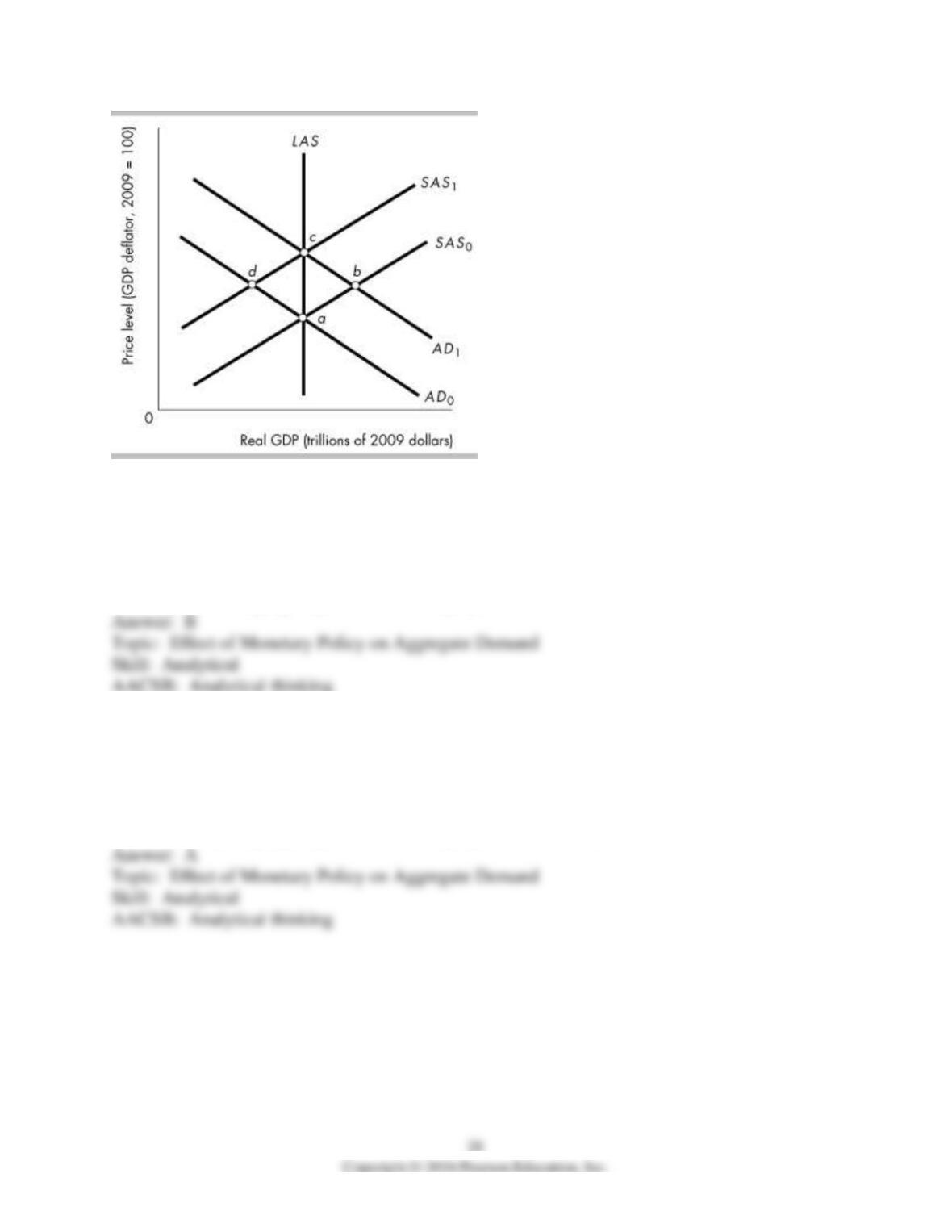
46) In the above figure, if the economy is initially at point a, the short-run effect of a cut in the
federal funds rate is given by movement from point
A) a to point b, increasing output and the unemployment rate.
B) a to point b, increasing output and decreasing the unemployment rate.
C) a to point d, decreasing output and increasing the unemployment rate.
D) a to point c, keeping output and the unemployment rate constant.
47) In the above figure, if the economy is initially at point c, the short-run effect of a hike in the
federal funds rate is given by movement from point
A) c to point d, decreasing output and increasing the unemployment rate.
B) c to point d, increasing output and decreasing the unemployment rate.
C) c to point b, increasing output and decreasing the unemployment rate.
D) c to point a, keeping output and the unemployment rate constant.
48) In the above figure, if the economy is initially at point d, the short-run effect of a cut in the
federal funds rate is given by movement from point
A) d to point c, increasing output and decreasing the unemployment rate.
B) d to point a, increasing output and decreasing the unemployment rate.
C) d to point b, increasing output and decreasing the unemployment rate.
D) d to point b, keeping output and the unemployment rate constant.
49) To fight a recession the Fed will
A) raise the federal funds rate.
B) lower the federal funds rate.
C) increase the budget deficit.
D) decrease taxes.
50) If the Fed is concerned with recession it will ________ the federal funds rate in order to
________ aggregate demand.
A) raise; increase
B) lower; increase
C) raise; decrease
D) lower; decrease
51) The Federal Reserve fights recession via open market operations, the supply of loanable
funds curve shifts ________ and the aggregate demand curve shifts ________.
A) leftward; leftward
B) leftward; rightward
C) rightward; leftward
D) rightward; rightward
52) If the Fed wanted to stimulate the economy to limit the effects of a recessionary gap, then it
should ________ the federal funds rate in order to ________ the real interest rate and thereby
________ investment.
A) lower; lower; increase
B) lower; raise; increase
C) raise; raise; decrease
D) lower; lower; decrease
53) If the Fed lowers the federal funds rate, the first effect in an AS/AD figure is a ________ shift
of the ________ curve.
A) rightward; AD
B) leftward; AD
C) rightward; SAS
D) leftward; SAS
54) In the short-run, lowering the federal funds rate will shift the ________ and ________ real
GDP.
A) aggregate demand curve leftward; decrease
B) aggregate demand curve rightward; increase
C) aggregate supply curve rightward; increase
D) aggregate demand curve leftward; increase
55) The central bank of Cobra sells securities in an open market operation. In the short run,
aggregate demand ________, real GDP ________, and the price level ________.
A) does not change; increases; falls
B) decreases; decreases; falls
C) increases; increases; rises
D) does not change; decreases; rises
56) The short-run effect of lowering the federal funds rate
A) raises the price level and increases real GDP.
B) raises the price level and decreases real GDP.
C) lowers the price level and increases real GDP.
D) lowers the price level and decreases real GDP.
57) When the Fed cuts the Federal funds rate, real GDP growth ________ and the inflation rate
________.
A) increases; increases
B) increases; decreases
C) decreases; increases
D) decreases; decreases
58) When the Federal Reserve fights recession via open market operations, the supply of
reserves curve shifts ________ and the supply of money curve shifts ________.
A) leftward; leftward
B) leftward; rightward
C) rightward; leftward
D) rightward; rightward
59) In the short run, ________ the federal funds rate ________ the price level and ________ real
GDP.
A) lowering; increases; decreases
B) lowering; increases; does not change
C) lowering; increases; increases
D) raising; decreases; does not change
60) Suppose the economy is in a recession and the Fed lowers the federal funds rate. Then
A) real GDP and the price level will both decrease.
B) real GDP will increase and the price level will decrease.
C) real GDP will decrease and the price level will increase.
D) real GDP and the price level will both increase.
61) Which of the following describes the chain of events the Fed uses to fight recession?
A) Raise the federal funds rate target, sell government securities, decrease reserves and loans,
increase aggregate demand.
B) Raise the federal funds rate target, buy government securities, increase reserves and loans,
decrease aggregate demand.
C) Lower the federal funds rate target, buy government securities, decrease reserves and loans,
decrease aggregate demand.
D) Lower the federal funds rate target, buy government securities, increase reserves and loans,
increase aggregate demand.
62) In order to combat a recession, the Fed will ________ the federal funds rate and thereby
________ the quantity of money.
A) raise; increasing
B) lower; increasing
C) raise; decreasing
D) lower; decreasing
63) In September 2012 unemployment was high and the Fed was concerned that the economy
would re-enter a recession. Therefore the Fed announced that it would ________ its purchases of
securities in an effort to ________.
A) decrease; keep the federal funds rate low
B) increase; keep the federal funds rate low
C) decrease; raise the federal funds rate
D) increase; raise the federal funds rate
64) If the aggregate demand curve shifts rightward following a decrease in the federal funds rate,
what can be concluded if the short-run aggregate supply curve is rather steep?
A) There will be a significant increase in real GDP with little impact on the price level.
B) There will be a significant increase in both real GDP and the price level.
C) There will be little increase in real GDP but a significant increase in the price level.
D) There is significant unemployment and slack in the economy.
65) In response to an inflationary gap, the Fed
A) waits until the price level falls before acting.
B) lowers the federal funds rate by buying U.S. government securities.
C) raises the federal funds rate by selling U.S. government securities.
D) raises the federal funds rate by buying U.S. government securities.
66) If the Fed wished to eliminate an inflationary gap, which of the following would be an
appropriate policy?
A) raise the federal funds rate
B) lower the federal funds rate
C) buy government securities
D) decease the government budget deficit
67) If the Fed is concerned with inflation it will ________ the federal funds rate in order to
________ aggregate demand.
A) raise; increase
B) lower; increase
C) raise; decrease
D) lower; decrease
68) If the Fed fears inflation it will undertake an open market ________ of securities, the federal
funds rate will ________ and the long-term real interest rate will ________.
A) sale; rise; fall
B) sale; rise; rise
C) purchase; rise; fall
D) purchase; fall; rise
69) In March 2013 the Fed announced that it might decrease its open market purchases of
securities by the end of the year. This announcement suggests that the Fed is concerned that
A) the unemployment rate will increase.
B) the inflation rate will rise.
C) the federal funds interest rate will fall too low for the Fed to control it.
D) the federal funds interest rate will rise too high for the Fed to control it.
70) When the Federal Reserve fights inflation via open market operations, the supply of reserves
curve shifts ________ and the supply of money curve shifts ________.
A) leftward; leftward
B) leftward; rightward
C) rightward; leftward
D) rightward; rightward
71) When the Federal Reserve fights inflation via open market operations, the supply of loanable
funds curve shifts ________ and the aggregate demand curve shifts ________.
A) leftward; leftward
B) leftward; rightward
C) rightward; leftward
D) rightward; rightward
72) If the Fed raises the interest rate, the first effect in an AS/AD figure is a ________ shift of the
________ curve.
A) rightward; AD
B) leftward; AD
C) rightward; SAS
D) leftward; SAS
73) If the Fed wants to fight inflation, it will ________ the federal funds rate, which in the short
run shifts the ________.
A) lower; AD curve rightward
B) lower; AD curve leftward
C) raise; AD curve rightward
D) raise; AD curve leftward
74) In the short run, the Fed’s actions to fight inflation shift the
A) aggregate demand curve rightward.
B) aggregate demand curve leftward.
C) short-run aggregate supply curve rightward.
D) short-run aggregate supply curve leftward.
75) According to the AS/AD model, in the short run an increase in the federal funds rate will
A) decrease the price level and decrease real GDP.
B) increase the price level and decrease real GDP.
C) decrease the price level but leave real GDP unchanged.
D) decrease real GDP but leave the price level unchanged.
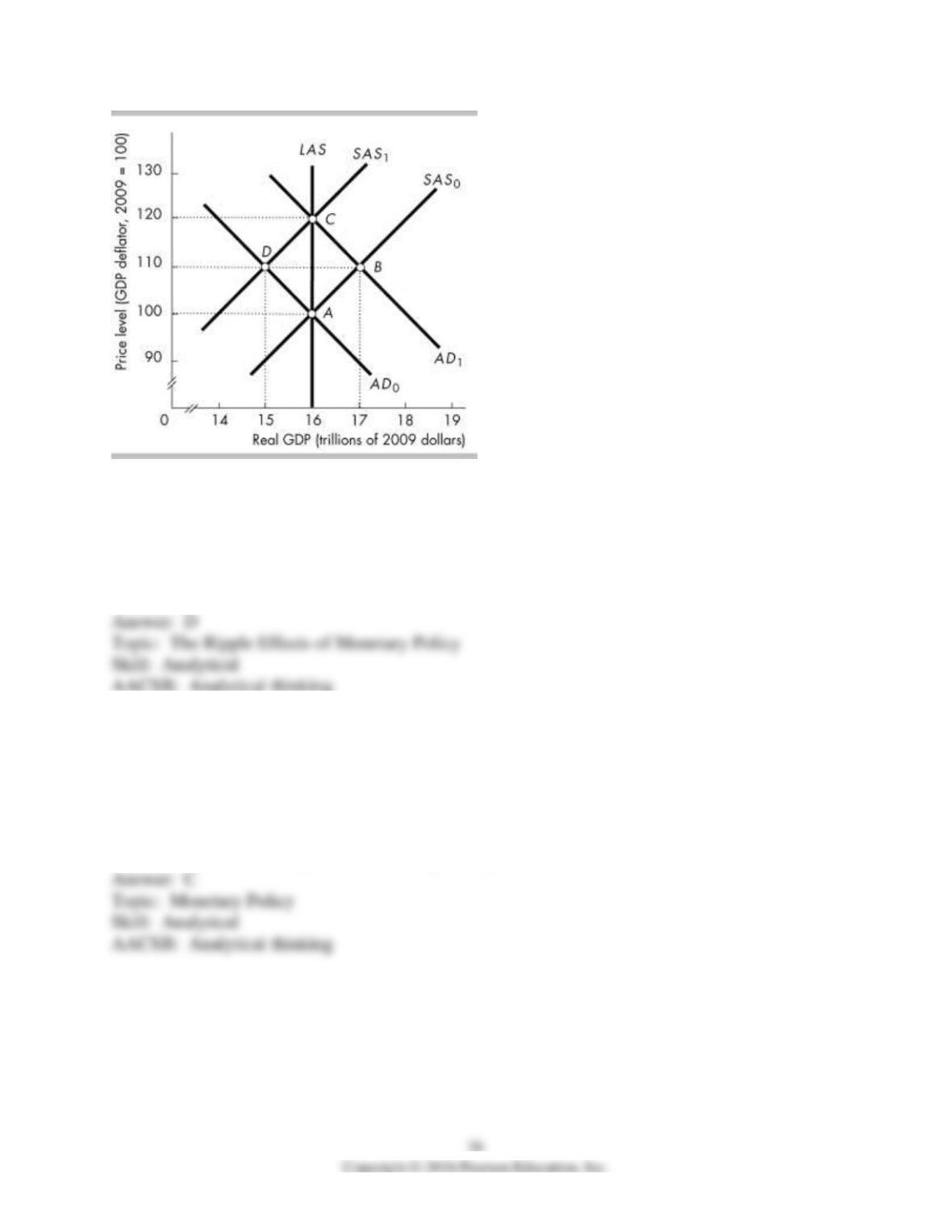
76) In the above figure, suppose that the economy is at point D. Which of the following occurs as
a result of an open market purchase of government securities by the Fed?
A) a decrease in the real interest rate
B) an increase in exports
C) an increase in investment
D) All of the above occur.
77) In the above figure, suppose that the economy was initially in an equilibrium at point D.
Where would the economy move if the Fed makes an open market purchase of government
securities?
A) A
B) B
C) C
D) D, that is, the economy would not change its equilibrium.
78) In the above figure, suppose that the economy is at point B. Which of the following policy
options for the Fed will move the economy toward its LAS?
A) lower the federal funds rate
B) raise the federal funds rate
C) decrease the government’s budget deficit
D) decrease taxes
79) In the above figure, if the economy is initially at point D, then if the Fed lowers the federal
funds rate
A) the supply of loanable funds decreases, the real interest rate falls, and the AD curve shifts
rightward.
B) other short-term interest rates fall, net exports increase, and the AD curve shifts rightward.
C) the exchange rate rises, investment increases, and the SAS curve shifts rightward.
D) the demand for loanable fund and supply of loanable funds both increase by the same amount
so that the AD curve shifts rightward.
80) In the above figure, suppose that the economy is at point D. If the Fed aims to fight the
recession, the economy will move to
A) point A.
B) point B.
C) point C.
D) Either point A or point C, depending on precisely how the Fed acted.
81) Suppose that several European countries enter a recession, thereby decreasing U.S. exports.
To move U.S. GDP back to potential GDP, the Fed should
A) lower the federal funds rate.
B) raise the federal funds rate.
C) increase the government’s budget deficit.
D) decrease the government’s budget deficit.
82) Consumer confidence in the economy rises, and as a result, real GDP increases above
potential GDP. To move U.S. GDP back to potential GDP, the Fed should
A) lower the federal funds rate.
B) raise the federal funds rate.
C) increase the government’s budget deficit.
D) decrease the government’s budget deficit.
83) A worldwide recession reduces the amount of U.S. exports, and as a result, aggregate
demand decreases. To move U.S. GDP back to potential GDP, the Fed should
A) lower the federal funds rate.
B) raise the federal funds rate.
C) increase the government’s budget deficit.
D) decreasing the quantity of money of money.
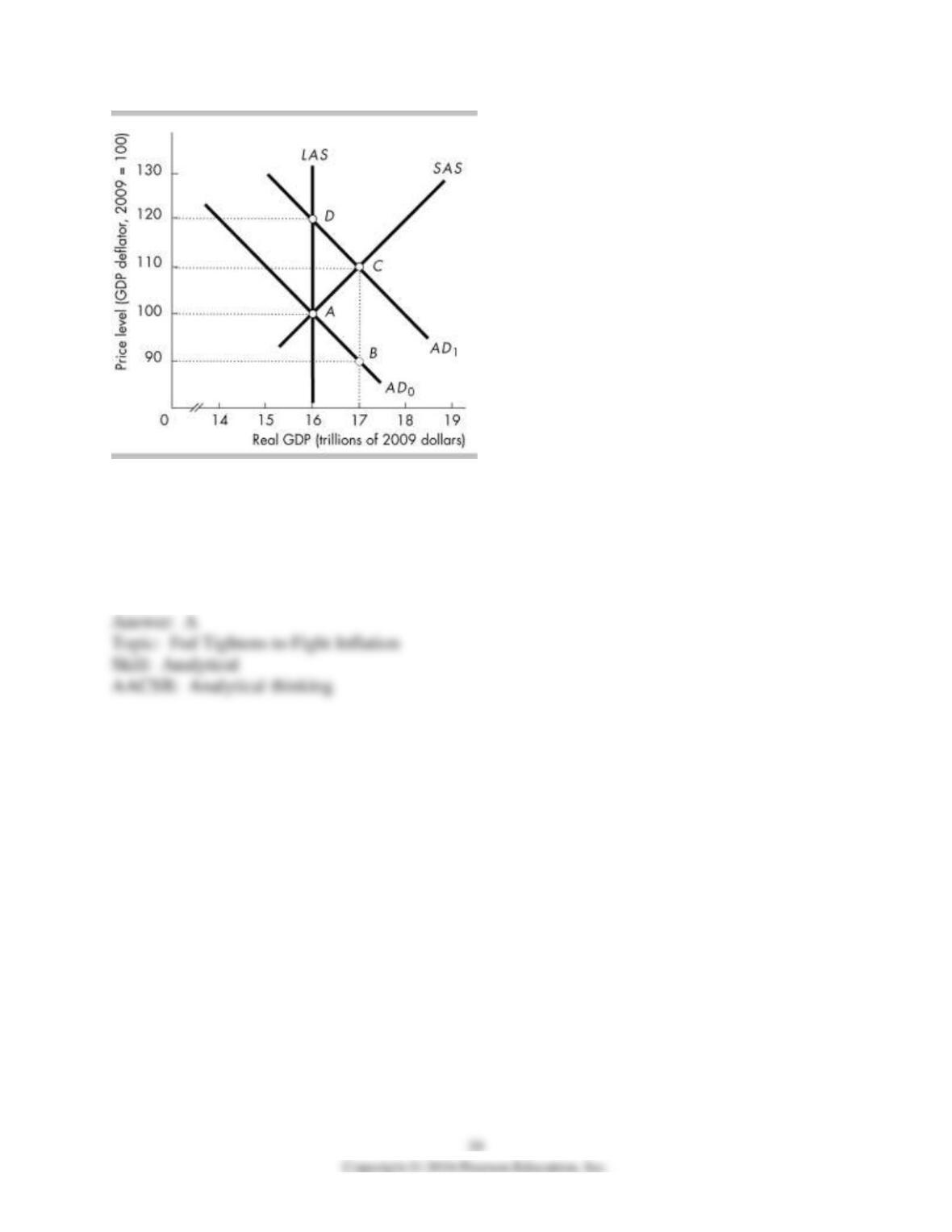
84) In the above figure, suppose point C is the original equilibrium. If the Fed increases the
federal funds rate, the new equilibrium is given by point
A) A.
B) B.
C) C (that is, the equilibrium does not change).
D) D.
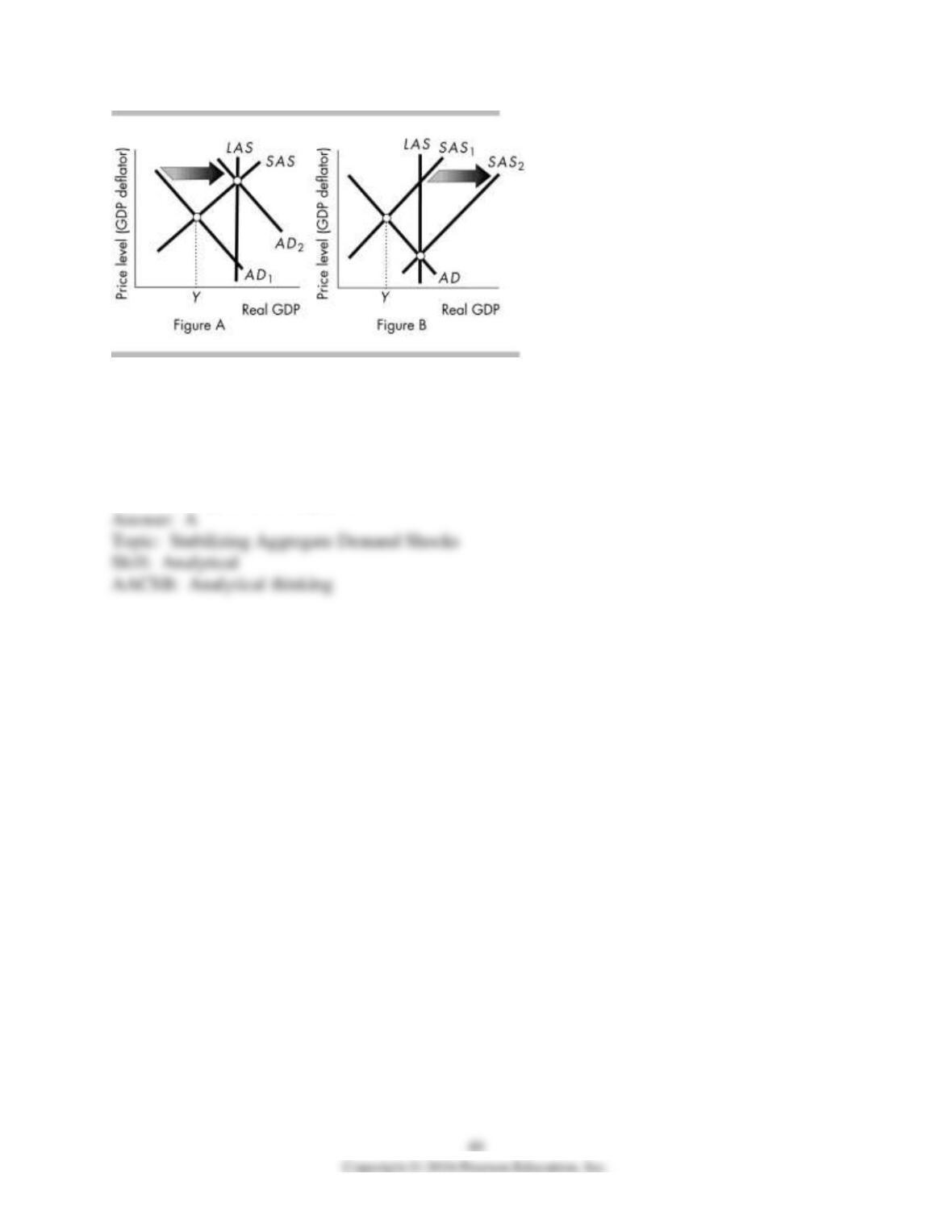
85) Which aggregate supply-aggregate demand diagram above shows the effect on real GDP and
the price level of monetary policy when it is used to fight a recession?
A) only Figure A
B) only Figure B
C) both Figure A and Figure B
D) neither Figure A nor Figure B