48) Suppose a transaction changes the balance sheet of Wells Fargo bank as indicated in the following T-
account.
Assets
Liabilities
Reserves + $1,000
Deposits + $1,000
At this point, what percentage of the new deposits does Wells Fargo hold in reserves?
A) 100 percent
B) 10 percent
C) 5 percent
D) 1 percent
49) Suppose a transaction changes a bank’s balance sheet as indicated in the following T-account, and
the required reserve ratio is 10 percent.
Assets
Liabilities
Reserves + $2,000
Deposits + $2,000
As a result of the transaction, the bank can make a maximum loan of
A) $0.
B) $200.
C) $1,800.
D) $2,000.
50) Consider the following T-account for National City Bank:
Assets
Liabilities
Reserves $10,000
Deposits $100,000
Loans $90,000
If the required reserve ratio is lowered to 8 percent, how much can National City loan out?
A) $10,000
B) $8,000
C) $2,000
D) $0
51) If the required reserve ratio is 5 percent, then the simple deposit multiplier is
A) 2.
B) 5.
C) 10.
D) 20.
52) If the required reserve ratio is RR, the simple deposit multiplier is defined as
A) .
B) .
C) × change in bank reserves.
D) × change in bank reserves.
53) The simple deposit multiplier is the ratio of the amount of
A) new reserves created by the banks to the amount of deposits.
B) new reserves created by the banks to the amount of loans.
C) deposits created by the banks to the amount of new reserves.
D) loans issued by the banks to deposits created by the banks.
54) With a required reserve ratio of 20 percent, an increase in reserves of $10,000 could lead to a
maximum increase in checking account deposits in the entire banking system of
A) $2,000.
B) $8,000.
C) $50,000.
D) $100,000.
55) The ________ the reserve ratio, the ________ the money multiplier.
A) smaller; smaller
B) smaller; larger
C) larger; larger
D) None of the above are correct.
56) A cash withdrawal from the banking system
A) decreases reserves.
B) decreases deposits.
C) decreases excess reserves.
D) All of the above are correct.
57) If banks do not loan out all their excess reserves, then the real world multiplier is
A) smaller than 1/RR.
B) larger than 1/RR.
C) equal to 1/RR.
D) not related to 1/RR.
58) If, during a deposit expansion, not all money gets redeposited into the banking system and some
leaks out as currency, then the real world multiplier is
A) smaller than 1/RR.
B) larger than 1/RR.
C) equal to 1/RR.
D) not related to 1/RR.
59) When banks gain ________, they can ________ their loans; and the money supply ________.
A) reserves; increase; contracts
B) withdrawals; increase; expands
C) withdrawals; decrease; expands
D) reserves; increase; expands
60) If banks receive a greater amount of reserves and do not hold all of these reserves as excess reserves,
the money supply expands.
61) If bankers become more uncertain regarding future deposits and withdrawals and choose to hold
more excess reserves against deposits, the money multiplier will increase.
62) The real-world money multiplier is greater than the simple money multiplier (1/RR).
63) Your checking account balance is included in your bank’s assets.
64) Consider the following T-account for a bank:
Assets
Liabilities
Reserves $1,000
Deposits $5,000
Loans $4,000
If the required reserve ratio is 20 percent and the bank is holding no excess reserves, the bank at this
point can make no more loans.
65) Consider the following T-account for a bank:
Assets
Liabilities
Reserves $1,000
Deposits $5,000
Loans $4,000
If the required reserve ratio is 10 percent, the bank at this point can make no more loans.
66) A cash withdrawal reduces deposits, reserves, and excess reserves in the banking system.
67) Why do banks create money? Do they create money to help the Federal Reserve control the money
supply or is there a more basic reason?
68) Why does the holding of excess reserves by banks and the holding of currency by households and
firms cause the real-world deposit multiplier to be less than the simple deposit multiplier?
47
69) Why is the real-world deposit multiplier smaller than 1/RR, where RR is the required reserve ratio?
70) Suppose that the required reserve ratio is 20 percent and you deposit $50,000 of currency into
Comerica Bank. What is the potential increase in deposits in the banking system brought about by your
deposit? What is the potential change in the money supply?
71) Suppose you withdraw $1,000 in cash from your checking account. Draw a T-account to show the
effect of this transaction on your bank’s balance sheet.

48
72) Suppose you deposit $4,000 in currency into your checking account at Bank of America. Assume
that Bank of America has no excess reserves at the time you make your deposit and that the required
reserve ratio is 10 percent.
a. Use a T-account to show the initial effect of this transaction on Bank of America’s balance sheet.
b. Suppose that Bank of America makes the maximum loan they can from the funds you deposited.
Use a T-account to show the initial effect on Bank of America’s balance sheet from granting the loan.
Also include in this T-account the transaction from question (a.).
c. Now suppose that whoever took out the loan in question (b) writes a check for this amount and that
the person receiving the check deposits it in Bank of Boston. Show the effect of these transactions on the
balance sheet of Bank of America and Bank of Boston, after the check has been cleared. On the T-
account for Bank of America, include the transactions from questions (a) and (b).
d. What is the maximum increase in checking account deposits that can result from your $4,000
deposit? What is the maximum increase in the money supply? Explain.

50
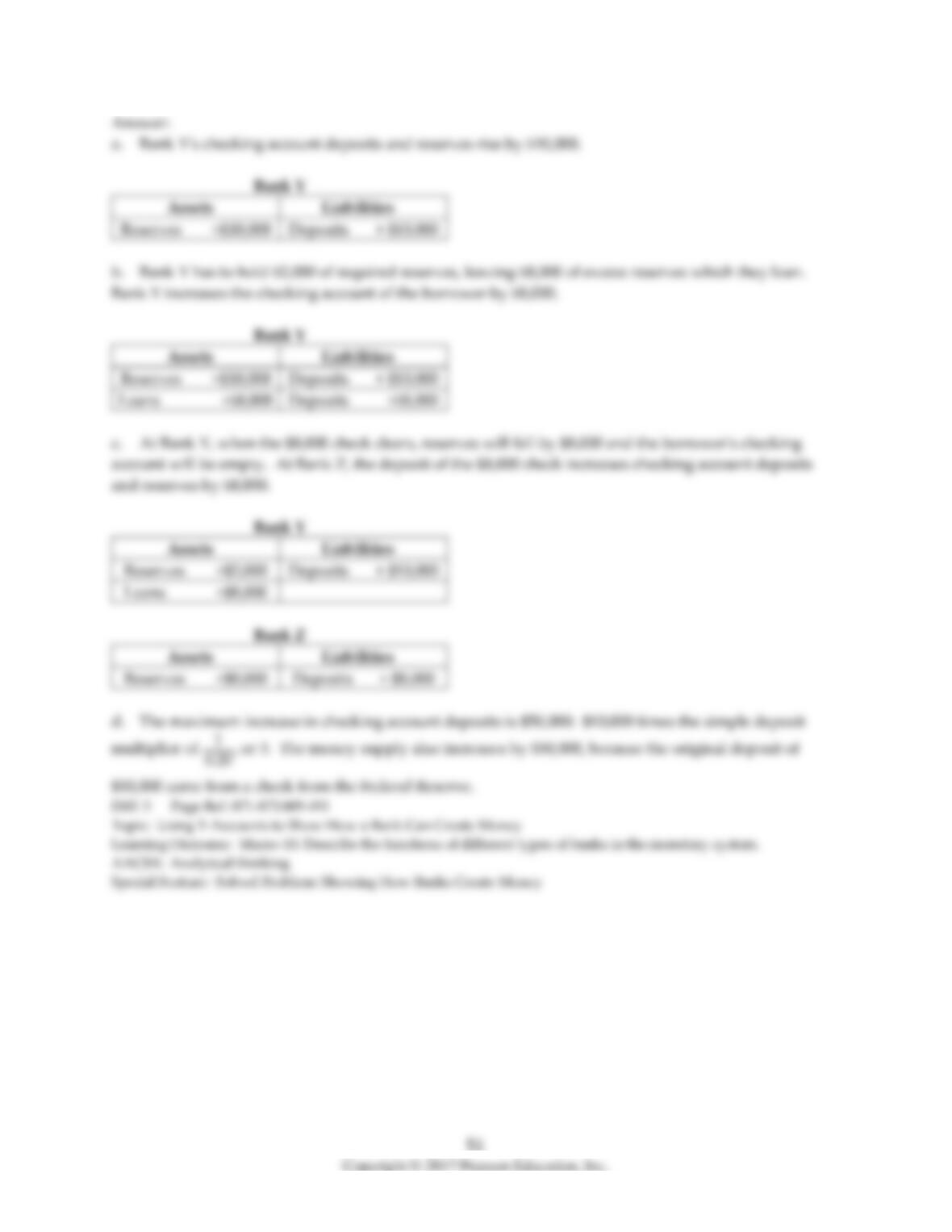
73) Suppose the Federal Reserve purchases $10,000 of Treasury bonds from you and that you deposit
the $10,000 into your checking account deposit at Bank Y. Assume that Bank Y has no excess reserves at
the time you make your deposit and that the required reserve ratio is 20 percent.
a. Use a T-account to show the initial effect of this transaction on Bank Y’s balance sheet.
b. Suppose that Bank Y makes the maximum loan they can from the funds you deposited. Use a T-
account to show the initial effect on Bank Y’s balance sheet from granting the loan. Also include in this
T-account the transaction from question (a.).
c. Now suppose that whoever took out the loan in question (b) writes a check for this amount and that
the person receiving the check deposits it in Bank Z. Show the effect of these transactions on the
balance sheet of Bank Y and Bank Z, after the check has been cleared. On the T-account for Bank Y,
include the transactions from questions (a) and (b).
d. What is the maximum increase in checking account deposits that can result from your $10,000
deposit? What is the maximum increase in the money supply? Explain.
74) Suppose a bank has the following balance sheet:
Assets
Liabilities
Reserves $14,000
Deposits $100,000
Loans $90,000
Net Worth $4,000
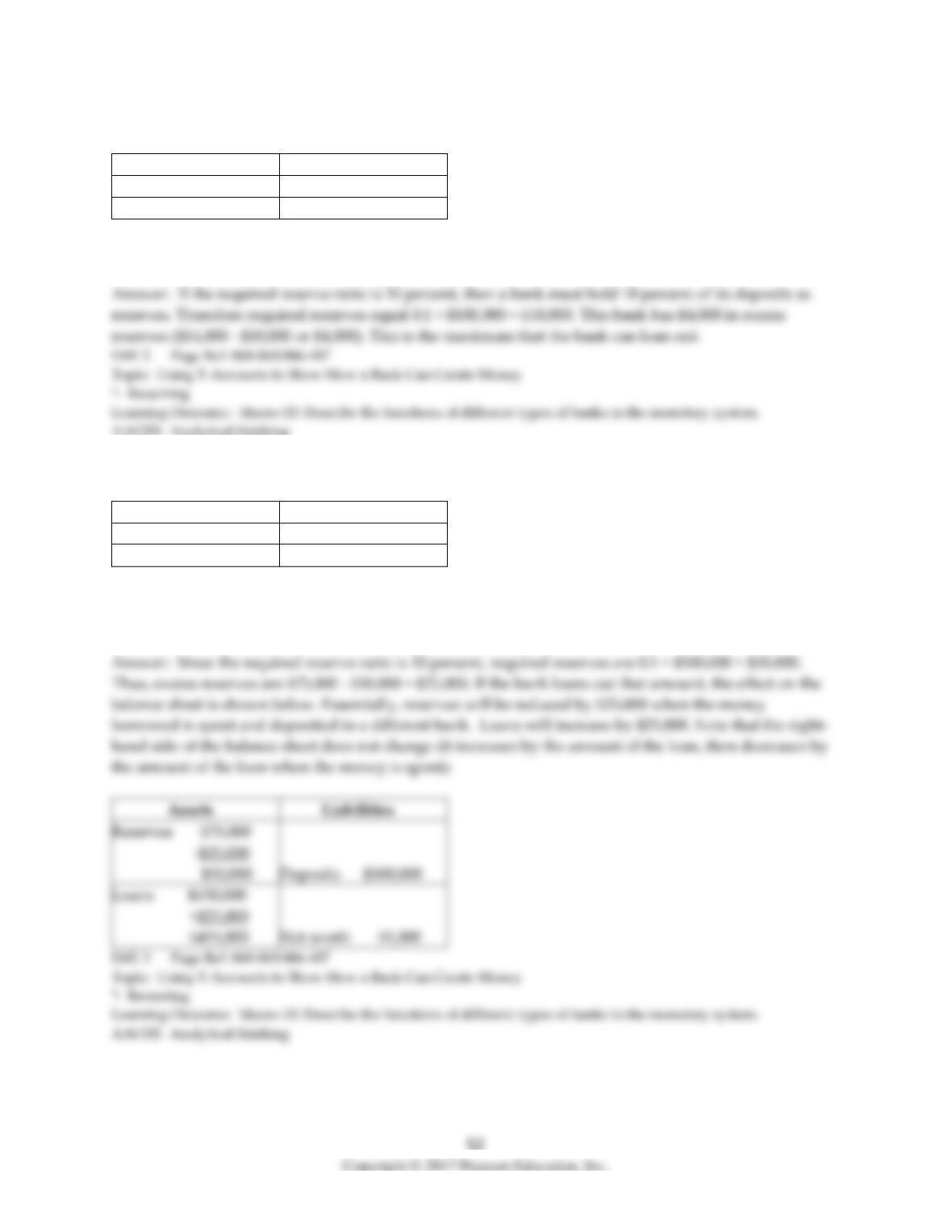
If the required reserve ratio is 10 percent, how much excess reserves does the bank have? What is the
maximum amount that the bank can expand its loans?
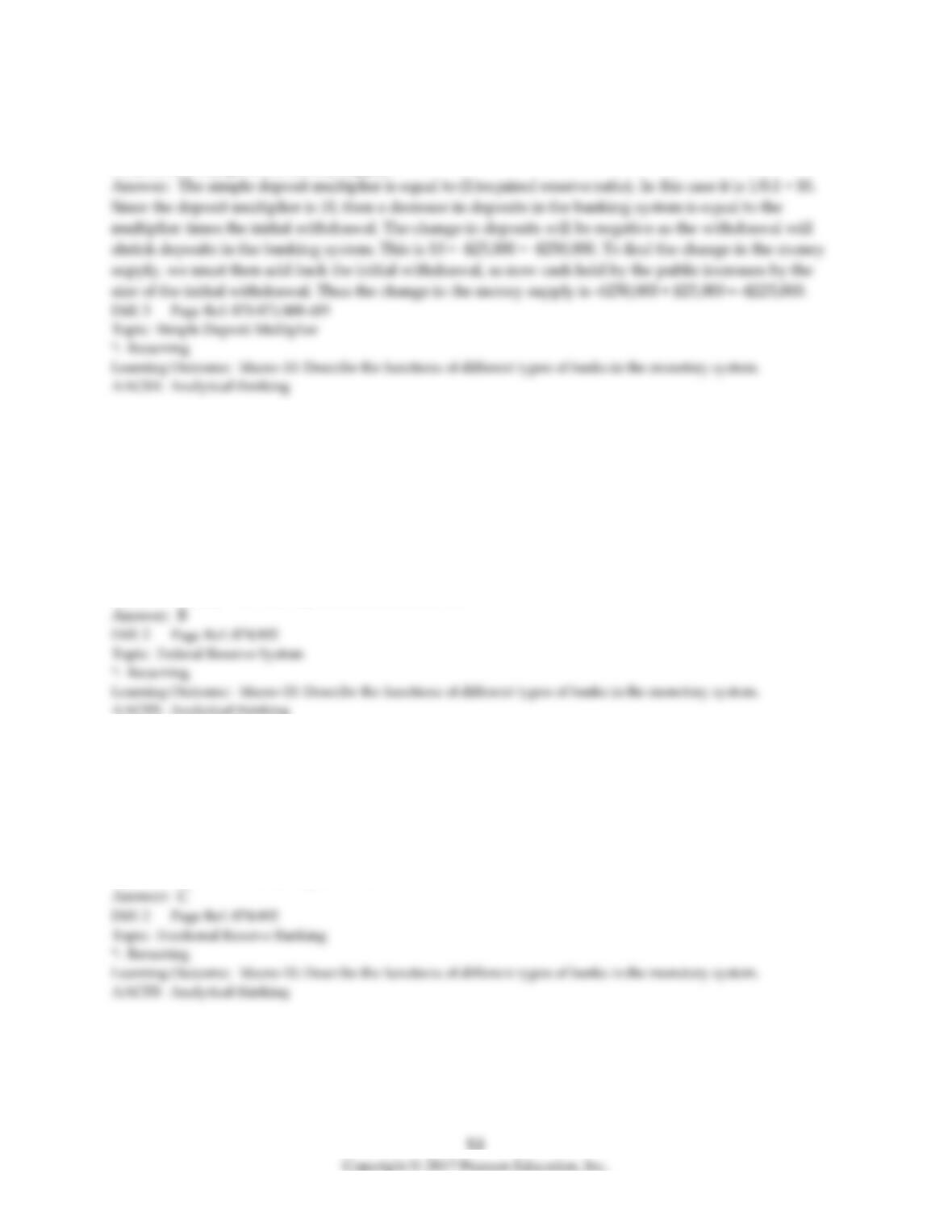
75) Suppose that the bank has the following balance sheet:
Assets
Liabilities
Reserves $75,000
Deposits $500,000
Loans $430,000
Net worth $5,000
If the required reserve ratio is 10 percent, what is the maximum the bank can loan out? Suppose the
bank makes this loan and the borrower spends the money, which is deposited in a different bank. Show
the impact of these transactions on the bank’s balance sheet.
Assets
Liabilities
$50,000
Deposits $500,000
$455,000
Net worth $5,000
76) Suppose that the required reserve ratio is 10 percent and you withdraw $25,000 from Comerica
Bank. What is the deposit multiplier? What is the total decrease in deposits in the banking system?
What is the change in the money supply?
14.4 The Federal Reserve System
1) Suppose there is a bank panic. Which of the following would not be a consequence of this bank
panic?
A) Bank total reserves would decrease.
B) Required reserves would increase.
C) Bank checking account balances would decrease.
D) Individual banks would have to shrink the value of loans they made.
E) The economy would likely enter into a recession.
2) Banks keep ________ of checking deposits as reserves because on a typical day withdrawals ________
deposits.
A) more than 100%; are much greater than
B) exactly 100%; are about the same as
C) less than 100%; are about the same as
D) exactly 100%; are much greater than
E) less than 100%; are much greater than
3) The Federal Reserve was established in 1913 to
A) prevent inflation by decreasing the money supply.
B) stimulate the economy by increasing bank reserves.
C) stop bank panics by acting as a lender of last resort.
D) prevent bad loans by requiring banks to hold reserves.
4) If the central bank can act as a lender of last resort during a banking panic, banks can
A) call in their loans to their customers and eventually restore the public’s faith in the banking system.
B) satisfy customer withdrawal needs and eventually restore the public’s faith in the banking system.
C) borrow more and more money from the central bank, and this will lower its reserves and decrease
the public’s faith in the banking system.
D) encourage the public to borrow directly from the central bank, and this will worsen the banking
panic.
5) The seven members of the Board of Governors of the Federal Reserve are appointed by
A) Congress.
B) the President.
C) the Governors of the States.
D) leaders in the banking industry.
E) the Treasury Department.
6) Which of the following is not a function of the Federal Reserve System, or the “Fed”?
A) acting as a lender of last resort
B) acting as a banker’s bank
C) performing check clearing services
D) insuring deposits in the banking system
E) taking actions to control the money supply
7) In response to the destructive bank panics of the Great Depression, future bank panics are designed
to be prevented by
A) the Federal Reserve System acting as a lender of last resort.
B) the Federal Reserve System conducting open market operations.
C) the establishment of the Federal Deposit Insurance Corporation.
D) establishing a fractional reserve system of banking.
E) increasing the required reserve ratio to 100%.
8) If people speculate that a run on one bank will cause a run on all banks in the financial system, and
this speculation proves accurate, then the financial system would experience what is known as a
A) commodity crisis.
B) securitization meltdown.
C) bank panic.
D) institutional death spiral.
9) A central bank like the Federal Reserve in the United States can help banks survive a bank run by
A) printing money.
B) acting as a lender of last resort.
C) raising the discount rate.
D) increasing the required reserve ratio.
10) Open market operations refer to the purchase or sale of ________ to control the money supply.
A) corporate bonds and stocks by the Federal Reserve
B) U.S. Treasury securities by the Federal Reserve
C) corporate bonds and stocks by the U.S. Treasury
D) U.S. Treasury securities by the U.S. Treasury
11) The Federal Open Market Committee consists of the seven members of the ________, the president
of the Federal Reserve Bank of New York, and ________.
A) Federal Reserve’s Board of Governors; four members of the Council of Economic Advisors
B) Federal Reserve’s Board of Governors; four presidents from the other 11 Federal Reserve banks
C) Council of Economic Advisors; four presidents from the 11 Federal Reserve banks
D) Council of Economic Advisors; four members of the U.S. Banking Committee
12) The three main monetary policy tools used by the Federal Reserve to manage the money supply are
A) interest rates, tax rates, and government spending.
B) tax rates, government purchases, and government transfer payments.
C) open market operations, discount policy, and reserve requirements.
D) open market operations, the exchange rate of the dollar against foreign currencies, and government
purchases.
13) The main tool that the Federal Reserve uses to conduct monetary policy is
A) open market operations.
B) discount policy.
C) setting reserve requirements.
D) acting as the lender of last resort.
E) check clearing.
14) The purchase of Treasury securities by the Federal Reserve will, in general,
A) not change the money supply.
B) not change the quantity of reserves held by banks.
C) increase the quantity of reserves held by banks.
D) decrease the quantity of reserves held by banks.
15) The sale of Treasury securities by the Federal Reserve will, in general,
A) not change the money supply.
B) not change the quantity of reserves held by banks.
C) increase the quantity of reserves held by banks.
D) decrease the quantity of reserves held by banks.
16) The purchase of $1 million of Treasury securities by the Federal Reserve, if there is no change in the
quantity of currency, will cause reserves at banks to
A) increase by $1 million.
B) increase by less than $1 million.
C) decrease by $1 million.
D) decrease by less than $1 million.
17) To increase the money supply, the Federal Reserve could
A) raise the discount rate.
B) decrease income taxes.
C) raise the required reserve ratio.
D) conduct an open market purchase of Treasury securities.
E) lower transfer payments.
18) To decrease the money supply, the Federal Reserve could
A) lower the discount rate.
B) raise income taxes.
C) lower the required reserve ratio.
D) conduct an open market sale of Treasury securities.
E) raise transfer payments.
19) A decrease in the discount rate ________ bank reserves and ________ the money supply if banks
respond appropriately to the change in the rate.
A) increases; increases
B) increases; decreases
C) decreases; increases
D) decreases; decreases
20) If a bank receives a $1 million discount loan from the Federal Reserve, then the bank‘s reserves will
A) not change.
B) increase by $1 million.
C) increase by less than $1 million.
D) increase by more than $1 million.
21) Suppose a bank has $100 million in checking account deposits with no excess reserves and the
required reserve ratio is 20 percent. If the Federal Reserve reduces the required reserve ratio to 15
percent, then the bank will now have excess reserves of
A) $0.
B) $5 million.
C) $15 million.
D) $20 million.
22) Suppose a bank has $100 million in checking account deposits with no excess reserves and the
required reserve ratio is 10 percent. If the Federal Reserve reduces the required reserve ratio to 8
percent, then the bank can make a maximum loan of
A) $0.
B) $2 million.
C) $8 million.
D) $10 million.
23) Suppose a bank has $100,000 in checking account deposits with no excess reserves and the required
reserve ratio is 10 percent. If the Federal Reserve raises the required reserve ratio to 12 percent, then the
bank will now have excess reserves of
A) $12,000.
B) $0.
C) -$2,000.
D) -$12,000.
24) A decrease in the reserve requirement ________ bank reserves and ________ the money supply.
A) increases; increases
B) increases; decreases
C) decreases; increases
D) decreases; decreases
25) Which of the following is not a consequence of the Fed changing the reserve requirement?
A) Changes in the ratio are easily incorporated into banks’ routine management.
B) Decreasing the ratio will increase excess reserves.
C) Increasing the ratio will decrease the amount of reserves banks have to loan.
D) Changes in the ratio effectively places a tax on banks’ deposit taking and lending activities.
26) To offset the effect of households and firms deciding to hold less of their money in checking account
deposits and more in currency, the Federal Reserve could
A) raise the required reserve ratio.
B) buy Treasury securities.
C) raise the discount rate.
D) lower bank taxes.
27) To offset the effect of households and firms deciding to hold more of their money in checking
account deposits and less in currency, the Federal Reserve could
A) raise bank taxes.
B) sell Treasury securities.
C) raise government spending.
D) lower the required reserve ratio.
28) The process of bundling loans together and buying and selling these bundles in a secondary
financial market is called
A) open market operations.
B) securitization.
C) fractional reserve lending.
D) seigniorage.
29) One way investment banks differ from commercial banks is that investment banks
A) lend exclusively to households.
B) do not take in deposits.
C) only buy and sell mortgages.
D) trade only in foreign exchange markets.