1. The Phillips curve is named after the economist A. W. Phillips, who found that there is:
a.
an inverse relationship between the PPI and the budget deficit in the United States.
b.
an inverse relationship between wage rates in Great Britain and the unemployment rate.
c.
an inverse relationship between economic growth and the unemployment rate in Great Britain.
d.
a positive relationship between inflation and the unemployment rate in the United States.
e.
a positive relationship between British national debt and economic downturns.
2. The Phillips curve based on the unemployment and inflation rates in the U.S. between 1961 and 1969 was:
a.
upward-sloping.
b.
downward-sloping.
c.
horizontal.
d.
vertical.
e.
upward-sloping but kinked.
b
Easy
MACR.BOYE.16.71 – ch. 14, 1
United States – Unemployment
The Phillips Curve
Knowledge
3. Contrary to what believers in the Phillips curve would say, U.S. economic data from 1955 to 2000 show evidence of:
a.
a positive relationship between the unemployment rate and inflation.
b.
no short-run relationship between the unemployment rate and inflation.
c.
increases in both unemployment and inflation rates.
d.
a constant rate of inflation, with changing rates of unemployment.
e.
a constant rate of unemployment, with changing rates of inflation.
Moderate
MACR.BOYE.16.71 – ch. 14, 1
The Phillips Curve
Knowledge
Revised
b
Moderate
MACR.BOYE.16.71 – ch. 14, 1
The Phillips Curve
Knowledge
Revised
4. The slope of the short-run Phillips curve is consistent with:
a.
the long-run trade-off between the unemployment rate and inflation.
b.
the long-run trade-off between inflation and GDP.
c.
the short-run trade-off between the money supply and interest rates.
d.
the short-run trade-off between business productivity and wage contracts.
e.
the short-run trade-off between the unemployment rate and inflation.
5. Consider a nation experiencing the relationship illustrated by the short-run Phillips curve. An increase in both
unemployment and inflation in this nation over the next ten years can be explained by:
a.
a downward movement along the short-run Phillips curve.
b.
a series of outward shifts of the short-run Phillips curve.
c.
an upward movement along the short-run Phillips curve.
d.
a series of inward shifts of the short-run Phillips curve.
e.
a complete change in the slope of the Phillips curve.
MACR.BOYE.16.72 – ch. 14, 2
The Phillips Curve
6. In the short run, an expansionary monetary policy by the Fed would:
a.
reduce unemployment at the cost of higher inflation.
b.
reduce inflation at the cost of a rise in the natural rate of unemployment.
c.
reduce inflation and leave the natural unemployment rate unchanged.
d.
reduce both inflation and unemployment.
e.
increase both inflation and unemployment.
MACR.BOYE.16.72 – ch. 14, 2
The Phillips Curve
MACR.BOYE.16.72 – ch. 14, 2
The Phillips Curve
7. In the short run, a decline in aggregate demand would be associated with:
a.
an inward shift of the Phillips curve.
b.
an outward shift of the Phillips curve.
c.
an upward movement along the Phillips curve.
d.
a downward movement along the Phillips curve.
e.
no change along the Phillips curve.
8. If the short-run Phillips curve shifts to the right, we can conclude that:
a.
the trade-off between inflation and unemployment has improved over time.
b.
the trade-off between inflation and unemployment has worsened over time.
c.
the inflation rate associated with any given level of unemployment has declined.
d.
the unemployment rate associated with any given inflation rate has declined.
e.
the trade-off between inflation and unemployment has remained unchanged.
MACR.BOYE.16.72 – ch. 14, 2
The Phillips Curve
9. The long-run aggregate supply curve at potential national income is analogous to:
a.
the short-run aggregate demand curve at potential national income.
b.
the long-run Phillips curve at the natural rate of unemployment.
c.
the long-run aggregate demand curve at each price level.
d.
the short-run Phillips curve at the natural rate of unemployment.
e.
the horizontal portion of the Phillips curve.
MACR.BOYE.16.72 – ch. 14, 2
MACR.BOYE.16.72 – ch. 14, 2
10. The long-run Phillips curve indicates that the consequences of trying to reduce unemployment below its natural rate
would be:
a.
an ever-rising rate of unemployment.
b.
an inflation rate equal to zero.
c.
a very high uncontrollable rate of inflation.
d.
a very low rate of inflation.
e.
a natural rate of unemployment equal to zero.
11. According to the long-run Phillips curve, which of the following will be the end result of an expansionary monetary
policy when unemployment is at its natural rate?
a.
Zero inflation
b.
Deflation
c.
A constant level of potential real GDP
d.
A decrease in unemployment
e.
An increase in unemployment
Moderate
MACR.BOYE.16.72 – ch. 14, 2
The Phillips Curve
The figure given below depicts the long run equilibrium in an economy.
Figure 14.1
MACR.BOYE.16.72 – ch. 14, 2
United States – Reflective Thinking
The Phillips Curve
Comprehension
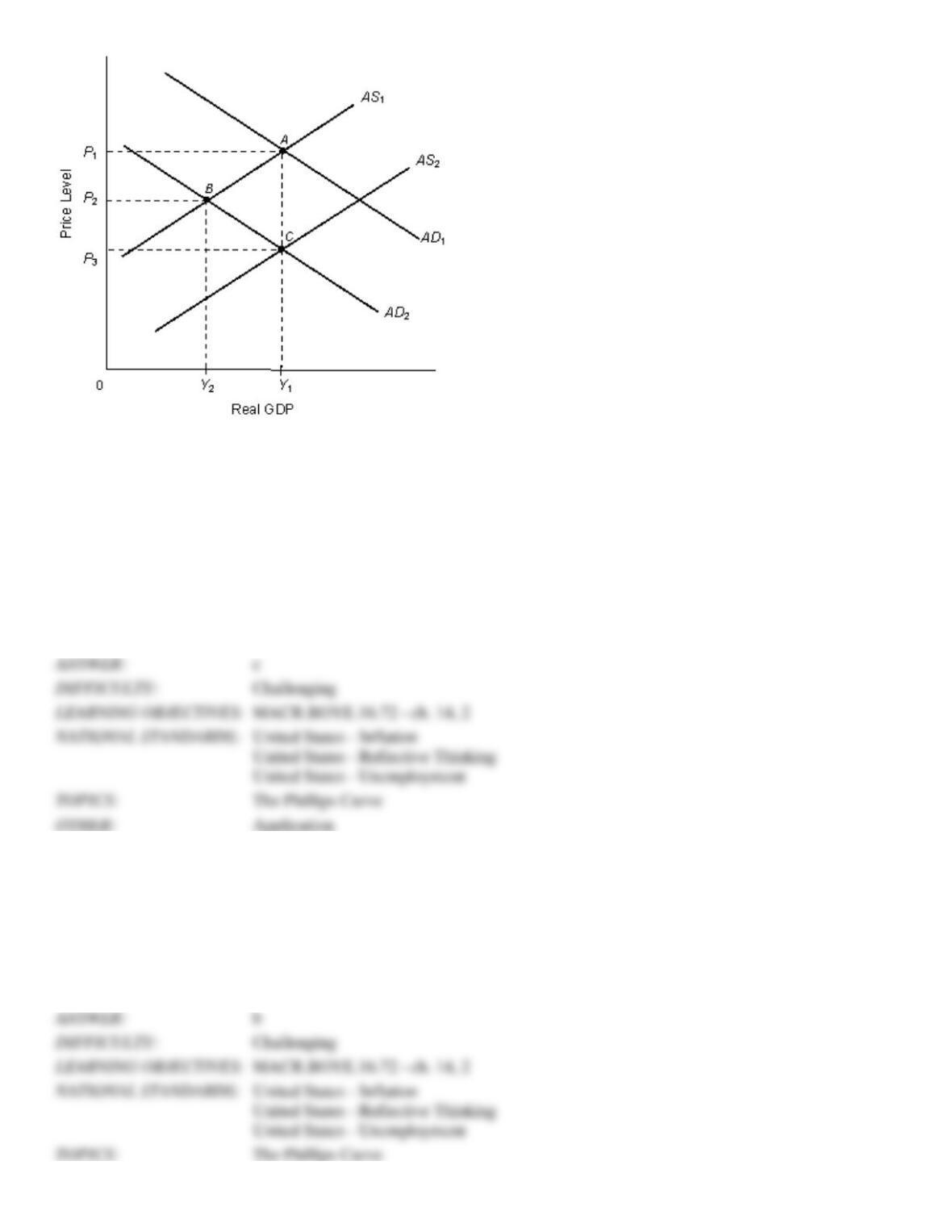
In the figure:
AD1 and AD2: Aggregate demand curves
AS1 and AS2: Aggregate supply curves
12. Refer to Figure 14.1. The movement from point A to point B to point C results in:
a.
a constant price level and a decline in the natural rate of unemployment.
b.
a rightward shift of the short-run Phillips curve.
c.
a lower price level and no change in the natural rate of unemployment.
d.
a movement up the short-run Phillips curve.
e.
a lower price level and a decline in the natural rate of unemployment.
13. Refer to Figure 14.1. When the economy moves from point B to point C:
a.
both the unemployment rate and the rate of inflation increases.
b.
both the unemployment rate and the rate of inflation declines.
c.
the unemployment rate declines at the cost of higher inflation.
d.
the rate of inflation declines at the cost of a higher unemployment rate.
e.
the rate of inflation declines with no change in the unemployment rate.
United States – Unemployment
MACR.BOYE.16.72 – ch. 14, 2
The Phillips Curve
14. Refer to Figure 14.1. Movement from point A to point C is equivalent to:
a.
an upward movement along the long-run Phillips curve.
b.
an outward shift of the short-run Phillips curve.
c.
an upward movement along the short-run Phillips curve.
d.
an inward shift of the long-run Phillips curve.
e.
a downward movement along the long-run Phillips curve.
Challenging
MACR.BOYE.16.72 – ch. 14, 2
The Phillips Curve
Revised
The figure given below shows the Phillips curves of the U.S. economy during early 1960s to late 1970s.
Figure 14.2
15. Refer to Figure 14.2. Phillips curve II is associated with the late 1980s in the United States and indicates that 5 percent
unemployment was consistent with 4 percent inflation. Which curve would be associated with the late 1970s in the United
States?
a.
I
b.
II
c.
III
d.
IV
e.
V
Application
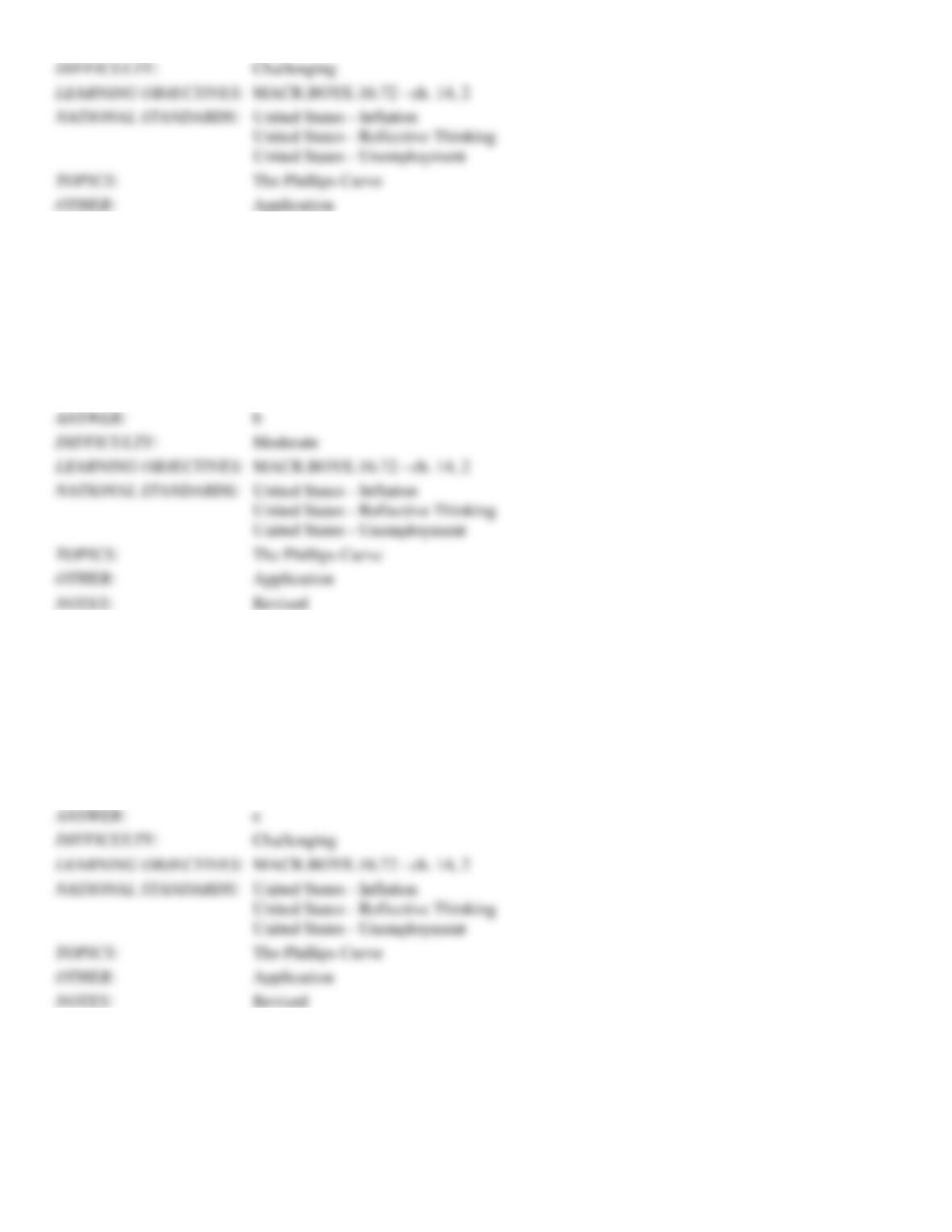
16. Refer to Figure 14.2. If the natural rate of unemployment is 5 percent, which of the following would cause a
movement along Phillips curve III from point A to point B?
a.
An inward shift of the aggregate demand curve
b.
An outward shift of the aggregate demand curve
c.
A downward movement along the aggregate supply curve
d.
A downward movement along the aggregate demand curve
e.
An upward movement along the aggregate demand curve
MACR.BOYE.16.72 – ch. 14, 2
United States – Unemployment
The Phillips Curve
17. Refer to Figure 14.2. Following the movement from point A to point B on Phillips curve III, what would cause the
Phillips curve to shift up so that 5 percent unemployment is associated with 10 percent inflation?
a.
An upward movement along the aggregate supply curve
b.
A downward movement along the aggregate supply curve
c.
A downward movement along the aggregate demand curve
d.
An outward shift of the aggregate supply curve
e.
An inward shift of the aggregate supply curve
MACR.BOYE.16.72 – ch. 14, 2
United States – Unemployment
The Phillips Curve
18. What is the difference between the short-run Phillips curve and the long-run Phillips curve?
a.
The long-run Phillips curve is horizontal, indicating that the unemployment rate may change but inflation
remains the same, whereas the short-run curve is vertical.
b.
The long-run Phillips curve slopes upward, indicating a positive relationship between the unemployment rate
and inflation, whereas the short-run curve slopes downward.
c.
The long-run Phillips curve is vertical, indicating that the unemployment rate may change but inflation does
MACR.BOYE.16.72 – ch. 14, 2
The Phillips Curve
not, whereas the short-run curve is positively sloped.
d.
The long-run Phillips curve is vertical, indicating that inflation may change but the unemployment rate does
not, whereas the short-run curve is negatively sloped.
e.
The long-run Phillips curve is negatively sloped, indicating an inverse relationship between unemployment
and inflation, whereas the short-run curve is vertical.
19. The natural rate of unemployment is defined as the unemployment rate that exists in the absence of:
a.
structural unemployment.
b.
frictional unemployment.
c.
cyclical unemployment.
d.
seasonal unemployment.
e.
inflation.
Easy
MACR.BOYE.16.72 – ch. 14, 2
United States – Inflation
The Phillips Curve
20. Which of the following is most likely to increase the natural rate of unemployment?
a.
An increase in the age of the working population
b.
A shift from service to manufacturing jobs
c.
An increase in the minimum wage rate
d.
A reduction in social security benefits
e.
A reduction in direct taxes
Moderate
MACR.BOYE.16.72 – ch. 14, 2
United States – Unemployment
Economic Insight – The Natural Rate of Unemployment
Knowledge
21. The key feature due to which unexpected inflation decreases the unemployment rate is that:
a.
expectations are formed irrationally.
b.
reservation wages of workers are fixed.
d
Moderate
MACR.BOYE.16.72 – ch. 14, 2
United States – Inflation
The Phillips Curve
c.
workers behave irrationally.
d.
firms are greedy.
e.
government policy is time consistent.
22. If an increase in inflation is expected, which of the following events is the least likely to occur?
a.
There will be an upward movement along the long-run Phillips curve.
b.
Nominal GDP will increase.
c.
Nominal wage rates will increase at the same rate as expected inflation.
d.
A worker’s reservation wage will rise at the same rate as expected inflation.
e.
Unemployment rate will increase.
MACR.BOYE.16.73 – ch. 14, 3
The Role of Expectations
23. Assume that an unemployed person expects inflation to be 4.5 percent. In reality, inflation turns out to be 2.9 percent.
If wage expectations lag behind actual price changes:
a.
job offers below the reservation wage will decline, and the unemployment rate will rise.
b.
job offers above the reservation wage will rise, and the unemployment rate will fall.
c.
job offers above the reservation wage will decline, and the unemployment rate will rise.
d.
job offers above the reservation wage will decline, and the unemployment rate will fall.
e.
job offers below the reservation wage will increase, and the unemployment rate will fall.
MACR.BOYE.16.73 – ch. 14, 3
United States – Unemployment
The Role of Expectations
24. When workers expect more inflation than actually occurs:
a.
the Phillips curve becomes vertical.
b.
the long-run Phillips curve shifts to the right.
MACR.BOYE.16.73 – ch. 14, 3
The Role of Expectations
c.
the short-run Phillips curve shifts to the left.
d.
there will be a movement down the short-run Phillips curve.
e.
there will be a movement up the short-run Phillips curve.
25. The observed unemployment rate is less than the natural rate of unemployment if:
a.
the inflation rate is lower than expected.
b.
the reservation wage is adjusted to account for higher inflation.
c.
real wage increases with increase in prices.
d.
reservation wages go up with the rate of inflation.
e.
the inflation rate is higher than expected.
MACR.BOYE.16.73 – ch. 14, 3
The Role of Expectations
26. When the reservation wage is adjusted to account for a higher inflation rate:
a.
the aggregate demand curve shifts to the right.
b.
the price level falls.
c.
the short-run Phillips curve shifts outward.
d.
production costs of businesses decline.
e.
the aggregate supply curve shifts to the right.
MACR.BOYE.16.73 – ch. 14, 3
The Role of Expectations
27. The actual rate of inflation is equal to the expected rate of inflation along the:
a.
downward-sloping Phillips curve.
b.
upward-sloping aggregate supply curve.
c.
horizontal aggregate supply curve.
d.
downward-sloping aggregate demand curve.
MACR.BOYE.16.73 – ch. 14, 3
The Role of Expectations
e.
vertical Phillips curve.
28. If the percentage increase in nominal wage rates is less than the percentage increase in the price level, then:
a.
real wage rate rises and the unemployment rate falls.
b.
both real wage rate and the unemployment rate rises.
c.
both real wage rate and the unemployment rate falls.
d.
real wage rate rises and the unemployment rate remains unchanged.
e.
both real wage rate and the unemployment rate remains unchanged.
MACR.BOYE.16.73 – ch. 14, 3
The Role of Expectations
29. If workers realize that an increase in nominal wage rates does not necessarily constitute a rise in real wages, then we
would expect:
a.
an increase in employment.
b.
a decrease in employment.
c.
a downward movement along the Philips curve.
d.
a rightward shift of the Phillips curve.
e.
a leftward shift of the Phillips curve.
MACR.BOYE.16.73 – ch. 14, 3
United States – Unemployment
The Role of Expectations
30. Suppose that an increase in aggregate demand causes an unplanned depletion in business inventories. Which of the
following situations will result from this?
a.
The economy moves up the short-run Phillips curve.
b.
The short-run Phillips curve shifts to the right.
c.
The short-run Phillips curve shifts to the left.
d.
The aggregate supply curve shifts to the left.
MACR.BOYE.16.73 – ch. 14, 3
The Role of Expectations
e.
The economy moves down the short-run Phillips curve.
31. Following an unexpected decline in aggregate demand, once production cutbacks start offsetting rising inventory
levels:
a.
the aggregate demand curve will shift to the right.
b.
the aggregate supply curve will shift to the left.
c.
the economy will return to its natural rate of unemployment.
d.
the short-run Phillips curve will shift to the right.
e.
the economy will face both higher inflation and a higher unemployment rate.
MACR.BOYE.16.73 – ch. 14, 3
The Role of Expectations
32. If nominal wage rates are contractually determined and cannot change in the short run, then an unexpected increase in
the inflation rate will:
a.
increase business profits and reduce the unemployment rate.
b.
reduce both business profits and the unemployment rate.
c.
reduce business profits and increase the unemployment rate.
d.
increase both business profits and the unemployment rate.
e.
cause no change in business profits or the unemployment rate
MACR.BOYE.16.73 – ch. 14, 3
The Role of Expectations
33. When aggregate demand declines unexpectedly and wage contracts are fixed, then the average price level will:
a.
increase and business firms will hire new workers.
b.
decline and firms will reduce wages.
c.
decline and business firms will lay off workers.
d.
increase and business firms will lay off workers.
MACR.BOYE.16.73 – ch. 14, 3
The Role of Expectations
e.
increase and business firms will increase wages.
34. Following a decline in the inflation rate, once long-term wage contracts are renegotiated and all prices in the economy
adjust to their new equilibrium:
a.
the economy will move up the short-run Phillips curve.
b.
the short-run Phillips curve will shift to the left.
c.
the economy will return to the vertical Phillips curve.
d.
the aggregate supply curve will shift to the right.
e.
the aggregate demand curve will shift to the right.
MACR.BOYE.16.73 – ch. 14, 3
The Role of Expectations
35. A look at macroeconomic data across countries reveals that when economies experience recessions, unemployment
rates rise, but wages fall very little, if at all. Which of the following is most likely to support this observation?
a.
Wages are determined by the interaction of the forces of labor demand and supply.
b.
The demand for labor is derived demand and hence does not fall during recessions.
c.
The labor market usually exhibits perfect competition.
d.
The labor supply curve becomes perfectly inelastic during recessions.
e.
Long term labor contracts make the wage rates sticky downwards.
MACR.BOYE.16.73 – ch. 14, 3
36. According to the theory of adaptive expectations, if the inflation rate has been 4.2 percent for the last ten years, people
will expect next year’s inflation rate to be:
a.
4.2 percent.
b.
higher than 4.2 percent.
MACR.BOYE.16.73 – ch. 14, 3
The Role of Expectations
c.
lower than 4.2 percent.
d.
0; that is, they will expect no inflation.
e.
8.4 percent.
37. Suppose that a labor union negotiates an increase in wages of 4 percent for the coming year because annual inflation
for the past five years has been 4 percent. The expectations formed by the union are:
a.
pessimistic expectations.
b.
deductive expectations.
c.
rational expectations.
d.
adaptive expectations.
e.
optimistic expectations.
MACR.BOYE.16.74 – ch. 14, 4
The Role of Expectations
38. The adaptive expectations theory suggests that:
a.
the price level that people expect in the future is based on the behavior of prices in the past.
b.
the unemployment rate adapts immediately to the inflation rate.
c.
people have perfect foresight and always predict future price levels correctly.
d.
people use all current information available to formulate their inflation expectations.
e.
people react spontaneously to price level changes and do not consider any past or present information.
MACR.BOYE.16.74 – ch. 14, 4
The Role of Expectations
39. Suppose the inflation rate has risen 0.5 percent a year for the past three years. Using this experience an individual
forecasts a 0.5 percent rise in the coming year’s inflation rate. This is an example of:
a.
traditional expectations.
b.
rational expectations.
MACR.BOYE.16.74 – ch. 14, 4
The Role of Expectations
c.
adaptive expectations.
d.
reflective expectations.
e.
deductive expectations.
40. According to the theory of rational expectations, expansionary fiscal policy that is anticipated will:
a.
cause wage expectations to adjust downward immediately following the lower price level.
b.
increase the real wage rate in the long run.
c.
cause a permanent decline in the natural rate of unemployment.
d.
decrease the real wage rate in the long run.
e.
cause wage expectations to adjust upward immediately following the higher price level.
MACR.BOYE.16.74 – ch. 14, 4
The Role of Expectations
41. According to the rational expectations view, _____.
a.
the economy will never deviate from the natural rate of unemployment for any anticipated policy
b.
the long-run inflation rate is equal to zero
c.
expected inflation is always less than actual inflation
d.
people use only past information to form expectations about future inflation rates
e.
announced money-growth policies are quite effective in reducing unemployment below its natural rate
MACR.BOYE.16.74 – ch. 14, 4
The Role of Expectations
The figure given below depicts the equilibrium level of real GDP and the price level in an economy, derived from the
aggregate demand aggregate supply model.
Figure 14.3
MACR.BOYE.16.74 – ch. 14, 4
The Role of Expectations
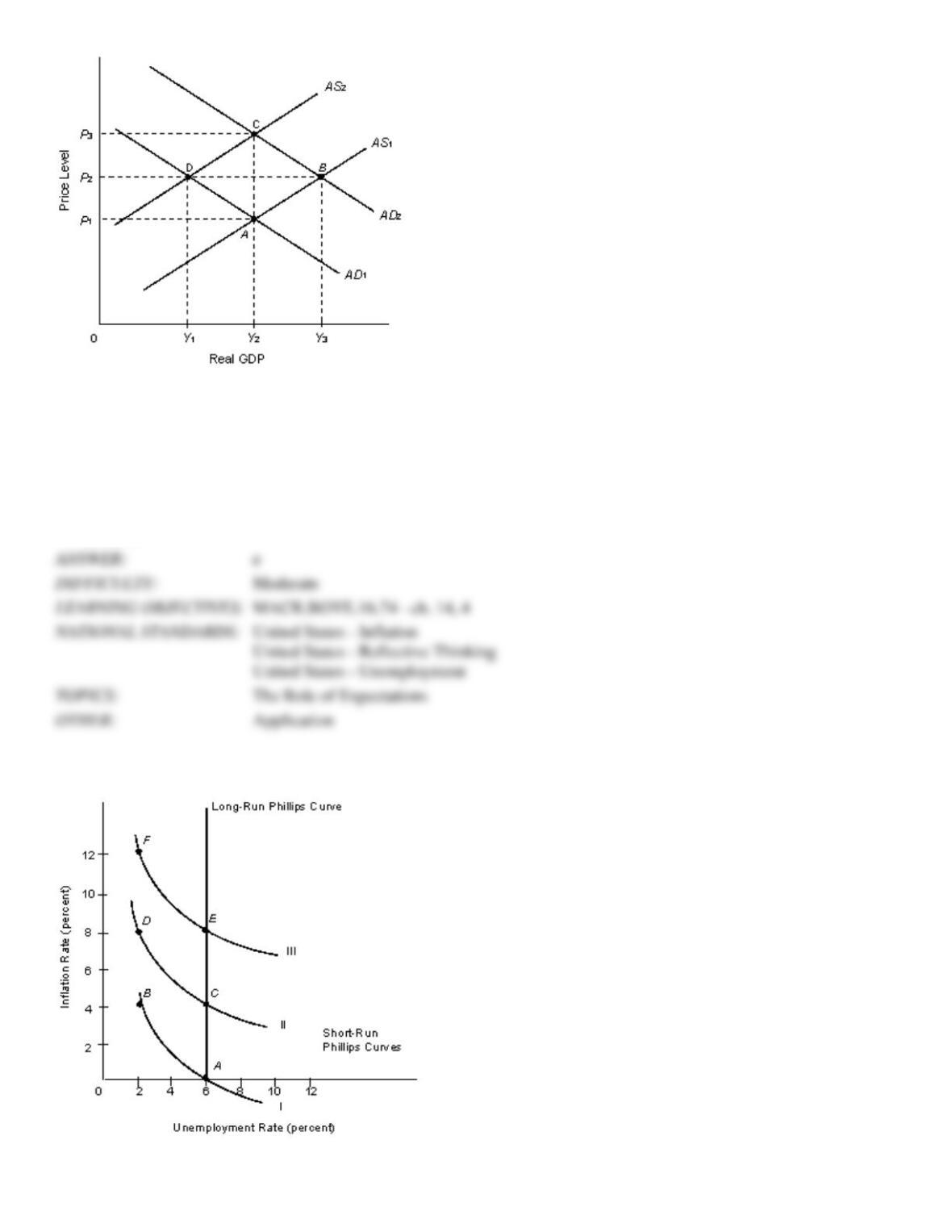
42. Refer to Figure 14.3. Consider that the economy initially operates at point A. Therefore, according to the theory of
rational expectations, an unanticipated increase in consumer confidence will cause the economy to move along the path:
a.
ADC.
b.
AC.
c.
ABDC.
d.
AD.
e.
ABC.
The figure given below represents the short-run and long-run Phillips curve.
Figure 14.4
MACR.BOYE.16.74 – ch. 14, 4
The Role of Expectations
43. Refer to Figure 14.4. If the observed unemployment rate equals the natural rate, and the expected rate of inflation
equals zero, the economy will be operating at:
a.
point A.
b.
point B.
c.
point C.
d.
point D.
e.
point E.
44. Refer to Figure 14.4. Suppose the economy is operating at point A, but the government increases spending because it
believes that 6 percent unemployment is unacceptably high. If the adaptive expectations hypothesis holds, in the short run,
the economy will move to:
a.
point B.
b.
point C.
c.
point D.
d.
point E.
e.
point F.
MACR.BOYE.16.74 – ch. 14, 4
The Role of Expectations
45. Refer to Figure 14.4. If the adaptive expectations hypothesis holds, and the economy moves from point C to point D
because of expansionary fiscal policy, what rate of inflation are people expecting at point D?
a.
2 percent
b.
4 percent
c.
6 percent
d.
8 percent
e.
10 percent
MACR.BOYE.16.74 – ch. 14, 4
United States – Unemployment
The Role of Expectations
46. Refer to Figure 14.4. Suppose the rational expectations hypothesis holds, and the Fed implements a fully expected
increase in money supply growth. Starting from point C in the short run, the economy will tend to move to:
a.
point A.
b.
point B.
c.
point D.
d.
point E.
e.
point F.
MACR.BOYE.16.74 – ch. 14, 4
United States – Unemployment
The Role of Expectations
47. Refer to Figure 14.4. A movement from point A to point C would be associated with an:
a.
outward shift of both the aggregate demand and the aggregate supply curve.
b.
outward shift of the aggregate supply curve and an inward shift of the aggregate demand curve.
c.
outward shift of the aggregate demand curve and an inward shift of the aggregate supply curve.
d.
outward shift of the aggregate demand curve but no change in the aggregate supply curve.
e.
inward shift of both the aggregate demand and the aggregate supply curve
MACR.BOYE.16.74 – ch. 14, 4
The Role of Expectations
48. A time-inconsistent monetary policy is one that:
a.
is set by congressional decree.
b.
is based on monetary targets established by law.
c.
changes over time as economic conditions change.
d.
follows a zero percent inflation rate.
e.
does not adapt to changing economic conditions.
MACR.BOYE.16.75 – ch. 14, 5
49. Which of the following gives the Fed a credibility problem because the Fed may change its planned policies in light of
new economic developments?
a.
Adaptive expectations
b.
Time inconsistency
c.
Wage expectations
d.
Disinflation
e.
Rational expectations
50. Assume that a low-wage contract is in force in the society, and the central bank follows a low-money-growth policy.
Which of the following will be observed?
a.
The actual inflation rate will match the low rate that people had expected.
b.
The actual inflation rate will be higher than the natural rate.
c.
The actual inflation rate will be higher than the low rate that people had expected.
d.
The actual inflation rate will be lower than the high rate that people had expected.
e.
The unemployment rate will be lower than the natural rate.
MACR.BOYE.16.75 – ch. 14, 5
Credibility and Time Inconsistency
Knowledge
51. Suppose workers do not believe the Fed will implement its announced monetary policy plans and the Fed wants to
achieve low unemployment. In this situation the Fed would be best off:
a.
implementing a policy of high money growth.
b.
announcing and implementing a policy of low money growth.
c.
announcing a policy of high money growth and implementing a policy of low money growth.
d.
following a policy that forces the actual inflation rate to coincide with the expected inflation rate.
e.
promoting a low rate of inflation and adjusting actual policy plans to economic conditions.
Challenging
MACR.BOYE.16.75 – ch. 14, 5
Credibility and Time Inconsistency
b
Easy
MACR.BOYE.16.75 – ch. 14, 5
Credibility and Time Inconsistency
52. Suppose that the Fed announces a low-money-growth policy to control inflation and workers sign low-wage contracts
as a result. If instead, the Fed had implemented a high-money-growth policy, which of the following would not occur?
a.
The unemployment rate would increase.
b.
The Fed’s stated policy would be time inconsistent.
c.
The unemployment rate would be less than the natural rate.
d.
The Fed would not achieve credibility through its actions.
e.
The rate of inflation would be higher than expected.
Moderate
MACR.BOYE.16.75 – ch. 14, 5
United States – Monetary and Fiscal Policy
United States – Reflective Thinking
Credibility and Time Inconsistency
Comprehension
53. Suppose that the economy has witnessed an 8 percent increase in its money supply over the last few years and the Fed
now announces a plan to increase the money supply by 4 percent per year. What will be the public response, assuming
that the Fed has a reputation for always implementing its announced plans?
a.
High-wage contracts will prevail, and the economy will experience lower inflation at the cost of higher
unemployment.
b.
High-wage contracts will prevail, and the economy will experience lower unemployment at the cost of higher
inflation.
c.
Low-wage contracts will emerge, and the economy will experience lower inflation with no change in the
unemployment rate.
d.
Low-wage contracts will emerge and the economy will experience higher unemployment with no change in
the inflation rate.
e.
Low-wage contracts will emerge, and the economy will experience lower inflation at the cost of higher
unemployment.
Challenging
MACR.BOYE.16.75 – ch. 14, 5
United States – Reflective Thinking
United States – Unemployment
Credibility and Time Inconsistency
Analysis
54. Critics of the Federal Reserve maintain that, to correct the credibility problem of monetary policy, the Fed should:
a.
tighten monetary policy.
b.
be required to maintain a growth rate of the money supply that is fixed by law.
c.
give more power to the Federal Open Market Committee.
d.
ignore public opinion and establish more discretionary power over monetary policy.
e.
merge with the U.S. Treasury and be dissolved as an independent agency.
b
Comprehension
Revised