27) Media reports often suggest that the increasing public debt is a burden on future generations.
What they mean is that
A) it reduces the current level of investment.
B) it makes predicting future unemployment levels unpredictable.
C) it causes deflation.
D) it reduces both nominal and real interest rates.
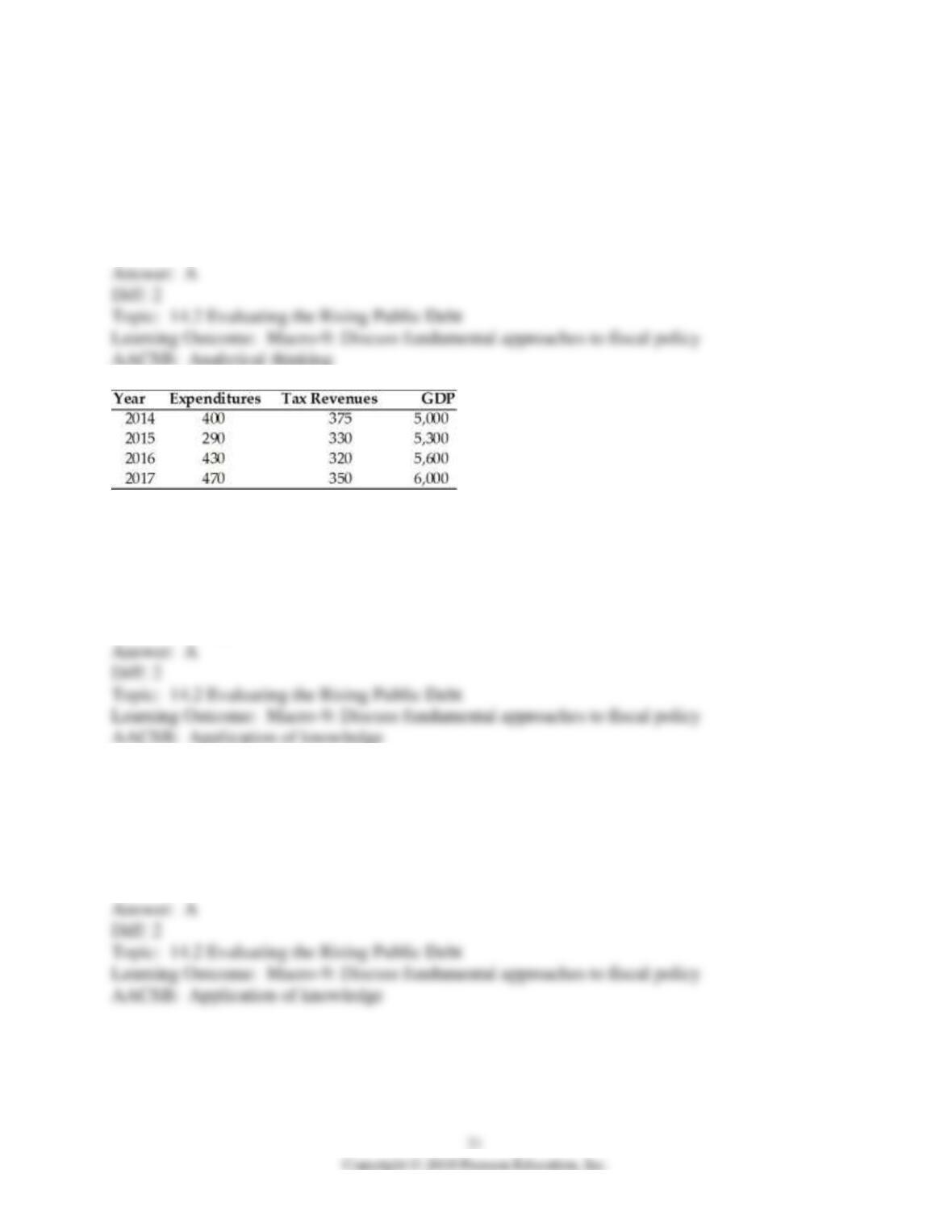
28) Suppose that initially there is no public debt. Using the above table, the public debt over this
four-year period would have
A) increased by $215.
B) decreased by $100.
C) increased by $1,375.
D) decreased by $1,590.
29) Suppose that initially there is no public debt. Using the above table, what is the public debt
as a percentage of GDP in 2014?
A) 0.5 percent
B) 2.0 percent
C) 3.6 percent
D) 8.0 percent
30) Suppose that initially there is no public debt. Using the above table, what is the public debt
as a percentage of GDP in 2016?
A) 1.7 percent
B) 2.0 percent
C) 7.7 percent
D) 5.9 percent
31) The gross public debt is the
A) amount of U.S. paper currency and coins in circulation.
B) difference between current government expenditures and tax revenues.
C) ratio of past deficits to past surpluses.
D) total of all accumulated deficits and surpluses.
32) If the net public debt expanded last year, then which of the following most likely occurred
during the year?
A) The government’s budget was balanced.
B) The government experienced a budget surplus.
C) The government experienced a budget deficit.
D) The government’s tax collections exceeded its spending.
33) One mechanism through which increasing public debt may impact the economy is that the
resulting
A) increased competition for funds increases interest rates and causes a reduction in investment.
B) increased competition for funds decreases interest rates and causes an increase in investment.
C) decreased competition for funds decreases interest rates and causes a reduction in investment.
D) decreased competition for funds decreases interest rates and causes an increase in investment.
34) If the net public debt declined last year, then which of the following most likely occurred
during that year?
A) The government’s budget was balanced.
B) The government experienced a budget surplus.
C) The government experienced a budget deficit.
D) The share of foreign holdings of the government’s debt increased.
35) To evaluate relative changes in the net public debt, we must
A) look at the absolute amount owed by the government.
B) compare it to the nation’s real GDP.
C) look at the annual percentage change in the public debt.
D) compare it to the debts of all developed countries.
36) Gross public debt is the amount of funds that
A) U.S. residents owe to foreign residents.
B) states owe to the federal government.
C) the federal government owes to taxpayers.
D) the federal government owes to all holders of U.S. securities.
37) Which of the following statements is FALSE?
A) The federal budget deficit in 2017 was about 3 percent of the GDP.
B) A budget deficit of $100 billion in a given year increases the public debt by $100 billion.
C) The public debt of $100 billion is the accumulated debt of all U.S. individuals, firms, and
institutions.
D) During the past five years, the U.S. public debt has been increasing.
38) Net public debt is equal to
A) the gross public debt minus current year tax revenue collection.
B) the gross public debt minus taxes paid by foreign corporations on their profits made in the
United States.
C) the gross public debt plus all governmental interagency borrowing.
D) the gross public debt minus all governmental interagency borrowing.
39) Borrowing to finance the increases in government expenditures
A) reduces current private investment expenditures.
B) increases interest rates.
C) reduces growth in the nation’s private capital stock.
D) all of the above.
40) The two ways in which deficit spending can impose a burden on future generations are
A) by requiring future generations to face higher taxes and to work with a lower accumulated
stock of capital goods.
B) by requiring future generations to face lower government spending and to utilize a smaller
stock of human capital.
C) by substituting private goods for public goods and thereby shifting resources to foreign
residents.
D) by substituting private goods for public goods and thereby benefiting only large businesses.
41) If the net public debt remains unchanged during a given period, but the gross public debt
increases, then which of the following statements must be correct?
A) Government interagency borrowing must have increased during the period.
B) Government interagency borrowing must have decreased during the period.
C) Foreign ownership of U.S. Treasury securities must have risen during the period.
D) Foreign ownership of U.S. Treasury securities must have fallen during the period.
42) Which of the following is the best measure of the total amount that the federal government
owes to private owners of U.S. Treasury securities?
A) government interagency borrowing
B) the government budget deficit
C) the gross public debt
D) the net public debt
43) Which of the following correctly describes a way in which deficit spending can impose a
burden on future generations?
I. Failure to allocate deficit spending to uses that boost future real Gross Domestic Product
(GDP) will require taxing future generations at a higher rate to repay the resulting higher public
debt.
II. Government deficits that lead to higher employment and real Gross Domestic Product (GDP)
in the future will generate increased income taxes for future governments, which will respond by
spending the higher tax revenues, creating higher future government budget deficits.
III. Other things being equal, deficit spending fuels increased consumption of goods and services
by the current generation that crowds out capital investment, thereby leaving future generations
with a smaller stock of capital than otherwise would have existed.
A) I only
B) II only
C) I and III only
D) II and III only
44) Which of the following is TRUE of the portion of the net public debt held by foreign
residents?
A) It will definitely be a benefit to current and future generations of U.S residents, because
foreign residents have shown a willingness to lend to the U.S. government in exchange for rates
of return significantly lower than they can receive elsewhere in the world.
B) It will definitely be a burden on current and future generations of U.S. residents who will
have to pay interest on this portion of the debt, thereby transferring a portion of future U.S.
incomes abroad.
C) It will be a burden on future generations of U.S. residents only if funds that the U.S.
government obtains from borrowing are expended on projects with rates of return lower than the
rates of interest that the government pays foreign residents.
D) It will be a benefit to future generations of U.S. residents only if funds that the U.S.
government obtains from borrowing are expended on projects with rates of return lower than the
rates of interest that the government pays foreign residents
45) Net public debt is
A) the excess of annual government spending over annual tax revenues.
B) the excess of annual tax revenues over annual government spending.
C) the portion of government debt held by private individuals and firms.
D) the sum owed by the public to keep the Social Security system afloat.
46) To compare the net public debt of various countries, the debt has to be compared to
A) the country’s trade deficit.
B) the country’s current budget deficit or surplus.
C) the country’s real GDP.
D) the country’s national defense expenditure.
47) Explain how deficit spending could be a burden to future generations.
48) Explain how deficit spending can benefit future generations.
14.3 Growing U.S. Government Deficits: Implications for U.S. Economic Performance
1) In which decade did the United States begin experiencing large trade deficits?
A) 1960s
B) 1970s
C) 1990s
D) 2000s
2) Are federal budget deficits related to trade deficits?
A) Yes. If U.S. consumers buy too many imported goods they don’t have money to save and a
budget deficit results.
B) No. The budget deficit is entirely a domestic matter while the trade deficit only affects U.S.
citizens who travel abroad.
C) Yes. As deficit spending goes up, it is likely government borrowing will, too. Then foreign
residents who lend funds to the U.S. government have less to spend on our goods, so U.S.
exports will fall.
D) Yes, but only if the quality of U.S. goods and services is deteriorating.
3) Which of the following statements is TRUE about the historical relationship between the trade
deficits and government budget deficits?
A) There is no relationship between trade deficits and budget deficits.
B) There is a positive relationship between trade deficits and budget deficits.
C) There is a negative relationship between trade deficits and budget deficits.
D) A relationship exists only when there is a balanced budget.
4) Historic data indicate that there is usually a ________ relationship between trade deficits and
federal government budget deficits.
A) positive
B) zero
C) negative
D) fluctuating
5) A trade surplus occurs when
A) the value of imports is less than the value of exports.
B) government spending is less than total tax revenue.
C) consumption is greater than disposable income.
D) none of the above.
6) Which of the following is TRUE about how trade deficits and government budget deficits are
related?
A) The trade deficit leads to a reduction in investment that leads to a government budget deficit.
B) The trade deficit leads to a decline in imports relative to exports that leads to a government
budget deficit.
C) The government budget deficit leads to higher interest rates that will lead to a trade deficit.
D) The government budget deficit leads to lower interest rates that will lead to a lower trade
deficit.
7) If foreign residents buy U.S. Treasury securities to finance the budget deficit, then which of
the following will likely occur?
A) an increase in the trade deficit
B) a decrease in the trade deficit
C) there will be a trade balance
D) a reduction in the public debt
8) Historical evidence seems to indicate that
A) budget and trade deficits generally move in the same direction.
B) budget and trade deficits generally move in the opposite direction.
C) there is no consistent relationship between trade and budget deficits.
D) trade and budget deficits decrease when the president is a Republican, and increase when the
president is a Democrat.
9) Which of the following is TRUE of the relationship between U.S. trade deficits and federal
government budget deficits?
A) Increases in the budget deficit tend to be associated with increases in the trade deficit.
B) Increases in the budget deficit tend to be associated with reductions in the trade deficit.
C) Increases in the budget deficit are always associated with increases in the trade deficit.
D) Increases in the budget deficit are always associated with reductions in the trade deficit.
10) Which of the following is TRUE of the U.S. trade balance and the federal government
budget?
A) In most years since the 1970s, both have been in surplus.
B) In most years since the 1970s, both have been in deficit.
C) Both exhibited greater variability before the 1970s than they have since.
D) The federal government budget deficit was more variable before the 1970s, but the trade
deficit has been more variable since.
11) Are federal budget deficits related to trade deficits?
A) Yes. If U.S. consumers buy too many imported goods, they do not have funds to save, and a
budget deficit results.
B) No. The budget deficit is entirely a domestic matter, while the trade deficit only affects U.S.
citizens who travel abroad.
C) Yes. Higher deficit spending goes up resulting in more government borrowing, and foreign
residents who lend funds to the U.S. government have fewer resources to spend U.S. export
goods.
D) Yes, but only if the quality of U.S. goods and services is deteriorating.
12) What is the short-run effect of increased deficit spending on an economy experiencing a
recessionary gap?
A) Aggregate demand increases, and the gap closes.
B) Aggregate supply increases, closing the gap.
C) Aggregate demand decreases, and the gap widens.
D) Aggregate demand will increase, creating an inflationary gap.
13) In the long run, what effect does a government’s deficit spending have on equilibrium real
Gross Domestic Product (GDP)?
A) The government’s deficit spending will increase equilibrium real Gross Domestic Product
(GDP).
B) Deficit spending will decrease the nation’s equilibrium real Gross Domestic Product (GDP).
C) Higher government deficits will not raise equilibrium Gross Domestic Product (GDP) above
the full-employment level.
D) Equilibrium real Gross Domestic Product (GDP) will increase beyond the full-employment
level and there will also be an inflationary effect.
14) One of the long-run effects of higher government budget deficits is
A) a redistribution of real Gross Domestic Product (GDP) away from government-provided
goods and toward more privately provided goods.
B) an increase in the government’s share of the nation’s economic activity.
C) growth in the economy’s private sector at the same time the government sector shrinks.
D) a fall in the equilibrium price level.