
CHAPTER 14: CAPITAL STRUCTURE MANAGEMENT IN PRACTICE
1. Raw material and direct labor costs are examples of
a. fixed costs
b. overhead costs
c. variable costs
d. capital costs
2. When fixed operating costs are incurred by the firm, a change in is magnified into a relatively larger
change in earnings before interest and taxes.
a. overhead expenses
b. interest charges
c. labor costs
d. sales revenue
3. When fixed capital costs are incurred by the firm, a change in is magnified into a larger change in earnings
per share.
a. earnings before interest and taxes
b. overhead expenses
c. interest charges
d. preferred dividends
4. The percentage change in a firm’s EBIT that results in a 1% change in sales or output is known as the
a. degree of combined leverage
b. degree of financial leverage
c. degree of operating leverage
d. degree of business risk
5. The total variability of the firm’s EPS associated with a change in sales is an indication of combined leverage
and is best measured by
a. DOL
b. DFL
c. DOL + DFL
d. DOL × DFL

Chapter 14: Capital Structure Management in Practice
6. In the analysis of financial leverage, all of the following are referred to as fixed charges except:
a. bond interest
b. common stock dividends
c. bank interest
d. preferred stock dividends
7. The degree of combined leverage is defined as the percentage change in earnings per share resulting from a
given percentage change in
a. operating costs
b. interest charges
c. common stock dividends
d. sales (or output)
8. The degree of combined leverage is equal to the degree of operating leverage the degree of financial
leverage.
a. added to
b. divided by
c. multiplied by
d. subtracted from
9. Rent, insurance, and the salaries of top management are examples of:
a. fixed costs
b. capital costs
c. variable costs
d. fluctuating costs
10. A firm that employs relatively large amounts of labor- saving equipment in its operations will have a relatively
degree of operating leverage.
a. low
b. constant
c. insignificant
d. high

Chapter 14: Capital Structure Management in Practice
11. A firm that employs a relatively large proportion of debt and preferred stock in its capital structure will have a
relatively degree of financial leverage.
a. low
b. high
c. insignificant
d. constant
12. The degree of combined leverage is equal to the multiplied by the .
a. degree of operating leverage, variable cost ratio
b. degree of financial leverage, variable cost ratio
c. degree of operating leverage, degree of financial leverage
d. degree of operating leverage, fixed cost ratio
13. A firm is considering the purchase of assets that will increase its fixed operating costs. The firm should
decrease the proportion of it employs in its capital structure if it wants to maintain its existing degree of
combined leverage.
a. debt
b. warrants
c. common stock
d. common stock and warrants
14. To balance the operating and financial risks that are so variable for a multinational company, Nestle allows its
foreign operating subsidiaries operational flexibility and follows a financing strategy.
a. decentralized, centralized
b. centralized, centralized
c. centralized, decentralized
d. decentralized, decentralized
15. The degree of financial leverage is defined as the percentage change in
a. EBIT resulting from a given percentage change in sales
b. EPS resulting from a given percentage changes in sales
c. EBIT resulting from a given percentage change in EPS
d. EPS resulting from a given percentage change in EBIT

Chapter 14: Capital Structure Management in Practice
16. An analytical technique called can be used to help determine when debt financing is advantageous and
when equity financing is advantageous.
a. DFL-EPS analysis
b. EBIT-EPS analysis
c. DCL-EPS analysis
d. DOL-EBIT analysis
17. Cash insolvency analysis evaluates the adequacy of a firm’s cash position in a
a. bankruptcy proceeding
b. non-normal environment
c. highly competitive environment
d. recessionary environment
18. Financial leverage causes a firm’s to change at a rate greater than the change in .
a. EBIT; EPS
b. EPS; EBIT
c. EBIT; sales
d. sales; EBIT
19. In EBIT-EPS analysis, the indifference point is found at the point where for the two alternative financing
plans are equal.
a. EBIT
b. EPS
c. stock prices
d. DOL
20. A firm which has a 2.5 DOL (degree of operating leverage) would find that an 8% increase in EBIT would
result from a increase in sales.
a. 3.2%
b. 5.4%
c. 20.0%
d. 2.0%

Chapter 14: Capital Structure Management in Practice
21. A negative DOL indicates the percentage in operating losses that occurs as the result of a 1% increase in
output.
a. increase
b. reduction
c. change
d. none of these
22. A DFL (degree of financial leverage) of 3.0 indicates that a 27% increase in EPS is the result of a increase
in EBIT.
a. 81%
b. 3%
c. 9%
d. 6%
23. The use of increasing amounts of combined leverage the risk of financial distress.
a. decreases
b. increases
c. has no effect on
d. creates diversity in
24. A firm is said to be if it is unable to meet its current obligations.
a. cash insolvent
b. bankrupt
c. free cash challenged
d. technically insolvent
25. Illinois Tool Company’s (ITC) fixed operating costs are $1,260,000 and its variable cost ratio (i.e., variable
costs as a fraction of sales) is 0.70. The firm has $3,000,000 in bonds outstanding at an interest rate of 8
percent. ITC has 30,000 shares of $5 preferred stock and 150,000 shares of common stock outstanding. ITC is
in the 50 percent corporate income tax bracket. Forecasted sales for next year are $9 million. What is ITC’s
degree of operating leverage at a sales level of $9 million?
a. 1.60
b. 1.875
c. 3.0
d. 1.26
Chapter 14: Capital Structure Management in Practice
26. Illinois Tool Company’s (ITC) fixed operating costs are $1,260,000 and its variable cost ratio (i.e., variable
costs as a fraction of sales) is 0.70. The firm has $3,000,000 in bonds outstanding at an interest rate of 8
percent. ITC has 30,000 shares of $5 preferred stock and 150,000 shares of common stock outstanding. ITC is
in the 50 percent corporate income tax bracket. Forecasted sales for next year are $9 million. What is ITC’s
degree of financial leverage at an EBIT level of $1,440,000?
a. 1.20
b. 1.875
c. 3.0
d. 1.60
27. Illinois Tool Company’s (ITC) fixed operating costs are $1,260,000 and its variable cost ratio (i.e., variable
costs as a fraction of sales) is 0.70. The firm has $3,000,000 in bonds outstanding at an interest rate of 8
percent. ITC has 30,000 shares of $5 preferred stock and 150,000 shares of common stock outstanding. ITC is
in the 50 percent corporate income tax bracket. Forecasted sales for next year are $9 million. What is ITC’s
degree of combined leverage at a sales level of $10 million?
a. 2.00
b. 1.72
c. 2.50
d. 1.25
28. Suppose that ITC’s degree of combined leverage (DCL) is 3.00 at a sales volume of $9 million. Determine
ITC’s percentage change in earnings per share (EPS) if forecasted sales increase by 20 percent to $10,800,000.
a. 60%
b. 50%
c. 32%
d. 30%

Chapter 14: Capital Structure Management in Practice
29. The Lincoln Mint produces various types of one ounce silver commemorative medals for sale to collectors. The
cost of producing and selling a given medal is as follows:
Fixed costs:
Design and preparation of dies
$ 8,000
Promotion and selling expenses
25,000
Administrative overhead
7,000
Total
$40,000
Variable costs:
Silver blanks
$ 6.00
Striking medals
0.50
Mailing expenses
3.50
Total
$ 10.00
Projected selling price: $ 14.00
What is the degree of operating leverage at an output level of 15,000 units?
a. 0.0
b. 1.0
c. 3.0
d. cannot be determined from the information provided
30. Last year Avator’s operating income (EBIT) increased by 22 percent while its dollar sales increased by 15%.
What is Avator’s degree of operating leverage (DOL)?
a. 0.68
b. 2.0
c. 1.47
d. 0.32
31. Kermit’s Hardware’s (KH) fixed operating costs are $20.8 million and its variable cost ratio is 0.30. The firm
has $10 million in bonds outstanding with a coupon interest rate of 9%. KH has 200,000 shares of common
stock outstanding. The firm has revenues of $32.2 million and its marginal tax rate is 40%. Compute KH’s
degree of operating leverage.
a. 14.81
b. 5.19
c. 12.95
d. 4.54
Chapter 14: Capital Structure Management in Practice
32. Kermit’s Hardware’s (KH) fixed operating costs are $20.8 million and its variable cost ratio is 0.30. The firm
has $10 million in bonds outstanding with a coupon interest rate of 9%. KH has 200,000 shares of common
stock outstanding. The firm has revenues of $32.2 million and its marginal tax rate is 40%. Compute KH’s
degree of financial leverage.
a. 1.22
b. 2.07
c. 1.09
d. 1.04
33. Kermit’s Hardware’s (KH) fixed operating costs are $20.8 million and its variable cost ratio is 0.30. The firm
has $10 million in bonds outstanding with a coupon interest rate of 9%. KH has 200,000 shares of common
stock outstanding. The firm has revenues of $32.2 million and its marginal tax rate is 40%. Compute KH’s
degree of combined leverage.
a. 26.8
b. 5.5
c. 29.1
d. 4.7
34. Weis Products has fixed operating costs of $20 million and a variable cost ratio of 0.55. Weis has 4 million
common shares outstanding and a marginal tax rate of 45%. What is Weis’s degree of operating leverage at an
expected sales level of $150 million?
a. 1.00
b. 1.74
c. 1.42
d. 1.32
Chapter 14: Capital Structure Management in Practice
35. Kenzel has an EPS of $4.20 and sales are $9 million. If the firm has a degree of operating leverage of 4.0 and a
degree of financial leverage of 5.2, forecast EPS if the firm expects a 4% sales decline.
a. $0.71
b. $3.49
c. $4.03
d. $3.33
36. Leigh Fibers expects its operating income over the coming year to equal $2.5 million with a standard deviation
of $800,000. Leigh must pay interest charges of $1.2 million next year and preferred dividends of $300,000.
Leigh’s marginal tax rate is 35%. What is the probability that Leigh will have negative EPS next year if its
operating income is expected to be normally distributed? (Problem requires normal distribution table.)
a. 14.7%
b. 5.2%
c. 10.6%
d. 15.7%
37. Chemex has a cash and marketable securities balance of $200 million. Management expects free cash flows of
$320 million during the coming year. If management is considering a restructuring of its capital structure that
would add an additional $350 million of annual fixed financial charges, what is the expected cash balance at
the end of the year?
a. –$30 million
b. $170 million
c. $230 million
d. $470 million
Chapter 14: Capital Structure Management in Practice
38. The Albany Corporation has a present capital structure consisting of common stock ($200 million, 10 million
shares) and debt ($150 million, 8%). The company is planning a major expansion and is undecided between
two financing plans.
Plan A: Equity financing. Under this plan, an additional 2.5 million shares of common stock will be sold at
$15 each.
Plan B: Debt financing. Under this plan, $37.5 million of 10% long-term debt will be sold.
What is the EBIT-EPS indifference point? Assume a 40 percent marginal tax rate.
a. $33.9 million
b. $30.75 million
c. $37.0 million
d. $12.9 million
39. The Albany Corporation has a present capital structure consisting of common stock ($200 million, 10 million
shares) and debt ($150 million, 8%). The company is planning a major expansion and is undecided between
two financing plans.
Plan A: Equity financing. Under this plan, an additional 2.5 million shares of common stock will be sold at
$15 each.
Plan B: Debt financing. Under this plan, $37.5 million of 10% long-term debt will be sold.
What happens to the EBIT indifference point if the interest rate on the new debt decreases and the common
stock price remains constant?
a. the indifference point increases
b. the indifference point decreases
c. the indifference point does not change
d. cannot be determined from the information provided

Chapter 14: Capital Structure Management in Practice
40. Two companies, Jefferson and Jackson, are virtually identical in all aspects of their operations except that the
two companies differ in their capital structures, as shown below:
Jefferson
Jackson
Debt (10%)
$200 million
$100 million
Common equity
$300 million
$400 million
No. shares outstanding
15 million
20 million
Both companies have $500 million in total assets and both have a 40% marginal tax rate. What is the EPS for
Jefferson at an EBIT level of $50 million?
a. –$1.20
b. $1.20
c. $2.20
d. $3.33
41. Two companies, Jefferson and Jackson, are virtually identical in all aspects of their operations except that the
two companies differ in their capital structures, as shown below:
Jefferson
Jackson
Debt (10%)
$200 million
$100 million
Common equity
$300 million
$400 million
No. shares outstanding
15 million
20 million
Both companies have $500 million in total assets and both have a 40% marginal tax rate. What is the EPS for
Jackson at an EBIT level of $50 million?
a. $1.50
b. $1.20
c. $2.00
d. $2.50
42. Onex expects to have an EBIT of $240,000 with a standard deviation of $90,000. The distribution of operating
income is approximately normal. What is the probability that Onex will have an EBIT that is below $0?
a. 0.47%
b. 2.67%
c. 0.38%
d. 2.25%
Chapter 14: Capital Structure Management in Practice
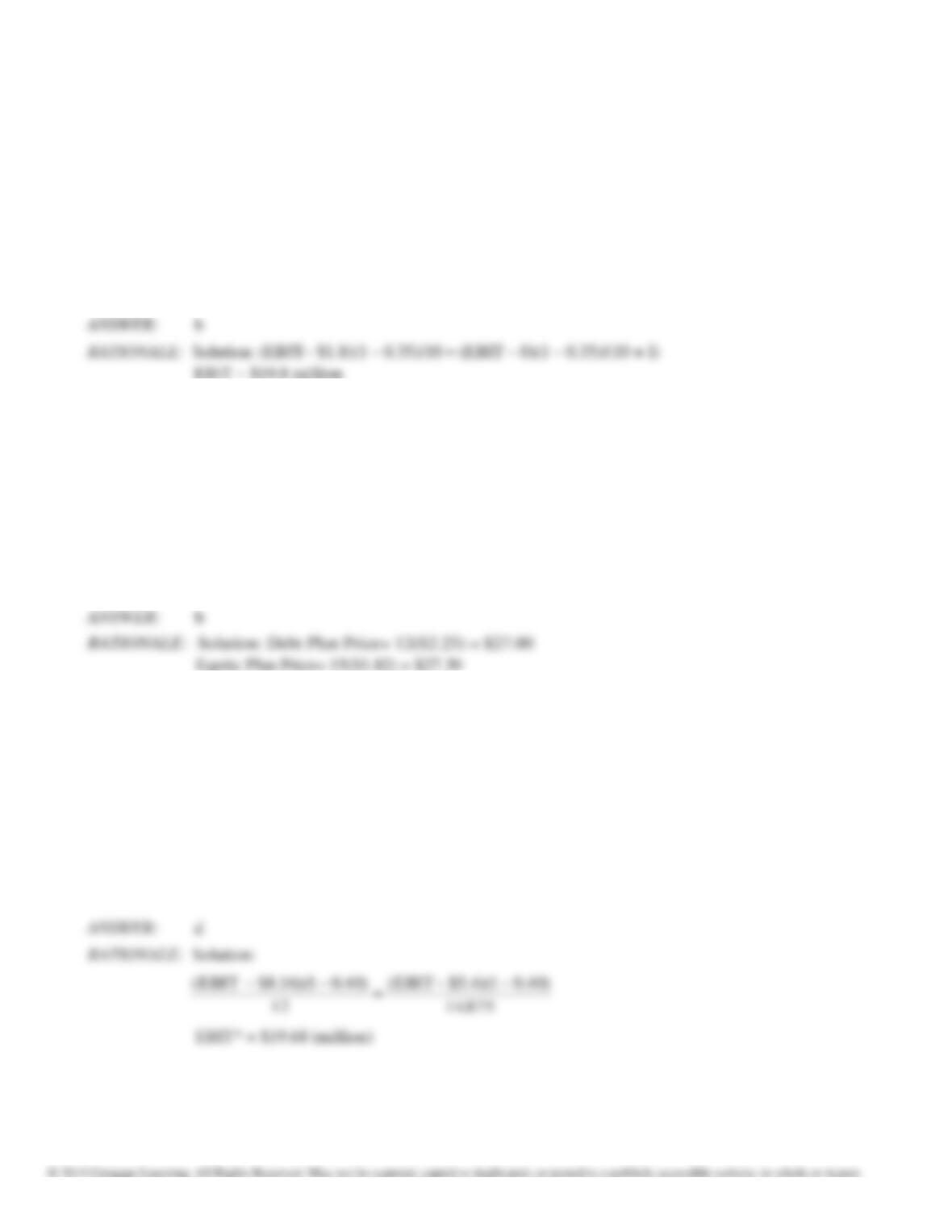
43.
Alace is an all equity firm with 10 million shares outstanding that is evaluating two alternative financing plans.
With
the first plan
,
Alace will sell 1 million shares of common stock at $15 each. Under the second plan, the
firm would sell $15 million of 12 percent long-term debt. If Alace has a marginal tax rate of 35 percent, what is
the EBlT-EPS
indifference point?
a.
$12.9 million
b.
$19.8 million
c.
$11.7 million
d.
$18.0 million
44.
Knight Moves is considering two alternative financing plans. The firm is expected to operate at the $75 million
EBlT
level. Under Plan D (debt financing) EPS is expected to be $2.25, and under Plan E (equity financing)
EPS is
expected to be $1.82. If the market is expected to assign a PIE ratio of 12 to the debt plan and 15 to the
equity plan,
which plan should Knight pursue?
a.
debt
b.
equity
c.
indifferent between the two alternatives
d.
neither is satisfactory
45.
Dagger Company has a current capital structure consisting of$60 million in long-term debt with an interest rate
of 9% and $60 million in common equity (12 million shares). The firm is considering an expansion plan
costing $23 million. The expansion plan can be financed with additional long-term debt at a 12% interest rate
or the sale of new common stock at $8 per share. The firm’s marginal tax rate is 40%. Determine the
indifference level of EBIT for the two financing plans.
a.
–$30.24 million
b.
$18.36 million
c.
$30.24 million
d.
$19.68 million
Chapter 14: Capital Structure Management in Practice
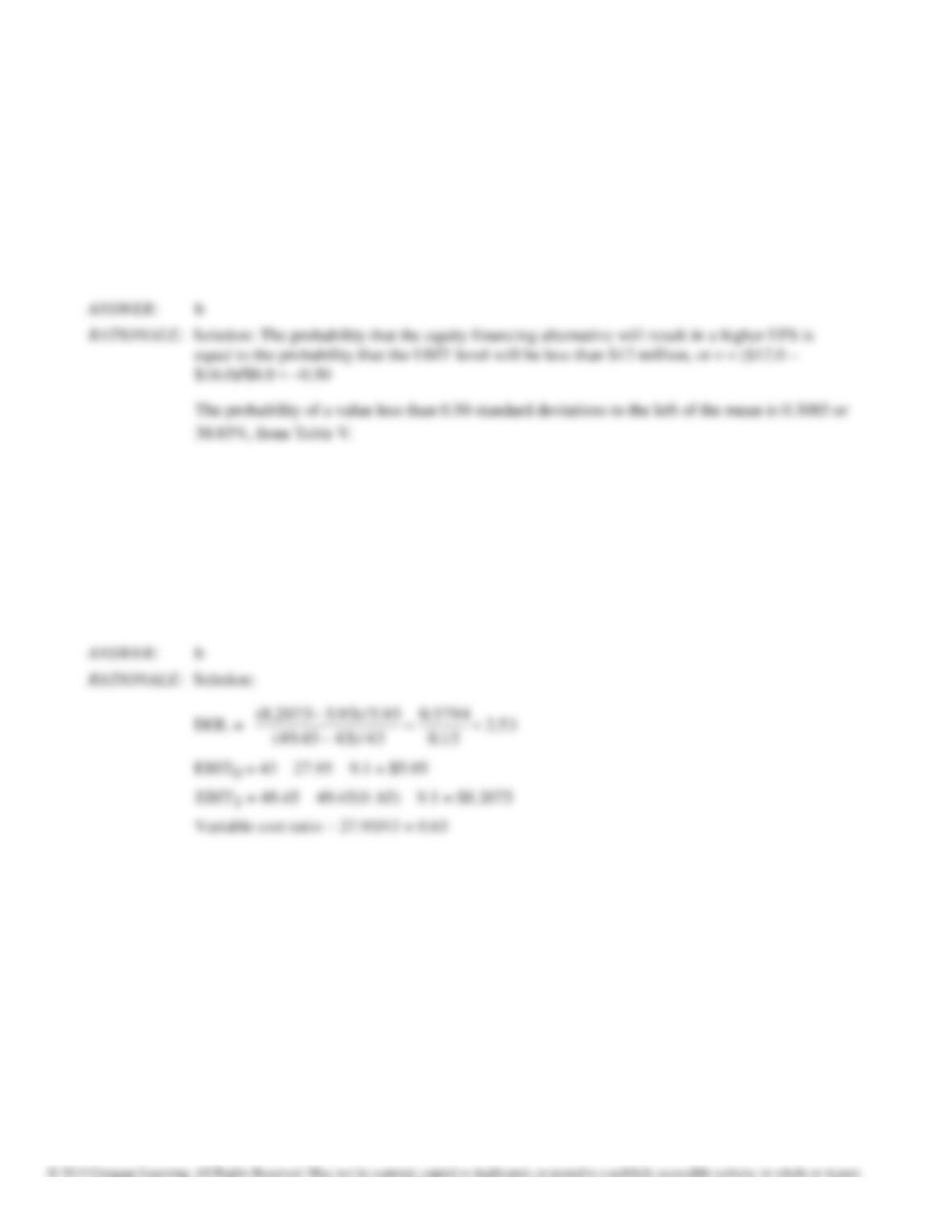
46.
The Ames Company has an expected EBIT of $16 million with a standard deviation of $8 million. The
indifference point between a debt financing alternative and a common stock financing alternative was
computed to be $12 million. Determine the probability that the equity financing alternative will be superior to
the debt financing alternative (i.e., have a higher EPS). (Problem requires normal distribution table.)
a.
50.0%
b.
30.85%
c.
69.15%
d.
cannot be computed
47.
Centex, a producer of telephone systems for small businesses, has current sales of$43 million and variable
operating costs of$27.95 million. Centex expects to increase sales in the coming year by 15% while keeping
fixed operating costs constant at $9.1 million. What is the DOL for Centex?
a.
3.3
b.
2.5
c.
7.2
d.
1.0