
Tests, Surveys, and Pools Tests
Test Canvas : TestBanks Chapter 14: Oligopoly
Microeconom ics, 3e
Test Canvas: TestBanks Chapter 14: Oligopoly
The Test Canvas allows you to add and edit questions, add Question Sets or Random Blocks, reorder questions,
and review the test. More Help
Delete Points Update Hide Question Details
Select: All None Select by Type:
– Question Type –
Description
Instructions
Total Questions 237
Total Points 0
1. True/False: The term imperfect competition is use…
Question The term imperfect competition is used to refer to both oligopoly and monopolistic
competition.
2. True/False: If the Baltimore furniture market had…
Question If the Baltimore furniture market had only a few sellers, it would be considered an
oligopoly.
3. True/False: In the U.S. economy, oligopoly is rare.
Question In the U.S. economy, oligopoly is rare.
4. True/False: Cartels are illegal in the United Sta…
Question Cartels are illegal in the United States.
Edit Mode is:
ON
Question SettingsCreate Question Reuse Question Upload Questions
Points: 0
Points: 0
Points: 0
Points: 0
Success: 237 questions added as a copy.

5. True/False: One of the most inefficient least pro…
Question One of the most inefficient least profitable ways for duopolists to earn a profit is to
engage in collusion or form a cartel.
6. True/False: The fact that the price effect for an...
Question The fact that the price effect for an oligopolist is less than the price effect for a
monopolist helps explain why firms are likely to cheat on a cartel agreement.
7. True/False: Suppose all of the firms in an indust…
Question Suppose all of the firms in an industry form a cartel and succeed in raising the
price to the monopoly level by reducing output. Any single firm will find that it can
increase its profits by cheating on the cartel agreement.
8. True/False: Oligopolists will earn zero profits u...
Question Oligopolists will earn zero profits unless they can collude.
9. True/False: Each firm in a cartel has an incentiv...
Question Each firm in a cartel has an incentive to break its word and produce more than the
agreed quantity.
10. True/False: A Nash equilibrium results when each ...
Question A Nash equilibrium results when each player chooses the action that maximizes
his or her payoff given the actions of other players.
11. True/False: A strategy of tit-for-tat involves pl...
Question
Points: 0
Points: 0
Points: 0
Points: 0
Points: 0
Points: 0
Points: 0
A strategy of tit-for-tat involves playing cooperatively at first, then doing whatever
the other player did the previous period.
12. True/False: The noncooperative equilibrium of a p...
Question The noncooperative equilibrium of a prisoners‘ dilemma kind of game can be
avoided if the game is played repeatedly and firms engage in strategic behavior.
13. True/False: A situation in which each firm acts i...
Question A situation in which each firm acts in order to raise the profits of its rivals (and of
itself) without any formal agreement between firms is known as tacit collusion.
14. True/False: Until 1890, trusts in which firms wit...
Question Until 1890, trusts in which firms within an industry agreed to limit production and
raise prices were legal in the United States.
15. True/False: Oligopolistic firms often choose not …
Question Oligopolistic firms often choose not to compete on price.
16. True/False: To limit competition, oligopolists of...
Question To limit competition, oligopolists often practice product differentiation.
17. True/False: In the 1960s and 1970s, General Motor...
Question In the 1960s and 1970s, General Motors often set prices for the new model year
and Ford and Chrysler would follow. This was a form of tacit collusion known as
price leadership.
18. Multiple Choice: In an oligopoly:
Points: 0
Points: 0
Points: 0
Points: 0
Points: 0
Points: 0
Points: 0
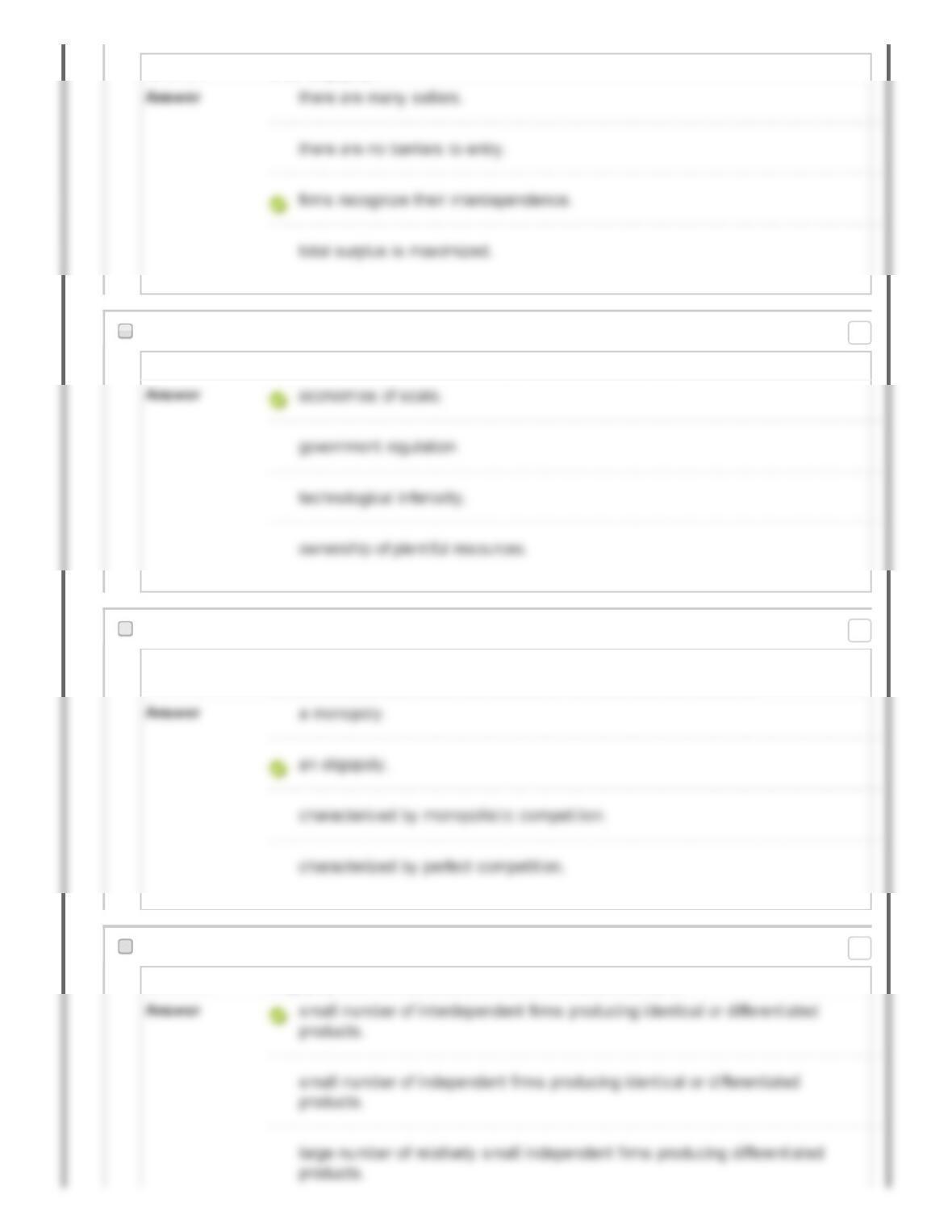
Question In an oligopoly:
19. Multiple Choice: The most important source of oligopol...
Question The most important source of oligopoly in an industry is:
20. Multiple Choice: An industry that is dominated by a fe…
Question An industry that is dominated by a few firms, each of whose firms recognizes that
its own choices can affect the choices of its rivals and vice versa, is:
21. Multiple Choice: Oligopoly is a market structure that ...
Question Oligopoly is a market structure that is characterized by a:
Points: 0
Points: 0
Points: 0
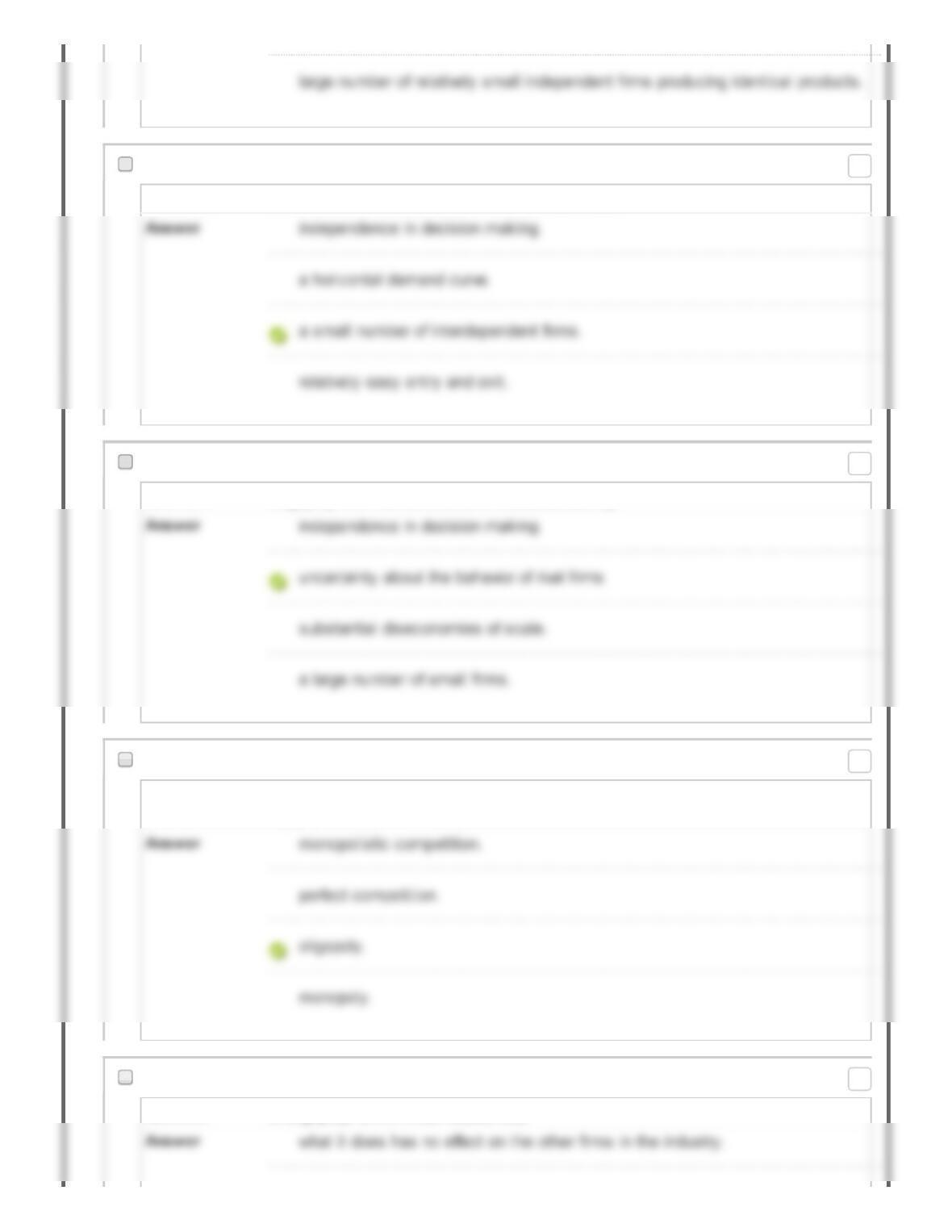
22. Multiple Choice: To be called an oligopoly, an industr…
Question To be called an oligopoly, an industry must have:
23. Multiple Choice: Oligopoly is a market structure chara…
Question Oligopoly is a market structure characterized by:
24. Multiple Choice: The market structure characterized by…
Question The market structure characterized by a few interdependent firms and barriers to
entry is called:
25. Multiple Choice: In oligopoly, a firm must realize that:
Question In oligopoly, a firm must realize that:
Points: 0
Points: 0
Points: 0
Points: 0
26. Multiple Choice: A firm that is in an oligopoly knows …
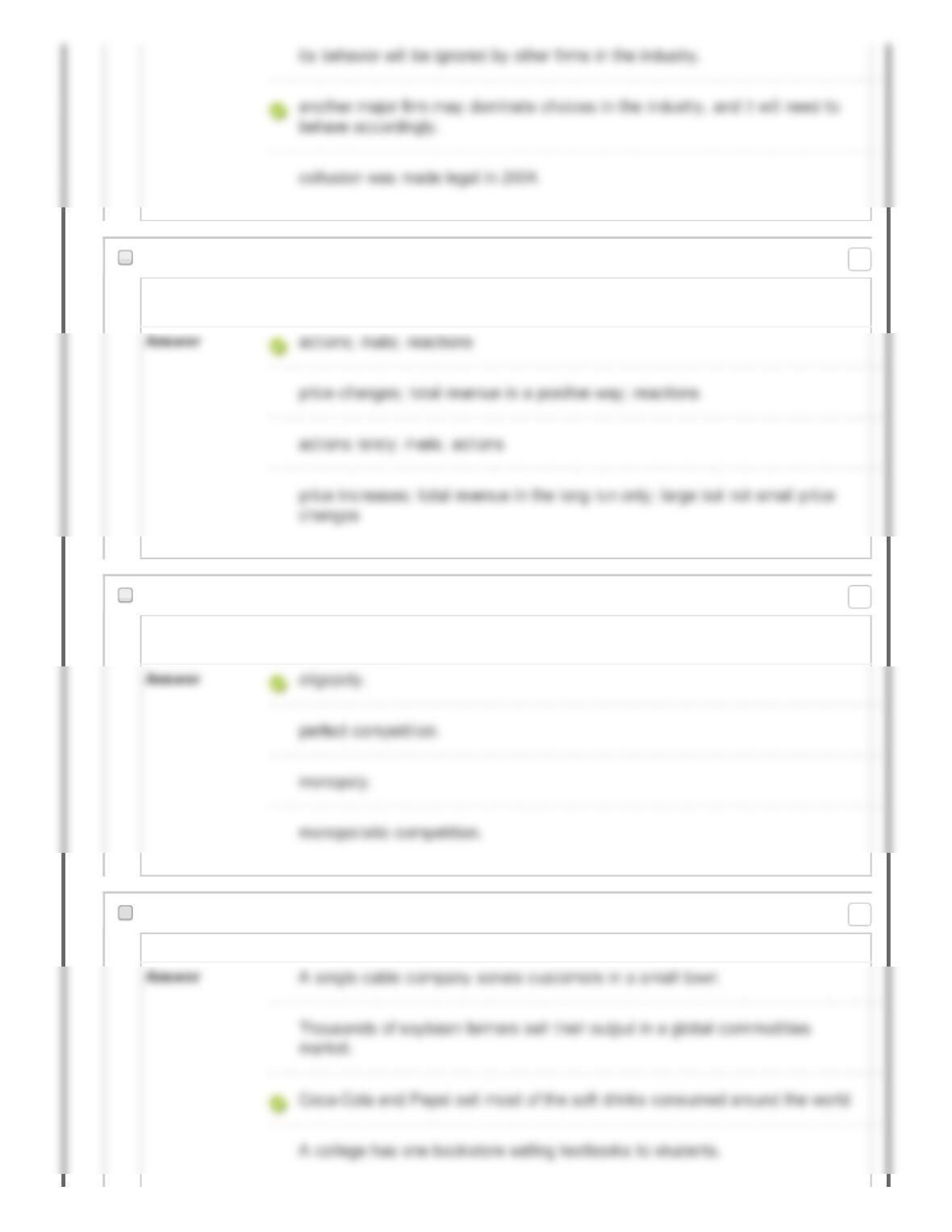
Question A firm that is in an oligopoly knows that its ________ affect its ________ and that
the ________ of its rivals will affect it.
27. Multiple Choice: The market structure that is characte…
Question The market structure that is characterized by only a small number of producers is
referred to as a(n):
28. Multiple Choice: Which of the following scenarios best...
Question Which of the following scenarios best describes an oligopolistic industry?
Points: 0
Points: 0
Points: 0
29. Multiple Choice: To calculate the Herfindahl–Hir...
Question To calculate the Herfindahl–Hirschman index (HHI), one must:
30. Multiple Choice: An industry is dominated by a few fir…
Question An industry is dominated by a few firms. Each of these firms acknowledges that its
own choices affect the choices of its rivals. Each firm also recognizes that its rivals‘
choices affect the decisions it makes. This industry is an example of:
31. Multiple Choice: Oligopoly is a market structure that ...
Question Oligopoly is a market structure that is characterized by a ________ number of
________ firms that produce ________ products.
32. Multiple Choice: An industry characterized by a few in…
Question An industry characterized by a few interdependent firms and by barriers to entry is
called:
Answer perfect competition.
Points: 0
Points: 0
Points: 0
Points: 0
33. Multiple Choice: The sum of the squared market shares …
Question The sum of the squared market shares of each firm in an industry is the:
34. Multiple Choice: A monopoly will have a Herfindahl&nda…
Question A monopoly will have a Herfindahl–Hirschman index (HHI) equal to:
35. Multiple Choice: Which of the following Herfindahl&nda...
Question Which of the following Herfindahl–Hirschman indices is most likely to indicate a
perfectly competitive market?
36. Multiple Choice: The Herfindahl–Hirschman index ...
Points: 0
Points: 0
Points: 0
Points: 0
Question The Herfindahl–Hirschman index is a measure of concentration found by:
37. Multiple Choice: The largest HHI possible is ________ ...
Question The largest HHI possible is ________ and the industry is a(n) ________ .
38. Multiple Choice: The Herfindahl–Hirschman index ...
Question The Herfindahl–Hirschman index equals ________ when ________ have (has)
________ of the market.
39. Multiple Choice: Large barriers to entry in the gas st…
Question Large barriers to entry in the gas station business explain why the two only gas
stations in a small town:
Points: 0
Points: 0
Points: 0
40. Multiple Choice: An industry with only two firms is ge...
Question An industry with only two firms is generally called:
41. Multiple Choice: A duopoly is an industry that consist...
Question A duopoly is an industry that consists of:
42. Multiple Choice: An industry that consists of two firm…
Question An industry that consists of two firms is:
43. Multiple Choice: If the only two firms in an industry ...
Question If the only two firms in an industry agree to fix the price at a given level, this is an
example of:
Points: 0
Points: 0
Points: 0
Points: 0
44. Multiple Choice: An extreme case of oligopoly in which…
Question An extreme case of oligopoly in which firms collude to raise joint profits is known
as a:
45. Multiple Choice: When firms openly agree on price and …
Question When firms openly agree on price and output and they jointly make other decisions
aimed at achieving monopoly profits, those firms are practicing:
46. Multiple Choice: Overt collusion exists if:
Question Overt collusion exists if:
Points: 0
Points: 0
Points: 0
47. Multiple Choice: A cartel is an example of:
Question A cartel is an example of:
48. Multiple Choice: If there are two gas stations in a ve…
Question If there are two gas stations in a very small town,, then the gas station business
there is probably best characterized as:
49. Multiple Choice: Collusive agreements are typically di...
Question Collusive agreements are typically difficult for cartels to maintain because each firm
can increase profits by:
50. Multiple Choice: Which of the following characteristic…
Question
Points: 0
Points: 0
Points: 0
Points: 0
Which of the following characteristics make an industry more conducive to
collusive behavior?
51. Multiple Choice: The owners of the gas stations in a t...
Question The owners of the gas stations in a town are trying to set up a cartel that will raise
the price of gasoline. Which of the following will increase the chances that the
cartel will fail because of cheating by the owners?
52. Multiple Choice: In an oligopolistic market structure,...
Question In an oligopolistic market structure, collusion between firms usually leads to higher
profits than noncooperative behavior. However, formal, overt collusion doesn’t
usually occur in the United States because:
53. Multiple Choice: Gary‘s Gas and Frank’s Fuel are the o...
Question
Points: 0
Points: 0
Points: 0
Gary’s Gas and Frank‘s Fuel are the only two providers of gasoline in their small
town. Gary and Frank decide to form a cartel to raise the price of gasoline. The
total industry profits are highest when ________, and Gary‘s profits are highest
when ________.
54. Multiple Choice: By practicing ________, firms openly …
Question By practicing ________, firms openly agree on price and output and jointly make
other decisions in order to achieve monopoly profits.
55. Multiple Choice: In which of the following situations ...
Question In which of the following situations does overt collusion exist?
56. Multiple Choice: If the only two firms in an industry ...
Question
Points: 0
Points: 0
Points: 0
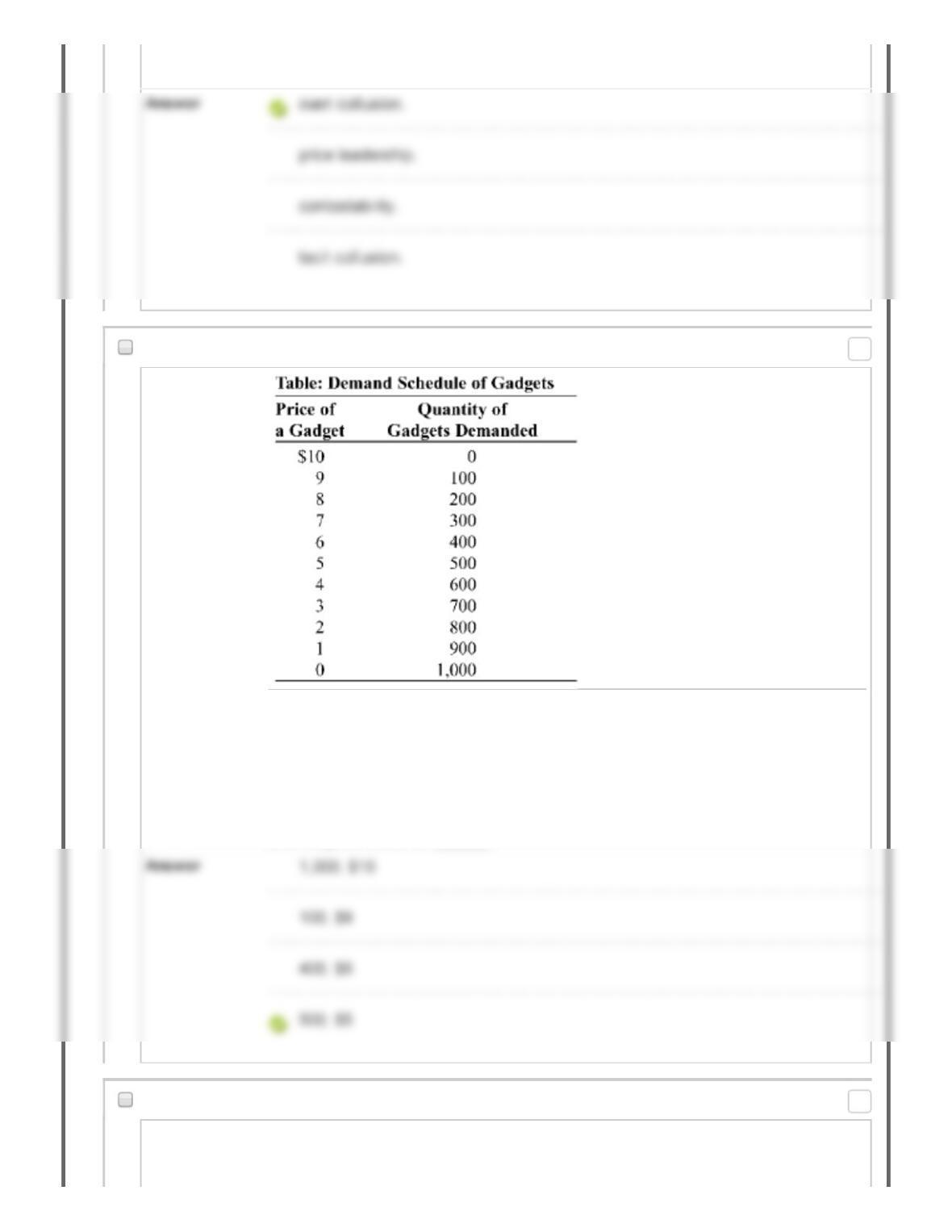
If the only two firms in an industry openly agree to fix the price at a given level, then
this is an example of:
57. Multiple Choice: Reference: Ref 14-1 (Table: Demand S…
Question
Reference: Ref 14-1
(Table: Demand Schedule for Gadgets) Look at the table Demand Schedule for
Gadgets. The market for gadgets is dominated by two producers, Margaret and
Ray. Each firm can produce gadgets at a marginal cost of $0. The table shows the
market demand schedule for gadgets. If these two producers formed a cartel and
acted to maximize total industry profits, total industry output would be _________
and the price would be ______.
58. Multiple Choice: Reference: Ref 14-1 (Table: Demand S…
Question
Points: 0
Points: 0
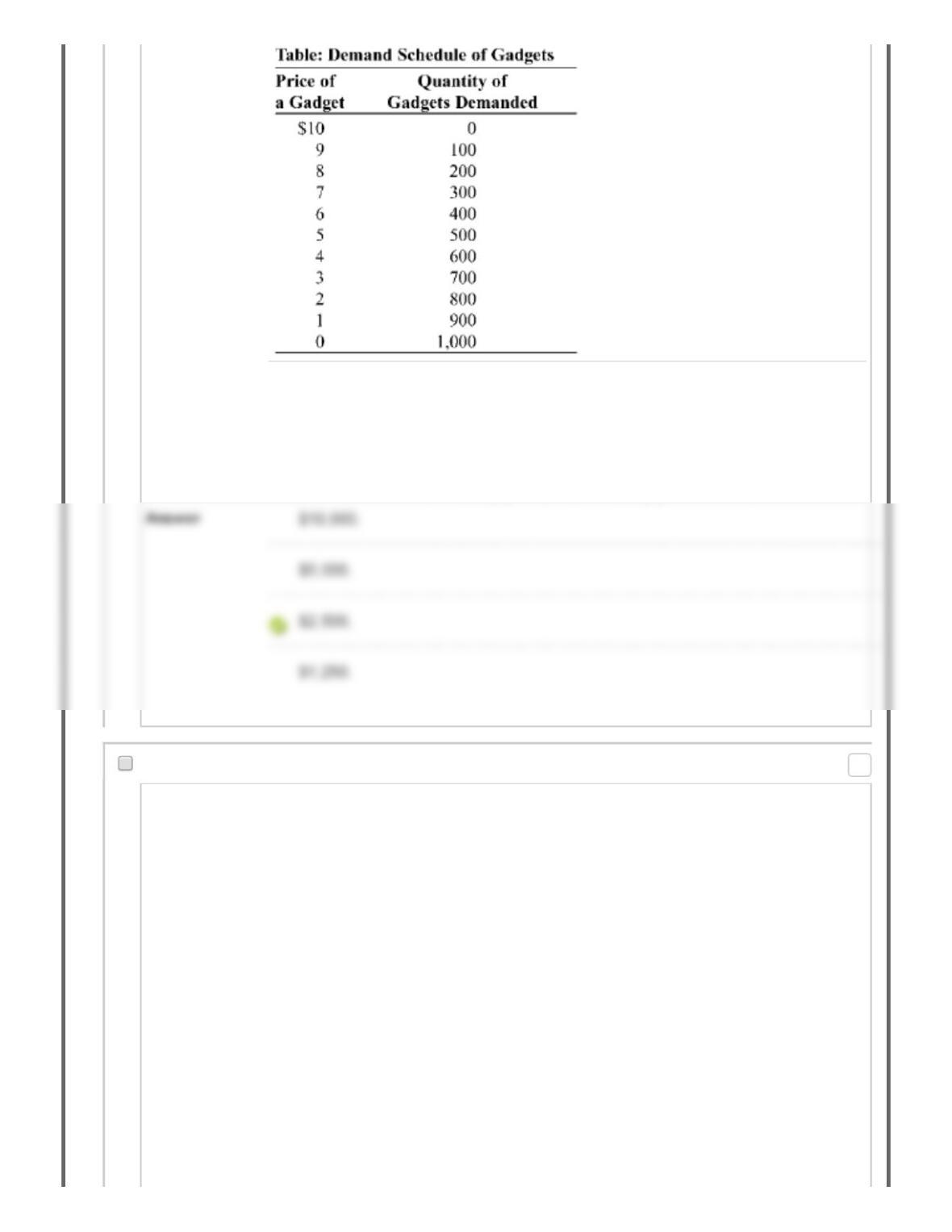
Reference: Ref 14-1
(Table: Demand Schedule for Gadgets) Look at the table Demand Schedule for
Gadgets. The market for gadgets is dominated by two producers, Margaret and
Ray. Each firm can produce gadgets at a marginal cost of $0. The table shows the
market demand schedule for gadgets. If these two producers formed a cartel and
acted to maximize total industry profits, total industry profit would be:
59. Multiple Choice: Reference: Ref 14-1 (Table: Demand S…
Question
Points: 0
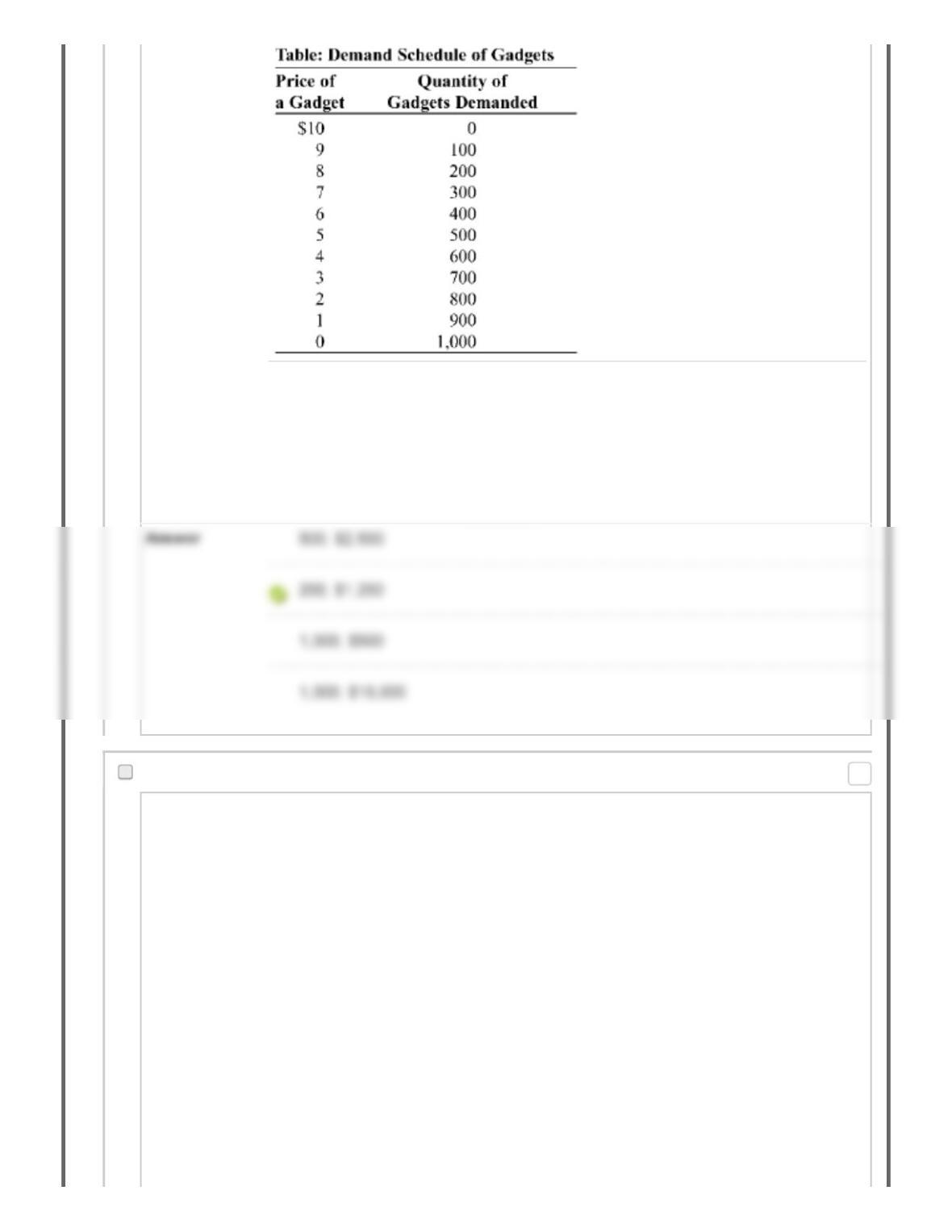
Reference: Ref 14-1
(Table: Demand Schedule for Gadgets) Look at the table Demand Schedule for
Gadgets. The market for gadgets is dominated by two producers, Margaret and
Ray. Each firm can produce gadgets at a marginal cost of $0. The table shows the
market demand schedule for gadgets. If these two producers formed a cartel and
acted to maximize total industry profits, each firm’s output would be ________ and
each firm’s profit would be _________.
60. Multiple Choice: Reference: Ref 14-1 (Table: Demand S…
Question
Points: 0
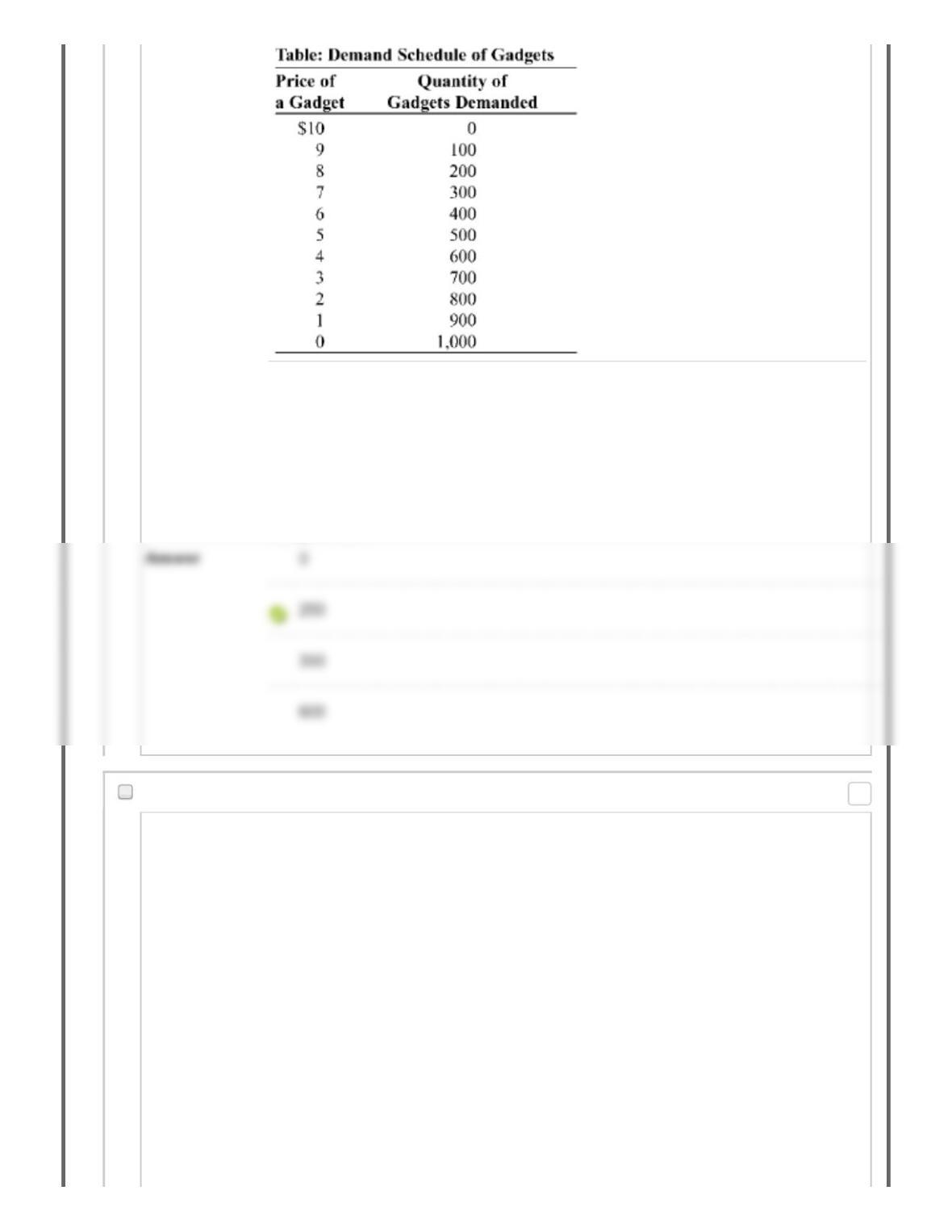
Reference: Ref 14-1
(Table: Demand Schedule for Gadgets) Look at the table Demand Schedule for
Gadgets. The market for gadgets is dominated by two producers, Margaret and
Ray. Each firm can produce gadgets at a marginal cost of $0. The table shows the
market demand schedule for gadgets. Suppose that these two producers have
formed a cartel and are maximizing total industry profits. If Margaret decides to
cheat on the agreement and sell 100 more gadgets, how many gadgets will
Margaret sell?
61. Multiple Choice: Reference: Ref 14-1 (Table: Demand S…
Question
Points: 0
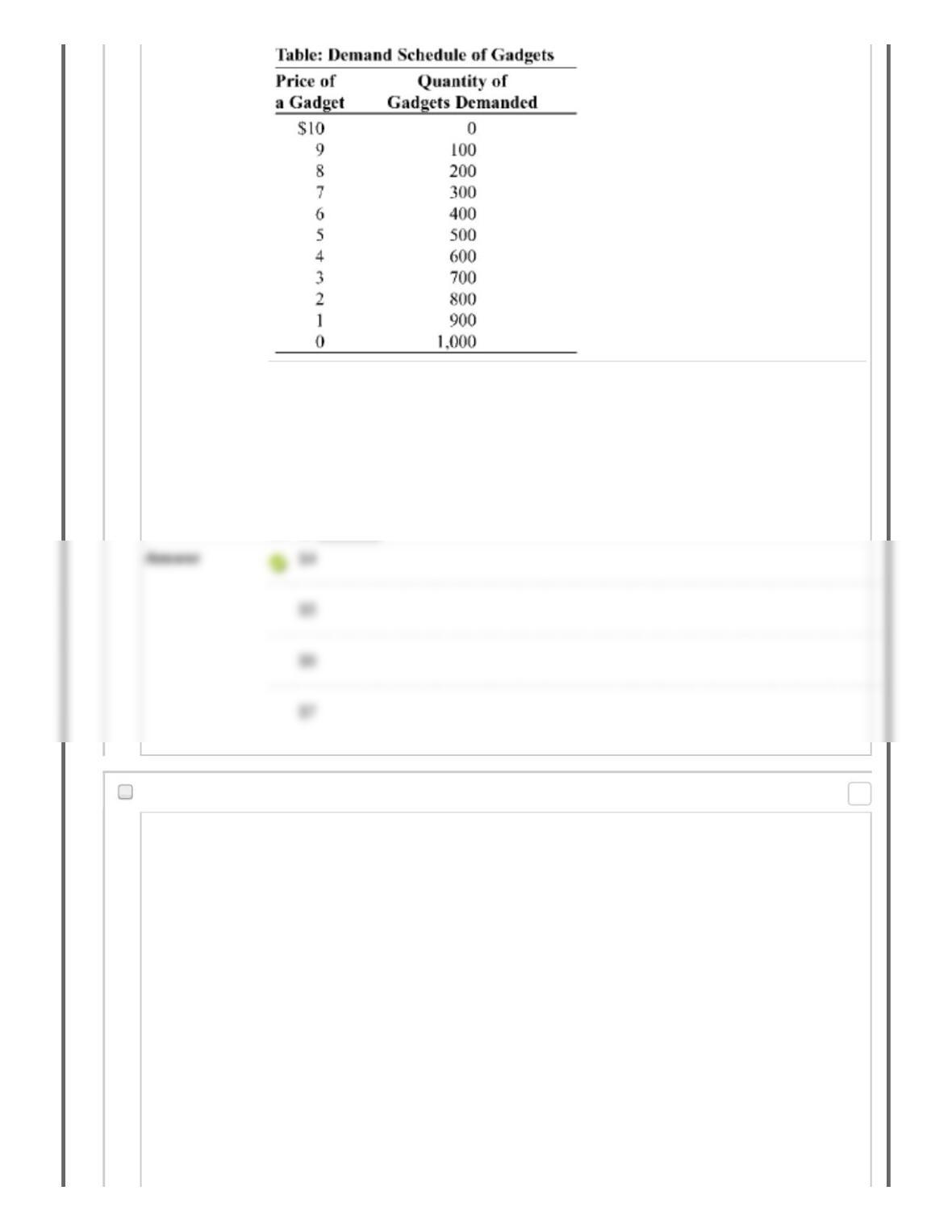
Reference: Ref 14-1
(Table: Demand Schedule for Gadgets) Look at the table Demand Schedule for
Gadgets. The market for gadgets is dominated by two producers, Margaret and
Ray. Each firm can produce gadgets at a marginal cost of $0. The table shows the
market demand schedule for gadgets. Suppose that these two producers have
formed a cartel and are maximizing total industry profits. If Margaret decides to
cheat on the agreement and sell 100 more gadgets, the market price of gadgets
will be _______.
62. Multiple Choice: Reference: Ref 14-1 (Table: Demand S…
Question
Points: 0
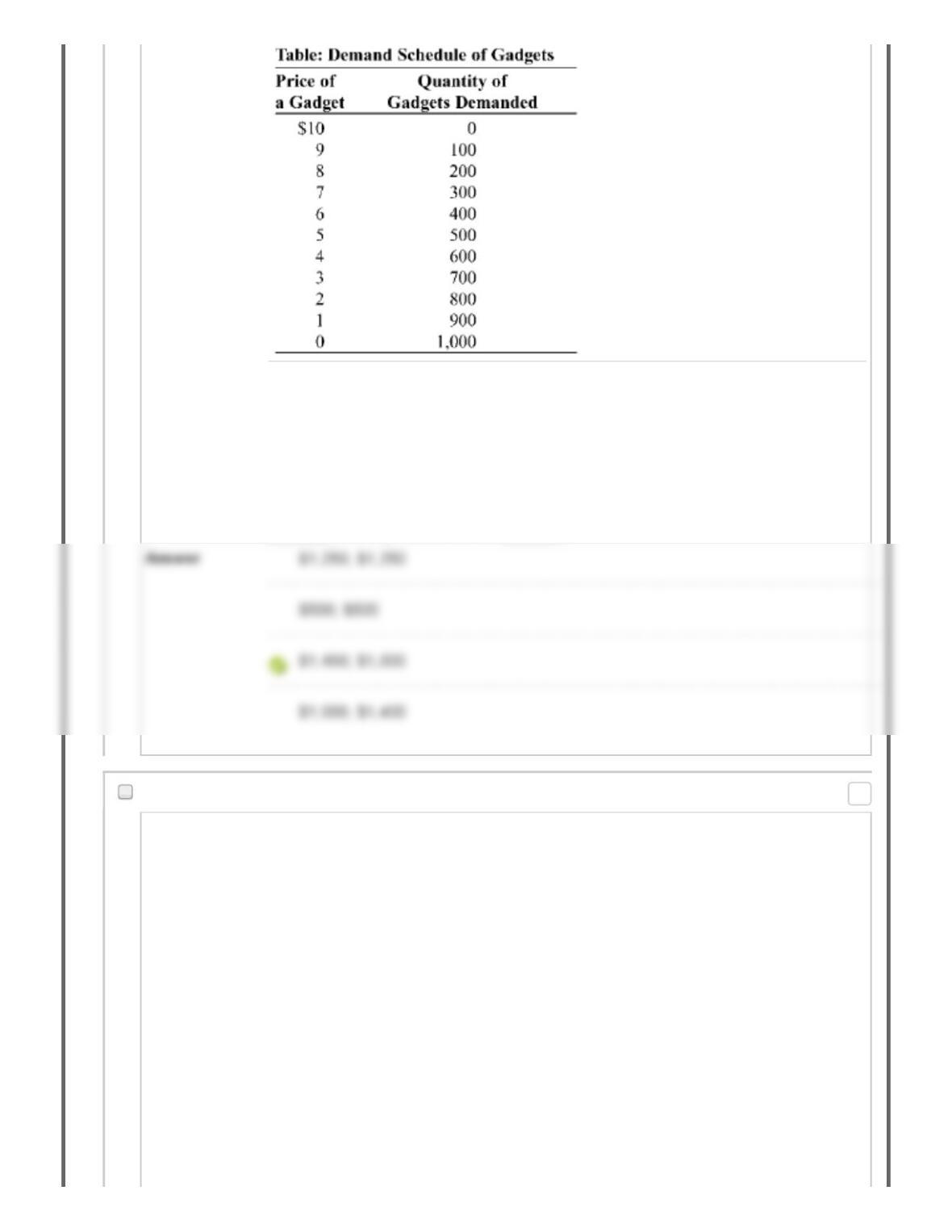
Reference: Ref 14-1
(Table: Demand Schedule for Gadgets) Look at the table Demand Schedule for
Gadgets. The market for gadgets is dominated by two producers, Margaret and
Ray. Each firm can produce gadgets at a marginal cost of $0. The table shows the
market demand schedule for gadgets. Suppose that these two producers have
formed a cartel and are maximizing total industry profits. If Margaret decides to
cheat on the agreement and sell 100 more gadgets, Margaret‘s profit will be
_______ and Ray‘s profit will be _______.
63. Multiple Choice: Reference: Ref 14-1 (Table: Demand S…
Question
Points: 0