CHAPTER 14—GAME THEORY AND COMPETITIVE
STRATEGY Key
1. In a game:
2. Because any profit recorded by the buyer of an option is exactly matched by the seller’s loss, options can be
described as a:
3. When bidders on a government contract collude to divide markets and eliminate uncertainty, their collusion
can be describes as a:
4. Joint action is favored in:
5. The general principle for players in a sequential game is to:
6. Economic games are set in a:
7. In any strategic game:
8. In a simultaneous-move game, players:
9. Sequential games:
10. In the Prisoner’s Dilemma game:
11. Nash equilibrium:
12. Solving complex sequential games that involve millions of calculations:
13. When Coca-Cola and Pepsi vie to become exclusive suppliers of soft drinks at the next Olympics, they are
competing in a:
14. When Coca-Cola and Pepsi vie to become exclusive suppliers of soft drinks at the next Olympics, they are
competing in a:
15. Maintaining cartel-like agreements is made easier in the:
16. Nash bargaining is a:
17. Every one-shot game:
18. When Gillette invests millions of dollars to establish high-quality brand-name recognition with repeat
customers, it is involved in a:
19. Trigger strategies can be used to:
20. Monopoly profits reflect:
21. With limit pricing:
22. Limit pricing is a competitive strategy to set
23. In a predatory pricing strategy:
24. Market penetration pricing is:
25. The success of market penetration pricing strategies does not depend on the eventual emergence of:
26. Game Types. Portray each of the following circumstances as a zero-sum game, a positive-sum game, or a
negative-sum game. Illustrate your answer.
A.
The ongoing discussion between Home Depot and its employees concerning an increase in the payment deductible for health benefits.
B.
The bargaining that occurs between a Kraft Foods and the local water utility concerning payment responsibility for an increase in water
and sewer costs tied to a business expansion.
C.
GM and the UAW join forces to lobby Congress for increased national health insurance expenditures.
D.
Procter & Gamble issues price discount coupons for heavy users of Tide detergent.
E.
Intel Corp. and competitor Advanced Micro Devices, Inc., engage in brutal price competition for a State Department contract.
and a dollar-for-dollar increase in employee expenses.
water and sewer costs tied to a business expansion is a classic example of a negative-sum game. Both parties end up sharing, to a
greater or lesser degree, the responsibility for paying such costs.
benefits promised to it employees. The UAW will benefit whenever its members enjoy greater health benefits.
beneficial exchange is the basic motivation for such interactions. It is with these gains in mind that companies make investments in
brand-name reputation.
competitor that got shut out. The only way for a firm to win in the competitive game is for the unlucky competitor to lose.
27. Game Types. Describe each of the following circumstances as a zero-sum game, a positive-sum game, or a
negative-sum game. Illuminate your answer.
A.
JP Morgan Chase and Citigroup battle over a Federal contract to oversee private accounts for social security investments.
B.
Altria Group, maker of Marlboro cigarettes, battles with insurers over the payment of health care costs tied to smoking.
C.
The hiring conflict that occurs among departments at Honeywell when an expansion in staff becomes necessary following the award of
a big new contract.
D.
The discussion between Johnson & Johnson senior management and employees concerning a new MBA tuition cost-sharing benefit.
E.
General Electric agrees to sign long-term contracts with suppliers who meet stringent quality guidelines.
28. Game Types. Depict each of the following circumstances as a zero-sum game, a positive-sum game, or a
negative-sum game. Explain your answer.
A.
United Technologies and competitor 3M Co. engage in brutal price competition for a U.S. Department of Defense contract.
B.
The ongoing discussion between American Express and its employees concerning a reduction in travel allowances for business trips.
C.
Competitors Merck and Pfizer lobby Congress to increase Medicaid payments for pharmaceutical products.
D.
McDonalds Corp. offers free food and prizes to loyal customers.
E.
The bargaining that occurs between Wal-Mart and a municipal government concerning payment responsibility for interchange and
access road costs made necessary by the location of a new Supercenter.
competitor that got shut out. The only way for a firm to win in the competitive game is for the unlucky competitor to lose.
bad result.
of a positive-sum game because all such parties share, in greater or lesser degree, the benefits associated with corporate expansion.
workers get a valuable new benefit that will help make them higher salaries, and employers get better-motivated and more productive
employees.
beneficial exchange is the basic motivation for such interactions.
29. Game Types. Distinguish each of the following circumstances as a zero-sum game, a positive-sum game, or
a negative-sum game. Demonstrate your answer.
A.
Microsoft gives code access to make it easier for suppliers of applications software to write Windows-compatible software.
B.
IBM and Hewlett-Packard compete to provide the Social Security Administration with a big new services contract.
C.
ExxonMobil and Du Pont settle a disputed supply contract.
D.
Competitors SBC Communications and Verizon Communications lobby Congress concerning Internet access charges.
E.
The Walt Disney Co. and local units of government agree to share environmental costs tied to Walt Disney World operations.
beneficial exchange is the basic motivation for such interactions.
competitor that got shut out. The only way for a firm to win in the competitive game is for the unlucky competitor to lose.
negotiations with the responsibility for paying some of the costs of the legal settlement. They are sharing in a bad result.
competitors both benefit.
environmental expenses.
competitor that got shut out. The only way for a firm to win in the competitive game is for the unlucky competitor to lose.
allowances represents a decrease in employer costs and a dollar-for-dollar increase in employee expenses.
profits.
loyal customers.
resulting benefits.)
30. Game Theory Concepts. Indicate whether each of the following statements is true or false, and explain
your answer.
A.
The theory of games is used to study irrational behavior by individuals and firms in interactive decision problems.
B.
In a game, only a single player strives to maximize expected utility by choosing particular courses of action.
C.
Game theory is applied during situations in which decision makers must take into account the reasoning of other decision makers.
D.
All economic and business games share the common feature of decision payoff independence.
E.
In competitive games, the outcome for each firm depends upon the strategies conducted by all competitors.
31. Game Theory Classifications. Demonstrate whether each of the following statements is true or false.
A.
In a zero-sum game, one player’s gain is another player’s loss.
B.
Joint action is favored in all positive-sum games.
C.
If a game that holds the potential for mutual gain, it is called a cooperative game.
D.
In a sequential game players act at the same point in time and must make their initial moves in isolation without any direct knowledge
of moves made by other players.
E.
When conflict holds the potential for mutual loss, it is called a negative-sum game.
A.
True. In a zero-sum game, one player’s gain is another player’s loss.
B.
False. Joint action is favored in all cooperative games.
C.
False. If parties are engaged in a game that holds the potential for mutual gain, it is called a positive-sum game.
D.
False. In a simultaneous-move game, players act at the same point in time and must make their initial moves in isolation without any
direct knowledge of moves made by other players.
True. When conflict holds the potential for mutual loss, it is called a negative-sum game.
32. Role of Interdependence. Describe each of the following statements as true or false, and explain your
answer.
A.
An implicit assumption of game theory is that rational players are able to anticipate the equilibrium calculations of any other player.
B.
Disequilibrium outcomes are anticipated and thwarted by the look ahead and extrapolate back principle.
C.
In a sequential game, each player moves in succession, and each player is aware of all prior moves.
D.
The general principle for players in a simultaneous-move game is to look ahead and extrapolate back.
E.
A given allocation of payoffs is called a disequilibrium outcome if the payoff to no player can be improved by unilateral action.
interactive decision problems.
False. In a game, all individual decision makers, called players or agents, strive to maximize their expected utility by choosing
particular courses of action.
C.
True. Game theory is applied during situations in which decision makers must take into account the reasoning of other decision makers.
D.
False. All economic and business games share the common feature of game payoff interdependence.
E.
True. In competitive games, the outcome for each firm depends upon the strategies conducted by all competitors.
33. Prisoner’s Dilemma. Characterize each of the following statements as true or false, and justify your
answer.
A.
While each suspect can control the range of sentencing outcomes, neither can control the ultimate outcome. In this situation, there is no
secure strategy that creates the best result for either suspect regardless of the action taken by the other.
B.
A dominant strategy guarantees the best possible outcome given the worst possible scenario.
C.
The Prisoner’s Dilemma is a one-shot game because the underlying interaction between competitors occurs only once.
D.
Either player can choose a given cell outcome from the payoff matrix.
E.
The Prisoner’s Dilemma is a repeated game because of ongoing interaction between competitors.
outcome. In this situation, there is no dominant strategy that creates the best result for either suspect regardless of the action taken by
the other.
scenario.
C.
True. The Prisoner’s Dilemma is a one-shot game because the underlying interaction between competitors occurs only once.
False. Neither player can unilaterally choose a given cell outcome from the payoff matrix. Cell outcomes result from the interdependent
strategies chosen by both players.
repeated game, there is ongoing interaction between competitors.
34. Nash Equilibrium. Characterize each of the following statements as true or false, and justify your answer.
A.
A first-mover advantage is a benefit earned by the player able to make the initial move in a sequential move or multistage game.
B.
In one-shot game, the timing of player moves becomes important.
C.
If there is uncertainty about when a game will end, the conduct of a finitely repeated game mirrors an infinitely repeated game.
D.
A Nash bargaining game is another application of the simultaneous-move, one-shot game.
E.
Given the strategy of its competitor, neither firm can improve its own payoff by unilaterally changing its own strategy in a Nash
equilibrium.
A.
True. A first-mover advantage is a benefit earned by the player able to make the initial move in a sequential move or multistage game.
B.
False. In multistage game, the timing of player moves becomes important.
True. If there is uncertainty about when a game will end, the conduct of a finitely repeated game mirrors an infinitely repeated game.
agreement.
equilibrium.
True. Disequilibrium outcomes are anticipated and thwarted by the look ahead and extrapolate back principle.
C.
True. In a sequential game, each player moves in succession, and each player is aware of all prior moves.
D.
False. The general principle for players in a sequential game is to look ahead and extrapolate back.
E.
False. A given allocation of payoffs is called an equilibrium outcome if the payoff to no player can be improved by unilateral action.
35. Pricing Strategy. Describe each of the following statements as true or false, and support your answer.
A.
Predatory pricing is a competitive strategy to set less than monopoly prices in an effort to deter market entry by new and viable
competitors. Predatory pricing strategies are widely adopted by firms with pricing power as means for maintaining lead market
positions, albeit with less than maximum short-term profits.
B.
Limit pricing is pricing below marginal cost in the hope of knocking out rival producers and subsequently raising prices to obtain
monopoly profits. Limit pricing involves a tradeoff between lower current prices and profits in return for higher subsequent prices and
profits.
C.
Market penetration pricing is a pricing strategy of charging very low initial prices to create a new market or grab market share in an
established market.
D.
Customer lock-in effects are often tied to network externalities that lead to significant first-mover advantages.
E.
Evidence of predatory pricing would confirm the presence of strong monopoly power.
36. Dominant Strategies. Suppose two competitors each face important strategic decisions where the payoff to
each decision depends upon the reactions of the competitor. Firm A can choose either row in the payoff matrix
defined below, whereas firm B can choose either column. For firm A the choice is either “up” or “down;” for
firm B the choice is either “left” or “right.” Notice that neither firm can unilaterally choose a given cell in the
profit payoff matrix. The ultimate result of this one-shot, simultaneous-move game depends upon the choices
made by both competitors. In this payoff matrix, strategic decisions made by firm A or firm B could signify
decisions to offer a money-back guarantee, lower prices, offer free shipping, and so on. The first number in each
cell is the profit payoff to firm A; the second number is the profit payoff to firm B.
Firm B
Firm A
Competitive Strategy
Left
Right
Up
$6 million; $1 million
$4 million; $3.5 million
Down
$2 million; $2 million
$3 million; $3 million
A.
Is there a dominant strategy for firm A? If so, what is it?
B.
Is there a dominant strategy for firm B? If so, what is it?
in return for higher subsequent prices and profits. Predatory pricing practices are illegal in the United States under the Sherman
Antitrust Act and rarely observed.
False. Limit pricing is a competitive strategy to set less than monopoly prices in an effort to deter market entry by new and viable
competitors. Limit pricing strategies are widely adopted by monopoly firms and other firms with pricing power as a means for
maintaining lead market positions, albeit with less than maximum short-term profits.
True. Market penetration pricing is a pricing strategy of charging very low initial prices to create a new market or grab market share in
an established market. The objective is to gain a critical mass of customers, create strong network effects, and eventually establish a
viable business.
True. Customer lock-in effects are often tied to network externalities that lead to significant first-mover advantages. A network is a
series of links among producers or customers that can be physical or economic in nature.
False. If aggressive predatory pricing strategies are necessary to limit competitor entry, it seems unlikely that incumbent firms would
enjoy truly unsurmountable barriers to entry. This suggests that evidence of predatory pricing would be evidence of weak rather than
strong monopoly power.
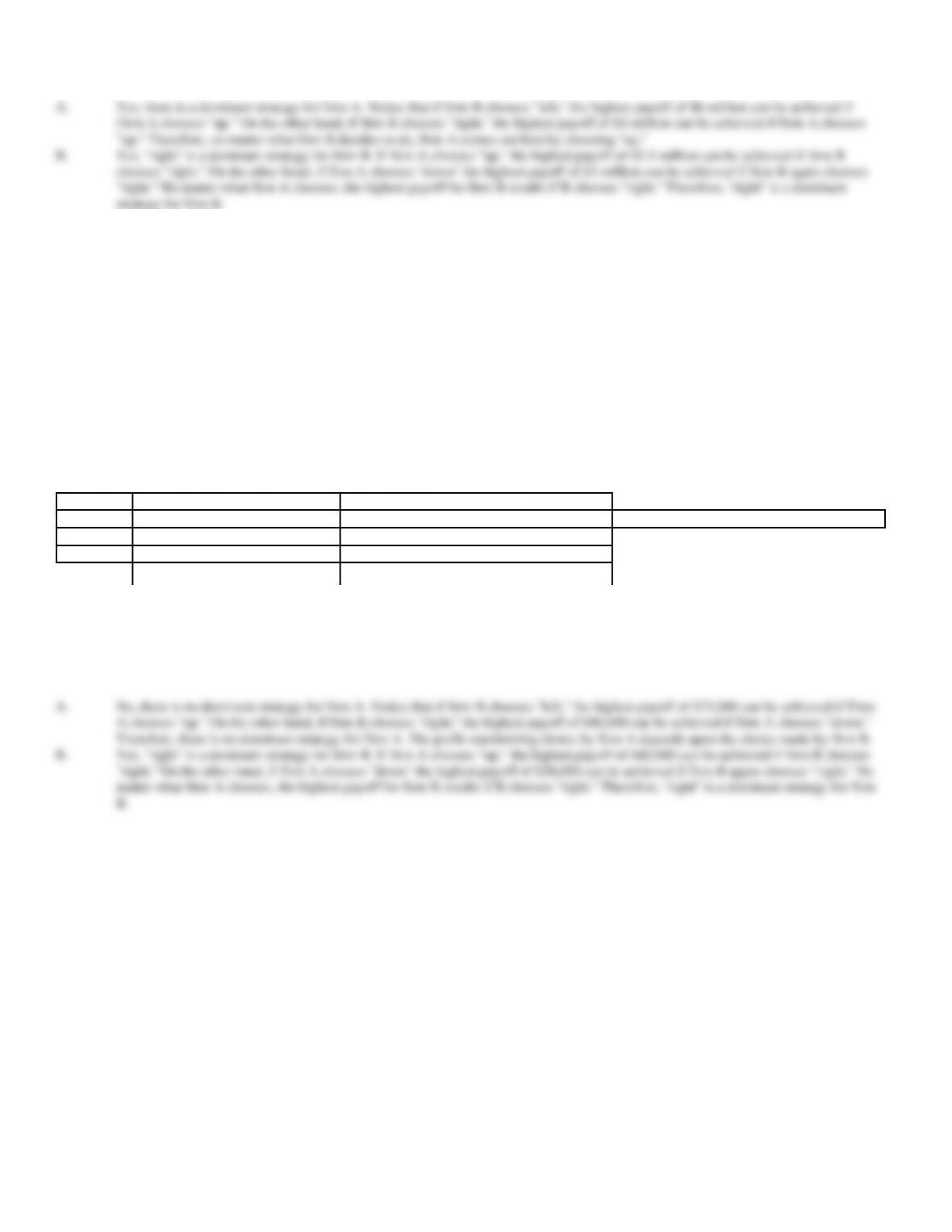
37. Dominant Strategies. Suppose two competitors each face important strategic decisions where the payoff to
each decision depends upon the reactions of the competitor. Firm A can choose either row in the payoff matrix
defined below, whereas firm B can choose either column. For firm A the choice is either “up” or “down;” for
firm B the choice is either “left” or “right.” Notice that neither firm can unilaterally choose a given cell in the
profit payoff matrix. The ultimate result of this one-shot, simultaneous-move game depends upon the choices
made by both competitors. In this payoff matrix, strategic decisions made by firm A or firm B could signify
decisions to offer a money-back guarantee, lower prices, offer free shipping, and so on. The first number in each
cell is the profit payoff to firm A; the second number is the profit payoff to firm B.
Firm B
Firm A
Competitive Strategy
Left
Right
Up
$75,000; $10,000
$50,000; $40,000
Down
$25,000; $25,000
$80,000; $30,000
A.
Is there a dominant strategy for firm A? If so, what is it?
B.
Is there a dominant strategy for firm B? If so, what is it?
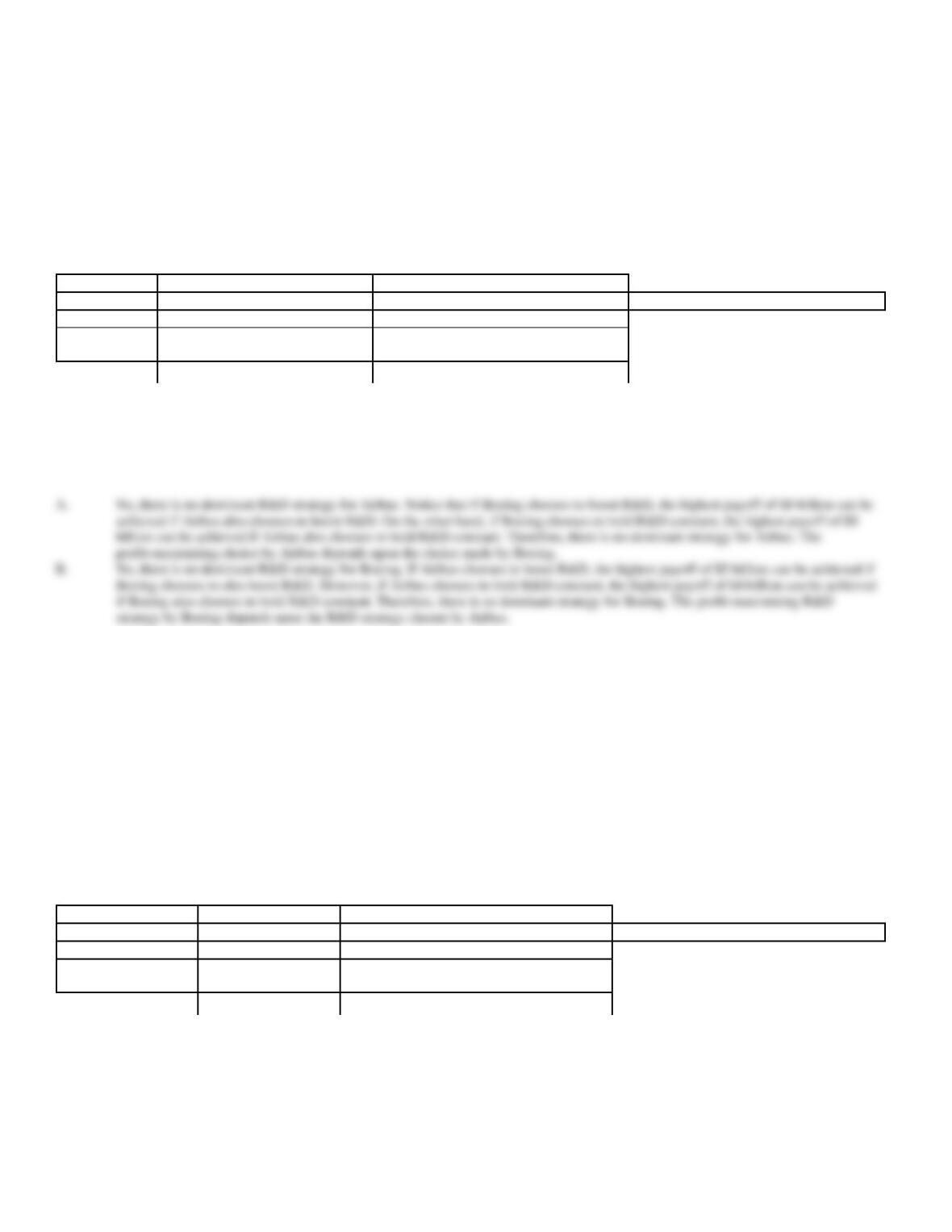
38. Dominant Strategies. Suppose two competitors, Airbus and Boeing, each face an important strategic
decision concerning whether or not they should boost research and development (R&D) spending on new
aircraft designs. Airbus can choose either row in the payoff matrix defined below, whereas Boeing can choose
either column. For Airbus, the choice is either “boost R&D” or “hold R&D constant;” for Boeing the choices
are the same. Notice that neither firm can unilaterally choose a given cell in the profit payoff matrix. The
ultimate result of this one-shot, simultaneous-move game depends upon the choices made by both competitors.
In this payoff matrix, the first number in each cell is the profit payoff to Airbus (in billions); the second number
is the profit payoff to Boeing (in billions).
Boeing
Airbus
Competitive Strategy
Boost R&D
Hold R&D Constant
Boost R&D
$8 billion; $5 billion
$5 billion; $3 billion
Hold R&D
Constant
$4 billion; $2 billion
$9 billion; $4 billion
A.
Is there a dominant strategy for Airbus? If so, what is it?
B.
Is there a dominant strategy for Boeing? If so, what is it?
39. Dominant Strategies. Suppose two competitors, Caterpillar, Inc., and Deer & Co., each face an important
strategic decision concerning whether or not they should boost advertising on new product introductions.
Caterpillar can choose either row in the payoff matrix defined below, whereas Deere can choose either column.
For Caterpillar, the choice is either “boost advertising” or “hold advertising constant.” For Deere, the choices
are the same. Notice that neither firm can unilaterally choose a given cell in the profit payoff matrix. The
ultimate result of this one-shot, simultaneous-move game depends upon the choices made by both competitors.
In this payoff matrix, the first number in each cell is the profit payoff to Caterpillar (in billions); the second
number is the profit payoff to Deere (in billions).
Deere & Co.
Caterpillar, Inc.
Competitive Strategy
Boost Advertising
Hold Advertising Constant
Boost Advertising
$8 billion; $5 billion
$5 billion; $3 billion
Hold Advertising
Constant
$4 billion; $2 billion
$9 billion; $4 billion
A.
Is there a dominant strategy for Caterpillar? If so, what is it?
B.
Is there a dominant strategy for Deere? If so, what is it?
billion can be achieved if Airbus also chooses to hold R&D constant. Therefore, there is no dominant strategy for Airbus. The
profit-maximizing choice by Airbus depends upon the choice made by Boeing.
if Boeing also chooses to hold R&D constant. Therefore, there is no dominant strategy for Boeing. The profit-maximizing R&D
strategy by Boeing depends upon the R&D strategy chosen by Airbus.
40. Prisoner’s Dilemma. In the classic characterization of the prisoner’s dilemma, two hypothetical suspects,
Bernie Ebbers and Scott Sullivan, are arrested by the FBI. Suppose the FBI has insufficient evidence for a
conviction, and having separated both prisoners, visit each of them and offer the same deal: if one agrees to
confess and implicates the other, while the other remains silent, the silent accomplice receives the full 5-year
sentence and the confessor goes free. If both stay silent, the FBI can only gain a conviction on a lesser charge
for which both prisoners will get a fine and serve probation for 6 months in prison. If both confess, they will
each receive a 2-year sentence. Each prisoner has two options: to remain quiet and not implicate the
accomplice, or to betray the accomplice and confess. The outcome of each choice depends on the choice of the
accomplice. However, neither prisoner knows the choice of the accomplice. Assume both prisoners are
completely selfish and their only goal is to minimize their own jail terms.
Prisoner #2: “Scott Sullivan”
Prisoner #1: “Bernie
Ebbers”
Confession Strategy
Does not Implicate
Implicates Other
Does not Implicate
Both get Fine &
Probation
Prisoner #1 gets 5 years; Prisoner #2 goes free
Implicates Other
Prisoner #1 goes free;
Prisoner #2 gets 5 years
Both get 2 years
A
Is there a dominant strategy in the classic prisoner’s dilemma problem?
B.
Illustrate how the classic prisoner’s dilemma problem shows that independent rational behavior can sometimes lead to a suboptimal
outcome for everybody.
5 years. If either prisoner expects their accomplice to confess and implicate them, the best personal strategy choice for each accomplice
is to also confess and thereby avoid having to spend 5 years in prison.
In the event that both confess, both will spend 2 years in prison. If, however, both prisoners deny their guilt (stay quiet), both would be
able to get convicted on a lesser charge and receive a mere fine and probation.
leads to a poor outcome whereby both confess and both get a heavy jail sentence of 2 years. This is the core of the classic prisoner’s
dilemma. Independent rational behavior leads to a suboptimal outcome for all.
strategy for Caterpillar. The profit-maximizing choice by Caterpillar depends upon the choice made by Deere.
profit-maximizing Advertising strategy by Deere depends upon the Advertising strategy chosen by Caterpillar.
41. Prisoner’s Dilemma. In the classic characterization of the prisoner’s dilemma, two hypothetical suspects,
Ken Lay and Andy Fastnow, are arrested by the FBI. Assume the FBI has insufficient evidence for a conviction,
and having separated both prisoners, visit each of them and offer the same deal: if one agrees to confess and
implicates the other, while the other remains silent, the silent accomplice receives the full 10-year sentence and
the confessor gets 1 year. If both stay silent, the FBI can only gain a conviction on a lesser charge for which
both prisoners will get 2 years in prison. If both confess, they will each receive a 5-year sentence. Each prisoner
has two options: to remain quiet and not implicate the accomplice, or to betray the accomplice and confess. The
outcome of each choice depends on the choice of the accomplice. However, neither prisoner knows the choice
of the accomplice. Assume both prisoners are completely selfish and their only goal is to minimize their own
jail terms.
Prisoner #2: “Andy Fastnow”
Prisoner #1: “Ken Lay”
Confession Strategy
Does not Implicate
Implicates Other
Does not Implicate
Both get 2 years
Prisoner #1 gets 10 years; Prisoner #2 gets 1
year
Implicates Other
Prisoner #1 gets 1 year;
Prisoner #2 gets 10
years
Both get 5 years
A
Is there a dominant strategy in the classic prisoner’s dilemma problem?
B.
Illustrate how the classic prisoner’s dilemma problem shows that independent rational behavior can sometimes lead to a suboptimal
outcome for everybody.
strategy choice for each accomplice is to also confess and thereby avoid having to spend 10 years in prison. In the event that both
confess, both will spend 5 years in prison. If, however, both prisoners deny their guilt (stay quiet), both would be able to get convicted
on a lesser charge and receive a relatively mild one-year sentence.
leads to a poor outcome whereby both confess and both get a heavy jail sentence of 5 years. This is the core of the classic prisoner’s
dilemma. Independent rational behavior leads to a suboptimal outcome for all.
considered together. By each following their own selfish interests, the two prisoners each receive a lengthy sentence of 5 years and
thereby suffer from their lack of cooperation.
considered together. By each following their own selfish interests, the two prisoners each receive a lengthy sentence of 2 years and
thereby suffer from their lack of cooperation.
42. Secure Strategies. Suppose two competitors, McGraw-Hill, Inc., and Pearson, PLC., each face an important
strategic decision concerning whether or not they should boost promotion on new product introductions.
McGraw-Hill can choose either row in the payoff matrix defined below, whereas Pearson can choose either
column. For McGraw-Hill, the choice is either “boost promotion” or “hold promotion constant.” For Pearson,
the choices are the same. Notice that neither firm can unilaterally choose a given cell in the profit payoff matrix.
The ultimate result of this one-shot, simultaneous-move game depends upon the choices made by both
competitors. In this payoff matrix, the first number in each cell is the profit payoff to McGraw-Hill; the second
number is the profit payoff to Pearson (in billions).
Pearson, PLC.
McGraw-Hill, Inc.
Competitive Strategy
Boost Promotion
Hold Promotion Constant
Boost Promotion
$750 million; $150
million
$800 million; $100 million
Hold Promotion Constant
$500 million; $200
million
$900 million; $250 million
A.
Are there dominant strategies for McGraw-Hill and Pearson? If so, what are they?
B.
Are there secure strategies for McGraw-Hill and Pearson? If so, what are they?
43. Secure Strategies. Imagine two competitors, Microsoft Corp. and Google, Inc., each facing an important
strategic decision concerning the pricing of Internet search technology. Microsoft can choose either row in the
payoff matrix defined below, whereas Google can choose either column. For Microsoft and Google, the choices
are either “market penetration pricing” or “monopoly pricing.” Notice that neither firm can unilaterally choose a
given cell in the profit payoff matrix. The ultimate result of this one-shot, simultaneous-move game depends
upon the choices made by both competitors. In this payoff matrix, the first number in each cell is the profit
payoff to Microsoft; the second number is the profit payoff to Google.
Google, Inc.
Microsoft Corp.
Competitive Strategy
Market Penetration Pricing
Monopoly Pricing
Market Penetration
Pricing
$10 billion; $1 billion
$9 billion; $500 million
Monopoly Pricing
$5 billion; $2 billion
$12 billion; $1 billion
A.
Are there dominant strategies for Microsoft and Google? If so, what are they?
B.
Are there secure strategies for Microsoft and Google? If so, what are they?
promotion strategy chosen by McGraw-Hill.
strategy for Pearson also is to boost promotion in order to avoid the worst possible profit of $150 million. therefore, the secure strategy
for both McGraw-Hill and Pearson is to boost promotion.
44. Nash Equilibrium. Consider two competitors, Coca-Cola and Pepsi, each facing an important strategic
decision concerning whether or not they should offer limit pricing. In the limit pricing payoff matrix, Coca-Cola
can choose a given row of outcomes by offering a limit price (“up”) or monopoly price (“down”). Pepsi can
choose a given column of outcomes by choosing to offer a limit price (“left”) or monopoly price (“right”).
Neither firm can choose which cell of the payoff matrix to obtain; the payoff for each firm depends upon the
pricing strategies of both firms.
Pepsi
Coca-Cola
Pricing Strategy
Limit Price
Monopoly Price
Limit Price
$4 billion, $2 billion
$8 billion, $1 billion
Monopoly Price
$2 billion, $5 billion
$6 billion, $4 billion
A.
Is there a dominant strategy equilibrium in this problem? If so, what is it?
B.
Is there a Nash equilibrium in this problem? If so, what is it?
players, limit pricing constitutes a dominant strategy equilibrium.
dominant-strategy equilibria. Also, in some games, multiple Nash equilibriums exist.
The profit-maximizing pricing strategy by Google does not depend upon the pricing strategy chosen by Microsoft.
secure strategy for both Microsoft and Google is to adopt market penetration pricing.
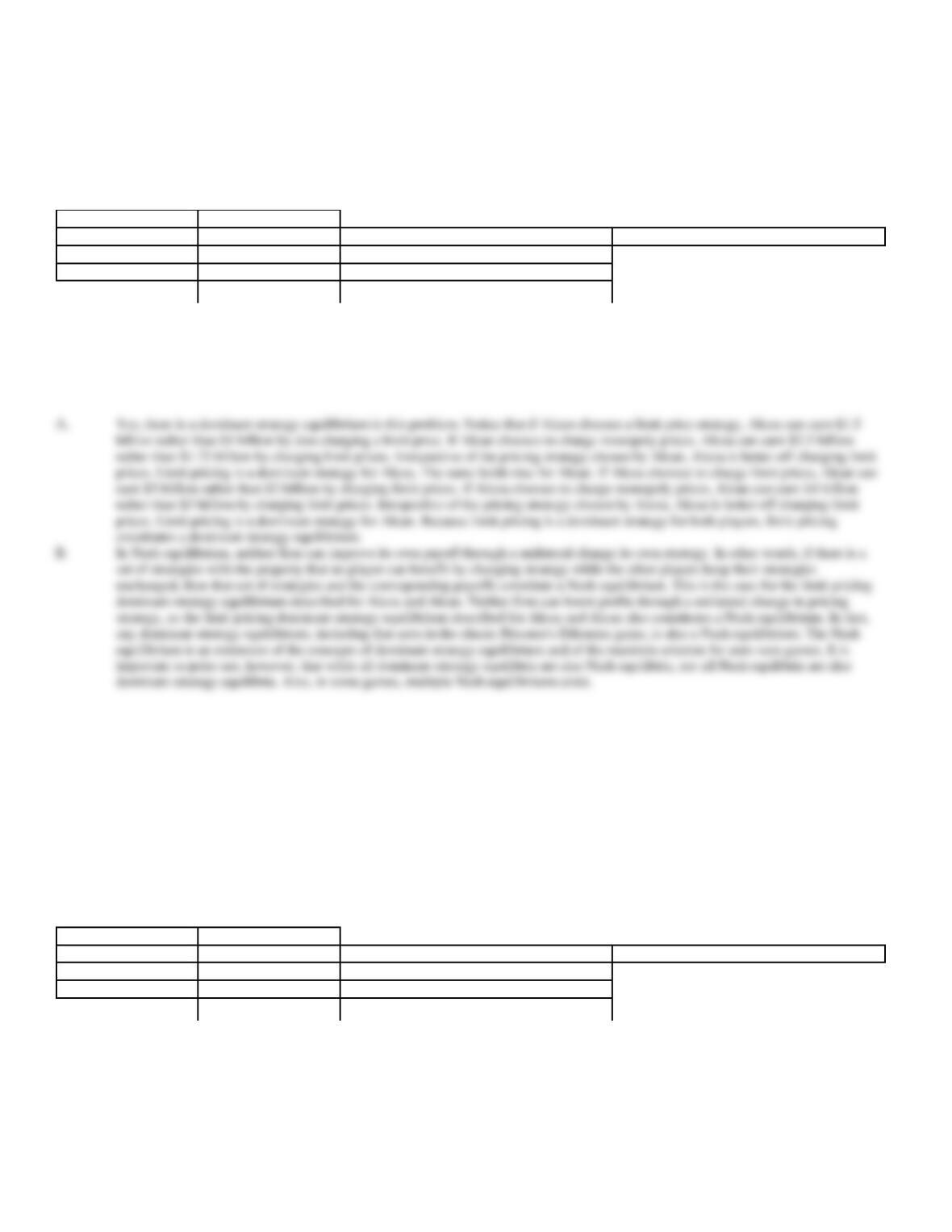
45. Nash Equilibrium. Suppose two competitors, Alcoa, Inc., and Alcan, Inc., are locked in a bitter pricing
struggle in the aluminum industry. In the limit pricing payoff matrix, Alcoa can choose a given row of outcomes
by offering a limit price (“up”) or monopoly price (“down”). Alcan can choose a given column of outcomes by
choosing to offer a limit price (“left”) or monopoly price (“right”). Neither firm can choose which cell of the
payoff matrix to obtain; the payoff for each firm depends upon the pricing strategies of both firms.
Alcan
Alcoa
Pricing Strategy
Limit Price
Monopoly Price
Limit Price
$1.5 billion, $3 billion
$2.5 billion, $2 billion
Monopoly Price
$1 billion, $4 billion
$1.75 billion, $3 billion
A.
Is there a dominant strategy equilibrium in this problem? If so, what is it?
B.
Is there a Nash equilibrium in this problem? If so, what is it?
46. Nash Equilibrium. Assume two competitors, American International Group (AIG), Inc., and Axa, SA., are
locked in a bitter pricing struggle in the reinsurance business. In the pricing payoff matrix, AIG can choose a
given row of outcomes by offering a limit price (“up”) or monopoly price (“down”). Axa can choose a given
column of outcomes by choosing to offer a limit price (“left”) or monopoly price (“right”). Neither firm can
choose which cell of the payoff matrix to obtain; the payoff for each firm depends upon the pricing strategies of
both firms.
Axa
AIG
Pricing Strategy
Limit Price
Monopoly Price
Limit Price
$8 billion, $3 billion
$12 billion, $2 billion
Monopoly Price
$6 billion, $5 billion
$10 billion, $4 billion
A.
Is there a Nash equilibrium in this problem? If so, what is it?
B.
Describe the potential benefits to be derived from collusion. Do you see any obstacles to coordinating such collusion?
constitutes a dominant strategy equilibrium.
dominant-strategy equilibria. Also, in some games, multiple Nash equilibriums exist.
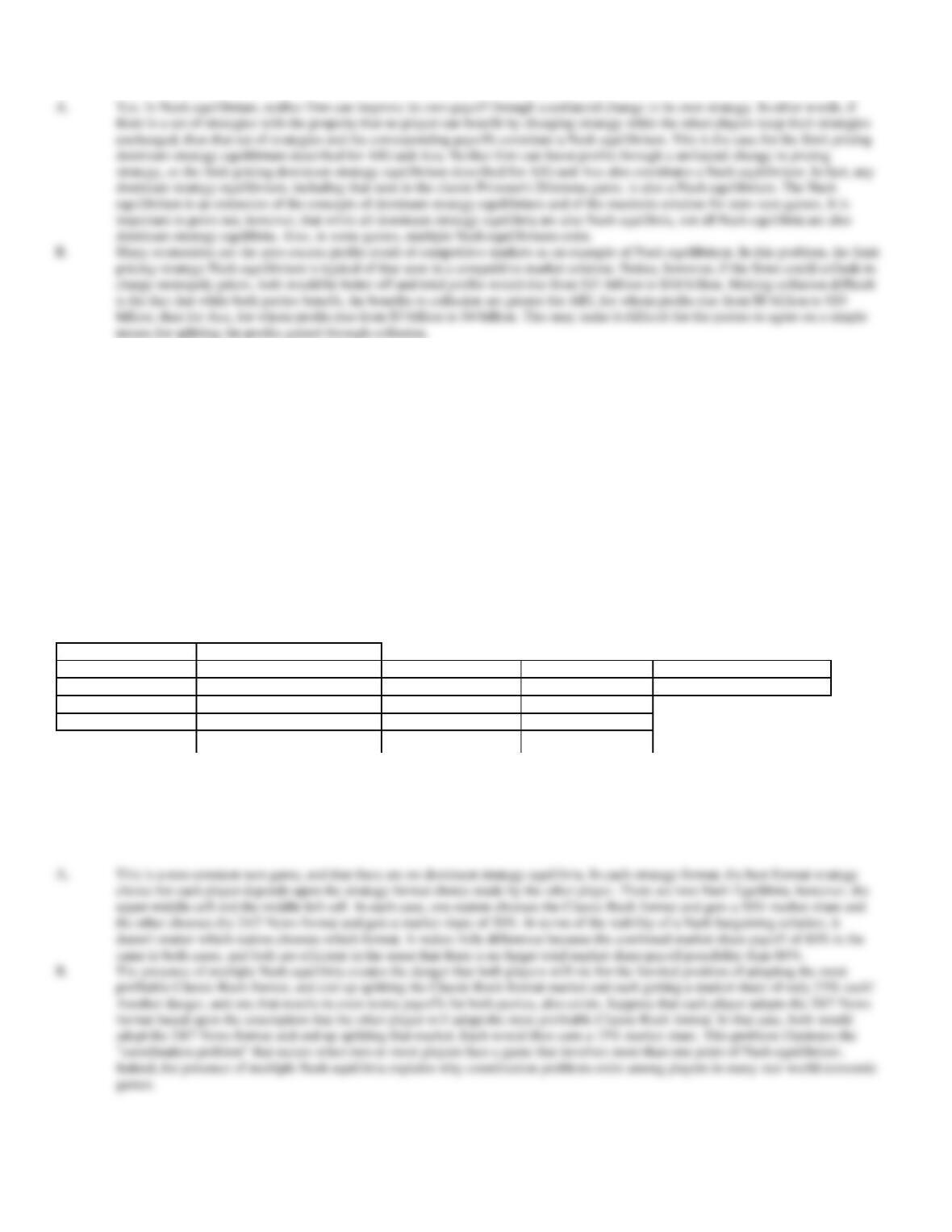
47. Multiple Nash Equilibria. Suppose two Cincinnati-based radio stations, WKRP and KFOX, have decided
to change broadcast formats. Both stations are considering three alternative formats: “Classic Rock,” an
all-news format called “24/7 News,” or a format called “Country Favorites.” The potential audience market
shares for these three formats are Classic Rock (50%), 24/7 News (30%), and Country Favorites (20%). If the
two stations choose the same format, they will split the audience for that format equally. If the two stations
choose different formats, each will get the total potential audience for that format. Assume that audience shares
are proportionate to advertising revenues and profit payoffs, so the audience share numbers can suffice as inputs
to the payoff matrix. The first number in the market share payoff matrix is the market share gained by WKRP;
the second number is the market share payoff to KFOX.
KFOX
Format Strategy
Classic Rock
24/7 News
Country Favorites
WKRP
Classic Rock
25%; 25%
50%; 30%
50%; 20%
24/7 News
30%; 50%
15%; 15%
30%; 20%
Country Favorites
20%; 50%
20%; 30%
10%; 10%
A.
Document the fact that there are multiple Nash equilibria in this problem. Explain your answer.
B.
Does the presence of multiple Nash equilibria pose coordination problems in arriving at a point of Nash equilibrium? Explain.
same in both cases, and both are efficient in the sense that there is no larger total market share payoff possibility than 80%.
games.
dominant-strategy equilibria. Also, in some games, multiple Nash equilibriums exist.
means for splitting the profits gained through collusion.
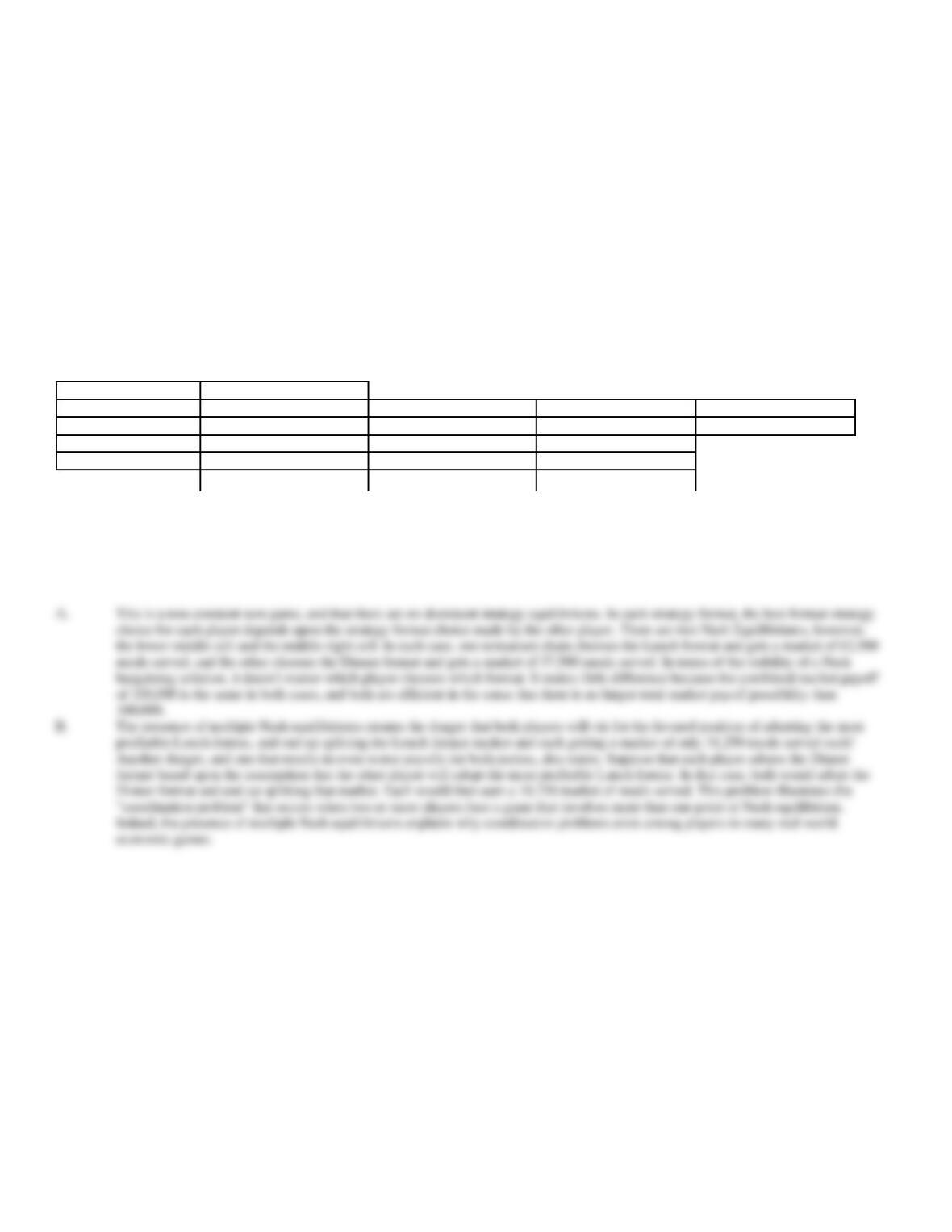
48. Multiple Nash Equilibria. YUM! Brands, Inc., based in Louisville, Kentucky, offers a diverse portfolio of
“family style” restaurant concepts that do not serve alcoholic beverages, including: KFC, Pizza Hut, Taco Bell,
Long John Silver, and A&W All-American Food Restaurants, among others. AFC Enterprises, Inc., based in
Atlanta, Georgia, is a big competitor. AFC offers spicy fried chicken under popular Popeyes Chicken &
Biscuits brand.. Suppose YUM! and AFC are contemplating entry into the rapidly-growing Austin, Texas,
market. Both companies are considering three alternative restaurant formats to focus their efforts on one of
three popular meal times: “Breakfast,” “Lunch,” or “Dinner.” The potential number of meals served per month
for these three restaurant formats are Breakfast (25,000), Lunch (62,500), and Dinner (37,500). If the two
restaurant chains choose the same format, they will split the market for that format equally. If the two restaurant
chains choose different formats, each will get the total potential market for that format. Assume that profit
payoff are proportionate to the number of meals served, so the meals served numbers can suffice as inputs to the
payoff matrix. The first number in the payoff matrix is the number of meals served by YUM! Brands; the
second number is the number of meals served by AFC Enterprises.
AFC Enterprises
Format Strategy
Breakfast
Lunch
Dinner
YUM! Brands
Breakfast
12,500; 12,500
25,000; 62,500
25,000; 37,500
Lunch
62,500; 25,000
31,250; 31,250
62,500; 37,500
Dinner
37,500; 25,000
37,500; 62,500
18,750: 18,750
A.
Document the fact that there are multiple Nash equilibriums in this problem. Explain your answer.
B.
Does the presence of multiple Nash equilibriums pose coordination problems in arriving at a point of Nash equilibrium? Explain.
49. Limit Pricing. Microsoft Corp. maintains an Internet web site called MSN Money with an amazing variety
of investment news and information that the Company makes freely available to anyone with an Internet
connection. MSN Money generates revenue by delivering relevant, cost-effective online advertising to brokers
and other financial service providers.
A.
Describe Microsoft’s policy of offering free investments news and information on the Internet within the context of the limit pricing
concept.
B.
Is Microsoft’s policy of offering free investment news and information on the Internet a good example of limit pricing, predatory
pricing, or market penetration pricing?
of 100,000 is the same in both cases, and both are efficient in the sense that there is no larger total market payoff possibility than
100,000.
Indeed, the presence of multiple Nash equilibriums explains why coordination problems exist among players in many real-world
economic games.
50. End-of-game problem. In mid-2005, former WorldCom Inc. Chief Executive Bernard Ebbers asked a
federal judge for a lighter sentence than the “draconian life sentence” recommended by the government. Ebbers
made the request in a presentencing report that followed his conviction in March of nine counts of fraud,
conspiracy and making false filings with regulators. In a brief filed in the U.S. District Court for the Southern
District of New York, attorneys for Ebbers, who was then 63 years old, cited his good character, age, poor
health and low risk of a repeat offense among the reasons they asked Judge Barbara Jones to give Ebbers a
lighter sentence.
WorldCom, now known as MCI Inc., was at the center of the biggest accounting fraud in U.S. history and filed
for Chapter 11 bankruptcy protection shortly after the $11 billion fraud began to come to light in 2002. It has
since reemerged from bankruptcy protection. Five former executives, including former Chief Financial Officer
Scott Sullivan, plead guilty to fraud-related charges in connection with the scandal.
A.
Explain how incentive problems caused by poorly designed management compensation plans can be a manifestation of the end–of-game
problem.
B.
What methods do you suggest for remedying such problems?
are modestly paid and often face strong temptation to accept bribes or give favors, especially late in their careers. To fight corruption,
many cities require those convicted of corrupt behavior to forfeit all retirement pay and benefits.
several years after retirement. In these and other cases, employers have settled on simple means for solving the end–of-game problem:
simply extend the game!
reasonably maintain that the marginal cost of service is zero.
software companies have taken the market penetration pricing concept to its logical extreme by actually giving away their services.