16) In an effort to address the troubled economy, …”For the ninth time in just over a year, the
Federal Reserve is expected to cut interest rates, quite possibly its last reduction in this
downturn.” Rates have not been this low “… since 2003, when the economy was growing at a
snail’s pace.”
www.csmonitor.com, 10/28/2008
The “interest rates” the Fed is cutting is the ________.
A) reserve interest rate
B) Federal Funds rate
C) nominal long-term interest rate
D) real long-term interest rate
17) In an effort to address the troubled economy, …”For the ninth time in just over a year, the
Federal Reserve is expected to cut interest rates, quite possibly its last reduction in this
downturn.” Rates have not been this low “… since 2003, when the economy was growing at a
snail’s pace.”
www.csmonitor.com, 10/28/2008
The Fed’s rate cuts will ________ bank reserves and ________.
A) increase; increase the money supply and real GDP
B) decrease; decrease the money supply and real GDP
C) increase; increase the exchange rate and real GDP
D) decrease bank reserves; decrease the exchange rate and real GDP
18) In an effort to address the troubled economy, …”For the ninth time in just over a year, the
Federal Reserve is expected to cut interest rates, quite possibly its last reduction in this
downturn.” Rates have not been this low “… since 2003, when the economy was growing at a
snail’s pace.”
www.csmonitor.com, 10/28/2008
The Fed’s rates cuts will initially impact ________ and eventually ________.
A) bank reserves; government spending
B) the money supply; bank reserves
C) bank reserves; real GDP
D) investment; the real interest rate
19) In an effort to address the troubled economy, …”For the ninth time in just over a year, the
Federal Reserve is expected to cut interest rates, quite possibly its last reduction in this
downturn.” Rates have not been this low “… since 2003, when the economy was growing at a
snail’s pace.”
www.csmonitor.com, 10/28/2008
These rate cuts are designed to
A) decrease the real long-term interest rate and increase real GDP.
B) increase the exchange rate and decrease government spending.
C) increase bank reserves and the exchange rate.
D) decrease the exchange rate and investment.
1) Why does the Fed pursue price stability as its ultimate goal?
2) Describe how open market operations change the quantity of money.
3) Does an open market operation in which the Fed buys securities from the general public
decrease or increase the banking system’s reserves?
4) Suppose in the money market the equilibrium interest rate is 5 percent and quantity of money
demanded and supplied are both equal to $2 trillion dollars. If the Fed increases the quantity of
money, what is the effect on the interest rate?
5) Assume the Fed is concerned with a possible recession so it wants to lower the interest rate.
How does the Fed lower the interest rate in the short run?
6) What is the effect of lowering the interest rate on net exports? Explain your answer.
7) List and briefly explain the steps in how monetary policy affects real GDP in the AS/AD
model. Tell what the impact is when the Fed eases monetary policy to fight a recession.
8) Discuss how the Fed raising the federal funds rate ripples through the different sectors of the
economy.
9) Explain the ripple effects of a sale of securities in an open market operation.
10) Suppose the economy is in recession. Write a letter to the brand-new chairman of the Federal
Reserve suggesting how the Fed might help end the recession. Be sure to explain how a change
in monetary policy will affect economic activity.
11) In the aggregate demand/aggregate supply framework, lowering the federal funds rate has
what short-run effects on real GDP?
12) Explain how the Fed’s response to inflation works its way through the economy to ultimately
affecting real GDP and the price level.
13) “When the Fed is concerned with inflation, it buys government securities.” Is the previous
statement correct or incorrect? Explain your answer.
14) If the Fed is concerned about inflation, in the short run what is the proper monetary policy to
restore price stability? What actions can the Fed undertake to restore price stability?
15) When would the Fed want to carry out a monetary policy that decreases aggregate demand?
16) Explain how the Fed’s response to a recession works its way through the economy to
ultimately affecting real GDP and the price level.
17) In the short run, if the Fed wants to fight a recession, should it buy or sell government
securities? Why?
18) When the economy is in recession, does the Fed want to raise the interest rate so as to
increase aggregate demand and increase real GDP? Explain your answer.
1) The core inflation rate is more volatile than the total CPI inflation rate.
2) A positive output gap is an inflationary gap.
3) The President of the United States is also the chairman of the Federal Reserve.
4) The Fed targets the 30-year bond rate as its monetary policy instrument.
5) When the Fed purchases U.S. government securities in the open market, the federal funds
falls.
6) If the Fed carries out an open market operation and sells U.S. government securities, the
federal funds rate falls and the quantity of money increases.
7) If the Fed carries out an open market operation and sells U.S. government securities, the
federal funds rises and the quantity of money decreases.
8) If the federal funds rate is below the Fed target, the Fed will conduct an open market sale to
increase the federal funds rate to the desired level.
9) Long-term interest rates fluctuate more than short-term rates.
10) If the Fed sells bonds in the open market, net exports will increase.
11) If the Fed sells bonds in the open market, net exports will decrease.
12) A decrease in the supply of loanable funds decreases the real interest rate.
13) When the Fed lowers the federal funds rate, it increases reserves and increases the quantity
of deposits and loans created.
14) To decrease inflation, the Federal Reserve would adjust its target for the federal funds rate
upward.
15) If the Fed lowers the federal funds rate, aggregate demand decreases.
16) The less sensitive to the interest rate are consumption expenditure and investment, the
smaller is the shift in the AD curve when the Fed changes the federal funds rate.
17) In the short run, the Fed’s actions to fight inflation shift the aggregate demand curve
leftward.
18) The Taylor Rule maintains that the Fed should set the growth rate of the quantity of money
equal to the growth rate of real GDP.
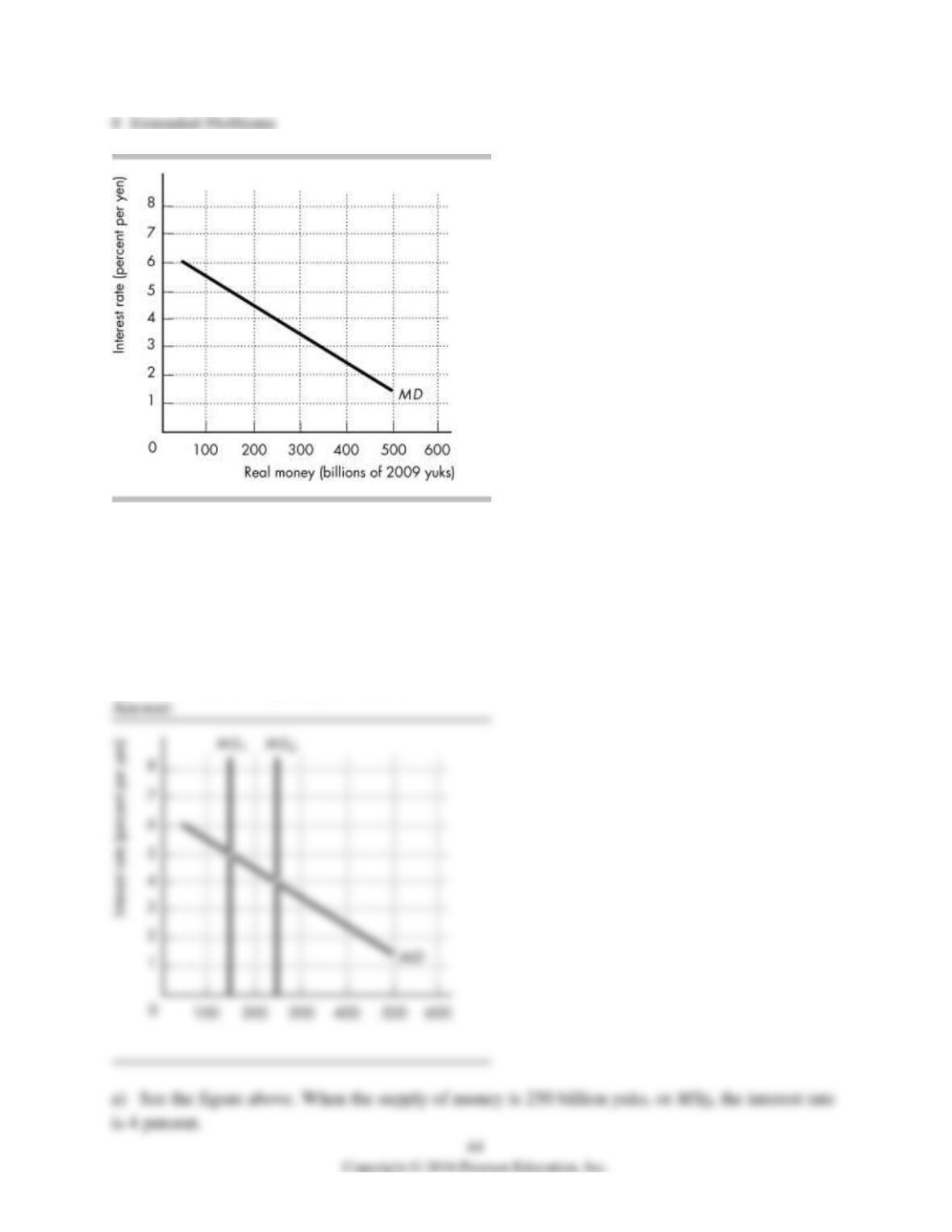
1) The figure above shows the demand for money in Kiteland.
a) If the Kiteland Central Bank has set the quantity of money so that the equilibrium interest
rate is 4 percent, draw the supply of money curve.
b) Suppose that Kiteland’s Central Bank wants to raise the interest rate by 1 percentage point.
By how much must it change the quantity of real money?
c) In order to change the quantity of money to raise the interest rate by one percentage point, if
the Central Bank uses an open market operation, does it make an open market purchase or an
open market sale? Explain your answer.
65
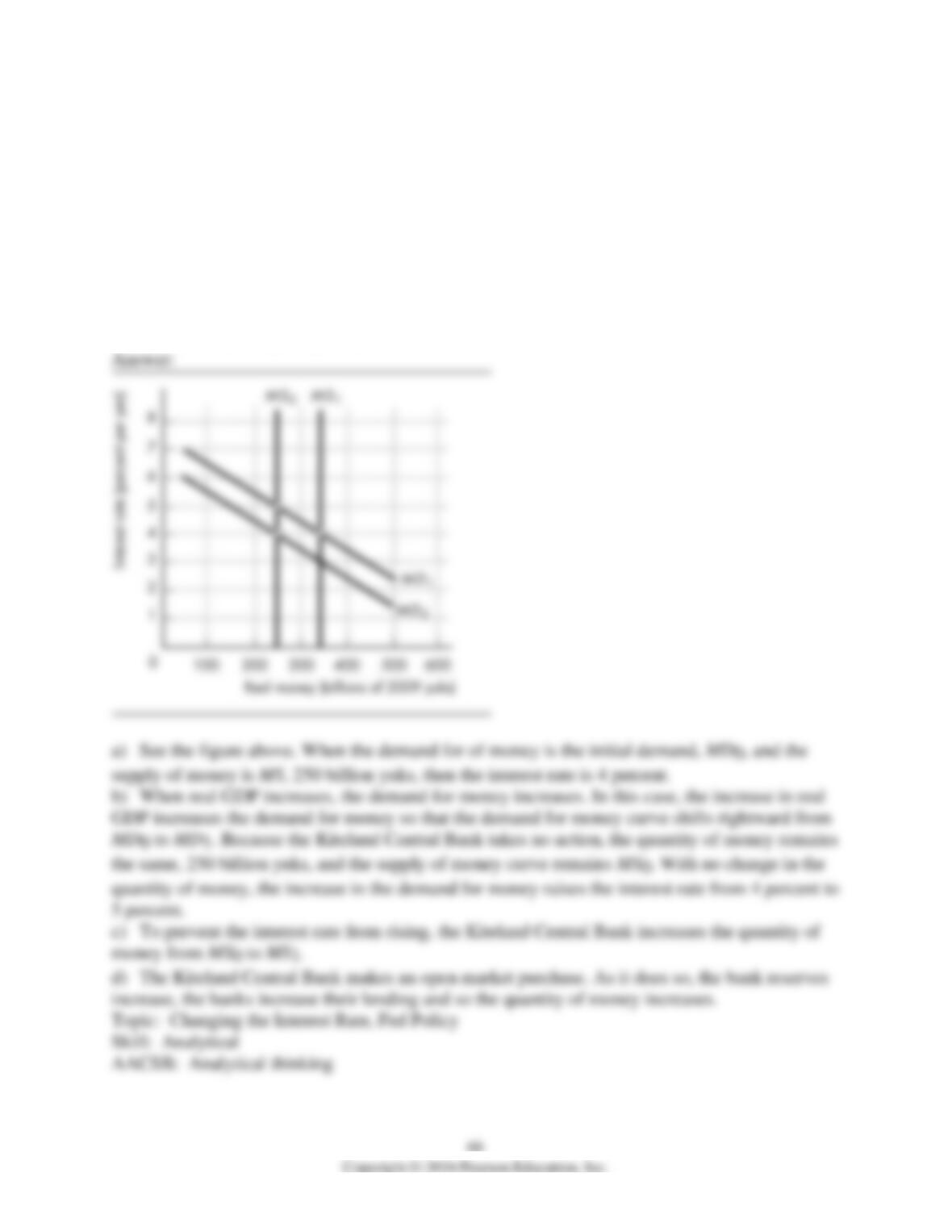
2) The figure above shows the demand for money in Kiteland.
a) If the Kiteland Central Bank has set the quantity of money so that the equilibrium interest
rate is 4 percent, draw the supply of money curve.
b) Suppose Kiteland’s real GDP increases so that the demand for money changes by 100 billion
yaks. The Kiteland Central Bank takes no actions. Show the effects of this event on your figure.
What happens to the interest rate? What happens to the quantity of money in the economy?
c) If the Central Bank wants to prevent the interest rate from changing, what must it do to the
quantity of money? Draw the new supply of money curve.
d) In order to change the quantity of money to keep the interest rate constant, suppose the
Kiteland Central Bank uses open market operations. Does it make an open market purchase or an
open market sale? Explain your answer.
67
3) In the economy of Rulewania, the current inflation rate is 6 percent and the Central Bank’s
target inflation rate is 2 percent. Real GDP exceeds potential GDP by 1 percent, and the long-
term growth rate of real GDP is 5 percent. The medium-term growth rate of the velocity of
circulation of the monetary base is 2 percent. According to the Taylor rule, what federal funds
rate should the Central Bank set?