Macroeconomics 2017 (Hubbard)
Chapter 14 Money, Banks, and the Federal Reserve System
14.1 What Is Money, and Why Do We Need It?
1) Your roommate argues that he can think of no better situation than living in a deflationary economy,
as prices of goods and services would continuously fall. You disagree and argue that during a
deflation, people can be made worse off because
A) the purchasing power of people’s incomes would increase.
B) the purchasing power of the currency would decrease.
C) the value of the real interest rate will drop below the nominal interest rate.
D) borrowers will have to pay increasing amounts in real terms over time.
2) In economics, money is defined as
A) the total value of one’s assets in current prices.
B) the total value of one’s assets minus the total value of one‘s debts, in current prices.
C) the total amount of salary, interest, and rental income earned during a year.
D) any asset people generally accept in exchange for goods and services.
3) Economies where goods and services are traded directly for other goods and services are called
________ economies.
A) trade
B) barter
C) direct
D) seigniorage
4) The major shortcoming of a barter economy is
A) the requirement of a double coincidence of wants.
B) the requirement of specialization and exchange.
C) that goods and services are not traded.
D) that money loses value from inflation.
5) Commodity money
A) has value independent of its use as money.
B) has little to no value independent of its use as money.
C) is backed by a valuable commodity such as gold.
D) can be used to purchase commodities, but not services.
6) Silver is an example of a
A) commodity money.
B) barter money.
C) fiat money.
D) representative money.
7) Soldiers in a World War II prisoner-of-war camp
A) used gold as a fiat money.
B) used cowrie shells as money.
C) used cigarettes as money.
D) used U.S. dollars as a commodity money.
8) Which of the following is one of the most important benefits of money in an economy?
A) Money allows for the exchange of goods and services.
B) Money allows for the accumulation of wealth.
C) Money makes exchange easier, leading to more specialization and higher productivity.
D) Money encourages people to produce all of their own goods (self-sufficiency) and therefore increases
economic stability.
9) In an economy with ________, there are more prices than in an economy with ________.
A) barter; money
B) money; barter
C) fiat money; commodity money
D) fiat money; barter
10) The statement, “My iPhone is worth $300″ represents money’s function as
A) a medium of exchange.
B) a unit of account.
C) a store of value.
D) a standard of deferred payment.
11) Which of the following functions of money would be violated if inflation were high?
A) unit of account
B) store of value
C) certificate of gold
D) medium of exchange
12) Which of the following assets is most liquid?
A) money
B) bond
C) savings account
D) stock
13) If whole tomatoes were money, which of the following functions of money would be the hardest for
tomatoes to satisfy?
A) unit of account
B) store of value
C) certificate of gold
D) medium of exchange
14) People hold money as opposed to financial assets because money
A) earns interest.
B) is perfectly liquid.
C) earns no interest.
D) earns a higher return than other financial assets.
15) Fiat money has
A) little to no intrinsic value but is backed by the quantity of gold held by the central bank.
B) little to no intrinsic value and is authorized by the central bank or governmental body.
C) value, because it can be redeemed for gold by the central bank.
D) a great intrinsic value that is independent of its use as money.
16) Which of the following information about fiat money is false? Fiat money
A) is backed by gold.
B) serves as a medium of exchange.
C) has little to no value except as money.
D) is authorized by a central bank or governmental body.
17) Which of the following statements regarding the use of gold as money is false?
A) It has standardized quality.
B) It is durable.
C) It has value other than money.
D) It is acceptable to traders.
18) Dollar bills in the modern economy serve as money because
A) they are backed by the gold stored in Fort Knox.
B) they can be redeemed for gold by the central bank.
C) they have value as a commodity independent of their use as money.
D) people have confidence that others will accept them as money.
19) According to the U.S. Treasury,
A) the government will not accept cash in payment of taxes.
B) creditors do not have to accept cash in payment of debts.
C) firms do not have to accept cash as payment for goods and services.
D) U.S. dollars must be accepted as payment for any good or service sold in the United States.
20) Following the 2007-2009 financial crisis, many people feared that Greece might leave the euro and
resume using the drachma. If that happened, the drachma might be worth less than the euro. When
using fiat money like the drachma, the key to acceptance is that households and firms have confidence
that if they accept drachma in exchange for goods and services, the drachma will not lose much value
during the time they hold them. If sellers were not willing to accept the drachma in exchange for goods
and services, the drachma would not serve as
A) a unit of account.
B) fiat money.
C) legal tender.
D) a medium of exchange.
21) Money is
A) an asset that people are willing to accept in exchange for goods and services.
B) a liability that people are willing to accept in exchange for goods and services.
C) the income one earns over a period of time.
D) one’s assets net of one’s liabilities at any point in time.
22) A barter economy is an economy where
A) goods and services are exchanged for money.
B) money is exchanged for goods and services.
C) goods and services are exchanged for other goods and services.
D) goods and services are exchanged for liabilities.
23) A major source of inefficiency in barter economies is that they require
A) a standard of deferred payment to make trade possible.
B) a double coincidence of wants in exchange.
C) more liquid stores of value than do monetary economies.
D) All of the above are correct.
24) Commodity money is a good
A) used as money that has no secondary use.
B) that is designated as money by law.
C) used as money that also has value independent of its use as money.
D) used as money that has no intrinsic value.
25) By making exchange ________, money allows for ________ and higher ________.
A) harder; specialization; costs
B) easier; specialization; productivity
C) harder; generalization; productivity
D) easier; specialization; costs
26) Which of the following is a function that money serves?
A) medium of exchange
B) unit of account
C) store of value
D) All of the above are correct.
27) During World War II, prisoners of war used ________ as money.
A) bullets
B) cowrie shells
C) chocolate
D) cigarettes
28) When a grocery store accepts your $5 bill in exchange for bread and milk, the $5 bill serves as a
A) medium of exchange.
B) unit of account.
C) store of value.
D) standard of deferred payment.
29) The statement “This Dell laptop costs $1,200″ illustrates which function of money?
A) medium of exchange
B) unit of account
C) store of value
D) standard of deferred payment
30) A farm worker gets paid today in money, but plans to spend the money next week. This illustrates
which function of money?
A) medium of exchange
B) unit of account
C) store of value
D) standard of deferred payment
31) Which of the following is the most liquid asset?
A) a Renoir painting
B) bonds
C) a car
D) money
32) Liquidity is defined as
A) the ease with which a given asset can be converted to a store of value.
B) the ease with which a given asset can be converted to a unit of account.
C) the ease with which a given asset can be converted to a medium of exchange.
D) the ease with which a given asset can be converted to a standard of deferred payment.
33) Among potential stores of value, money
A) offers the highest rate of return.
B) increases in value during periods of inflation.
C) has the advantage of being the most liquid asset.
D) provides more services than the other assets.
34) A car dealer sells you a car today in exchange for money in the future. This illustrates which
function of money?
A) medium of exchange
B) unit of account
C) store of value
D) standard of deferred payment
35) Which is not one of the criteria necessary for a commodity to make a suitable medium of exchange?
A) It should be durable.
B) It should be of standardized quality.
C) It should be valuable relative to its weight.
D) It should have intrinsic value.
36) Gold is an example of
A) commodity money.
B) fiat money.
C) barter money.
D) M1.
37) Which of the following criteria would make gold a poor medium of exchange?
A) Its value depends on its purity, and its purity is not easy to visibly identify.
B) durability so that value is not lost by spoilage
C) value relative to its weight so that amounts large enough to be useful in trade can be easily
transported
D) divisibility because different goods are valued differently
38) Paper currency is a
A) commodity money.
B) fiat money.
C) barter money.
D) bond.
39) Fiat money
A) has no or very little value except as money.
B) is rarely used in modern economies.
C) functions well only if can be redeemed for gold or other precious metals.
D) serves well as a medium of exchange, but not as a store of value.
40) Fiat money is generally issued by
A) private banks.
B) central banks.
C) brokerage firms.
D) major multinational corporations.
41) A good can serve as money only if
A) government mandates that the good must be accepted in payment of debts.
B) it is declared by authorities to be legal tender.
C) it has intrinsic value or if it is backed by precious metals.
D) citizens accept the good as a means of payment for transactions and debts.
42) Because Federal Reserve Notes (paper currency) are legal tender,
A) U.S. workers must accept them as payment for labor services.
B) U.S. creditors must accept them in payment of debts.
C) U.S. firms must accept them as payment for goods and services.
D) All of he above are correct.
43) Economies cannot function without money.
44) If gold is used as money in an economy, the money supply is easy to control.
45) Money will fail to serve as a medium of exchange if it ceases to be a store of value.
46) An economy without money would have no exchanges of goods and services.
47) In an economy with money, as opposed to barter, people are more likely to specialize in the
production of goods and services.
48) The supply of money is easier to control with commodity money than it is with fiat money.
49) Would the use of money, as opposed to barter, increase the growth rate of real GDP in a country
over time? Why or why not?
50) What are the four functions of money? Can something be considered money if it does not fulfill all
four functions?
51) Using the five criteria in the book, explain how U.S. currency is suitable to use as a medium of
exchange.
52) Money cannot serve as a medium of exchange unless it also serves as a store of value. Is this
statement true or false? Explain.
53) Although gold is highly valued by most people, it is difficult to use as a medium of exchange.
Explain.
14.2 How Is Money Measured in the United States Today?
1) The most liquid measure of money supply is
A) M0.
B) M1.
C) M2.
D) M3.
2) The M1 measure of the money supply equals
A) paper money plus coins in circulation.
B) currency plus checking account balances.
C) currency plus checking account balances plus traveler’s checks.
D) currency plus checking account balances plus traveler’s checks plus savings account balances.
3) The Federal Reserve’s narrowest definition of the money supply is
A) M0.
B) M1.
C) M2.
D) M3.
4) The largest proportion of M1 is made up of
A) currency.
B) checking account deposits.
C) traveler’s checks.
D) savings account deposits.
E) time deposits.
5) Economists estimate that ________ of U.S. currency is outside the United States and held primarily by
________.
A) over half; households and firms in countries where there is little confidence in the local currency
B) over half; foreign banks and foreign governments
C) less than one quarter; households and firms in countries where there is little confidence in the local
currency
D) less than one quarter; foreign banks and foreign governments
6) Which of the following is not counted in M1?
A) checking account balances
B) credit card balances
C) coins in circulation
D) currency in circulation
E) traveler’s check balances
7) If the Federal Reserve decided to include virtual money like Bitcoins in its measure of the money
supply, what would be the effect on M1 or M2?
A) M1 would rise.
B) M1 would fall.
C) M1 would rise and M2 would remain constant.
D) M2 would rise but M1 would remain constant.
8) Money’s most narrow definition is based on its function as a
A) store of value.
B) unit of account.
C) standard of deferred payment.
D) medium of exchange.
E) standard of barter.
9) The M2 measure of the money supply equals
A) savings account balances plus small-denomination time deposits plus traveler’s checks.
B) savings account balances plus small-denomination time deposits plus noninstitutional money market
fund shares.
C) M1 plus savings account balances plus small-denomination time deposits.
D) M1 plus savings account balances plus small-denomination time deposits plus noninstitutional
money market fund shares.
10) You earn $500 a month, currently have $200 in currency, $100 in your checking account, $2,000 in
your savings accounts, $3,000 worth of illiquid assets and $1,000 of debt. You have
A) money = $2,300, annual income = $6,000, and wealth = $5,000.
B) money = $300, annual income = $6,000, and wealth = $4,300.
C) money = $200, annual income = $500, and wealth = $4,300.
D) money = $300, annual income = $6,000, and wealth = $5,000.
11) If a person withdraws $500 from his/her savings account and puts it in his/her checking account,
then M1 will ________ and M2 will ________.
A) increase; decrease
B) increase; not change
C) not change; increase
D) not change; decrease
E) not change; not change
12) If a person withdraws $500 from his/her checking account and holds it as currency, then M1 will
________ and M2 will ________.
A) increase; decrease
B) not change; not change
C) not change; increase
D) decrease; increase
E) decrease: decrease
13) If a person takes $100 from his/her piggy bank at home and puts it in his/her savings account, then
M1 will ________ and M2 will ________.
A) increase; increase
B) not change; increase
C) decrease; increase
D) decrease; not change
E) increase; decrease
14) If credit card balances rise in the economy, then M1 will ________ and M2 will ________.
A) increase; increase
B) not change; increase
C) decrease; increase
D) not change; not change
E) increase; decrease
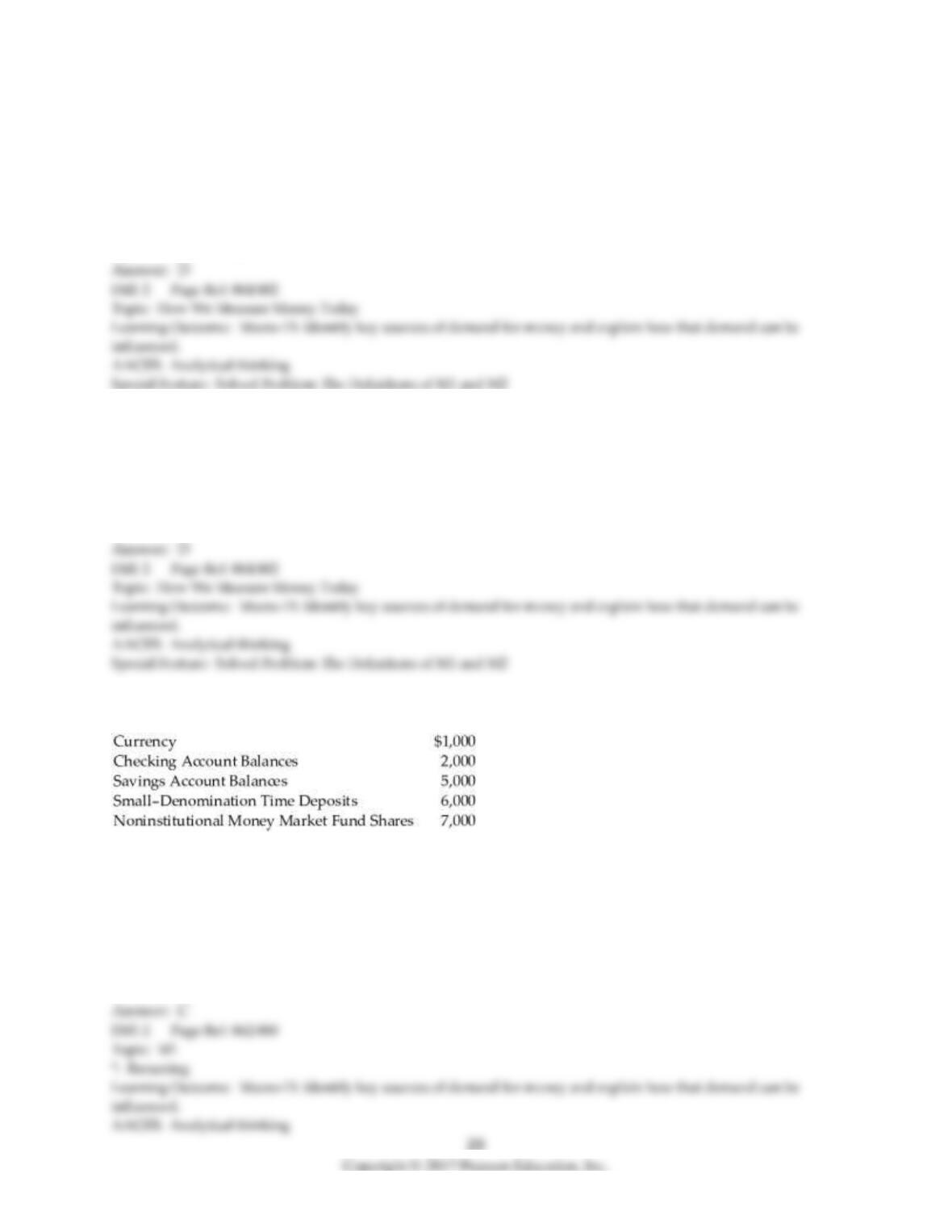
Scenario 14-1
Consider the information above for a simple economy. Assume there are no traveler’s checks.
15) Refer to Scenario 14-1. M1 in this simple economy equals
A) $1,000.
B) $2,000.
C) $3,000.
D) $8,000.