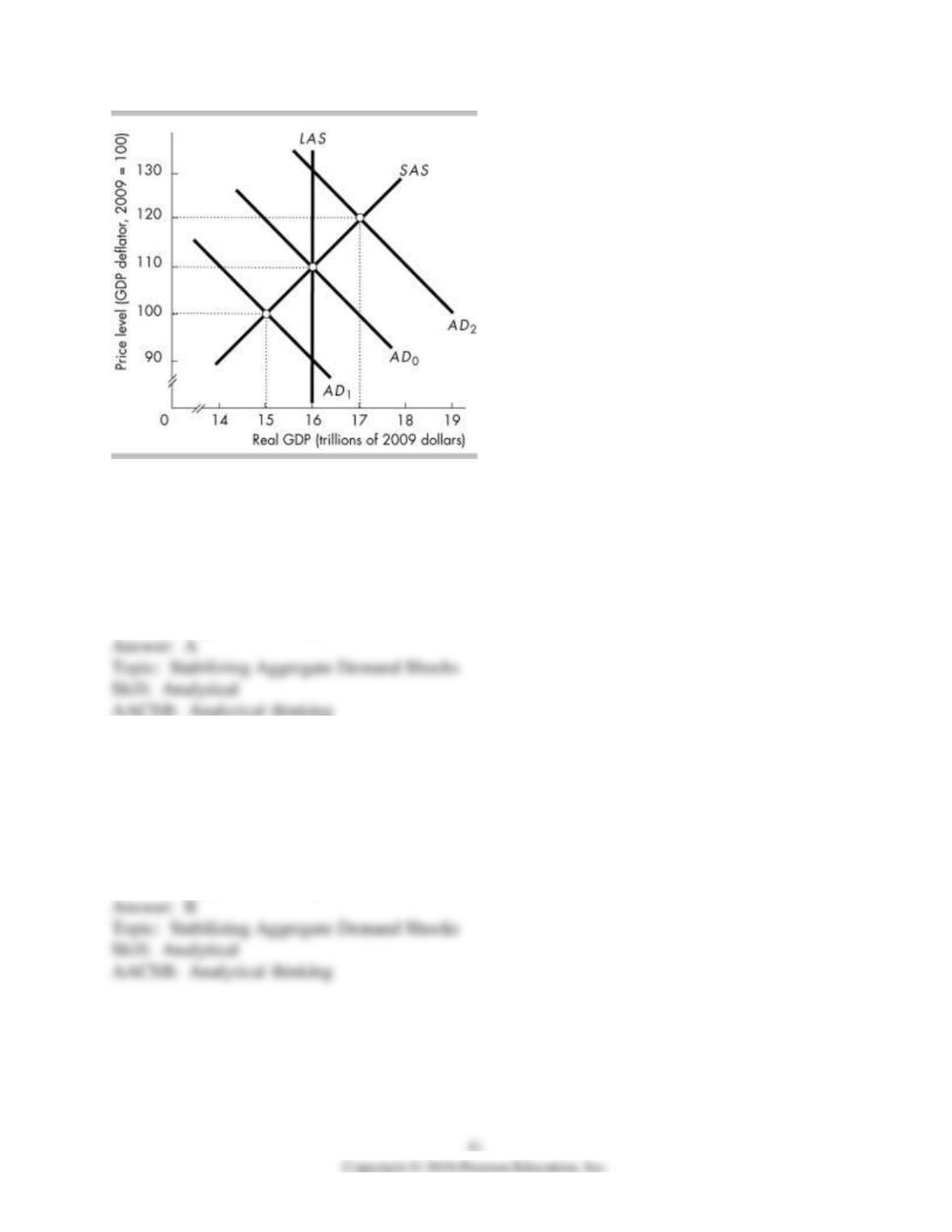
86) In the above figure, the economy experiences a decrease in aggregate demand so that the
aggregate demand curve shifts from AD0 to AD1. If the Fed wants to offset this change, it would
________.
A) purchase government securities on the open market
B) sell government securities on the open market
C) lower taxes
D) increase government expenditures
87) In the above figure, the economy experiences an increase in aggregate demand so that the
aggregate demand curve shifts from AD0 to AD2. If the Fed wants to offset this change, it would
________.
A) purchase government securities on the open market
B) sell government securities on the open market
C) raise taxes
D) increase government expenditures
88) Suppose that initially real GDP equals potential GDP. Then an increase in aggregate demand
occurs. According to the Taylor rule, the Fed should ________ the federal funds rate by
________ government securities in the open market.
A) raise; selling
B) lower; selling
C) raise; buying
D) lower; buying
89) Suppose that initially real GDP equals potential GDP. Then a decrease in aggregate demand
occurs. According to the Taylor rule, the Fed should ________ the federal funds rate by
________ government securities in the open market.
A) raise; selling
B) lower; selling
C) raise; buying
D) lower; buying
90) Which of the following is a problem in pursuing monetary policy?
A) The lag between a change in the quantity of money and its effect on economic activity is too
short.
B) Monetary policy must be approved by the Congress.
C) The Fed cannot control the federal funds rate.
D) None of the above answers is correct.
91) One problem with the ripple effect from the Fed’s monetary policy is
A) the fact that the monetary policy transmission process is long and drawn out.
B) that changing the Federal funds target rate seldom has an effect on the markets for reserves
and loanable funds.
C) the tight relationship between that the Federal funds rate has to aggregate spending.
D) the frequent misalignment of the spread between the Federal funds rate and the Federal funds
rate target.
92) In the short run, the Fed’s actions to fight an inflationary gap shift the
A) aggregate demand curve rightward.
B) aggregate demand curve leftward.
C) short-run aggregate supply curve rightward.
D) short-run aggregate supply curve leftward.
93) In the short run, a rise in the federal funds rate shifts the
A) AD curve leftward.
B) SAS curve leftward.
C) LAS curve leftward.
D) None of the above because a decrease in the quantity of money does not shift a curve.
94) The Fed’s actions to fight an inflation shift the
A) aggregate demand curve rightward.
B) aggregate demand curve leftward.
C) long-run aggregate supply curve rightward.
D) long-run aggregate supply curve leftward.
95) In the short run, a rise in the federal funds rate ________ the price level and ________ real
GDP.
A) lowers; decreases
B) lowers; does not change
C) lowers; increases
D) does not change; increases
96) Businesses become convinced that future profits from investment will be less than initially
believed. This conviction leads to a change in aggregate ________ and so the Fed should
________ the federal funds rate if it wants to try to offset this change.
A) demand; raise
B) demand; lower
C) supply; raise
D) supply; lower
97) A rise in the federal funds rate
A) raises the long-term real interest rate.
B) does not change the long-term real interest rate.
C) lowers the long-term real interest rate.
D) may raise or lower the long-term real interest rate, depending on whether the demand for
4 Extraordinary Monetary Stimulus
1) A widespread fall in asset prices means that banks might become
A) insolvent.
B) solvent.
C) illiquid.
D) too liquid.
2) During the financial crisis of 2008-2009, the Fed was concerned about
A) the bubble that was forcing asset prices higher.
B) the public’s rush to deposit its currency into banks.
C) keeping the federal funds rate from falling too far.
D) providing the banking system with enough liquidity.
3) During the financial crisis of 2008-2009, the Fed’s actions to supply reserves to the banking
system was an attempt to
A) limit the troubling rise in asset prices.
B) increase the public’s belief that their deposits were insured.
C) help the U.S. Treasury finance the TARP.
D) make certain that banks had enough liquidity to avoid collapse.
4) Uncertainty about monetary policy
A) was the factor that started the financial crisis in 2008.
B) can keep investment low.
C) is why the Fed does not use inflation rate targeting.
D) makes deposits in banks more desirable because they become safer.
5) In September 2012 the Fed announced that because of weak labor market conditions, it would
________ $40 billion of mortgage backed securities per month. Critics of the action said that
banks have ________ excessive reserves so the action would be futile.
A) sell; huge amounts of
B) buy; huge amounts of
C) buy; very little
D) sell; very little
6) In September 2012 the Fed announced that it would buy $40 billion of mortgage backed
securities per month. One goal of this policy was to ________ the price of these securities and
thereby help ________.
A) raise; prices of housing to fall to their new equilibrium
B) raise; lower long-term interest rates
C) lower; make the short-term interest rate more responsive to Fed actions
D) raise; raise long-term interest rates
7) The Taylor rule
A) focuses on only fluctuations in real GDP.
B) ignores price level stability to focus on responding to fluctuations in real GDP.
C) is the rule actually followed by the Fed.
D) shows how the Fed could set the federal funds rate.
8) The Taylor Rule states that the
A) Fed should target the monetary base and not the federal funds rate.
B) use of an exchange rate target, although costly, is economically efficient.
C) Fed should adjust the federal funds rate to take account of the deviations of the inflation rate
from its target and real GDP from potential GDP.
D) None of the above is correct.
9) The Taylor rule uses three variables to determine the target for the federal funds rate. Which
of the following is NOT one of those variables?
A) monetary base
B) equilibrium real interest rate
C) inflation rate
D) output gap
10) If the Fed follows the Taylor rule and the economy goes into a recession, the Fed would
A) lower the federal funds rate.
B) reduce tax rates.
C) increase government expenditures.
D) None of the above answers are correct.
11) Suppose that the equilibrium real interest rate is 2 percent per year, inflation is 2.5 percent
and the output gap is 1 percent. Using the Taylor rule, what is the federal funds rate?
A) 3 percent
B) 3.5 percent
C) 5.25 percent
D) 5.5 percent
12) Suppose that the inflation rate is 3 percent and the output gap is -1 percent. Assuming that
the equilibrium real interest rate is 2 percent, what target should the Fed set for the federal funds
rate, if the Taylor rule is used?
A) 5 percent
B) 6 percent
C) 4 percent
D) 1 percent
13) An inflation rate targeting rule
A) reduces uncertainty about monetary policy.
B) will not work if the Fed continues to sue open market operations.
C) has been adopted the by the Fed in response to the financial crisis of 2008-2009.
D) means that the inflation rate must exceed 5 percent in order for the rule to be effective.
5 News Based Questions
1) The People’s Bank of China announced that it was lowering by 1.08 percentage points the
one-year lending rate in response to the slowdown in the Chinese economy. This rate is the
Chinese equivalent of the federal funds rate in the United States.
www.nytimes.com, 11/26/2008
This policy ________ the supply of loanable funds. As a result, the long-term real interest rate
________, and planned expenditures ________.
A) increases; increases; increase
B) decreases; decreases; decrease
C) increases; decreases; increase
D) decreases; increases; increase
2) The People’s Bank of China announced that it was lowering by 1.08 percentage points the
one-year lending rate in response to the slowdown in the Chinese economy. This rate is the
Chinese equivalent of the federal funds rate in the United States.
www.nytimes.com, 11/26/2008
Other things remaining the same, there will be ________ in the exchange rate, ________ in
imports and ________ in exports.
A) a decrease; a decrease; an increase
B) a decrease; an increase; a decrease
C) an increase; a decrease; an increase
D) an increase; an increase; a decrease
3) The People’s Bank of China announced that it was lowering by 1.08 percentage points the
one-year lending rate in response to the slowdown in the Chinese economy. This rate is the
Chinese equivalent of the federal funds rate in the United States.
www.nytimes.com, 11/26/2008
Other things remaining the same, which of the following components will decrease in response
to the bank’s actions?
I. exchange rate
II. interest rate
III. investment
A) I and II only
B) I, II and III
C) II and III only
D) II only
4) In October 2008, central banks around the world coordinated a decrease in interest rates. Ben
Bernanke, then Chairman of the Federal Reserve, stated that “policy makers will remain in close
contact, monitor developments closely and stand ready to take additional steps should conditions
warrant.”
If all the banks enacted the policy simultaneously, the U.S. interest rate differential would
________ and so the U.S. exchange rate would ________.
A) increase; fall
B) decrease; rise
C) not change; not change
D) not change; rise
5) In October 2008, central banks around the world coordinated a decrease in interest rates. Ben
Bernanke, then Chairman of the Federal Reserve, stated that “policy makers will remain in close
contact, monitor developments closely and stand ready to take additional steps should conditions
warrant.”
If all the banks enacted the policy simultaneously, which of the following expenditure
components would increase in the United States?
I. exports
II. consumption
III. investment
A) I, II and III
B) II and III only
C) II only
D) I and III only
6) In November 2008, the Reserve Bank of India (RBI) lowered its “repo” rate, the rate at which
it lends to banks, from 8 percent to 7.5 percent. Only two weeks earlier, it had lowered the rate
from 9 percent to 8 percent.
The Economist, 11/6/2008
The Reserve Bank of India is lowering its rates to fight
A) inflation.
B) recession.
C) rising net exports.
D) a decrease in money demand.
7) In November 2008, the Reserve Bank of India (RBI) lowered its “repo” rate, the rate at which
it lends to banks, from 8 percent to 7.5 percent. Only two weeks earlier, it had lowered the rate
from 9 percent to 8 percent.
The Economist, 11/6/2008
In its attempt to change real GDP, which of following sequences CORRECTLY describes the
transmission of RBI’s monetary policy?
I. The real interest rate falls.
II. The money supply increases.
III. Bank reserves increase.
IV. Supply of loanable funds increases.
V. Aggregate demand increases.
A) III, II, IV, I,V
B) II, I, III, V, IV
C) V, I, II, IV, III
D) III, IV, I, III, V
8) “As the Fed Chases Inflation, Critics Shout, ‘Faster!'”
“For weeks, the Fed has broadcast its intention to raise interest rates glacially.” The Fed was
moving slowly, according to an economist because “…the declining price of oil, economic
fundamentals, including productivity and global competition, will keep inflation in check.” The
Fed, recognizing that the economy was improving stated it planned to “respond to changes in
economic prospects as needed to fulfill its obligation to maintain price stability.” Other
economists disagree with the Fed’s restrained policy as a “mistake.”
www.nytimes, 7/1/2004
By increasing the federal funds target, the Fed will ________ reserves and ________ the
quantity of money.
A) increase; increase
B) decrease; decrease
C) decrease; increase
D) increase; decrease
9) “As the Fed Chases Inflation, Critics Shout, ‘Faster!'”
“For weeks, the Fed has broadcast its intention to raise interest rates glacially.” The Fed was
moving slowly, according to an economist because “…the declining price of oil, economic
fundamentals, including productivity and global competition, will keep inflation in check.” The
Fed, recognizing that the economy was improving stated it planned to “respond to changes in
economic prospects as needed to fulfill its obligation to maintain price stability.” Other
economists disagree with the Fed’s restrained policy as a “mistake.”
www.nytimes, 7/1/2004
Economists estimate that if the Fed’s policy was enacted in July 2004, the impact on the
economy
A) will occur to its fullest extent within one month.
B) can be expected to stretch over one to two years.
C) will not be evident in the exchange rate market until 2005.
D) will reach its fullest extent, affecting real GDP, in three to six months.
10) “As the Fed Chases Inflation, Critics Shout, ‘Faster!'”
“For weeks, the Fed has broadcast its intention to raise interest rates glacially.” The Fed was
moving slowly, according to an economist because “…the declining price of oil, economic
fundamentals, including productivity and global competition, will keep inflation in check.” The
Fed, recognizing that the economy was improving stated it planned to “respond to changes in
economic prospects as needed to fulfill its obligation to maintain price stability.” Other
economists disagree with the Fed’s restrained policy as a “mistake.”
www.nytimes, 7/1/2004
The Fed’s policy will ________ the quantity of money and ________ the supply of loanable
funds.
A) decrease; decrease
B) increase; decrease
C) decrease; increase
D) increase; increase
11) “As the Fed Chases Inflation, Critics Shout, ‘Faster!'”
“For weeks, the Fed has broadcast its intention to raise interest rates glacially.” The Fed was
moving slowly, according to an economist because “…the declining price of oil, economic
fundamentals, including productivity and global competition, will keep inflation in check.” The
Fed, recognizing that the economy was improving stated it planned to “respond to changes in
economic prospects as needed to fulfill its obligation to maintain price stability.” Other
economists disagree with the Fed’s restrained policy as a “mistake.”
www.nytimes, 7/1/2004
As a result of the Fed’s policy, which of the rates will increase?
A) the long-term interest rate
B) the short-term interest rate
C) the exchange rate
D) All of the above answers are correct.
12) “As the Fed Chases Inflation, Critics Shout, ‘Faster!'”
“For weeks, the Fed has broadcast its intention to raise interest rates glacially.” The Fed was
moving slowly, according to an economist because “…the declining price of oil, economic
fundamentals, including productivity and global competition, will keep inflation in check.” The
Fed, recognizing that the economy was improving stated it planned to “respond to changes in
economic prospects as needed to fulfill its obligation to maintain price stability.” Other
economists disagree with the Fed’s restrained policy as a “mistake.”
www.nytimes, 7/1/2004
The goal of the Fed’s policy in 2004 was to decrease
A) the exchange rate
B) consumption expenditure
C) the long-term interest rate
D) the short-term interest rate
13) In December, the Bank of England reduced interest rates by another 50 basis points (a basis
point is 0.01 percentage point) after it had cut them by 150 basis points in November. But the
rate cut may even be larger. Economists “… expect the Monetary Policy Committee [MPC] to cut
rates to 2.5 percent,”…while others “…saw a bigger 75 point cut”…or “a 100 basis point move.”
Reuters, 11/27/2008
In order to ________, the Bank of England’s rate cut must ________.
A) decrease consumption; increase the long-run interest rate
B) increase real GDP; decrease the nominal long-run interest rate
C) decrease real GDP; increase the real long-run interest rate
D) increase consumption; decrease the real long-run interest rate
14) In December, the Bank of England reduced interest rates by another 50 basis points after
points (a basis point is 0.01 percentage point) it had cut them by 150 basis points in November.
But the rate cut may even be larger. Economists “… expect the Monetary Policy Committee
[MPC] to cut rates to 2.5 percent,”…while others “…saw a bigger 75 point cut”…or “a 100 basis
point move.” Data show that “… inflation staged its biggest drop since records began
…potentially opening the door to even bigger cuts.”
Reuters, 11/27/2008
If the Bank’s policies given above can ________ the real long-term interest rate,the Bank will be
able to ________.
A) lower; decrease investment
B) lower; increase aggregate demand
C) raise; increase short-run aggregate supply
D) lower; raise the exchange rate
15) “The Bank of Israel lowered its benchmark lending rate by half a percentage point, the fourth
cut in seven weeks, as the global financial turmoil slows economic growth and inflation
expectations ease.”
www.bloomberg.com 11/24/2008
The Bank of Israel’s actions ________ bank reserves and have the goal of ________
consumption.
A) decrease; decreasing
B) increase; decreasing
C) increase; increasing
D) decrease; increasing