Macroeconomics, 7e (Abel/Bernanke/Croushore)
Chapter 14 Monetary Policy and the Federal Reserve System
14.1 Principles of Money Supply Determination
1) Which of the following are depository institutions?
A) The Federal Reserve Banks of New York and Chicago
B) The U.S. Treasury and the IRS
C) Banks and thrifts
D) Investment banks and finance companies
2) The monetary base is defined as
A) bank reserves plus currency held by the nonbank public.
B) bank reserves minus vault cash.
C) all deposits at the Fed.
D) deposits at the Fed plus vault cash.
3) High-powered money consists of
A) bank reserves plus currency held by the nonbank public.
B) bank reserves minus vault cash.
C) all deposits at the Fed.
D) deposits at the Fed plus vault cash.
4) Vault cash is equal to $2 million, deposits by depository institutions at the central bank are $1
million, the monetary base is $15 million, and bank deposits are $35 million. Currency held by
the nonbank public is
A) $3 million.
B) $12 million.
C) $15 million.
D) $20 million.
5) Vault cash is equal to $2 million, deposits by depository institutions at the central bank are $1
million, the monetary base is $15 million, and bank deposits are $30 million. Bank reserves are
equal to
A) $2 million.
B) $3 million.
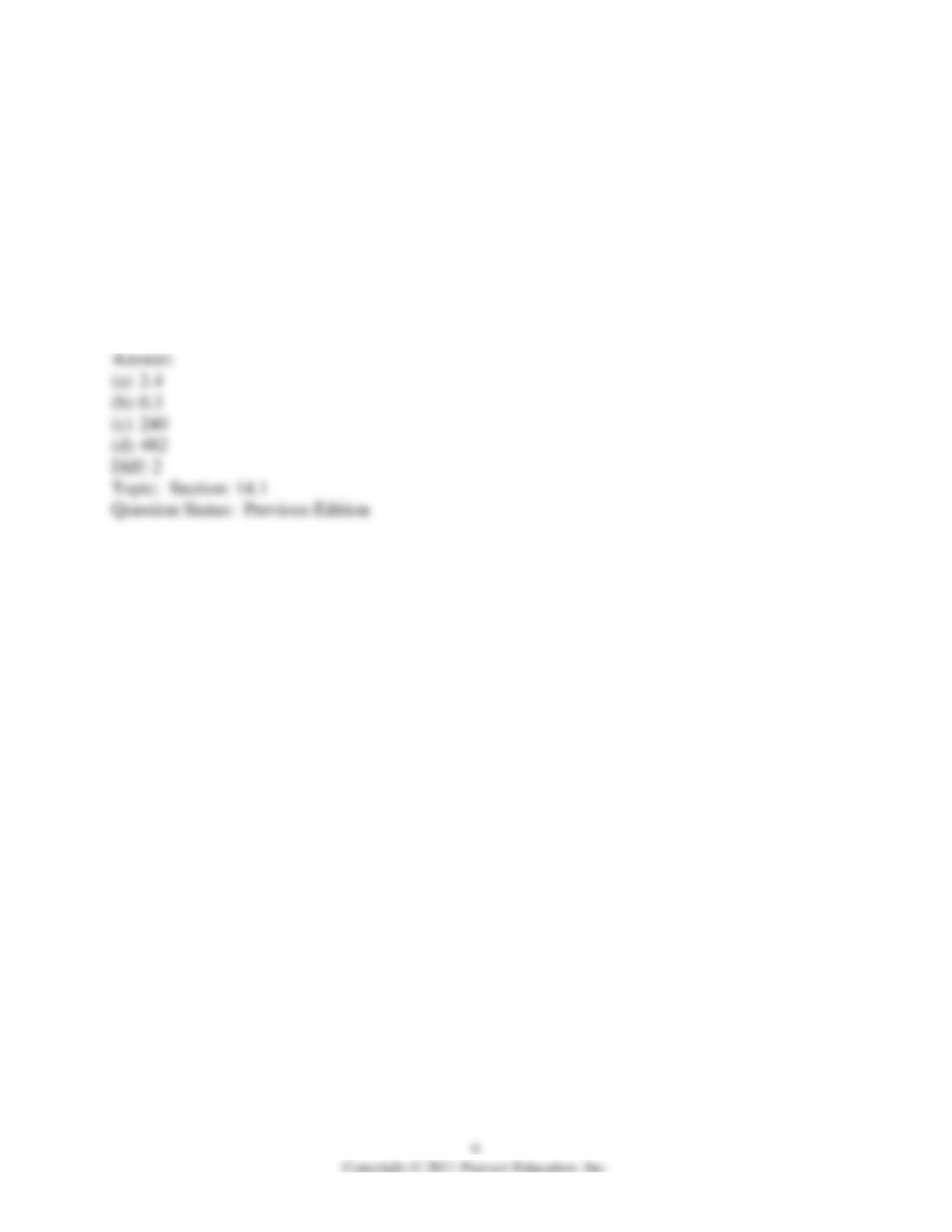
C) $5 million.
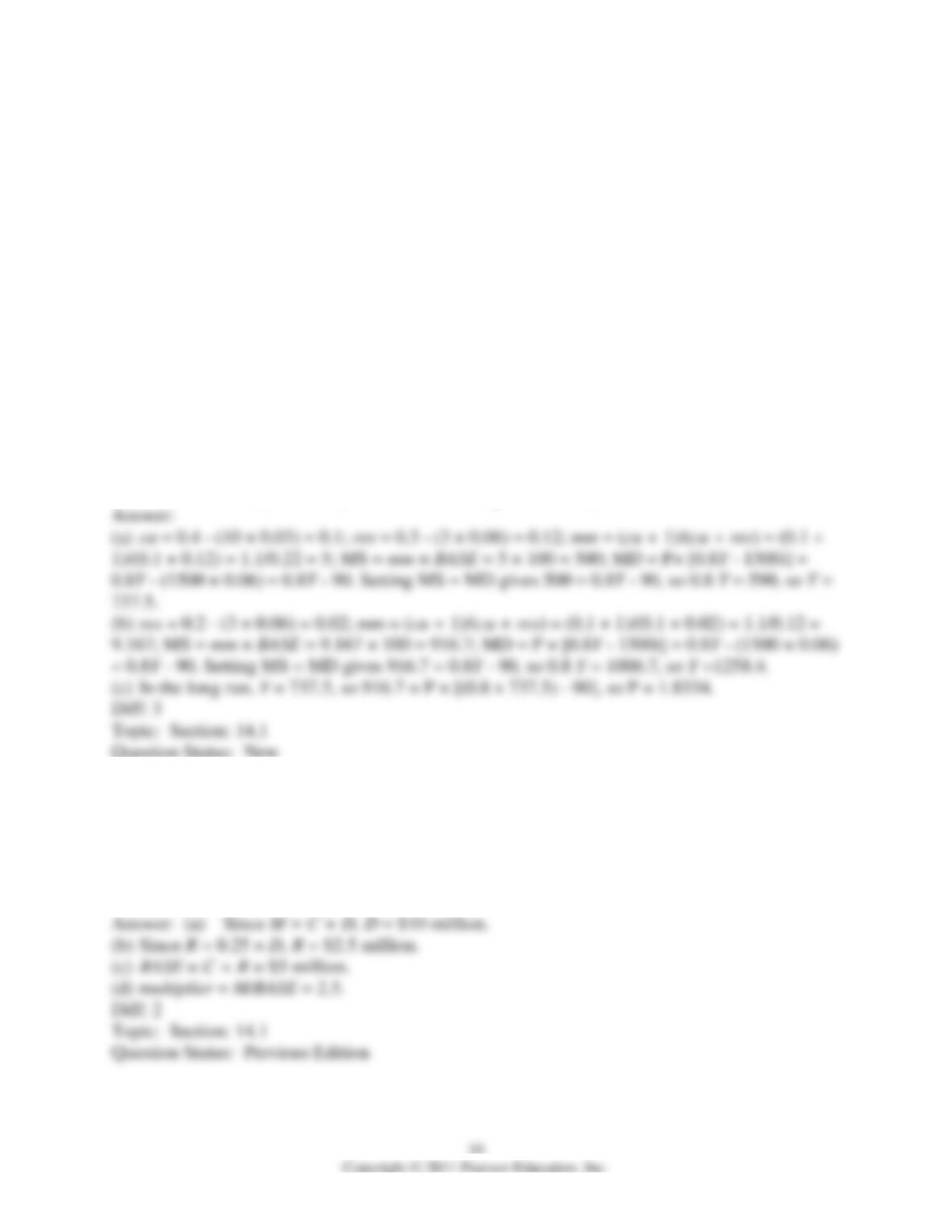
D) $10 million.
6) Fractional reserve banking is the system that
A) allows banks not to insure their deposits.
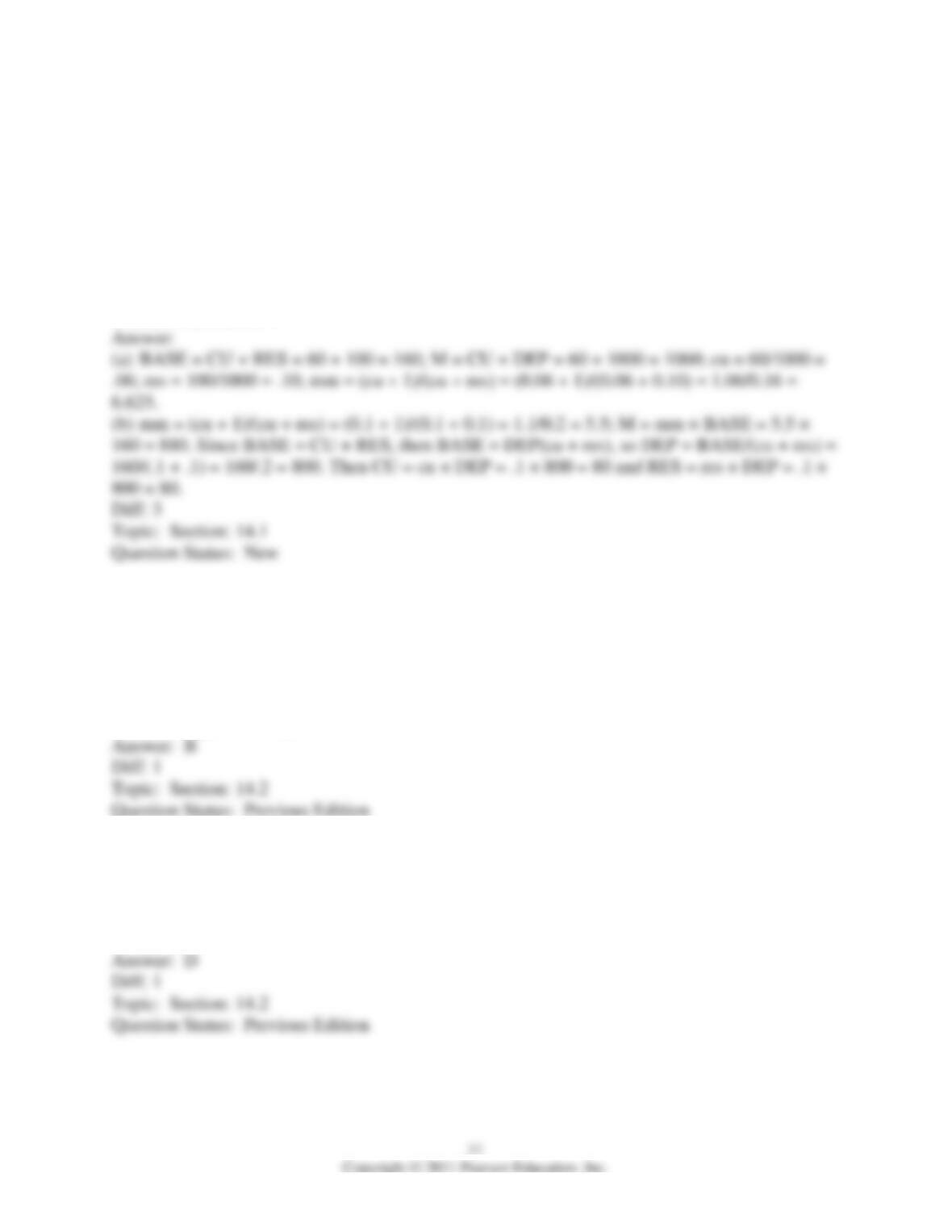
B) allows banks not to join the Federal Reserve System.
C) limits banks’ activities from crossing state lines.
D) allows banks to keep smaller reserves than their deposits.
7) Banks hold some deposits on reserve at the Fed because
A) the Fed requires every bank to hold at least $100 million on deposit at all times.
B) the Fed will insure those deposits, but will not insure regular bank deposits.
C) these are membership dues for being a member bank.
D) these deposits meet the reserve requirements of the Fed.
8) The currency-deposit ratio is determined by
A) banks.
B) the public.
C) the Federal Reserve.
D) Congress.
9) In a fractional reserve banking system with no currency where res is the ratio of reserves to
deposits, the money multiplier is
A) 1 – res.
B) 1 + res.
C) 1/res.
D) res2
10) Assume that the currency-deposit ratio is 0.2 and the reserve-deposit ratio is 0.1. The Federal
Reserve carries out open-market operations, purchasing $1 million worth of bonds from banks.
This action will increase the money supply by
A) $1 million.
B) $2 million.
C) $3 million.
D) $4 million.
11) Assume that the reserve-deposit ratio is 0.2. The Federal Reserve carries out open-market
operations, purchasing $1,000,000 worth of bonds from banks. This action increased the money
supply by $2,600,000. What is the currency-deposit ratio?
A) 0.2
B) 0.3
C) 0.4
D) 0.5
12) Assume that the reserve-deposit ratio is 0.4. The Federal Reserve carries out open-market
operations, purchasing $1,000,000 worth of bonds from banks. This action increased the money
supply by $1,750,000. What is the reserve-deposit ratio?
A) 0.2
B) 0.3
C) 0.4
D) 0.5
13) Assume that the currency-deposit ratio is 0.5. The Federal Reserve carries out open-market
operations, purchasing $1 million worth of bonds from banks. This action increased the money
supply by $2 million. What is the reserve-deposit ratio?
A) 0.25
B) 0.35
C) 0.40
D) 0.50
14) Assume that the currency-deposit ratio is 0.3 and the reserve-deposit ratio is 0.2. What is the
money multiplier?
A) 1.5
B) 2.0
C) 2.6
D) 5.0
15) Suppose there was a banking crisis. The money supply would shrink by the greatest amount
if the public ________ their currency-deposit ratio and the banks ________ their reserve-deposit
ratio.
A) decreased; decreased
B) decreased; increased
C) increased; decreased
D) increased; increased
16) Suppose the Federal Reserve wanted to reduce the money supply without using open-market
operations. It could try to get the public to ________ their currency-deposit ratio and ________
banks’ reserve requirements, which would in turn change the banks’ reserve-deposit ratio.
A) decrease; lower
B) decrease; raise
C) increase; lower
D) increase; raise
17) The money supply is $10 million, currency held by the nonbank public is $2 million, and the
reserve-deposit ratio is 0.2. Bank reserves are equal to
A) $1.6 million.
B) $2 million.
C) $4 million.
D) $8 million.
18) The money supply is $10 million, currency held by the nonbank public is $2 million, and the
reserve-deposit ratio is 0.2. Bank deposits are equal to
A) $1.6 million.
B) $2 million.
C) $4 million.
D) $8 million.
19) The money supply is $6 million, currency held by the nonbank public is $2 million, and the
reserve-deposit ratio is 0.1. The monetary base is equal to
A) $2 million.
B) $2.4 million.
C) $2.6 million.
D) $4 million.
20) Vault cash is equal to $8 million, deposits by depository institutions at the central bank are
$2 million, the monetary base is $40 million, and bank deposits are $90 million. The money
multiplier is equal to
A) 2.5.
B) 3.0.
C) 4.0.
D) 5.0.
21) Vault cash is equal to $8 million, deposits by depository institutions at the central bank are
$2 million, the monetary base is $30 million, and bank deposits are $100 million. The money
multiplier is equal to
A) 2.5.
B) 3.0.
C) 4.0.
D) 5.0.
22) Suppose that in Mysore, the reserve-deposit ratio is
res = 0.5 – 2 i,
where i is the nominal interest rate. The currency-deposit ratio is 0.2 and the monetary base
equals 100. The real quantity of money demanded is given by the money demand function
L(Y, i) = 0.5Y – 10i,
where Y is real output. Currently, the real interest rate is 5% and the economy expects an
inflation rate of 5%. The money multiplier equals
A) 2.00.
B) 2.40.
C) 3.00.
D) 4.00.
23) Suppose that in Mysore, the reserve-deposit ratio is
res = 0.5 – 2i,
where i is the nominal interest rate. The currency-deposit ratio is 0.2 and the monetary base
equals 100. The real quantity of money demanded is given by the money demand function
L(Y, i) = 0.5Y – 10i,
where Y is real output. Currently, the real interest rate is 5% and the economy expects an
inflation rate of 5%. The money supply equals
A) 200.
B) 240.
C) 300.
D) 400.
24) If the Fed decreases the monetary base by $100 million and the money multiplier is 4, M1
will
A) rise by $400 million.
B) fall by $400 million.
C) rise by $25 million.
D) fall by $25 million.
25) If the money multiplier is 10, the purchase of $1 billion of securities by the Fed on the open
market causes a
A) $10 billion decrease in the money supply.
B) $1 billion decrease in the money supply.
C) $1 billion increase in the money supply.
D) $10 billion increase in the money supply.
26) If the money multiplier is 10, the sale of $1 billion of securities by the Fed on the open
market causes a
A) $10 billion decrease in the money supply.
B) $1 billion decrease in the money supply.
C) $1 billion increase in the money supply.
D) $10 billion increase in the money supply.
27) A bank run is
A) a large-scale, panicky withdrawal of deposits from a bank.
B) the transfer of funds from one bank to another.
C) a situation when a bank borrows from the Fed’s discount window.
D) a situation in which a bank borrows at the Federal funds rate.
28) Which of the following is the Federal Reserve most likely to use to change the nation’s
money supply?
A) Open-market operations
B) Reserve requirements
C) Discount lending
D) Credit controls
29) The Fed can reduce the money supply by reducing
A) the currency-deposit ratio.
B) the monetary base.
C) reserve requirements.
D) the discount rate.
30) Last year, the currency-deposit ratio was 0.2 and the reserve-deposit ratio was 0.2. Over the
past year, the public changed its currency-deposit ratio, to which the Fed responded by reducing
the reserve-deposit ratio to 0.15, to keep the money supply from changing and keeping the same
monetary base. Calculate the new currency-deposit ratio. Show your work.
31) Suppose the reserve-deposit ratio is
res = 0.5 – 2 i,
where i is the nominal interest rate. The currency-deposit ratio is 0.2 and the monetary base
equals 100. The real quantity of money demanded is given by the money demand function
L(Y, i) = 0.5Y – 10 i,
where Y is real output. Currently the real interest rate is 5% and the economy expects an inflation
rate of 5%. Assume the price level P is equal to 1.
(a) Calculate the money multiplier.
(b) Calculate the reserve-deposit ratio.
(c) Calculate the money supply.
(d) Calculate the value of output Y that clears the asset market.
32) Suppose that bank reserves (res) are a function of the nominal interest rate (i):
res = 0.3 – 3i.
The money multiplier is (cu + 1)/(cu + res), where cu is the currency-deposit ratio. Initially,
suppose the real interest rate (r) equals 0.03, the expected inflation rate (pe) equals 0.03, and the
currency-deposit ratio equals :
cu = 0.4 – (10 × pe).
The real money demand function is L(Y,i) = 0.8Y – 1500i, where Y is the level of output. The
monetary base equals 100. The price level equals 1.0 initially and will not change in the short
run, but will adjust in the long run.
(a) Calculate the currency-deposit ratio, the reserve-deposit ratio, the money multiplier, the
money supply, and the equilibrium level of output. Assume that this level of output equals full-
employment output, so you are assuming that the economy is in general equilibrium with the
price level equal to 1.0. Show your work.
(b) Suppose financial innovation causes the reserve-deposit ratio to decline to res = 0.2 – 3i.
Calculate the new currency-deposit ratio, the reserve-deposit ratio, the money multiplier, the
money supply, and the equilibrium level of output in the short run, assuming a Keynesian model
with the price level fixed in the short run. Show your work.
(c) Calculate the equilibrium price level in the long run. Show your work.
33) The money supply is $12.5 million, currency held by the nonbank public is $2.5 million, and
the reserve-deposit ratio is 0.25.
(a) What is the quantity of bank deposits?
(b) What is the quantity of bank reserves?
(c) What is the quantity of the monetary base?
(d) What is the money multiplier (give a number)?
34) Suppose the following statistics are available for the economy:
CU = $60 billion
RES = $100 billion
DEP = $1000 billion
(a) Calculate the size of the monetary base, the money supply, the reserve-deposit ratio, the
currency-deposit ratio, and the money multiplier.
(b) Suppose the currency-deposit ratio rises to .10, while the reserve-deposit ratio and monetary
base remain unchanged. Calculate the money multiplier, the money supply, and the new values
of CU, RES, and DEP.
14.2 Monetary Control in the United States
1) How many Federal Reserve Banks are there?
A) 7
B) 12
C) 15
D) 5,500 (approximately)
2) The Federal Reserve is
A) a Kentucky bourbon.
B) a wild game preserve.
C) an express mail service.
D) the central bank of the United States.
3) The leadership of the Federal Reserve System is provided by
A) the Board of Governors.
B) the Federal Advisory Committee.
C) the Federal Open Market Committee.
D) the directors of the twelve Federal Reserve banks.
4) The current chairman of the Board of Governors of the Federal Reserve System is
A) Milton Friedman.
B) Alan Greenspan.
C) Ben Bernanke.
D) Paul Volcker.
5) Who determines the open-market operations of the Federal Reserve System?
A) Board of Governors
B) FDIC
C) FHLBB
D) FOMC
6) The Federal Open Market Committee consists of all the following people EXCEPT
A) the Board of Governors of the Federal Reserve System.
B) five presidents of Federal Reserve Banks, on a rotating basis.
C) the chairman of the President’s Council of Economic Advisors.
D) the President of the Federal Reserve Bank of New York.
7) The Federal Reserve System’s largest asset among the assets listed below is
A) gold.
B) loans to depository institutions.
C) deposits of depository institutions.
D) U.S. Treasury securities.
8) Which of the Fed’s instruments is most frequently used?
A) Changing reserve requirements
B) Open-market operations
C) Changing the discount rate
D) Changing margin requirements for the stock market
9) Since the 1930s, the Fed’s most important tool for controlling the money supply has been
A) setting the discount rate.
B) setting reserve requirements.
C) moral suasion.
D) open-market operations.
10) Changes in reserve requirements directly and immediately affect
A) the monetary base.
B) banks’ holdings of securities.
C) the Fed’s holdings of foreign exchange.
D) the money multiplier.
11) The primary purpose of the discount window is to
A) influence the nation’s money supply.
B) fulfill the bank’s lender of last resort role.
C) control banks’ excess reserves.
D) influence the amount of loans that banks provide to the public.
12) When U.S. banks borrow from one another, they must pay the
A) discount rate.
B) prime rate.
C) Fed funds rate.
D) Interbank Offer Rate.
13) The Federal funds market is a market for trading funds between
A) a bank and a multinational corporation.
B) a bank and the government.
C) a bank and another bank.
D) a bank and the Federal Reserve Bank.
14) If a bank borrows from a Federal Reserve Bank, the interest rate is called
A) the prime rate.
B) the discount rate.
C) the Fed funds rate.
D) the reserve availability rate.