18) La Super Rica is a taco stand in Santa Barbara, California. It is popular with the locals and
even the late Julia Child found the food delicious. If La Super Rica is currently producing where
marginal revenue is greater than marginal cost, to increase its profit La Super Rica should
A) increase production.
B) decrease production.
C) not change its production because it is maximizing its profit.
D) Not enough information is given to determine what La Super Rica should do.
5 Essay Questions
1) List four characteristics of monopolistic competition.
2) “One of the defining features of monopolistic competition is product variety.” Is the previous
statement correct or incorrect?
3) How do the characteristics of perfect competition and monopolistic competition differ?
4) What is product differentiation? What market structure is characterized by product
differentiation?
5) What do demand and marginal revenue curves look like in monopolistic competition? How do
they compare to the demand and marginal revenue curves in perfect competition and monopoly?
6) “A firm in monopolistic competition maximizes its profit by producing where its price is equal
to its marginal cost.” Is the previous statement correct or incorrect?
7) How does a firm in monopolistic competition determine its price and quantity? What type of
profit can it make in the short run and the long run?
8) What type of profit can a firm in monopolistic competition make in the long run? Explain
your answer.
9) Why are firms in monopolistic competition unable to make an economic profit in the long
run?
10) What is excess capacity? What industry has excess capacity in the long run: perfect
competition or monopolistic competition?
11) Define the efficient scale of production. For the situation of a firm in monopolistic
competition, discuss its excess capacity.
12) Explain why firms in monopolistic competition have excess capacity in the long run.
13) In monopolistic competition, firms sell a differentiated product. In perfect competition, firms
sell an identical product. How do these markets differ as a result?
14) A monopoly firm can make economic profit in the long run. A firm in monopolistic
competition cannot. What creates this difference?
15) How do product development and marketing affect a firm in monopolistic competition?
16) Why would a firm in a monopolistically competitive industry ever advertise?
17) Explain the role of advertising in monopolistic competition. Describe how advertising by all
firms in a monopolistically competitive industry impacts a firm’s ATC curve, its MC curve, its
demand curve, and its MR curve.
18) Why are selling costs high in monopolistic competition?
19) Explain how selling costs in monopolistic competition affect the efficiency of monopolistic
competition.
20) What is a firm’s markup? What does it show?
6 Numeric and Graphing Questions
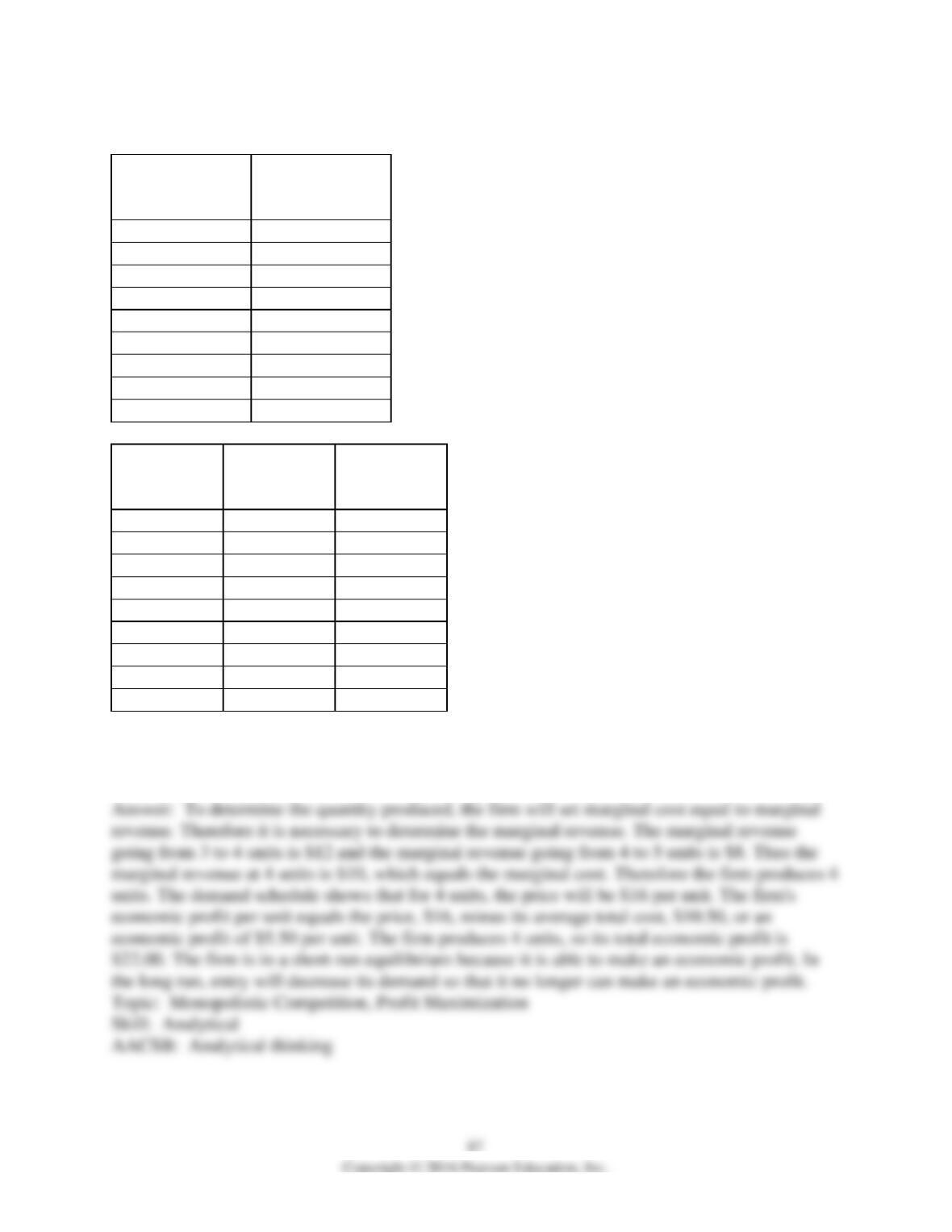
Price
(dollars per unit)
Quantity
demanded
(units)
26
0
24
1
22
2
20
3
18
4
16
5
14
6
12
7
10
8
Quantity
produced
(units)
Average total
cost
(dollars)
Marginal cost
(dollars)
0
1
18.00
8.00
2
12.00
6.00
3
10.66
8.00
4
10.50
10.00
5
11.20
14.00
6
12.66
20.00
7
15.14
30.00
8
23.25
80.00
1) The demand and cost schedules for a firm in monopolistic competition are in the above tables.
What is the profit-maximizing level of output and price? What amount of profit is the firm
earning? Is this firm in a short-run or long-run equilibrium? Why?
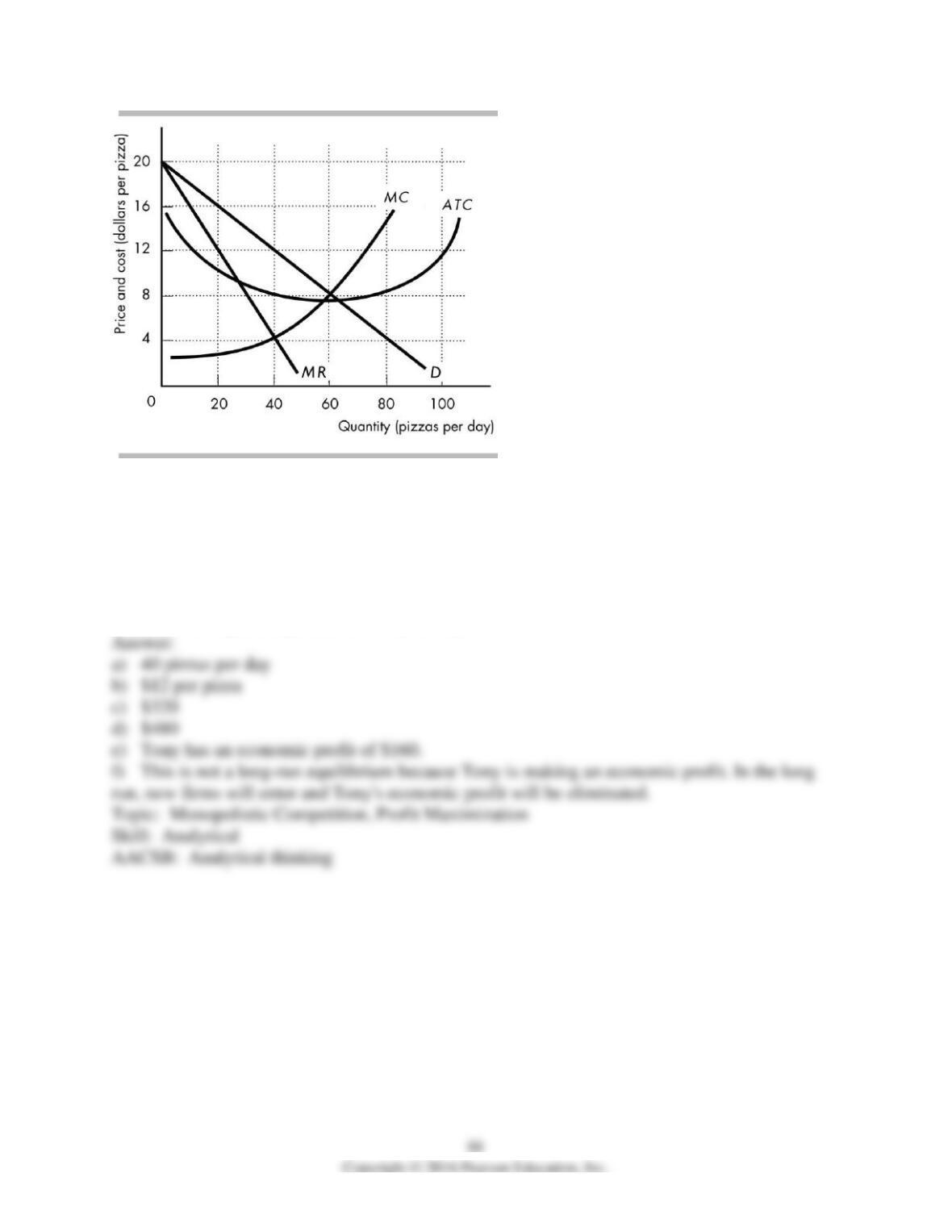
2) The above figure represents Tony’s Pizza Parlor, a firm in monopolistic competition.
a) What quantity will be produced?
b) What price will be charged?
c) What is Tony’s total cost?
d) What is Tony’s total revenue?
e) What is Tony’s economic profit or loss?
f) Is this a long-run equilibrium? Why or why not?
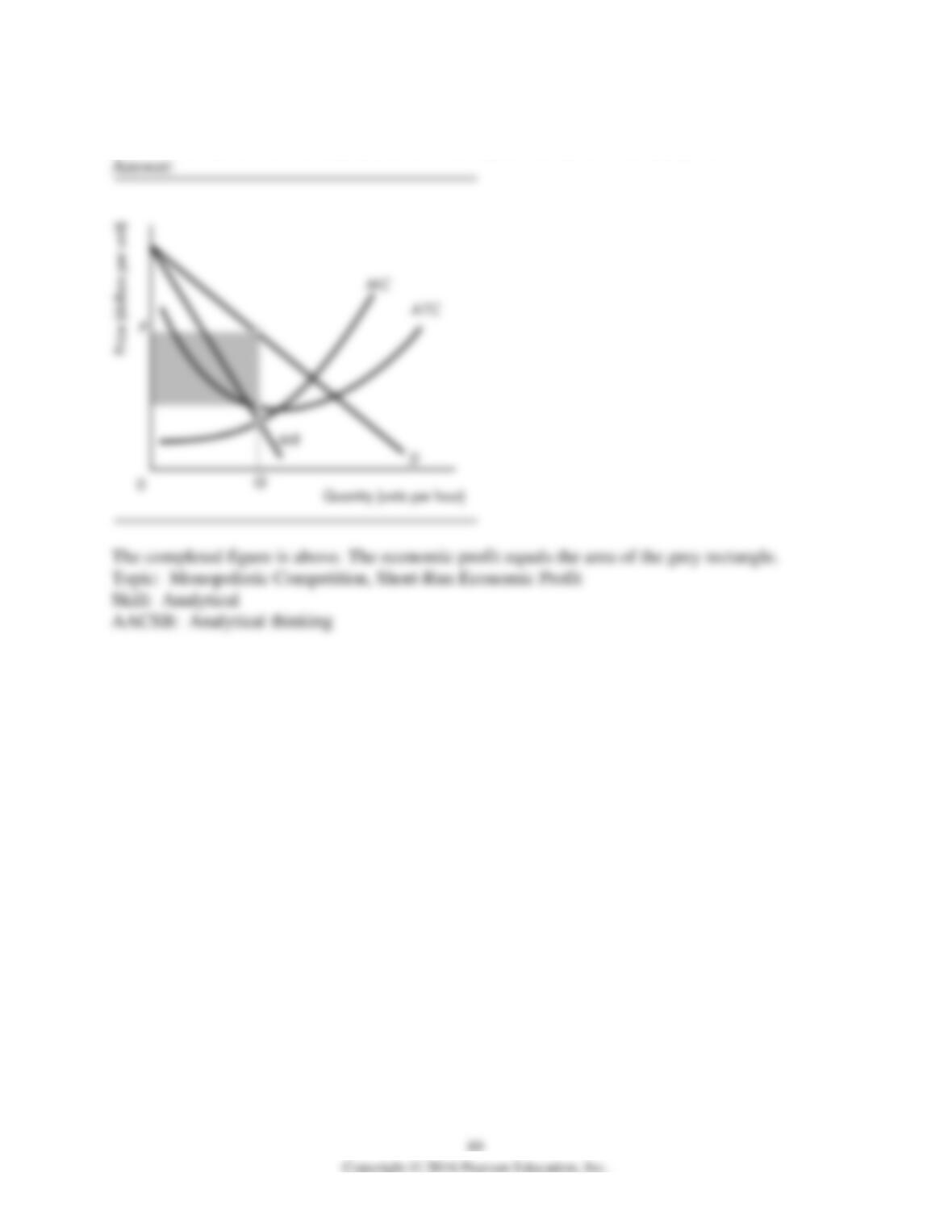
3) Draw an example of a firm in monopolistic competition that is earning an economic profit. Be
sure to label all the curves. Indicate the area that equals the firm’s economic profit.
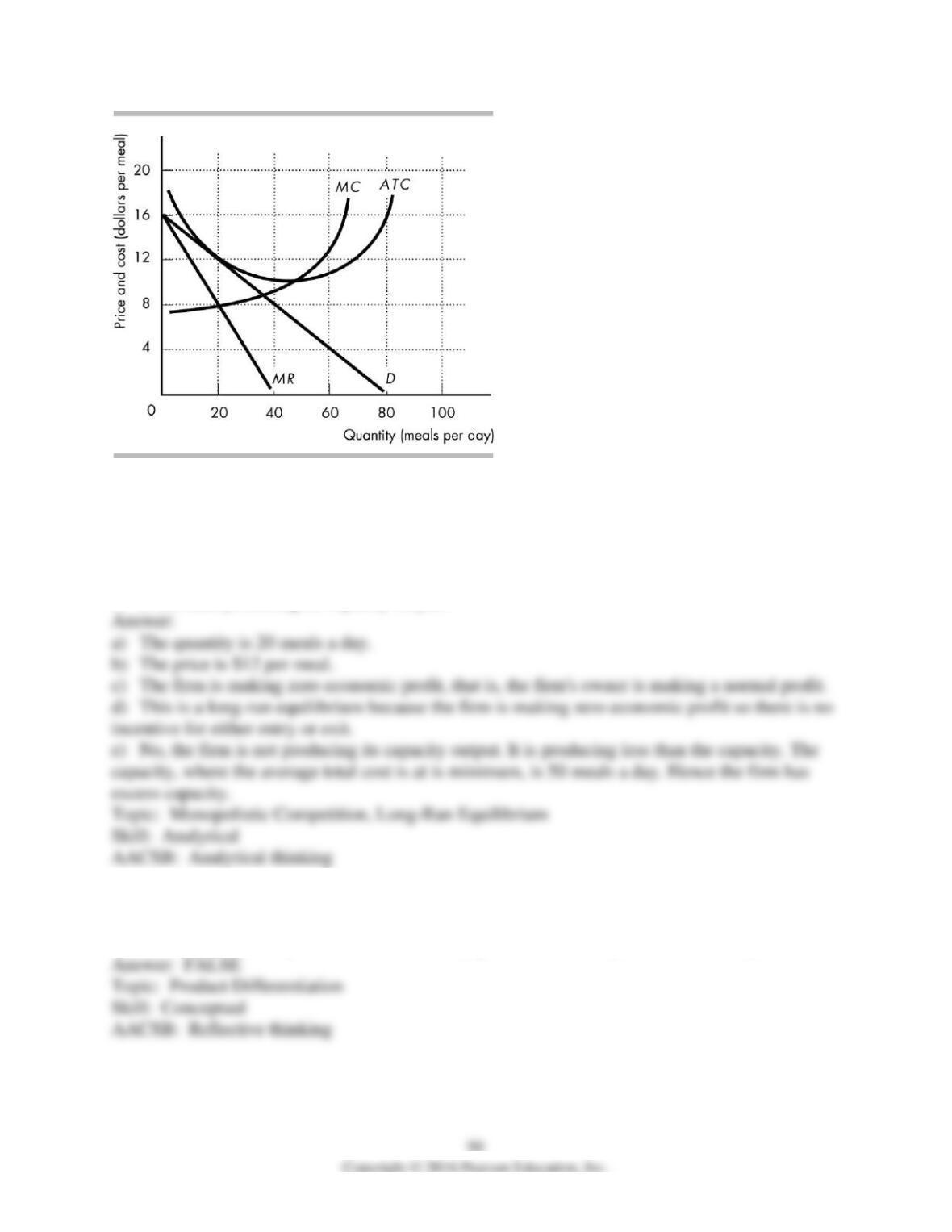
4) The above figure represents a restaurant operating in monopolistic competition.
a) What is the profit-maximizing level of output?
b) What price will the firm charge?
c) What is the firm’s economic profit (or loss)?
d) Is this a long-run equilibrium? Why or why not?
e) Is this firm producing its capacity output?
7 True or False
1) In monopolistic competition, barriers to entry give the firms the power to set their price.
2) In monopolistic competition, product differentiation gives the firms the power to set their
prices.
3) In monopolistic competition, firms compete on product quality, price and marketing.
4) Firms in monopolistic competition maximize their profit by setting their price equal to their
marginal revenue.
5) In the short run, a firm in monopolistic competition produces where P = MC.
6) In the short run, a firm in monopolistic competition produces where MR = MC.
7) In monopolistic competition, free entry and free exit mean that in the long run firms in the
industry make zero economic profit.
8) Firms in monopolistic competition can make an economic profit in the long run.
9) In the long run, firms in monopolistic competition become price takers.
10) In the long-run equilibrium in monopolistic competition, price equals marginal cost.
11) Under monopolistic competition, firms make zero economic profit in the long run and
produce at the minimum ATC.
12) In the long run, monopolistically competitive firms make zero economic profits because of
government regulations.
13) In the long run, monopolistically competitive firms can make an economic profit because of
product differentiation.
14) Excess capacity refers to any unsold output due to insufficient demand.
15) In the long run, firms in monopolistic competition have excess capacity.
16) In monopolistic competition, firms do not have to produce innovative products because they
have downward-sloping demand curves.

94
8 Extended Problems
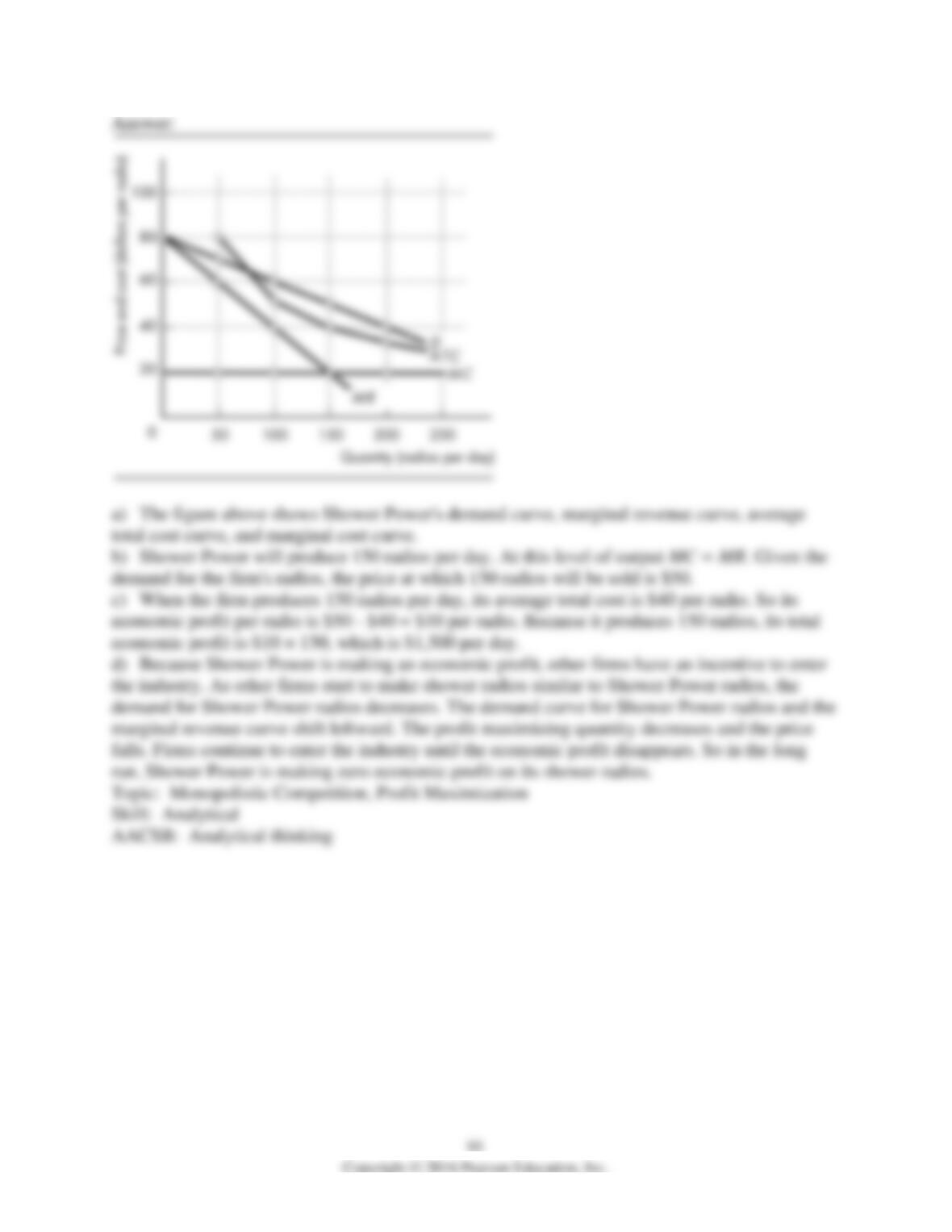
1) Shower Power, Inc., a firm in monopolistic competition, produces shower radios. The
company’s economists know that it can sell no radios at $80, and for each $10 cut in price, the
quantity of radios it can sell increases by 50 a day. This relationship continues to hold until the
price falls to $20. The firm’s total fixed cost is $3,000 a day. Its marginal cost is constant at $20
per radio.
a) Draw the demand curve faced by the firm and its marginal revenue curve. Also draw Shower
Power’s marginal cost and average total cost curves.
b) What quantity of radios should Shower Power produce to maximize its profit? What price
should it charge?
c) What is the firm’s short-run economic profit or loss?
d) In the long run, what will happen to the demand for Shower Power’s radios, the quantity of
radios sold, the price charged, and the firm’s economic profit?’

96
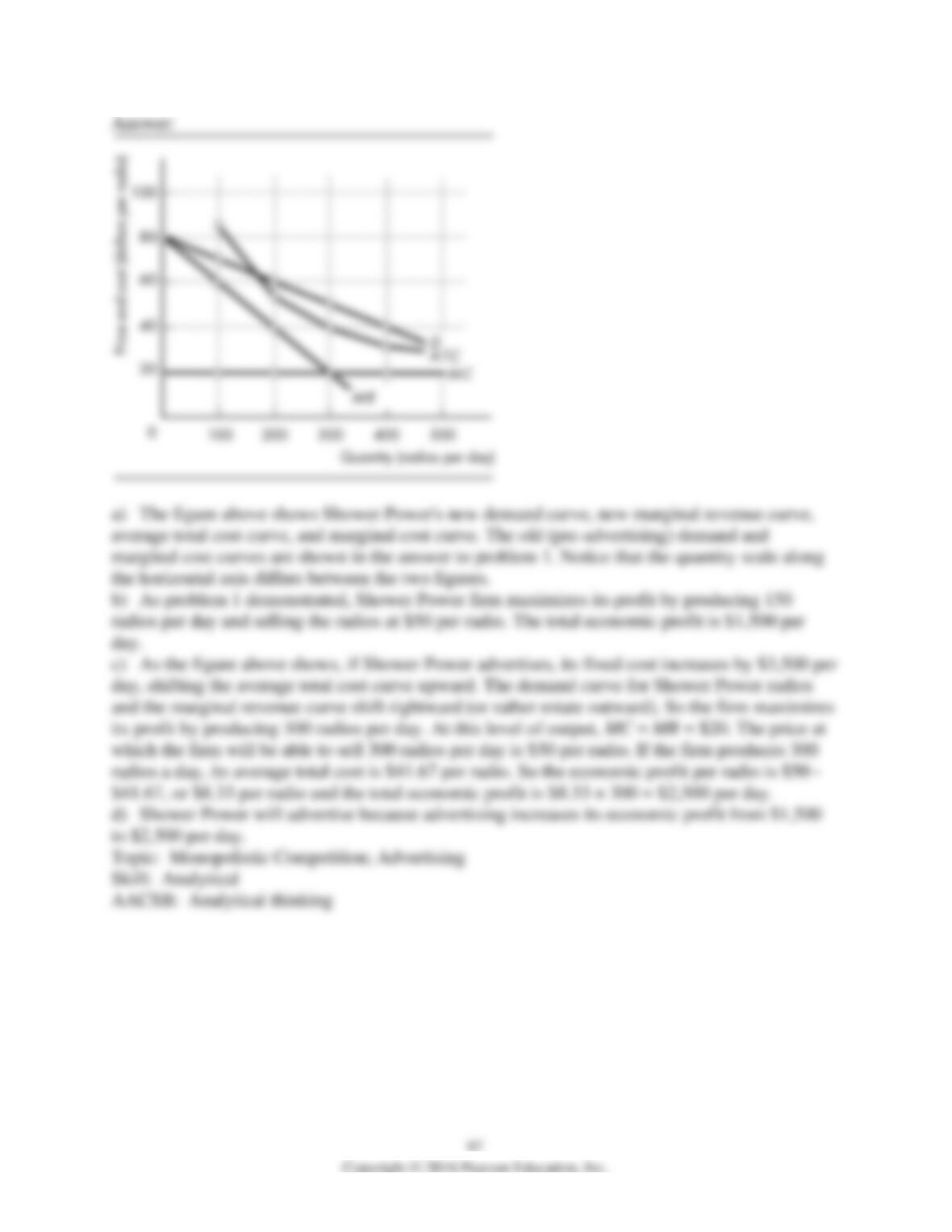
2) Shower Power, Inc., a firm in monopolistic competition, produces shower radios. The
company’s economists know that it if it does not advertise, it can sell no radios at $80, and for
each $10 cut in price, the quantity of radios it can sell increases by 50 a day. This relationship
continues to hold until the price falls to $20. The firm’s total fixed cost is $3,000 a day. Its
marginal cost is constant at $20 per radio. Shower Power’s economists have determined that if
the firm spends $3,500 a day on advertising, it can double the quantity of radios sold at each
price.
a) Draw the new demand curve faced by the firm and its new marginal revenue curve. Also
draw Shower Power’s marginal cost and average total cost curves.
b) If Shower Power does not advertise, what quantity of radios sold maximizes its profit? What
is the profit-maximizing price? What is the firm’s economic profit?
c) If Shower Power does advertise, what quantity of radios sold maximizes its profit? What is
the profit-maximizing price? What is the maximum economic profit that the firm can make on its
shower radios? Draw a diagram to show the effects of advertising.
d) Will Shower Power advertise? Why or why not?

98
3) Shower Power, Inc., a firm in monopolistic competition, produces shower radios. The
company’s economists know that it can sell no radios at $80, and for each $10 cut in price, the
quantity of radios it can sell increases by 50 a day. This relationship continues to hold until the
price falls to $20. The firm’s total fixed cost is $3,000 a day. Its marginal cost is constant at $20
per radio. Shower Power’s managers are considering some quality improvements in their shower
radios, which would raise the firm’s total fixed cost by $200 per day and double its marginal cost.
Shower Power’s economists report that if the firm undertakes these quality improvements, from
the demand relationship given above Shower Power will be able to increase the quantity of
radios sold by 20 percent at each price.
a) Draw the new demand curve faced by the firm and its new marginal revenue curve. Draw
Shower Power’s new marginal cost and new average total cost curves.
b) With no quality improvements, what quantity of radios maximizes Shower Power’s profit?
What is the profit-maximizing price? What is the firm’s economic profit?
c) If Shower Power undertakes the quality improvements, what quantity of radios should it sell
to maximize its profit? What is the profit-maximizing price? What is its economic profit?
d) Should Shower Power implement the quality improvements? Why or why not?