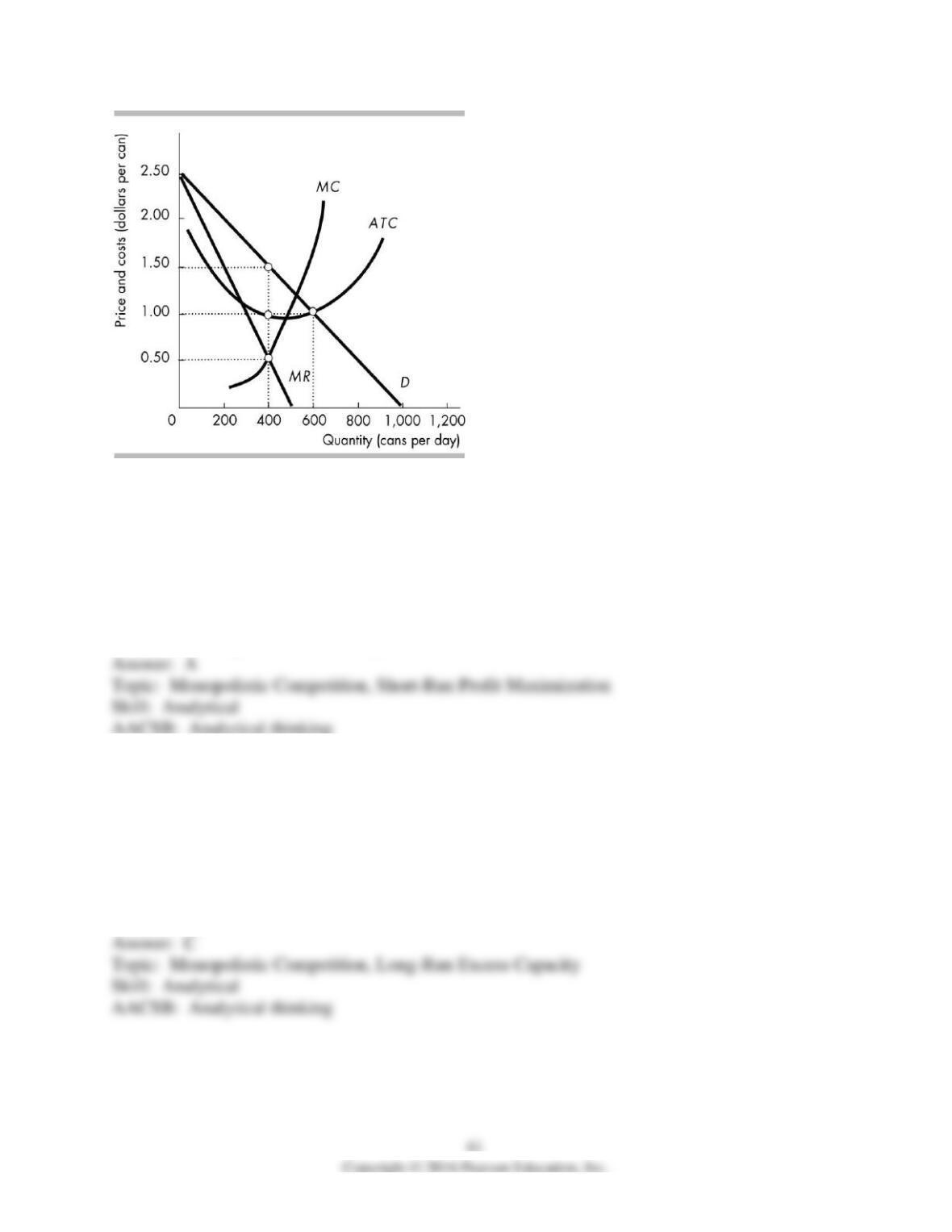
141) The figure above shows the cost, marginal revenue, and demand curves of Golden Chow, a
producer of dog food. The market for dog food is monopolistic competition. In the short run,
Golden Chow sells 400 cans of dog food per day and makes ________. Other firms have
________ incentive to enter the industry.
A) an economic profit of $200 a day; an
B) an economic profit of $400 a day; an
C) a normal profit of $200 a day; no
D) an economic profit of $400 a day; no
142) The figure above shows the cost, marginal revenue, and demand curves of Golden Chow, a
producer of dog food. The market for dog food is monopolistic competition. In the long run as
new firms enter, Golden Chow cuts its output to 200 cans per day. Its excess capacity is
________ cans per day.
A) 0
B) between 0 and 200
C) between 201 and 400
D) more than 401
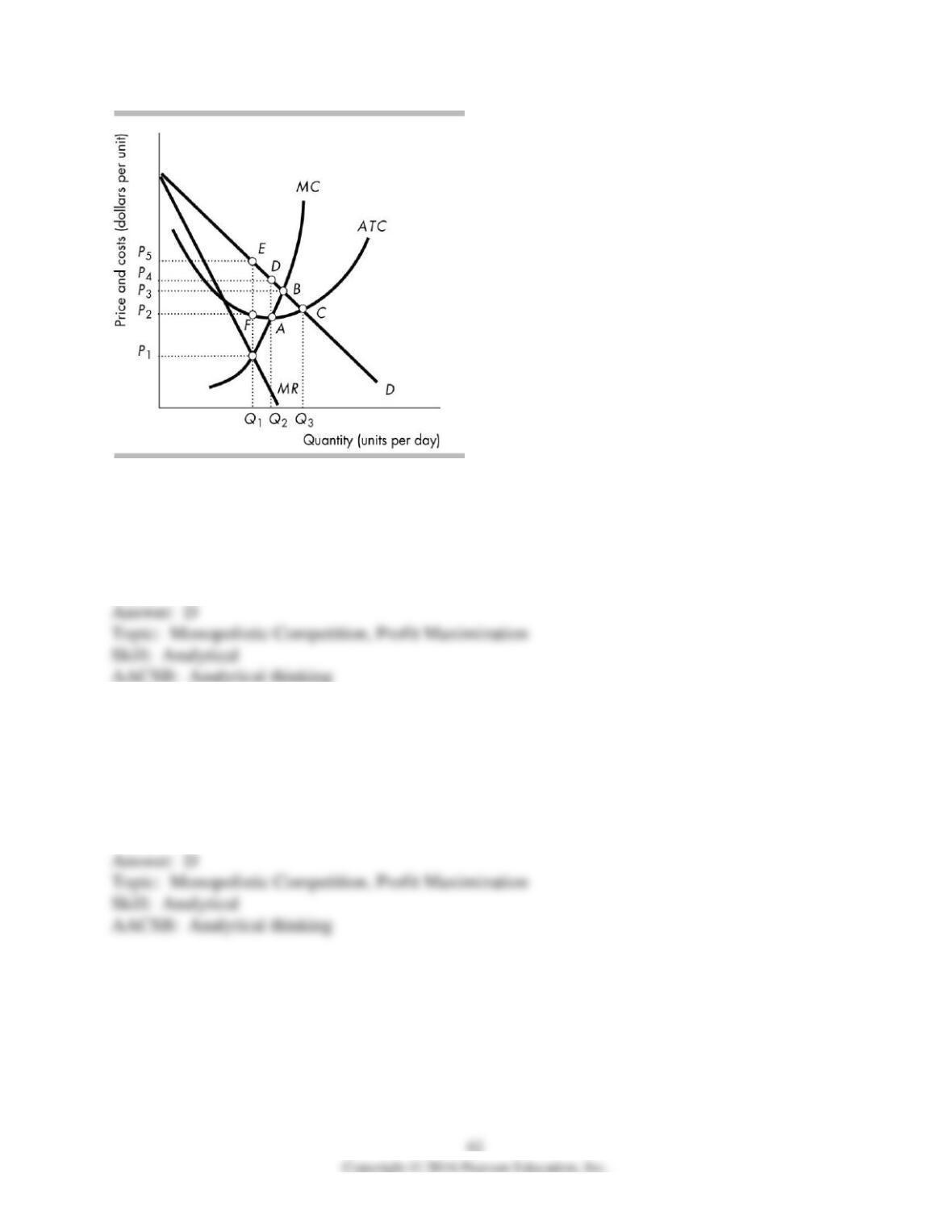
143) In the above figure, the monopolistically competitive firm produces
A) Q3 and sets the price at P3.
B) Q2 and sets the price at P2.
C) Q1 and sets the price at P1.
D) Q1 and sets the price at P5.
144) In the above figure of a monopolistically competitive firm, the marginal cost of the last unit
produced is equal to ________ and is ________ marginal revenue.
A) P2; greater than
B) P3; greater than
C) P1; greater than
D) P1; equal to
145) In the above figure of a monopolistically competitive firm, the area of economic profit is
A) ADB.
B) ABC.
C) P2AD P4.
D) P2FEP5.
146) The above figure shows a monopolistically competitive firm. The figure
A) is only a short-run illustration because the firm is making an economic profit.
B) could be either a short-run or long-run illustration because monopolistically competitive firms
can make an economic profit in the long-run.
C) is only a long-run illustration because the firm is making zero economic profit.
D) is neither a short- nor a long-run illustration.
147) In the above figure of a monopolistically competitive firm, in the long run after all industry
adjustments have taken place, assuming that this firm’s costs have not changed the firm will
A) produce more output at a higher price.
B) produce less output at a lower price.
C) produce the same quantity at the same price.
D) Any of the above are possible.
148) When the monopolistically competitive firm shown in the above figure is at its long-run
equilibrium, it will be
A) producing the efficient scale of output and is at point A on the ATC curve.
B) producing more than the efficient scale of output and is at point C on the ATC curve.
C) producing at less than the efficient scale of output and is at a point such as F on the ATC
curve.
D) producing the efficient scale of output and is at point B on the MC curve.
149) A monopolistically competitive firm has excess capacity because in the
A) short run its MR exceeds its MC.
B) short run its ATC is less than its AVC.
C) long run its ATC exceeds its minimum ATC.
D) long run it makes an economic profit.
150) A monopolistically competitive firm is like a perfectly competitive firm insofar as both
A) have negatively sloping demand curves.
B) can make zero economic profit in the long run.
C) have horizontal MR curves.
D) are protected by high barriers to entry.
151) A monopolistically competitive firm has excess capacity because in the
A) short run its MR exceeds its MC.
B) short run its ATC is less than its AVC.
C) long run its ATC exceeds its minimum ATC.
D) long run it makes an economic profit.
3 Product Development and Marketing
1) Dole Co. operates in a monopolistically competitive market. To try to earn an economic profit,
Dole Co. will
A) prevent other firms from entering the market.
B) increase its product’s price.
C) continually seek to differentiate its product.
D) increase output.
2) A firm in ________ will engage in ________ to try to earn an economic profit.
A) perfect competition; advertising
B) monopolistic competition; product differentiation
C) perfect competition; price wars
D) monopolistic competition; price wars
3) In monopolistic competition, product improvement and development
A) are valued by the consumer at an amount equal to the costs the producers have incurred.
B) yields a marginal benefit to the producer equal to price of the good.
C) is less than its efficient amount.
D) None of the above answers are correct.
4) A monopolistically competitive firm can increase its economic profit by ________.
A) developing new products
B) producing at the efficient quantity
C) eliminating excess capacity
D) advertising less
5) At a monopolistically competitive firm’s current level of product development, marginal
revenue of product development is greater than its marginal cost. The firm will ________.
A) sell only new products
B) increase product development only if the consumer benefits
C) decrease product development
D) increase product development
6) “It is clear from the theory of monopolistic competition that product development is not
pushed to its efficient level.” This statement is
A) false because there is so much product differentiation in monopolistic competition.
B) true because there is little incentive to innovate in monopolistic competition.
C) false because there are so many wasteful innovations in monopolistic competition that are
merely cosmetic.
D) true because price exceeds marginal revenue in monopolistic competition.
7) The decision to undertake product development in monopolistic competition is made by
comparing the
A) marginal benefit of product development to the marginal cost of product development.
B) average revenue of product development to the average total cost of product development.
C) total revenue of product development to the total cost of product development.
D) firm’s expenditure on product development to expenditures by competing firms.
8) Product development is efficient if the
A) new product actually brings great benefits to the consumer.
B) producer’s marginal cost of product development equals the consumer’s marginal benefit.
C) producer surplus from selling the product equals the consumer surplus.
D) average cost of the product development equals the average revenue generated.
9) In monopolistic competition, advertising costs
A) are fixed costs.
B) are variable costs.
C) affect the firm’s ATC curve.
D) All of the above answers are correct.
10) An increase in advertising costs affect a firm in a monopolistic competition by increasing the
firm’s
A) total fixed cost.
B) marginal cost.
C) total variable cost.
D) average variable cost.
11) In monopolistic competition, an increase in a firm’s advertising
A) has no effect on its average cost curves.
B) has no effect on demand.
C) increases the firm’s average total cost.
D) increases the firm’s marginal cost.
12) If a firm spends $600 more on advertising, its
A) ATC and MC curves shift upward.
B) MC curve shifts upward and its ATC curve does not shift.
C) ATC curve shifts upward and its MC curve does not shift.
D) ATC curve shifts upward and its MC curve shifts downward.
13) Advertising costs are ________ costs and the per unit cost of advertising ________ as
production increases.
A) fixed; increases
B) variable; increases
C) fixed; decreases
D) variable; does not change
14) Expenditures on advertising ________.
A) can lower average total cost if the advertising increases the quantity sold by a large enough
amount
B) cannot lower average total cost because when a firm advertises it increases its costs
C) always lower average total cost because whenever a firm advertises, it increases the quantity
sold
D) are variable costs so do not affect the average total cost
15) Monopolistically competitive firms increasing their advertising will definitely achieve which
of the following?
A) shift their average total cost curve up
B) shift their demand curve to the right
C) increase their economic profit
D) shift their demand curve to the right and shift their average total cost curve up
16) If a firm spends $600 more on advertising, its goal is for the demand curve for its product to
shift ________ and its marginal revenue curve to shift ________.
A) leftward; rightward
B) leftward; leftward
C) rightward; leftward
D) rightward, rightward
17) Selling costs, such as advertising, are likely to be a large share of total cost in an industry
that is
A) perfectly competitive.
B) monopolistically competitive.
C) a monopoly.
D) non-profit.
18) Excess capacity and high advertising expenditures are most likely to be encountered in
A) perfect competition.
B) monopolistic competition.
C) monopoly.
D) both monopolistic and perfect competition.
19) Advertising costs of a monopolistically competitive firm are ________.
A) greater than a monopoly and the same as a perfectly competitive firm
B) greater than a perfectly competitive firm
C) less than a perfectly competitive firm
D) the same as a monopoly
20) Advertising by firms in monopolistic competition
A) provides consumers with no useful information.
B) does not occur.
C) can persuade customers that product differentiation exists.
D) wastes resources because the entry of rivals forces firms to be price takers.
21) A textbook publisher is in monopolistic competition. The firm can sell no books at $100 a
book, but for each $10 cut in price, the quantity of books it can sell increases by 20 books a day.
The firm’s average variable cost and marginal cost is a constant $20 per book. What is the
publisher’s profit-maximizing level of output?
A) 60 books per day
B) 80 books per day
C) 100 books per day
D) 120 books per day
22) A textbook publisher is in monopolistic competition. The firm can sell no books at $100 a
book, but for each $10 cut in price, the quantity of books it can sell increases by 20 books a day.
The firm’s average variable cost and marginal cost is a constant $20 per book. What is the
publisher’s profit-maximizing price?
A) $40
B) $50
C) $60
D) $70
23) A textbook publisher is in monopolistic competition. The firm can sell no books at $100 a
book, but for each $10 cut in price, the quantity of books it can sell increases by 20 books a day.
The firm’s average variable cost and marginal cost is a constant $20 per book. What is the firm’s
markup?
A) zero
B) $20
C) $40
D) $60
24) A textbook publisher is in monopolistic competition. The firm can sell no books at $100 a
book, but for each $10 cut in price, the quantity of books it can sell increases by 20 books a day.
The firm’s total fixed cost is $2,400 a day. Its average variable cost and marginal cost is a
constant $20 per book. What is the firm’s maximum economic profit?
A) zero
B) $800
C) -$400
D) $1,000
25) A textbook publisher is in monopolistic competition. If the firm spends nothing on
advertising, it can sell no books at $100 a book, but for each $10 cut in price, the quantity of
books it can sell increases by 20 books a day. The firm’s total fixed cost is $2,400 a day. Its
average variable cost and marginal cost is a constant $20 per book. If the firm spends $1,200 a
day on advertising, it can increase the quantity of books sold at each price by 50 percent. If the
publisher advertises, its profit maximizing level of output is
A) 120 books per day.
B) 80 books per day.
C) 160 books per day.
D) 100 books per day.
26) A textbook publisher is in monopolistic competition. If the firm spends nothing on
advertising, it can sell no books at $100 a book, but for each $10 cut in price, the quantity of
books it can sell increases by 20 books a day. The firm’s total fixed cost is $2,400 a day. Its
average variable cost and marginal cost is a constant $20 per book. If the firm spends $1,200 a
day on advertising, it can increase the quantity of books sold at each price by 50 percent.
Compared to the situation if it does not advertise, if the firm advertises, the profit-maximizing
output
A) doubles.
B) increases by 40 books per day.
C) decreases by 40 books per day.
D) is the same as without advertising.
27) A textbook publisher is in monopolistic competition. If the firm spends nothing on
advertising, it can sell no books at $100 a book, but for each $10 cut in price, the quantity of
books it can sell increases by 20 books a day. The firm’s total fixed cost is $2,400 a day. Its
average variable cost and marginal cost is a constant $20 per book. If the firm spends $1,200 a
day on advertising, it can increase the quantity of books sold at each price by 50 percent. If the
publisher advertises, its profit maximizing price is
A) $40.
B) $50.
C) $60.
D) $70.
28) A textbook publisher is in monopolistic competition. If the firm spends nothing on
advertising, it can sell no books at $100 a book, but for each $10 cut in price, the quantity of
books it can sell increases by 20 books a day. The firm’s total fixed cost is $2,400 a day. Its
average variable cost and marginal cost is a constant $20 per book. If the firm spends $1,200 a
day on advertising, it can increase the quantity of books sold at each price by 50 percent.
Compared to the situation if it does not advertise, if the firm advertises, the profit-maximizing
price
A) rises by $10.
B) falls by $10.
C) rises by $5.
D) does not change.
29) A textbook publisher is in monopolistic competition. If the firm spends nothing on
advertising, it can sell no books at $100 a book, but for each $10 cut in price, the quantity of
books it can sell increases by 20 books a day. The firm’s total fixed cost is $2,400 a day. Its
average variable cost and marginal cost is a constant $20 per book. If the firm spends $1,200 a
day on advertising, it can increase the quantity of books sold at each price by 50 percent. If the
firm advertises, its maximum economic profit is
A) zero.
B) $800.
C) $1,200.
D) -$400.
30) A textbook publisher is in monopolistic competition. If the firm spends nothing on
advertising, it can sell no books at $100 a book, but for each $10 cut in price, the quantity of
books it can sell increases by 20 books a day. The firm’s total fixed cost is $2,400 a day. Its
average variable cost and marginal cost is a constant $20 per book. If the firm spends $1,200 a
day on advertising, it can increase the quantity of books sold at each price by 50 percent.
Compared to the situation if it does not advertise, if the firm advertises, its economic profit
A) increases by $400.
B) decreases by $400.
C) doubles.
D) is the same as with no advertising.
31) A textbook publisher is in monopolistic competition. If the firm spends nothing on
advertising, it can sell no books at $100 a book, but for each $10 cut in price, the quantity of
books it can sell increases by 20 books a day. The firm’s total fixed cost is $2,400 a day. Its
average variable cost and marginal cost is a constant $20 per book. If the firm spends $1,200 a
day on advertising, it can increase the quantity of books sold at each price by 50 percent. The
firm will
A) advertise because advertising will increase its economic profit.
B) not advertise because advertising will lower its economic profit.
C) advertise because advertising will decrease its economic loss.
D) not advertise because advertising will increase its economic loss.
Suppose that at one of the Talbot’s shops, marginal cost of a coat is constant at $150, and total
fixed cost is $3,000 a day. The shop maximizes its profit by selling 15 coats a day at $500 per
coat. Then the shops nearby increase their advertising. The Talbot shop responds by spending
$1,500 a day more on advertising its coats. As a result, its profit-maximizing number of coats
sold increases to 25 a day at $400 per coat.
32) In the scenario above, as a result of increased advertising, Talbot’s average total cost
A) falls by $20 per coat.
B) rises by $50 per coat.
C) rises by $30 per coat.
D) falls by $40 per coat.
33) In the scenario above, as a result of increased advertising, Talbot’s markup
A) decreases by $100.
B) increases by $50.
C) increases by $75.
D) decreases by $60.
34) In the scenario above, as a result of increased advertising, Talbot’s economic profit
A) decreases by $500.
B) increases by $170.
C) increases by $750.
D) decreases by $100.
35) Product variety and information for consumers are gains from
A) perfect competition.
B) monopolistic competition.
C) monopoly.
D) oligopoly.
36) The loss of efficiency that occurs in monopolistic competition has to be weighed against the
gain of
A) higher wages for employees.
B) an increase in employment.
C) greater product variety.
D) reduced environmental damage.
37) One benefit of monopolistic competition over perfect competition is
A) economic profit.
B) product variety.
C) excess capacity.
D) efficiency.
38) Because consumers value product variety
A) society must be more efficient with monopolistic competition than with perfect competition.
B) the inefficiency and deadweight loss created by monopolistic competition is offset.
C) in the long run, monopolistically competitive firms earn an economic profit.
D) monopolistically competitive industries are efficient.
39) Monopolistically competitive firms constantly develop new products in an effort to
A) make the demand for their product more elastic.
B) increase the demand for their product.
C) increase the marginal cost of their product.
D) None of the above are correct.
1) Lee, J Brand, Joe’s Jeans, Paper Denim & Cloth, Levi’s, Wrangler, and many others are all
producers of jeans. In what type of market does Lee operate?
A) monopolistic competition
B) monopoly
C) oligopoly
D) perfect competition
2) Lee, J Brand, Joe’s Jeans, Paper Denim & Cloth, Levi’s, Wrangler, and many others are all
producers of jeans. J Brand jeans sell for about $200 a pair. What would happen if J Brand priced
their jeans at $220 per pair?
A) They would sell fewer jeans because demand is elastic.
B) They would not sell any jeans.
C) They would sell more jeans.
D) They would sell fewer jeans because demand is perfectly elastic.
3) Lee, J Brand, Joe’s Jeans, Paper Denim & Cloth, Levi’s, Wrangler, and many others are all
producers of jeans. J Brand jeans sell for $200 a pair. Suppose at the short-run profit maximizing
quantity, J Brand’s ATC was $180 and AVC was $100, which statement is TRUE?
A) J Brand will produce in the short and long run.
B) J Brand will produce in the short run but go out of business in the long run.
C) J Brand will shut down in the short run and go out of business in the long run.
D) J Brand will produce in the short run and shut down in the long run.
4) Lee, J Brand, Joe’s Jeans, Paper Denim & Cloth, Levi’s, Wrangler, and many others are all
producers of jeans. J Brand jeans sell for $200 a pair. Suppose at the profit maximizing quantity,
J Brand’s ATC was $220 and AVC was $110, which statement is TRUE?
A) J Brand will shut down in the short run and go out of business in the long run.
B) J Brand will produce in the short run but go out of business in the long run.
C) J Brand will produce in the short run and shut down in the long run.
D) J Brand will produce in the short and long run.
5) Agave, Six Feet Under, Globe, Silk, Sotto Sotto and Zocalo are all restaurants in Atlanta. In
this monopolistic market, economic profit would encourage ________, which decreases the
________ for each firm’s meals.
A) entry; demand
B) entry; supply
C) exit; demand
D) exit; supply
6) Agave, Six Feet Under, Globe, Silk, Sotto Sotto and Zocalo are all restaurants in Atlanta. In
the short run, Globe could
I. make an economic profit.
II. make zero economic profit.
III. incur an economic loss.
A) Only I
B) Only II
C) I, II, and III
D) Only I and II
7) Agave, Six Feet Under, Globe, Silk, Sotto Sotto and Zocalo are all restaurants in Atlanta. In
the long run, Globe could
I. make a positive economic profit.
II. make zero economic profit.
III. incur an economic loss.
A) Only I
B) Only II
C) I, II, and III
D) Only I and II
8) Agave, Six Feet Under, Globe, Silk, Sotto Sotto and Zocalo are all restaurants in Atlanta.
Suppose at the profit maximizing quantity, Zocalo charges $22 for each dinner entrée, and its
ATC is equal to $24. What should Zocalo do?
A) Cannot determine whether Zocalo should stay open or shut down in short run, but Zocalo
should go out of business in the long run.
B) Produce in the short run and go out of business in the long run.
C) Shut down in the short run and go out of business in the long run.
D) Cannot determine whether Zocalo’s should stay open or shut down in the short or long run.
9) Which of the following four firms would most likely be part of a monopolistically competitive
market?
A) Lee, J Brand, Joe’s Jeans, Paper Denim & Cloth, Levi’s, and Wrangler are all producers of
jeans.
B) Mark sells the tomatoes he grew in his backyard at the local farmers market.
C) The WaveHouse is the only place in San Diego where you can ride an indoor 10 foot wave.
D) Amara Massage is the only firm which specializes in pre- and post-natal massage.
10) The Karaoke Channel Online streams professional-grade karaoke for $9.95 a month.
Suppose Karaoke Channel Online has a constant marginal cost of $1 per customer and total fixed
cost is $20,000. The profit maximizing number of customers is 10,000. Several competitors start
to advertise online. Karaoke Channel Online now spends $5,000 a month on advertising and the
profit maximizing number of customers increases to 12,000. What is Karaoke Channel Online’s
average total cost before the advertising begins?
A) $3
B) $2
C) $1
D) $2.66
11) The Karaoke Channel Online streams professional-grade karaoke for $9.95 a month.
Suppose Karaoke Channel Online has a constant marginal cost of $1 per customer and total fixed
cost is $20,000. The profit maximizing number of customers is 10,000. Several competitors start
to advertise online. Karaoke Channel Online now spends $5,000 a month on advertising and the
profit maximizing number of customers increases to 12,000. What is Karaoke Channel Online’s
average total cost after the advertising begins?
A) $3.08
B) $3
C) $2.08
D) $2.50
12) The Karaoke Channel Online streams professional-grade karaoke for $9.95 a month.
Suppose Karaoke Channel Online has a constant marginal cost of $1 per customer and total fixed
cost is $20,000. The profit maximizing number of customers is 10,000. Several competitors start
to advertise online. Karaoke Channel Online now spends $5,000 a month on advertising and the
profit maximizing number of customers increases to 12,000 and the streaming price remains
constant. What is Karaoke Channel Online’s total profit before the advertising begins?
A) $66,500
B) $99,500
C) $64,500
D) $76,500
13) The Karaoke Channel Online streams professional-grade karaoke for $9.95 a month.
Suppose Karaoke Channel Online has a constant marginal cost of $1 per customer and total fixed
cost is $20,000. The profit maximizing number of customers is 10,000. Several competitors start
to advertise online. Karaoke Channel Online now spends $5,000 a month on advertising and the
profit maximizing number of customers increases to 12,000 and the streaming price remains
constant. What is Karaoke Channel Online’s total profit after the advertising begins?
A) $84,400
B) $66,500
C) $119,400
D) $89,400
14) Which of the following is NOT a TRUE statement about perfectly competitive and
monopolistically competitive firms?
A) Both monopolistically competitive and perfectly competitive firms have perfectly elastic
demands.
B) In the long run, only monopolistically competitive firms have excess capacity.
C) Perfectly competitive firms produce at their efficient scale.
D) There are a large number of firms in both monopolistically competitive and perfectly
competitive markets.
15) The market for wheat can be described at perfectly competitive while the market for pizza is
better described as monopolistically competitive. Which of the following is a NOT a similarity
between perfectly competitive and monopolistically competitive firms?
A) Both monopolistically competitive and perfectly competitive firms produce at their efficient
scale.
B) Both monopolistically competitive and perfectly competitive firms are free to enter and exit
the market.
C) Both monopolistically competitive and perfectly competitive firms have a small market share.
D) There are a large number of firms in both monopolistically competitive and perfectly
competitive markets.
16) La Super Rica is a taco stand in Santa Barbara, California. It is popular with the locals and
even the late Julia Child found the food delicious. If La Super Rica is making an economic
profit, what is the probable outcome in the taco market?
A) The number of firms will increase, decreasing La Super Rica’s demand.
B) The number of firms will decrease, decreasing La Super Rica’s demand.
C) The number of firms will increase, increasing La Super Rica’s demand.
D) The number of firms will decrease, increasing La Super Rica’s demand.
17) La Super Rica is a taco stand in Santa Barbara, California. It is popular with the locals and
even the late Julia Child found the food delicious. Suppose La Super Rica maximizes its profit. If
La Super Rica’s lunch price is greater than its average total cost, which of the following
statements is NOT true?
A) La Super Rica is producing at its efficient scale.
B) La Super Rica is making an economic profit.
C) La Super Rica is producing a quantity where marginal revenue equals marginal cost.
D) La Super Rica has excess capacity.