
93. A company that produces simple textiles outsources its operations to Indonesia. Wages for
Indonesian workers will ________ and their employment will ________.
a. rise; rise d. fall; stay the same
b. fall; rise e. fall; fall
c. stay the same; fall
94. A situation with only one buyer of labor is called a(n)
a. monopoly. d. labor market equilibrium.
b. oligopoly. e. labor market disequilibrium.
c. monopsony.
95. Kaitlin has recently been trained as a highly specialized medical physician. There is only one
hospital that needs her services. Kaitlin can expect her wages to be ________ compared to what
her wages would be in a situation of perfect competition.
a. higher d. the same
b. double e. lower
c. half
96. Which of the following situations describes a monopsony?
a. Nicolette is an ice cream artist and several shops are hiring.
b. Francine is the only teleport technician in the world.
c. Fernando is an accountant in New York City.
d. Leslie is a college instructor and there is only one university within 300 miles of her
permanent residence.
e. Leo is the only professional dog groomer in town.
97. What is the best economic explanation for the high pay earned by National Hockey League stars?
a. There are many highly skilled players.
b. They have superior bargaining skills in contract negotiations.
c. Talent allows for higher pay.
d. Fans want to see really good players, and team owners are willing to pay more for good
players.
e. The league is promoting these players.
98. Tamar’s sister complains that Tamar gets paid considerably more as a caterer than she is paid as a
chef, even though the careers are similar. What might explain this situation?
a. People rarely hire caterers for their events and so are willing to pay a premium for the service.
b. There are many chefs in town, but few caterers.
c. The training required to be a chef is so advanced that people cannot afford her services.

d. There are many substitutes for a chef.
e. Tamar’s catering business can go to a person’s residence, and her sister’s position does not
allow such mobility.
99. As Apple’s iPads become more popular, we can expect the wages of Apple workers with specific
skills pertaining to the production of iPads to ________ relative to PC workers.
a. increase d. fall to the minimum wage
b. stagnate e. decrease
c. decrease slowly
100. Economic rent is
a. what a landlord earns by leasing land or capital.
b. the amount of money a person could have earned by using land for another purpose.
c. the difference between the market price and the rental price of a piece of land.
d. the difference between the rental price and the amount of money that could have been earned
using the piece of land for another purpose.
e. the profits earned by a firm in production.
101. The rental price of land is the
a. cost of leasing a piece of land for a determined time period.
b. amount of money required to buy a piece of land.
c. entire bill associated with maintaining land used in production.
d. amount of money a firm could have made by using the land for another purpose.
e. amount of money a firm pays to build a plant on a piece of land.
102. Where would economic rents be highest?
a. Cincinnati, Ohio d. Toledo, Ohio
b. St. Louis, Missouri e. Grand Rapids, Michigan
c. New York City
103. If Marguerite rents her land for $250/month and her next-best use of the land would earn her
$100/month, her economic rent is ________.
a. $250 d. $75
b. $150 e. $25
c. $100
104. When a new major league baseball stadium is built in the suburbs of a large city, the rents of
apartments surrounding the stadium skyrocket because

a. the supply of the apartments is high.
b. the amount of land available for apartments is fixed.
c. stadium owners want the area to be upscale.
d. everyone wants to live near a stadium.
e. the players want to live nearby and can afford high rents.
105. A formerly quiet town with fantastic weather becomes “the place” to live for people from colder
climates. We can expect the rental price of land to ________ and ________ land to be devoted to
housing.
a. decrease; more d. decrease; the same amount of
b. increase; less e. increase; the same amount of
c. increase; more
106. If demand for land increases, the rental price ________ and the equilibrium amount of land
________.
a. increases; falls d. decreases; stays the same
b. decreases; increases e. increases; stays the same
c. increases; increases
107. Assume that the Welter Company is renting capital and hiring labor such that the bang per buck
from each resource is the same. If wages of labor increase, its use of labor ________ and capital
________.
a. increases; falls d. stays the same; falls
b. falls; falls e. falls; increases
c. increases; increases
108. If there is a massive wave of immigration, the wages of workers ________ and it is more profitable
for firms to use more ________.
a. drop; capital and fewer workers d. drop; workers and less capital
b. increase; land and fewer workers e. increase; workers and less land
c. increase; capital and less land
109. It is profitable for Jack’s Jingles to use more equipment in the production of its songs when the
a. rental price of land decreases. d. rental price of capital decreases.
b. rental price of capital increases. e. marginal product of labor falls.
c. wages of workers falls.
110. Companies can rent a manufacturing robot named RoboMan for $2,500 a month and must pay
workers $20 an hour. The value of the marginal product of RoboMan is $5,000, and the value of
the marginal product of labor is $20. Companies should hire ________ RoboMen and ________
workers.
a. more; fewer d. fewer; more
b. more; more e. the same amount of; more
c. fewer; fewer
111. You know that the rental price of capital is $3,000, the rental price of land is $2,000, and the wage
of labor is $100. The value of the marginal product produced by each factor is $30,000, $4,000,
and $200, respectively. You would advise the company to hire more
a. labor. d. less labor and more land.
b. land. e. less capital and more labor.
c. capital.
112. A firm is currently using two inputs: labor and capital. It rents equipment for $1,000, which
produces a value of the marginal product of $5,000. It hires workers at $10 per hour, who produce
a value of the marginal product of $100. The wages of workers rise by 20 percent and the rental
price of capital increases by 25 percent. The firm should hire ________ labor and ________
capital.
a. more; more
b. more; less
c. the same amount of; the same amount of
d. less; more
e. less; less
113. Most of the total income made in the U.S. economy is paid as
a. profits to businesses. d. wages and benefits to laborers.
b. interest to capital lenders. e. taxes to government.
c. rent to building owners.
114. Of the total income earned in the U.S. economy, about
a. 67 percent is earned by landowners, while 33 percent is earned by capitalists.
b. 50 percent is earned by laborers, 25 percent by landowners, and 25 percent by capital lenders.
c. 40 percent is earned by government, 50 percent by landowners, and 10 percent by laborers.
d. 67 percent is earned by laborers, and 33 percent is earned by other factors.
e. 51 percent is earned by laborers, and 49 percent is earned by land and capital owners.
115. About what percent of the U.S. income is earned in wages and benefits?
a. 40 d. 33
b. 72 e. 60
c. 67
116. Which factor of production earns the most income in the U.S. economy?
a. labor d. entrepreneurship
b. capital e. government
c. land
117. Income in the U.S. economy consists of
a. wages and benefits paid to laborers.
b. wages and benefits paid to laborers and profits to businesses.
c. profits to businesses, interest to capital lenders, and rent to landowners.
d. rent to landowners and profits to businesses.
e. wages and benefits to laborers, and profits to businesses.
118. Factors of production are another term for the
a. multiplier (factor) by which production can be increased by using new technology.
b. certain technical aspects (factors such as temperature and humidity) by which more output is
produced.
c. accounting techniques (factors) used to report increased production.
d. aspects (factors) by which production determines derived demand.
e. inputs (factors) to the production process.
119. Which of the following is an example of a factor of production?
a. Medicare support payments
b. workers hired to repair worn-out furniture
c. interest on loans to purchase more capital
d. rent on agricultural land
e. profits paid to Apple stores
120. Which of the following are the three factors of production?
a. labor, business, factories d. capital, government, land
b. land, labor, capital e. business, land, labor
c. workers, government, business
121. The most important aspect(s) of labor, land, and capital is/are that they
a. have derived demands.
b. are factors of production.
c. are inputs to the production process.
d. are resources in our economy.
e. have derived demands and are factors of production, inputs to the production process, and
resources in our economy.
122. Which of the following is an example of derived demand?
a. Economic actions that decrease labor demand will lower wages.
b. More highly educated workers earn more than less-educated workers.
c. Garment industry demand for workers who sew depends on the number of garments produced.
d. A lower price for pencils will lead to fewer pencil workers.
e. A citrus disease will raise citrus fruit prices, leading to more fruit produced by plantations not
affected by the disease.
123. Because a product’s demand for an input to its production depends on the decision to produce this
product, it is called ________ demand.
a. dependent d. production
b. secondary e. input
c. derived
124. The markets for factors of production differ from markets for products in an important aspect
because
a. markets for factors are rarely in equilibrium, whereas markets for products are usually in
equilibrium.
b. demand for factors of production is a derived demand.
c. the shape of the product’s demand curve will be more elastic than the shape of the factor’s
demand curve.
d. supply of a factor is dependent on the supply of a product.
e. the shape of the product’s supply curve will be more elastic than the shape of the factor’s
supply curve.
125. Markets for people who work on bicycles are influenced by
a. demand for bicycles.
b. supply of bicycles.
c. price elasticity of demand for bicycles.
d. cross-price elasticity of bicycle helmets.
e. miles of bike lanes.
126. How does diminishing marginal product affect the shape of the production function?
a. The slope of the production function increases as the quantity of input increases.
b. The slope of the production function becomes more positive with diminishing marginal
product.
c. The slope of the production function becomes horizontal once diminishing marginal product is
achieved.
d. The slope of the production function decreases as the quantity of input increases.
e. The slope of the production function is not affected by diminishing marginal product.
127. A profit-maximizing firm in a competitive market that is producing on a production curve where
the marginal product of labor is diminishing also has
a. an upward-sloping labor demand curve.
b. a downward-sloping labor demand curve.
c. a perfectly elastic labor supply curve.
d. a perfectly inelastic labor supply curve.
e. a perfectly inelastic labor demand curve.
128. One of the primary causes of diminishing marginal product is
a. increasing marginal cost. d. diminishing total cost.
b. increasing price. e. diminishing average fixed cost.
c. decreasing marginal cost.
129. If a profit-maximizing firm hires its eleventh worker, then it can be inferred that when the firm
hired the first 10 workers, the
a. wage was larger than the value of the marginal product of labor (VMPL).
b. value of the marginal product of labor (VMPL) was larger than the wage.
c. marginal product of labor was increasing.
d. market was becoming less competitive.
e. labor demand curve of this firm was becoming more steep.
130. The value of the marginal product is
a. total output divided by total inputs.
b. the marginal product of an input times the price of the output.
c. the change in total output divided by the change of an input.
d. total revenue minus total cost.
e. marginal revenue minus marginal cost.
131. A profit-maximizing firm in a competitive market will employ more workers until the
a. marginal product equals the wage.
b. marginal product equals zero.
c. marginal revenue product equals zero.
d. marginal revenue product equals marginal cost.
e. value of the marginal product equals the wage.
132. Suppose that a profit-maximizing firm in a competitive market hires labor up to the point at which
the value of the marginal product equals the wage and that labor is the only variable input. The
price of the product is $150 per unit. If the firm pays a wage of $700 per week and the marginal
product of labor equals 20 units per week, then the marginal cost of producing an additional unit of
output is
a. $35. d. $3,000 divided by total output.
b. $70. e. $4.29.
c. $14,000 divided by total output.
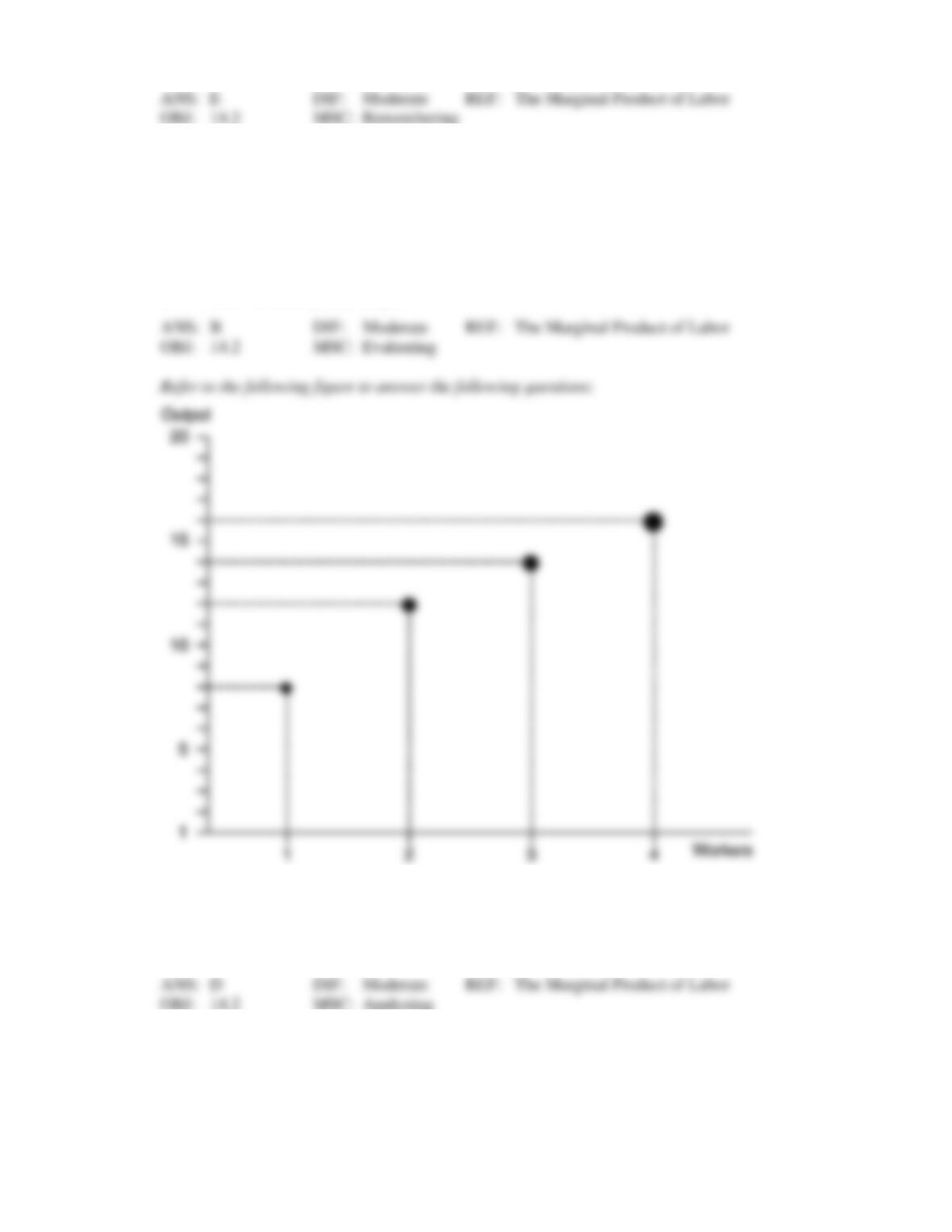
133. What is the marginal product of the second worker?
a. 12 units d. 4 units
b. 8 units e. 2 units
c. 6 units
134. What is the marginal product of the third worker?
a. 3.75 units d. 14 units
b. 12 units e. 2 units
c. 4.67 units
135. What is the marginal product of the fourth worker?
a. 3.75 units d. 1 unit
b. 15 units e. 4.67 units
c. 2 units
136. If the price of the product is $10, then what is the value of the marginal product of labor (VMPL)
of the second worker?
a. $40 d. $10
b. $120 e. $80
c. $20
137. If the price of the product is $30, then what is the value of the marginal product of labor (VMPL)
of the third worker?
a. $60 d. $30
b. $120 e. $240
c. $420
138. If the price of the product is $20, then what is the value of the marginal product of labor (VMPL)
of the fourth worker?
a. $40 d. $80
b. $20 e. $420
c. $300
139. What is the marginal product of the second worker?
a. 9 units d. 7 units
b. 8 units e. 18 units
c. 10 units
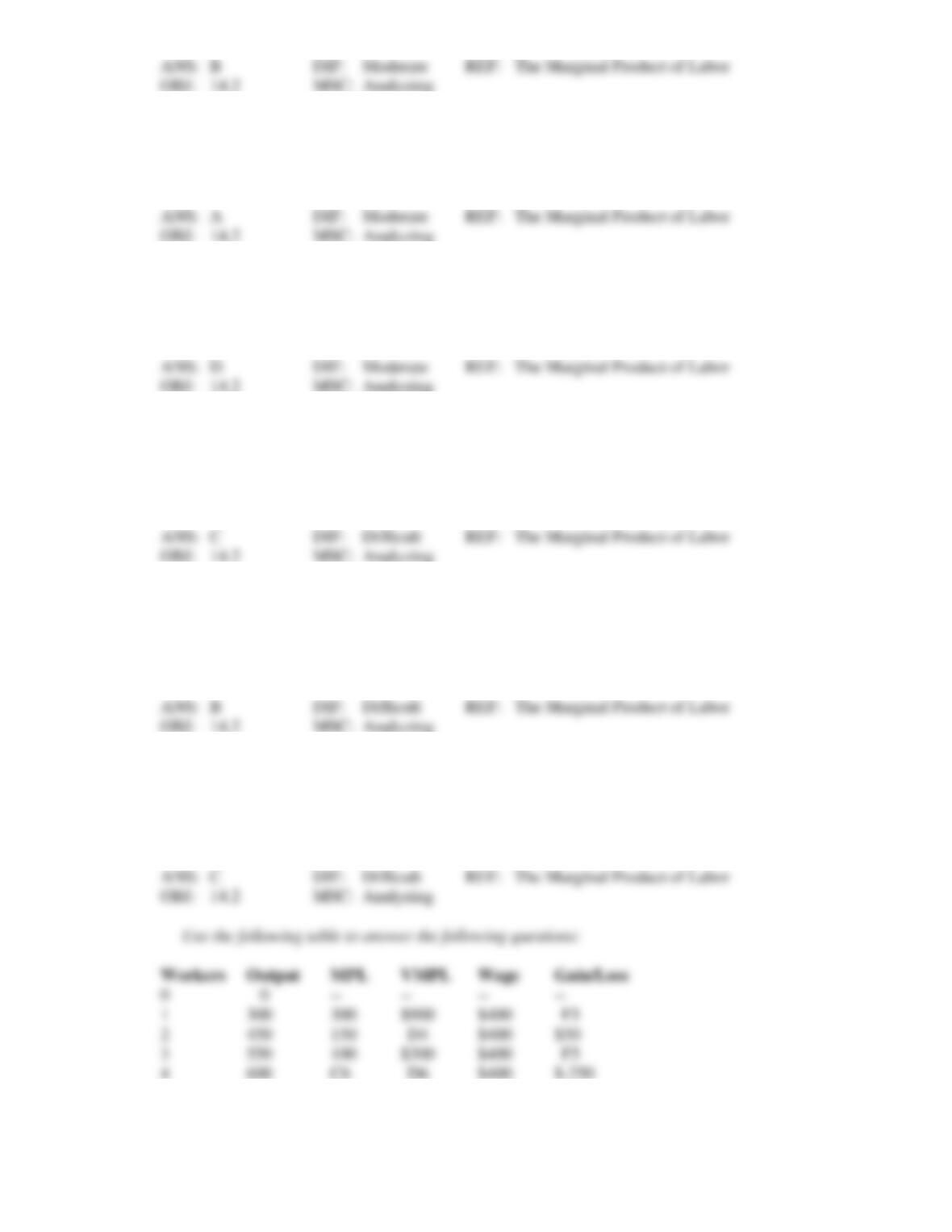
140. What is the marginal product of the third worker?
a. 7 units d. 75 units
b. 8.33 units e. 8 units
c. 25 units
141. What is the marginal product of the fourth worker?
a. 7.5 units d. 5 units
b. 8.33 units e. 6.25 units
c. 25 units
142. If the workers are paid $8 per hour, the price of the product is $4, and the fixed cost of the business
is $20, then how many workers should the business employ?
a. three d. six
b. four e. seven
c. five
143. If the workers are paid $10 per hour, the price of the product is $3, and the fixed cost of the
business is $10, then how many workers should the business employ?
a. three d. six
b. four e. seven
c. five
144. If the workers are paid $10 per hour, the price of the product is $4, and the fixed cost of the
business is $10, then how many workers should the business employ?
a. three d. six
b. four e. seven
c. five
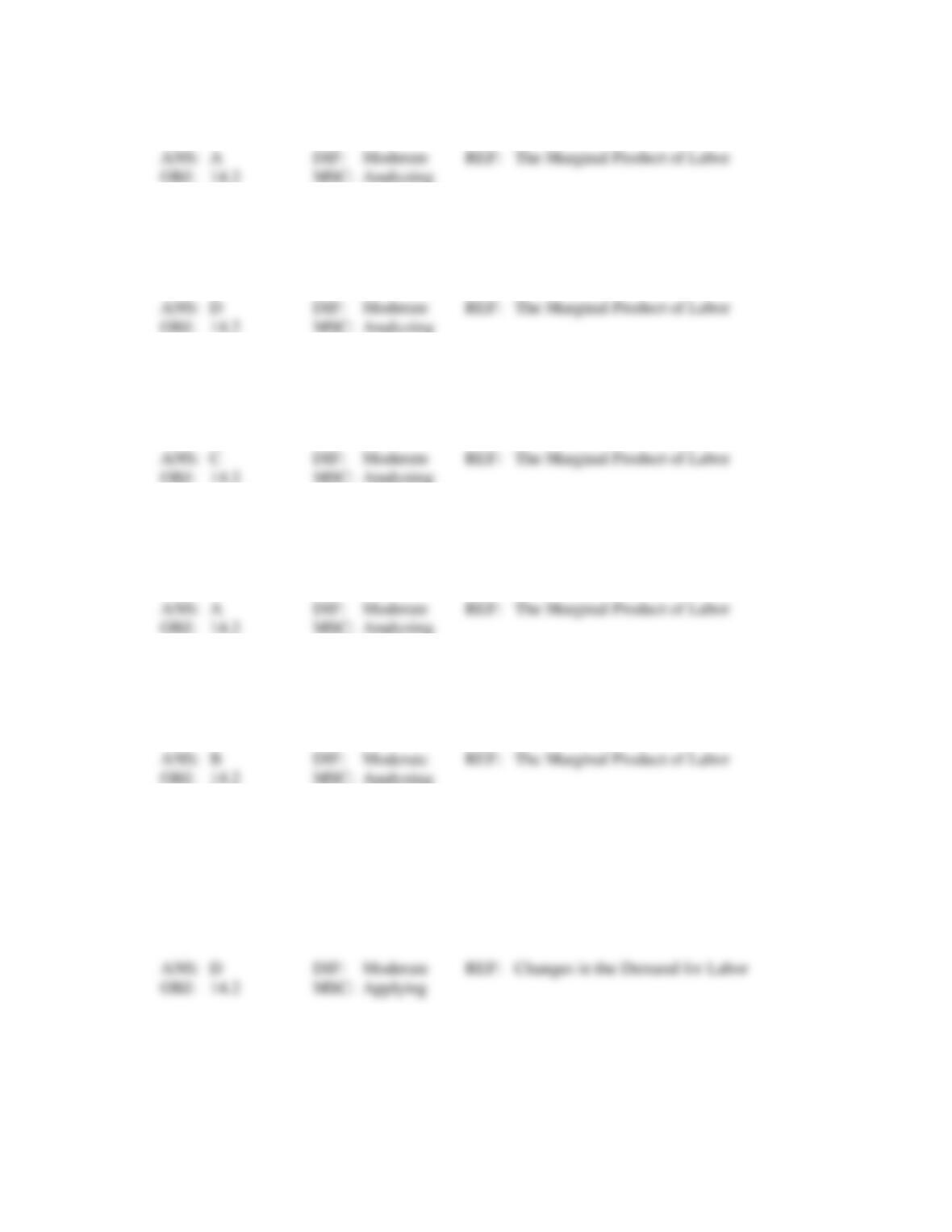
145. What is the value that belongs in cell C6?
a. 50 d. 200
b. 100 e. 300
c. 150
146. What is the value that belongs in cell D4?
a. $600 d. $450
b. $500 e. $300
c. $150
147. What is the value that belongs in cell D6?
a. $50 d. $200
b. $100 e. $300
c. $150
148. What is the value that belongs in cell F3?
a. $500 d. $600
b. $ – 100 e. $ – 300
c. $750
149. What is the value that belongs in cell F5?
a. $–50 d. $–200
b. $–100 e. $300
c. $150
150. Which of the following would increase the demand for labor?
a. a decrease in the product price
b. a decrease in the product price and a labor-saving machine acquisition
c. an increase in the product price
d. an increase in the product price and a labor-enhancing machine acquisition
e. a decrease in the product price, an increase in the product price, and a labor-saving machine
acquisition
SHORT ANSWER
1. The total production schedule for greeting card writers is as follows:
Quantity of Writers Total Cards
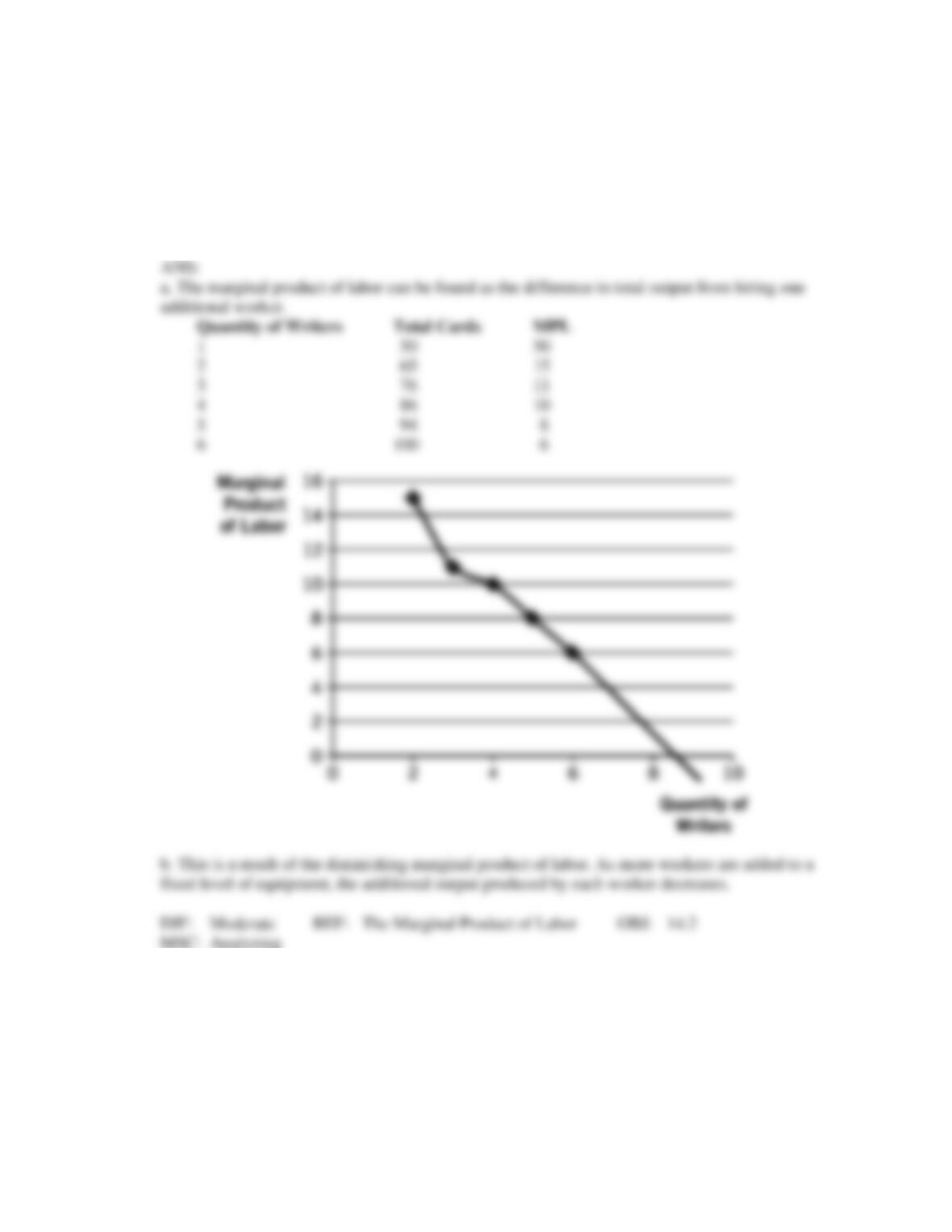
1 50
2 65
3 76
4 86
5 94
6 100
a. Find the marginal product for each additional worker, and graph the marginal product of labor
(MPL) curve.
b. Why is the slope of the MPL curve negative?
2. The following table contains the relationship between a number of trainers working at the new
gym (Crossfit by Shawna) and how many clients they can train. These clients represent the output
of trainers. Clients pay $40 per session.
Number of Trainers Clients Trained
1 10
2 50
3 80
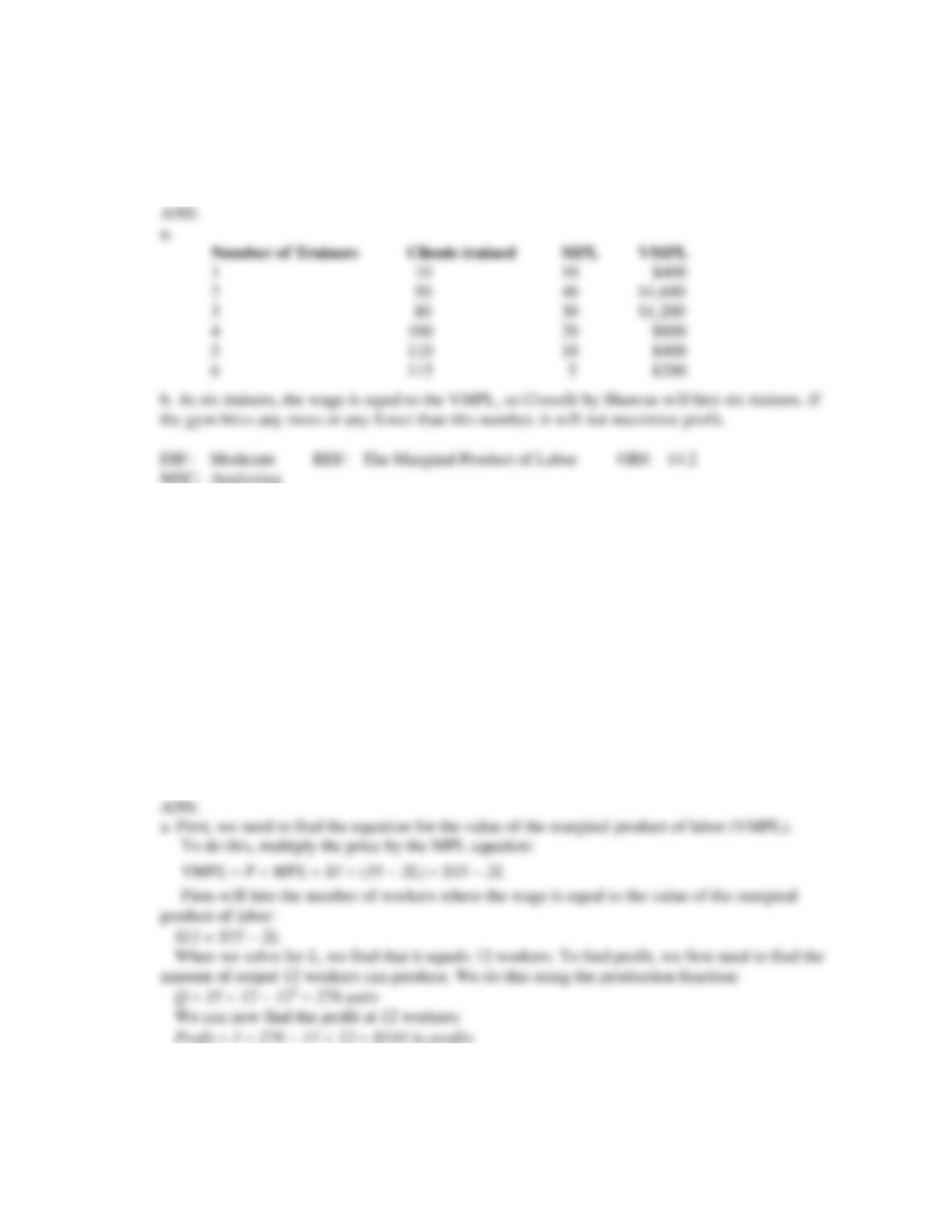
4 100
5 110
6 115
a. Find the marginal product of labor (MPL) and the value of the marginal product of labor
(VMPL) for each additional trainer hired, and record these numbers in columns on the table.
b. Crossfit by Shawna’s premier trainers earn $200 an hour. How many trainers will the gym hire?
3. A firm calculates that the marginal product of labor (MPL) can be found from the following
equation:
MPL = 35 − 2L
where L is the number of workers hired.
The production function for this firm is as follows:
Q = 35L − L2
The firm knows it can find profits with the following equation:
Profit = P Q − W L
where P stands for the selling price of the good, Q stands for total output, and W represents the
wage. Price is equal to $1.
a. If the wage is $11, how many workers will the firm hire? How much profit will it earn?
b. Compare this level of profits to those earned by the firm if it hired one fewer worker than L* and
one worker more than L* to demonstrate that L* workers generate the most profit for the firm.
4. Assume that consumer demand for hybrid vehicles is increasing and that for large SUVs it is
decreasing. The labor supply is the same for both markets.
a. How does this difference in consumer demand affect the labor demand for workers producing
hybrid vehicles versus that of workers making SUVs?
b. Using a supply and demand graph and your answer to part a, show why workers producing
hybrids earn more than workers who build SUVs.

5. The following table includes information on the labor market for bakers:
Wage Labor Demand Labor Supply
$10 50 10
$15 45 20
$20 40 40
$25 35 70
$30 30 110
$35 25 160
a. What is the equilibrium wage and quantity of bakers in this market?
b. With the invention of instant teleportation, baker positions can be outsourced to countries with
cheaper labor without sacrificing freshly baked goods. This reduces the labor demand for
bakers by four-fifths. What is the new equilibrium wage and quantity of bakers hired?
c. Who wins in this situation in the short run? Who loses? What needs to happen in the long run so
that the economic losers can benefit from outsourcing?
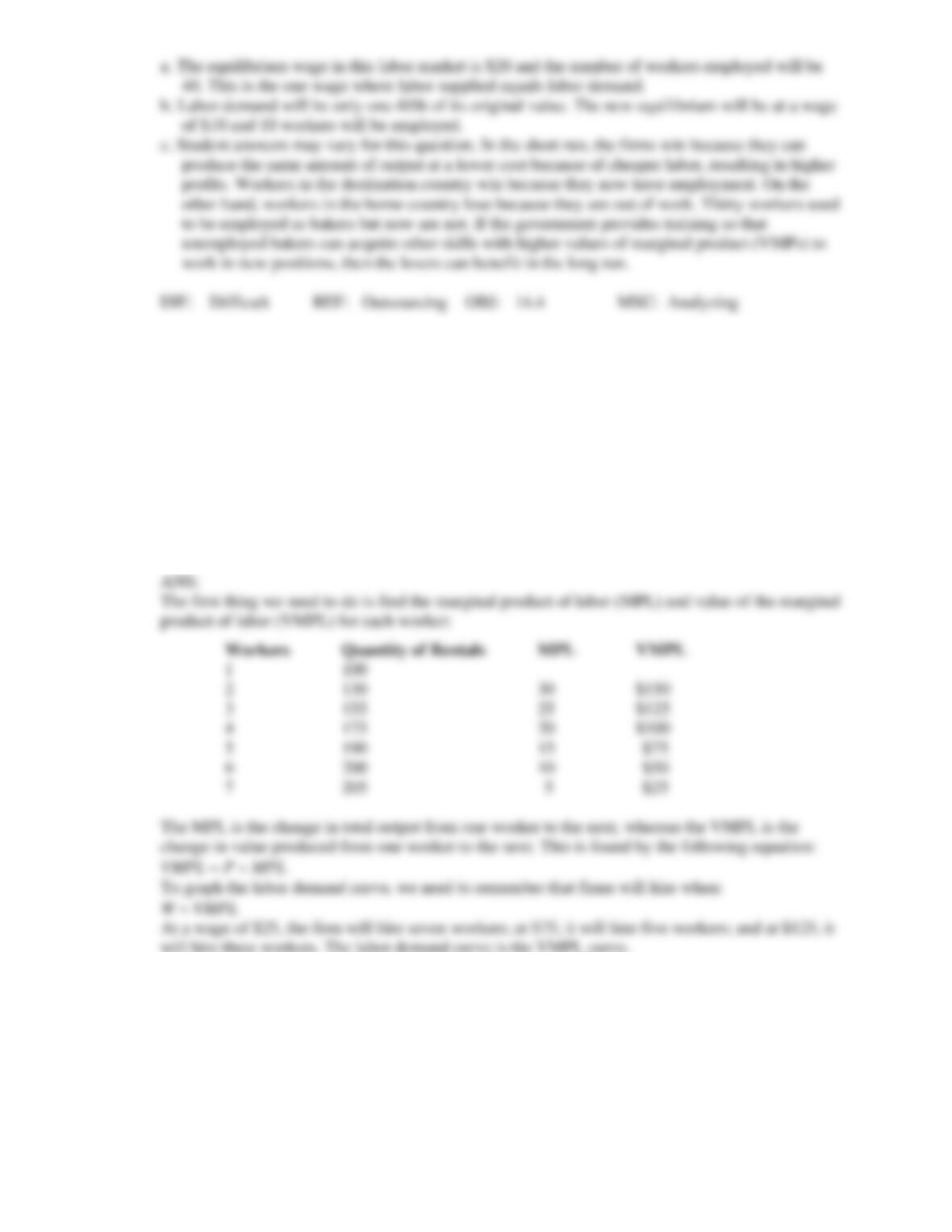
6. Lakeside Tubing knows that its total product schedule is as shown in the following table. It
currently rents an inner tube for $5. Graph the labor demand curve.
Workers Quantity of Rentals
1 100
2 130
3 155
4 175
5 190
6 200
7 205
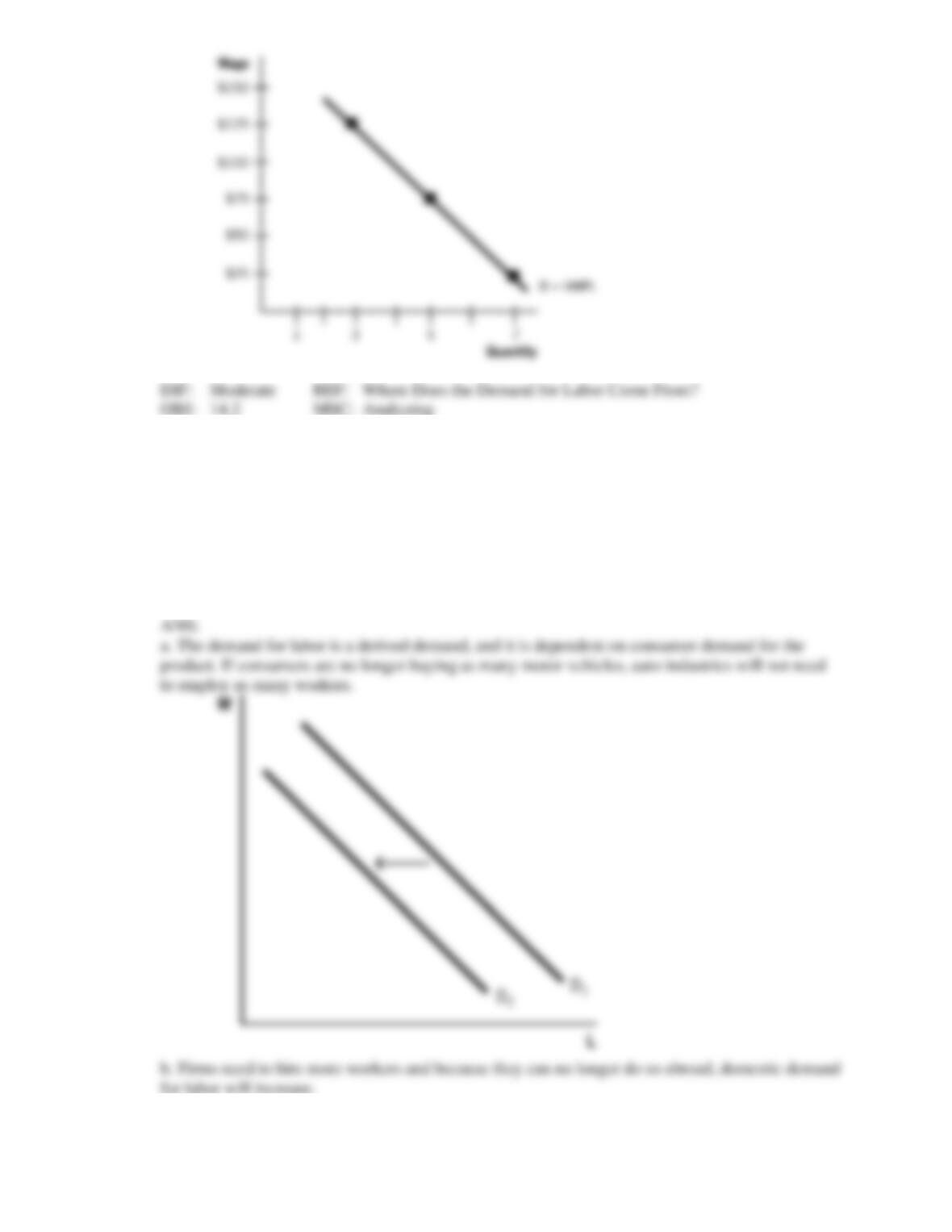
7. Consider the labor market for autoworkers. Graph and explain how the following events would
affect the labor demand curve for these workers:
a. Citizens become more concerned about the environment, choosing public transportation over
motor vehicles.
b. Domestic pressures and governmental policy make it harder for firms to outsource their
production to other countries. As business expands, firms must hire domestically.
c. Assembly line technology improves to the point where only a handful of workers are needed to
operate the production system.