CHAPTER 14: The Demand and Supply of Resources
MULTIPLE CHOICE
1. Derived demand is
a. consumer demand for goods and services.
b. based on the prices of factors of production.
c. the demand for factors of production directly by business.
d. the demand for factors of production dependent on consumer demand for output.
e. calculated for firms.
2. Factors of production are
a. goods and services.
b. used to make goods and services.
c. purchased by the consumer for personal use.
d. sold by the consumer for income.
e. the property of firms.
3. Which of the following is NOT a factor of production?
a. land d. entrepreneurship
b. output e. capital
c. inputs
4. Derived demand best describes the demand for which of the following options?
a. cupcakes d. cat food
b. canned soda e. cars
c. computer chips
5. Derived demand is NOT represented by the demand for
a. bakers. d. office space.
b. home ovens. e. car engines.
c. fast-food fryers.
6. The marginal product of labor is the
a. additional amount of consumer goods that can be bought from an additional hour’s worth of
work.
b. additional amount of inputs a firm demands based on a change in consumer demand for the
output.
c. additional amount of output that can be produced from hiring one more worker.

d. decreasing amount of output that can be produced from hiring one more worker.
e. value of production from the last worker hired.
7. The fact that workers must share a limited amount of space and equipment results in ________
marginal productivity.
a. increasing d. unpredictable
b. constant e. diminishing
c. fluctuating
8. The area underneath a firm’s labor demand curve and above the market wage is the graphical
representation of the firm’s
a. revenues. d. losses.
b. costs. e. hiring decisions.
c. profits.
9. The diminishing marginal product of labor exists when the last worker hired produces ________
the previous worker.
a. more output than d. the same amount of output as
b. more value than e. the same amount of value as
c. less value than
10. The marginal product of labor of the fourth worker is
a. 10. d. 38.
b. 20. e. 42.
c. 4.
11. The marginal product of the first worker is
a. 4. d. 20.
b. 6. e. 2.
c. 10.
12. If the price of output is $5, the value of the marginal product of labor of the third worker is
a. $8. d. $38.
b. $30. e. $190.
c. $40.
13. If the price of output falls from $5 to $2, the value of the marginal product of labor of all workers
a. increases. d. decreases at an increasing rate.
b. remains unchanged. e. decreases.
c. increases at an increasing rate.
14. If the price of output is $2 and the wage for workers is $4, how many workers will the firm hire?
a. one d. four
b. two e. five
c. three
15. What additional amount of output does the thirtieth worker contribute?
a. 150 units d. 14 units
b. 60 units e. 9 units
c. 2 units
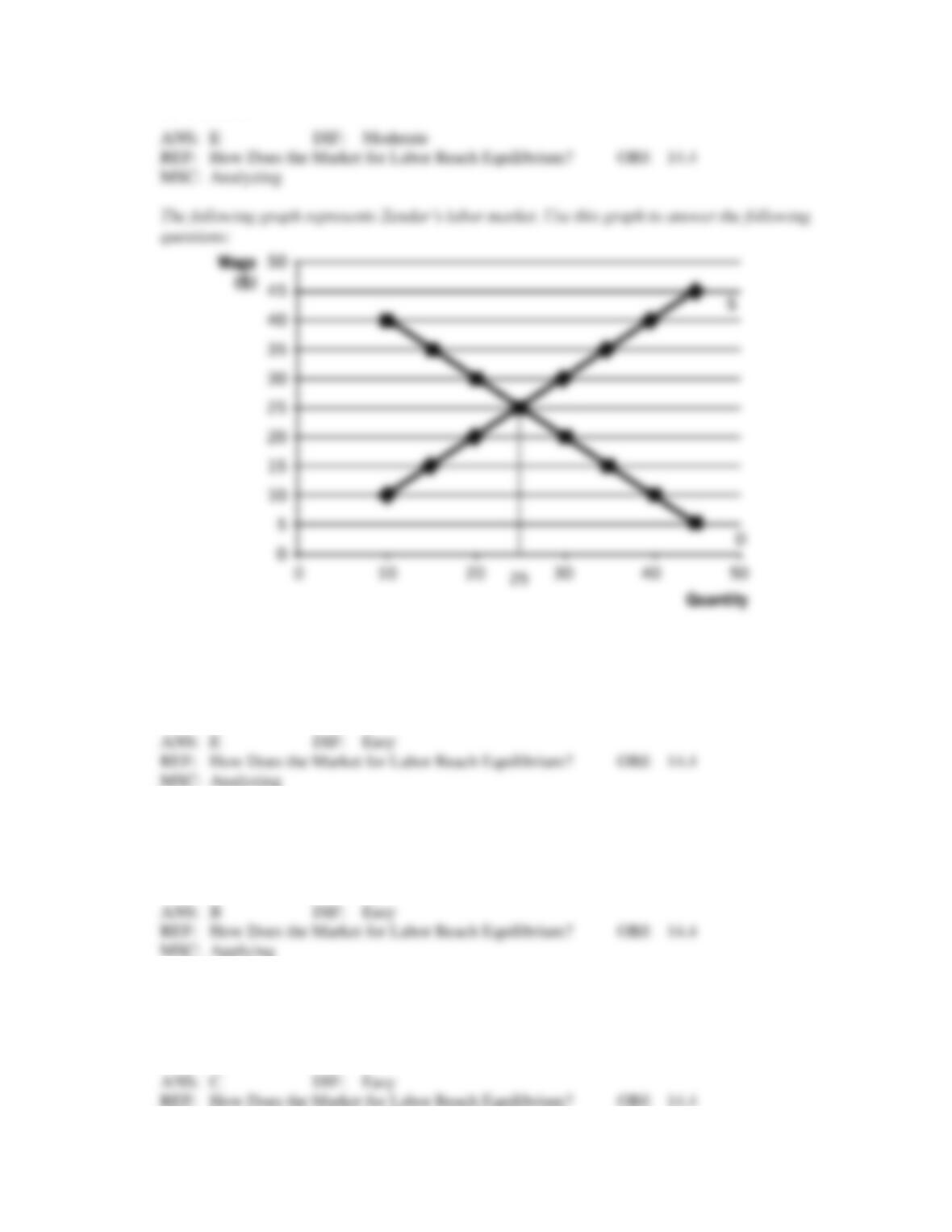
16. What is the value of additional output produced by the twelfth worker?
a. $20 d. $60
b. $100 e. $80
c. $10
17. What wage would be required to allow Mickey to hire the twenty–fifth worker?
a. $3 d. $125
b. $7 e. $25
c. $21
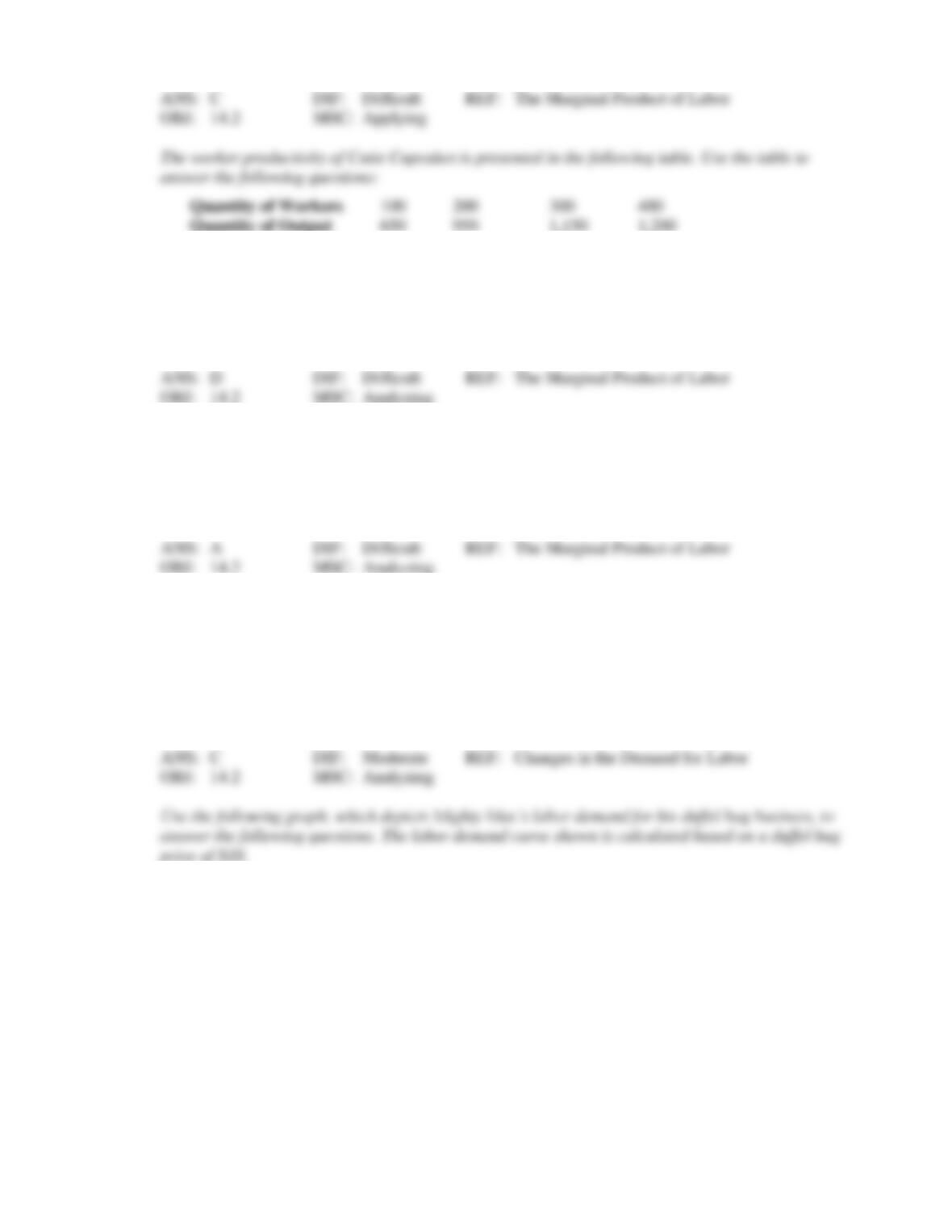
18. When Cutie Cupcakes hires its three hundredth worker, what is that worker’s marginal product of
labor?
a. 300 cupcakes d. 2 cupcakes
b. 200 cupcakes e. 3 cupcakes
c. 100 cupcakes
19. If the wage is $8 and the price of a cupcake is $4, what are Cutie Cupcakes’ profits at the optimal
amount of labor?
a. $2,200 d. $5,000
b. $2,600 e. $7,500
c. $4,600
20. Cupcakes previously sold for $3 and now sell for $5. The number of workers that Cutie Cupcakes
hires will
a. fall.
b. remain unchanged, but employees will have to work overtime.
c. increase.
d. stay the same.
e. increase indefinitely.
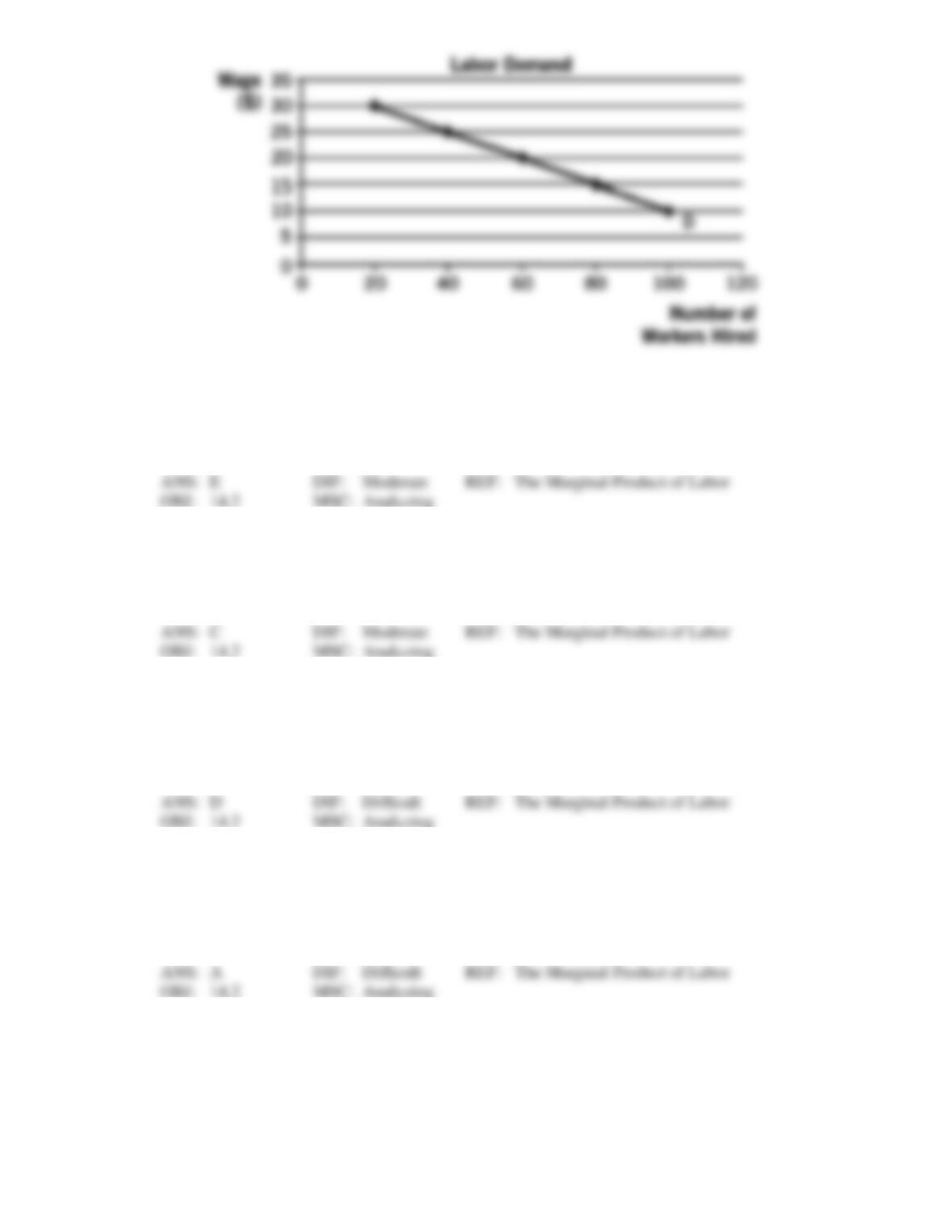
21. If the wage is $20, Mighty Max will hire __________ workers.
a. 20 d. 50
b. 30 e. 60
c. 40
22. If 80 workers are hired, you know that the wage rate must be
a. $25. d. $10.
b. $20. e. $5.
c. $15.
23. Assume that the price per duffel bag rises from $10 to $20. What is the value of the marginal
product of labor of the twentieth worker?
a. $30 d. $60
b. $40 e. $70
c. $50
24. Assume that the price of duffel bags is $10. If the marginal product of labor of the sixtieth worker
drops by half, what is the value of the marginal product of labor of the sixtieth worker now?
a. $10 d. $25
b. $15 e. $30
c. $20
25. If the price increases from $10 to $20 per bag, what happens to the labor demand curve?
a. It shifts to the left.
b. It shifts to the right.
c. It remains unchanged.
d. The firm moves upward along the labor demand curve.

e. The firm moves downward along the labor demand curve.
26. If the wage of the fifth worker is $20 and his or her value of the marginal product of labor is $25,
the firm
a. benefits by stopping at this level of labor.
b. is likely to fire the fifth worker.
c. asks this fifth worker to work overtime.
d. is likely to benefit by hiring more workers.
e. is likely to lose profit by hiring more workers.
27. Talia just applied for a position with Rory’s firm. Rory knows that Talia will earn $20 an hour and
can produce a value of the marginal product of labor (VMPL) of $40. Rory will ________ Talia
because her VMPL is ________.
a. hire; positive d. not hire; negative
b. not hire; positive e. possibly hire; positive
c. hire; negative
28. If workers become more productive in a given occupation, they will likely see their employment
________.
a. fall d. stay the same
b. double e. go into overtime
c. rise
29. If the price of pencils falls, the marginal product of labor will ________ and the value of the
marginal product of labor will ________.
a. fall; fall
b. remain unchanged; increase
c. rise; rise
d. remain unchanged; decrease
e. remain unchanged; remain unchanged
30. Bobby knows that she is producing a value just equal to her wage. If the price of what she makes
falls, Bobby knows that she
a. will be able to keep her job.
b. is likely to work overtime.
c. will work less.
d. is likely to be fired.
e. will not be able to find work anywhere.
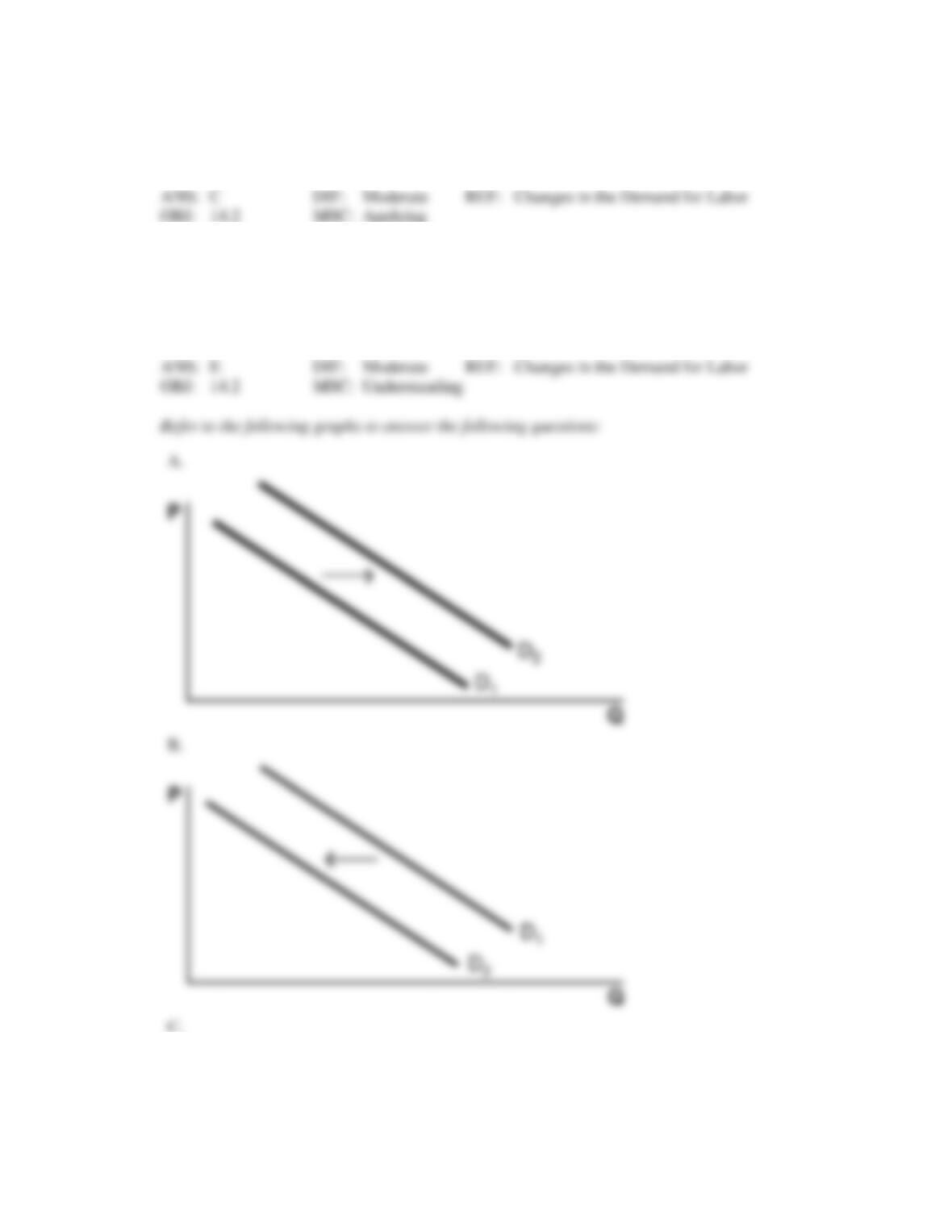
31. The use of farm machinery to plant and harvest crops has increased because it is more productive
than the typical farmhand. Demand for farmhands has
a. remained steady. d. fallen to zero.
b. shifted to other areas of the farm. e. increased.
c. decreased.
32. As computer usage in companies and in the home has increased, the labor demand for information
technology (IT) workers has
a. remained steady. d. infinitely increased.
b. decreased. e. increased.
c. fallen to zero.
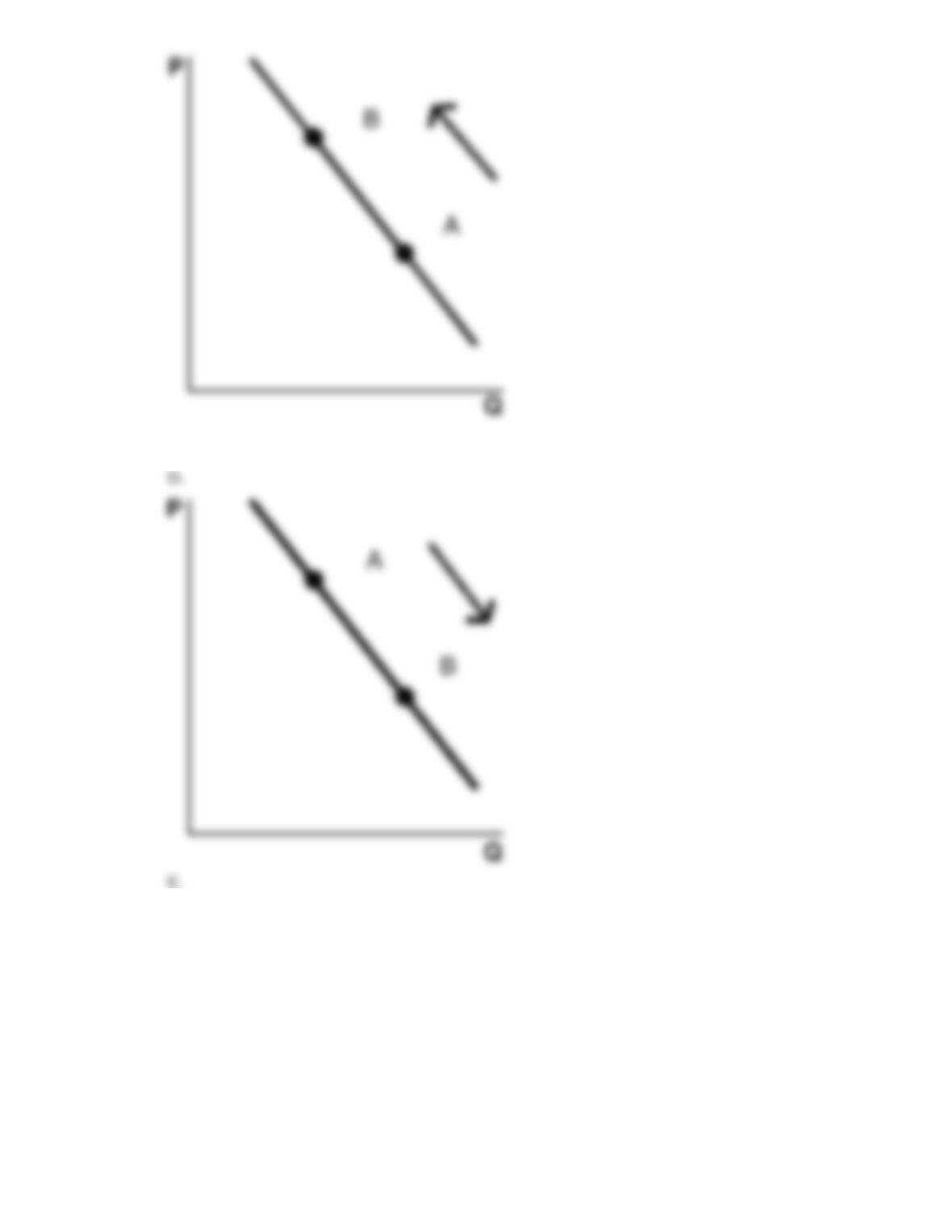
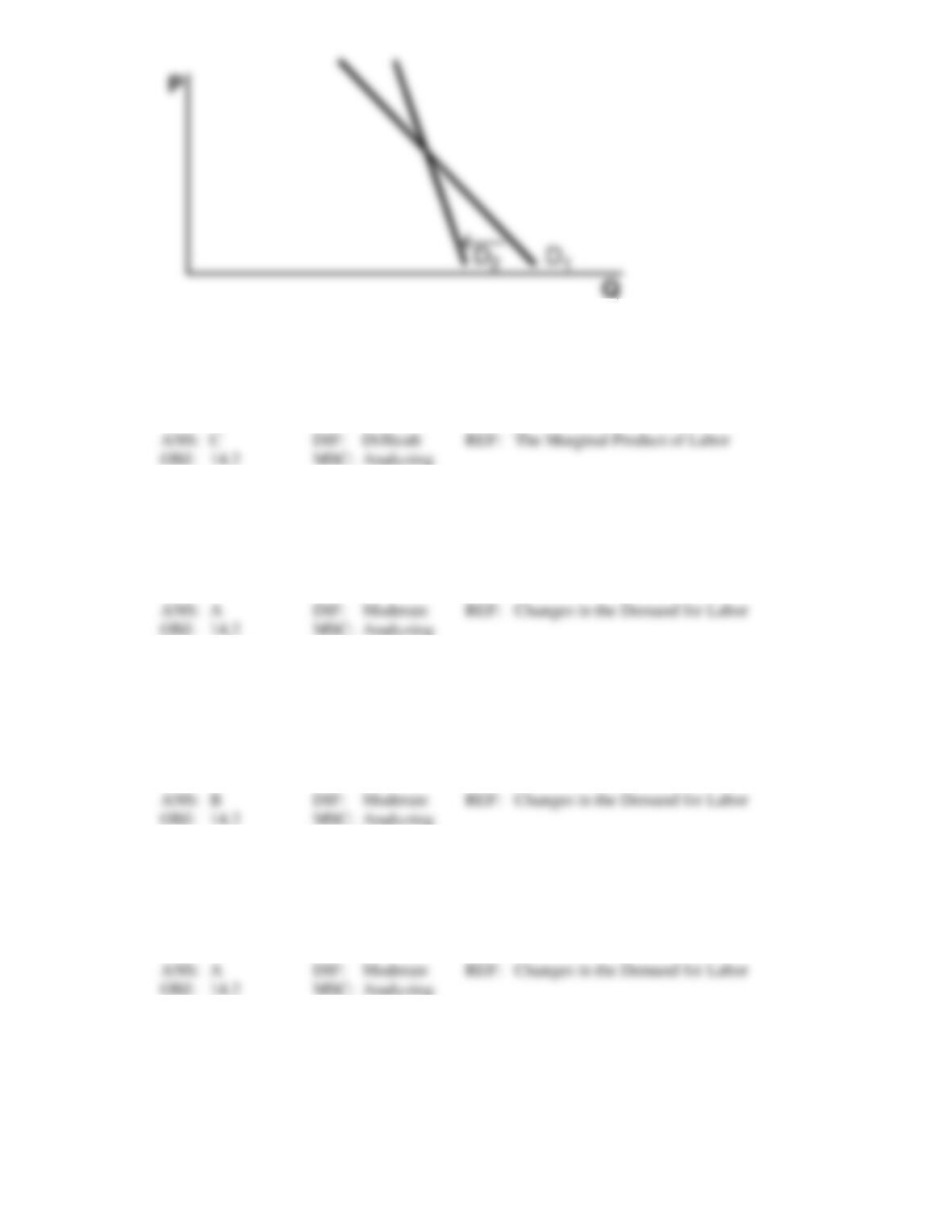
33. Choose the graph that represents the following situation: The government raises the minimum
wage.
a. Graph A d. Graph D
b. Graph B e. Graph E
c. Graph C
34. Choose the graph that represents the following situation: Consumer demand for Princeton Pickles
increases as customers find out that pickles are highly nutritious.
a. Graph A d. Graph D
b. Graph B e. Graph E
c. Graph C
35. Choose the graph that represents the following situation: A documentary on bottled water
demonstrates the high impact this product has on the environment. In response, consumers
drastically reduce their consumption of this product.
a. Graph A d. Graph D
b. Graph B e. Graph E
c. Graph C
36. Choose the graph that represents the following situation: Out of fear of losing their jobs in a
depressed economic climate, workers increase their rate of production.
a. Graph A d. Graph D
b. Graph B e. Graph E
c. Graph C
37. If more of the production process for automobiles were switched over to machines, the demand for
auto factory assembly line workers would ________ machine maintenance.
a. decline but increase d. increase and also increase
b. decline and also decline e. remained unchanged but increase
c. increase but decline
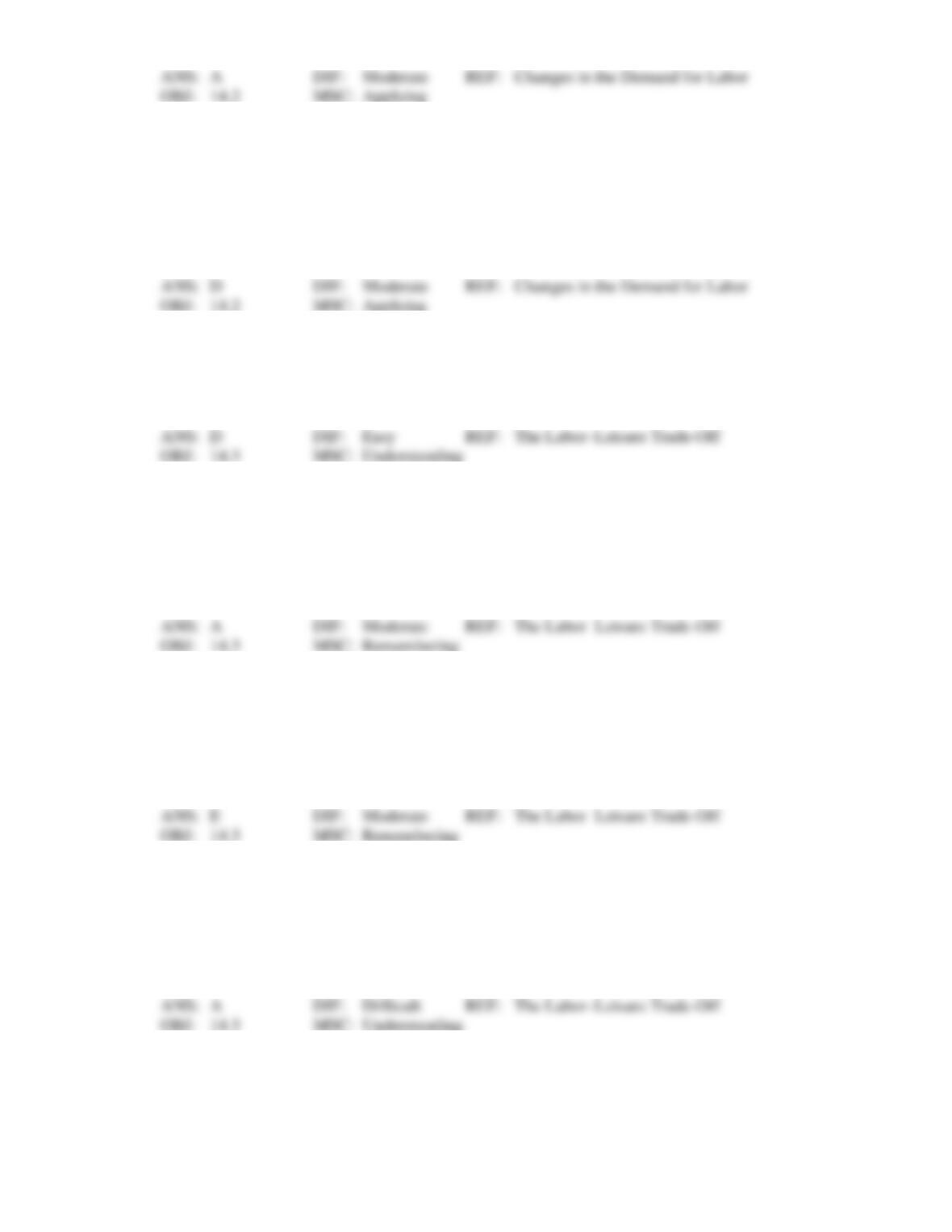
38. Yolanda owns a temp agency. She sees demand for her workers increase because firms prefer a
more contingent workforce. The value of the marginal product of labor of her temps
a. stays the same.
b. increases because the temps produce more per hour.
c. decreases because the temps know they are going to get jobs.
d. increases because the price of their services is higher.
e. falls because job uncertainty lowers productivity.
39. The fundamental decision faced by workers is called
a. labor demand. d. the labor–leisure trade-off.
b. labor supply. e. the substitution effect.
c. income effect.
40. The substitution effect describes the
a. incentive to work more when the wage rises.
b. incentive to work less when the wage rises.
c. decision whether to work more or less.
d. decision whether to join the labor force.
e. incentive to change jobs.
41. The income effect describes the
a. incentive to change jobs.
b. decision whether to join the labor force.
c. decision to ask for a raise.
d. incentive to work more when the wage rises.
e. incentive to work less when the wage rises.
42. The backward-bending labor supply curve occurs because workers value leisure
a. and income differently as wages change.
b. consistently more than they do income at all wages.
c. consistently less than they do income at all wages.
d. and income by the same amount at all wages.
e. and income by fluctuating, unpredictable amounts at any wage.
43. Labor supply is the relationship between
a. wages and willingness to hire workers.
b. price of output and amount of output for sale.
c. price of capital and amount of capital for sale.
d. wages and willingness to work.
e. wages and amount of output for sale.
44. When people make more money, they sometimes take more vacation time. Based on this
information, we can say that leisure is a(n) ________ good.
a. substitute d. Giffen
b. complement e. normal
c. inferior
45. Rowan is deciding whether to pick up more hours at work or to take a vacation. This decision best
describes
a. her hours decision.
b. her labor force participation decision.
c. the value she places on income.
d. the labor–leisure trade-off.
e. the necessity of income.
46. When Franklin earns more income but still works less, leisure is a ________ good for him.
a. substitute d. necessity
b. complement e. normal
c. luxury
47. No matter how high his wage rises, Johann will always work more. His labor supply curve is
a. downward-sloping.
b. horizontal.
c. vertical.
d. upward-sloping.
e. upward-sloping at an increasing rate.
48. If you know that the substitution effect dominates the income effect when Jasper’s wage rises, you
can tell that his labor supply curve is
a. upward-sloping.
b. downward-sloping.
c. vertical.
d. upward-sloping at an increasing rate.
e. downward-sloping at an increasing rate.
49. The backward-bending labor supply curve has its shape because, at
a. low wages, the income effect dominates the substitution effect, but the reverse occurs at high
wages.
b. high wages, the substitution effect dominates the income effect, but the reverse occurs at low
wages.
c. low wages, the substitution effect dominates the income effect, but the reverse occurs at high
wages.
d. all wages, the income effect dominates the substitution effect.
e. all wages, the substitution effect dominates the income effect.
50. When Noah’s wage rises and he decides to work more hours, we know that the ________ effect
has dominated the ________ effect.
a. substitution; income d. leisure; labor
b. labor; leisure e. substitution; leisure
c. income; substitution
51. When the opportunity cost of leisure is high, people tend to work ________ hours. When it is low,
people tend to work ________ hours.
a. the same; fewer d. more; the same
b. more; fewer e. fewer; the same
c. fewer; more
52. When their wages rise, Raymond works more and Brandi works less. We can infer that Raymond
values income ________ than Brandi.
a. less d. half as much
b. the same e. a third more
c. more
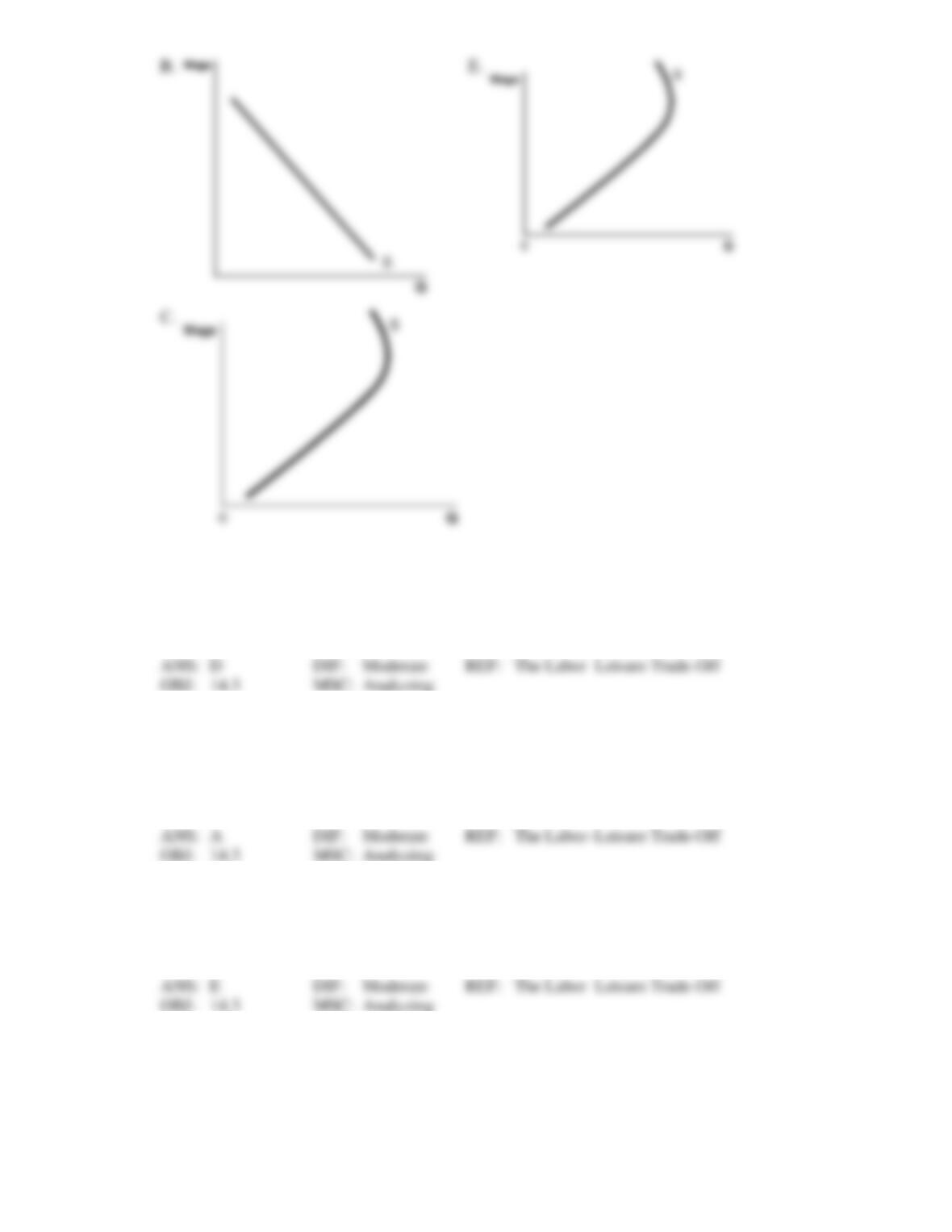
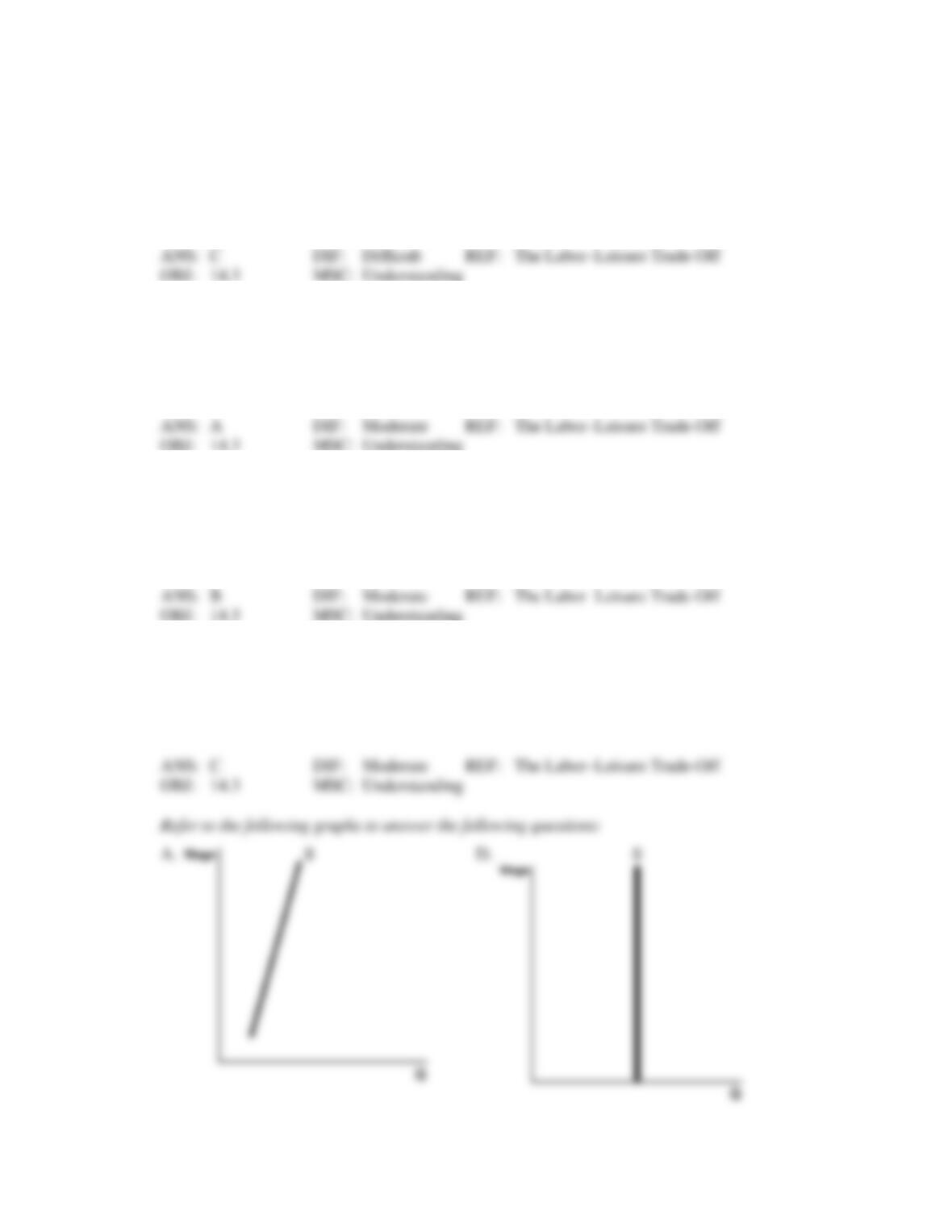
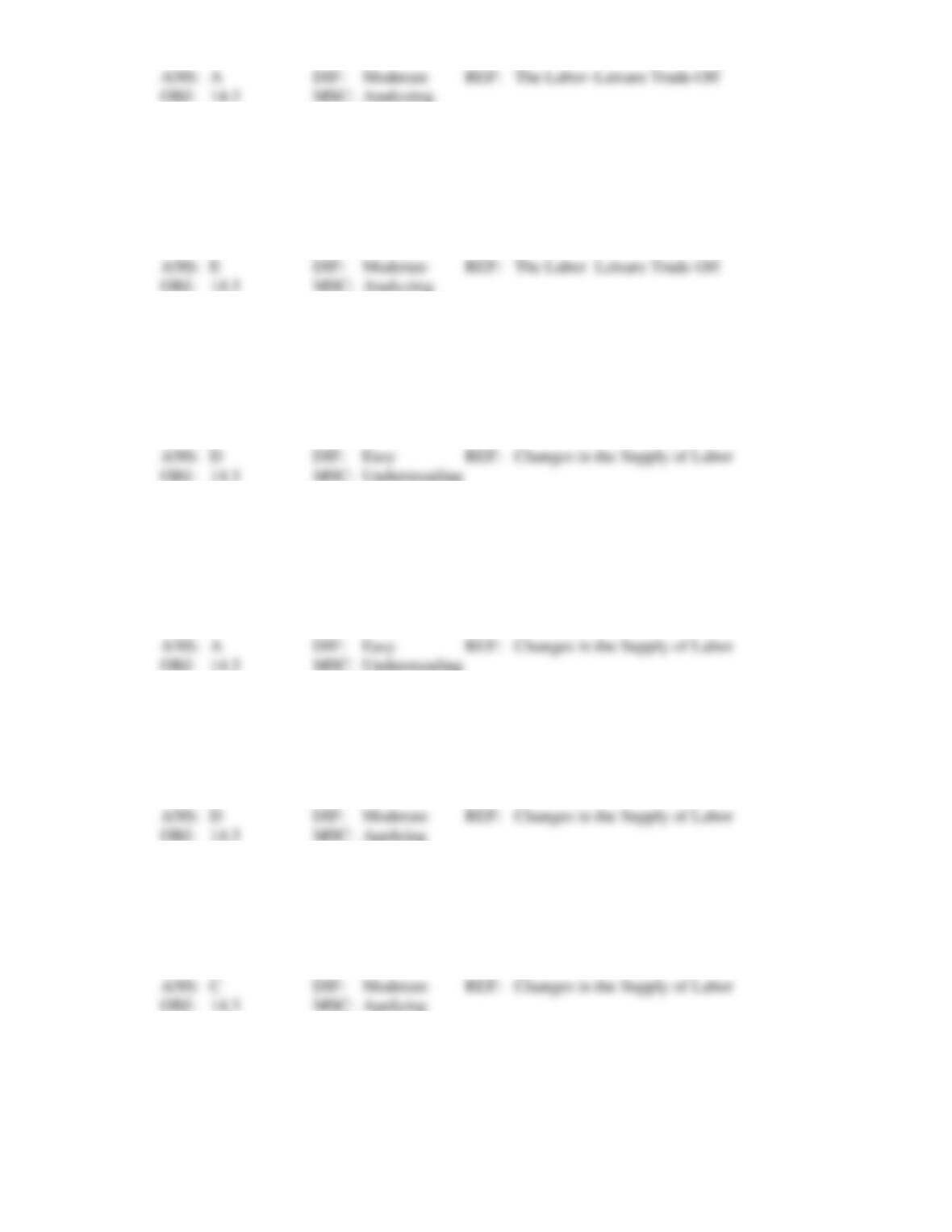
53. Which graph shows a person who has a fixed quantity of hours that he or she is willing to work per
week?
a. Graph A d. Graph D
b. Graph B e. Graph E
c. Graph C
54. Choose the graph that reflects this scenario: Roman decides that he values income much more
strongly because he uses the money to buy goods he can enjoy more than free time.
a. Graph A d. Graph D
b. Graph B e. Graph E
c. Graph C
55. Which graph shows the income effect dominating the substitution effect of higher wages?
a. Graph A d. Graph D
b. Graph B e. Graph E
c. Graph C
56. Which graph shows the substitution effect dominating the income effect of higher wages?
a. Graph A d. Graph D
b. Graph B e. Graph E
c. Graph C
57. Ummal travels back in time to deposit $100 in a high-interest-bearing savings account. When she
returns to the present, she is a billionaire. We can expect Ummal to work ________ hours because
of the ________ effect.
a. more; substitution d. more; labor–leisure
b. more; income e. fewer; income
c. fewer; substitution
58. Migration is when
a. foreign persons enter a country.
b. foreign persons leave a country.
c. citizens move to another country.
d. citizens move within their own country.
e. foreign persons move within their own country.
59. Immigration is when
a. foreign persons enter another country.
b. foreign persons leave another country.
c. citizens move to another country.
d. citizens move within their own country.
e. foreign persons move within their own country.
60. The minimum wage is increased to $15. This higher wage might ________ labor force
participation, shifting the labor supply curve to the ________.
a. decrease; right d. increase; right
b. increase; left e. not change; right
c. decrease; left
61. More job opportunities open up in the South, prompting labor supply curves in northern states to
________ and in southern states to ________.
a. remain unchanged; shift right d. shift left; remain unchanged
b. shift right; shift right e. shift left; shift left
c. shift left; shift right
62. The citizens of Robbinsville notice that their friends and family in the neighboring city of Deville
are earning higher wages. We would expect the labor supply in Robbinsville ________ and the
labor supply in Deville to ________.
a. shift right; shift right d. shift left; shift right

b. shift left; shift left e. shift right; shift left
c. remain unchanged; shift right
63. After World War II, social norms relating to women’s participation in the labor force relaxed and
women were more likely to be employed outside the home. We would expect to see the labor
supply curve
a. stay the same. d. stay the same but move downward.
b. shift left. e. shift right.
c. stay the same but move upward.
64. The government lowers the retirement age to 55. We would expect to see the labor supply curve
a. stay the same.
b. shift left.
c. stay the same but move upward.
d. stay the same but move downward.
e. shift right.
65. The labor market is said to be in equilibrium when
a. everyone who wants to work is supplying his or her labor.
b. the number of workers is equal to the number of jobs available at a specific wage.
c. firms are unwilling to hire more workers.
d. workers keep their hours constant.
e. the number of available workers is increasing.
66. There will be a ________ of workers when the wage is ________ the equilibrium wage.
a. surplus; at d. shortage; above
b. surplus; below e. shortage; at
c. surplus; above
67. There will be a ________ of workers when the wage is ________ the equilibrium wage.
a. surplus; at d. shortage; at
b. shortage; below e. surplus; below
c. shortage; above

68. The supply schedule indicates that the labor supply curve is
a. backward-bending. d. vertical.
b. upward-sloping. e. horizontal.
c. downward-sloping.
69. The equilibrium wage is
a. $10. d. $40.
b. $20. e. $50.
c. $30.
70. Wages above ________ will cause a ________.
a. $10; surplus d. $30; shortage
b. $50; shortage e. $40; shortage
c. $20; surplus
71. If the wage is temporarily set at $25, it will need to ________ to restore equilibrium.
a. rise d. decrease to zero
b. fall e. increase to $30
c. remain unchanged
72. If the wage is set temporarily at $15, it will need to ________ to restore equilibrium.
a. decrease to zero d. increase
b. increase to $35 e. remain unchanged
c. fall
73. There will be a surplus of ________ workers at a wage of ________.
a. 75; $10 d. 40; $40
b. 100; $20 e. 50; $30
c. 135; $40
74. To have no surplus or shortage of workers in Zendar, what does the wage rate have to be?
a. $5 d. $20
b. $10 e. $25
c. $15
75. What is the equilibrium number of workers in Zendar?
a. 20 d. 35
b. 25 e. 40
c. 30
76. At a wage of ________, there is a ________ of ________ workers.
a. $10; surplus; 30 d. $35; shortage; 20
b. $40; shortage; 30 e. $25; surplus; 10
c. $10; shortage; 30

77. At all wages below ________, there will be ________.
a. $10; a surplus d. $35; no labor supplied
b. $25; a shortage e. $20; no labor demanded
c. $40; a surplus
78. At a wage of ________, ________ workers are demanded.
a. $5; 10 d. $40; 10
b. $10; 35 e. $45; 45
c. $15; 40
79. Companies begin to find that customers, when calling customer service, want to talk to real people
rather than to a recording. The demand for receptionists will ________ and the market equilibrium
wage will ________.
a. fall; fall d. decrease; rise
b. increase; fall e. increase; increase
c. stay the same; rise
80. With a large group of citizens leaving a country, what will happen to the equilibrium wage and
quantity of workers employed?
a. Both will fall.
b. Both will rise.
c. The equilibrium number of workers will rise and the wage will fall.
d. The equilibrium number of workers will fall and the wage will fall.
e. The equilibrium number of workers will fall and the wage will rise.
81. In the distant future, companies will be using technology that can replicate food. What will happen
to the equilibrium wage and quantity of cooks?
a. The wage will rise and the number of cooks employed will rise.
b. Both will remain unchanged.
c. The wage will stay the same, but many cooks will leave the market.
d. The wage will rise, and the number of cooks employed will fall.
e. The wage and quantity demand will both decrease because firms won’t hire as many cooks.

82. The labor supply curve is given by the equation LS = 3W + 20 and the labor demand curve is given
by the equation LD = 80 − 2W. The equilibrium wage in this labor market is
a. $10. d. $56.
b. $12. e. $80.
c. $36.
83. The labor supply curve is given by the equation LS = 3W + 20 and the labor demand curve is given
by the equation LD = 80 − 2W. The equilibrium number of workers in this labor market is
a. 12. d. 56.
b. 20. e. 80.
c. 36.
84. The labor supply curve is given by the equation LS = 3W + 20 and the labor demand curve is given
by the equation LD = 80 − 2W. If the wage is $20, there will be a ________ of ________ workers.
a. surplus; 80 d. surplus; 40
b. shortage; 40 e. surplus; 20
c. shortage; 80
85. Lorelei finds that she is consistently unable to fill all of the open positions at her bakery. This
indicates that the wage she is offering is
a. above the market rate.
b. at the market rate.
c. double what her competitors are offering their employees.
d. half of what her competitors are offering their employees.
e. below the market rate.
86. Mauna decides that worker turnover is too high at her firm. She hopes that by paying above-market
wages, workers will stay longer. This may create
a. a surplus of workers. d. a shortage of overtime.
b. a surplus of jobs. e. no disequilibrium.
c. a shortage of workers.
87. Outsourcing is when
a. consumers buy products made in another country.
b. foreign consumers buy products made in the United States.

c. U.S. firms shift jobs to outside the company.
d. the costs of operating are higher in another country.
e. the domestic labor supply shrinks.
88. Which position is most easily outsourced?
a. a customer service representative at your local cable company
b. a hair stylist
c. a local town chocolatier
d. a general practitioner doctor
e. an economics professor
89. Which company is most easily able to outsource its operations and have its good or service
produced in another country?
a. Hannah’s Hair Salons d. Busker Baseball Team
b. Darling Dentistry e. Penelope’s Fresh Pretzels
c. Queen’s Quilts
90. Companies outsource their operations because
a. the weather is nicer in other countries.
b. employees in other countries take less sick leave.
c. governments in other countries allow them to operate.
d. labor costs are lower.
e. no one wants to do the work domestically.
91. In theory, some people might lose in the short run from outsourcing, but in the long run, all should
benefit. Which option demonstrates that this theory might NOT be true?
a. Lower labor costs lead to lower prices, so more foreigners can buy imports.
b. Income earned at outsourced jobs allows foreign workers to purchase imports.
c. Lower prices allow more consumers to buy the good domestically.
d. Outsourcing stimulates competition.
e. Inadequate transition programs hinder the ability of domestic workers, who lost their jobs to
outsourcing, to obtain new jobs.
92. In the short run, wages in the home country will ________ when a company outsources its
operations because labor demand in the home country has ________.
a. rise; risen d. fall by a third; risen
b. stay the same; fallen e. fall; fallen
c. double; risen