
Chapter 14 – Rent, Interest, and Profit
14-1
CHAPTER 14
Rent, Interest, and Profit
A. Short-Answer, Essays, and Problems
1. What determines the economic rent for land? Explain from a supply and demand perspective.
2. How does the supply of land differ from the supply of most labor? How will the effect on price of an
outward shift in demand for labor differ from the effect on price of an equivalent shift in the demand for
land?
3. David Ricardo, a nineteenth century economist, wrote “The price of corn is not high because a rent is paid,
but a rent is paid because the price of corn is high.” Explain this statement in the context of supply and
demand.
4. Assume that the quantity of a certain type of farmland is 400,000 acres and the demand for this land is that
given in the table below.
Pure land rent,
per acre
Land demanded,
acres
$500
100,000
400
200,000
300
300,000
200
400,000
100
500,000
50
600,000
(a) What will be the economic rent and how much land will be rented?
(b) If the productivity of the land increases such that 200,000 more acres are demanded at each price, what
will the economic rent be and how much land will be supplied?
(c) Given the new demand schedule in (b), if landowners were taxed at a rate of $200 per acre for their
land, what would be the economic rent on this land after taxes and how many acres would be rented?
5. Using the below axes draw a supply and demand graph for land showing it as a “free” good.
6. What explains differences in the economic rent charged for two plots of 500 acres of land that are used for
growing corn and located in the same county of a state?
7. Why would farmland closer to the limits of a city be worth more than farmland farther out?
8. Why is land rent a “surplus payment” from the perspective of economists?

Chapter 14 – Rent, Interest, and Profit
14-2
9. What is the difference between society’s view and an individual firm’s view of economic rent?
10. Explain the economic rationale for Henry George’s proposal for a single tax on land.
11. Explain: “The land value tax is the economist’s ideal; it is neutral in its economic effects.”
12. Assume that the quantity of a certain type of farmland is 300,000 acres and the demand for this land is that
given in the table below.
Pure land rent,
per acre
Land demanded,
acres
$300
100,000
250
200,000
200
300,000
150
400,000
100
500,000
50
600,000
(a) What will be the economic rent and how much land will be rented?
(b) If the productivity of the land decreases such that 200,000 less acres are demanded at each price, what
will the economic rent be and how much land will be supplied?
(c) Given the new demand schedule in (b), if landowners were taxed at a rate of $50 per acre for their
land, what would be the pure rent on this land after taxes and how many acres would be rented?
13. What are four criticisms of the single tax on land?
14. Why is money not an economic resource? If it is not productive, then why do businesses want to obtain or
“buy” it?
15. What are the relationships among capital, interest rates, and interest income?
16. What factors might cause the interest rates to differ? Explain.
17. Economists often speak as if there is a single interest rate when in fact there are many interest rates. What
factors explain the differences in these interest rates?
18. What is the pure rate of interest?
19. Why is the supply of loanable funds not perfectly inelastic? (In other words, why is the supply curve
upsloping?)
20. Briefly explain the loanable funds theory of interest rate determination.
21. Suppose the total demand and supply of loanable funds (in billions) are as follows:
Quantity
demanded of
loanable funds
Interest
rate
(percent)
Quantity
supplied of
loanable funds
Surplus (+)
or
shortage (−)
85
4
72
_____
80
6
73
_____
75
8
75
_____
70
10
77
_____
65
12
79
_____
60
14
81
_____
Chapter 14 – Rent, Interest, and Profit
14-3
(a) What will be the market or equilibrium interest rate? What is the equilibrium quantity of loanable
funds? Complete the surplus-shortage column.
(b) Why will 4% not be the equilibrium interest rate in this market? Why not 14%?
(c) Now suppose that the government establishes a usury loan that sets the interest rate at 6%. Explain the
economic effects of this usury law.
22. How would the following situations affect the equilibrium interest rate in the loanable funds market?
(a) The states agree to abolish sales taxes.
(b) The government reduces the budget deficit.
(c) Technological improvements are made to increase expected rates of return.
23. What are some extensions to the simplified model of the loanable funds market?
24. Explain the role interest rates play in understanding the time value of money.
25. What is meant by the term compound interest? Give an example based on $1000 and a 10 percent interest
rate over a two-year period.
26. How do economists differentiate present value from future value?
27. (Consider This) How did economist Irving Fisher explain interest to a masseur?
28. Why is the interest rate such an important price in the economy?
29. What role does the interest rate play in the economy? Is the distinction between real and nominal interest
rates an important one in discussing these roles?
30. Distinguish between the nominal and real rates of interest using an example.
31. What are usury laws and what are their economic effects?
32. Explain the difference between the economist’s and the accountant’s view of profit.
33. What is the difference between economic profit and normal profit?
34. What are the nonroutine decisions of entrepreneurs that involve substantial financial risk?
35. In what way are entrepreneurs residual claimants?
36. What is the difference between insurable and uninsurable risk?
37. What are four general sources that contribute to uninsurable risk?
38. Why does an entrepreneur deserve to be compensated with profit?

Chapter 14 – Rent, Interest, and Profit
14-4
39. Using the below axes draw a graph for a purely competitive firm that is earning normal profit in the long
run. Explain why an entrepreneur may earn an economic profit and not just a normal profit, even in the
long run.
40. What are three basic sources of economic profit? Which ones are most beneficial for society?
41. How does profit ration entrepreneurship?
42. What economic functions do rent, interest, and profit payments perform? How effective are they in
performing these functions?
43. Why are expectations important when discussing profits? What effects do these profit expectations have on
the economic system?
44. What is the sociopolitical significance of income shares; that is, what might income shares tell us about the
overall character of our society? What implications might income shares have for economic stability? For
economic growth?
45. Describe how the income shares of national income are distributed to “labor” and to “capitalists.” How has
this distribution changed since 1900?
46. The following table shows estimated wages and salaries, proprietors’ income, corporate profits, interest,
rent, and national. income based on these categories.
Wages and salaries
$7792 billion
Proprietors’ income
1041 billion
Corporate profits
1309 billion
Interest
788 billion
Rent
268 billion
National income
11198 billion
(a) What were wages and salaries as a percentage of national income?
(b) What were labor’s share of the national income and the capitalist’s share as a percentage of national
income? Show your calculations.
47. (Last Word) Give five examples showing how different factors affect interest rate calculations.
48. (Last Word) What are three ways that lenders increase the rate of interest paid relative to what it appears to
be?
Chapter 14 – Rent, Interest, and Profit
14-5
B. Answers to Short-Answer, Essays, and Problems
1. What determines the economic rent for land? Explain from a supply and demand perspective.
2. How does the supply of land differ from the supply of most labor? How will the effect on price of an
outward shift in demand for labor differ from the effect on price of an equivalent shift in the demand for
land?
3. David Ricardo, a nineteenth century economist, wrote “The price of corn is not high because a rent is paid,
but a rent is paid because the price of corn is high.” Explain this statement in the context of supply and
demand.
4. Assume that the quantity of a certain type of farmland is 400,000 acres and the demand for this land is that
given in the table below.
Pure land rent,
per acre
Land demanded,
acres
$500
100,000
400
200,000
300
300,000
200
400,000
100
500,000
50
600,000
(a) What will be the economic rent and how much land will be rented?
(b) If the productivity of the land increases such that 200,000 more acres are demanded at each price, what
will the economic rent be and how much land will be supplied?
(c) Given the new demand schedule in (b), if landowners were taxed at a rate of $200 per acre for their
land, what would be the economic rent on this land after taxes and how many acres would be rented?
Chapter 14 – Rent, Interest, and Profit
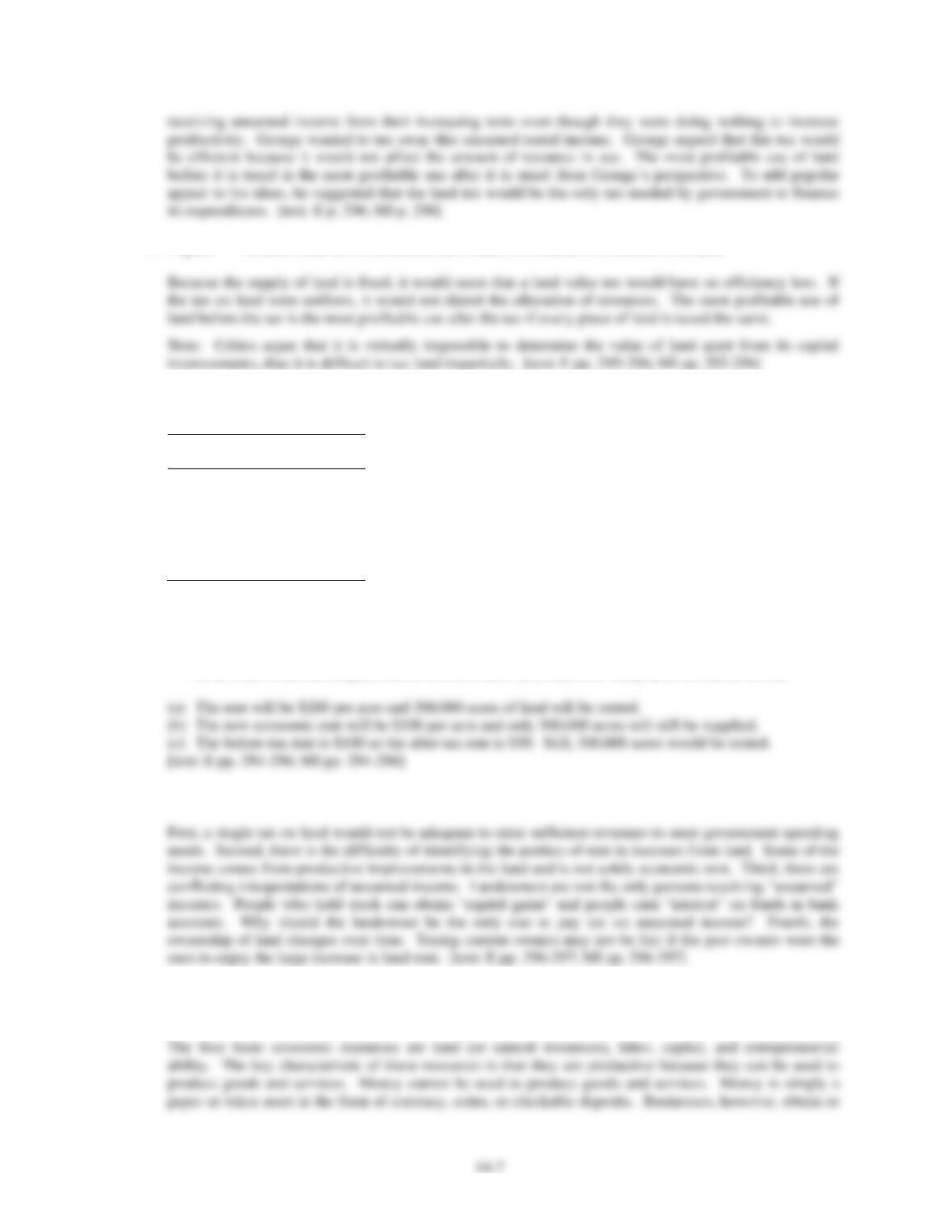
5. Using the below axes draw a supply and demand graph for land showing it as a “free” good.
6. What explains differences in the economic rent charged for two plots of 500 acres of land that are used for
growing corn and located in the same county of a state?
7. Why would farmland closer to the limits of a city be worth more than farmland farther out?
8. Why is land rent a “surplus payment” from the perspective of economists?
9. What is the difference between society’s view and an individual firm’s view of economic rent?
10. Explain the economic rationale for Henry George’s proposal for a single tax on land.
Chapter 14 – Rent, Interest, and Profit
12. Assume that the quantity of a certain type of farmland is 300,000 acres and the demand for this land is that
given in the table below.
Pure land rent,
per acre
Land demanded,
acres
$300
100,000
250
200,000
200
300,000
150
400,000
100
500,000
50
600,000
(a) What will be the economic rent and how much land will be rented?
(b) If the productivity of the land decreases such that 200,000 less acres are demanded at each price, what
will the economic rent be and how much land will be supplied?
(c) Given the new demand schedule in (b), if landowners were taxed at a rate of $50 per acre for their
13. What are four criticisms of the single tax on land?
14. Why is money not an economic resource? If it is not productive, then why do businesses want to obtain or
“buy” it?
Chapter 14 – Rent, Interest, and Profit
15. What are the relationships among capital, interest rates, and interest income?
16. What factors might cause the interest rates to differ? Explain.
17. Economists often speak as if there is a single interest rate when in fact there are many interest rates. What
factors explain the differences in these interest rates?
18. What is the pure rate of interest?
19. Why is the supply of loanable funds not perfectly inelastic? (In other words, why is the supply curve
upsloping?)
20. Briefly explain the loanable funds theory of interest rate determination.
Chapter 14 – Rent, Interest, and Profit
14-9
21. Suppose the total demand and supply of loanable funds (in billions) are as follows:
Quantity
demanded of
loanable funds
Interest
rate
(percent)
Quantity
supplied of
loanable funds
Surplus (+)
or
shortage (−)
85
4
72
_____
80
6
73
_____
75
8
75
_____
70
10
77
_____
65
12
79
_____
60
14
81
_____
(a) What will be the market or equilibrium interest rate? What is the equilibrium quantity of loanable
funds? Complete the surplus-shortage column.
(b) Why will 4% not be the equilibrium interest rate in this market? Why not 14%?
(c) Now suppose that the government establishes a usury loan that sets the interest rate at 6%. Explain the
economic effects of this usury law.
22. How would the following situations affect the equilibrium interest rate in the loanable funds market?
(a) The states agree to abolish sales taxes.
(b) The government reduces the budget deficit.
(c) Technological improvements are made to increase expected rates of return.
Chapter 14 – Rent, Interest, and Profit
23. What are some extensions to the simplified model of the loanable funds market?
24. Explain the role interest rates play in understanding the time value of money.
25. What is meant by the term compound interest? Give an example based on $1000 and a 10 percent interest
rate over a two-year period.
26. How do economists differentiate present value from future value?
27. (Consider This) How did economist Irving Fisher explain interest to a masseur?
28. Why is the interest rate such an important price in the economy?
Chapter 14 – Rent, Interest, and Profit
29. What role does the interest rate play in the economy? Is the distinction between real and nominal interest
rates an important one in discussing these roles?
30. Distinguish between the nominal and real rates of interest using an example.
31. What are usury laws and what are their economic effects?
32. Explain the difference between the economist’s and the accountant’s view of profit.
33. What is the difference between economic profit and normal profit?
Chapter 14 – Rent, Interest, and Profit
14–12
34. What are the nonroutine decisions of entrepreneurs that involve substantial financial risk?
35. In what way are entrepreneurs residual claimants?
36. What is the difference between insurable and uninsurable risk?
37. What are four general sources that contribute to uninsurable risk?
38. Why does an entrepreneur deserve to be compensated with profit?
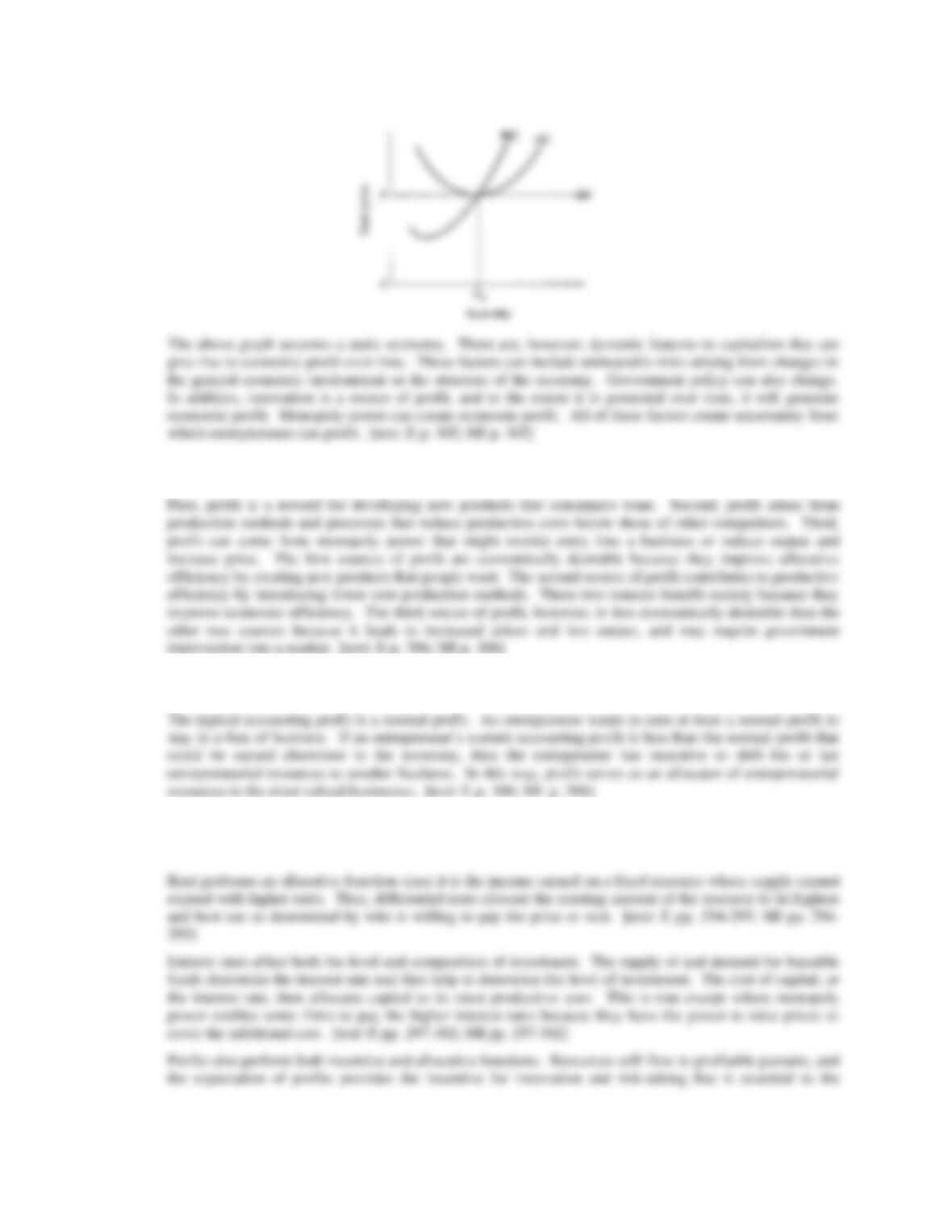
39. Using the below axes draw a graph for a purely competitive firm that is earning normal profit in the long
run. Explain why an entrepreneur may earn an economic profit and not just a normal profit, even in the
long run.
Chapter 14 – Rent, Interest, and Profit
14–13
40. What are three basic sources of economic profit? Which ones are most beneficial for society?
41. How does profit ration entrepreneurship?
42. What economic functions do rent, interest, and profit payments perform? How effective are they in
performing these functions?
Chapter 14 – Rent, Interest, and Profit
43. Why are expectations important when discussing profits? What effects do these profit expectations have on
the economic system?
Chapter 14 – Rent, Interest, and Profit
14–15
44. What is the sociopolitical significance of income shares; that is, what might income shares tell us about the
overall character of our society? What implications might income shares have for economic stability? For
economic growth?
45. Describe how the income shares of national income are distributed to “labor” and to “capitalists.” How has
this distribution changed since 1900?
46. The following table shows estimated wages and salaries, proprietors’ income, corporate profits, interest,
rent, and national. income based on these categories.
Wages and salaries
$7792 billion
Proprietors’ income
1041 billion
Corporate profits
1309 billion
Interest
788 billion
Rent
268 billion
National income
11198 billion
(a) What were wages and salaries as a percentage of national income?
(b) What were labor’s share of the national income and the capitalist’s share as a percentage of national
income? Show your calculations.
47. (Last Word) Give five examples showing how different factors affect interest rate calculations.
Chapter 14 – Rent, Interest, and Profit
14–16
48. (Last Word) What are three ways that lenders increase the rate of interest paid relative to what it appears to
be?