Chapter 13 – Wage Determination (+ Appendix)
201. In a labor dispute in which the existing contract has expired, a:
202. Which of the following bargaining tactics is illegal?
203. Private-sector strikes and lockouts typically end because:
Chapter 13 – Wage Determination (+ Appendix)
204. Collective bargaining occurs under a framework of rules established in the:
205. A major function of the National Labor Relations Board is to:
206. Which of the following is correct?
Chapter 13 – Wage Determination (+ Appendix)
207. Those who feel that unions positively affect productivity and efficiency argue that unions
are:
208. By reducing labor turnover, unions may increase productivity because a lower turnover
rate:
209. Some economists claim that unions reduce economic efficiency by:
Chapter 13 – Wage Determination (+ Appendix)
210. Unions may increase productivity by:
211. Featherbedding refers to:
212. Available research suggests that the union wage advantage diminishes the national
output by:
Chapter 13 – Wage Determination (+ Appendix)
13–77
213. Suppose a worker feels unhappy with his job and consequently quits. This illustrates:
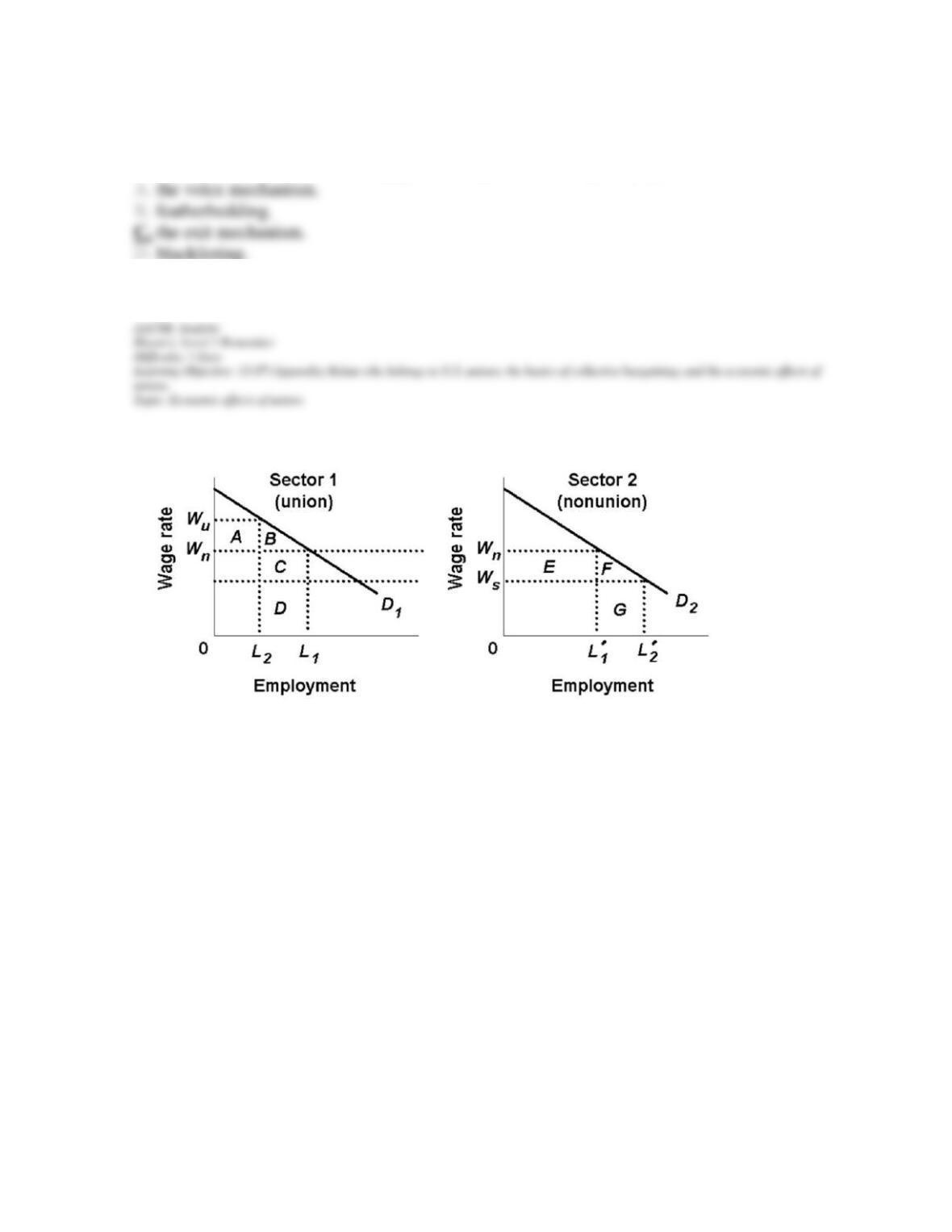
Assumptions: These two graphs show two sectors of the labor market for a particular kind of
labor. Relevant product markets are competitive. The two labor demand curves are identical
and initially the quantities of labor employed in the two sectors are L1 and L’1and the wage
rate in each sector is Wn.
Chapter 13 – Wage Determination (+ Appendix)
214. Refer to the above diagram and assumptions. If a union is formed in sector 1 and the
union increases the wage rate from Wnto Wu, then employment will:
215. Refer to the above diagrams and assumptions. The change in employment in sector 1 to
which a Wn to Wu union wage increase gives rise will cause output in that sector to:
Chapter 13 – Wage Determination (+ Appendix)
216. Refer to the above diagrams and assumptions. If all the workers who lose their jobs in
the union sector because of a Wn to Wu union wage increase are reemployed in nonunion
sector 2, output in that sector will:
217. Refer to the above diagrams and assumptions. This analysis suggests that a union wage
advantage of Wu minus Ws causes a net efficiency:
218. Empirical studies suggest that the efficiency loss associated with the misallocation of
labor caused by the union wage advantage is:
Chapter 13 – Wage Determination (+ Appendix)
219. Which of the following statements is correct?
220. Which one of the following research findings is most consistent with the hypothesis that
unions increase productivity?
Chapter 13 – Wage Determination (+ Appendix)
221. Since the mid-1950s, union membership has declined as a percentage of employed wage
and salary workers.
222. The rate of unionization is substantially higher for protective service workers than for
sales workers.
223. Unions prefer agency shops to open shops.
224. There is no evidence that unions are able to increase wage rates above those that the
market would otherwise provide.
Chapter 13 – Wage Determination (+ Appendix)
225. Union workers have higher rates of job turnover than do nonunion workers.
226. Right-to-work laws prohibit the formation of labor unions.
227. The presence of an agency shop requires all workers to join the union within the first 30
days of employment.
228. Six of the 50 states account for approximately half of all union members in the United
States.

Chapter 13 – Wage Determination (+ Appendix)
229. African-Americans have higher unionization rates than whites.
230. In 2009, approximately 5 percent of all work time lost was due to work stoppages.