Chapter 13 – Wage Determination (+ Appendix)
121. Incentive pay plans that seek to tie worker compensation more closely to worker
performance includes the following, except:
122. Pay-for-performance systems seek to deal with the:
Chapter 13 – Wage Determination (+ Appendix)
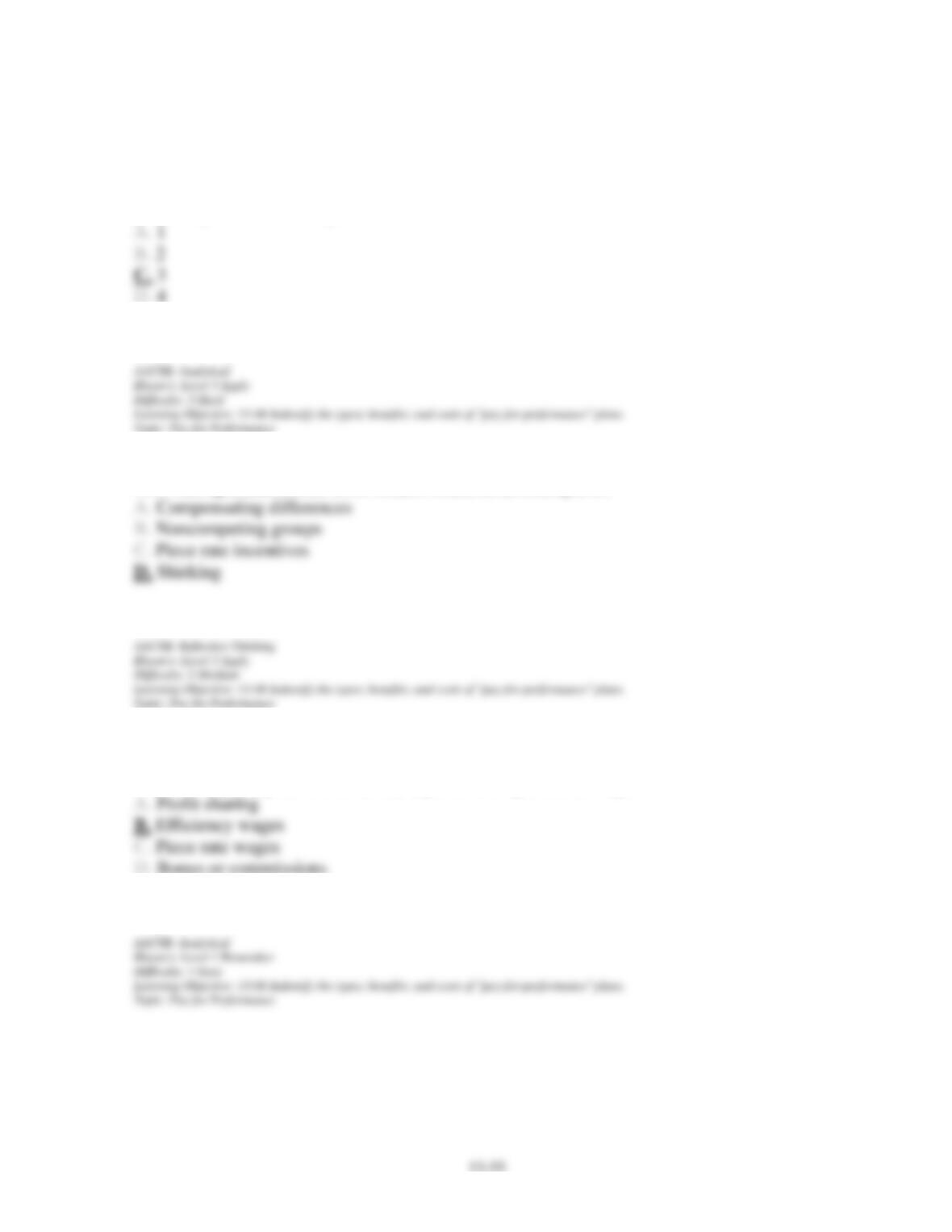
123. A wage payment system in a firm incorporates a guaranteed wage with an incentive
element, provided that a certain minimum level of output is achieved. Which of the above
graphs represents such a system?
124. Taking unauthorized work breaks would be an example of:
125. What concept is associated with the notion that employers can get greater effort from
workers by paying them a relatively high, above-equilibrium wage?
Chapter 13 – Wage Determination (+ Appendix)
126. Which would be an example of a negative side effect of pay for performance plans?
127. Those economists who justify high pay packages for CEOs say that they:
128. Critics of large pay packages for CEOs argue that they:
Chapter 13 – Wage Determination (+ Appendix)
129. If you received a 6% increase in your nominal wage and the price level increased by 4%,
then your real wage has increased by 4%.
130. Nominal wage measures the purchasing power of real wage.
131. One reason for the high wage rates in the United States and other advanced economies is
the high productivity of labor in these countries.
132. In a purely competitive labor market, a profit-maximizing firm will hire labor up to the
point where the marginal resource cost equals the wage rate.
Chapter 13 – Wage Determination (+ Appendix)
133. If a firm must pay a daily wage of $35 to hire 11 workers, and a daily wage of $40 to
hire 12 workers, its marginal resource cost of hiring the twelfth worker is $40.
134. Monopsonists hire more workers than would be hired if the labor market were purely
competitive.
135. A monopsonist faces an upsloping supply curve of labor, but it could face a horizontal
demand curve for its product in the output market.
136. A monopsonist in equilibrium will hire labor at a level where MRP = MRC > W.
Chapter 13 – Wage Determination (+ Appendix)
137. An example of a monopsonist is a labor union whose members include all the workers in
a particular industry.
138. In the demand-enhancing union model, a union increases the wage rate by increasing
labor demand through actions that increase product demand, raise labor productivity, or alter
the prices of related inputs.
139. Professions that require its practitioners to pass a licensure exam, like accountants and
doctors, exemplify the exclusive union model of how a labor union raises wage rates by
reducing labor supply.
140. Restricting the supply of labor is a means of increasing wage rates more commonly used
by industrial unions than craft unions.
Chapter 13 – Wage Determination (+ Appendix)
141. Minimum wage laws have contributed to higher unemployment levels among teenagers
and minorities.
142. In monopsony situations, a minimum wage might increase wage and employment levels.
143. Education is a form of human capital and it helps explain wage differentials.
144. Immobile resources contribute to wage differentials.
Chapter 13 – Wage Determination (+ Appendix)
145. There will be no principal-agent problem if a firm’s owner (like a business consultant)
does all the work of the firm.
146. Commissions or royalties may be an inexpensive way of reducing shirking on a job when
the costs of monitoring work performance are high.
147. Firms that pay efficiency wages tend to have higher worker turnover.
Chapter 13 – Wage Determination (+ Appendix)
148. Which of the following industries had the highest unionization rate in 2009?
149. Which of the following is not a major reason for the decline of unionism in the U.S.?
150. Which of the following is not a major common topic of collective bargaining?
Chapter 13 – Wage Determination (+ Appendix)
151. Which union status provides the weakest form of union security?
152. Which union status allows the firm to hire nonunion workers, provided that these
workers would join the union within a specified period or lose their jobs?
153. Which of the following economic effects of unions tends to improve efficiency?
Chapter 13 – Wage Determination (+ Appendix)
154. In 2009, sales workers had a much higher unionization rate than teachers.
155. Union membership among workers in America has been declining since the 1950’s.
156. Right-to-work laws in some states prohibit the closed-shop and agency-shop union
setups.
157. A labor union may engage in a lockout if the collective bargaining process breaks down.
Chapter 13 – Wage Determination (+ Appendix)
158. One clear effect of labor unions is an increase in the wage rates of their members.