Chapter 13 – Wage Determination (+ Appendix)
107. Refer to the above labor market diagrams. The case of bilateral monopoly is represented
by Figure:
108. Refer to the above labor market diagrams. The economic impact of occupational
licensing can best be demonstrated through Figure:
Chapter 13 – Wage Determination (+ Appendix)
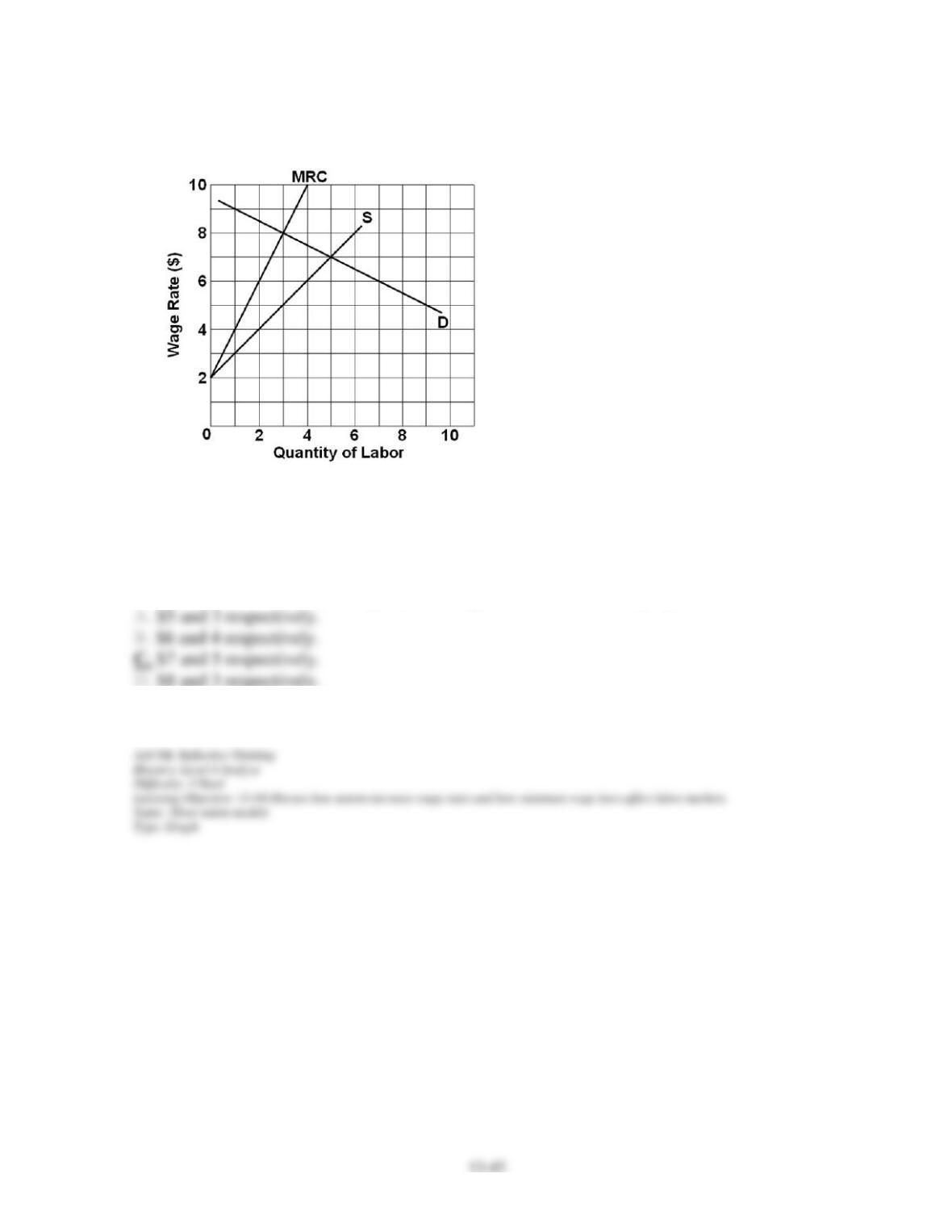
109. Refer to the above labor market diagram where D is the labor demand curve, S is the
labor supply curve, and MRC is the marginal resource (labor) cost curve. If this were a purely
competitive labor market, the equilibrium wage rate and level of employment would be:
Chapter 13 – Wage Determination (+ Appendix)
110. Refer to the above labor market diagram where D is the labor demand curve, S is the
labor supply curve, and MRC is the marginal resource (labor) cost curve. If this were a
monopsonistic labor market, the equilibrium wage rate and level of employment would be:
111. Refer to the above labor market diagram where D is the labor demand curve, S is the
labor supply curve, and MRC is the marginal resource (labor) cost curve. If an inclusive union
was formed and was able to get the monopsonist to agree to a $7 wage rate, then the
monopsonist would:
Chapter 13 – Wage Determination (+ Appendix)
112. Refer to the above labor market diagram where D is the labor demand curve, S is the
labor supply curve, and MRC is the marginal resource (labor) cost curve. If an inclusive union
was able to get the monopsonist to pay a $6 wage rate, then:
113. Refer to the above labor market diagram where D is the labor demand curve, S is the
labor supply curve, and MRC is the marginal resource (labor) cost curve. An inclusive union
could increase the level of employment above that which the monopsonist would provide if it
could get the monopsonist to agree to any wage rate:
Chapter 13 – Wage Determination (+ Appendix)
114. Minimum-wage legislation is less likely to have adverse effects on employment when
the:
115. Critics of minimum-wage legislation argue that it:
116. Many economists are critical of the minimum wage because they believe that it:
Chapter 13 – Wage Determination (+ Appendix)
117. Unions might support a higher minimum wage because:
118. Critics of the minimum wage argue that as an antipoverty device it is “poorly targeted.”
By this they mean that:
119. If the minimum wage is set too high, in some labor markets we can expect to see:
Chapter 13 – Wage Determination (+ Appendix)
120. According to some supporters of the minimum wage, it has very small or even
nonexistent negative employment effects because:
121. If all workers are homogeneous, all jobs are equally attractive to workers, and labor
markets are perfectly competitive:
122. Wage differentials may result from all the following except:
Chapter 13 – Wage Determination (+ Appendix)
123. Suppose all workers are identical, but working for Ajax is more pleasant than working
for Acme. In all other nonwage aspects the two firms offer the same job characteristics. We
would expect:
124. Noncompeting groups of workers are the result of:
125. Compensating differences in wages:
Chapter 13 – Wage Determination (+ Appendix)
126. Compensating differences in wages pay workers for:
127. Which of the following factors is not relevant in explaining the persistence of wage
differentials?
128. The idea of compensating differences is used:
Chapter 13 – Wage Determination (+ Appendix)
129. The concept of investment in human capital indicates that:
130. Data on education and earnings reveal:
131. According to age-earnings data,
Chapter 13 – Wage Determination (+ Appendix)
132. The earnings of highly educated workers:
133. Economists regard expenditures on education as investments because:
134. Which of the following involves the creation of human capital?
Chapter 13 – Wage Determination (+ Appendix)
135. Human capital is best defined as:
136. Which of the following is a market imperfection that might explain persistent wage
differentials within an occupation?
137. Which of the following is a market imperfection that might explain persistent wage
differentials within an occupation?
Chapter 13 – Wage Determination (+ Appendix)
138. Which of the following is not an example of a market imperfection that might explain
persistent wage differentials within an occupation?
139. Jack and Jill have identical skills and training but Jill earns higher wages in her job.
Which of the following reasons would best explain why Jill earns more than Jack?
140. The principal-agent problem arises in labor markets because:
Chapter 13 – Wage Determination (+ Appendix)
141. The principal-agent problem arises primarily because:
142. Which one of the following best exemplifies the principal-agent problem in the
employer-employee relationship?
143. In the context of labor markets, shirking refers to:
Chapter 13 – Wage Determination (+ Appendix)
144. Traveling sales representative Harold Hill only calls on clients four days a week rather
than the five days expected by his employer. This is an example of:
145. The idea of efficiency wages is that:
146. Paying an above-equilibrium wage rate might reduce unit labor costs by:
Chapter 13 – Wage Determination (+ Appendix)
147. Compensation paid in proportion to the number of units of personal output best
describes:
148. A firm might choose to pay its employees a wage higher than that which would clear the
market because:
149. For the firm, the major goal of profit sharing plans is to:
Chapter 13 – Wage Determination (+ Appendix)
150. Stock options as a form of payment are designed to:
151. One of the potential negative side-effects of pay in the form of sales commissions is:
152. (Consider This) The main idea highlighted in the story about artist Pablo Picasso is:
Chapter 13 – Wage Determination (+ Appendix)
153. (Consider This) The story about artist Pablo Picasso illustrates the point that:
154. (Last Word) Chief Executive Officers (CEOs) of large American corporations:
155. (Last Word) In 2005, Chief Executive Officers’ (CEOs’) pay at U.S. firms with around
$500 million in annual sales averaged:
Chapter 13 – Wage Determination (+ Appendix)
156. (Last Word) The dispute over the pay of Chief Executive Officers (CEOs) of U.S.
corporations hinges on whether or not such pay:
157. Marginal resource (labor) cost will exceed the wage rate when there is imperfect
competition in the hire of labor.
158. The rising general level of real wages in the United States has occurred because growing
population has increased the supply of labor relative to the demand for it.
Chapter 13 – Wage Determination (+ Appendix)
159. Marginal resource (labor) cost will always exceed the wage rate when the employer is
selling its product in an imperfectly competitive market.
160. A monopsonistic employer may sell its product in a competitive market.
161. Industrial unions are more likely to increase wage rates by restricting the supply of labor
than are craft unions.
162. The labor supply curve facing a purely competitive firm is perfectly inelastic.