Chapter 13 – Wage Determination (+ Appendix)
1. The concept of “wages” includes the following items, except:
2. If the price level rises by 4 percent in a year and nominal wages increase by 2 percent, then
real wages will:
Chapter 13 – Wage Determination (+ Appendix)
3. Assume that your nominal wage was fixed at $15 an hour, and the price index rose from
100 to 105. In this case, your:
4. Real wages would rise if the:
5. Which statement is correct?
Chapter 13 – Wage Determination (+ Appendix)
6. The consumer price index is 113 in Year 1 and 118 in Year 2. The nominal wage rate is $8
in Year 1 and $9 in Year 2. What is the approximate percentage change in the real wage rate
from Year 1 to Year 2?
7. Nominal monthly wages increase from $1,500 to $1,800 while the price level increases by
4 percent. The percentage change in real monthly wages is about:
8. The nominal annual wage increases from $20,000 to $21,000 while the price level increases
by 7 percent. In this case, the percentage change in the real annual wage is about:
Chapter 13 – Wage Determination (+ Appendix)
9. Productivity measures (such as output per worker-hour) and wage rates adjusted for
10. Which of the following has not been a major factor contributing to the high productivity
of labor in the United States?
11. Which would be an explanation for the high labor-productivity in the United States?
Chapter 13 – Wage Determination (+ Appendix)
12. Which is a valid explanation for real wage growth?
13. The basic explanation for high real wages in the United States and other industrially
advanced economies is that the:
14. A characteristic of a purely competitive labor market would be:
Chapter 13 – Wage Determination (+ Appendix)
15. In a purely competitive labor market, a profit-maximizing firm will hire labor up to the
point where the marginal revenue product of labor equals the:
16. A firm in a purely competitive product market finds that it must increase wages to attract
extra workers. The firm will hire labor up to the point where the marginal:
17. If the supply of labor in a purely competitive labor market increases, then the product:
Chapter 13 – Wage Determination (+ Appendix)
13-7
18. A firm that hires labor and sells its product both in purely competitive markets will:
19. If the wage rate in a purely competitive labor market increases, it will cause the:
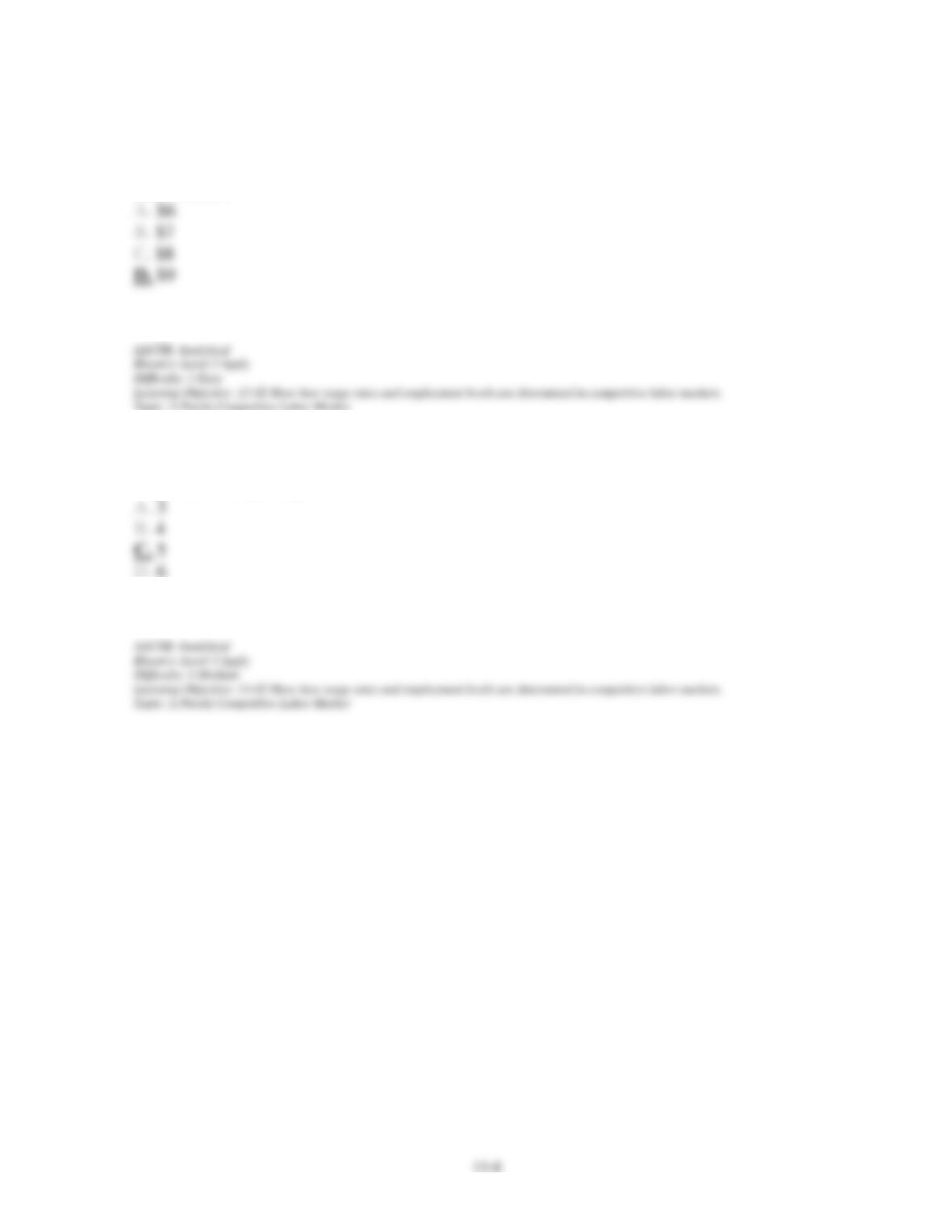
A firm’s labor input, total output of labor, and product price schedules are given below. Labor
is the only variable input.
Chapter 13 – Wage Determination (+ Appendix)
20. Refer to the above table and information. What is the marginal revenue product of the
fifth worker?
21. Refer to the above table and information. How many workers will the firm hire if the
wage rate is $8 per day?
Chapter 13 – Wage Determination (+ Appendix)
13-9
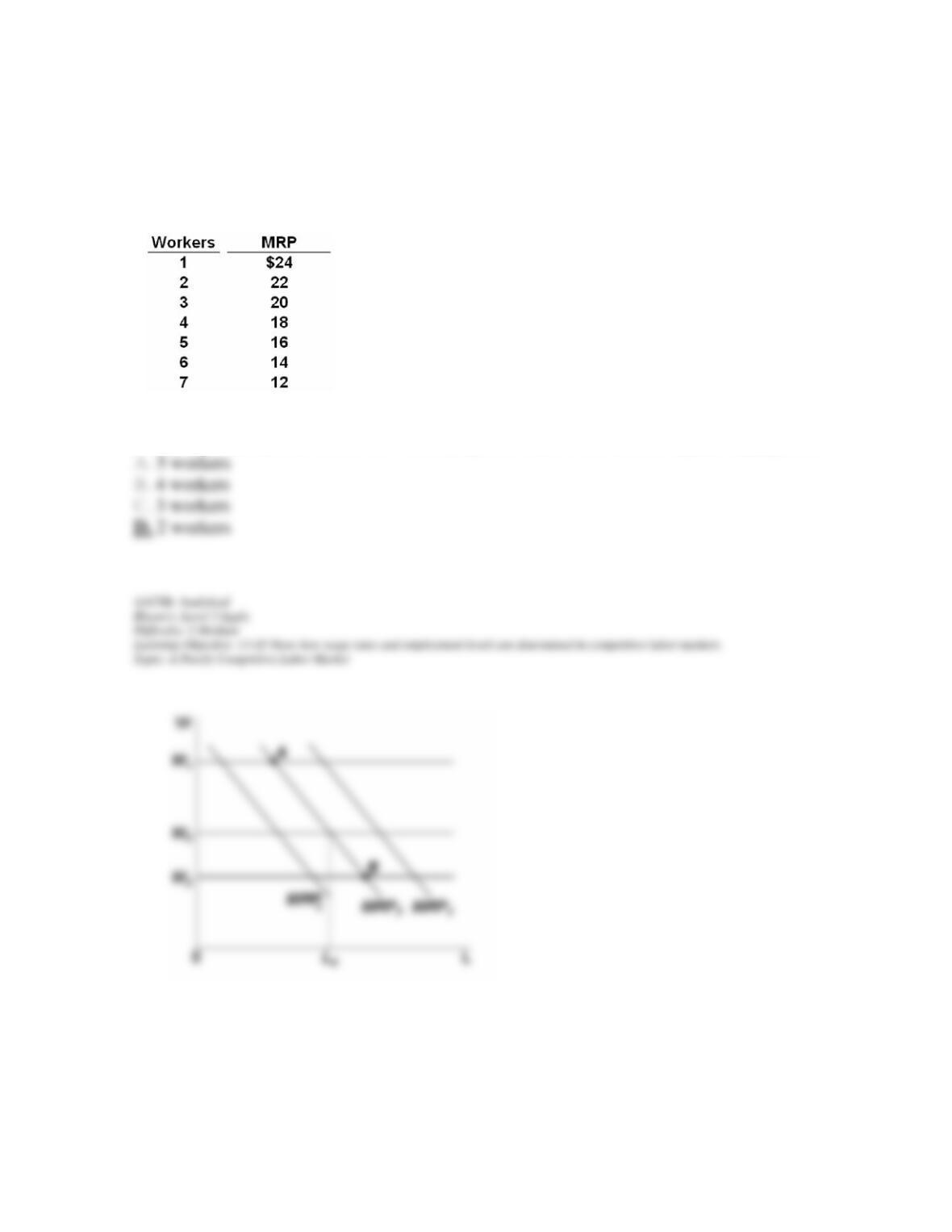
22. A firm operating in a purely competitive labor market has the following marginal revenue
product schedule.
If the wage rate decreases from $17 to $13, by how much will the firm expand employment?
Chapter 13 – Wage Determination (+ Appendix)
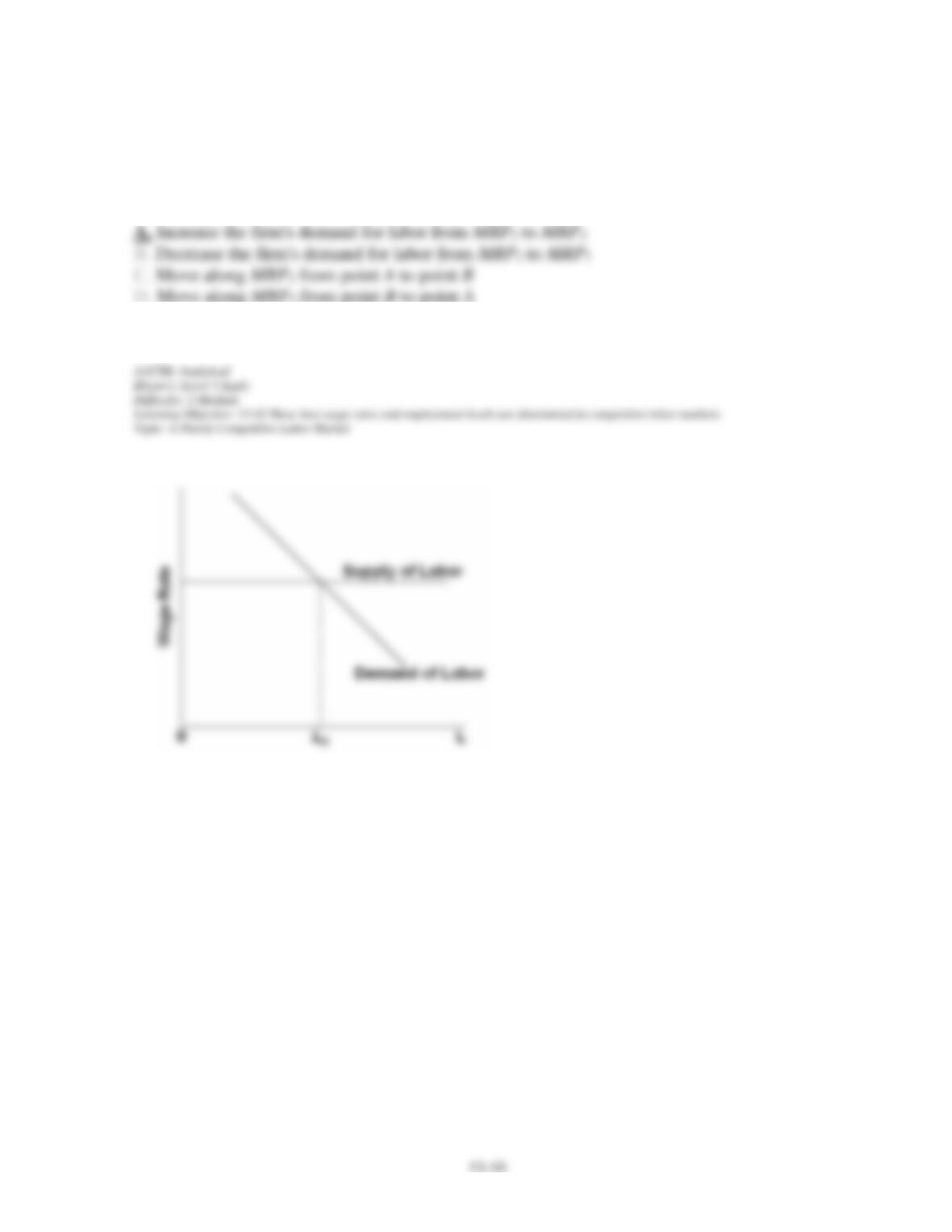
23. Refer to the above graph. Suppose that a competitive firm in long-run equilibrium along
MRP2 faces a market wage rate of W0. If the price of the firm’s product increases, other things
remaining the same, the effect of this change in price would be to:

Chapter 13 – Wage Determination (+ Appendix)
24. Refer to the above graph. It shows a firm which buys its inputs and sells its output in
competitive markets. If the firm develops a new technology that increases labor productivity,
25. A firm pays the same wage rate to all its workers. At present, 10 workers are employed at
$50 per day. Wages are then raised to $55 per day to attract an extra worker. Thus the
marginal labor cost per day is:
Chapter 13 – Wage Determination (+ Appendix)
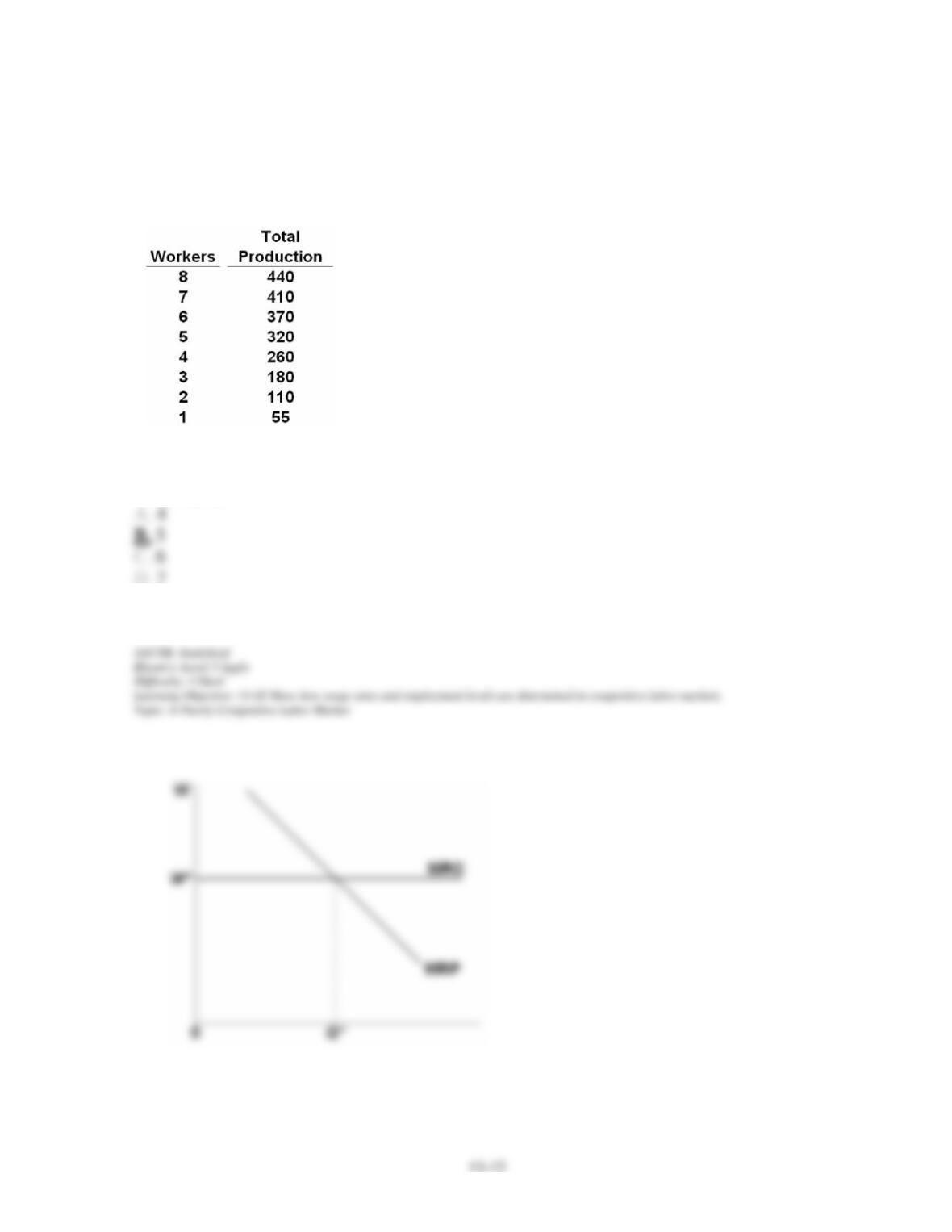
26. A profit-maximizing firm operates in purely competitive product and resource markets,
with the following resource and production schedules.
The product price is $10 per unit and the cost per worker is $540. How many workers will the
firm employ?
Chapter 13 – Wage Determination (+ Appendix)
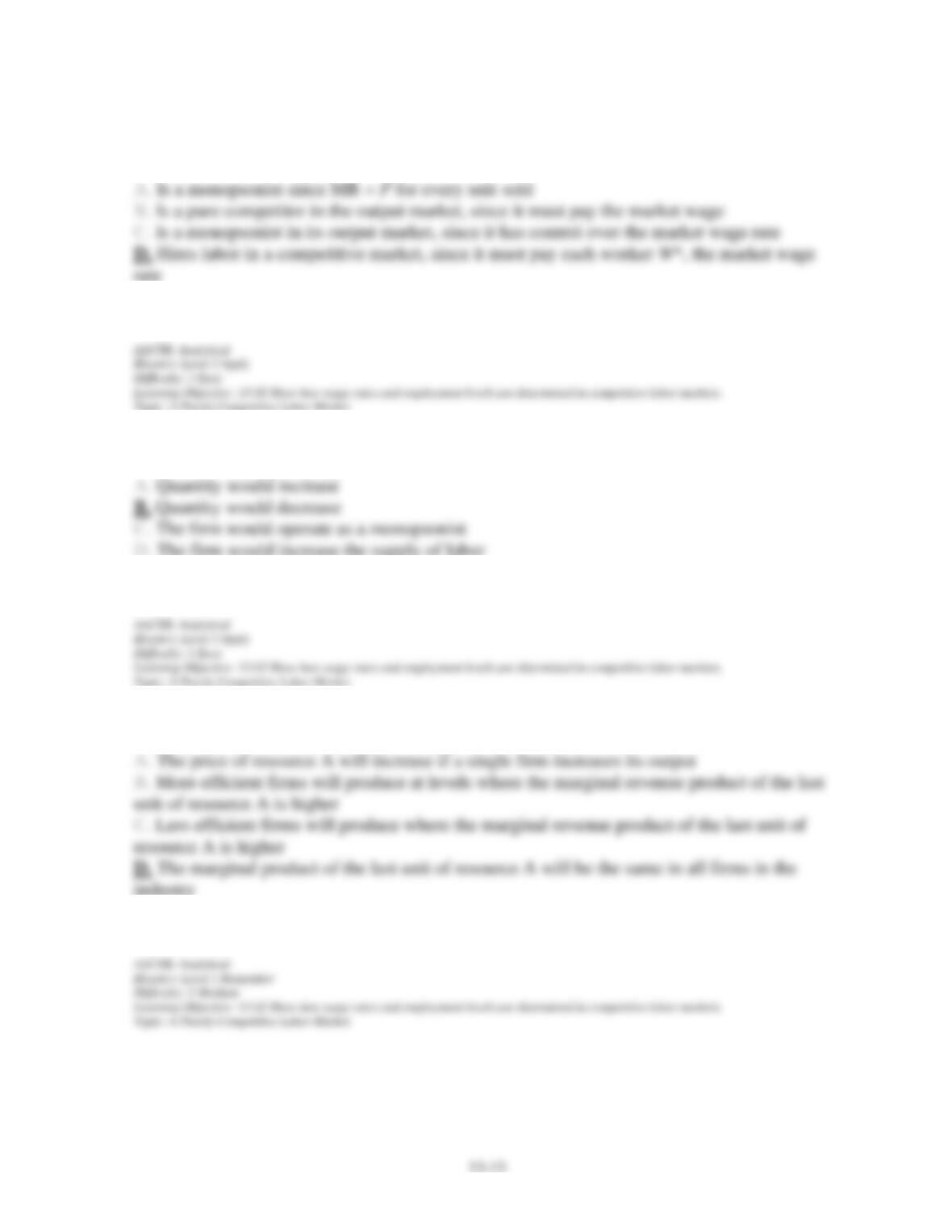
27. Refer to the above graph. The producer illustrated:
28. Refer to the above graph. If the MRC increased:
29. If all firms in an industry are price takers in the market for resource A, then:
Chapter 13 – Wage Determination (+ Appendix)
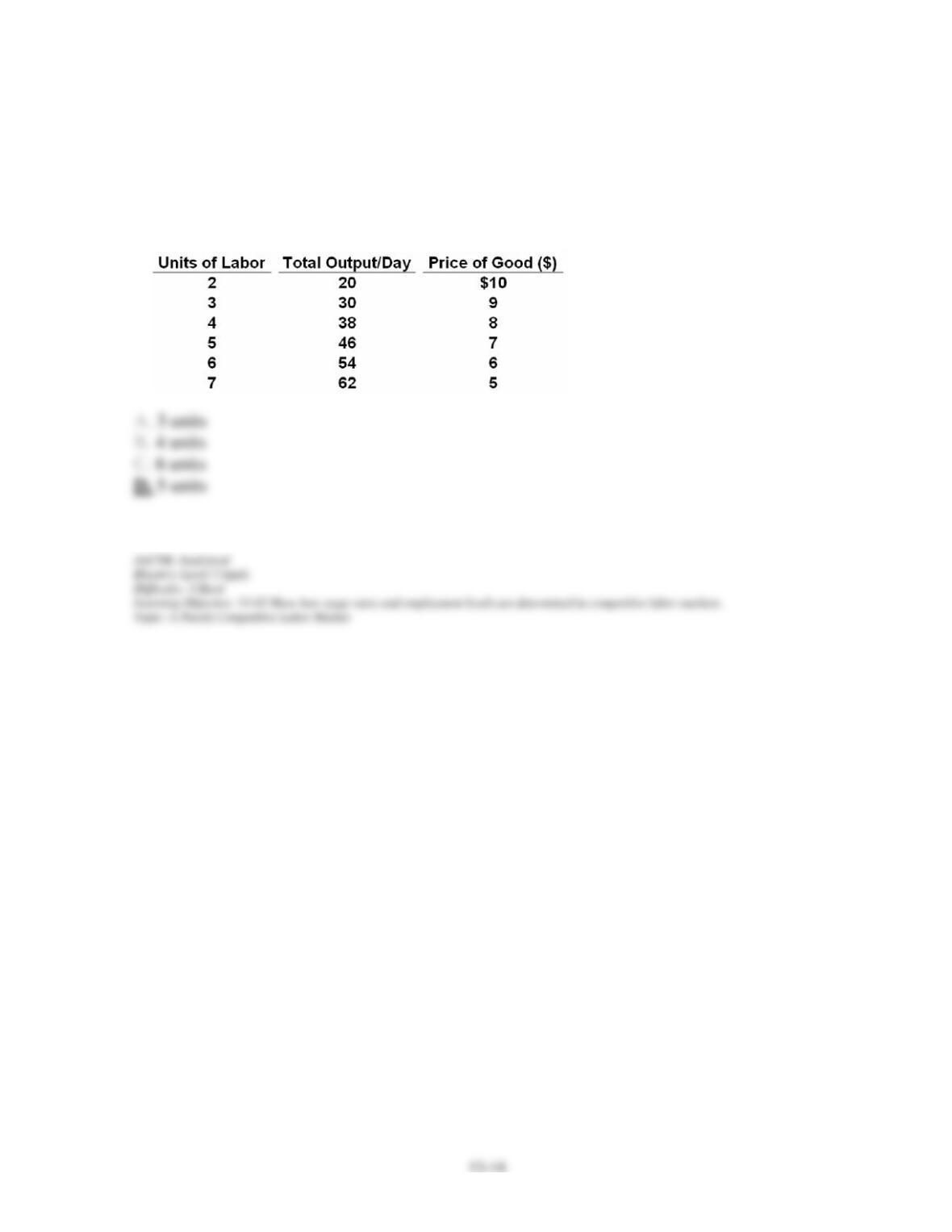
30. A firm’s resource input, total output of labor, and product price schedules are given below.
If labor is the only variable input, how much labor should the firm employ if the wage rate is
$15 per day?
Chapter 13 – Wage Determination (+ Appendix)
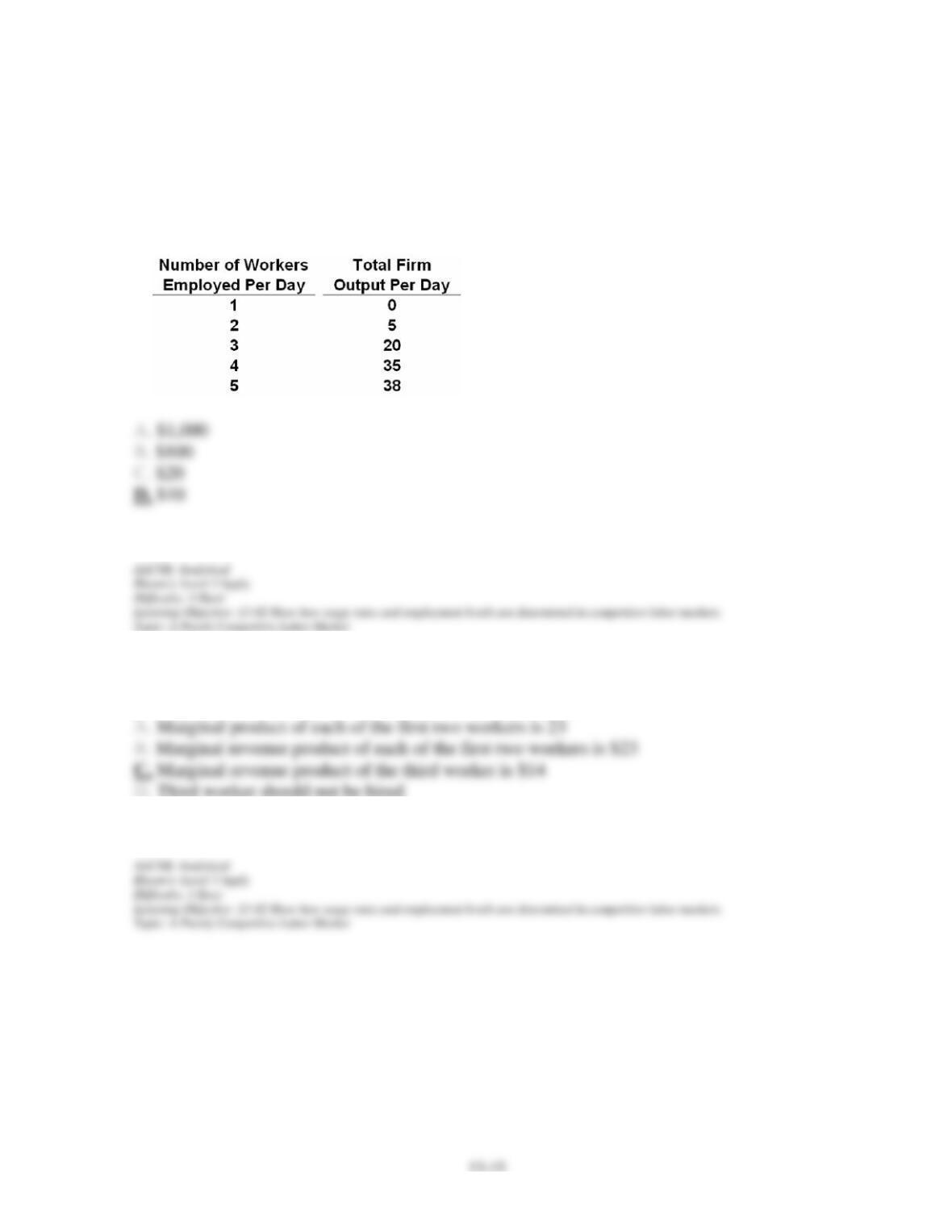
31. Given the following table for a competitive firm which is maximizing profits, if the
marginal revenue product of the last worker hired is $150 and three workers are employed per
day, the price of a unit of output must be:
32. Suppose two workers can harvest $46 and three workers can harvest $60 worth of apples
per day. On the basis of this information we can say that the:
Chapter 13 – Wage Determination (+ Appendix)
33. The individual firm which hires labor under competitive conditions faces a labor supply
curve which:
34. The marginal cost of a productive resource is equal to the price of the resource if a firm
is:
Chapter 13 – Wage Determination (+ Appendix)
35. Refer to the above graph. Given the total product curve shown and a competitive labor
market, if a firm can sell widgets for $12, what is the maximum amount it will pay the fourth
worker each day?
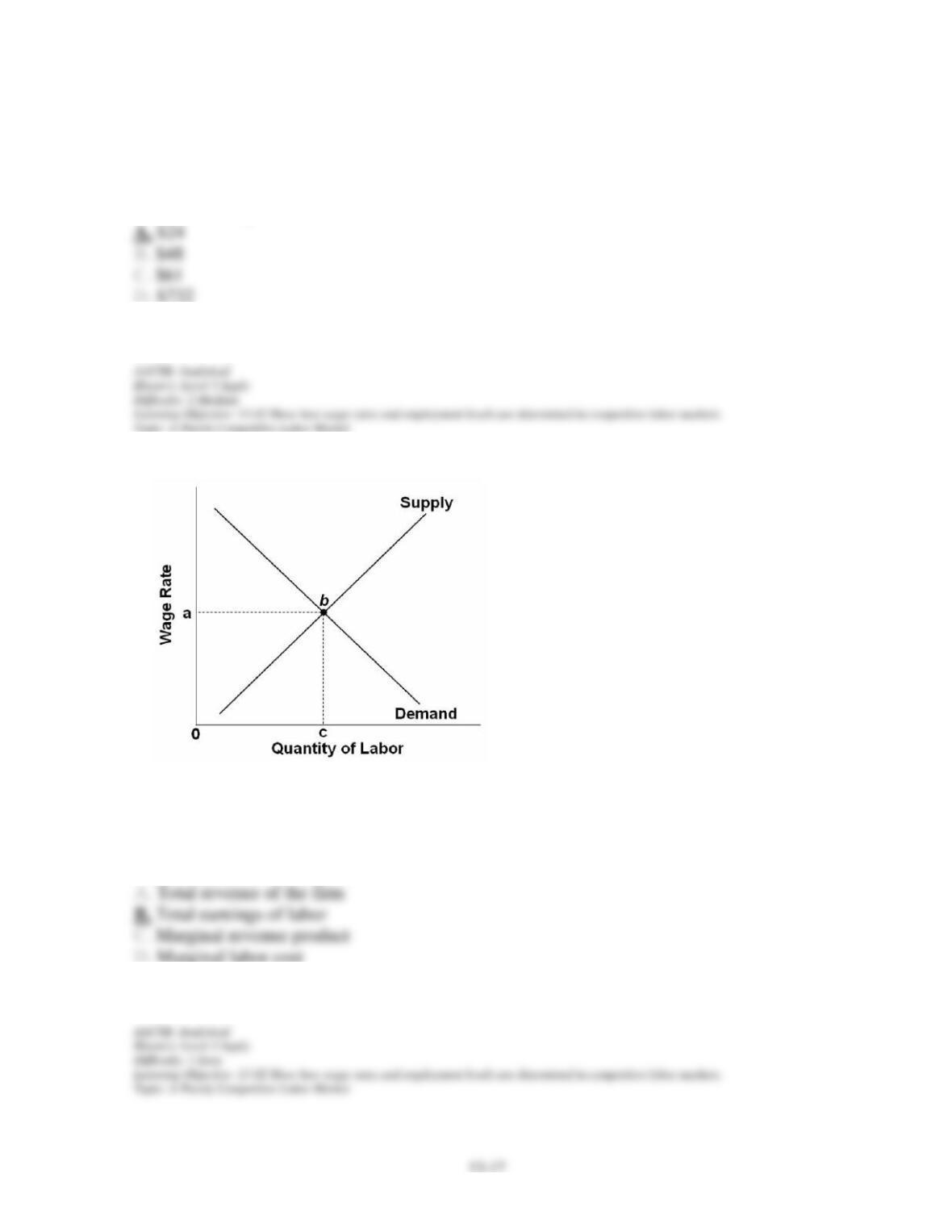
36. The graph above represents the supply and demand for labor in a purely competitive
market. The area 0abc represents:
Chapter 13 – Wage Determination (+ Appendix)
37. The reason that the supply curve for labor in a purely competitive market slopes upward is
because:
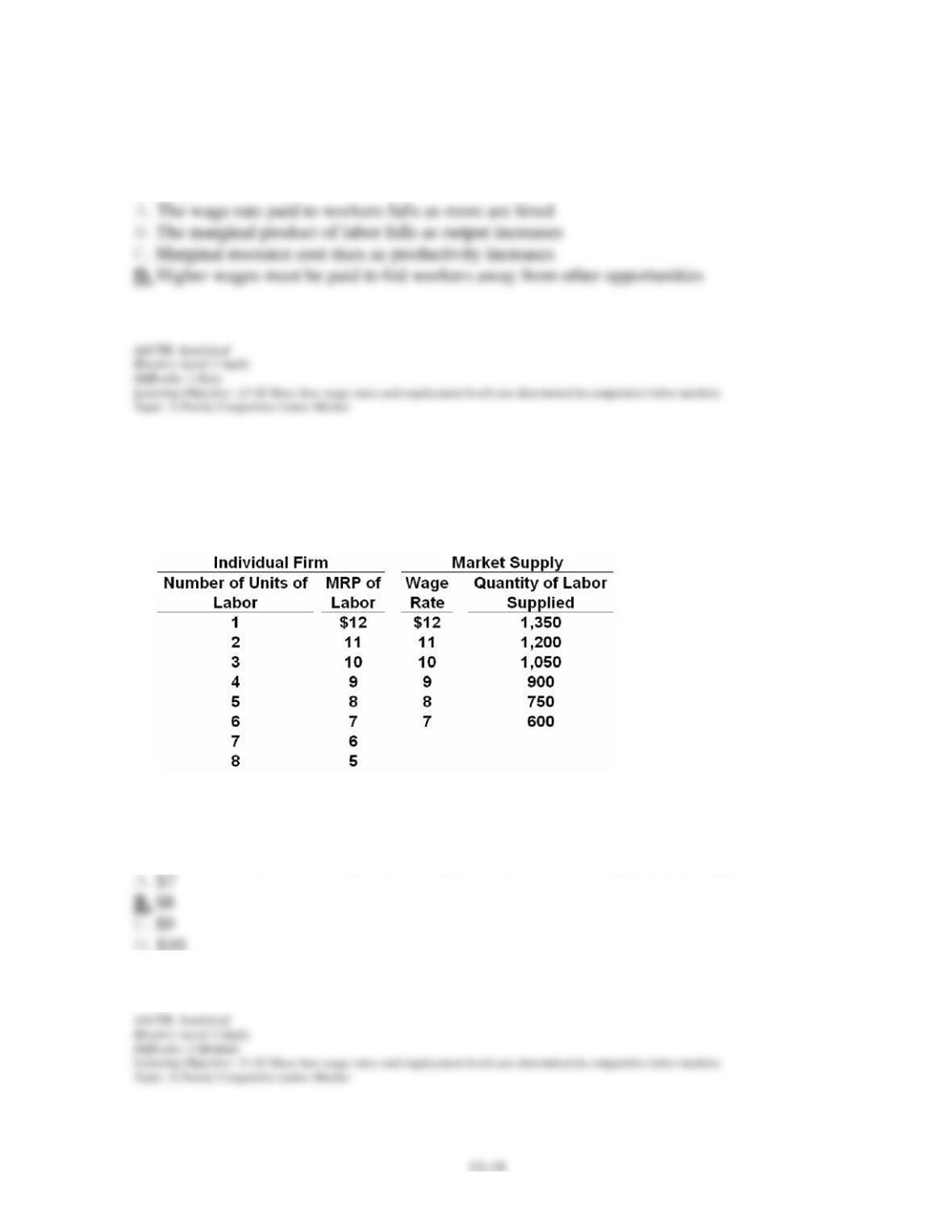
Suppose a single firm has the marginal revenue product schedule for a particular type of
labor given in the left table. Assume there are 150 firms with the same marginal-revenue-
product schedules for this particular type of labor.
38. Refer to the above table and information. What will be the equilibrium wage rate?
Chapter 13 – Wage Determination (+ Appendix)
39. Refer to the above table and information. How many workers will be hired?
40. Refer to the above table and information. What will be the marginal labor cost and wage
rate for the individual firm?
41. Refer to the above table and information. How would the imposition of a $9 minimum
wage rate change the total amount of labor hired in this market?
Chapter 13 – Wage Determination (+ Appendix)
42. A market where there is only a single buyer is called a(n):
43. Which of the following is characteristic of a labor market that is a monopsony?
44. The labor market for teachers in a small, isolated community that has one school district
would be best described as a(n):