70) Refer to the above figure. Suppose the relevant aggregate demand curve is AD2. If the
government wants to use fiscal policy to close the existing gap, it should
A) increase taxes.
B) decrease taxes.
C) increase the money supply.
D) increase government spending.
71) Refer to the above figure. If the relevant aggregate demand curve is AD1, then the economy
is experiencing
A) an inflationary gap.
B) a recessionary gap.
C) a deflationary gap.
D) full employment.
72) Refer to the above figure. If the current level of real GDP is $13 trillion, then the economy is
experiencing
A) an inflationary gap.
B) a recessionary gap.
C) a deflationary gap.
D) a fiscal deficit gap.
73) Suppose the current level of real GDP is below the full-employment level of real GDP.
Which of the following represents a fiscal policy action that could be implemented to reduce the
size of this recessionary gap?
A) Increase government spending.
B) Decrease interest rates.
C) Increase the money supply.
D) all of the above
74) When the current short-run equilibrium is to the right of the long-run aggregate supply,
appropriate discretionary fiscal policy used to address this problem would be to
A) increase taxes.
B) decrease taxes.
C) increase government spending.
D) decrease the discount rate.
75) Which of the following statements about fiscal policy is TRUE?
A) Real Gross Domestic Product (GDP) can be increased above its long-run equilibrium only in
the short run.
B) Real Gross Domestic Product (GDP) can never be increased above its long-run equilibrium,
even for a brief period of time.
C) Government can shift the aggregate demand curve inward by increasing spending.
D) Government can shift the aggregate demand curve outward by reducing spending.
76) Which one of the following is an example of discretionary fiscal policy used to correct a
recessionary gap?
A) a tax decrease passed into law by Congress
B) an increase in the money supply by the Federal Reserve
C) a decrease in government expenditures approved by Congress
D) an agreement among major banks to raise interest rates
77) Which one of the following is an example of discretionary fiscal policy used to correct an
inflationary gap?
A) a tax increase passed into law by Congress
B) decrease in the money supply by the Federal Reserve
C) an increase in government expenditures approved by Congress
D) an agreement among major banks to lower interest rates
78) What is discretionary fiscal policy and what is its purpose?
79) Explain how fiscal policy can correct a contractionary gap.
80) Suppose the government believes the economy is operating beyond the full-employment real
GDP. What kind of fiscal policy could it pursue?
13.2 Possible Offsets to Fiscal Policy
1) What does research tell us about the impact of Ricardian equivalence effects on the economy?
A) There is no evidence of any impact of Ricardian equivalence effects.
B) Ricardian equivalence effects have a huge impact on aggregate demand.
C) There is a very small impact on both aggregate demand and aggregate supply.
D) Ricardian equivalence effects may exist, but the sizes of those effects are unclear.
2) The Ricardian equivalence theorem states that
A) an increase in government spending has no effect on aggregate supply.
B) increases in government spending have a larger impact on real Gross Domestic Product
(GDP) than decreases in taxes.
C) an increase in the government budget deficit created by a current tax cut has no effect on
aggregate demand.
D) an increase in the government budget deficit has no effect on real Gross Domestic Product
(GDP) because it only affects the price index.
3) The concept that increased government spending will lead to lower investment and consumer
spending is referred to as the
A) inflationary effect.
B) crowding-out effect.
C) recessionary effect.
D) Keynesian effect.
4) The Laffer curve shows a relationship between
A) government spending and real Gross Domestic Product (GDP).
B) interest rates and investment spending.
C) the price level and real Gross Domestic Product (GDP).
D) tax rates and tax revenues.
5) By definition, a direct expenditure offset will occur whenever
A) the government increases spending in an area that competes with the private sector.
B) the government increases spending for the military.
C) the government increases spending to stimulate consumer spending.
D) the interest rate raises to offset the effects of fiscal policy.
6) If the government began providing free textbooks to college students who would otherwise
have bought their books from the private sector, the government’s action would result in
A) an increase in real Gross Domestic Product (GDP).
B) a direct expenditure offset.
C) a Ricardian dilemma.
D) a free market equilibrium.
7) If the government increases spending and there is a complete direct expenditure offset, then
A) aggregate demand and real Gross Domestic Product (GDP) will not change.
B) aggregate demand and real Gross Domestic Product (GDP) will increase by the amount of the
spending increase.
C) the price level will drop.
D) the government spending multiplier will be greater than zero.
8) The government wants to increase its spending to stimulate the economy. Taking into account
direct expenditure offset effects, what is its best spending option?
A) a new fighter jet for the military
B) expanding the school lunch program
C) constructing more low income housing
D) providing textbooks for college students
9) According to supply-side economics, changes in marginal tax rates will have which of the
following effects?
A) change the incentive to work
B) change the incentive to save
C) change the incentive to invest
D) all of the above
10) One part of the supply-side argument is that
A) lower marginal tax rates are required to induce Congress to reduce government spending.
B) lower marginal tax rates can increase total tax revenues.
C) the marginal tax rate should be set at 50 percent.
D) the relevant aggregate supply curve is close to horizontal.
11) The supporters of a proposal to increase marginal taxes on those earning over $250,000 a
year say this change would generate $100 million in new tax revenues. A supply-side economist
would argue that the actual revenue raised will be
A) less than $100 million because some people will respond by working less.
B) exactly $100 million because there are no offsetting factors to a tax increase.
C) more than $100 million, because lower income people will work harder when they perceive
the tax system to be fairer.
D) more than $100 million because interest rates will also be affected.
12) Supply-side economists argue that
A) higher tax rates can lead to lower tax revenues.
B) higher tax rates lead to increased productivity.
C) lower tax rates lead to a drop in real Gross Domestic Product (GDP).
D) lower tax rates always lead to lower tax revenues.
13) According to supply-side economists, lower marginal tax rates will not necessarily lead to
lower tax revenues because
A) the crowding out effect does not apply to taxes.
B) lower tax rates have no effect on the opportunity cost of labor.
C) the aggregate supply curve will shift inward to the left if the tax rates are lowered.
D) the lower marginal tax rates will be applied to a growing tax base due to a higher output level.
14) Supply-side economics focuses on tax cuts to stimulate
A) aggregate demand by reducing saving.
B) aggregate supply by increasing production.
C) government spending.
D) household consumption.
15) When supply-side policy is successful in raising equilibrium real Gross Domestic Product
(GDP), the reason is that the policy generates
A) a decrease in aggregate demand.
B) an increase in aggregate supply.
C) a decrease in employment.
D) a decrease in saving.
16) If the government increases its spending but does NOT raise taxes
A) aggregate demand will increase without any effect on the price level.
B) the government will have to borrow funds.
C) the government will have to reduce the money supply.
D) the government will have to raise expenditures or lower taxes the next year.
17) The crowding-out effect is
A) the tendency of contractionary fiscal policy to cause an increase in planned investment or
planned consumption in the private sector.
B) the tendency of expansionary fiscal policy to cause an increase in planned investment but not
in planned consumption in the private sector.
C) the tendency of expansionary fiscal policy to cause a decrease in planned investment or
planned consumption in the private sector.
D) the tendency of contractionary fiscal policy to cause an increase in planned investment but a
decrease in planned consumption in the private sector.
18) At tax rates higher than the tax rate that maximizes tax revenues along a Laffer curve
A) an increase in tax rates increases tax revenues.
B) a reduction in tax rates reduces tax revenues.
C) a reduction in tax rates increases tax revenues.
D) any variation in tax rates has no effect on tax revenues.
19) If the government increases spending while holding taxes constant, we expect
A) an increase in investment spending by businesses too, as they anticipate future economic
growth.
B) a decrease in real saving as consumers follow suit and also increase borrowing.
C) planned real investment spending by businesses to increase.
D) interest rates to rise.
20) The tendency for expansionary fiscal policy to cause a reduction in planned real investment
spending by the private sector is called
A) the indirect effect.
B) the multiplier effect.
C) the crowding-out effect.
D) the Laffer effect.
21) The crowding-out effect is
A) due to the upward slope of the SRAS when the economy is operating to the right of the LRAS
curve.
B) due to the government being more powerful in the markets when there is an increase in
government spending.
C) a situation in which expansionary fiscal policy leads to a decrease in planned spending in the
private sector.
D) only relevant when an inflationary gap is present.
22) If the crowding-out effect is complete and the marginal propensity to save is 0.1, then an
increase in government spending of $400 billion will generate how much more real GDP?
A) $0
B) $40 billion
C) $100 billion
D) $400 billion
23) A direct expenditure offset occurs when an increase in government spending
A) results in an increase in household saving for retirement.
B) is followed by an increase in consumer spending
C) results in a decrease in private spending.
D) is followed by an increase in taxes.
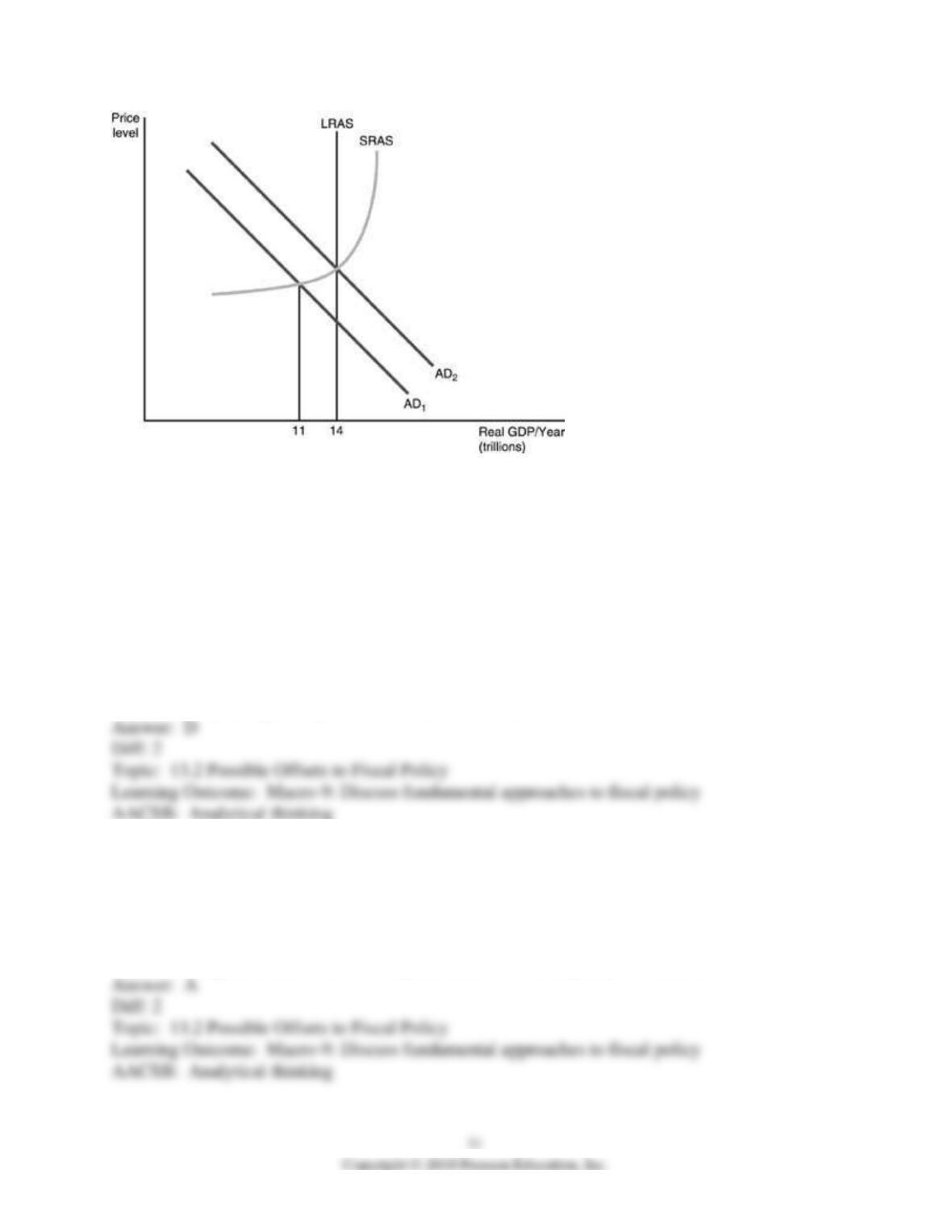
24) Refer to the above figure. The government has just engaged in expansionary fiscal policy
shifting the aggregate demand curve from AD1 to AD2. Interest rates have started to rise. Which
of the following statements is TRUE in the short run?
A) Real GDP will be $14 trillion since the effect of government spending is not influenced by
interest rates.
B) Real GDP will fall back to $11 trillion since the effect that increased government spending
has on real GDP is short lived.
C) Real GDP will go beyond $14 trillion as businesses and consumers react to the increase in
interest rates.
D) Real GDP will end up somewhere between $11 and $14 trillion as businesses and consumers
reduce their spending in response to the increase in interest rates.
25) When a direct expenditure offset occurs with the implementation of an expansionary fiscal
policy,
A) the stimulative effect will be less than expected.
B) the stimulative effect will be more than expected.
C) the fiscal policy will not be discretionary.
D) the time lags associated with the implementation of fiscal policy will shorten.
26) Suppose that real GDP is initially $20 trillion and the government attempts to increase real
GDP to $21 trillion. The marginal propensity to consume is 0.8, and every $1.00 increase in real
government spending crowds out $0.50 in real planned investment expenditures. Which increase
in government spending below could yield the desired level of real GDP?
A) $100 billion
B) $125 billion
C) $200 billion
D) $400 billion
27) Suppose that real GDP is initially $100 trillion and the government attempts to increase real
GDP to $101 trillion. The marginal propensity to consume is 0.75, and every $1.00 increase in
real government spending crowds out $0.50 in real planned investment expenditures. How much
increase in real government spending could lead to the desired level of real GDP?
A) $200 billion
B) $250 billion
C) $500 billion
D) $1 trillion
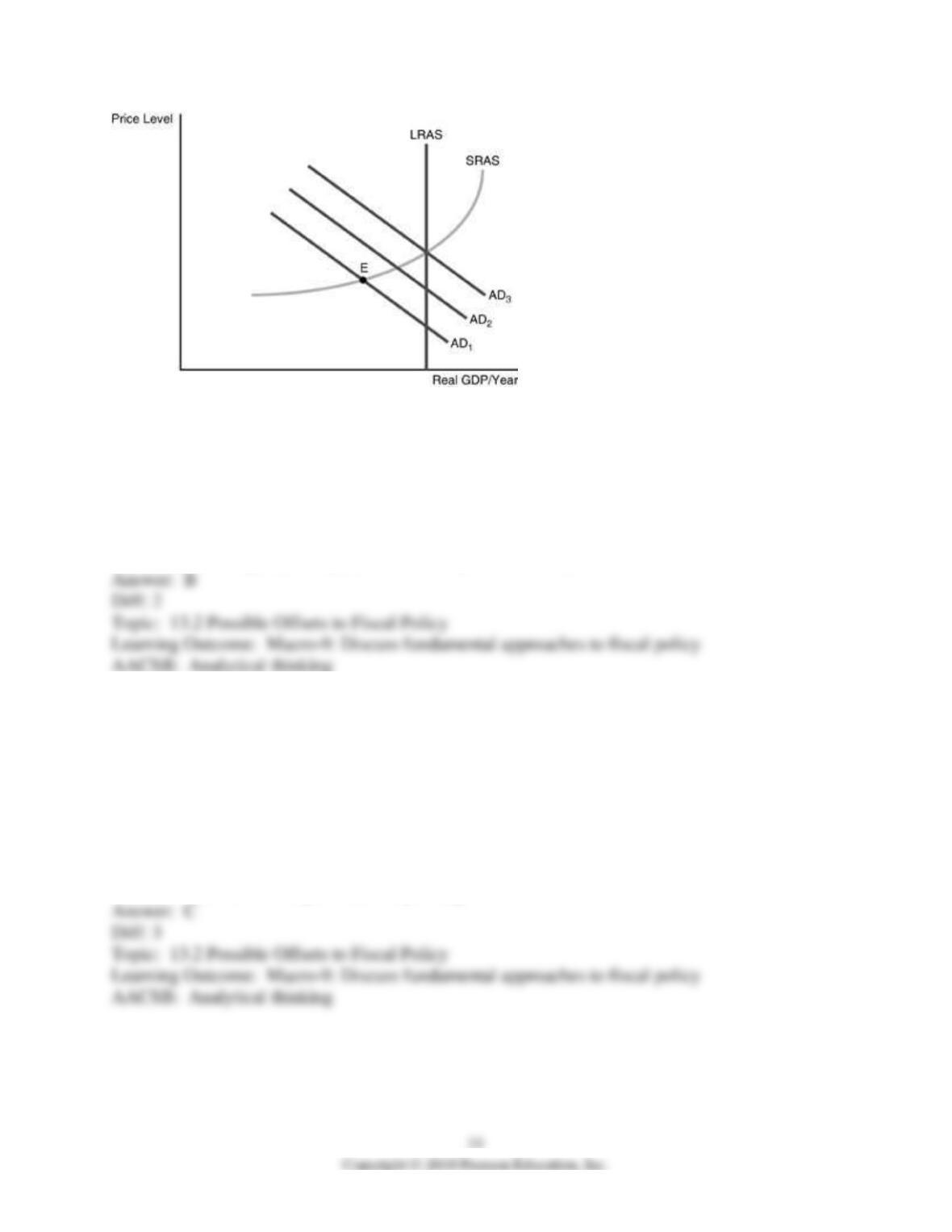
28) Refer to the above figure. If the economy is at E and the government wants to increase
aggregate demand to AD3, but the increase in spending only shifts the aggregate demand curve
to AD2, then
A) complete crowding out has occurred.
B) some crowding out has occurred.
C) the increased borrowing caused interest rates to fall.
D) the short-run aggregate supply curve is steeper than the figure indicates.
29) Refer to the above figure. Suppose the economy is at E and the government uses an
expansionary fiscal policy to move the aggregate demand curve to AD2. In the end, the
aggregate demand curve is still AD1. A possible reason for this is that
A) the economy is already at full employment.
B) the increased borrowing causes higher interest rates, which encourage people to save more
and increase investment spending due to the extra saving.
C) people increase saving because they anticipate higher future taxes, resulting in a reduction in
current consumption spending that offsets the increased government spending.
D) some of the increased government spending is not counted in GDP.
30) The Ricardian equivalence theorem states that
A) the effects of an increase in government spending are equivalent to the effects of an increase
in the money supply.
B) an increase in government spending financed by higher taxes has no effect on aggregate
demand.
C) spending on national defense is a direct expenditure offset.
D) government spending financed by taxes is equivalent to government spending financed by
borrowing.
31) According to the Ricardian equivalence theorem, a tax cut that increases the government
budget deficit will have
A) no effect on aggregate demand because people realize that there will be a future tax liability
so that there is no increase in consumption expenditures.
B) no effect on aggregate demand because people only look at changes in taxes or government
spending in the present.
C) a positive effect on aggregate demand because people look at changes in taxes or government
spending in the present.
D) an effect on aggregate demand. The magnitude the effect will have depends upon whether the
increase is caused by a reduction in taxes or an increase in government spending.
32) An increase in government spending will have no effect on real GDP if
A) people look at changes in taxes only in the present.
B) there is no crowding out.
C) the Ricardian equivalence theorem holds.
D) the tax decrease is offset by an increase in government spending.
33) The proposition that increases in government spending that raise the government budget
deficit has no effect on aggregate demand is called the
A) open-economy effect.
B) federalism effect.
C) Ricardian equivalence theorem.
D) interest-rate effect.
34) According to the Ricardian equivalence theorem, budget deficits resulting from tax cuts
A) increase aggregate demand.
B) increase both aggregate demand and aggregate supply.
C) have no effect on aggregate demand.
D) affect only aggregate supply.
35) Expansionary fiscal policy fails to achieve the government’s national economic goals. Some
economists claim it is due to indirect crowding out. What evidence would be consistent with this
claim?
A) An increase in consumer spending occurred.
B) The interest rate increased.
C) Saving decreased.
D) The price level decreased.
36) Three candidates for political office disagree over the benefits of enlarging the federal budget
deficit. Candidate X says the stimulation package is needed to increase employment and real
GDP; Candidate Y says it will only cause higher prices; and Candidate Z says it will have no
effect on either real GDP or the price level. How do the three candidates differ with respect to
the condition of the economy and the effects of fiscal policy?
A) Candidate X thinks the simple Keynesian model is applicable, while Y thinks the
expansionary policy will fully crowd out private investment. Z believes the economy is
experiencing a recessionary gap.
B) Candidate X thinks the simple Keynesian model is applicable; Y thinks the short-run
aggregate supply curve is horizontal; and Z thinks the expansionary policy will generate lower
interest rates.
C) Candidate X thinks the economy is below the full-employment real GDP and that the short-
run aggregate supply curve is horizontal. Candidate Y believes the economy is at full
employment. Candidate Z believes the expansionary policy will result only in direct fiscal
offsets.
D) Candidate X thinks the short-run aggregate supply curve is upward sloping; Y thinks interest
rates will rise; and Z thinks the economy is at full employment.
37) “Expansionary fiscal policy is always 100 percent effective when the short-run aggregate
supply curve is horizontal.” Is this statement TRUE?
A) yes, because theoretically nothing else can offset the effects of fiscal policy
B) yes, when the long-run aggregate supply curve is horizontal too
C) no, because crowding out could take place
D) no, because the increased spending may cause the price level to increase
38) Direct expenditure offsets are
A) the discretionary changing of government expenditures to achieve a higher employment level.
B) the decrease in planned investment that occurs as the result of an increase in interest rates.
C) the same as the Ricardian equivalence theorem.
D) the decrease in spending in the private sector in areas in which the government is competing.
39) Whenever government spending is a substitute for private spending
A) interest rates will rise.
B) the Ricardian equivalence theorem holds.
C) the effects of expansionary fiscal policy are dampened.
D) there is a direct multiplier effect.
40) The government has decided to give every resident a $1000 coupon that they can use to
purchase their choice of a new car. We would expect this policy to lead to
A) an increase in aggregate demand equivalent to the full impact of all of the coupons
redeemable.
B) no increase in aggregate demand due to the Ricardian equivalence theorem.
C) no increase in aggregate demand because there would be no direct expenditure offset.
D) an increase in aggregate demand but not equivalent to the full impact of all of the coupons
redeemed due to some direct expenditure offset.
41) The Laffer curve
A) initially slopes upward as increasing tax rates lead to increasing tax revenue but eventually
will slope downward as increasing tax rates lead to decreasing tax revenue.
B) slopes downward throughout its range since increasing tax rates will always lead to decreases
in tax revenue.
C) slopes upward throughout its range since increasing tax rates will always lead to increases in
tax revenue.
D) is horizontal because tax revenue is independent of the rate of interest.
42) Supply-side economics focuses on how fiscal policy might be used to
A) increase aggregate demand to the full-employment level of real GDP.
B) increase aggregate supply.
C) align aggregate demand and aggregate supply.
D) increase consumption.
43) The Laffer curve indicates which of the following?
A) There is an ideal interest rate that will maximize investment spending.
B) There is an ideal amount of government spending that will lead to full national employment.
C) There is an ideal tax-revenue-maximizing tax rate for government taxes.
D) There is an ideal income tax rate on individuals, depending on their consumption behavior.
44) According to the Laffer curve, increases in the tax rate will lead to a(n)
A) steady decrease in tax revenues.
B) steady increase in tax revenues.
C) initial decrease in tax revenues and then an increase in tax revenues.
D) initial increase in tax revenues and then a decrease in tax revenues.
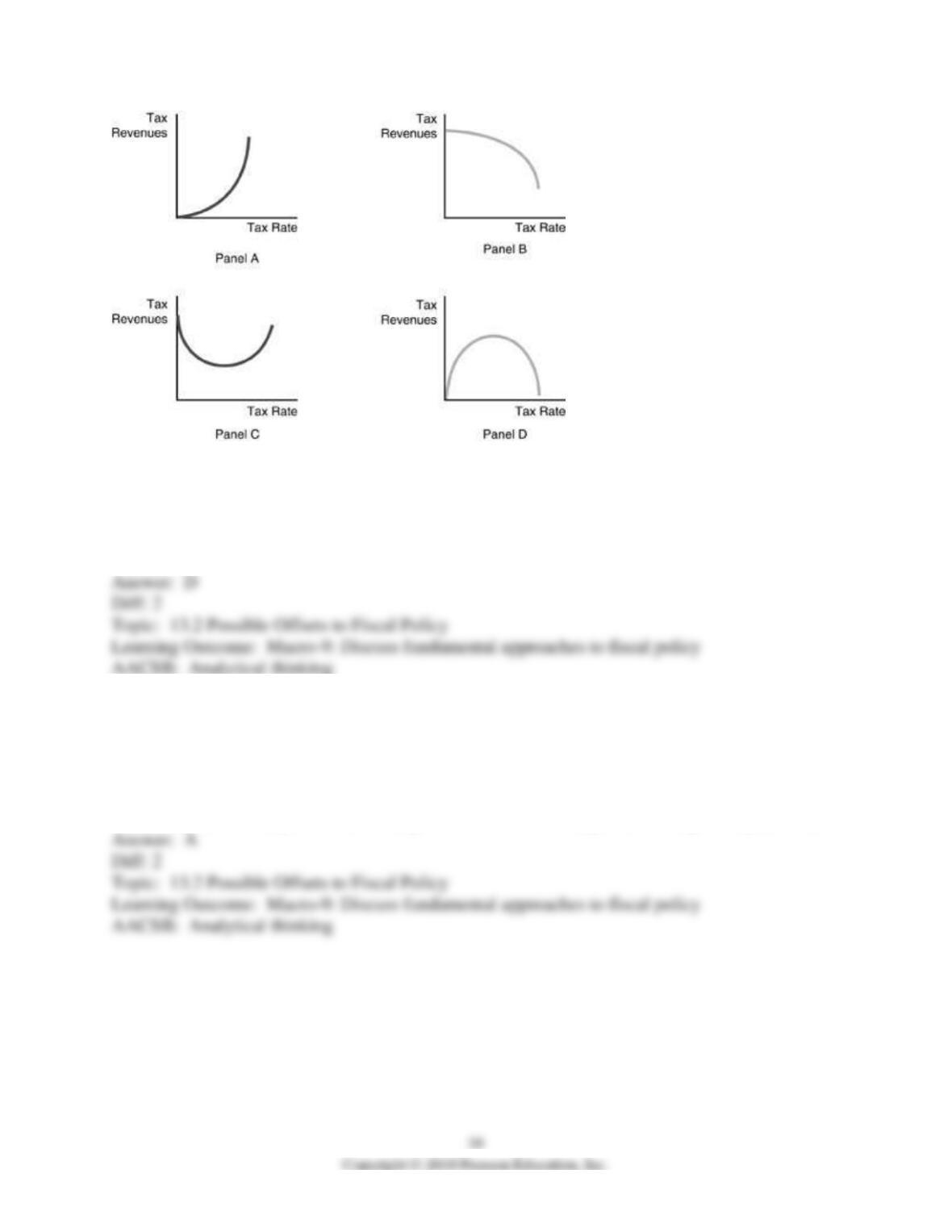
45) Refer to the above figure. Which panel is consistent with the Laffer curve?
A) Panel A
B) Panel B
C) Panel C
D) Panel D
46) If the government wishes to promote a higher rate of growth of real GDP, a supply-side
economist would argue the appropriate policy is
A) engaging in expansionary fiscal policy by lowering marginal tax rates.
B) engaging in expansionary fiscal policy of increasing government spending.
C) lowering marginal tax rates on people and raising them on corporations.
D) leaving the economy alone and letting the natural forces bring it into a long-run equilibrium.
47) According to supply-side economics, lower tax rates on wages
A) generate higher revenues for the government and increased unemployment.
B) create incentives to work more, which increases real GDP.
C) are less productive than lower tax rates on consumers.
D) have little effect on the economy.
48) The idea that creating incentives for individuals and firms to increase productivity leading to
an increase in long-run aggregate supply is
A) supply-side economics.
B) demand-side economics.
C) the Ricardian equivalence theorem.
D) laissez-faire economics.
49) Supply-side economics
A) promotes expansionary fiscal policy by simultaneously increasing taxes and government
spending.
B) promotes reducing taxes to create incentives to increase productivity.
C) is based on the crowding-out effects.
D) is based on the Ricardian equivalence theorem.