Scenario 13.1
Assume the following conditions hold.
a.
At all banks, excess reserves are zero.
b.
The deposit expansion multiplier is 3.
c.
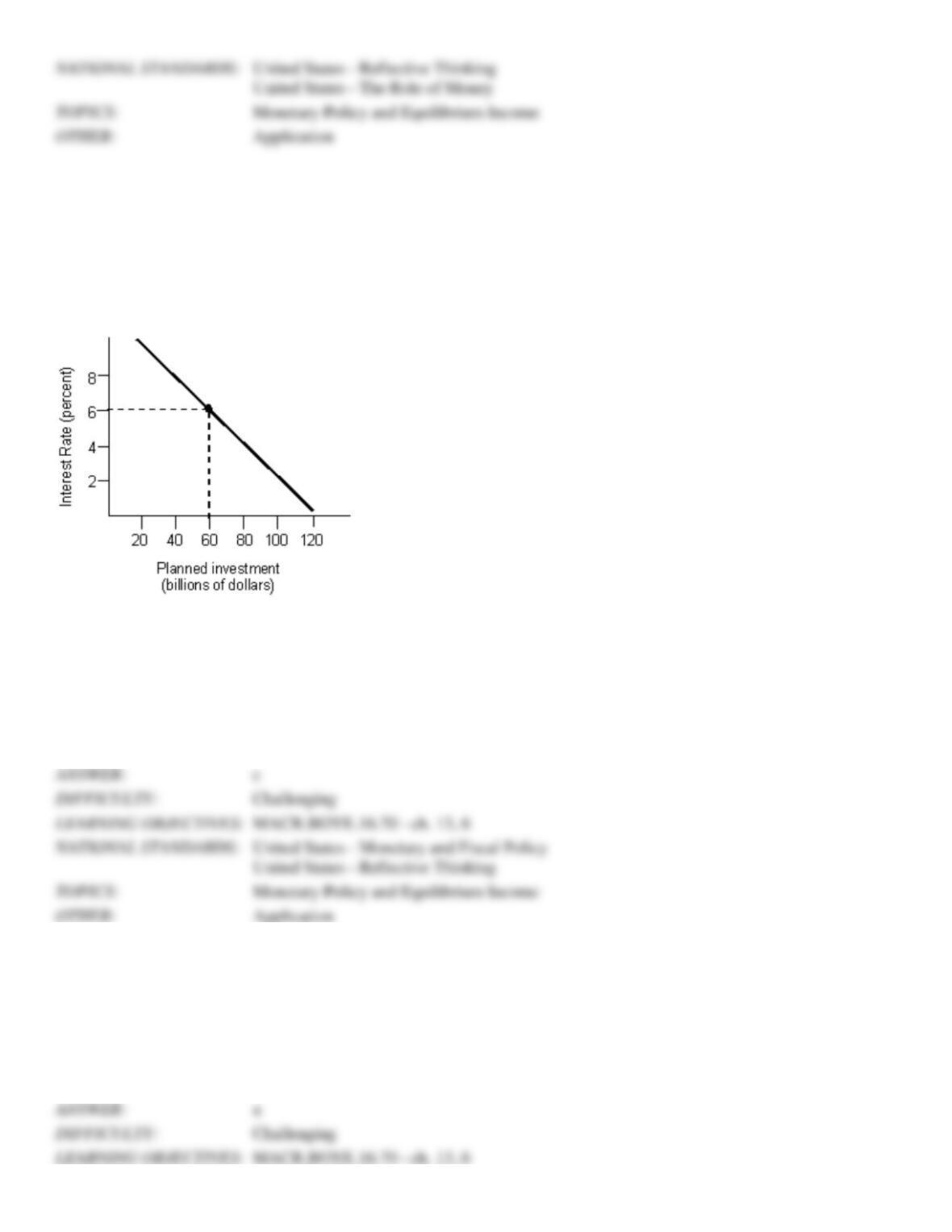
The investment spending function is as illustrated in the figure below.
Now the Federal Reserve engages in an open market operation by purchasing $1 billion worth of government bonds from
private bond dealers, who then deposit the $1 billion in the banks. This acts to lower the equilibrium interest rate by 2
percent.
102. Refer to Scenario 13.1. What is the change in excess reserves following the open market operation by the Fed?
a.
−$3 billion
b.
−$0.67 billion
c.
+$0.67 billion
d.
+$3 billion
e.
+$5 billion
Challenging
MACR.BOYE.16.70 – ch. 13, 6
Monetary Policy and Equilibrium Income
103. Refer to Scenario 13.1. What is the change in required reserves following the open market operation by the Fed?
a.
+$0.33 billion
b.
-$0.33 billion
c.
+$0.67 billion
d.
-$0.67 billion
e.
+1.0 billion
Scenario 13.2
Assume the following conditions hold.
a.
At all banks, excess reserves are zero.
b.
The deposit expansion multiplier is 3.
c.
The spending multiplier is 5.
d.
The initial equilibrium level of national income is $500 billion.
e.
The initial equilibrium interest rate equals 6 percent.
f.
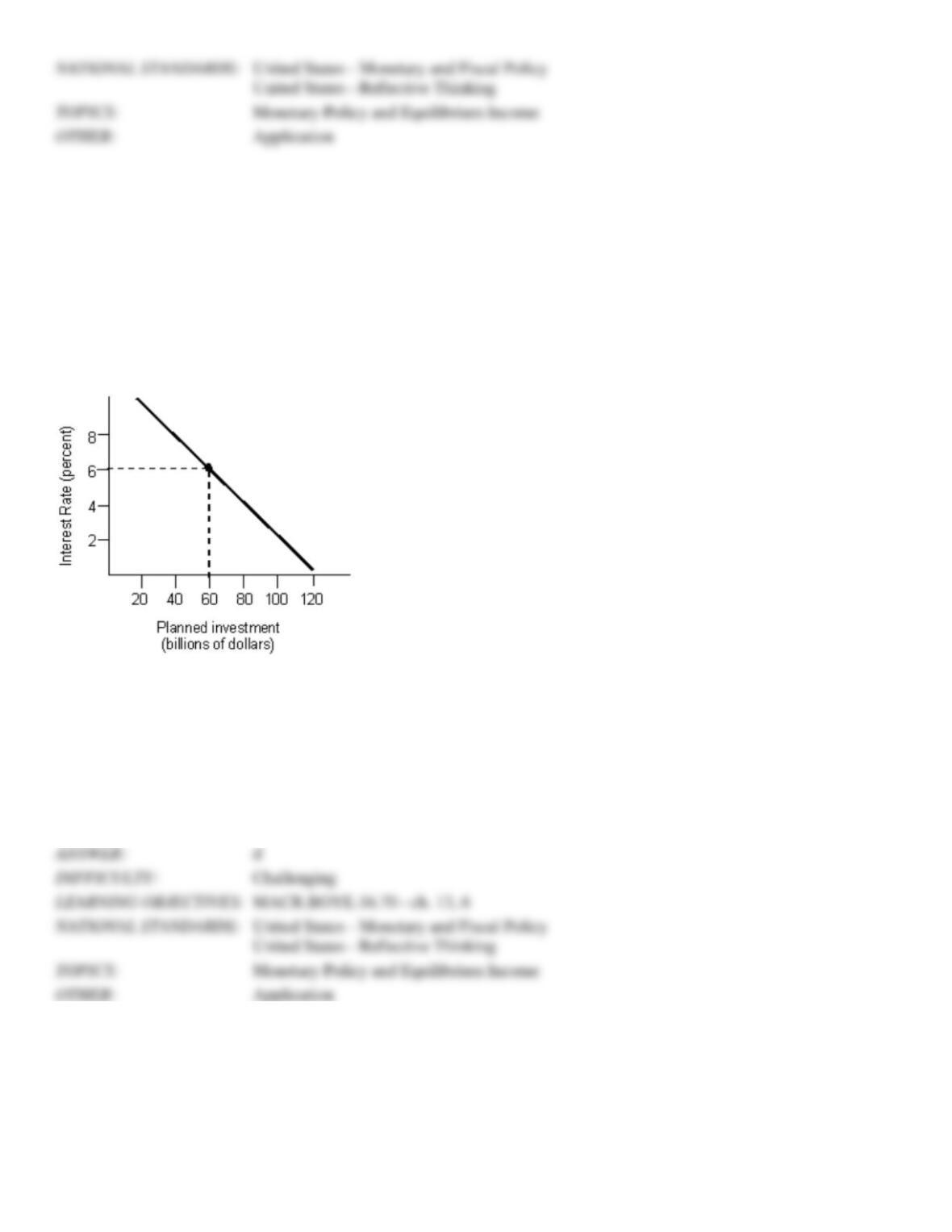
The investment spending function is as illustrated in the figure below.
Now the Federal Reserve engages in an open market operation by purchasing $1 billion worth of government bonds from
private bond dealers, who then deposit the $1 billion in the banks. This acts to lower the equilibrium interest rate by 2
percent.
104. Refer to Scenario 13.1. What is the ultimate change in the money supply following the open market operation by the
Fed?
a.
−$3 billion
b.
−$0.33 billion
c.
+$1 billion
d.
+$2.01 billion
e.
+$5.2 billion
d
Challenging
MACR.BOYE.16.70 – ch. 13, 6
United States – Reflective Thinking
Monetary Policy and Equilibrium Income
Application
105. Refer to Scenario 13.1. What is the change in investment spending following the open market operation by the Fed?
a.
−$20 billion
b.
−$10 billion
c.
+$20 billion
d.
+$30 billion
e.
+$50 billion
Application
106. The Federal Reserve (Fed) was created by the Congress as an independent agency.
a.
True
b.
False
True
Easy
MACR.BOYE.16.65 – ch. 13, 1
United States – Monetary and Fiscal Policy
The Federal Reserve System
Knowledge
107. All members of the Federal Board of Governors are appointed by the president and confirmed by the Senate.
a.
True
b.
False
True
Easy
MACR.BOYE.16.65 – ch. 13, 1
The Federal Reserve System
Knowledge
108. The monetary policy decisions made by the Federal Reserve must be approved by the Congress before they are
enacted.
a.
True
b.
False
False
MACR.BOYE.16.65 – ch. 13, 1
United States – Monetary and Fiscal Policy
The Federal Reserve System
Knowledge
109. The Board of Governors is the body responsible for setting and implementing monetary policy targets for the Federal
Reserve System.
a.
True
b.
False
False
Challenging
MACR.BOYE.16.70 – ch. 13, 6
United States – Reflective Thinking
Monetary Policy and Equilibrium Income
Application
110. The Fed controls the money supply to achieve the policy goals set by the United States International Trade
Commission.
a.
True
b.
False
False
Moderate
United States – Monetary and Fiscal Policy
The Federal Reserve System
Knowledge
111. The Fed controls the money supply in the U.S. economy largely through its ability to influence bank reserves and the
money creating power of commercial banks.
a.
True
b.
False
True
Moderate
MACR.BOYE.16.65 – ch. 13, 1
United States – Monetary and Fiscal Policy
The Federal Reserve System
Knowledge
112. According to the equation of exchange, a contractionary monetary policy must be adopted to offset any decrease in
the velocity of money.
a.
True
b.
False
False
Moderate
MACR.BOYE.16.66 – ch. 13, 2
Implementing Monetary Policy
Knowledge
113. Suppose that the nominal money supply equals $2 billion and nominal GDP is $16 billion. Then, according to the
equation of exchange, the velocity of money equals 8.
a.
True
b.
False
Easy
MACR.BOYE.16.65 – ch. 13, 1
The Federal Reserve System
Knowledge
114. As the velocity of money rises, the amount of money being held by individuals also rises.
a.
True
b.
False
False
Moderate
MACR.BOYE.16.66 – ch. 13, 2
United States – Monetary and Fiscal Policy
Implementing Monetary Policy
Knowledge
115. When the Fed uses money growth rates as an intermediate target, it implicitly assumes that the velocity of money is
constant over time, at least in the short run.
a.
True
b.
False
True
MACR.BOYE.16.66 – ch. 13, 2
United States – Monetary and Fiscal Policy
Implementing Monetary Policy
Knowledge
116. Inflation targeting usually increases the uncertainty about the course of action of central banks, as perceived by the
general public.
a.
True
b.
False
False
Easy
MACR.BOYE.16.66 – ch. 13, 2
Implementing Monetary Policy
Knowledge
117. The velocity of circulation of money is the ratio of the real gross domestic product to the money supply.
a.
True
b.
False
False
True
Challenging
MACR.BOYE.16.66 – ch. 13, 2
United States – Reflective Thinking
Implementing Monetary Policy
Application
118. The Fed can enhance liquidity in the U.S. economy by increasing the federal funds rate.
a.
True
b.
False
False
Moderate
MACR.BOYE.16.67 – ch. 13, 3
United States – Monetary and Fiscal Policy
Implementing Monetary Policy
Knowledge
119. The Fed usually sets a higher reserve requirement for savings accounts than for checking accounts.
a.
True
b.
False
False
Easy
MACR.BOYE.16.67 – ch. 13, 3
United States – Monetary and Fiscal Policy
Implementing Monetary Policy
Knowledge
120. The bank rate is the interest rate charged by the commercial banks to its borrowers.
a.
True
b.
False
False
Easy
MACR.BOYE.16.67 – ch. 13, 3
Implementing Monetary Policy
Knowledge
121. Other things equal, when the Fed raises the reserve requirement, the banking system’s excess reserves will fall, the
deposit expansion multiplier will decline, and the money supply will decrease.
a.
True
b.
False
True
MACR.BOYE.16.67 – ch. 13, 3
Moderate
MACR.BOYE.16.66 – ch. 13, 2
Implementing Monetary Policy
Knowledge
122. The “secondary credit” of the discount rate is usually lower than the “primary credit,” because it is intended for
banks in good financial condition.
a.
True
b.
False
False
Easy
MACR.BOYE.16.67 – ch. 13, 3
Implementing Monetary Policy
Knowledge
123. When the government raises spending to promote economic growth, the Fed sells government bonds on the open
market. This implies that the Federal Reserve and the federal government are following different policy goals.
a.
True
b.
False
True
Moderate
MACR.BOYE.16.67 – ch. 13, 3
Implementing Monetary Policy
Comprehension
124. When the FOMC sets a monetary policy, it first identifies its intermediate target and then works accordingly to
achieve its ultimate goal.
a.
True
b.
False
False
Moderate
MACR.BOYE.16.67 – ch. 13, 3
United States – Monetary and Fiscal Policy
Implementing Monetary Policy
Knowledge
125. The Fed has set a uniform reserve requirement of 3 percent for all deposits in the U.S. banking system.
a.
True
b.
False
False
MACR.BOYE.16.67 – ch. 13, 3
Knowledge
126. The quantity of excess reserves in the banking system and the federal funds rate can serve as short-run operating
targets for the FOMC and help it perform the open market operation.
a.
True
b.
False
True
Easy
MACR.BOYE.16.67 – ch. 13, 3
Implementing Monetary Policy
Knowledge
127. If a depreciation of the British pound is to be prevented, the U.S. Federal Reserve has to buy British pounds and sell
U.S. dollars.
a.
True
b.
False
True
Moderate
MACR.BOYE.16.68 – ch. 13, 4
Implementing Monetary Policy
Application
128. The sale of U.S. currency and purchase of foreign currency by the Federal Reserve would shift the demand curve for
U.S. dollars to the left.
a.
True
b.
False
False
Challenging
MACR.BOYE.16.68 – ch. 13, 4
United States – Reflective Thinking
Implementing Monetary Policy
Application
129. Sterilization occurs when a central bank offsets the effects of expansionary monetary policy through foreign
exchange market intervention.
a.
True
b.
False
Easy
Knowledge
130. Increased demand for U.S. products by foreign residents will lead to a depreciation of the U.S. dollar relative to
foreign currencies.
a.
True
b.
False
False
Moderate
MACR.BOYE.16.68 – ch. 13, 4
Implementing Monetary Policy
Knowledge
131. An individual who holds some of her wealth in the form of money in order to pay rent and buy groceries is
illustrating the transactions demand for money.
a.
True
b.
False
True
Easy
MACR.BOYE.16.69 – ch. 13, 5
Monetary Policy and Equilibrium Income
Application
132. The transactions demand for money increases when more people want to hold some of their wealth in the form of
money to reduce the risks associated with unexpected emergencies.
a.
True
b.
False
False
Moderate
MACR.BOYE.16.69 – ch. 13, 5
United States – The Role of Money
Monetary Policy and Equilibrium Income
Knowledge
133. If you believe that the price of U.S. government bonds will soon fall, you will want to increase your speculative
money demand.
a.
True
b.
False
True
MACR.BOYE.16.68 – ch. 13, 4
Implementing Monetary Policy
Knowledge
134. The interest rate represents the opportunity cost of holding non-monetary assets.
a.
True
b.
False
False
Easy
MACR.BOYE.16.69 – ch. 13, 5
United States – The Role of Money
Monetary Policy and Equilibrium Income
Knowledge
135. There is an inverse relationship between the interest rate and the quantity of money demanded.
a.
True
b.
False
True
Easy
MACR.BOYE.16.69 – ch. 13, 5
United States – The Role of Money
Monetary Policy and Equilibrium Income
Knowledge
136. Suppose you hold $5,000 in cash when the interest rate on bonds is 4 percent. Other things equal, as the bond interest
rate declines to 3 percent, you will want to hold more money because the opportunity cost of holding money has
decreased.
a.
True
b.
False
True
Moderate
MACR.BOYE.16.69 – ch. 13, 5
United States – The Role of Money
Monetary Policy and Equilibrium Income
Comprehension
137. Other things equal, an increase in the general price level causes the money demand function to shift to the left.
a.
True
b.
False
Easy
Moderate
MACR.BOYE.16.69 – ch. 13, 5
Monetary Policy and Equilibrium Income
Comprehension
138. The money supply function reflects a positive relationship between the interest rate and the quantity of money
supplied.
a.
True
b.
False
False
Moderate
MACR.BOYE.16.69 – ch. 13, 5
Monetary Policy and Equilibrium Income
Knowledge
139. If you buy for $100 a bond that pays 4.57 percent in annual interest and the current interest yield on the bond rises to
5.13 percent, then the price of the bond has fallen.
a.
True
b.
False
True
Moderate
MACR.BOYE.16.69 – ch. 13, 5
Monetary Policy and Equilibrium Income
Application
140. An outward shift of the money demand function indicates an increase in the market rate of interest and hence a
decrease in the level of investment in the economy.
a.
True
b.
False
False
Moderate
MACR.BOYE.16.70 – ch. 13, 6
United States – The Role of Money
Monetary Policy and Equilibrium Income
Knowledge
141. If the aggregate supply curve is positively sloped, an increase in the money supply will result in an increase in both
equilibrium national income and the equilibrium price level.
a.
True
b.
False
True
MACR.BOYE.16.69 – ch. 13, 5
Monetary Policy and Equilibrium Income
Knowledge