
45) The long-run aggregate supply curve shows the relationship between
A) short-run aggregate supply and short-run aggregate demand.
B) the price level and quantity of real GDP supplied.
C) the real interest rate and the nominal interest rate.
D) the quantity of real GDP supplied and the quantity of nominal GDP supplied.
46) On the long-run aggregate supply curve,
A) an increase in the price level increases the aggregate quantity of GDP supplied.
B) an increase in the price level reduces the aggregate quantity of GDP supplied.
C) an increase in the price level has no effect on the aggregate quantity of GDP supplied.
D) an increase in the price level increases the level of potential GDP.
47) Changes in ________ do not affect the level of aggregate supply in the long run.
A) technology
B) the number of workers in the economy
C) the price level
D) the amount of accumulated capital equipment
48) If technological change occurs in the economy,
A) the long-run aggregate supply curve will shift to the right.
B) the long-run aggregate supply curve will shift to the left.
C) we will move up along the long-run aggregate supply curve.
D) we will move down along the long-run aggregate supply curve.
49) Suppose a developing country experiences a reduction in machinery and capital equipment as
foreign entrepreneurs decrease the amount of investment in the economy. As a result,
A) the long-run aggregate supply curve will shift to the right.
B) the long-run aggregate supply curve will shift to the left.
C) the economy will move up along the long-run aggregate supply curve.
D) the economy will move down along the long-run aggregate supply curve.
50) The short-run aggregate supply curve has a
A) negative slope.
B) positive slope.
C) slope equal to infinity.
D) slope equal to zero.
51) The ________ curve has a positive slope because as prices of final goods and services rise, prices of
inputs rise more slowly.
A) short-run aggregate supply
B) long-run aggregate supply
C) short-run aggregate demand
D) long-run aggregate demand

52) If firms and workers could predict the future price level exactly, the short-run aggregate supply
curve would be
A) upward sloping.
B) downward sloping.
C) horizontal.
D) vertical.
53) A decrease in the price level will
A) shift the short-run aggregate supply curve to the left.
B) shift the short-run aggregate supply curve to the right.
C) move the economy up along a stationary short-run aggregate supply curve.
D) move the economy down along a stationary short-run aggregate supply curve.
54) If workers leave a country to seek out better opportunities in another country, then this will
A) shift the short-run aggregate supply curve of the original country to the left.
B) shift the short-run aggregate supply curve of the original country to the right.
C) move the original economy up along a stationary short-run aggregate supply curve.
D) move the original economy down along a stationary short-run aggregate supply curve.
55) The invention of the integrated circuit by Jack Kilby of Texas Instruments gave rise to the
information age. What did this technological change do the short-run supply curve?
A) It shifted the short-run aggregate supply curve to the left.
B) It shifted the short-run aggregate supply curve to the right.
C) It moved the economy up along a stationary short-run aggregate supply curve.
D) It moved the economy down along a stationary short-run aggregate supply curve.
56) Hurricane Katrina destroyed oil and natural gas refining capacity in the Gulf of Mexico. This
subsequently drove up natural gas, gasoline, and heating oil prices. As a result, this should
A) shift the short-run aggregate supply curve to the left.
B) shift the short-run aggregate supply curve to the right.
C) move the economy up along a stationary short-run aggregate supply curve.
D) move the economy down along a stationary short-run aggregate supply curve.
57) When the price level falls from 135 to 120, the aggregate level of GDP supplied falls from $140
billion to $125 billion. This ________ relationship represents the ________ relationship between GDP
and the price level.
A) negative; short-run
B) positive; short-run
C) negative; long-run
D) positive; long-run
58) If potential GDP is equal to $600 billion, what does the long-run aggregate supply curve look like?
A) It is a horizontal line at $600 billion of GDP.
B) It is a vertical line at a level of GDP below $600 billion.
C) It is a vertical line at $600 billion of GDP.
D) It is a vertical line at a level of GDP above $600 billion.
59) Workers expect inflation to fall from 4% to 1% next year. As a result, this should
A) shift the short-run aggregate supply curve to the left.
B) shift the short-run aggregate supply curve to the right.
C) move the economy up along a stationary short-run aggregate supply curve.
D) move the economy down along a stationary short-run aggregate supply curve.
60) Workers and firms both expect that prices will be 3% higher next year than they are this year. As a
result,
A) workers will be willing to take lower wages next year.
B) the purchasing power of wages will rise if wages increase by 3%.
C) the short-run aggregate supply curve will shift to the left as wages increase.
D) aggregate demand will increase by 3%.
61) Which of the following would cause the short-run aggregate supply curve to shift to the left?
A) an increase in the price level
B) an increase in inflation expectations
C) a technological advance
D) a decrease in interest rates
62) The long-run aggregate supply curve is vertical.
63) When potential GDP increases, long-run aggregate supply also increases.
64) A supply shock causes the long-run aggregate supply curve to shift left, decreasing the price level.
65) The short-run aggregate supply curve is vertical.
66) When potential GDP increases, short-run aggregate supply also increases, but long-run aggregate
supply does not change.
67) An adverse supply shock causes the short-run aggregate supply curve to shift left, increasing the
price level.
68) Explain why the long-run aggregate supply curve is vertical.
69) What variables cause the short-run aggregate supply curve to shift? For each variable, identify
whether an increase in that variable will cause the short-run aggregate supply curve to shift to the right
or to the left.
70) Explain how menu costs affect the slope of the short-run aggregate supply curve.
71) What are sticky prices, and how can contracts make them “sticky”?
72) Why does the short-run aggregate supply curve slope upward?
73) Explain how each of the following events would affect the long-run aggregate supply curve.
a. A lower price level
b. A decrease in the labor force
c. A decrease in the quantity of capital goods
d. Technological change
74) Explain how each of the following events would affect the short-run aggregate supply curve.
a. A decrease in the price level
b. A decrease in what the price level is expected to be in the future
c. A price level that is currently lower than expected
d. An unexpected decrease in the price of an important raw material
e. A decrease in the labor force
13.3 Macroeconomic Equilibrium in the Long Run and the Short Run
1) Long-run macroeconomic equilibrium occurs when
A) aggregate demand equals short-run aggregate supply.
B) aggregate demand equals short-run aggregate supply and they intersect at a point on the long-run
aggregate supply curve.
C) structural and frictional unemployment equals zero.
D) output is above potential GDP.
2) An increase in aggregate demand results in a(n) ________ in the ________.
A) recession; long run
B) expansion; long run
C) expansion; short run
D) recession; short run

3) Suppose there has been an increase in investment. As a result, real GDP will ________ in the short
run, and ________ in the long run.
A) increase; increase further
B) increase; decrease to its initial value
C) decrease; decrease further
D) decrease; increase to its initial level
4) A decrease in investment causes the price level to ________ in the short run and ________ in the long
run.
A) increase; increase further
B) increase; decrease
C) decrease; decrease further
D) decrease; increase
5) An increase in aggregate demand causes an increase in ________ only in the short run, but causes an
increase in ________ in both the short run and the long run.
A) the price level; real GDP
B) real GDP; real GDP
C) the price level; the price level
D) real GDP; the price level
6) Most recessions in the United States since World War II have begun with
A) a decline in residential construction.
B) a rapid increase in the price level.
C) a substantial number of bank failures.
D) a stock market crash.
7) When the aggregate demand curve and the short-run aggregate supply curve intersect,
A) the long-run aggregate supply curve must also intersect at the same point.
B) inflation must be increasing.
C) structural and frictional unemployment equal zero.
D) the economy is in short-run macroeconomic equilibrium.
8) Interest rates in the economy have fallen. How will this affect aggregate demand and equilibrium in
the short run?
A) Aggregate demand will rise, the equilibrium price level will rise, and the equilibrium level of GDP
will rise.
B) Aggregate demand will rise, the equilibrium price level will fall, and the equilibrium level of GDP
will rise.
C) Aggregate demand will fall, the equilibrium price level will fall, and the equilibrium level of GDP
will fall.
D) Aggregate demand will fall, the equilibrium price level will rise, and the equilibrium level of GDP
will fall.

9) A decrease in aggregate demand in the economy will have what effect on macroeconomic
equilibrium in the long run?
A) The price level will fall, and the level of GDP will be unaffected.
B) The price level will fall, and the level of GDP will fall.
C) The price level will rise, and the level of GDP will fall.
D) The price level will rise, and the level of GDP will be unaffected.
10) If the short-run aggregate supply increases by less than the long-run aggregate supply, then, at the
short-run equilibrium,
A) GDP will be below potential GDP.
B) aggregate demand will increase.
C) GDP will be above potential GDP.
D) GDP will be equal to potential GDP.
11) The process of an economy adjusting from a recession back to potential GDP in the long run without
any government intervention is known as
A) monetary policy.
B) an automatic mechanism.
C) “releasing sticky prices.”
D) fiscal policy.
12) Suppose the economy is at full employment and firms become more optimistic about the future
profitability of new investment. Which of the following will happen in the short run?
A) Output will decline.
B) Prices will decline.
C) Unemployment will decline.
D) The aggregate demand curve will shift to the left.
13) Suppose the economy is at a short-run equilibrium GDP that lies below potential GDP. Which of the
following will occur because of the automatic mechanism adjusting the economy back to potential
GDP?
A) Output will decrease.
B) Prices will increase.
C) Unemployment will rise.
D) Short-run aggregate supply will shift to the right.
14) Why does the short-run aggregate supply curve shift to the right in the long run, following a
decrease in aggregate demand?
A) Workers and firms adjust their expectations of wages and prices downward and they accept lower
wages and prices.
B) Workers and firms adjust their expectations of wages and prices downward and they push for higher
wages and prices.
C) Workers and firms adjust their expectations of wages and prices upward and they push for higher
wages and prices.
D) Workers and firms adjust their expectations of wages and prices upward and they accept lower
wages and prices.
15) The automatic mechanism ________ the price level in the case of ________ and ________ the price
level in the case of ________.
A) raises; recession; lowers; expansion
B) raises; expansion raises; recession
C) lowers; expansion; lowers; recession
D) lowers; recession; raises; expansion
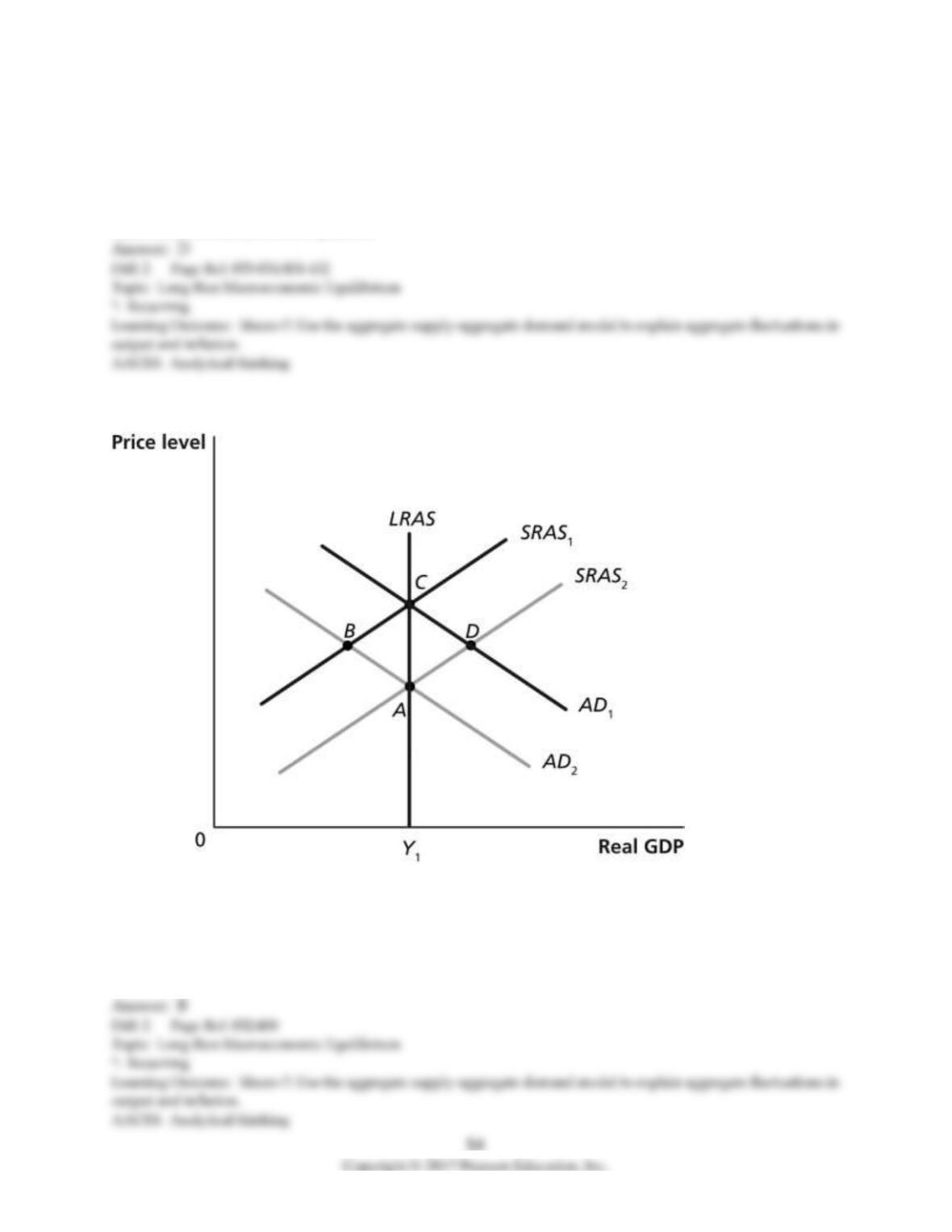
Figure 13-3
16) Refer to Figure 13-3. Which of the points in the above graph are possible long-run equilibria?
A) A and B
B) A and C
C) A and D
D) B and D

17) Refer to Figure 13-3. Which of the points in the above graph are possible short-run equilibria but
not long-run equilibria? Assume that Y1 represents potential GDP.
A) A and B
B) A and C
C) C and D
D) B and D
18) Refer to Figure 13-3. Suppose the economy is at point A. If investment spending increases in the
economy, where will the eventual long-run equilibrium be?
A) A
B) B
C) C
D) D
19) Refer to Figure 13-3. Suppose the economy is at point C. If government spending decreases in the
economy, where will the eventual long-run equilibrium be?
A) A
B) B
C) C
D) D
20) Refer to Figure 13-3. Suppose the economy is at point A. If the economy experiences a supply
shock, where will the eventual short-run equilibrium be?
A) A
B) B
C) C
D) D
21) Refer to Figure 13-3. Which of the points in the above graph are possible short-run equilibria?
A) A and B
B) A and C
C) A and D
D) A, B, C, and D
22) Refer to Figure 13-3. Suppose the economy is at point C. If investment spending decreases in the
economy, where will the eventual long-run equilibrium be?
A) A
B) B
C) C
D) D

23) Refer to Figure 13-3. Suppose the economy is at point A. If government spending increases in the
economy, where will the eventual long-run equilibrium be?
A) A
B) B
C) C
D) D
24) ________ of unemployment during ________ make it easier for workers to ________ wages.
A) High levels; a recession; negotiate higher
B) Low levels; an expansion; negotiate higher
C) Low levels; a recession; accept lower
D) High levels; an expansion; accept lower
25) A negative supply shock in the short run causes
A) the aggregate supply curve to shift to the left.
B) the price level to fall.
C) unemployment to fall.
D) equilibrium real GDP to rise.
26) Which of the following is considered a negative supply shock?
A) increasing immigration in the economy causes the labor supply to rise
B) an improvement in technology
C) an increase in unemployment
D) an unexpected decrease in the refining capacity for oil
27) The long-run adjustment to a negative supply shock results in
A) the short-run aggregate supply curve shifting to the right.
B) the price level rising.
C) unemployment rising.
D) workers being willing to accept higher wages.
28) In the long run,
A) GDP > potential GDP.
B) unemployment is at its natural rate.
C) LRAS and SRAS lie on the same line.
D) the inflation rate is zero.
29) When the price of oil rises unexpectedly, the equilibrium price level ________ and the
unemployment rate ________ in the short run.
A) rises; falls
B) rises; rises
C) falls; falls
D) falls; rises
30) After an unexpected ________ in the price of oil, the long-run adjustment decreases the price level
and ________ the unemployment rate as they return to their original levels.
A) increase; increases
B) increase; decreases
C) decrease; increases
D) decrease; decreases

31) Stagflation occurs when
A) inflation rises and GDP rises.
B) inflation falls and GDP rises.
C) inflation rises and GDP falls.
D) inflation falls and GDP falls.
32) Stagflation usually results from
A) a supply shock.
B) a decrease in aggregate demand.
C) an increase in aggregate supply.
D) an increase in aggregate demand.
33) On average, in the recessions since 1950, it has taken ________ for real GDP to return to its cyclical
peak.
A) about 6 months
B) about 1 year
C) about 18 months
D) almost 2.5 years
34) On average, in the recessions since 1950, it has taken ________ for employment to return to its
cyclical peak.
A) about 6 months
B) about 1 year
C) about 18 months
D) almost 2.5 years
35) Long-run macroeconomic equilibrium occurs when aggregate demand ________ short-run
aggregate supply and they ________ the long-run supply curve.
A) equals; intersect at a point to the right of
B) equals; intersect at a point on
C) is greater than; intersect at a point to the left of
D) is less than; intersect at a point to the right of
36) A decrease in aggregate demand results in a(n) ________ in the ________.
A) recession; long run
B) expansion; long run
C) expansion; short run
D) recession; short run