
68) A decrease in disposable income will shift the aggregate demand curve to the left.
69) An increase in the price level shifts the aggregate demand curve to the left.
70) An increase in exports decreases aggregate demand.
71) An increase in disposable income will shift the aggregate demand curve to the right.
72) An increase in the price level causes a movement down the aggregate demand curve.
73) President Obama has discussed raising income taxes for individuals earning over $250,000 in
income. Explain how these higher income taxes will affect the aggregate demand curve.
74) In September of 2007, the Federal Reserve Board Open Market Committee voted to lower interest
rates for the first time that year. Explain how lower interest rates affect the aggregate demand curve.
75) President Bush lowered income taxes for individuals in 2001. Explain how lower income taxes affect
the aggregate demand curve.
76) Explain the three reasons the aggregate demand curve slopes downward.
77) Explain how each of the following events would affect the aggregate demand curve.
a. Lower interest rates
b. A decrease in net exports
c. A decrease in the price level
d. Slower income growth in other countries
e. A decrease in imports
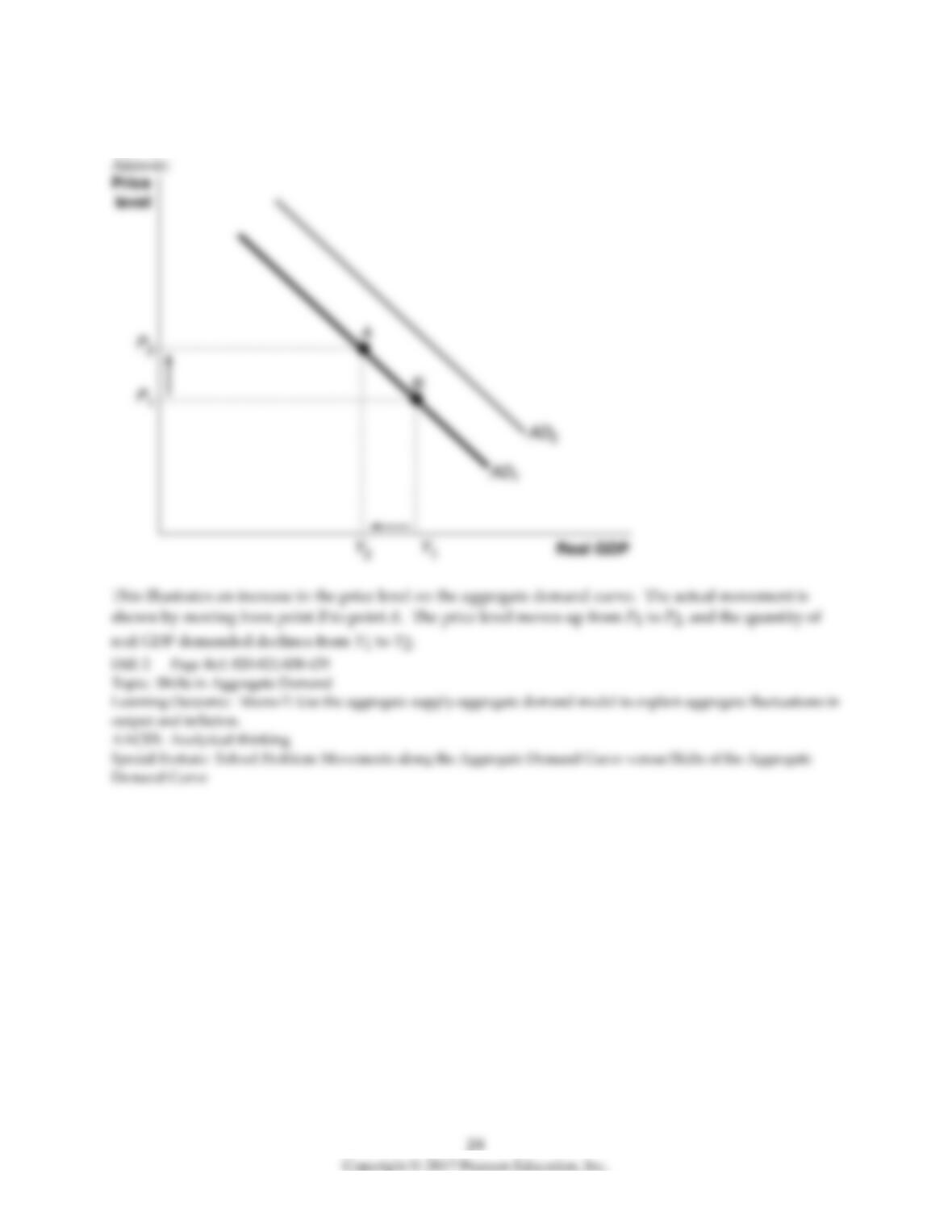
78) Using an aggregate demand graph, illustrate the impact of an increase in the price level on
aggregate demand.
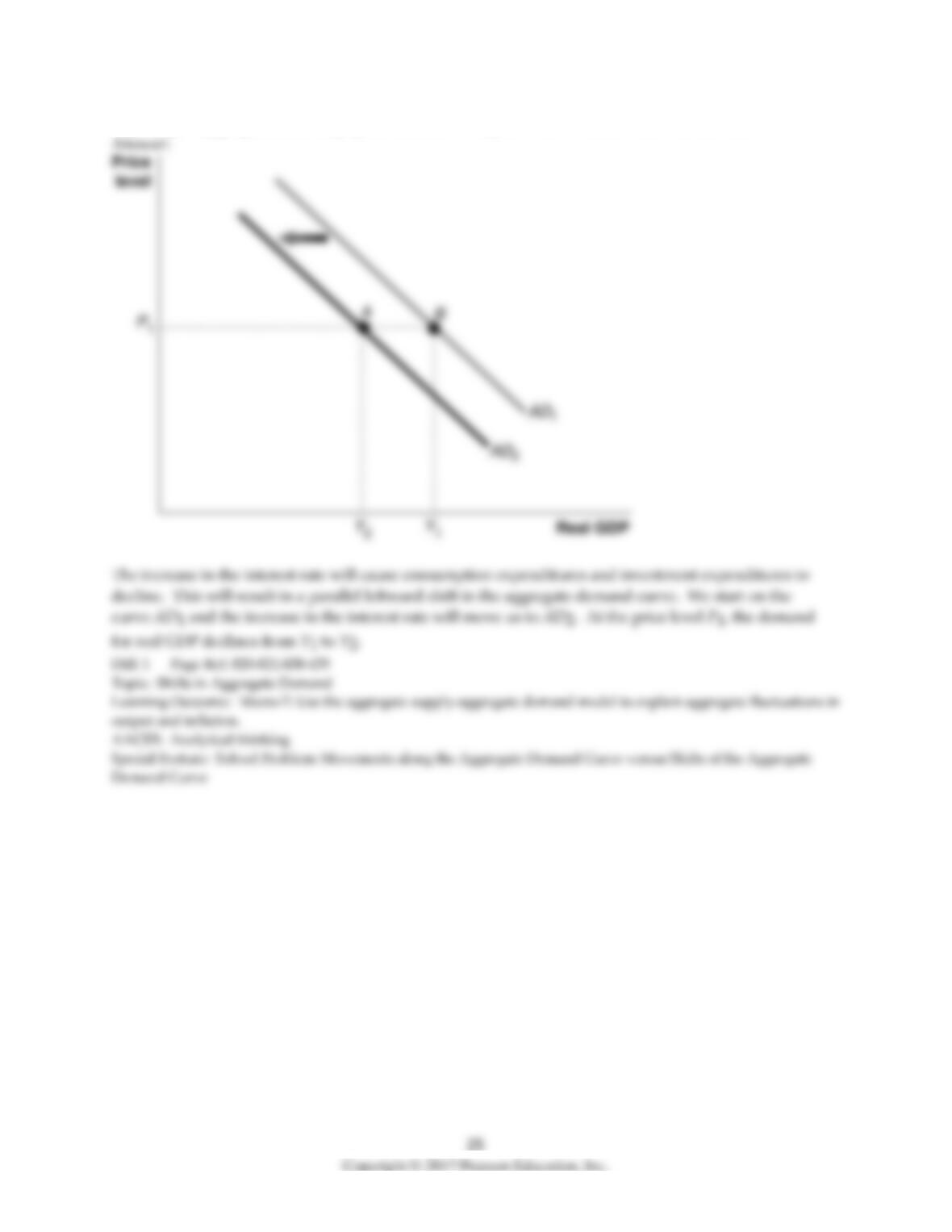
79) Using an aggregate demand graph, illustrate the impact of an increase in the interest rate.
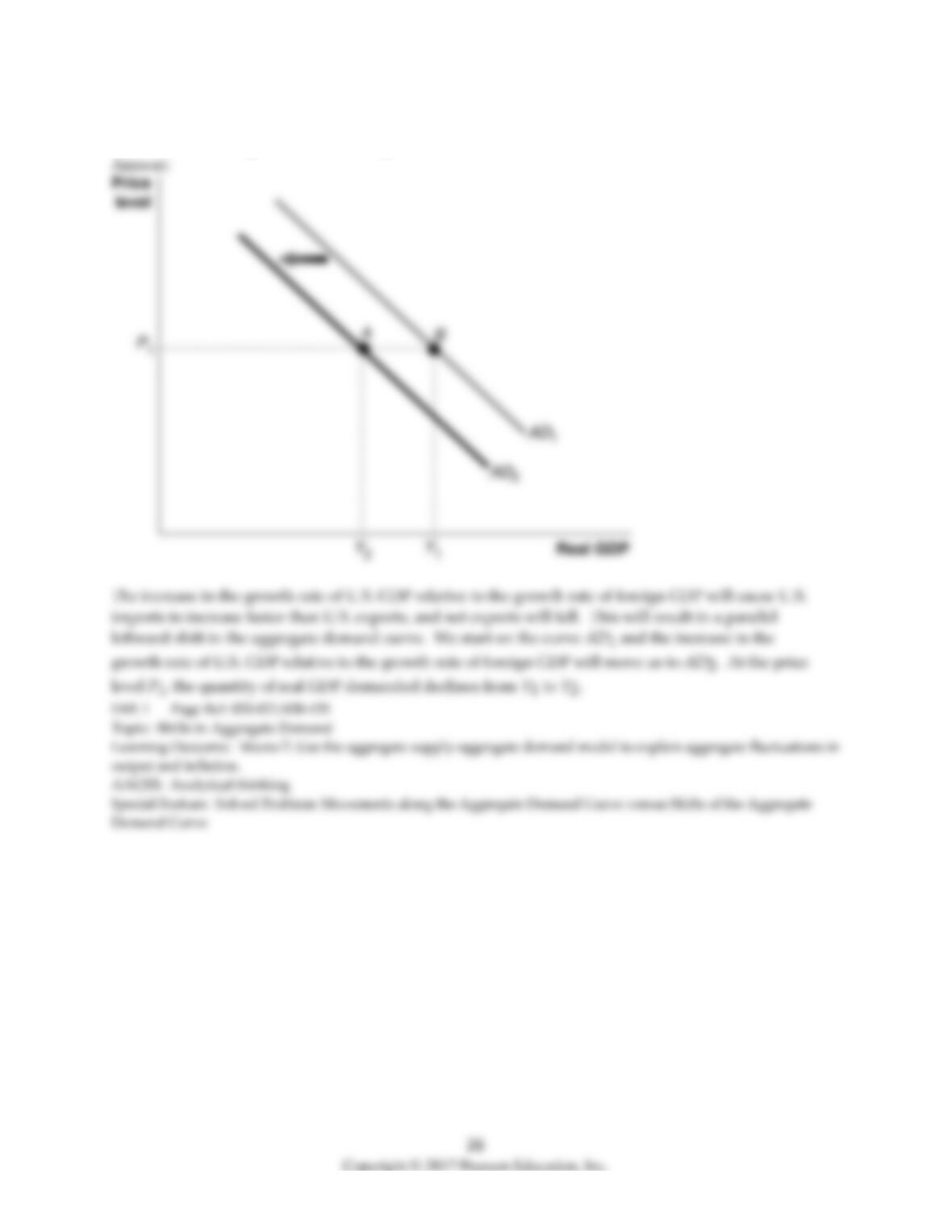
80) Using an aggregate demand graph, illustrate the impact of an increase in the growth rate of U.S.
GDP relative to the growth rate of foreign GDP.

13.2 Aggregate Supply
1) The level of aggregate supply in the long run is not affected by
A) changes in technology.
B) changes in the capital stock.
C) changes in the price level.
D) changes in the number of workers.
2) Potential GDP refers to the level of
A) real GDP in the long run.
B) nominal GDP in the long run.
C) real GDP in the short run.
D) nominal GDP in the short run.
3) The long-run aggregate supply curve
A) has a negative slope.
B) has a steep but positive slope.
C) is horizontal.
D) is vertical.
4) If stricter immigration laws are imposed and many foreign workers in the United States are forced to
go back to their home countries,
A) the long-run aggregate supply curve will shift to the right.
B) the long-run aggregate supply curve will shift to the left.
C) we will move up along the long-run aggregate supply curve.
D) we will move down along the long-run aggregate supply curve.

5) What is potential GDP?
A) It is the level of real GDP in the long run.
B) It is the difference between current GDP and maximum GDP.
C) It is the level of real GDP in the short run.
D) It is the level of GDP at which inflation is constant.
6) Full-employment GDP is also known as
A) realized GDP.
B) potential GDP.
C) politico-economic GDP.
D) balanced-budget GDP.
7) The long-run aggregate supply curve shows the relationship between the ________ and ________.
A) inflation rate; quantity of real GDP demanded
B) real interest rate; quantity of real GDP supplied
C) nominal interest rate; quantity of real GDP supplied
D) price level; quantity of real GDP supplied
8) On the long-run aggregate supply curve,
A) a decrease in the price level decreases the level of potential GDP.
B) a decrease in the price level increases the aggregate quantity of GDP supplied.
C) a decrease in the price level decreases the aggregate quantity of GDP supplied.
D) a decrease in the price level has no effect on the aggregate quantity of GDP supplied.

9) Changes in the price level
A) increase the level of aggregate supply in the long run.
B) decrease the level of aggregate supply in the long run.
C) do not affect the level of aggregate supply in the long run.
D) increase the level of aggregate supply in the long run only at very high levels of output.
10) The long-run aggregate supply curve will shift to the right if
A) the economy experiences technological change.
B) there is a decrease in population.
C) the economy experiences high levels of inflation.
D) net exports decrease.
11) Suppose a developing country receives more machinery and capital equipment as foreign
entrepreneurs increase the amount of investment in the economy. As a result,
A) the long-run aggregate supply curve will shift to the right.
B) the long-run aggregate supply curve will shift to the left.
C) the economy will move up along the long-run aggregate supply curve.
D) the economy will move down along the long-run aggregate supply curve.
12) Which aggregate supply curve has a positive slope?
A) long run only
B) short run only
C) both long run and short run
D) neither long run nor short run

13) The short-run aggregate supply curve has a(n) ________ slope because as prices of ________ rise,
prices of ________ rise more slowly.
A) positive; final goods and services; inputs
B) infinite; final goods and services; inputs
C) positive; inputs; final goods and services
D) infinite; inputs; final goods and services
14) All of the following are reasons why the wages of workers and the prices of inputs rise more slowly
than the prices of final goods and services except
A) unions are successful in pushing up wages.
B) firms are often slow to adjust wages.
C) contracts make prices and wages sticky.
D) menu costs make some prices sticky.
15) An increase in the price level will
A) shift the short-run aggregate supply curve to the left.
B) shift the short-run aggregate supply curve to the right.
C) move the economy up along a stationary short-run aggregate supply curve.
D) move the economy down along a stationary short-run aggregate supply curve.

16) If, due to a recession, foreign workers begin to leave the United States to search for temporary work
in their home countries until the recession has ended, this will
A) shift the short-run aggregate supply curve of the home country to the left.
B) shift the short-run aggregate supply curve of the home country to the right.
C) move the home country’s economy up along a stationary short-run aggregate supply curve.
D) move the home country’s economy down along a stationary short-run aggregate supply curve.
17) The invention of the cotton gin ushered in the Industrial Revolution and began a long period of
technological innovation. What did this technological change do the short-run supply curve?
A) It shifted the short-run aggregate supply curve to the left.
B) It shifted the short-run aggregate supply curve to the right.
C) It moved the economy up along a stationary short-run aggregate supply curve.
D) It moved the economy down along a stationary short-run aggregate supply curve.
18) Hurricane Katrina destroyed oil and natural gas refining capacity in the Gulf of Mexico which
subsequently drove up natural gas, gasoline, and heating oil prices. Three years later, once the refining
capacity was restored, these prices came back down. The restoration of refining capacity should
A) shift the short-run aggregate supply curve to the left.
B) shift the short-run aggregate supply curve to the right.
C) move the economy up along a stationary short-run aggregate supply curve.
D) move the economy down along a stationary short-run aggregate supply curve.

19) When the price level rises from 110 to 115, the aggregate level of GDP supplied rises from $80 billion
to $120 billion. This ________ relationship represents the ________ relationship between the quantity of
real GDP firms are willing to supply and the price level.
A) negative; short-run
B) positive; short-run
C) negative; long-run
D) positive; long-run
20) If full-employment GDP is equal to $4.2 trillion, what does the long-run aggregate supply curve look
like?
A) It is a horizontal line at $4.2 trillion of GDP.
B) It is a vertical line at a level of GDP below $4.2 trillion.
C) It is a vertical line at $4.2 trillion of GDP.
D) It is a vertical line at a level of GDP above $4.2 trillion.
21) Workers expect inflation to rise from 3% to 5% next year. As a result, this should
A) shift the short-run aggregate supply curve to the left.
B) shift the short-run aggregate supply curve to the right.
C) move the economy up along a stationary short-run aggregate supply curve.
D) move the economy down along a stationary short-run aggregate supply curve.

22) Workers and firms both expect that prices will be 2.5% higher next year than they are this year. As a
result,
A) workers will be willing to take lower wages next year, but not lower than a 2.5 percent decrease.
B) the purchasing power of wages will rise if wages increase by 2.5%.
C) the short-run aggregate supply curve will shift to the left as wages increase.
D) aggregate demand will increase by 2.5%.
23) Which of the following would cause the short-run aggregate supply curve to shift to the right?
A) an increase in the price level
B) a decrease in inflation expectations
C) a technological advance
D) an increase in interest rates
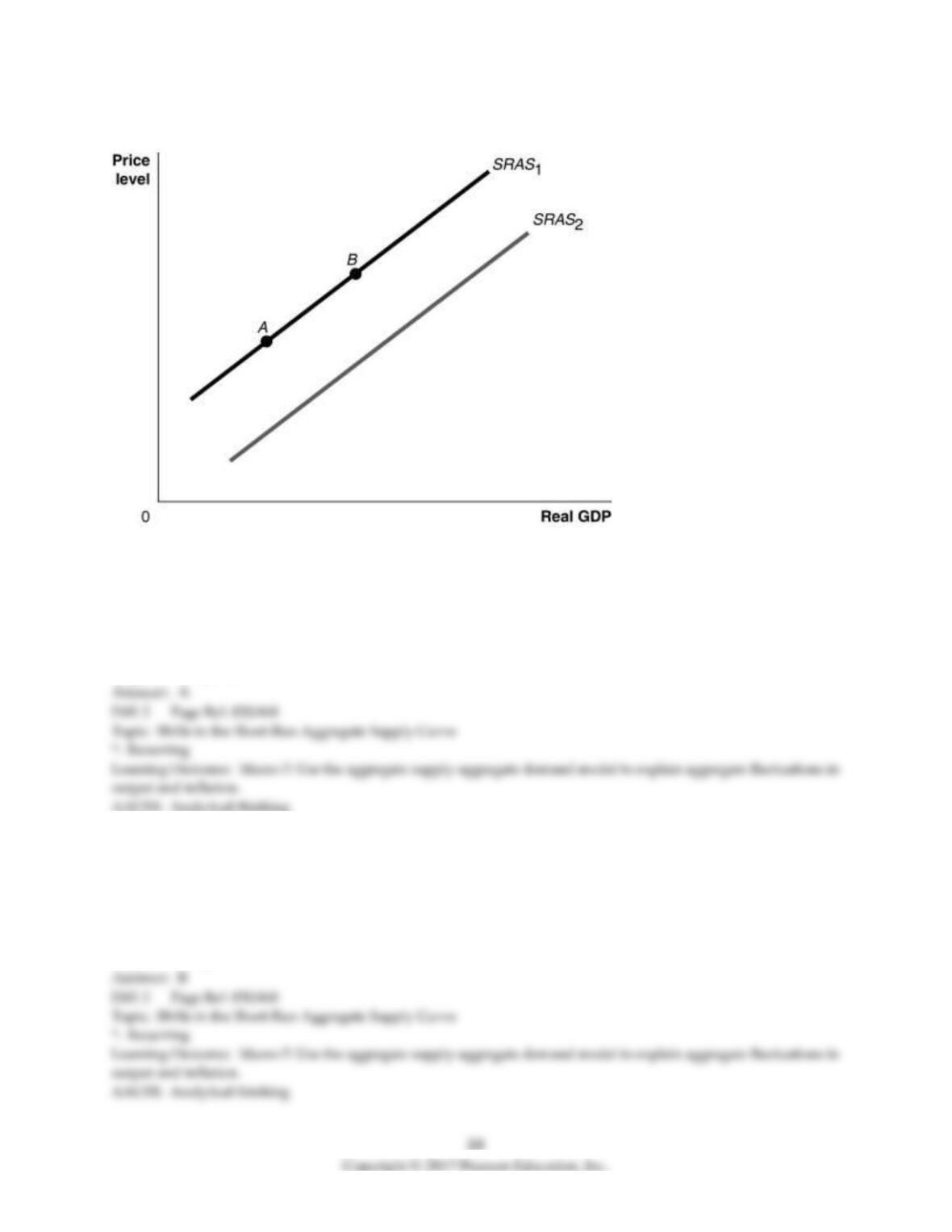
Figure 13-2
24) Refer to Figure 13-2. Ceteris paribus, an increase in the labor force would be represented by a
movement from
A) SRAS1 to SRAS2.
B) SRAS2 to SRAS1.
C) point A to point B.
D) point B to point A.
25) Refer to Figure 13-2. Ceteris paribus, a decrease in the capital stock would be represented by a
movement from
A) SRAS1 to SRAS2.
B) SRAS2 to SRAS1.
C) point A to point B.
D) point B to point A.

26) Refer to Figure 13-2. Ceteris paribus, an increase in productivity would be represented by a
movement from
A) SRAS1 to SRAS2.
B) SRAS2 to SRAS1.
C) point A to point B.
D) point B to point A.
27) Refer to Figure 13-2. Ceteris paribus, an increase in the price level would be represented by a
movement from
A) SRAS1 to SRAS2.
B) SRAS2 to SRAS1.
C) point A to point B.
D) point B to point A.
28) Refer to Figure 13-2. Ceteris paribus, an increase in the expected future price level would be
represented by a movement from
A) SRAS1 to SRAS2.
B) SRAS2 to SRAS1.
C) point A to point B.
D) point B to point A.

29) Refer to Figure 13-2. Ceteris paribus, an increase in workers and firms adjusting to having previously
overestimated the price level would be represented by a movement from
A) SRAS1 to SRAS2.
B) SRAS2 to SRAS1.
C) point A to point B.
D) point B to point A.
30) Refer to Figure 13-2. Ceteris paribus, an increase in the expected price of an important natural
resource would be represented by a movement from
A) SRAS1 to SRAS2.
B) SRAS2 to SRAS1.
C) point A to point B.
D) point B to point A.
31) Refer to Figure 13-2. Ceteris paribus, a decrease in the labor force would be represented by a
movement from
A) SRAS1 to SRAS2.
B) SRAS2 to SRAS1.
C) point A to point B.
D) point B to point A.

32) Refer to Figure 13-2. Ceteris paribus, an increase in the capital stock would be represented by a
movement from
A) SRAS1 to SRAS2.
B) SRAS2 to SRAS1.
C) point A to point B.
D) point B to point A.
33) Refer to Figure 13-2. Ceteris paribus, a decrease in productivity would be represented by a movement
from
A) SRAS1 to SRAS2.
B) SRAS2 to SRAS1.
C) point A to point B.
D) point B to point A.
34) Refer to Figure 13-2. Ceteris paribus, a decrease in the price level would be represented by a
movement from
A) SRAS1 to SRAS2.
B) SRAS2 to SRAS1.
C) point A to point B.
D) point B to point A.

35) Refer to Figure 13-2. Ceteris paribus, a decrease in the expected future price level would be
represented by a movement from
A) SRAS1 to SRAS2.
B) SRAS2 to SRAS1.
C) point A to point B.
D) point B to point A.
36) Refer to Figure 13-2. Ceteris paribus, an increase in workers and firms adjusting to having previously
underestimated the price level would be represented by a movement from
A) SRAS1 to SRAS2.
B) SRAS2 to SRAS1.
C) point A to point B.
D) point B to point A.
37) Refer to Figure 13-2. Ceteris paribus, a decrease in the expected price of an important natural resource
would be represented by a movement from
A) SRAS1 to SRAS2.
B) SRAS2 to SRAS1.
C) point A to point B.
D) point B to point A.

38) Studies have shown that
A) firms often cut nominal wages during recessions and allow inflation to gradually increase real
wages.
B) firms are reluctant to cut nominal wages during recessions but instead increase workers’ nominal
wages and allow inflation to gradually increase real wages.
C) firms are reluctant to cut nominal wages during recessions but instead freeze workers’ nominal
wages and allow inflation to gradually reduce real wages.
D) firms often freeze workers’ nominal wages during a recession and keep the wages frozen well after
the recession has ended.
39) The level of long-run aggregate supply is affected by all of the following except
A) changes in the price level.
B) changes in the technology.
C) changes in the capital stock.
D) changes in the number of workers.
40) The level of real GDP in the long run is called
A) potential GDP.
B) short-run GDP.
C) frictional GDP.
D) low-capacity GDP.

41) The ________ curve is vertical.
A) short-run aggregate supply
B) short-run aggregate demand
C) long-run aggregate supply
D) long-run aggregate demand
42) If the economy receives an influx of new workers from immigration,
A) the long-run aggregate supply curve will shift to the right.
B) the long-run aggregate supply curve will shift to the left.
C) we will move up along the long-run aggregate supply curve.
D) we will move down along the long-run aggregate supply curve.
43) The level of real GDP in the long run is
A) potential GDP.
B) affected by changes in the price level.
C) determined solely by aggregate demand.
D) the same as the level of nominal GDP in the long run.
44) Potential GDP is also referred to as
A) realized GDP.
B) full-employment GDP.
C) politico-economic GDP.
D) balanced-budget GDP.