65. Assume that the yen price of one U.S. dollar rises to 80 yen and that the Bank of Japan has a target exchange rate of
75 yen per dollar. As a result, the Bank of Japan will intervene in the foreign exchange market by:
a.
selling U.S. dollars and buying yen.
b.
selling both U.S. dollars and yen.
c.
buying U.S. dollars and selling yen.
d.
buying both U.S. dollars and yen.
e.
buying U.S. Treasury securities.
MACR.BOYE.16.68 – ch. 13, 4
United States – Reflective Thinking
Implementing Monetary Policy
66. To fix the foreign currency price of domestic currency below the free market equilibrium rate, a government must:
a.
sell both its own currency and foreign exchange.
b.
buy its own currency and sell foreign exchange.
c.
buy both its own currency and foreign exchange.
d.
sell its own currency and buy foreign exchange.
e.
revalue its own currency.
MACR.BOYE.16.68 – ch. 13, 4
Implementing Monetary Policy
67. In foreign exchange markets, a U.S. resident who imports New Zealand apples is:
a.
a demander and supplier of New Zealand dollars.
b.
a demander and supplier of U.S. dollars.
c.
a demander of New Zealand dollars and a supplier of U.S. dollars.
d.
a supplier of both New Zealand dollars and U.S. dollars.
e.
a supplier of New Zealand dollars and a demander of U.S. dollars.
MACR.BOYE.16.68 – ch. 13, 4
United States – Reflective Thinking
Implementing Monetary Policy
68. Which of the following people is most likely to demand U.S. dollars in the foreign exchange market?
a.
A United States resident who is traveling to the Greek Islands
b.
An American investor who intends to buy Japanese government bonds
c.
A resident of Australia who is traveling to Belgium
d.
A British importer of U.S. beef
e.
A U.S. company that is importing avocados from Mexico
MACR.BOYE.16.68 – ch. 13, 4
United States – Reflective Thinking
Implementing Monetary Policy
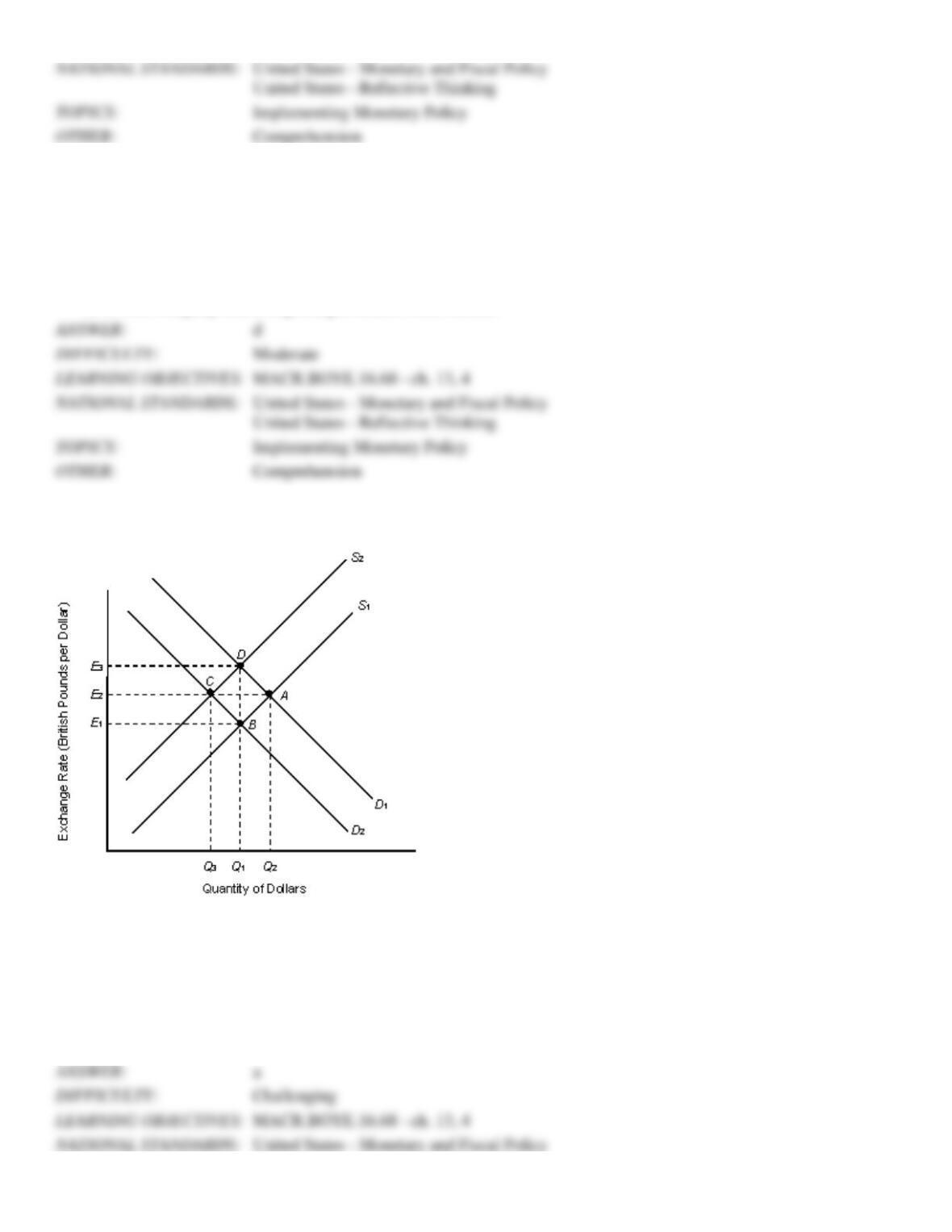
The figure given below depicts the equilibrium in the foreign exchange market.
Figure 13.1
69. Refer to Figure 13.1. Which of the following is most likely to cause equilibrium to change from point A to point D?
a.
A decrease in U.S. demand for British goods and services
b.
An increase in U.S. demand for British goods and services
c.
An increase in the supply of dollars on the foreign exchange market
d.
A decrease in the supply of British pounds on the foreign exchange market
e.
An increase in British demand for U.S. exports
MACR.BOYE.16.68 – ch. 13, 4
United States – Monetary and Fiscal Policy
70. Refer to Figure 13.1. If the current equilibrium exchange rate is E1 what action would the Fed have to take to achieve
a target exchange rate of E2?
a.
Sell (Q2 – Q1) amount of U.S. dollars.
b.
Buy (Q1 – Q3) amount of U.S. dollars.
c.
Buy (Q2 – Q3) amount of U.S. dollars.
d.
Buy (Q2 – Q1) amount of U.S. dollars.
e.
Sell (Q1 – Q3) amount of U.S. dollars.
MACR.BOYE.16.68 – ch. 13, 4
Implementing Monetary Policy
71. Refer to Figure 13.1. If the exchange rate is fixed at E2 but the free market equilibrium rate is E1 then:
a.
there is a shortage of British pounds at E1.
b.
no intervention is necessary to achieve the exchange rate E1.
c.
there is a permanent surplus of U.S. dollars at E1.
d.
there is a permanent surplus of U.S. dollars at E2.
e.
there is a permanent shortage of U.S. dollars at E3.
MACR.BOYE.16.68 – ch. 13, 4
Implementing Monetary Policy
72. When the foreign exchange value of the Mexican peso is above its equilibrium rate, the peso will:
a.
tend to be revalued.
b.
tend to increase in value over other currencies.
c.
be high demand in the foreign exchange market.
d.
tend to depreciate.
e.
tend to appreciate.
United States – Reflective Thinking
Implementing Monetary Policy
73. To keep the U.S. dollar from depreciating against the euro, the U.S. Federal Reserve must:
a.
buy euros and sell U.S. dollars.
b.
buy both euros and U.S. dollars.
c.
sell euros and buy U.S. dollars.
d.
sell both euros and U.S. dollars.
e.
buy U.S. government bonds
MACR.BOYE.16.68 – ch. 13, 4
United States – Monetary and Fiscal Policy
Implementing Monetary Policy
74. Assume that there is an unexpected increase in the demand for U.S. dollars in Switzerland. If the foreign currency
price of the U.S. dollar is fixed, the U.S. Federal Reserve must intervene in the foreign exchange market such that:
a.
the supply of U.S. dollars increases.
b.
the U.S. demand for the Swiss franc falls.
c.
the supply of U.S. dollars decreases.
d.
Swiss imports from the United States are reduced.
e.
the Swiss currency is devalued.
MACR.BOYE.16.68 – ch. 13, 4
Implementing Monetary Policy
75. If the U.S. dollar depreciates against the yen below the targeted exchange rate, the U.S. Federal Reserve has to
intervene in the foreign exchange market such that:
a.
the U.S. demand for yen rises.
b.
the supply of U.S. dollars rises.
c.
U.S. exports to Japan fall.
d.
the U.S. dollar is devalued.
e.
the supply of U.S. dollars falls.
MACR.BOYE.16.68 – ch. 13, 4
Implementing Monetary Policy
Implementing Monetary Policy
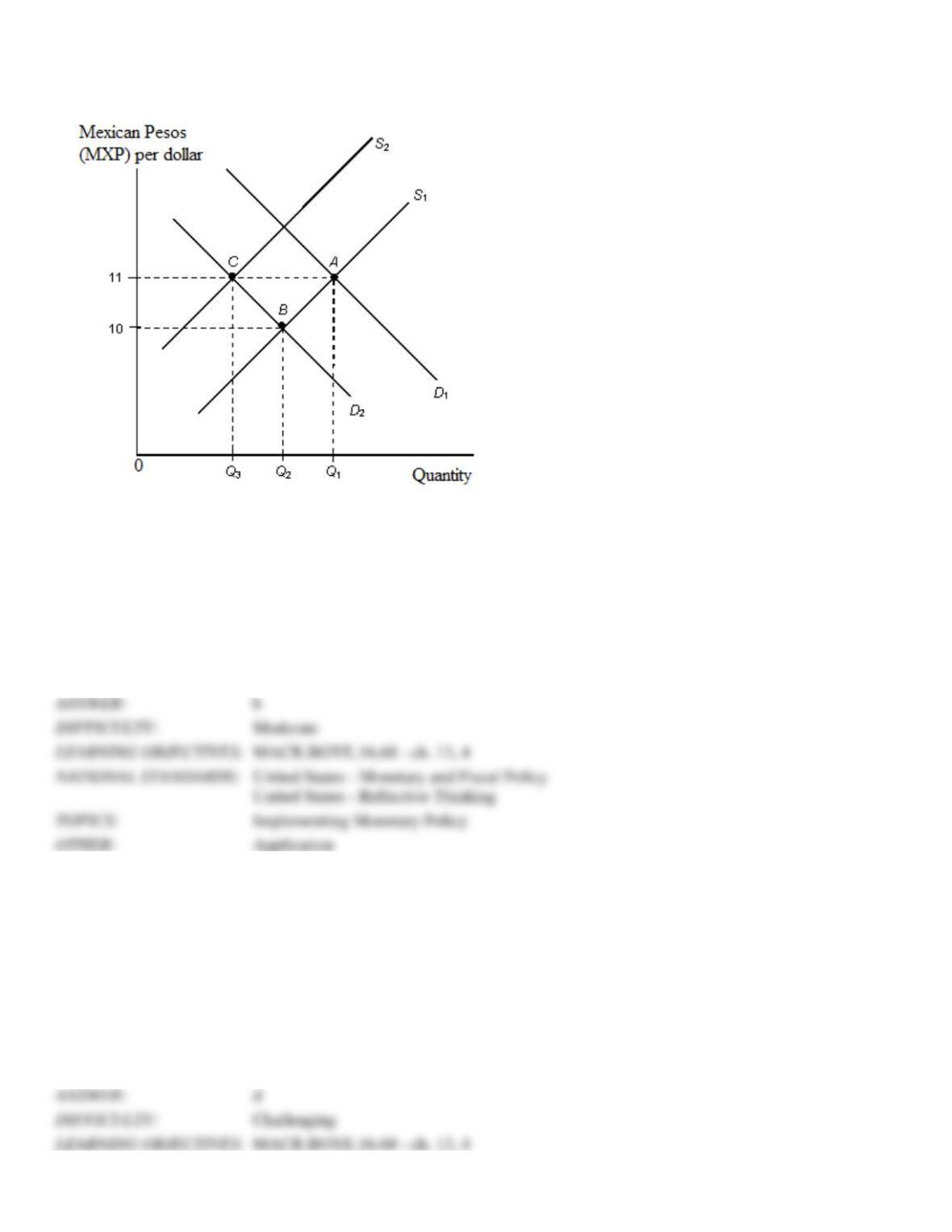
The figure given below depicts the equilibrium exchange rate between the U.S dollar and the Mexican peso.
Figure 13.2
76. Refer to Figure 13.2. When the Mexican demand for U.S. dollars rises from D2 to D1 and the relevant supply curve is
S1:
a.
the U.S. dollar depreciates in value relative to the peso.
b.
the Mexican peso depreciates in value relative to the U.S. dollar.
c.
the Mexican peso appreciates in value relative to the U.S. dollar
d.
U.S. imports from Mexico decreases.
e.
Mexican net exports to the United States becomes positive.
77. Refer to Figure 13.2. Given a target exchange rate of MXP 11 = $1 with S1 the relevant supply curve and a decline in
Mexican demand for U.S. dollars from D1 to D2 the Fed intervenes in the foreign exchange market by:
a.
selling Q3 amount of pesos.
b.
selling Q3 amount of U.S. dollars.
c.
buying (Q2 – Q1) amount of pesos.
d.
buying (Q1 – Q3) amount of U.S. dollars.
e.
buying (Q2 – Q3) amount of U.S dollars.
MACR.BOYE.16.68 – ch. 13, 4
United States – Reflective Thinking
Implementing Monetary Policy
78. Refer to Figure 13.2. Assume that the exchange rate is fixed at MXP 11 = $1 and the free market equilibrium rate is
MXP 10 = $1. This means that at MXP 11 = $1,
a.
there will be a permanent shortage of U.S. dollars.
b.
there will be a surplus of Mexican pesos.
c.
there will be a permanent surplus of U.S. dollars.
d.
U.S. net exports to Mexico will be positive.
e.
the U.S. budget deficit will fall.
MACR.BOYE.16.68 – ch. 13, 4
Implementing Monetary Policy
Application
79. When more than one central bank attempts to shift the equilibrium exchange rate, we refer to this as:
a.
sterilization.
b.
a currency crisis.
c.
coordinated intervention.
d.
an application of special drawing rights.
e.
a floating exchange rate system.
Easy
MACR.BOYE.16.68 – ch. 13, 4
United States – Monetary and Fiscal Policy
Implementing Monetary Policy
Knowledge
80. The use of domestic open market operations to counteract the effects of a foreign exchange market intervention on the
domestic money supply is known as:
a.
normalization.
b.
quantitative easing.
c.
sterilization.
d.
volatilization.
e.
depreciation.
Easy
MACR.BOYE.16.68 – ch. 13, 4
Application
81. Suppose the U.S. dollar appreciates in value against the Australian dollar, and the Fed intervenes in the foreign
exchange market by using U.S. dollars to buy Australian dollars. The Fed could sterilize the expansionary effect of this
intervention by:
a.
buying U.S. dollars in the foreign exchange market.
b.
buying U.S. government bonds in the domestic open market.
c.
selling Australian dollars in the foreign exchange market.
d.
selling U.S. government bonds in the domestic open market.
e.
buying Australian dollars in the foreign exchange market.
MACR.BOYE.16.68 – ch. 13, 4
Implementing Monetary Policy
82. The transactions demand for money exists because:
a.
people want to maintain a speculative cash reserve.
b.
people are insensitive to interest rate fluctuations and prefer to hoard money.
c.
people want to be prepared for unplanned emergency expenditures.
d.
people prefer cash over bank deposits.
e.
people do not receive their income at the same time they spend it.
MACR.BOYE.16.69 – ch. 13, 5
Monetary Policy and Equilibrium Income
83. The desire to keep assets in cash to take advantage of favorable changes in the value of non-cash assets is called the:
a.
speculative demand for money.
b.
wealth demand for money.
c.
risk interest in money.
d.
precautionary demand for money.
e.
transactions demand for money.
MACR.BOYE.16.69 – ch. 13, 5
United States – The Role of Money
Monetary Policy and Equilibrium Income
84. Suppose that a sharp downturn in the price of a country’s prime manufacturing product results in a terrible recession
and a massive decline in the general income level of the citizens. Other things constant, what would be the recession’s
most probable effect on money demand in the country?
a.
People will hold more money for any purpose, resulting in a decline in money demand.
b.
Local M1 money demand will rise.
c.
The transactions demand for money will fall such that the quantity of money demanded will be lower at any
given interest rate level.
d.
The speculative demand for money will fall, causing a downward movement along the money demand curve.
e.
The precautionary demand for money will increase, causing an upward shift in the money demand curve.
85. If interest rates decrease:
a.
the quantity of money demanded will not change.
b.
the money demand function will shift to the right.
c.
the quantity of money demanded will decrease.
d.
the money demand function will shift to the left.
e.
the quantity of money demanded will increase.
MACR.BOYE.16.69 – ch. 13, 5
United States – The Role of Money
Monetary Policy and Equilibrium Income
86. If a bond pays 11.5 percent interest a year and a bank deposit pays 3.5 percent, the opportunity cost of holding the
deposit is:
a.
11.5 percent.
b.
15 percent.
c.
8 percent.
d.
3.5 percent.
e.
13.5 percent.
MACR.BOYE.16.69 – ch. 13, 5
United States – Reflective Thinking
United States – The Role of Money
Monetary Policy and Equilibrium Income
87. A leftward shift in the money demand function would result from:
a.
a decrease in the money supply.
MACR.BOYE.16.69 – ch. 13, 5
United States – Reflective Thinking
Monetary Policy and Equilibrium Income
b.
a decrease in the price level.
c.
an increase in real income.
d.
a decrease in the interest rate.
e.
an increase in the interest rate
88. A change in the interest rate does not affect the quantity of money supplied. This means that:
a.
the money supply curve is negatively sloped.
b.
the money supply curve is vertical.
c.
the money supply curve is horizontal.
d.
the money supply curve is a 45 degree line drawn from the origin.
e.
the money supply curve is kinked.
MACR.BOYE.16.69 – ch. 13, 5
United States – The Role of Money
Monetary Policy and Equilibrium Income
89. Suppose a bond sells for $2,000 and pays $200 per year in interest. What will happen to the current interest rate if the
price of the bond changes to $1,800?
a.
It decreases by 10 percentage points.
b.
It increases by 10 percentage points.
c.
It remains unchanged.
d.
It increases by 1 percentage point.
e.
It decreases by 1 percentage point.
MACR.BOYE.16.69 – ch. 13, 5
United States – The Role of Money
Monetary Policy and Equilibrium Income
90. If a bond pays a fixed return of $500 a year and the current interest rate has risen from 5 percent to 10 percent, then
the bond price must have:
a.
risen from $25 to $50.
b.
fallen from $50 to $25.
c.
risen from $5,000 to $10,000.
d.
fallen from $10,000 to $5,000.
MACR.BOYE.16.69 – ch. 13, 5
Monetary Policy and Equilibrium Income
e.
risen from $1,000 to $5,000.
91. Suppose the interest rate on a bond is 12.5 percent and that bond pays $90 a year in interest and sells for $720. If the
supply of bonds increases and the price of the bond falls to $600, the interest rate will ____ to ____.
a.
increase; 15 percent
b.
increase; 17.5 percent
c.
decrease; 7.5 percent
d.
decrease; 10 percent
e.
increase; 13 percent
Challenging
MACR.BOYE.16.69 – ch. 13, 5
United States – The Role of Money
Monetary Policy and Equilibrium Income
Application
92. What is the current market price of a bond that pays $200 per year indefinitely and has a current yield of 16 percent?
a.
$800
b.
$1250
c.
$3,200
d.
$8,000
e.
$12,500
b
Moderate
MACR.BOYE.16.69 – ch. 13, 5
United States – The Role of Money
Monetary Policy and Equilibrium Income
Application
93. An increase in nominal income will result in:
a.
a decrease in money market equilibrium.
b.
an excess demand for bonds.
c.
an increase in bond prices.
d.
an excess supply of money.
e.
a higher interest rate.
d
Challenging
MACR.BOYE.16.69 – ch. 13, 5
Monetary Policy and Equilibrium Income
Application
94. An increase in the money supply will:
a.
decrease both investment spending and aggregate demand.
b.
decrease investment spending and increase aggregate demand.
c.
decrease both consumption spending and aggregate demand.
d.
increase both investment spending and aggregate demand.
e.
increase investment spending and decrease aggregate demand
MACR.BOYE.16.70 – ch. 13, 6
Monetary Policy and Equilibrium Income
95. An increase in the money supply will lead to an increase in equilibrium real GDP only if:
a.
the aggregate demand curve is horizontal.
b.
the aggregate supply curve is vertical.
c.
the investment function is horizontal.
d.
the aggregate supply curve is not vertical.
e.
the investment function is upward-sloping.
MACR.BOYE.16.70 – ch. 13, 6
United States – The Role of Money
Monetary Policy and Equilibrium Income
96. An excess demand for money will result in all the following, except:
a.
an excess supply of bonds.
b.
a rise in investment spending.
c.
a fall in bond prices.
d.
a fall in consumption spending.
e.
a fall in equilibrium real GDP.
MACR.BOYE.16.70 – ch. 13, 6
United States – The Role of Money
MACR.BOYE.16.70 – ch. 13, 6
Monetary Policy and Equilibrium Income
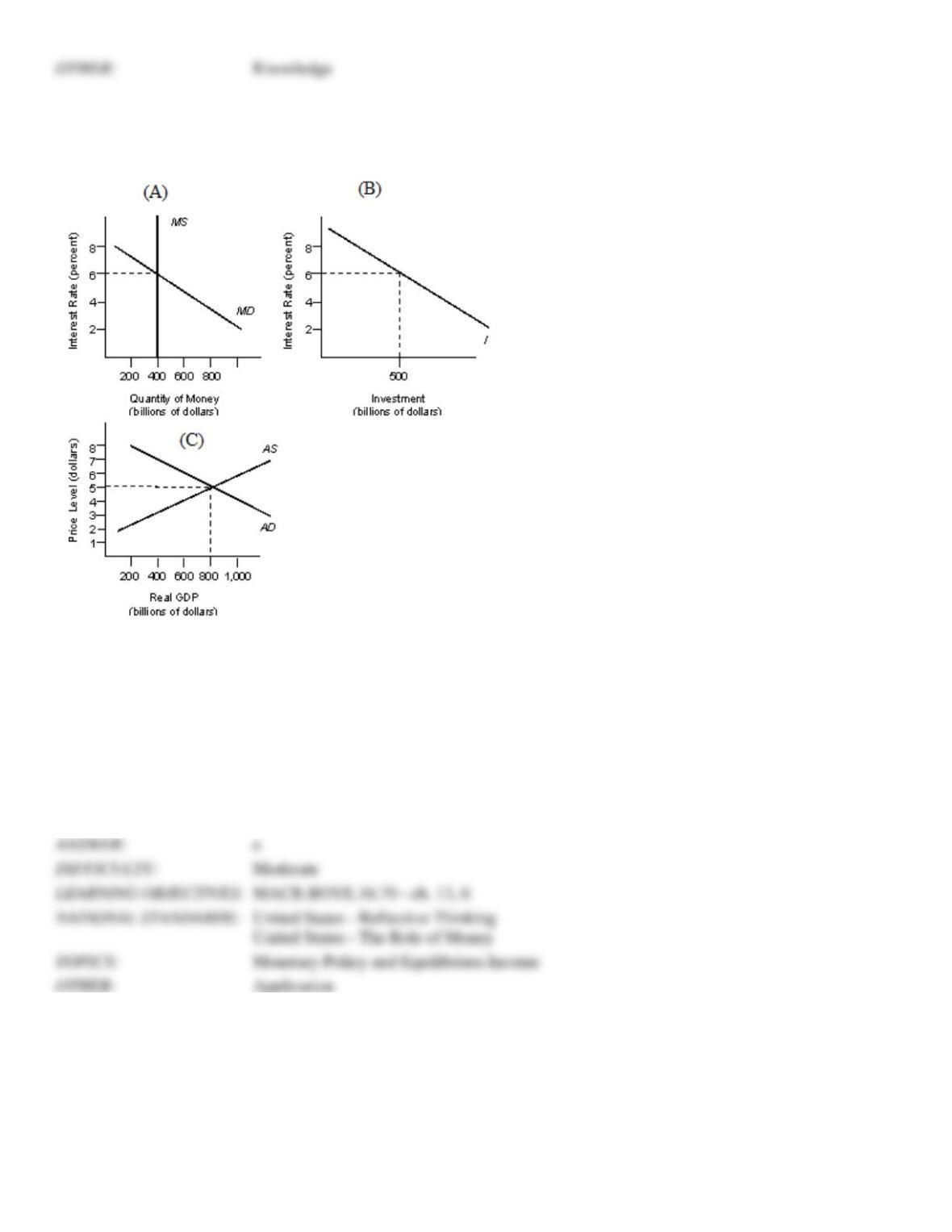
In the figure given below panel A represents money market equilibrium, panel B represents investment demand, and panel
C represents equilibrium real GDP.
Figure 13.3
97. Refer to Figure 13.3. Other things equal, if real GDP is equal to $900 billion, then:
a.
the money demand curve will be to the left of the one shown in the figure above.
b.
the quantity of money demanded will be less than $400 billion and can be illustrated by a downward
movement along the money demand curve.
c.
the quantity of money demanded will be greater than $400 billion and can be illustrated by an upward
movement along the money demand curve.
d.
the investment demand curve will be to the left of the one illustrated in Panel (A) of the figure.
e.
the money demand curve will be to the right of the one illustrated in Panel (A) of the figure.
MACR.BOYE.16.70 – ch. 13, 6
United States – Reflective Thinking
United States – The Role of Money
Monetary Policy and Equilibrium Income
98. Refer to Figure 13.3. Other things equal, if the interest rate is greater than 6 percent, then:
a.
investment spending will be greater than $500 billion.
b.
the equilibrium level of real GDP will increase.
c.
the equilibrium level of real GDP will decrease.
d.
the money demand curve will shift downward to the left.
e.
the equilibrium price level will increase.
99. Refer to Figure 13.3. When this economy is in equilibrium:
a.
investment spending is equal to $800 billion.
b.
the interest rate is equal to 4 percent.
c.
there is an excess demand for money.
d.
the price level will equal $5.
e.
real GDP will equal $500 billion.
d
Moderate
MACR.BOYE.16.70 – ch. 13, 6
Monetary Policy and Equilibrium Income
Application
100. Refer to Figure 13.3. Starting from the equilibrium illustrated in the graphs, if the Federal Reserve purchases
government bonds in the open market, then:
a.
investment spending will decline.
b.
bond prices will decline.
c.
equilibrium real GDP will fall.
d.
interest rates will fall.
e.
money demand will decline.
d
Challenging
MACR.BOYE.16.70 – ch. 13, 6
Monetary Policy and Equilibrium Income
Application
101. Assume the economy is in equilibrium as illustrated by Figure 13.3. Based on the equation of exchange, what is the
velocity of money?
a.
10
b.
6
c.
5
d.
20
e.
2
MACR.BOYE.16.70 – ch. 13, 6
Moderate
MACR.BOYE.16.70 – ch. 13, 6
United States – The Role of Money
Monetary Policy and Equilibrium Income
Application