21) The action time lag is the time period that elapses
A) between when an economic problem manifests itself and it is officially acknowledged.
B) between the recognition of an economic problem and implementing policies to solve it.
C) between implementing policies to solve an economic problem and when the results of that
policy can be measured.
D) between the beginning of the budgetary process and the final budget resolution.
22) The effect time lag is the time period that elapses
A) between when an economic problem manifests itself and it is officially acknowledged.
B) between the recognition of an economic problem and implementing policies to solve it.
C) between implementing policies to solve an economic problem and when the results of that
policy can be measured.
D) between the beginning of the budgetary process and the final budget resolution.
23) When data on the economy requires some time to gather and interpret, there is
A) an aggregate time lag.
B) an action time lag.
C) a recognition time lag.
D) an effect time lag.
24) When it takes time for the president and Congress to change fiscal policy to act on economic
data, we have a(n)
A) aggregate time lag.
B) action time lag.
C) recognition time lag.
D) effect time lag.
25) When there is an interval between when the fiscal policy changes and corresponding changes
in aggregate spending, we have a(n)
A) aggregate time lag.
B) action time lag.
C) recognition time lag.
D) effect time lag.
26) When fiscal policy is used, time lags are variable and last anywhere from
A) one to three weeks.
B) one to three months.
C) one to three years.
D) one to three decades.
27) Fiscal policy time lags tend to be
A) constant, always thirteen months long.
B) variable, between one and three years.
C) variable, between one and three weeks.
D) variable, between one and three months.
28) A recession begins in January but government policy makers do NOT reach a consensus that
a recession had in fact begun until June. This is an example of a(n)
A) recognition time lag.
B) action time lag.
C) effect time lag.
D) quick time lag.
29) What are the various time lags that affect discretionary fiscal policy, and what are their
effects?
13.4 Automatic Stabilizers
1) One characteristic of automatic stabilizers is that
A) they require no new legislative action by the government to have an effect.
B) they automatically produce surpluses during recessions and deficits during inflation.
C) they have no effect on the distribution of income.
D) they reduce the size of the public debt during times of recession.
2) Unemployment compensation programs are called automatic stabilizers because payments
increase during
A) expansionary periods.
B) periods of high unemployment.
C) both recessions and expansions.
D) wartime only.
3) All of the following are automatic fiscal stabilizers EXCEPT
A) a congressionally mandated decrease in tax rates to stimulate the economy.
B) a decrease in unemployment compensation payments during an expansion.
C) a decrease in overall tax revenues during a recession.
D) an increase in unemployment expenditures during a recession.
4) When real Gross Domestic Product (GDP) falls, which of the following will automatically
occur?
A) a decrease in all tax rates
B) a decrease in income tax revenues
C) a decrease in unemployment compensation expenditures
D) an increase in income tax revenues
5) Automatic stabilizers are
A) provisions that cause changes in government spending and taxes without new action by
Congress or the President.
B) policies set by certain committees in Congress.
C) tools used by the President’s Council of Economic Advisers.
D) provisions that cause the aggregate supply curve to be upward sloping.
6) An example of an automatic stabilizer is
A) unemployment compensation.
B) a newly enacted surtax to slow down an overheated economy.
C) a constant money supply rule.
D) a deliberate increase in government spending to fight recession.
7) An advantage of automatic stabilizers over discretionary fiscal policy is that
A) automatic stabilizers are not subject to the same time lags as discretionary fiscal policy.
B) automatic stabilizers can be easily fine-tuned to move the economy to full employment.
C) only policymakers are involved in implementing automatic stabilizers.
D) the Ricardian equivalence theorem applies more readily to automatic stabilizers than to
discretionary fiscal policy.
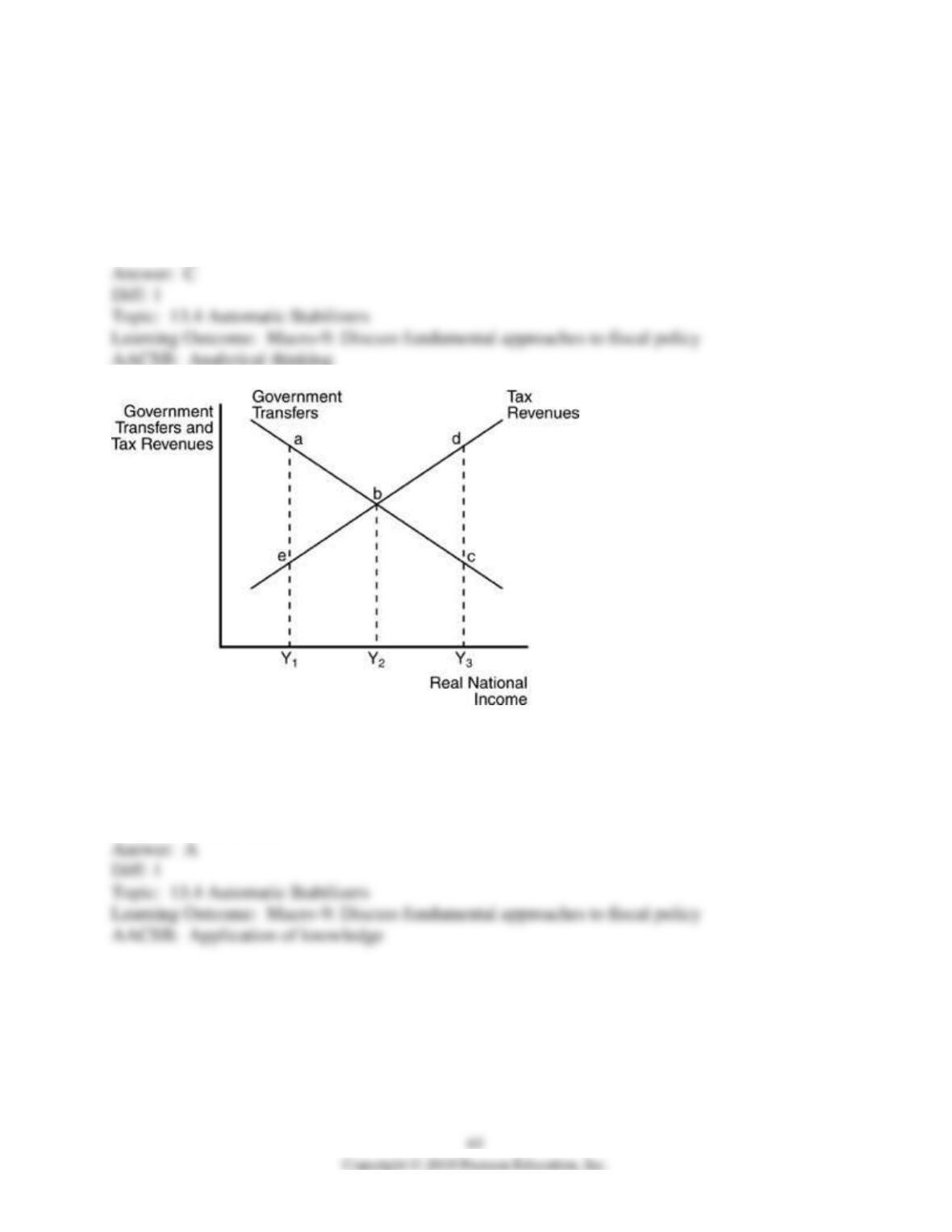
8) In the United States economy, the progressive income tax and unemployment compensation
are both
A) destabilizers.
B) discretionary presidential effectors.
C) automatic stabilizers.
D) time lag factors.
9) Refer to the above figure. As the real national income expands from Y2 to Y3,
A) a budget surplus occurs.
B) a budget deficit occurs.
C) tax revenues fall.
D) government transfers rise.
10) Refer to the above figure. A budget deficit occurs when real national income is
A) Y1.
B) Y2.
C) Y3.
D) None of the above: cannot be determined given the information.
11) Provisions that cause changes in government spending and taxes that do NOT require action
of the President or Congress are called
A) discretionary fiscal policy.
B) discretionary stabilizers.
C) automatic stabilizers.
D) private stabilization effects.
12) Many government programs, such as unemployment compensation, operate on a deficit
during recessions and a surplus during periods of economic expansion. The programs are
referred to as
A) discretionary fiscal policy.
B) automatic stabilizers.
C) Ricardian equivalence.
D) Recognition time lag.
13) The existence of automatic stabilizers will
A) reduce the recognition lag of discretionary fiscal policy.
B) eliminate recessions.
C) reduce the size of recessionary and inflationary gaps.
D) cause the effects of shocks to aggregate demand to have a larger effect on GDP.
14) Which of the following is an example of an automatic stabilizer?
A) cost of living adjustments to Social Security payments
B) unemployment benefits
C) a temporary tax rebate
D) all of the above
15) All of the following are automatic stabilizers EXCEPT
A) discretionary increases in government spending.
B) income transfer payments.
C) progressive income tax system.
D) unemployment compensation.
16) Suppose there are two economies that are identical in every way with the following
exception. Economy A has an unemployment compensation system while economy B does NOT
have an unemployment compensation system. Now suppose both economies experience the same
drop in planned investment. Which of the following is correct?
A) Real GDP will fall more in economy A than in economy B.
B) Real GDP will fall more in economy B than in economy A.
C) Real GDP will fall the same in both economies.
D) The effect on the relative size of the reduction in real GDP in the two economies is
ambiguous.
17) What do automatic stabilizers attempt to stabilize?
A) long-run aggregate supply
B) aggregate demand
C) exports
D) imports
18) Which of the following might be considered an automatic fiscal stabilizer?
A) government spending for the war effort
B) 401(k) retirement program
C) unemployment compensation
D) government budgeting for education
19) Government-provided unemployment insurance is an example of
A) a discretionary fiscal stabilizer.
B) an automatic fiscal stabilizer.
C) a monetary stabilizer.
D) an automatic monetary stabilizer.
20) Automatic stabilizers have the effect of
A) increasing aggregate demand during a recessionary gap.
B) increasing aggregate demand during an inflationary gap.
C) increasing long-run aggregate supply during a recessionary gap.
D) increasing long-run aggregate supply during an inflationary gap.
21) Which one of the following is NOT an automatic stabilizer?
A) the income tax system
B) the system of national defense procurement
C) the system of welfare payments
D) unemployment compensation programs
22) Automatic stabilizers are so-named because
A) they are automatically undertaken by the Federal Reserve Bank to reduce budget deficits.
B) they occur automatically when real GDP changes.
C) the policy suggestions of the Council of Economic Advisors are automatically followed.
D) the policy suggestions of the Office of Management and Budget are automatically followed.
23) An example of an automatic stabilizer is
A) the progressive tax system.
B) the decision of the President to cut taxes in a recession.
C) the Congressional decision to increase unemployment benefits in a recession.
D) the raising of taxes on cigarettes to discourage smoking to stabilize health-care costs.
24) The advantage of automatic stabilizers is that they
A) help to balance the budget.
B) reduce the size of the net public debt.
C) reduce the fluctuations in the business cycle.
D) help reduce the inflation rate.
25) All of the following are automatic stabilizers EXCEPT
A) the federal income tax system.
B) welfare payments.
C) discretionary tax cuts.
D) unemployment compensation.
26) Automatic stabilizers are fiscal policy measures that
A) must be determined by the Congress in each budget.
B) do not require new legislation.
C) are determined by the Federal Reserve System.
D) are part of discretionary fiscal policy.
27) Automatic stabilizers
A) work counter-cyclically to moderate the business cycle.
B) often make any downturn in the economy worse.
C) must be determined by the Congress in each budget.
D) are never altered.
28) Automatic stabilizers are designed to
A) promote global trade.
B) simplify the tax system.
C) moderate changes in disposable income.
D) stabilize the bi-partisan budget process.
29) If the government increases aggregate demand when the economy is at both short-run and
long-run equilibrium, the full long-run effect of this fiscal policy will be to
A) increase real Gross Domestic Product (GDP).
B) increase the price level.
C) increase either the real Gross Domestic Product (GDP) or the price level, depending on the
length of the time lag.
D) decrease both real Gross Domestic Product (GDP) and the price level.
30) During normal times, discretionary fiscal policy
A) is more effective in influencing real GDP than at times of a recession.
B) is probably not very effective in influencing real GDP due to time lags.
C) is more effective in influencing real GDP than automatic stabilizers.
D) works well because there are no lag problems in influencing real GDP.
31) Discretionary fiscal policy
A) is not very effective in influencing real GDP during normal times because of time lags.
B) can be very effective in influencing real GDP during abnormal times, such as when a nation is
at war.
C) may reassure investors and consumers that the federal government will be able to avert a
major economic downturn.
D) all of the above.
32) During which time will fiscal policy be the most effective?
A) normal times
B) times of war
C) in the middle of expansions
D) times of stagflation
33) During normal times
A) fiscal policy is very effective because it the effects of fiscal policy will swamp automatic
stabilizers and time lags can be.
B) fiscal policy can immediately correct problems in the economy.
C) the Ricardian equivalence theorem makes fiscal policy very effective.
D) fiscal policy is not effective because of the recognition time lag.