Macroeconomics 2017 (Hubbard)
Chapter 13 Aggregate Demand and Aggregate Supply Analysis
13.1 Aggregate Demand
1) The basic aggregate demand and aggregate supply curve model helps explain
A) short-term fluctuations in real GDP and the price level.
B) long-term growth.
C) price fluctuations in an individual market.
D) output fluctuations in an individual market.
2) During the severe 2007-2009 recession, Delta Airlines sold ________ passenger tickets and ________
the prices of the tickets it did sell. The result was a $1.2 billion loss in 2009.
A) fewer; raise
B) fewer; cut
C) more; raise
D) more; cut
3) When the economy enters into a recession, your employer is ________ to reduce your wages because
________.
A) unlikely; output and input prices generally fall during recession
B) unlikely; lower wages reduce productivity and morale
C) likely; output prices always fall during recession
D) likely; aggregate demand is vertical in the long run
4) The ________ shows the relationship between the price level and quantity of real GDP demanded.
A) consumer price index
B) aggregate expenditure line
C) 45-degree line
D) aggregate demand curve
5) Because of the slope of the aggregate demand curve, we can say that
A) a decrease in the price level leads to a lower level of real GDP demanded.
B) an increase in the price level leads to no change in the level of real GDP demanded.
C) a decrease in the price level leads to a higher level of real GDP demanded.
D) an increase in the price level leads to a higher level of real GDP demanded.
6) All of the following would be considered a positive addition to household wealth except
A) the equity in one’s home.
B) 500 shares of Google stock.
C) the balance in your savings account.
D) a credit card balance.
7) Which of the following best describes the “wealth effect”?
A) When the price level falls, the real value of household wealth falls.
B) When the price level falls, the nominal value of household wealth falls.
C) When the price level falls, the nominal value of household wealth rises.
D) When the price level falls, the real value of household wealth rises.
8) The “interest rate effect” can be described as an increase in the price level that raises the interest rate
and chokes off
A) government spending.
B) government spending and unplanned investment.
C) investment and consumption spending.
D) net exports.
9) An increase in the price level results in a(n) ________ in the quantity of real GDP demanded because
________.
A) decrease; a higher price level reduces consumption, investment, and net exports.
B) increase; a higher price level reduces consumption, investment, and net exports.
C) decrease; a higher price level increases consumption, investment, and net exports.
D) increase; a higher price level increases consumption, investment, and net exports.
10) When the price level in the United States falls relative to the price level of other countries, ________
will fall, ________ will rise, and ________ will rise.
A) imports; exports; net exports
B) exports; imports; net exports
C) net exports; exports; imports
D) net exports; imports; exports
11) The international trade effect states that
A) an increase in the price level will raise net exports.
B) an increase in the price level will lower net exports.
C) an increase in the price level will raise exports.
D) an increase in the price level will lower imports.
12) Which of the following is one explanation as to why the aggregate demand curve slopes downward?
A) Decreases in the price level raise the interest rate and increase consumption spending.
B) Decreases in the price level raise the interest rate and increase investment spending.
C) Decreases in the U.S. price level relative to the price level in other countries lower net exports.
D) Decreases in the price level raise real wealth and increase consumption spending.
13) An increase in the price level will
A) shift the aggregate demand curve to the left.
B) shift the aggregate demand curve to the right.
C) move the economy up along a stationary aggregate demand curve.
D) move the economy down along a stationary aggregate demand curve.
14) Deflation will
A) increase aggregate demand.
B) increase the quantity of real GDP demanded.
C) decrease aggregate demand.
D) decrease the quantity of real GDP demanded.
15) Spending on the war in Afghanistan is essentially categorized as government purchases. How do
increases in spending on the war in Afghanistan affect the aggregate demand curve?
A) They will move the economy up along a stationary aggregate demand curve.
B) They will move the economy down along a stationary aggregate demand curve.
C) They will shift the aggregate demand curve to the left.
D) They will shift the aggregate demand curve to the right.
16) The recession of 2007-2009 made many consumers pessimistic about their future incomes. How
does this increased pessimism affect the aggregate demand curve?
A) This will move the economy up along a stationary aggregate demand curve.
B) This will move the economy down along a stationary aggregate demand curve.
C) This will shift the aggregate demand curve to the left.
D) This will shift the aggregate demand curve to the right.
17) Higher personal income taxes
A) increase aggregate demand.
B) increase disposable income.
C) decrease aggregate demand.
D) both B and C
18) Which of the following will shift the aggregate demand curve to the right, ceteris paribus?
A) an increase in interest rates
B) a decrease in disposable income
C) a decrease in expected profits for firms
D) an increase in net exports
19) German luxury car exports were hurt in 2009 as a result of the recession. How would this decrease
in exports have affected Germany’s aggregate demand curve?
A) The aggregate demand curve would have shifted to the right.
B) The aggregate demand curve would not have shifted, but there would have been a movement up the
aggregate demand curve.
C) The aggregate demand curve would not have shifted, but there would have been a movement down
the aggregate demand curve.
D) The aggregate demand curve would have shifted to the left.
20) If the U.S. dollar decreases in value relative to other currencies, how does this affect the aggregate
demand curve?
A) This will move the economy up along a stationary aggregate demand curve.
B) This will move the economy down along a stationary aggregate demand curve.
C) This will shift the aggregate demand curve to the left.
D) This will shift the aggregate demand curve to the right.
21) Last week, six Swedish kronor could purchase one U.S. dollar. This week, it takes eight Swedish
kronor to purchase one U.S. dollar. This change in the value of the dollar will ________ exports from
the United States to Sweden and ________ U.S. aggregate demand.
A) increase; increase
B) decrease; decrease
C) increase; decrease
D) decrease; increase
22) Suppose the U.S. GDP growth rate is faster relative to other countries’ GDP growth rates. This will
A) move the economy up along a stationary aggregate demand curve.
B) move the economy down along a stationary aggregate demand curve.
C) shift the aggregate demand curve to the left.
D) shift the aggregate demand curve to the right.
23) If aggregate demand just increased, which of the following may have caused the increase?
A) an increase in government purchases
B) an increase in the interest rate
C) an increase in the price level
D) an increase in imports
24) How do lower taxes affect aggregate demand?
A) They increase disposable income, consumption, and aggregate demand.
B) They reduce disposable income, consumption, and aggregate demand.
C) they increase corporate investment and aggregate demand.
D) They increase aggregate supply and thus increase aggregate demand as well.
25) During the recession of 2007-2009 in the United States, ________ relative to potential GDP.
A) business fixed investment spending rose and net export spending declined
B) consumption spending rose and residential construction spending declined
C) federal government purchases rose and changes in business inventories declined
D) net export spending rose and consumption spending declined
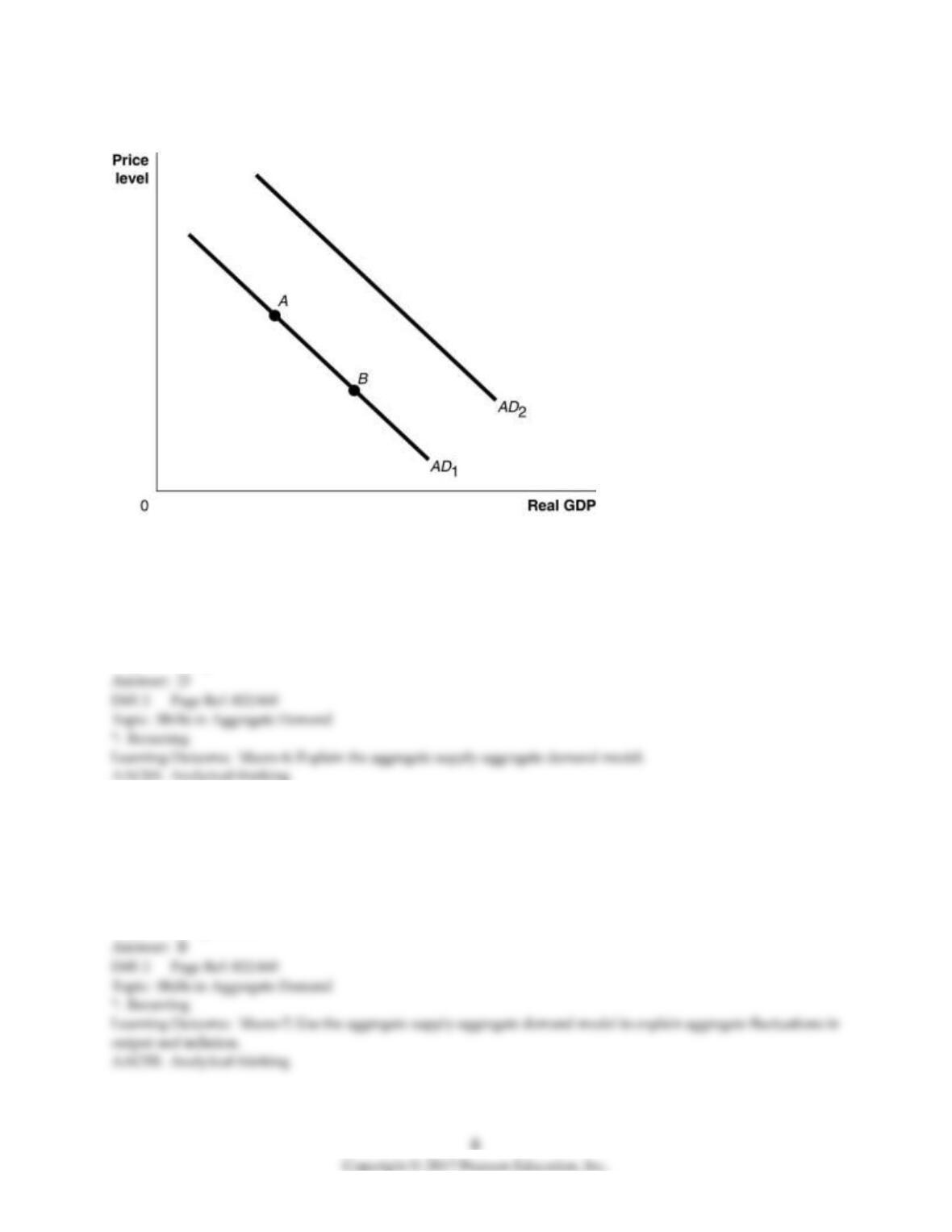
Figure 13-1
26) Refer to Figure 13-1. Ceteris paribus, an increase in the price level would be represented by a
movement from
A) AD1 to AD2.
B) AD2 to AD1.
C) point A to point B.
D) point B to point A.
27) Refer to Figure 13-1. Ceteris paribus, an increase in interest rates would be represented by a
movement from
A) AD1 to AD2.
B) AD2 to AD1.
C) point A to point B.
D) point B to point A.
28) Refer to Figure 13-1. Ceteris paribus, an increase in personal income taxes would be represented by a
movement from
A) AD1 to AD2.
B) AD2 to AD1.
C) point A to point B.
D) point B to point A.
29) Refer to Figure 13-1. Ceteris paribus, a decrease in government spending would be represented by a
movement from
A) AD1 to AD2.
B) AD2 to AD1.
C) point A to point B.
D) point B to point A.
30) Refer to Figure 13-1. Ceteris paribus, an increase in households’ expectations of their future income
would be represented by a movement from
A) AD1 to AD2.
B) AD2 to AD1.
C) point A to point B.
D) point B to point A.
31) Refer to Figure 13-1. Ceteris paribus, a decrease in firms’ expectations of the future profitability of
investment spending would be represented by a movement from
A) AD1 to AD2.
B) AD2 to AD1.
C) point A to point B.
D) point B to point A.
32) Refer to Figure 13-1. Ceteris paribus, a decrease in the growth rate of domestic GDP relative to the
growth rate of foreign GDP would be represented by a movement from
A) AD1 to AD2.
B) AD2 to AD1.
C) point A to point B.
D) point B to point A.
33) Refer to Figure 13-1. Ceteris paribus, an increase in the value of the domestic currency relative to
foreign currencies would be represented by a movement from
A) AD1 to AD2.
B) AD2 to AD1.
C) point A to point B.
D) point B to point A.
34) Refer to Figure 13-1. Ceteris paribus, a decrease in the price level would be represented by a
movement from
A) AD1 to AD2.
B) AD2 to AD1.
C) point A to point B.
D) point B to point A.
35) Refer to Figure 13-1. Ceteris paribus, a decrease in interest rates would be represented by a movement
from
A) AD1 to AD2.
B) AD2 to AD1.
C) point A to point B.
D) point B to point A.
36) Refer to Figure 13-1. Ceteris paribus, a decrease in personal income taxes would be represented by a
movement from
A) AD1 to AD2.
B) AD2 to AD1.
C) point A to point B.
D) point B to point A.
37) Refer to Figure 13-1. Ceteris paribus, an increase in government spending would be represented by a
movement from
A) AD1 to AD2.
B) AD2 to AD1.
C) point A to point B.
D) point B to point A.
38) Refer to Figure 13-1. Ceteris paribus, a decrease in households’ expectations of their future income
would be represented by a movement from
A) AD1 to AD2.
B) AD2 to AD1.
C) point A to point B.
D) point B to point A.
39) Refer to Figure 13-1. Ceteris paribus, an increase in firms’ expectations of the future profitability of
investment spending would be represented by a movement from
A) AD1 to AD2.
B) AD2 to AD1.
C) point A to point B.
D) point B to point A.
40) Refer to Figure 13-1. Ceteris paribus, an increase in the growth rate of domestic GDP relative to the
growth rate of foreign GDP would be represented by a movement from
A) AD1 to AD2.
B) AD2 to AD1.
C) point A to point B.
D) point B to point A.
41) Refer to Figure 13-1. Ceteris paribus, a decrease in the value of the domestic currency relative to
foreign currencies would be represented by a movement from
A) AD1 to AD2.
B) AD2 to AD1.
C) point A to point B.
D) point B to point A.
42) The basic aggregate demand and aggregate supply curve model helps explain ________ fluctuations
in real GDP and the price level.
A) short-term
B) long-term
C) both short-term and long-term
D) unrelated
43) The business cycle ________ on Delta Airlines since the company’s inception over 80 years ago.
A) has had virtually no effect
B) has always had a negative effect
C) has had a large effect
D) has always had a positive effect
44) When the economy enters a recession, your employer is unlikely to reduce your wages because
________ during a recession.
A) output and input prices generally fall
B) lower wages increase your incentive to find employment elsewhere
C) output prices always fall
D) output prices generally fall and input prices generally rise
45) The aggregate demand curve shows the relationship between the ________ and ________.
A) inflation rate; quantity of real GDP demanded
B) real interest rate: quantity of real GDP supplied
C) nominal interest rate; quantity of real GDP demanded
D) price level; quantity of real GDP demanded
46) Because of the slope(s) of the ________, we can say that a decrease in the price level leads to a higher
level of real GDP demanded.
A) aggregate demand curve
B) short-run aggregate supply curve
C) long-run aggregate supply curve
D) short-run and long-run aggregate supply curves
47) Which of the following would not be considered a positive addition to household wealth?
A) the equity in one’s home
B) 1,000 shares of Microsoft stock
C) a credit card balance
D) the balance in your checking account
48) According to the “wealth effect,” when the ________ falls, the ________ rises.
A) inflation rate; nominal value of household assets
B) unemployment rate; average level of household income
C) price level; the nominal value of household wealth
D) price level; the real value of household wealth
49) Which of the following best describes the “interest rate effect”?
A) An increase in the price level raises the interest rate and chokes off government spending.
B) An increase in the price level lowers the interest rate and chokes off government spending.
C) An increase in the price level raises the interest rate and chokes off investment and consumption
spending.
D) An increase in the price level lowers the interest rate and chokes off investment and consumption
spending.
50) A decrease in the price level results in a(n) ________ in the quantity of real GDP demanded because
a lower price level ________ consumption, investment, and net exports.
A) decrease; increases
B) increase; increases
C) decrease; decreases
D) increase; decreases
16
51) When the price level in the United States rises relative to the price level of other countries, ________
will rise, ________ will fall, and ________ will fall.
A) imports; exports; net exports
B) exports; imports; net exports
C) net exports; exports; imports
D) net exports; imports; exports
52) The international trade effect states that a(n) ________ in the price level will ________ net exports.
A) increase; increase
B) increase; decrease
C) decrease; decrease
D) decrease; not affect
53) Just before, during, and after the recession of 2007-2009, net exports in the United States
A) fell and remained negative.
B) fell, but remained positive.
C) rose and became positive.
D) rose, but remained negative.
54) Which of the following is one explanation as to why the aggregate demand curve slopes downward?
A) Increases in the price level lower the interest rate and decrease consumption spending.
B) Increases in the price level lower the interest rate and decrease investment spending.
C) Increases in the U.S. price level relative to the price level in other countries lowers net exports.
D) Increases in the price level raise real wealth and lowers consumption spending.
55) A decrease in the price level will
A) shift the aggregate demand curve to the left.
B) shift the aggregate demand curve to the right.
C) move the economy up along a stationary aggregate demand curve.
D) move the economy down along a stationary aggregate demand curve.
56) Inflation will
A) increase aggregate demand.
B) increase the quantity of real GDP demanded.
C) decrease aggregate demand.
D) decrease the quantity of real GDP demanded.
57) Spending on the war in Afghanistan is essentially categorized as government purchases. How do
decreases in spending on the war in Afghanistan affect the aggregate demand curve?
A) They will move the economy down along a stationary aggregate demand curve.
B) They will move the economy up along a stationary aggregate demand curve.
C) They will shift the aggregate demand curve to the right.
D) They will shift the aggregate demand curve to the left.
58) The impact of Hurricane Katrina on consumers in the economy was to make them very pessimistic
about their future incomes. How does this increased pessimism affect the aggregate demand curve?
A) This will move the economy up along a stationary aggregate demand curve.
B) This will move the economy down along a stationary aggregate demand curve.
C) This will shift the aggregate demand curve to the left.
D) This will shift the aggregate demand curve to the right.
59) Lower personal income taxes
A) increase aggregate demand.
B) decrease disposable income.
C) decrease aggregate demand.
D) increase transfer payments.
60) Which of the following will shift the aggregate demand curve to the left, ceteris paribus?
A) an increase in interest rates
B) an increase in disposable income
C) an increase in expected profits for firms
D) an increase in net exports
61) Japanese electronics exports were hurt in 2008 as a result of the recession. How would this decrease
in exports have affected Japan’s aggregate demand curve?
A) The aggregate demand curve would have shifted to the right.
B) The aggregate demand curve would not have shifted, but there would have been a movement up the
aggregate demand curve.
C) The aggregate demand curve would not have shifted, but there would have been a movement down
the aggregate demand curve.
D) The aggregate demand curve would have shifted to the left.
62) If the U.S. dollar increases in value relative to other currencies, how does this affect the aggregate
demand curve?
A) This will move the economy up along a stationary aggregate demand curve.
B) This will move the economy down along a stationary aggregate demand curve.
C) This will shift the aggregate demand curve to the left.
D) This will shift the aggregate demand curve to the right.
63) Last week, 13 Mexican pesos could purchase one U.S. dollar. This week, it takes 11 Mexican pesos
to purchase one U.S. dollar. This change in the value of the dollar will ________ exports from the
United States to Mexico and ________ U.S. aggregate demand.
A) increase; increase
B) decrease; decrease
C) increase; decrease
D) decrease; increase
64) Suppose the U.S. GDP growth rate is slower relative to other countries’ GDP growth rates. This will
A) move the economy up along a stationary aggregate demand curve.
B) move the economy down along a stationary aggregate demand curve.
C) shift the aggregate demand curve to the left.
D) shift the aggregate demand curve to the right.
65) If aggregate demand just decreased, which of the following may have caused the decrease?
A) a decrease in exports
B) a decrease in the interest rate
C) a decrease in the price level
D) a decrease in imports
66) How do changes in income tax policies affect aggregate demand?
A) Higher taxes increase disposable income, consumption, and aggregate demand.
B) Higher taxes reduce disposable income, consumption, and aggregate demand.
C) Higher taxes increase corporate investment and aggregate demand.
D) Higher taxes increase aggregate supply and thus increase aggregate demand as well.
67) An increase in imports increases aggregate demand.