50) A government proposal to increase marginal tax rates on the wealthiest 1 percent of U.S.
residents is supposed to generate an additional $200 billion in tax revenues. It is likely that
A) the actual revenue raised will exceed the $200 billion, because the other 98 percent of the
population will increase their work effort with a more fair tax system.
B) the actual revenue raised will be more than $200 billion, because the short-run aggregate
supply curve is upward sloping.
C) the actual revenue raised will be less than $200 billion, because some of the people will
respond by working less and earning less income that can be taxed.
D) the actual revenue raised will be close to $200 billion, because the wealthy don’t respond to
work incentives the way poorer workers do.
51) An increase in government spending without any increase in taxes
A) does not increase aggregate demand.
B) would effectively eliminate an inflationary gap.
C) causes investment spending to increase.
D) requires additional government borrowing.
52) Which one of the following statements is NOT true?
A) Expansionary fiscal policy is employed to offset recessionary gaps.
B) Expansionary fiscal policy has an effect on interest rates.
C) Crowding out dilutes the effect of expansionary fiscal policy.
D) When crowding out occurs, fiscal policy has a larger effect on aggregate demand.
53) In the extreme case of a complete crowding-out effect
A) an increase in interest rates will stimulate investment spending.
B) an increase in tax rates will stimulate work effort.
C) an increase in government spending will not increase aggregate demand.
D) an increase in government spending will stimulate investment spending.
54) Because of crowding out
A) expansionary fiscal policy during a recession must involve a tax increase.
B) expansionary fiscal policy during a recession is reinforced by private investment spending.
C) the effect of expansionary fiscal policy is partially offset by the decline in investment
spending caused by higher interest rates.
D) expansionary fiscal policy is completely achieved even with a decline in investment spending.
55) If an increase in government spending causes an increase in government borrowing, this
could induce
A) an increase in interest rates, which would cause private domestic investment to fall.
B) an increase in interest rates, which would cause private domestic investment to rise.
C) an increase in interest rates but no effect on private domestic investment.
D) a decrease in interest rates, which would cause private domestic investment to rise.
56) The crowding-out effect refers to
A) an increase in the consumption of domestic goods at the expense of imported goods.
B) an increase in the consumption of imported goods at the expense of domestic goods.
C) a decrease in consumption and investment caused by an increase in government borrowing.
D) a decrease in consumer spending caused by a decrease in consumer confidence.
57) The permanent income hypothesis implies that the effect of a temporary tax cut on economic
activity
A) is greater than the effect of a permanent tax cut.
B) is the same as the effect of a permanent tax cut.
C) can be greater than or smaller than the effect of a permanent tax cut, depending on how the
tax cut affects the government.
D) is smaller than the effect of a permanent tax cut.
58) According to the permanent income hypothesis, taxpayers react to a one-time tax rebate
A) by spending all of the tax rebate.
B) by spending more than the amount of the tax rebate.
C) by saving half of the tax rebate and spending the rest.
D) by saving all of the tax rebate.
59) Assuming that the Ricardian equivalence theorem is TRUE, which of the conditions below
will hold?
A) An increase in the government budget deficit will not affect aggregate demand.
B) Exports will not be considered part of aggregate demand.
C) Investment spending will not be considered part of aggregate demand.
D) The long-run aggregate supply curve will not be vertical.
60) Which of the following best explains why the federal tax rebates in the 2000s had almost no
effects on aggregate demand?
A) According to the permanent income hypothesis, those one-time tax rebates did not affect
consumption because they did not change taxpayers’ permanent income.
B) According to the permanent income hypothesis, those one-time tax rebates did not affect
consumption because taxpayers did not believe the rebates would occur.
C) According to Ricardian equivalence theorem, those tax rebates did not affect aggregate
demand because they were accompanied by more government spending.
D) According to Ricardian equivalence theorem, those tax rebates did not affect aggregate
demand because there were no direct expenditure offsets.
61) If there is a dollar-for-dollar direct expenditure offset, then
A) increases in aggregate demand will also increase long-run aggregate supply.
B) increases in government spending will not increase aggregate demand.
C) increases in aggregate demand will increase the price level, but leave real output unchanged.
D) increases in aggregate demand will increase real output, but leave the price level unchanged.
62) The theory that government borrowing may function like an increase in taxes is known as
A) the marginal propensity to consume.
B) the Ricardian equivalence theorem.
C) planned tax policy.
D) Congressional Tax policy.
63) Who formulated the theory that government borrowing may function like an increase in taxes
in the sense of reducing current consumption and business expenditures?
A) John Maynard Keynes
B) Jean Baptiste Say
C) David Ricardo
D) Adam Smith
64) The idea that a tax reduction funded by government borrowing has no effect on aggregate
demand is known as
A) the expenditure-offset theorem.
B) the Keynesian Cross.
C) the balanced budget multiplier.
D) the Ricardian equivalence theorem.
65) Supply-side economists argue that changes in tax rates cause changes in
A) the full-employment level of output.
B) labor supply.
C) tax revenues.
D) all of the above.
66) Supply-side theory asserts that high marginal tax rates
A) encourage private saving.
B) encourage business investment.
C) raise additional tax revenues.
D) discourage work effort.
67) Supply-side theory suggests that
A) aggregate supply does not depend on labor productivity.
B) increased government spending does not increase aggregate demand.
C) higher tax rates may not increase overall tax revenues.
D) increased labor productivity may not increase real output.
68) Supply-side economists argue that decreasing marginal tax rates
A) increases productivity and shifts the AS curve to the right.
B) decreases productivity and shifts the AD curve to the right.
C) increases productivity and shifts the AD curve to the left.
D) due to the Ricardian equivalence, has no impact on the economy.
69) Supply-side economists argue cuts in tax rates
A) always reduce tax revenues.
B) can raise tax revenues.
C) always increase budget deficits.
D) only lead to reductions in government spending.
70) The concept that a decline in tax rates and other incentives will induce individuals and firms
to increase productivity is typically referred to as
A) demand-side economics.
B) Ricardian equivalence.
C) supply-side economics.
D) Keynesian economics.
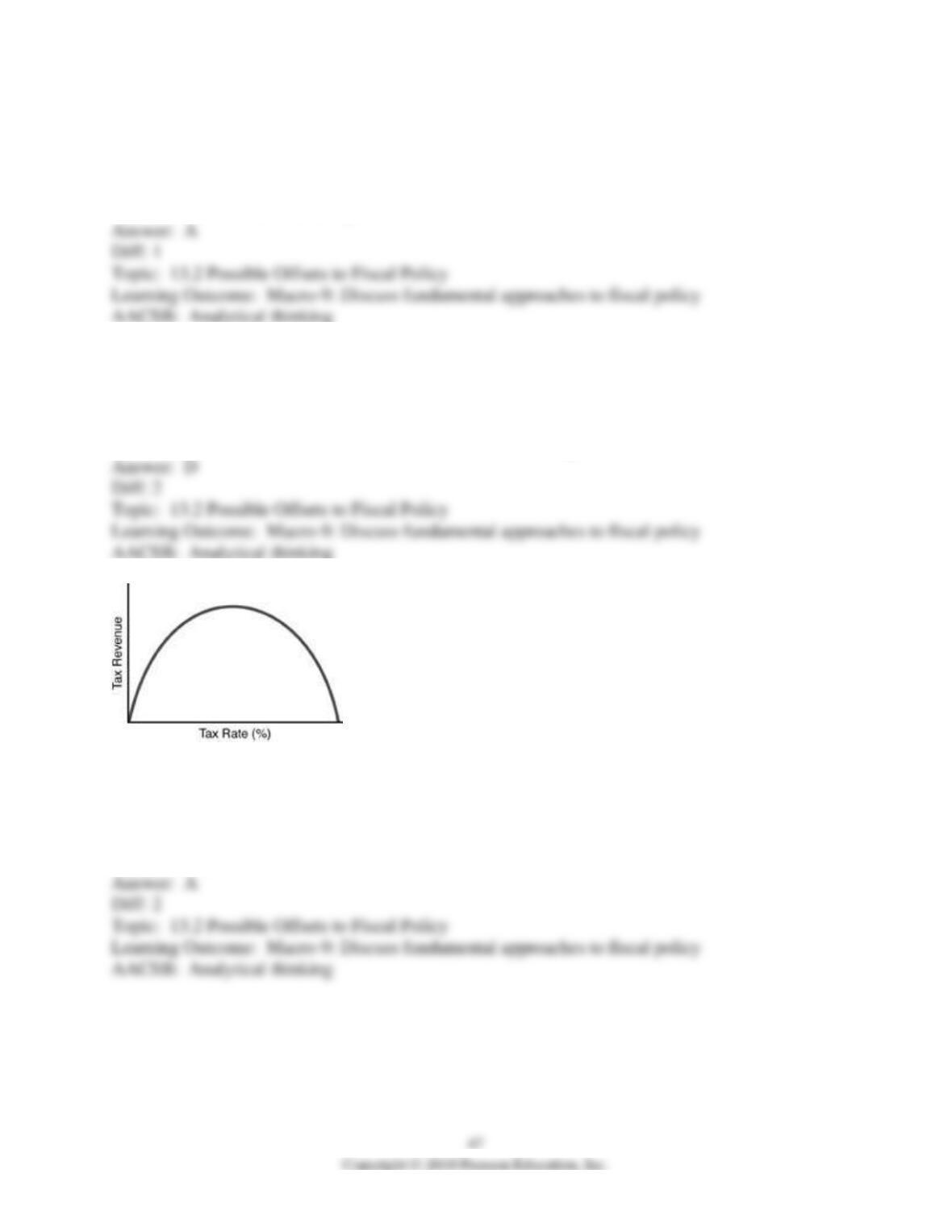
71) The Laffer curve shows that as tax rates increase
A) initially tax revenues increase, then decrease.
B) tax revenues decrease as the incidence of cheating on tax returns increases.
C) tax revenues increase as more individuals and businesses have to pay taxes.
D) tax revenues remain unchanged.
72) According to the Laffer curve, we know with certainty that an increase in the tax rate will
A) cause tax revenue to increase.
B) cause tax revenue to decrease.
C) have no effect on tax revenue.
D) cause tax revenue to increase, decrease, or remain unchanged.
73) Consider the above figure. The curve shown is sometimes referred to as
A) the Laffer curve.
B) the Ricardian curve.
C) the Keynesian curve.
D) the Phillips curve.
74) Consider the above figure. This curve suggests that as the government continues to raise the
tax rate, the revenues that are collected will eventually
A) increase.
B) decline.
C) approach infinity.
D) become negative.
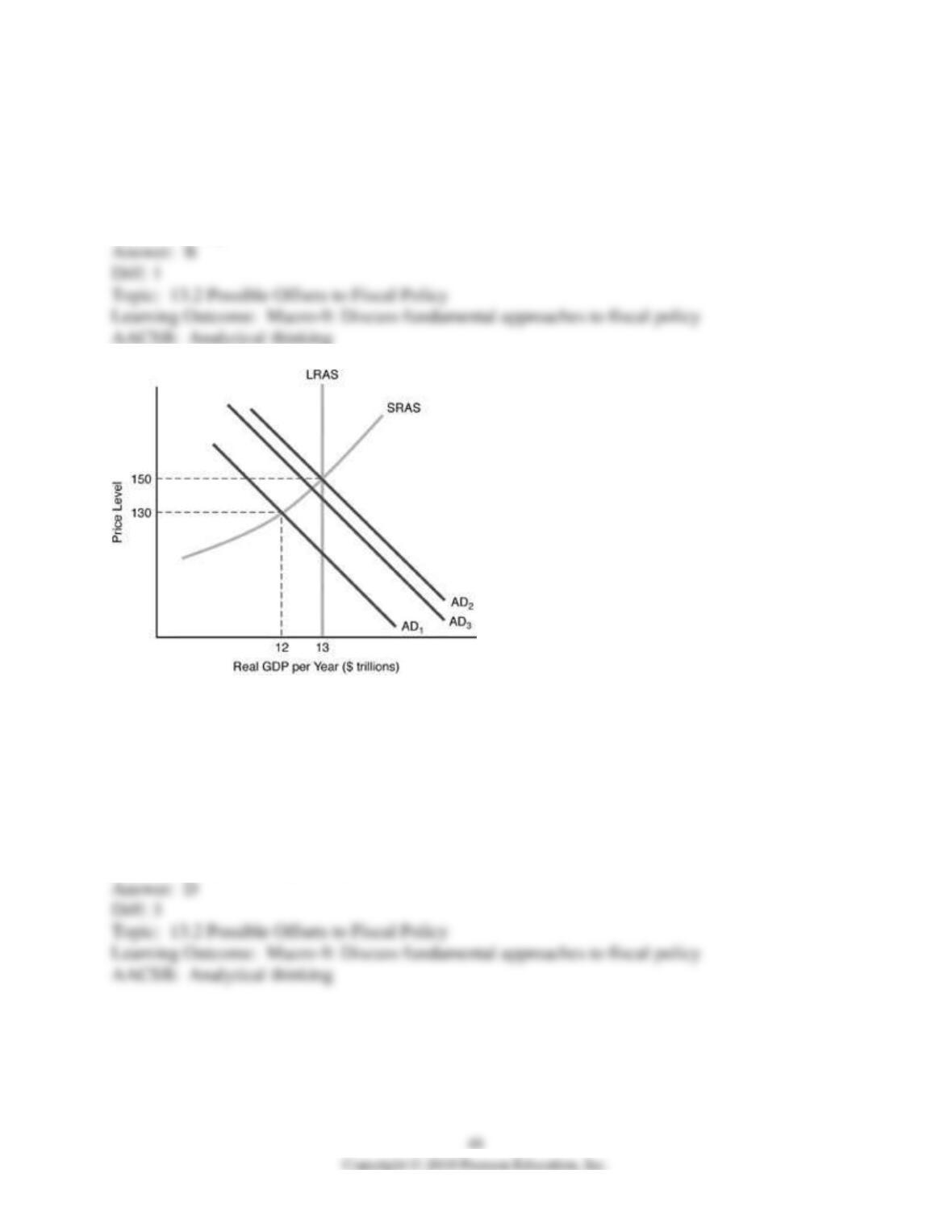
75) Refer to the above figure. Suppose that the economy initially is operating along AD1. If the
government seeks to close the recessionary gap by raising government spending without any
change in taxation, which moves the aggregate demand curve from AD1 to AD2, then to AD3.
Which of the following scenarios is TRUE?
A) Interest rates fall and investment rises.
B) Both interest rates and investment fall.
C) Both interest rates and investment rise.
D) Interest rates rise and investment falls.
76) Refer to the above figure. Suppose that the economy starts at AD1. If the government
reduces taxes, then the economy goes to AD2, but then falls back to AD3. This is an example of
A) partial crowding-out effect.
B) Ricardian equivalence.
C) laissez-faire.
D) complete crowding-out effect.
77) Refer to the above figure. Suppose that the economy starts at AD1. If the government
reduces taxes, then the economy goes to AD2, but then falls back to AD1. This is an example of
A) partial crowding-out effect.
B) the free rider problem.
C) laissez-faire.
D) complete crowding-out effect.
78) If the federal government borrows from households to pay for increased budget deficits, this
will cause
A) a decrease in planned investment and planned consumption.
B) an increase in planned investment and planned consumption.
C) a decrease in planned investment and an increase in planned consumption.
D) an increase in planned investment and a decrease in planned consumption.
79) The crowding out effect of expansionary fiscal policy refers to which of the following?
A) a reduction in private sector planned investment
B) a reduction in interest rates
C) the reduction in the size of the budget deficit
D) the reduction in the size of the inflationary gap
80) When private expenditures decrease as a result of increased government spending, this is
known as
A) a monetary effect.
B) the crowding out effect.
C) the multiplier effect.
D) an automatic stabilizer.
81) The crowding out effect refers to
A) a permanent increase in taxes.
B) an increase in the interest rate caused by government borrowing.
C) the reinforcing impact of state and local tax changes on federal tax changes.
D) the impact of a tax rate increase when the aggregate supply function is horizontal.
82) Suppose policy makers pass a budget that results in a reduction in government spending and
no change in taxes. This reduction in government spending will likely
A) increase government borrowing and increase interest rates.
B) generate extra tax revenues to cover the extra spending.
C) reduce interest rates and increase planned investment.
D) reduce interest rates, increase in planned investment, and increase real GDP.
83) An increase in government spending that is NOT financed by an increase in taxes will cause
which of the following?
A) an increase in interest rates and an increase in planned investment
B) an increase in interest rates and a reduction in planned investment
C) a reduction in interest rates and an increase in planned investment
D) a reduction in interest rates and a reduction in planned investment
84) The crowding-out effect refers to the tendency of expansionary fiscal policy to
A) cause decreases in planned expenditures in the private sector.
B) cause households to save less.
C) replace low-skilled labor with higher-skilled labor.
D) cause firms to produce above their full capacity.
85) To offset the indirect crowding-out effects, a government engaging in expansionary policy
aimed at eliminating a recessionary gap could
A) increase spending less than the simplest Keynesian model would predict.
B) increase spending more than the simplest Keynesian model would predict.
C) reduce taxes rather than increase government spending.
D) both reduce taxes and reduce spending to be able to achieve full employment.
86) Other factors being constant, what happens when the federal government finances a growing
budget deficit by increasing the amount it borrows from the private sector?
A) There will be an increase in the interest rate.
B) There will be a decrease in the interest rate.
C) The crowding out effect will be cancelled out.
D) There will be an increase in net exports.
87) According to the Ricardian equivalence theorem, an increase in government spending
without any tax increase will not increase aggregate demand because
A) consumers will consume less and save more to prepare for increased taxes in the future.
B) the private sector is more likely than the public sector to spend any extra income on national
defense.
C) consumers will increase their consumption proportionately more than Keynesian economists
believe they will.
D) consumers will save less than they otherwise would have.
88) The Ricardian equivalence theorem suggests that an increase in the government budget
deficit created by a tax cut will
A) increase real Gross Domestic Product (GDP) in both the short and long run.
B) decrease real Gross Domestic Product (GDP) in the short run, but increase it in the long run.
C) increase real Gross Domestic Product (GDP) in the short run, but decrease it in the long run.
D) have no effect on real Gross Domestic Product (GDP) in either the short run or the long run.
89) Which of the following is a basic assumption of the Ricardian equivalence theorem?
A) Consumers pay no attention to government budget deficits.
B) Consumers think only in terms of the present.
C) If current tax cuts result in budget deficit increases, consumers increase their labor supply
today.
D) Consumers consider future tax payments when deciding how much to spend and save today.
90) The proposition that an increase in the federal budget deficit caused entirely by a current tax
cut has no effect on aggregate demand is called the
A) indirect effect.
B) interest rate effect.
C) open-economy effect.
D) Ricardian equivalence theorem.
91) What is supply-side economics?
92) Using graphs, explain how indirect crowding out can occur when the government increases
spending in an attempt to stimulate the economy.
93) What are direct expenditure offsets and how do they influence the effects of fiscal policy?
94) Suppose the government pursues expansionary fiscal policy by lowering taxes. What are the
expected demand-side effects? What are the possible offsets to the demand-side effect? How
might supply-side effects change these results?
95) Explain how indirect crowding out can offset expansionary fiscal policy.
96) Explain the Ricardian equivalence theorem.
97) Explain why proponents of supply-side effects of tax rate variations who also believe that
tax-rate changes influence aggregate demand might claim that cuts in marginal income tax rates
can potentially push up real Gross Domestic Product (GDP) without generating inflation.
13.3 Discretionary Fiscal Policy in Practice: Coping with Time Lags
1) The period between the recognition of a problem and the implementation of a policy to solve
the problem is
A) the recognition lag.
B) the action lag.
C) the policy effect lag.
D) the political decision lag.
2) Which of the following are time lags that fiscal policy makers must cope with?
A) recognition lags
B) action lags
C) effect lags
D) All of the above are correct.
3) The effect time lag of fiscal policy refers to
A) the time needed for Congress to enact a policy.
B) the delay in recognizing an economic problem.
C) the time between the onset of a policy and when the policy has impact on the economy.
D) the difficulty in getting the President and the Congress to agree on an appropriate policy.
4) The time required to collect information about the current state of the economy is known as
A) the recognition lag.
B) the action lag.
C) the effect lag.
D) the fiscal lag.
5) Fiscal policy may end up being destabilizing to an economy because
A) time lags are always too short for policy actions to take effect.
B) the economy is almost always at full employment.
C) the President may have different goals than Congress.
D) various time lags associated with fiscal policy cause the policy changes to take effect too late
to solve the problem it was supposed to solve.
6) The recognition time lag recognizes that it takes time
A) to collect information about the state of the economy.
B) to get politicians to agree on the best policy to enact.
C) for any change in policy to take effect and for people to recognize that the policies are
effective.
D) for the politicians to enact the policy once the need for change has been recognized.
7) The amount of time that it takes to identify a national economic problem is
A) fiscal policy.
B) the recognition time lag.
C) the effect time lag.
D) the action time lag.
8) The amount of time that it takes between recognizing an economic problem and implementing
policy to solve it is
A) fiscal policy.
B) the recognition time lag.
C) the effect time lag.
D) the action time lag.
9) The amount of time that elapses between the implementation of a policy and the results of that
policy is
A) fiscal policy.
B) the recognition time lag.
C) the effect time lag.
D) the action time lag.
10) Once either expansionary or contractionary fiscal policy has been undertaken,
A) aggregate demand will respond quickly and the problems in the economy will be corrected.
B) aggregate demand will respond quickly in the short run but the economy will not improve in
the long-run.
C) a time lag exists between implementation and the results of the policy.
D) taxes will need to be adjusted because of the recognition time lag.
11) The amount of time it takes the government to determine the size of a tax policy is known as
the
A) action time lag.
B) effect time lag.
C) recognition time lag.
D) Ricardian-equivalence time lag.
12) The various time lags involved with fiscal policy imply that
A) fiscal policy is effective only slowly, but the slowness ensures that it is effective in the long
run.
B) fiscal policy is most effective as a short-run measure to fine tune the economy’s quarterly ups
and downs.
C) fiscal policy may often be destabilizing if the policy effects occur after the need is over.
D) when fiscal policy is carefully coordinated, it can quickly move to keep the economy at the
full-employment level of real GDP.
13) In January 2009, the President submitted a bill to Congress that was designed to stimulate the
economy and increase employment. The legislation was passed in March 2009, and the spending
occurred from June 2009 to September 2010. Consequently
A) the economy should have been at full employment by December 2009.
B) the full impact of the bill would be felt by March 2009 because people anticipated the effects
of the increased spending.
C) the full impact of the bill would be felt by the end of September 2010.
D) the full effect of the spending would be felt some time after September 2010 because the full
multiplier effects could not be felt until all the increase in spending took place.
14) In January 2009, the President submitted a bill to Congress in order to stimulate the economy
and increase employment. The legislation was passed in March 2009, and the spending occurred
from June 2009 to March 2011. As a result
A) the full effect of the fiscal policy change would not be felt until after March 2011 because of
the effect time lag.
B) the full effect of the fiscal policy change would not be felt until after March 2011 because of
the recognition time lag.
C) the full effect of the fiscal policy change would be felt by March 2011 because people
anticipated the spending and changed their behavior accordingly.
D) the full effect of the fiscal policy change would be felt when the last of the funds were spent
by the government.
15) Discretionary fiscal policy
A) may not have desired effects on real GDP because of the time lags.
B) may not have desired effects on real GDP because it leads to increases in aggregate demand.
C) may not have desired effects on real GDP because it leads to decreases in aggregate demand.
D) would have a larger effect on real GDP if the multiplier was smaller.
16) To the extent that the political process of moving legislation through Congress is slow
A) the effect time lag will be long.
B) the recognition time lag will be long.
C) the action time lag will be long.
D) automatic stabilizers will not be effective.
17) The time required to acquire information about the state of the economy is known as
A) the action lag.
B) the recognition lag.
C) the effect lag.
D) the data lag.
18) The period between the implementation of a policy and its intended result is known as
A) the action time lag.
B) the recognition time lag.
C) the effect time lag.
D) the data lag.
19) A problem with using fiscal policy to fine-tune the economy is that
A) it takes time for policymakers to agree on the appropriate fiscal policy.
B) fiscal policy impacts the economy too fast.
C) fiscal policy impacts only urban areas of the nation.
D) fiscal policy impacts only the largest states in the nation.
20) The recognition time lag is the time between
A) when an economic problem manifests itself and it is officially acknowledged.
B) the recognition of an economic problem and implementing policies to solve it.
C) implementing policies to solve an economic problem and when the results of that policy can
be measured.
D) the beginning of the budgetary process and the final budget resolution.