4) Refer to Figure 13-4. Given the economy is at point A in year 1, what is the inflation rate between
year 1 and year 2?
A) 0.9%
B) 1.8%
C) 2.7%
D) 3.0%
5) Refer to Figure 13-4. Given the economy is at point A in year 1, what will happen to the
unemployment rate in year 2?
A) It will rise.
B) It will fall.
C) It will remain constant.
D) not enough information to answer the question
6) Refer to Figure 13-4. In the figure above, AD1, LRAS1 and SRAS1 denote AD, LRAS and SRAS in
year 1, while AD2, LRAS2 and SRAS2 denote AD, LRAS and SRAS in year 2. Given the economy is at
point A in year 1, what is the actual growth rate in GDP in year 2?
A) 2.5%
B) 7.3%
C) 8.0%
D) 10.0%
7) Refer to Figure 13-4. Given the economy is at point A in year 1, what is the difference between the
actual growth rate in GDP in year 2 and the potential growth rate in GDP in year 2?
A) 0.3%
B) 1.1%
C) 2.7%
D) 3.7%
8) Refer to Figure 13-4. Given the economy is at point A in year 1, what will happen to the price level in
year 2?
A) It will rise.
B) It will fall.
C) It will remain constant.
D) not enough information to answer the question
9) When people became less concerned with the underlying value of their houses and instead focused
on the expectations of the prices of their houses increasing, ________ occurred.
A) stagflation
B) an automatic destabilizer
C) a housing bubble
D) a supply shock
10) At the beginning of the recession of 2007-2009, real GDP in the United States was ________ potential
GDP, and in June 2009, real GDP was ________ potential GDP.
A) below; above
B) below; below
C) above; below
D) above; above
11) As the recession persisted into 2009, the unemployment rate in the United States rose to ________,
the highest rate since the recession of 2001-2002 and the second highest since the Great Depression.
A) 5.5 percent
B) 9.3 percent
C) 17.6 percent
D) 25.1 percent
12) In the dynamic aggregated demand and aggregate supply model, if AD shifts faster than AS,
A) inflation occurs.
B) deflation occurs.
C) stagflation occurs.
D) disinflation occurs.
13) Which of the following could explain why there is an increase in potential GDP but the equilibrium
level of GDP does not rise?
A) SRAS shifted to the right by more than LRAS.
B) AD shifted to the right by more than SRAS.
C) AD shifted to the right by less than SRAS.
D) SRAS and AD do not shift.
14) All of the following are assumptions made by the dynamic model of aggregate demand and
aggregate supply except
A) aggregate demand and potential real GDP decrease continuously.
B) the aggregate demand curve shifts to the right during most periods.
C) potential real GDP increases continuously.
D) the short-run aggregate supply curve shifts to the right except during periods when workers and
firms expect higher wages.
15) Which of the following is one reason for the decline in aggregate demand that led to the recession of
2007-2009?
A) falling oil prices
B) an increase in net exports
C) the end of the housing bubble
D) a decline in government spending
16) When people became ________ concerned with the underlying value of their houses and became
________ concerned with the expectations of the prices of their houses increasing, a housing bubble
occurred.
A) less; less
B) less; more
C) more; less
D) more; more
17) During 2008, oil price increases
A) shifted the short-run aggregate supply curve farther to the left than similar increases had 30 years
earlier.
B) shifted the aggregate demand curve farther to the right than similar increases had 30 years earlier.
C) did not shift the short-run aggregate supply curve as far to the left as similar increases had 30 years
earlier.
D) shifted the aggregate demand curve farther to the left than similar increases had 30 years earlier.
18) The recession of 2007-2009 began in ________, with the end of the economic expansion that had
begun in ________.
A) January 2007; April 1984
B) December 2007; November 2001
C) July 2007; August 2006
D) March 2007; March 1995
19) In the dynamic aggregated demand and aggregate supply model, inflation occurs if
A) AD shifts faster than SRAS.
B) AD shifts slower than SRAS.
C) SRAS shifts faster than AD.
D) LRAS shifts faster than AD.
20) Which of the following could explain why there is an increase in potential GDP but the equilibrium
level of GDP falls?
A) SRAS shifted to the right by more than LRAS.
B) AD shifted to the right by more than SRAS.
C) AD shifted to the right by less than SRAS.
D) AD did not shift and SRAS shifted to the left.
21) The dynamic aggregate demand and aggregate supply model assumes that potential GDP increases
over time.
22) Inflation is generally the result of total spending growing faster than total production.
23) One factor which brought on the recession of 2007-2009 was the end of the housing bubble.
24) One factor which brought on the recession of 2007-2009 was the financial crisis in 2008.
25) In the dynamic aggregate demand and aggregate supply model, what is the result of aggregate
demand increasing slower than potential real GDP?
26) Explain how the aggregate demand and aggregate supply model can be made more dynamic.
27) In the dynamic aggregate demand and aggregate supply model, what is the result of aggregate
demand increasing faster than potential real GDP?
28) Explain whether Delta Airlines’ sales are likely to fluctuate more or less than the sales of each of the
following firms as the economy moves from recession to expansion and back to recession.
Whirlpool Corporation (appliance manufacturer)
Taco Bell
The Boeing Company (aircraft manufacturer)
GameStop (video game sales and rentals)
85
29) Explain how the static aggregate demand and aggregate supply model gives us misleading results
about the price level, particularly with respect to decreases in aggregate demand. Describe how the
aggregate demand curve is different in the dynamic model as compared to the static model. Describe
how potential GDP is different in the dynamic model as compared to the static model.
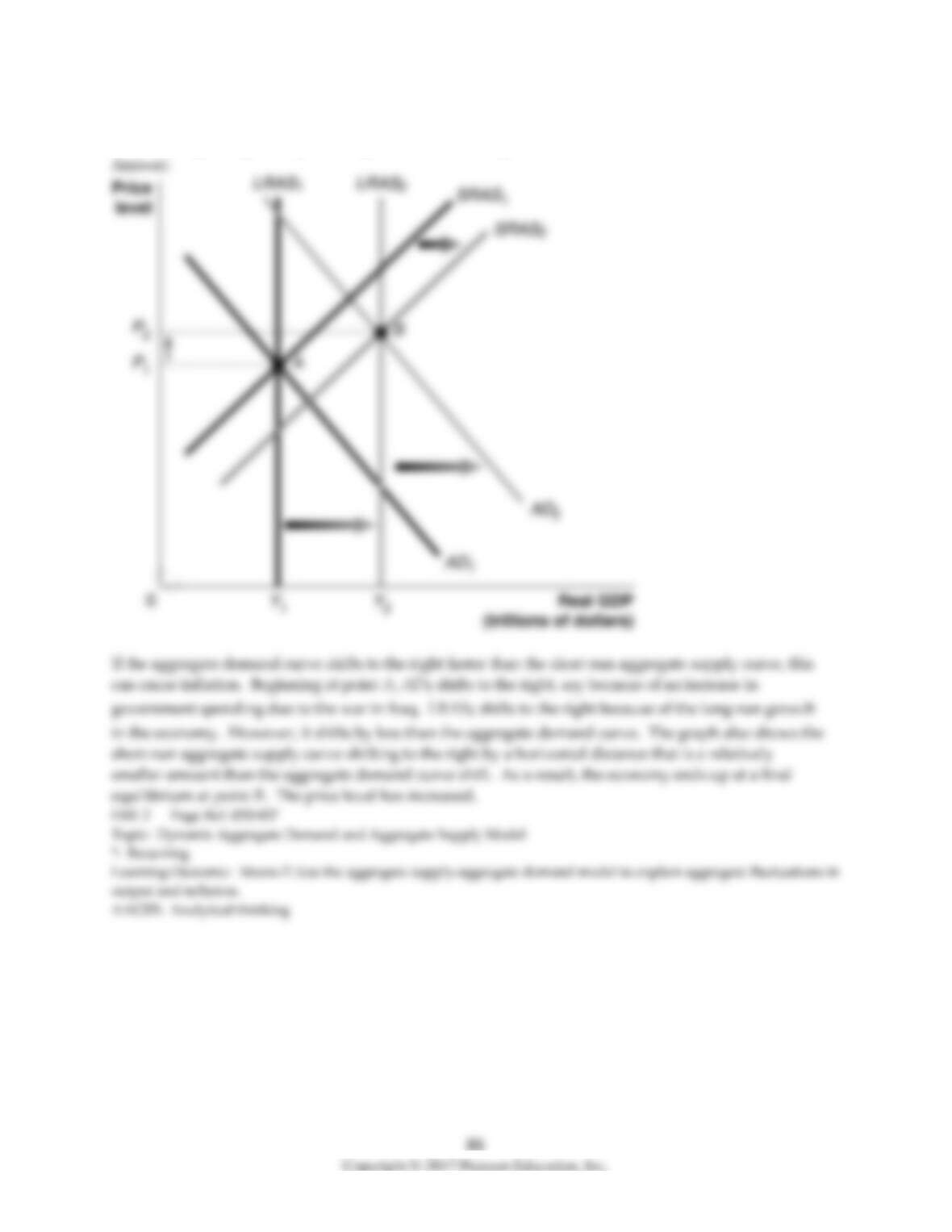
30) Use the dynamic model of aggregate demand and supply to illustrate a situation where the
economy is growing but experiencing inflation in the long run.
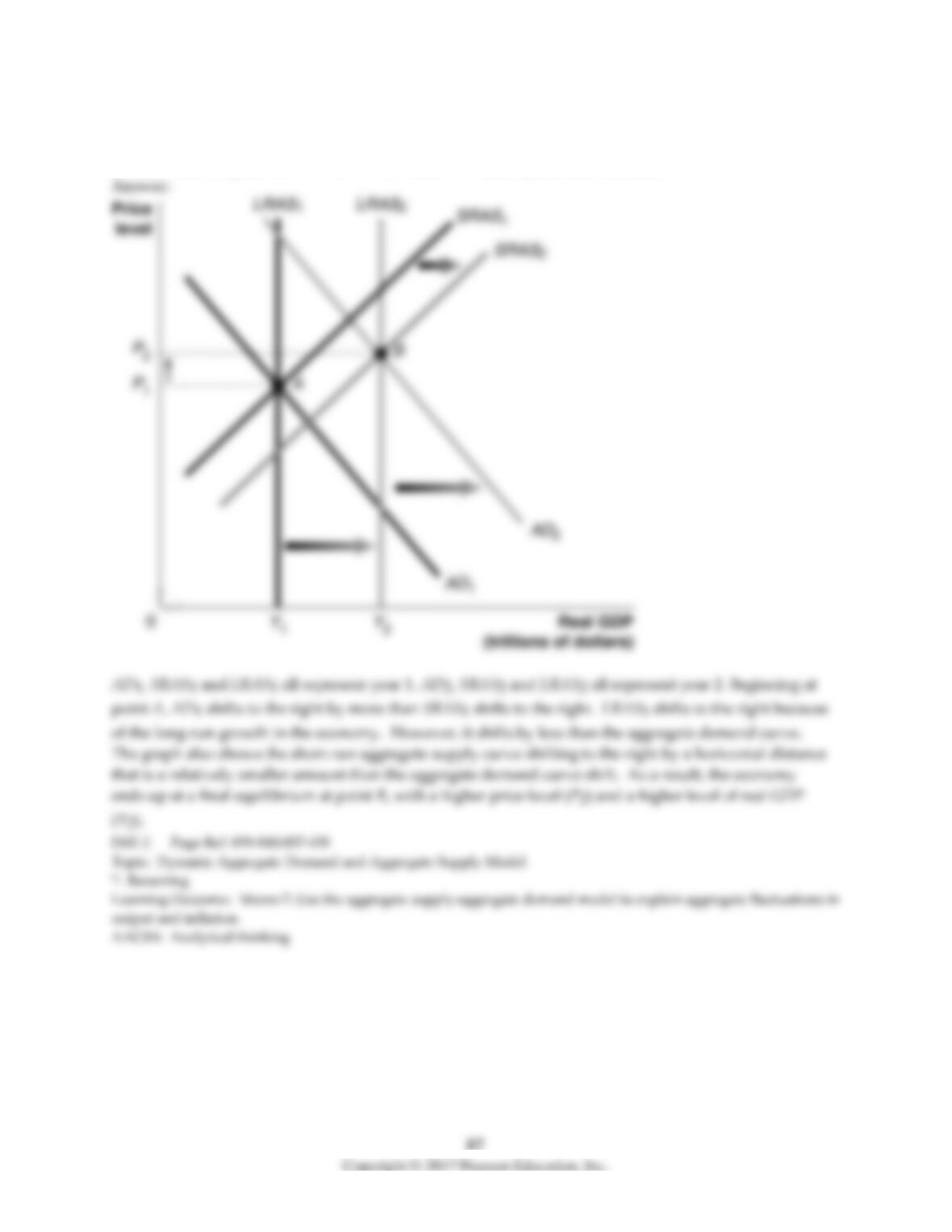
31) Use the dynamic model of aggregate demand and supply to illustrate a situation where aggregate
demand and short-run aggregate supply are both increasing from year 1 to year 2, resulting in a higher
price level and higher level of real GDP at macroeconomic equilibrium in year 2.
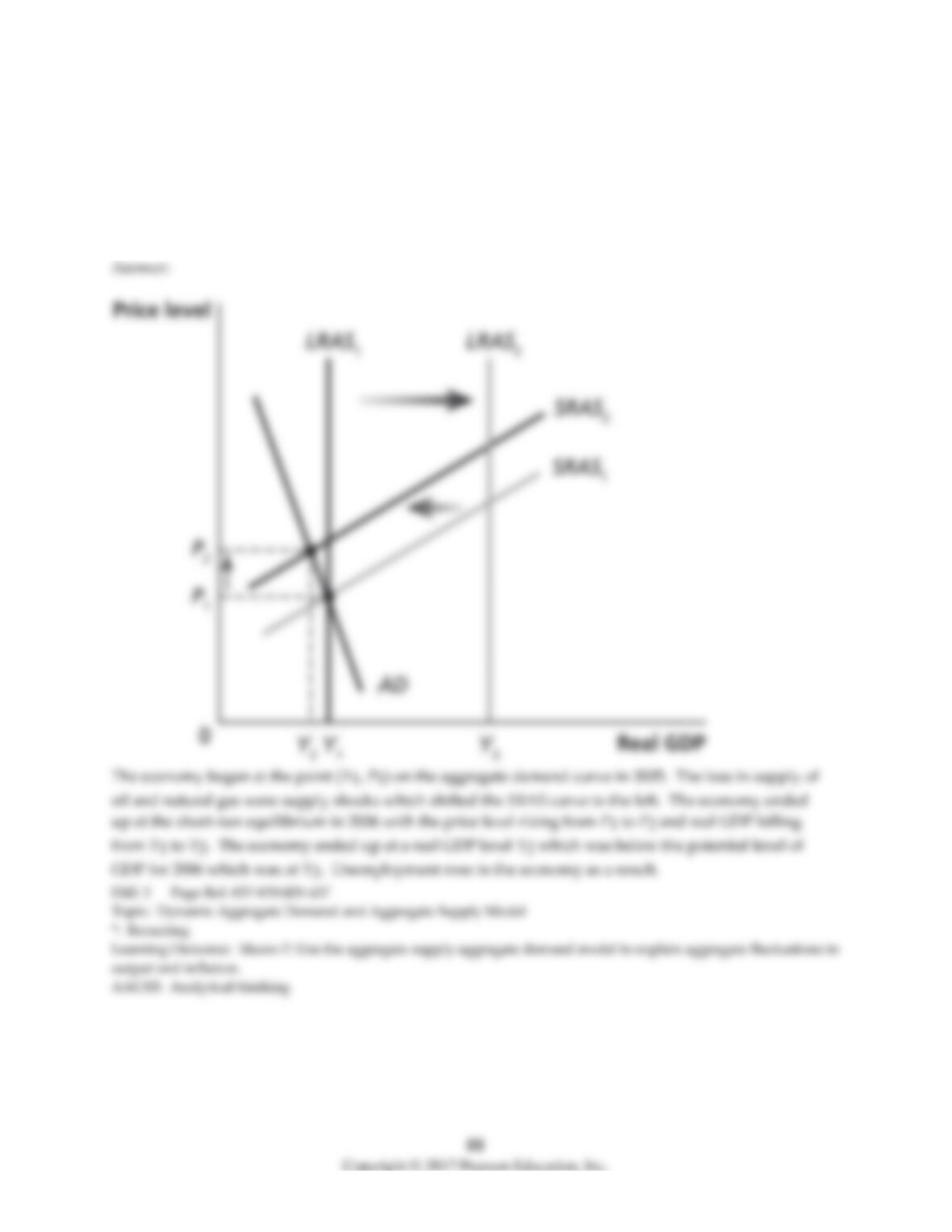
32) Hurricane Katrina resulted in a decline in oil production infrastructure along the gulf coast. As a
result there was an unexpected decline in oil and natural gas supplies in 2005. Suppose that this caused
an increase in the price level and a decline in real GDP in 2006. Also assume that potential real GDP
continued to grow due to other factors. You can assume the aggregate demand curve did not change.
Show the macroeconomic equilibrium for 2005 and 2006 using the dynamic aggregate supply and
aggregate demand model.
13.5 Appendix: Macroeconomic Schools of Thought
1) Which of the following models relies on emphasizing the importance of sticky wages and prices?
A) the monetarist model
B) the new classical model
C) the real business cycle model
D) the new Keynesian model
2) The new classical model has as its central idea that
A) wage and price stickiness explain fluctuations in real GDP.
B) workers and firms have rational expectations.
C) the Federal Reserve should adopt a monetary growth rule.
D) shifts in aggregate demand have no impact on real GDP.
3) Which of the following models advocate that the quantity of money should be increased at a constant
rate?
A) the monetarist model
B) the new classical model
C) the real business cycle model
D) the new Keynesian model
4) The real business cycle model focuses on how
A) wage and price stickiness explains fluctuations in real GDP.
B) the labor theory of value is the best measure of value of a good or service.
C) the Federal Reserve should adopt a monetary growth rule.
D) productivity shocks explain fluctuations in real GDP.
5) Proponents of the real business cycle model argue that the short-run aggregate supply curve is
A) flat.
B) positively sloped.
C) vertical.
D) negatively sloped.
6) According to the real business cycle model, ________ in aggregate demand ________ GDP.
A) increases; decrease
B) increases; increase
C) increases; do not affect
D) decreases; increase
7) If workers and firms have rational expectations, they form their expectations using
A) all the information available to them.
B) only information from the past.
C) only information provided to them by the government.
D) only information gathered from random sources.
8) The proponents of ________ and ________ think that the Federal Reserve should adopt a constant
monetary growth rule.
A) new Keynesianism; the new classical model
B) the real business cycle model; Marxism
C) rational expectations; monetarism
D) the monetarist model; the Keynesian model
9) According to Marx, which of the following factors of production did not contribute anything of value
to production?
A) labor
B) capital
C) natural resources
D) entrepreneurship
10) Monetarism is a school of thought put forth by ________, who argued that the economy would most
likely be at potential GDP.
A) Karl Marx
B) Milton Friedman
C) Finn Kydland and Edward Prescott
D) Robert Lucas and Thomas Sargent
11) The new Keynesians emphasize the importance of
A) rational expectations.
B) the monetary growth rule.
C) real causes of the business cycle.
D) sticky wages and prices.
12) Which of the following models has as its central idea that workers and firms have rational
expectations?
A) the monetarist model
B) the new classical model
C) the real business cycle model
D) the new Keynesian model
13) The main result of the monetarist model is that
A) workers and firms have rational expectations.
B) the quantity of money should be increased at a constant rate.
C) productivity shocks explain fluctuations in real GDP.
D) the economy is slow to adjust to sticky wages and prices.
14) Which of the following models focuses on how productivity shocks explain fluctuations in real
GDP?
A) the monetarist model
B) the new classical model
C) the real business cycle model
D) the new Keynesian model
15) Proponents of the ________ model argue that the short-run supply curve is vertical.
A) the monetarist model
B) the new classical model
C) the real business cycle model
D) the new Keynesian model
16) According to the real business cycle model,
A) increases in aggregate demand raise GDP.
B) increases in aggregate demand lower GDP.
C) increases in aggregate demand do not affect GDP.
D) increases in aggregate demand lower the price level.
17) The monetary growth rule is a plan for increasing the quantity of money
A) at a fixed rate that does not respond to changes in the economic condition.
B) at a rate which increases as the economy grows.
C) at a rate which decreases as the economy declines.
D) at a rate which increases during recessions and decreases during expansions.
18) The proponents of rational expectations and monetarism think that the Federal Reserve should
adopt
A) an inflation target.
B) a monetary aggregate target.
C) a constant monetary growth rule.
D) an interest rate target.
19) According to ________, entrepreneurship does not contribute anything of value to production.
A) Robert Lucas and Thomas Sargent
B) Milton Friedman
C) John Maynard Keynes
D) Karl Marx
20) Monetarism is a school of thought put forth by Milton Friedman. He argued that the economy
would most likely
A) be below potential GDP.
B) be at potential GDP.
C) be unstable.
D) be above potential GDP.
21) New classical macroeconomic theory emphasizes the role of “sticky” prices in the economy.
22) Monetarists believe that the quantity of money should be increased at an increasing rate.
23) New Keynesian macroeconomic theory emphasizes the role of “sticky” prices in the economy.
24) What does the phrase “Keynesian revolution” refer to?
25) Briefly describe monetarism and the monetary growth rule.