14) “More than 9,000 laid-off Nevada workers will qualify for a second 13-week round of
extended unemployment benefits, under federal legislation signed by President Bush. [The]
workers exhausted their first 13 weeks of extended benefits and will now be eligible for the new
benefits, which pay an average of $293 a week.”
www.mercurynews.com 11/24/2008
Unemployment benefits are considered part of ________ fiscal policy. The extension of benefits
would ________ fiscal policy.
A) automatic; be discretionary
B) discretionary; be automatic
C) automatic; also be considered automatic
D) discretionary; also be considered discretionary
15) In response to the economic downturn, New Zealand’s government had enacted a $3.8
stimulus package.
www.iht.com, 11/26/2008
The stimulus plan is considered
A) automatic fiscal policy.
B) contractionary fiscal policy.
C) discretionary fiscal policy.
D) needs-tested spending.
16) “European Economic Recovery Plan”
“The European Commission urged EU governments to jointly combat the economic slowdown
with 200 billion euros ($256 billion) in spending and tax cuts to boost growth and consumer and
business confidence.” The plan “…would see the 27 EU governments spend 1.5 percent of the
bloc’s gross domestic product to halt the slowdown that has already pushed some European
nations into recession.”
www.iht.com, 11/26/2008
Which of the following describe the EU’s plan?
I. It is discretionary fiscal policy
II. It will generate a cyclical surplus.
A) I and II
B) II only
C) I only
D) neither I nor II
17) In response to the 2008 recession, New Zealand’s Finance Minister Bill English stated that
“… the 7 billion New Zealand dollars would be allocated to new infrastructure spending,
providing financial aid to workers hit by layoffs as the economy slows and includes tax cuts
planned for April.”
www.iht.com, 11/26/2008
New Zealand’s government expects the policies to shift the ________ but at this point in time the
________ might weaken its ability to affect real GDP.
A) AD curve rightward; recognition lag
B) LAS curve leftward; impact lag
C) SAS curve rightward; law-making lag
D) AD curve rightward; impact lag
18) “European Economic Recovery Plan”
“The European Commission urged EU governments to jointly combat the economic slowdown
with 200 billion euros ($256 billion) in spending and tax cuts to boost growth and consumer and
business confidence.” The plan “…would see the 27 EU governments spend 1.5 percent of the
bloc’s gross domestic product to halt the slowdown that has already pushed some European
nations into recession.”
www.iht.com, 11/26/2008
The plan is expected to
A) shift the AD curve rightward and increase real GDP.
B) shift the AD curve leftward and decrease the recessionary gap.
C) decrease the recessionary gap and decrease the price level.
D) use the autonomous tax multiplier to eliminate the inflationary gap.
19) “Obama Considers Delaying Tax Increase”
“U.S. President-elect Barack Obama is considering delaying his proposal to repeal the Bush tax
cuts for the wealthiest Americans in light of the economic downturn.”
www.nytimes.com 11/23/2008
Obama’s possible decision to delay the tax increase recognizes the fact that a tax increase will
________ disposable income and ________ real GDP.
A) decrease; increase
B) decrease; decrease
C) increase; increase
D) increase; decrease
20) In January 2008, the unemployment rate was only 4.9 percent and real GDP was growing.
But President Bush “acknowledged that Americans were ‘anxious about the economy’.” As a
result, it was reported that “…the Bush administration and Congressional leaders, increasingly
concerned about a possible recession, are moving closer to agreeing that an economic stimulus
package is needed soon.” In order for the package to be approved, the leaders in Washington
implied that “… they might be able to put aside longstanding partisan differences.”
www.nytimes.com 1/12/2008
Which of the following lags are government officials trying to avoid?
A) the recognition lag
B) the impact lag
C) the law-making lag
D) all of the above
1) What is fiscal policy and what are its purposes?
2) What does the Employment Act of 1946 specify? Why is it an important economic milestone?
3) According to tax receipt and outlay categories, what are the main components of the federal
government budget?
4) Depending on the relative size of the federal government’s outlays and tax receipts, the federal
government’s budget can be in three possible conditions. What are the three possible conditions
and what is the relationship of federal government outlays and tax receipts for each?
5) What is the difference between budget surplus, budget deficit and a balanced budget? Which
of these three budget outcomes is currently the case in the United States?
6) “The federal budget is required by law to balance.” Is the previous statement correct or
incorrect?
7) How has the federal government debt as a percentage of GDP changed since the end of World
War II?
8) How does a tax on labor income affect potential GDP?
9) What is the Laffer curve? Where on their Laffer curves are the United States, the United
Kingdom and France located?
10) If the government raises taxes on labor income and interest income, explain how potential
GDP and economic growth are affected.
11) What is the difference between discretionary fiscal policy and automatic fiscal policy?
12) What is automatic fiscal policy? How does it affect the budget deficit and/or budget surplus
during a recession and during an expansion?
13) What is the government expenditure multiplier?
14) What is needs-tested spending and how does it affect the government expenditure multiplier?
15) Ignoring any supply-side effects, how does the magnitude of the government expenditure
multiplier compare to the magnitude of the tax multiplier? Explain your answer.
16) What is the effect on aggregate demand and the AD curve from either an increase in
government expenditure or a cut in taxes?
17) If employment is less than full employment, what fiscal policy should the government
pursue?
18) How can discretionary fiscal policy be used to close a recessionary gap?
19) If employment exceeds full employment, what fiscal policy actions could eliminate the gap?
20) What are some of the limitations of fiscal policy? Briefly discuss them.
1) A country reports that its government outlays total $1.8 trillion and its receipts total $1.6
trillion. Does the country have a budget surplus or deficit and what is the surplus or deficit?
2) The above table gives a country’s government outlays and tax receipts for 2011 through 2015.
During which years did the country have a balanced budget, budget surplus, and budget deficit?
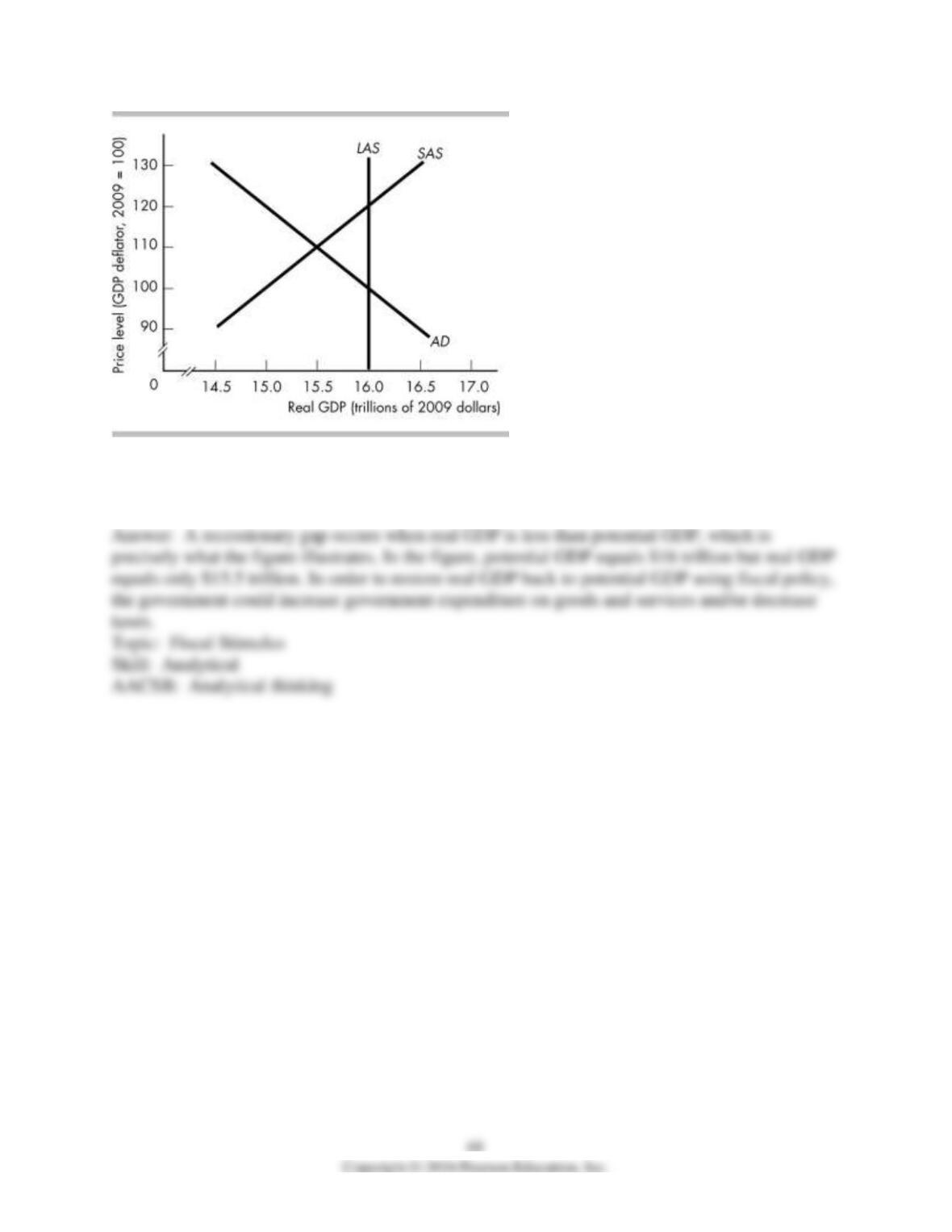
3) Does the figure above illustrate a recessionary or an inflationary gap? What do potential GDP
and real GDP equal? What is an appropriate fiscal policy to restore real GDP to potential real
GDP?
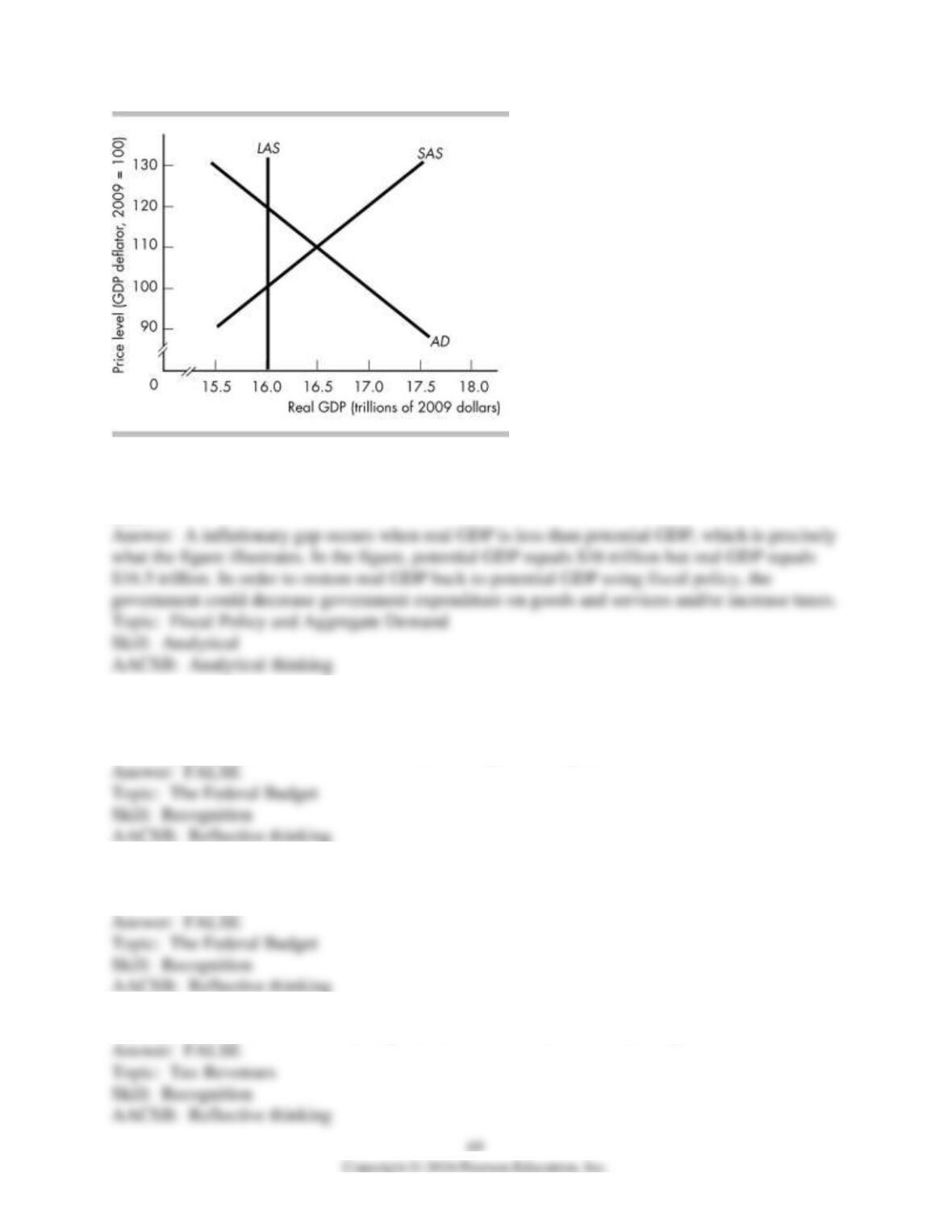
4) Does the figure above illustrate a recessionary or an inflationary gap? What do potential GDP
and real GDP equal? What is an appropriate fiscal policy to restore real GDP to potential real
GDP?
8 True or False
1) Each president can decide when to submit a budget to Congress.
2) Government expenditure on goods and services is the largest component of total federal
government expenditures.
3) Corporate income taxes are the largest source of revenue for the federal government.
4) Personal income taxes are the largest source of revenue for the federal government.
5) Federal government expenditures as a percentage of GDP are currently equal to approximately
10 percent.
6) If tax receipts are greater than government outlays the government has a budget surplus.
7) If tax receipts exactly equaled government outlays in a year, the federal government debt
would be zero.
8) If tax receipts exactly equaled government outlays in a year, the budget deficit would be zero.
9) The main goal of fiscal policy is to produce a balanced budget.
10) All developed countries have about the same ratio of government deficit to GDP.
11) An increase in taxes on labor income decreases potential GDP.
12) An increase in taxes on labor income shifts the labor supply curve leftward and the after-tax
wage rate falls.
13) A tax cut decreases government saving and can thereby crowd out investment.
14) Deliberate changes in government expenditures and taxes to influence GDP are discretionary
fiscal policy.
15) Discretionary policy requires an act of Congress.
16) The structural surplus measures whether a budget surplus is cyclical or structural.
17) By its very definition, every budget deficit is structural in nature.
18) A fiscal stimulus is used to increase production and employment.
19) An increase in government expenditure leads to rightward shift of the AD curve.
20) The aggregate demand curve is shifted rightward by an increase in tax rates.
21) The aggregate demand curve is shifted rightward by an increase in government expenditure.
22) Automatic fiscal policy is not subject to all the same time lags to which discretionary fiscal
policy is subject.
73
9 Extended Problems
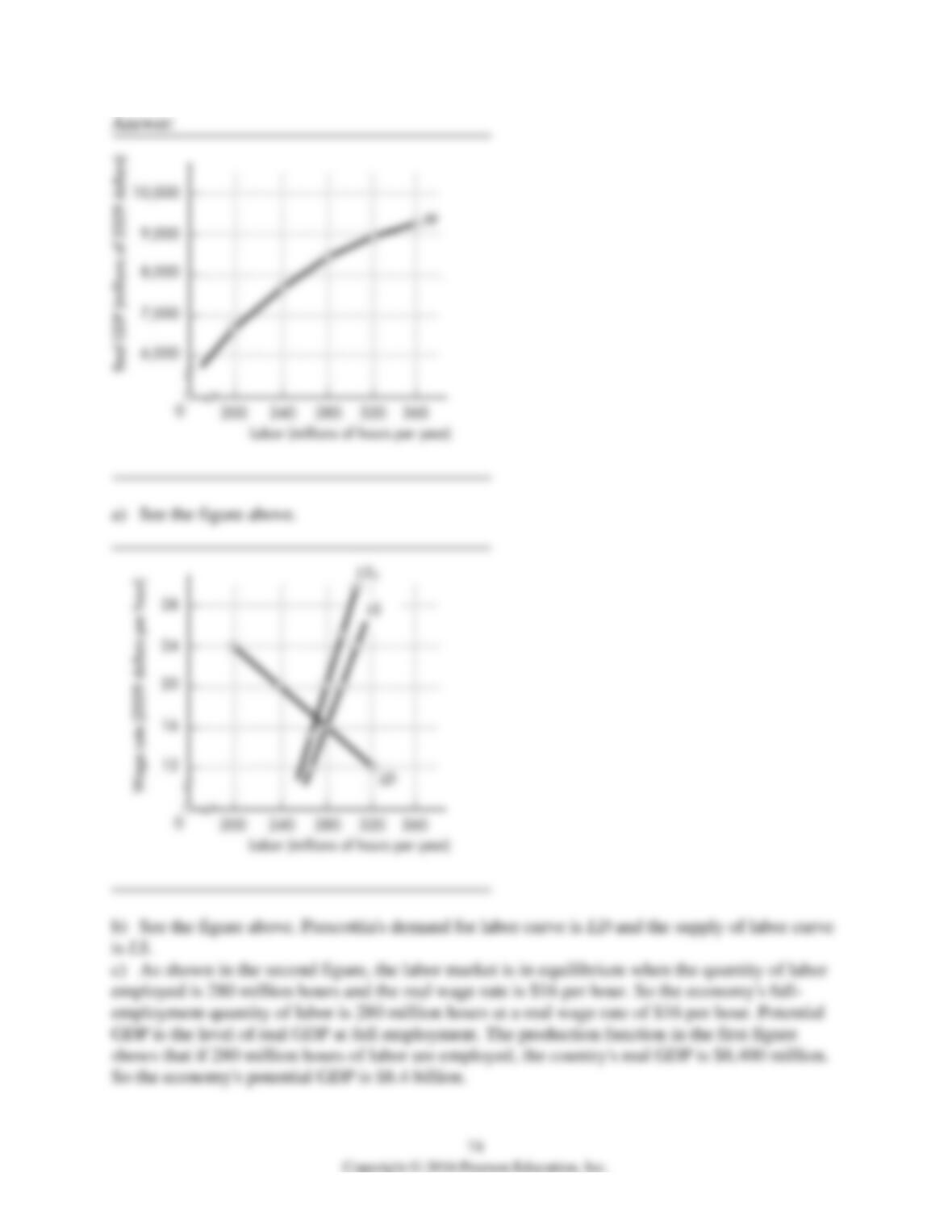
Labor
(millions of hours per
year)
Real GDP
(millions of 2009 dollars)
200
6,800
240
7,680
280
8,400
320
8,960
360
9,360
1) The table above shows the aggregate production function in the economy of Prescottia. The
people of Prescottia pay no taxes and are willing to work 248 million hours a year for a real
wage rate of $8 an hour, and for each dollar increase in the real wage, they are willing to work 4
million additional hours per year.
a) Draw the economy’s aggregate production function.
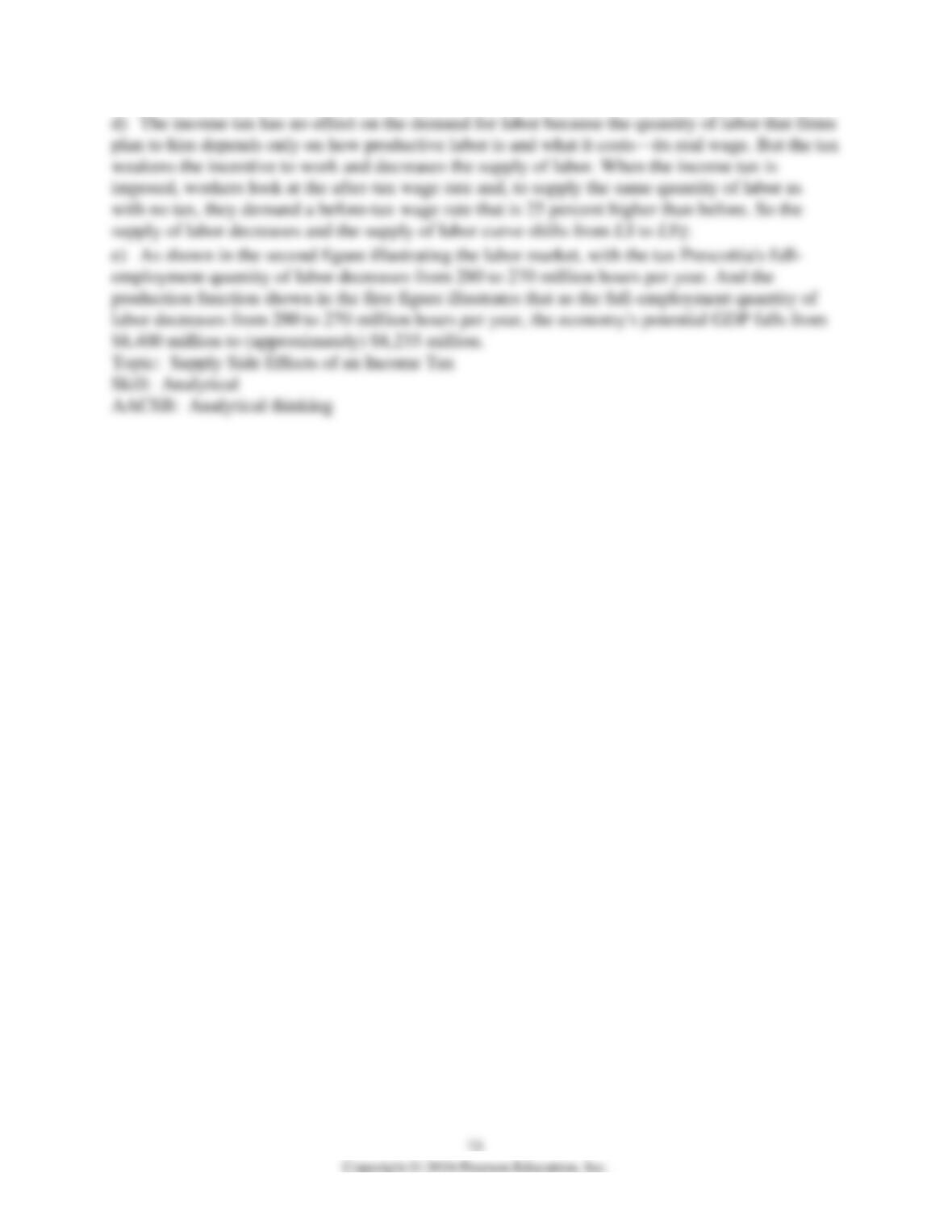
Wage rate
(dollars per hour)
Quantity of labor demanded
(millions of hours per year)
24
200
20
240
16
280
12
320
b) Prescottia’s demand for labor schedule is in the table above. Draw Prescottia’s demand for
labor and supply of labor curves.
c) What are the economy’s full-employment quantity of labor and real wage rate? What is the
country’s potential GDP?
d) Suppose that Prescottia’s government introduces a 25 percent income tax. Using your graph,
what happens to the demand for labor? What happens to the supply of labor? Explain.
e) After the tax is imposed, what happens to Prescottia’s full-employment quantity of labor?
What happens to Prescottia’s potential GDP?