CHAPTER 13—MONOPOLISTIC COMPETITION AND
OLIGOPOLY Key
1. For a firm in monopolistically competitive market equilibrium:
2. In oligopoly equilibrium:
3. A perfectly functioning cartel results in a:
4. A successfully exploited niche market involves elements of:
5. In both monopolistic competition and oligopoly markets:
6. When prices in monopolistically competitive markets exceed those in a perfectly competitive equilibrium,
7. Monopolistic competition always entails:
8. Monopolistic competition is characterized by:
9. In a monopolistically competitive industry, firms:
10. The demand curve faced by a firm in a monopolistically competitive industry is:
11. In long-run equilibrium, the monopolistically competitive firm will set a price equal to:
12. A perfectly functioning cartel leads to a price/output combination identical to an industry that is:
13. An formal agreement to set prices and output is called:
14. The demand faced by an industry price leader is:
15. The industry supply curve is derived through the horizontal summation of firm:
16. The kinked demand curve theory of oligopoly assumes that rival firms:
17. Equilibrium in oligopoly markets is characterized by:
18. A firm should increase advertising if the net marginal revenue derived is:
19. The vigor of competition always decreases with a fall in:
20. The four-firm concentration ratio will rise following:
21. A kinked demand curve results from:
22. A perfectly functioning cartel results in:
23. In monopolistically competitive markets, the firm demand curve is:
24. In oligopoly markets, the market demand curve is:
25. A theory used to explain rigid or “sticky” in oligopoly markets is proposed in the:
26. Competition Concepts. Indicate whether each of the following statements is true or false and why.
A.
A high ratio of distribution cost to total cost tends to increase competition by widening the geographic area over which any individual
producer can compete.
B.
The price elasticity of demand will tend to fall as new competitors introduce substitute products.
C.
Equilibrium in monopolistically competitive markets requires that firms be operating at the minimum point on the long-run average cost
curve.
D.
An increase in product differentiation will tend to decrease the slope of firm demand curves.
E.
A perfectly functioning cartel would achieve the perfectly competitive industry price-output combination.
A.
False. A low ratio of distribution cost to total cost tends to increase competition by widening the geographic area over which any
individual producer can compete.
B.
False. The price elasticity of demand will tend to rise as new competitors introduce substitute products.
D.
False. An increase in product differentiation will tend to increase the slope of individual firm demand curves.
E.
False. A perfectly functioning cartel would achieve the monopoly price-output combination.
27. Pricing Discretion. Would the following factors increase or decrease the ability of domestic manufacturers
to raise prices and profit margins? Why?
A.
Elimination of uniform product safety standards.
B.
Increased import tariffs (taxes).
C.
Increase import quotas.
D.
A rising value of the dollar that has the effect of lowering import prices.
E.
A tax on price advertising.
28. Monopolistic Competition. Soft Lens, Inc., has enjoyed rapid growth in sales and high operating profits on
its innovative extended-wear soft contact lenses. However, the company faces potentially fierce competition
from a host of new competitors as some important basic patents expire during the coming year. Unless the
company is able to thwart such competition, severe downward pressure on prices and profit margins is
anticipated.
A.
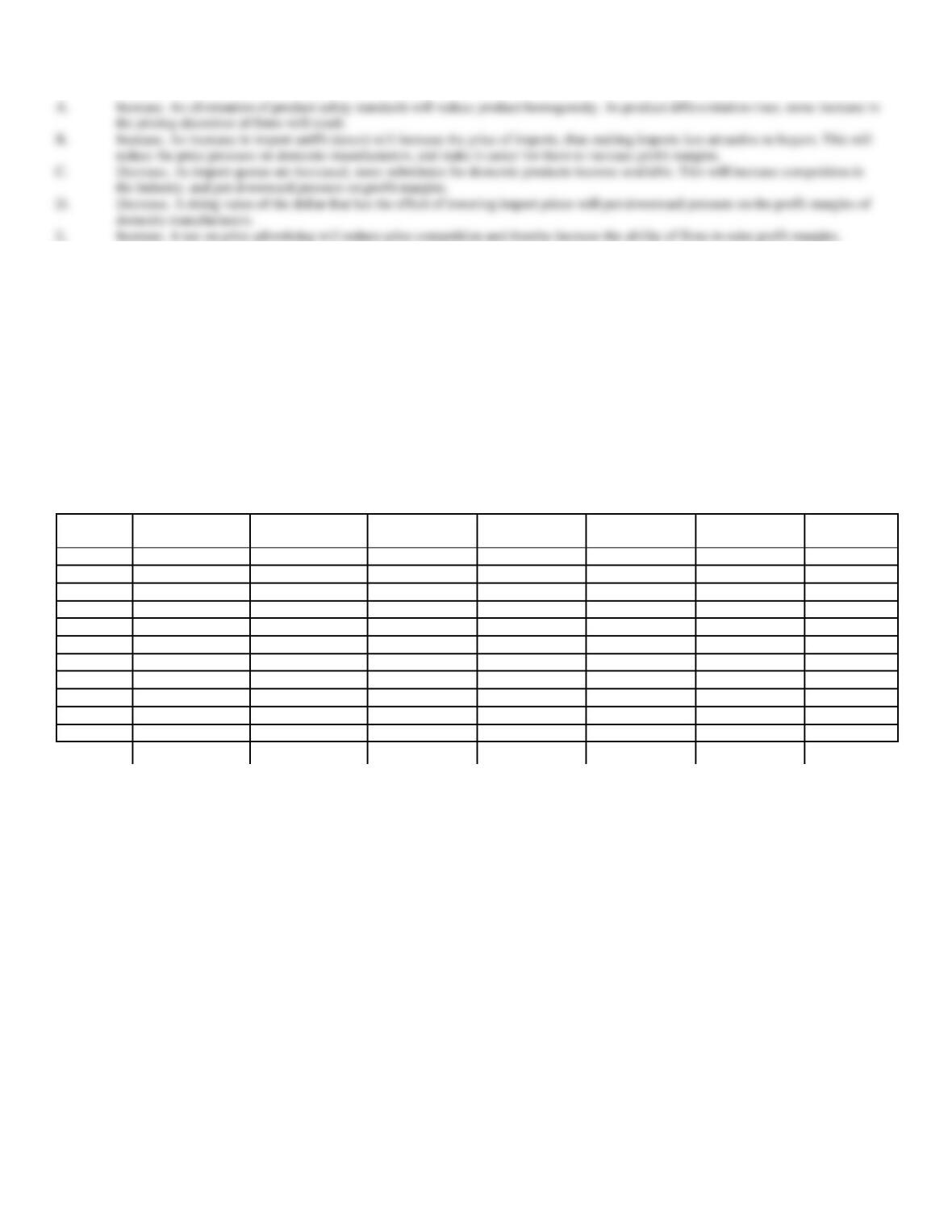
Use Soft Lens’ current price, output, and total cost data to complete the following table:
Price ($)
Monthly Output
(mil.)
Total Revenue
(mil.)
Marginal
Revenue (mil.)
Total Cost (mil.)
Marginal Cost
(mil.)
Average Cost
(mil.)
Total Profit
(mil.)
$20
0
$ 0
19
1
12
18
2
27
17
3
42
16
4
58
15
5
75
14
6
84
13
7
92
12
8
96
11
9
99
10
10
105
(Note: Total costs include a risk-adjusted normal rate of return.)
B.
If cost conditions remain constant, what is the monopolistically competitive high-price/low-output long-run equilibrium in this
industry? What are industry profits?
C.
Under these same cost conditions, what is the monopolistically competitive low-price/high-output equilibrium in this industry? What
are industry profits?
D.
Now assume that Soft Lens is able to enter into restrictive licensing agreements with potential competitors and create an effective cartel
in the industry. If demand and cost conditions remain constant, what is the cartel price/output and profit equilibrium?
A.
B.
Increase. An increase in import tariffs (taxes) will increase the price of imports, thus making imports less attractive to buyers. This will
reduce the price pressure on domestic manufacturers, and make it easier for them to increase profit margins.
C.
Decrease. As import quotas are increased, more substitutes for domestic products become available. This will increase competition in
the industry, and put downward pressure on profit margins.
Decrease. A rising value of the dollar that has the effect of lowering import prices will put downward pressure on the profit margins of
Increase. A tax on price advertising will reduce price competition and thereby increase the ability of firms to raise profit margins.
29. Monopolistic Competition. Merck & Co. markets a product called ZOCOR that treats people who suffer
from high cholesterol and heart disease. ZOCOR works by reducing the amount of cholesterol in your blood.
ZOCOR can dramatically lower LDL (“bad”) responsible for depositing cholesterol in artery walls and elevate
HDL (“good”) cholesterol, which helps return LDL cholesterol to the bloodstream, thus preventing buildup of
cholesterol in the artery walls. Elevated LDL cholesterol is associated with a greater risk of heart disease, and
heart disease is the leading cause of death for people in the United States.
A.
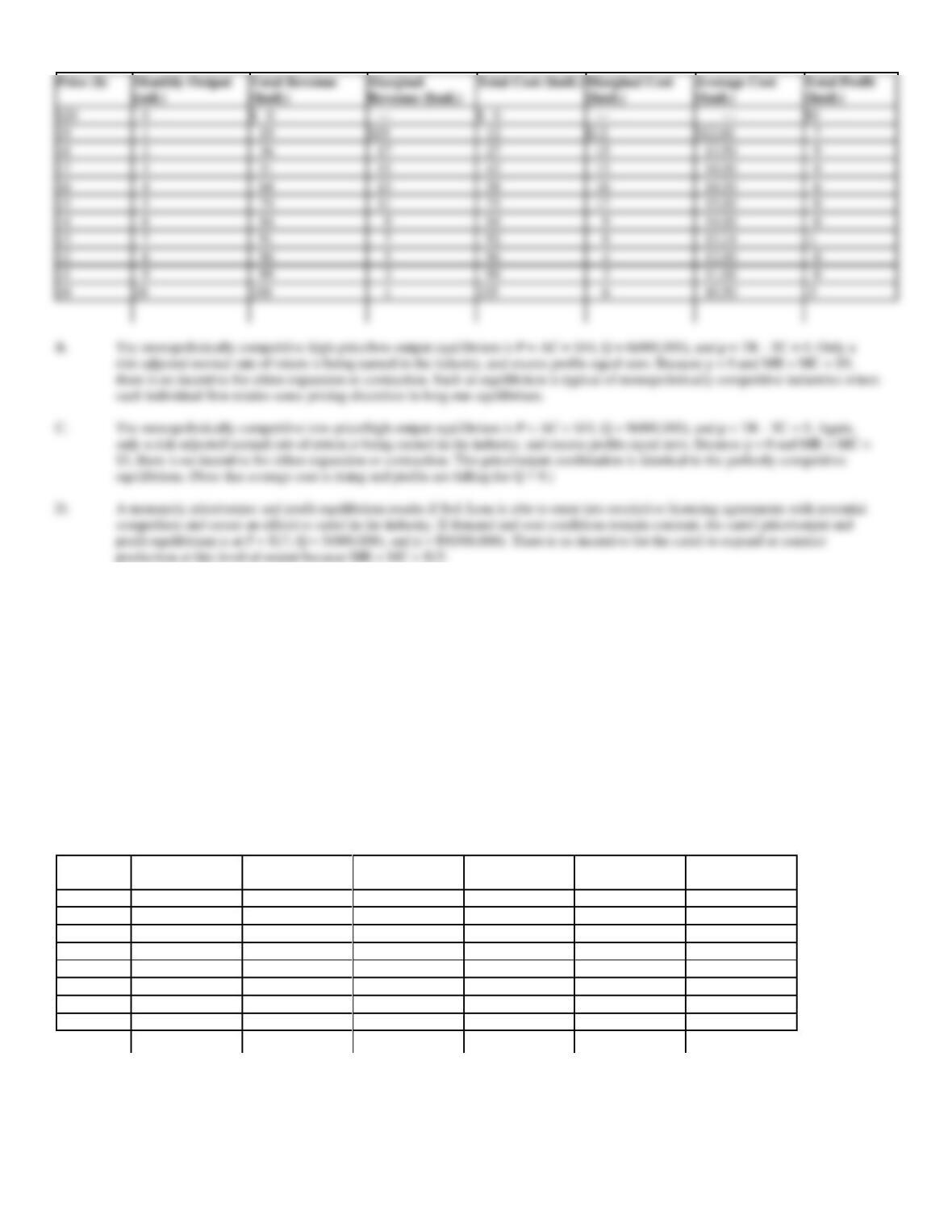
Assume the following table shows relevant information for ZOCOR. Complete the table.
Price per
unit
Output (billion)
Total Revenue
(billion)
Marginal
Revenue (billion)
Total Cost
(billion)
Marginal Cost
(billion)
Average Cost ($)
$30
0
$ 6
28
1
30
26
2
52
24
3
72
22
4
90
20
5
100
18
6
108
16
7
133
B.
Assuming cost conditions remain constant, what is the monopolistically competitive high-price/low-output long-run equilibrium?
C.
What is the monopolistically competitive low-price/high-output equilibrium?
(Note: This is also the perfectly competitive equilibrium.)
0
$ 0
—
$ 0
—
—
$0
19
1
19
$19
12
$12
$12.00
7
18
2
36
17
27
15
13.50
9
17
3
51
15
42
15
14.00
9
16
4
64
13
58
16
14.50
6
15
5
75
11
75
17
15.00
0
14
6
84
9
84
9
14.00
0
13
7
91
7
92
8
13.14
-1
12
8
96
5
96
4
12.00
0
11
9
99
3
99
3
11.00
0
10
10
100
1
105
6
10.50
-5
production at this level of output because MR = MC = $15.
30. Monopolistic Competition. Paintless Dent Removal, Inc., was an early innovator in the noninvasive
removal of dents, dings, and hail damage from cars, trucks and SUVs. Imitation by traditional auto body repair
shops and a host of new rivals is poised to eliminate the company’s early lead.
A.
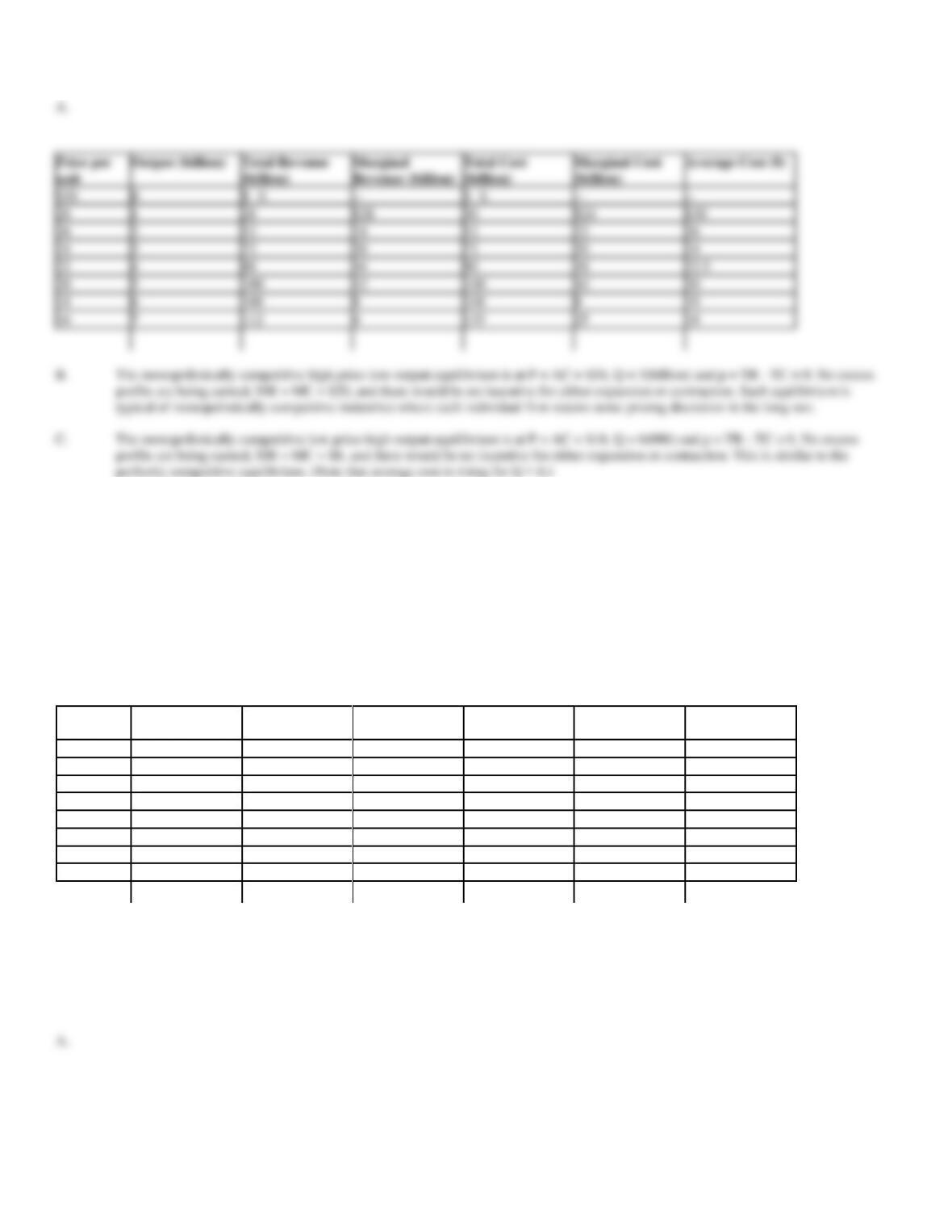
Assume the following table shows relevant information for Paintless Dent Removal. Complete the table.
Price per
unit
Output (000)
Total Revenue
($000)
Marginal
Revenue ($000)
Total Cost ($000)
Marginal Cost
($000)
Average Cost ($)
$625
0
$ 25
600
1
600
575
2
1,150
550
3
1,650
525
4
2,085
500
5
2,500
475
6
2,850
450
7
3,360
B.
Assuming cost conditions remain constant, what is the monopolistically competitive high-price/low-output long-run equilibrium?
C.
What is the monopolistically competitive low-price/high-output equilibrium?
(Note: This is also the perfectly competitive equilibrium.)
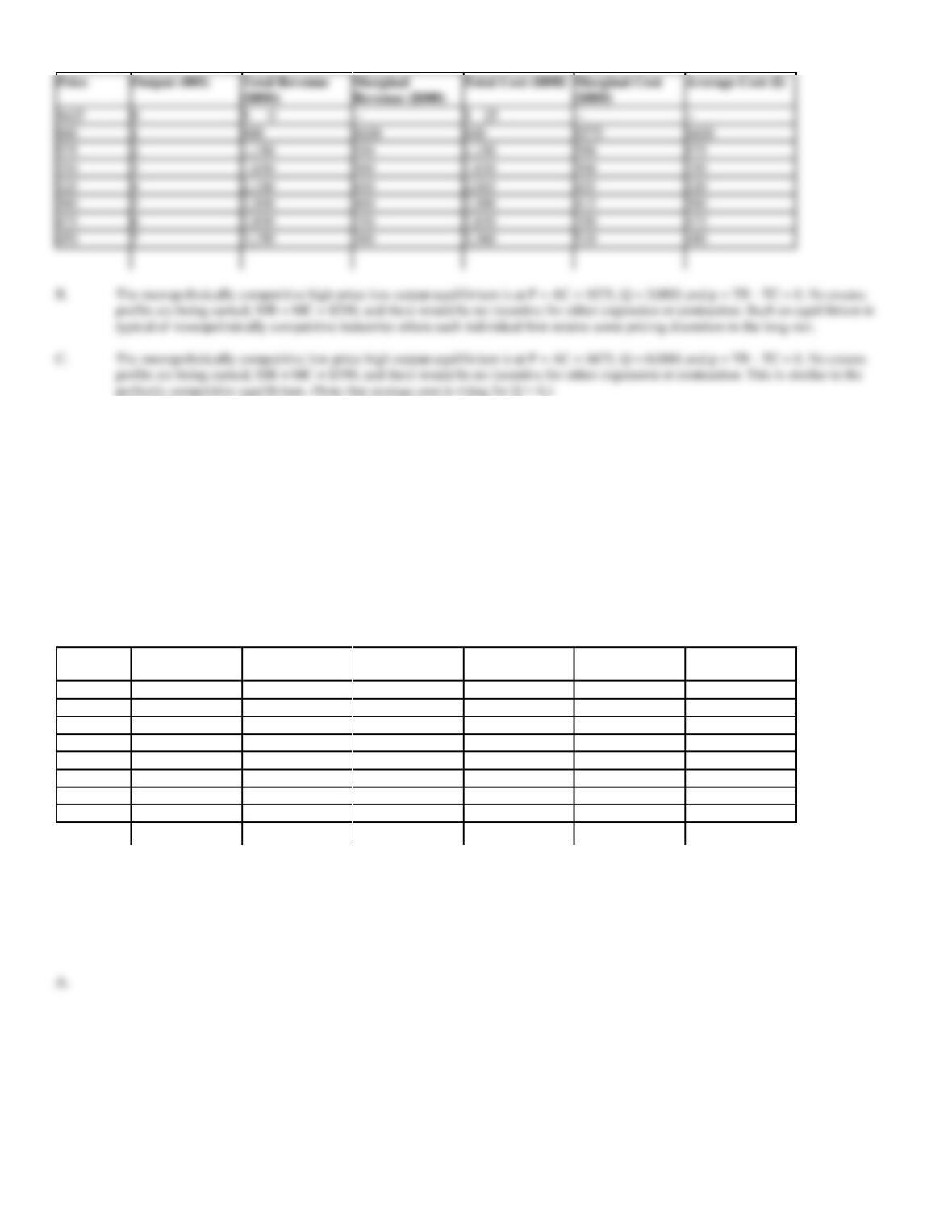
A.
Price per
Output (billion)
Total Revenue
Marginal
Total Cost
Marginal Cost
Average Cost ($)
$30
0
$ 0
—
$ 6
—
—
28
1
28
$28
30
$24
$30
26
2
52
24
52
22
26
24
3
72
20
72
20
24
22
4
88
16
90
18
22.5
20
5
100
12
100
10
20
18
6
108
8
108
8
19
16
7
112
4
133
25
18
31. Monopolistic Competition. Asian Imports, Inc., markets electronic devices imported from Asian
producers. The company recently introduced an innovative and enormously successful 5 GB Joystick (computer
memory device), but a flood of competitor entry and downward pressure on both prices and profits is expected
during the coming year.
A.
Use Asian Imports’ price, output and total cost data to complete the following table:
Price per
unit
Output (000)
Total Revenue
($000)
Marginal
Revenue ($000)
Total Cost ($000)
Marginal Cost
($000)
Average Cost ($)
$50
0
$ 600
48
100
5,000
46
200
9,200
44
300
13,200
42
400
16,700
40
500
20,100
38
600
22,800
36
700
25,200
B.
Assuming cost conditions remain constant, what is the monopolistically competitive high-price/low-output long-run equilibrium?
C.
What is the monopolistically competitive low-price/high-output equilibrium?
(Note: This is also the perfectly competitive equilibrium.)
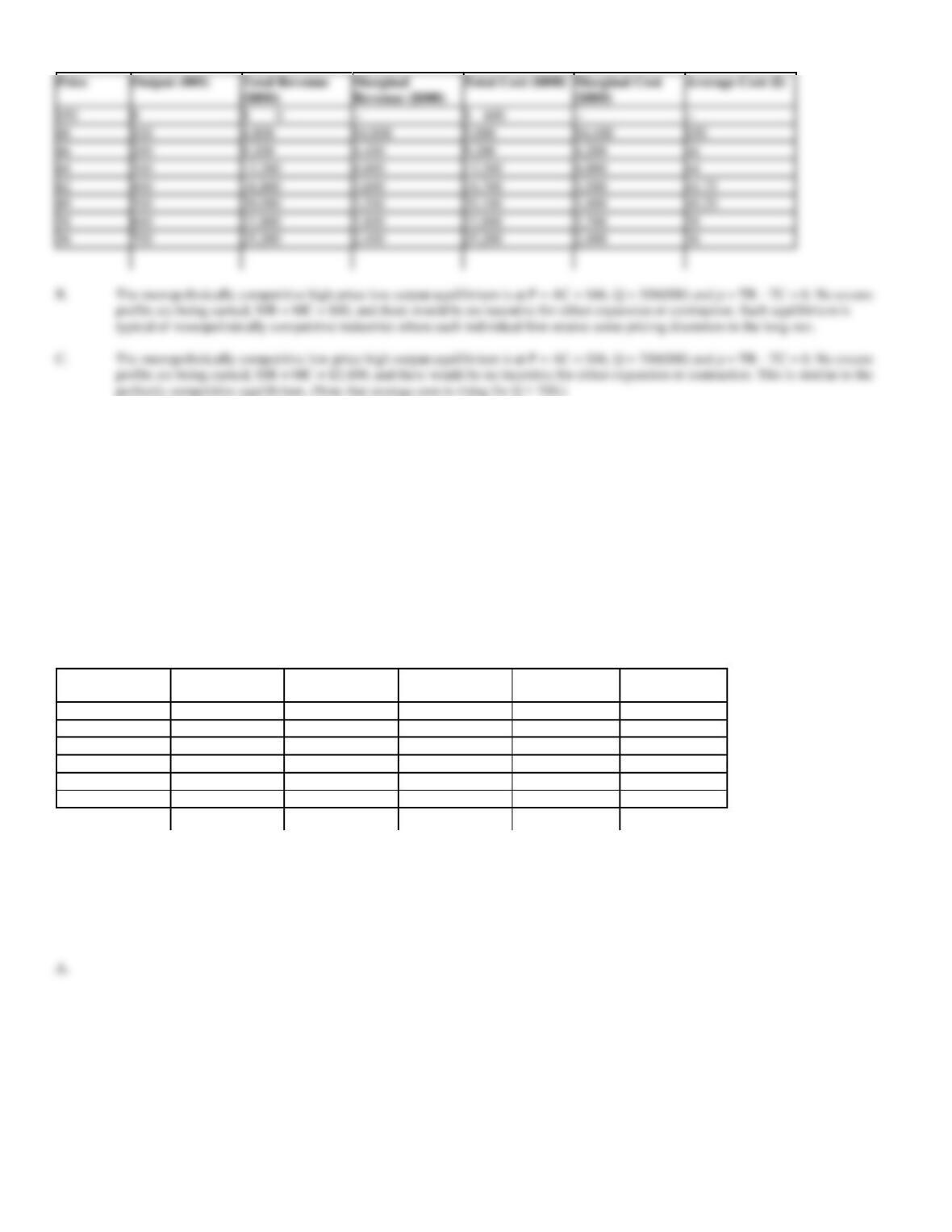
A.
Price
Output (000)
Total Revenue
($000)
Marginal
Revenue ($000)
Total Cost ($000)
Marginal Cost
($000)
Average Cost ($)
$625
0
$ 0
$ 25
600
1
600
$600
600
$575
$600
575
2
1,150
550
1,150
550
575
550
3
1,650
500
1,650
500
550
525
4
2,100
450
2,085
435
520
500
5
2,500
400
2,500
415
500
475
6
2,850
350
2,850
350
475
450
7
3,150
300
3,360
510
480
32. Price/Output Equilibrium. Osteopathic Devices, Inc., makes products used in the surgical replacement of
degenerated bone material. During recent years, its unique hip joint replacement product has successfully
exploited a small but profitable niche in the market. The company’s monopoly position in this market niche is
now threatened by a competitor’s announcement of a new device with capabilities similar to those of the
Osteopathic product.
A.
Complete the following table based on the Osteopathic product’s price, output and costs per month:
Output (00)
Price
Total Revenue
($00)
Marginal Revenue
($00)
Total Cost ($00)
Marginal Cost
($00)
0
$2,500
$2,000
1
2,400
3,000
2
2,300
4,500
3
2,200
6,500
4
2,100
8,400
5
2,000
10,000
B.
While Osteopathic still enjoys a monopoly position, what is their output, price, and profit at the profit-maximizing activity level?
C.
What is the output, price, and profit for this product if a monopolistically competitive equilibrium evolves in this market following the
successful introduction of the competitor’s product? (Assume identical costs conditions for each firm.)
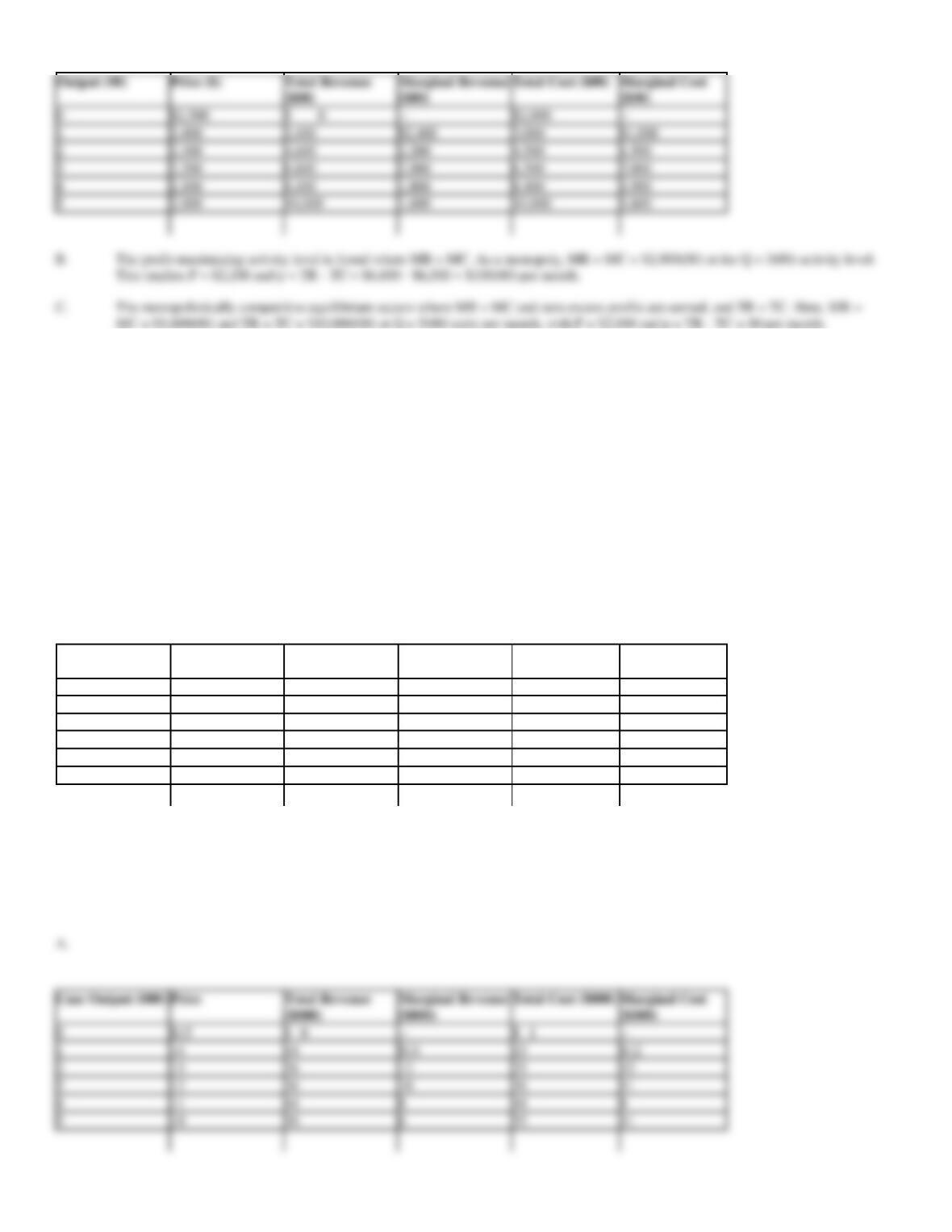
A.
Price
Output (000)
Total Revenue
($000)
Marginal
Revenue ($000)
Total Cost ($000)
Marginal Cost
($000)
Average Cost ($)
0
$ 0
$ 600
4,800
$4,800
5,000
$4,400
9,200
4,400
9,200
4,200
13,200
4,000
13,200
4,000
16,800
3,600
16,700
3,500
41.75
20,000
3,200
20,100
3,400
40.20
22,800
2,800
22,800
2,700
25,200
2,400
25,200
2,400
33. Price/Output Equilibrium. Suppose Target Stores, Inc., sell RainAway, an innovative product with
polymers used to coat the windshields of cars, planes, and boats. RainAway makes windshields and other such
surfaces slick enough for rain to slide off easily. In the case of windshields, RainAway makes it possible to
avoid the use of windshield wiper blades except during the most torrential downpours. During recent years,
RainAway has used its unique windshield coating product to successfully exploited a small but profitable niche
in the market. However, RainAway’s monopoly position in this market niche is now threatened by a
competitor’s announcement of a new product with capabilities similar to those of the RainAway product.
A.
Complete the following table based on the RainAway product’s price, output and costs per year:
Case Output (000)
Price
Total Revenue
($000)
Marginal Revenue
($000)
Total Cost ($000)
Marginal Cost
($000)
0
$15
$ 1
1
14
13
2
13
25
3
12
36
4
11
44
5
10
55
B.
While RainAway still enjoys a monopoly position, what is their output, price, and profit at the profit-maximizing activity level?
C.
What is the output, price, and profit for this product if a monopolistically competitive equilibrium evolves in this market following the
successful introduction of the competitor’s product? (Assume similar cost conditions for each firm.)
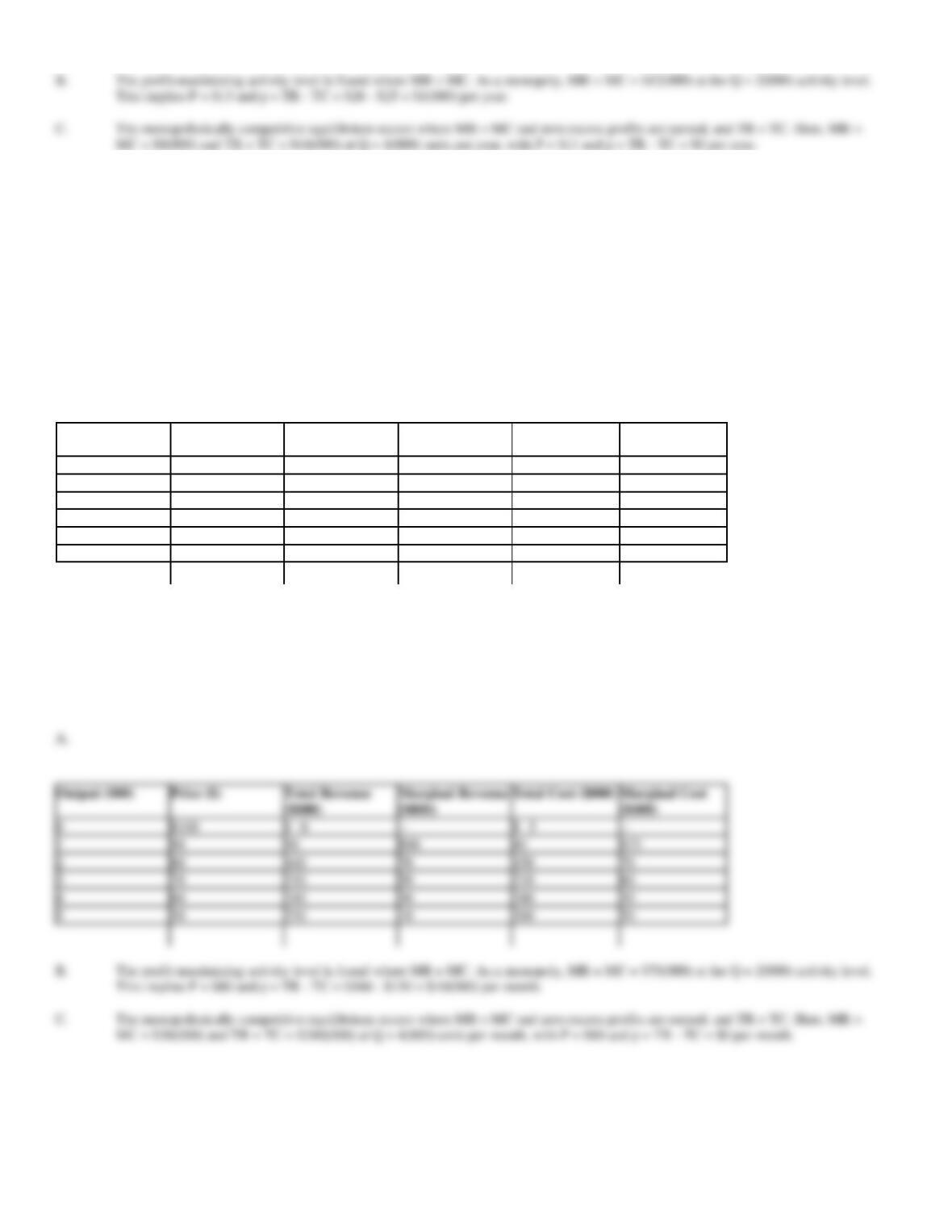
A.
Case Output (000)
Price
Total Revenue
Marginal Revenue
Total Cost ($000)
Marginal Cost
0
$15
$ 0
$ 1
1
14
14
$14
13
$12
2
13
26
12
25
12
3
12
36
10
36
11
0
$2,500
$ 0
$2,000
1
2,400
2,400
$2,400
3,000
$1,000
2
2,300
4,600
2,200
4,500
1,500
3
2,200
6,600
2,000
6,500
2,000
4
2,100
8,400
1,800
8,400
1,900
5
2,000
10,000
1,600
10,000
1,600
C.
The monopolistically competitive equilibrium occurs where MR = MC and zero excess profits are earned, and TR = TC. Here, MR =
MC = $1,600(00) and TR = TC = $10,000(00) at Q = 5(00) units per month, with P = $2,000 and p = TR – TC = $0 per month.
34. Price/Output Equilibrium. Dentists market a variety of tooth whitening products and services to a growing
market of aging baby boomers. Until recently, tooth whitening services provided by dentists were a relatively
small but highly profitable niche in the dental services market. Now, the position of dentists in the tooth
whitening services market is threatened by a host of new product introductions by leading suppliers of
toothpaste and mouth wash products.
A.
Assume the following data shows annual data for tooth whitening services provided by dentists in a typical major metropolitan area.
Output (000)
Price
Total Revenue
($000)
Marginal Revenue
($000)
Total Cost ($000)
Marginal Cost
($000)
0
$100
$ 5
1
90
80
2
80
150
3
70
210
4
60
240
5
50
260
B.
If dentists had an exclusive ability to offer such services, what would be their output, price, and profit at the profit-maximizing activity
level?
C.
What is the output, price, and profit for this product if a monopolistically competitive equilibrium evolves in this market following the
successful introduction of competing products? (Assume similar costs conditions for each firm.)
0
$100
$ 0
$ 5
1
90
90
$90
80
$75
2
80
160
70
150
70
3
70
210
50
210
60
4
60
240
30
240
30
5
50
250
10
260
20
C.
The monopolistically competitive equilibrium occurs where MR = MC and zero excess profits are earned, and TR = TC. Here, MR =
MC = $30(000) and TR = TC = $240(000) at Q = 4(000) units per month, with P = $60 and p = TR – TC = $0 per month.
C.
The monopolistically competitive equilibrium occurs where MR = MC and zero excess profits are earned, and TR = TC. Here, MR =
MC = $8(000) and TR = TC = $44(000) at Q = 4(000) units per year, with P = $11 and p = TR – TC = $0 per year.
35. Price/Output Equilibrium. Sears markets an innovative two-step carpet cleaning process. Because leftover
carpet cleaning solutions can act as a magnet for dirt, Sears exclusive two-step carpet cleaning system includes
a specially formulated pH-balancing fiber rinse that removes carpet cleaning solution residue right along with
deep-down dirt. According to Sear’s, all that’s left behind is cleaner, softer, more beautiful carpet.
A.
Assume the following table shows relevant information for Sear’s two-step carpet cleaning business in a medium-size metropolitan area.
Complete the following table.
Square Yards
Output (000)
Price
Total Revenue
($000)
Marginal Revenue
($000)
Total Cost ($000)
Marginal Cost
($000)
0
$30
$ 0
1
28
26
2
26
48
3
24
68
4
22
88
5
20
100
B.
While Sear’s enjoys a monopoly position, what is their output, price, and profit at the profit-maximizing activity level?
C.
What is the output, price, and profit for this product if a monopolistically competitive equilibrium evolves in this market following the
successful introduction of the competitor services? (Assume similar costs conditions for each firm.)
Output (000)
Price ($)
Total Revenue
($000)
Marginal Revenue
($000)
Total Cost ($000)
Marginal Cost
($000)
0
$30
$ 0
$ 0
1
28
28
$28
26
$26
2
26
52
24
48
22
3
24
72
20
68
20
4
22
88
16
88
20
5
20
100
12
100
12
36. Price/Output Equilibrium. The domestic sewing machine manufacturing industry is highly concentrated
with only three active firms. Annual output and the marginal cost of production for “free arm” models produced
by each company are as follows:
Marginal Cost
Annual Output (million)
Frantic Frasier (F)
Neurotic Niles (N)
Delightful Daphne (D)
1
$1,000
$1,200
$1,500
2
900
1,000
1,200
3
800
800
900
4
700
600
600
5
750
750
700
6
850
900
750
7
950
1,000
800
Competition from low-priced imports has been effectively limited by import tariffs (taxes). Given this import protection, domestic firms are able to
sell as much output as they wish at the current wholesale market price of $750. However, industry prices haven’t risen above $750 because this price
triggers a flood of foreign competition.
A.
Calculate industry output and the market share of each firm based on the assumptions that prices are stable, and therefore that P = MR =
$750, and that MC > AVC.
B.
Calculate industry output and the market share of each firm if removal of import restrictions reduces prices such that P = MR = $600.
Again assume that MC > AVC.
A.
Each industry participant will produce to the point where MR = MC. Given P = MR = $750, each firm will produce such that MC = MR
= $750. A total Q = 16(000,000) units will be produced as follows:
Firm
Output
Market Share
Frasier (F)
5
31.25%
Niles (N)
5
31.25%
Daphne (D)
6
37.50%
Total
16
100.00%
Following a decrease in industry prices to P = MR = $600, industry output will fall to Q = 8(000,000) distributed as follows:
Firm
Output
Market Share
Frasier (F)
0
0%
Niles (N)
4
50%
Daphne (D)
4
50%
Total
8
100%
Note that Frasier, with a minimum MC = $700, will be unable to justify production when P = MR = $600 and therefore will withdraw
from the industry.
37. Cartel Pricing. The optical fiber manufacturing industry is highly concentrated with only three active firms.
Annual output and the marginal cost of production for each company are as follows:
Marginal Cost
Annual Output (million)
Corning (C)
Fibercore (F)
INO (I)
1
$2,300
$2,400
$2,500
2
2,200
2,150
2,300
3
2,050
1,950
2,100
4
1,800
1,800
1,900
5
1,900
2,000
2,000
6
2,000
2,100
2,150
7
2,220
2,300
2,250
Competition from lower-priced imports has been effectively limited by import tariffs (taxes). Given this import protection, domestic firms are able to
sell as much output as they wish at the current wholesale market price of $2,000. However, industry prices haven’t risen above $2,000 because this
price triggers a flood of foreign competition.
A.
Calculate industry output and the market share of each firm based on the assumptions that prices are stable, and therefore that P = MR =
$2,000, and that MC > AVC.
B.
Calculate industry output and the market share of each firm if removal of import restrictions reduces prices such that P = MR = $1,800.
Again assume that MC > AVC.
A.
Each industry participant will produce to the point where MR = MC. Given P = MR = $2,000, each firm will produce such that MC =
MR = $2,000. A total Q = 16(000,000) units will be produced as follows:
Firm
Output
Market Share
Corning (C)
6
37.50%
Fibercore (F)
5
31.25%
INO (I)
5
31.25%
Total
100.00%
Following a decrease in industry prices to P = MR = $1,800, industry output will fall to Q = 8(000,000) distributed as follows:
Firm
Output
Market Share
Corning (C)
4
50%
Fibercore (F)
4
50%
INO (I)
0
Total
8
100%
Note that INO with a minimum MC = $1,900 will be unable to justify production when P = MR = $1,800 and therefore will withdraw
from the industry.
38. Cartel Pricing. The domestic color separator manufacturing industry is highly concentrated with only three
active firms. Color separators are used in the production of high-quality images used to produce glossy color,
pamphlets, newspapers, etc. Annual output and the marginal cost of production for production grade models
produced by each company are as follows:
Marginal Cost
Annual Output (thousand)
Houston Graphics (H)
Rapid Color (R)
Color Purple (C)
1
$70,000
$60,000
$80,000
2
50,000
40,000
50,000
3
35,000
20,000
20,000
4
45,000
30,000
35,000
5
55,000
35,000
50,000
6
65,000
55,000
65,000
7
75,000
65,000
75,000
Competition from low-priced imports has been effectively limited by import tariffs (taxes). Given this import protection, domestic firms are able to
sell as much output as they wish at the current wholesale market price of $35,000. However, industry prices haven’t risen above $35,000 because this
price triggers a flood of foreign competition.
A.
Calculate industry output and the market share of each firm based on the assumptions that prices are stable, and therefore that P = MR =
$35,000, and that MC > AVC.
B.
Calculate industry output and the market share of each firm if removal of import restrictions reduces prices such as P = MR = $20,000.
Again assume that MC > AVC.
A.
Each industry participant will produce to the point where MR = MC. Given P = MR = $35,000, each firm will produce such that MC =
MR = $35,000. A total Q = 12(000) units will be produced as follows:
Firm
Output
Market Share
Houston Graphics (H)
3
25.00%
Rapid Color (R)
5
41.67%
Color Purple (C)
4
33.33%
Total
100%
Following a decrease in industry prices to P = MR = $20,000, industry output will fall to Q = 6(000) distributed as follows:
Firm
Output
Market Share
Houston Graphics (H)
0
Rapid Color (R)
3
50%
Color Purple (C)
3
50%
Total
6
100%
Note that Houston Graphics, with a minimum MC = $35,000 is unable to justify production when P = MR = $20,000 and therefore will
withdraw from the industry.
39. Cartel Pricing. The highway asphalt resurfacing business in upstate New York is highly concentrated with
only three active firms. Weekly output and the marginal cost of asphalt resurfacing services by each company
are as follows:
Marginal Cost
Output
(miles per week)
Pataki Construction
Hillary & Co.
Cuomo-Sumo, Inc.
1
$230,000
$230,000
$260,000
2
210,000
210,000
240,000
3
190,000
195,000
220,000
4
200,000
180,000
205,000
5
215,000
200,000
180,000
6
230,000
215,000
200,000
7
245,000
225,000
220,000
Competition from low-priced out-of-state competitors has been effectively limited by licensing requirements. Given this protection, local firms are
able to sell as much output as they wish at the current wholesale market price of $200,000. However, industry prices haven’t risen above $200,000
because this price triggers a flood of out-of-state competition.
A.
Calculate industry output and the market share of each firm based on the assumptions that prices are stable, and therefore that P = MR =
$200,000, and that MC > AVC.
B.
Calculate industry output and the market share of each firm if removal of import restrictions reduces prices such as P = MR = $180,000.
Again assume that MC > AVC.
A.
Each industry participant will produce to the point where MR = MC. Given P = MR = $200,000, each firm will produce such that MC =
MR = $200,000. A total Q = 15 units will be produced as follows:
Firm
Output
Market Share
Pataki Construction
4
26.67%
Hillary & Co.
5
33.33%
Cuomo-Sumo, Inc.
6
40.00%
Total
100.00%
Following a decrease in industry prices to P = MR = $180,000, industry output will fall to Q = 9 distributed as follows:
Firm
Output
Market Share
Pataki Construction
0
Hillary & Co.
4
44%
Cuomo-Sumo, Inc.
5
56%
Note that Pataki Construction, with a minimum MC = $190,000 will be unable to justify production when P = MR = $180,000 and
therefore will withdraw from the industry.
40. Cartel Pricing. An illegal cartel has been formed by three leading residential sanitation (trash pick-up)
service companies in Honolulu, Hawaii. Total production costs at various levels of service per month are as
follows:
Total Cost ($000)
Pick-ups per Month (000)
Aloha Pick-up Ltd.
Beta Service, Inc.
Delta Sanitation, Inc.
0
$ 2
$ 4
$ 0
1
7
10
2
2
11
14
5
3
14
17
9
4
16
22
14
5
25
30
20
A.
Construct a table showing the marginal cost of production per firm.
B.
From the data in part A, determine an optimal allocation of output and maximum profits if the cartel sets Q = 10(000) and P = $6.
C.
Is there an incentive for individual members to cheat by expanding output when the cartel sets Q = 10(000) and P = $6?
A.
Marginal Cost ($000)
Pick-ups per Month (000)
Aloha Pick-up Ltd.
Beta Service, Inc.
Delta Sanitation, Inc.
0
1
2
4
4
3
3
3
3
4
4
2
5
5
5
9
8
6
Aloha
4
40%
Beta
3
30%
Delta
3
30%
Total
10
100%
Profits
= TR – TCA – TCB – TCD
= $6(10) – $16 – $17 – $9
= $18(000) per month