9) On January 1, 2013 the income tax rate for single taxpayers making more than $400,000 per
year increased from 35 percent to 39.6 percent. This tax rise has ________ potential GDP.
A) increased
B) not changed
C) decreased
D) None of the above answers are correct because the tax rise could have increased, decreased,
or not changed potential GDP.
10) The difference between the before-tax and after-tax rates is referred to as the
A) tax plug.
B) deadweight gain.
C) tax wedge.
D) taxation penalty.
11) In January 2013 the Social Security payroll tax increased by 2 percentage points. This rise in
the Social Security payroll tax ________ the U.S tax wedge.
A) decreased
B) did not change
C) increased
D) More information about the total amount of the tax is needed to determine the impact on the
tax wedge.
12) If we compare the United States to France, the U.S. tax wedge is ________ the French tax
wedge.
A) larger than
B) equals to
C) smaller than
D) not comparable to
13) If we compare the United States to France, we see that potential GDP per person in France is
________ than that in the United States because the French tax wedge is ________ than the U.S.
tax wedge.
A) greater; larger
B) greater; smaller
C) less; larger
D) less; smaller
14) An increase in taxes on interest income ________ supply of loanable funds curve and
________ the demand for loanable funds curve.
A) shifts; does not shift
B) does not shift; shifts
C) does not shift; does not shift
D) shifts; shifts
15) The supply side effects of a cut in tax rates include ________ in the supply of labor and
________ in the supply of loanable funds.
A) an increase; an increase
B) an increase; a decrease
C) a decrease; an increase
D) a decrease; a decrease
16) When interest income is taxed and the inflation rate rises, the tax revenue collected by the
government
A) increases.
B) doesn’t change.
C) decreases.
D) could either increase or decrease.
17) Suppose that the tax rate on interest income is 50 percent, the real interest rate is 3 percent,
and the inflation rate is 4 percent. In this case, the real after-tax interest rate is equal to
A) -0.5 percent.
B) 3.5 percent.
C) 3.0 percent.
D) 4.0 percent.
18) Suppose that the tax rate on interest income is 25 percent, the real interest rate is 4 percent,
and the inflation rate is 4 percent. In this case, the real after-tax interest rate is equal to
A) .5 percent.
B) 3.5 percent.
C) 4.0 percent.
D) 2.0 percent.
19) The Laffer curve is the relationship between
A) government purchases and potential GDP.
B) tax rates and potential GDP.
C) tax revenue and potential GDP.
D) tax rates and tax revenue.
20) During the Reagan administration in the 1980s, tax rates were ________ and the budget
deficit ________.
A) raised; increased
B) raised; decreased
C) cut; increased
D) cut; decreased
21) According to the Laffer curve, raising the tax rate
A) always increases the amount of tax revenue.
B) always decreases the amount of tax revenue.
C) does not change the amount of tax revenue.
D) might increase, decrease, or not change the amount of tax revenue.
22) The Laffer curve shows that increasing ________ increases ________ when ________ low.
A) tax revenue; potential GDP; tax revenue is
B) tax rates; tax revenue; tax rates are
C) potential GDP; tax revenue; tax revenue is
D) None of the above answers is correct.
23) According to the Laffer Curve, when tax rates are low, there is ________relationship
between them and tax revenue.
A) a positive
B) a negative
C) sometimes a positive, sometimes a negative
D) an indeterminate
24) According to the Laffer Curve, the amount of tax revenue _______when tax rates are
________ and tax rates are ________.
A) increases,; low; increased
B) increases; high; increased
C) decreases; low; increased
D) decreases; high; decreased
25) A decrease in the income tax rate
A) decreases potential GDP.
B) increases the supply of labor.
C) increases the tax wedge.
D) decreases the demand for labor.
26) An increase in the income tax rate ________ employment and ________ potential GDP.
A) increases; increases
B) increases; decreases
C) decreases; increases
D) decreases; decreases
27) An increase in the tax on interest income ________ the supply of loanable funds and
________ the equilibrium investment.
A) increases; increases
B) increases; decreases
C) decreases; increases
D) decreases; decreases
1) The system that measures the lifetime tax burden and benefits of each generation is called
A) actuarial genealogy.
B) generational actuary.
C) generational accounting.
D) actuarial accounting.
2) Generational accounting does NOT investigate issues involving
A) the budget deficit.
B) government obligations such as Social Security.
C) the ownership of corporate stock.
D) the burden of taxes.
3) The ________ the interest rate, the ________ the present value of a given future amount.
A) higher; larger
B) lower; smaller
C) lower; larger
D) indeterminate from the information given
4) If $1,000 is invested at 3 percent per year for 10 years, the investment grows to $1,343.92.
This means that the present value of $1,343.92 at an interest rate of 3 percent 10 years from now
is
A) 3 percent.
B) $1,000.
C) $343.92.
D) $1,343.92.
5) The present value of the government’s commitments to pay benefits minus the present value of
its tax revenues is called
A) calculated fiscal obligations.
B) fiscal imbalance.
C) fiscal balance.
D) fiscal obligations.
6) The largest component of the fiscal imbalance is
A) Social Security.
B) Medicare.
C) defense spending.
D) none of the above.
7) Splitting the fiscal imbalance between the current generation and future generations is called
A) genealogical accounting.
B) actuarial accounting.
C) generational imbalance.
D) actuarial balance.
8) Comparing the fiscal imbalance for the current generation versus future generations, it is the
case that
A) future generations pay a larger share of the fiscal imbalance.
B) the current generation pays a larger share of the fiscal imbalance.
C) each generation pays half of the fiscal imbalance.
D) each generation pays all of its fiscal imbalance.
9) To eliminate the fiscal imbalance the government could
A) lower benefits and lower tax rates.
B) increase benefits and increase tax rates.
C) lower benefits and increase tax rates.
D) increase benefits and lower tax rates
10) In order for the United States to repay its international debt, the United States would need to
A) have a current account deficit.
B) cut taxes.
C) have a surplus of imports over exports.
D) have a surplus of exports over imports.
11) In order for the United States to have a surplus of exports over imports to repay its
international debt, the United States would need to
A) increase consumption and decrease saving.
B) increase consumption and increase saving.
C) decrease consumption and decrease saving.
D) decrease consumption and increase saving.
12) In January 2013 the Chinese government held approximately $1 trillion in U.S. government
debt. The Chinese government accumulated such a large about of the U.S. government debt
because for the past decade, the United States
A) government made substantial foreign aid available to the Chinese government.
B) has grown more rapidly than has the Chinese economy.
C) has exported more to China than it has imported from China.
D) has imported more from China than it has exported to China.
13) Generational accounting shows that the present value of the government’s commitments to
pay benefits are ________ the present value of its taxes.
A) greater than
B) less than
C) equal to
D) not comparable to
4 Fiscal Stimulus
1) Taxes and government expenditures that change in response to changes in the level of
economic activity, without need for additional government action, are examples of
A) discretionary fiscal variables.
B) automatic fiscal policy.
C) built-in monetary stabilizers.
D) cyclically balanced budgets.
2) One characteristic of automatic fiscal policy is that it
A) requires no legislative action by Congress to be made effective.
B) automatically produces surpluses during recessions and deficits during inflation.
C) has no effect on unemployment.
D) reduces the size of the federal government debt during times of recession.
3) A fiscal action that is triggered by the state of the economy is called
A) the government expenditure multiplier.
B) discretionary fiscal policy.
C) automatic fiscal policy.
D) generational fiscal policy.
4) A discretionary fiscal policy is a fiscal policy that
A) involves a change in government defense spending.
B) is triggered by the state of the economy.
C) requires action by the Congress.
D) involves a change in corporate tax rates.
5) A fiscal action that is initiated by an act of Congress is called
A) the government expenditure multiplier.
B) discretionary fiscal policy.
C) automatic fiscal policy.
D) generational fiscal policy.
6) Deliberate changes in government expenditures and taxes to influence GDP
A) are examples of automatic fiscal policy because the politicians automatically respond.
B) are forms of discretionary fiscal policy.
C) are enacted by the Council of Economic Advisers.
D) operate without time lags.
7) The stimulus package passed by Congress in 2009 to combat the recession is an example of
A) automatic fiscal policy.
B) discretionary fiscal policy.
C) monetary policy.
D) increased taxation.
8) The difference between automatic fiscal policy and discretionary fiscal policy is that
A) Congress initiates automatic fiscal policy.
B) the President has nothing to do with discretionary fiscal policy.
C) Congress must pass laws implementing discretionary fiscal policy.
D) the President initiates discretionary fiscal policy.
9) When the economy is hit by spending fluctuations, the government can try to minimize the
effects by
A) changing government expenditures on goods.
B) changing taxes.
C) changing government expenditures on services.
D) all of the above
10) An example of a discretionary fiscal policy is when
A) tax receipts fall as incomes fall.
B) unemployment compensation payments rise with unemployment rates.
C) food stamp payments rise when the economy is in a recession.
D) Congress passes a law that raises marginal tax rates.
11) An increase in tax rates as a result of a new tax law passed by Congress is an example of
________.
A) discretionary fiscal policy
B) increasing the government debt
C) increasing the government deficit
D) needs-tested taxing change.
12) The tax rebates passed by Congress in 2008 to help move the economy more rapidly toward
potential GDP are an example of
A) automatic fiscal policy.
B) discretionary fiscal policy.
C) non-needs spending.
D) contractionary fiscal policy.
13) Unemployment insurance are payments made to unemployed workers. Typically workers are
paid for no more than 26 weeks. In December 2012, the federal government passed legislation
that would extend the payments to a maximum of 73 weeks. This extension is an example of
A) automatic fiscal policy.
B) discretionary fiscal policy.
C) non-needs spending.
D) contractionary fiscal policy.
14) Tax revenues
A) are autonomous.
B) are independent of real GDP.
C) vary with real GDP.
D) are fixed over time.
15) A fall in income that results in a decrease in tax revenues is an example of ________.
A) automatic fiscal policy
B) needs-tested tax programs
C) a recession
D) discretionary fiscal policy
16) When the economy grows, ________ increase because real GDP ________.
A) tax revenues; decreases
B) tax revenues; increases
C) structural deficits; decreases
D) recognition lags; increases
17) Income taxes in the United States are part of automatic fiscal policy because
A) tax revenues increase when income increases, thus offsetting some of the increase in
aggregate demand.
B) tax revenues decrease when income increases, intensifying the increase in aggregate demand.
C) the President can increase tax rates whenever the President deems such a policy appropriate.
D) tax rates can be adjusted by the Congress to counteract economic fluctuations.
18) An example of automatic fiscal policy is when
A) tax revenues decrease as real GDP decreases.
B) Congress passes a law that raises tax rates.
C) Congress decides to cut government expenditure.
D) the president drafts a bill to reduce defense spending.
19) Tax revenues ________ during recessions and ________ during expansions.
A) decrease; decrease
B) decrease; increase
C) increase; expansions
D) increase; increase
20) Spending on programs that result in transfer payments that depend on the economic state of
individuals and businesses is called ________.
A) transfer spending
B) welfare
C) needs-tested spending
D) business subsidies
21) Needs-tested spending ________ during recessions and ________ during expansions.
A) decreases; decreases
B) decreases; increases
C) increases; decreases
D) increases; increases
22) If the economy falls into a recession, which of the following responses constitutes the use of
automatic fiscal policy?
A) an income tax cut voted on by Congress and quickly signed by the President
B) an existing system to make government payments to the growing ranks of unemployed
workers
C) a new program to fund local governments’ hiring of 100,000 street sweepers within a year
D) All of the above answers are correct.
23) Automatic fiscal policy occurs
A) because monetary policy is effective.
B) because tax revenues and transfer payments fluctuate with real GDP.
C) because government expenditures on goods and services fluctuate with real GDP.
D) when the Congress makes changes to transfer payment programs.
24) Automatic fiscal policy is at work if, as real GDP increases, ________.
A) transfer payments decrease and interest rates decrease
B) transfer payments increase and tax revenues decrease
C) tax revenues increase and transfer payments decrease
D) tax revenues decrease and interest rates increase
25) Because of automatic fiscal policy, when real GDP decreases
A) government expenditures decrease and tax revenues increase.
B) government expenditures increase and tax revenues decrease.
C) government expenditures equal tax revenues.
D) the economy will automatically go to full employment.
26) Government transfer payments ________ during expansions and ________ during
recessions.
A) increase; increase
B) increase; decrease
C) decrease; increase
D) decrease; decrease
27) During an expansion, tax revenues ________, while during a recession, tax revenues
________.
A) decrease; increase
B) increase; decrease
C) remain stable; decrease
D) fail to cover expenditures; fail to match transfer payments
28) During an expansion, tax revenues ________ and government transfer payments ________.
A) increase; increase
B) increase; decrease
C) decrease; increase
D) decrease; decrease
29) The government budget deficit tends to decrease during the expansion phase of a business
cycle because tax revenues ________ and government transfer payments ________.
A) increase; increase
B) increase; decrease
C) decrease; increase
D) decrease; decrease
30) The structural deficit or surplus is the
A) difference between actual government outlays and actual government receipts.
B) change in national debt that will result from current budgetary policies.
C) government budget deficit or surplus that would occur if the economy were at potential GDP.
D) actual government budget deficit or surplus minus expenditures for capital improvements.
31) The structural deficit is the deficit
A) during a recession.
B) during an expansion.
C) that would occur at full employment.
D) caused by the business cycle.
32) The structural deficit is the deficit that occurs when
A) real GDP departs from potential GDP.
B) real GDP equals potential GDP.
C) aggregate demand is greater than short-run aggregate supply.
D) short-run aggregate supply is greater than aggregate demand.
33) The structural surplus
A) equals the actual surplus plus the cyclical surplus.
B) is the government budget surplus that would exist if the economy was at potential GDP.
C) is, by definition, equal to the negative of the cyclical deficit.
D) is legally required to be positive.
34) A structural deficit occurs when the government budget has a deficit
A) even though real GDP is less than potential GDP.
B) even though real GDP is greater than structural GDP.
C) even though real GDP is equal to potential GDP.
D) that is nominal, as opposed to a real budget deficit.
35) The structural deficit is that deficit that would exist
A) with the taxes and outlays that would occur if the economy was at the equilibrium level of
real GDP.
B) with the taxes and outlays that would occur if the economy was at the full employment level
of real GDP.
C) if tax rates were set to maximize tax revenues.
D) if there were no discretionary fiscal interventions into the economy.
36) At the start of 2013, the U.S. government predicted that economic growth would rise by
2016 and that the government’s deficit would also increase. The government therefore was
predicting that in 2016 the cyclical deficit would ________ and the structural deficit would
________.
A) increase; increase
B) decrease; increase
C) increase; decrease
D) decrease; decrease
37) The cyclical deficit is the portion of the deficit
A) created by fluctuations in real GDP.
B) that is the result of nondiscretionary federal spending.
C) that would exist if the economy were at potential real GDP.
D) the result of discretionary federal spending.
38) A cyclical surplus is a
A) budget surplus only because real GDP is less than potential GDP.
B) budget surplus only because real GDP is greater than potential GDP.
C) budget surplus only because real GDP is equal to potential GDP.
D) nominal, as opposed to real, budget surplus.
39) In early 2013, economists predicted that the U.S. economy would grow more rapidly than
had been predicted. If this prediction comes true, then the structural deficit will ________ than
had been predicted.
A) shrink more rapidly
B) shrink more slowly
C) increase more slowly
D) None of the above are correct because the growth of the economy does not affect the size of
the structural deficit.
40) In early 2013, economists predicted that the U.S. economy would grow more rapidly than
had been predicted. If this prediction comes true, then the cyclical deficit will ________ than had
been predicted.
A) shrink more rapidly
B) shrink more slowly
C) increase more slowly
D) None of the above are correct because the growth of the economy does not affect the size of
the cyclical deficit.
41) Which of the following relationships is CORRECT?
A) actual budget deficit = structural deficit – cyclical deficit
B) cyclical surplus = actual budget deficit – cyclical deficit
C) actual budget deficit = structural deficit + cyclical deficit
D) cyclical deficit = actual budget deficit + structural deficit
42) When an economy is above full employment and the government has a budget deficit, that
deficit ________.
A) exceeds the structural deficit
B) is equal to the structural deficit minus the cyclical deficit
C) is equal to the cyclical deficit minus the structural deficit
D) is less than the structural deficit
43) The actual budget deficit is equal to the
A) structural deficit.
B) cyclical deficit.
C) structural deficit minus the cyclical deficit.
D) structural deficit plus the cyclical deficit.
44) If the budget deficit is $50 billion and the structural deficit is $10 billion, the cyclical deficit
is
A) $10 billion.
B) $40 billion.
C) $60 billion.
D) $50 billion
45) If the economy has a structural deficit of $25 billion and a cyclical deficit of $75, we can
conclude that the current budget deficit is ________ billion.
A) $25
B) $50
C) $75
D) $100
46) In December 2012 the structural deficit was estimated to be $325 billion and the cyclical
deficit was estimated to be $700 billion. That means that the actual budget deficit equaled
________ billion.
A) $1,025
B) $375
C) $700
D) None of the above answers are correct.
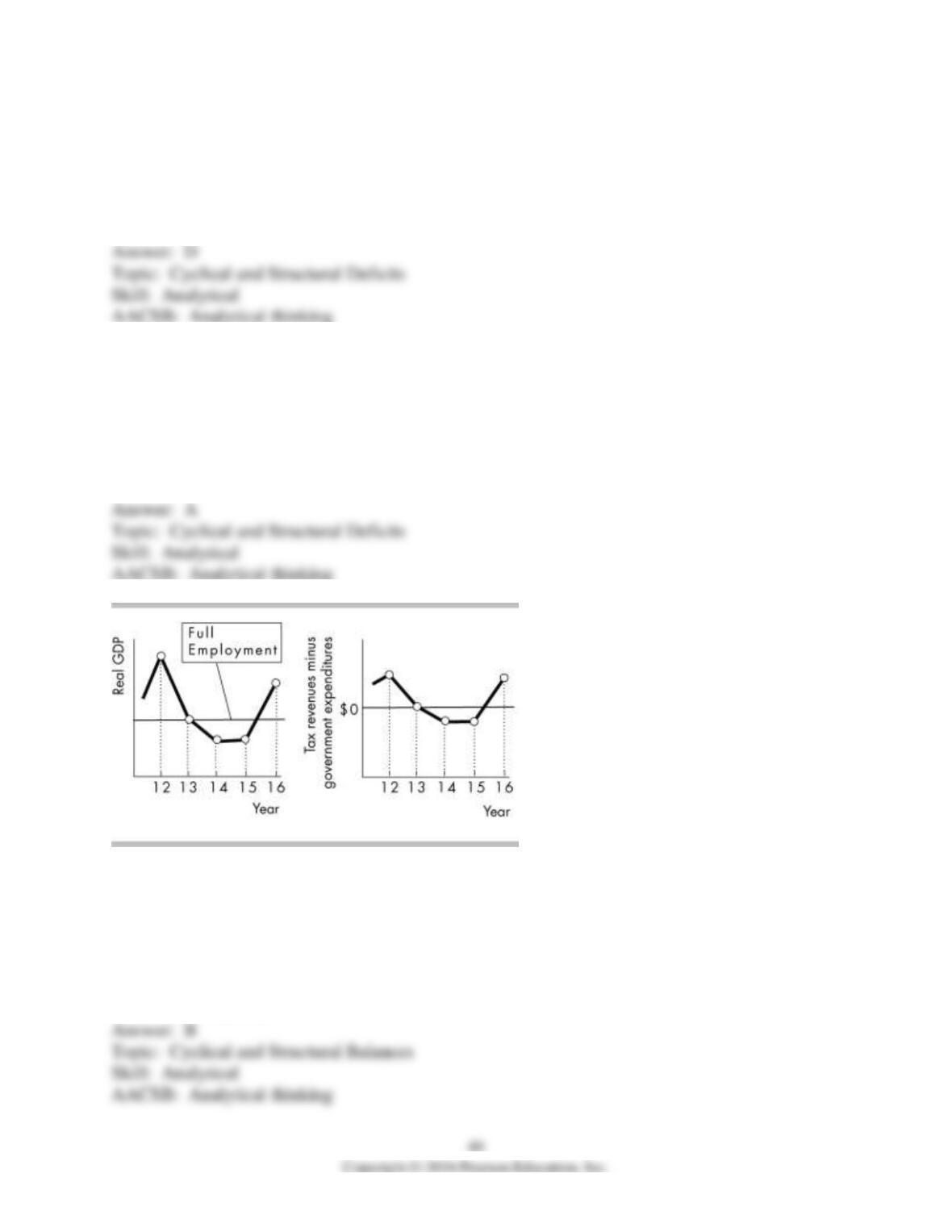
47) Economic data for a mythical economy in the years 2012-2016 are summarized in the figure
above. Assume that the spending formulas and tax schedules are identical for all years. When the
economy is at full employment, the government has a
A) budget surplus.
B) balanced budget.
C) budget deficit.
D) procyclical policy.