Macroeconomics, 12e (Parkin)
Chapter 13 Fiscal Policy
1 The Federal Budget
1) Prior to the Great Depression, the purpose of the federal budget was to ________.
A) stabilize the economy
B) finance the activities of the government
C) maintain low interest rates
D) decrease unemployment
2) The use of the U.S. federal budget to help stabilize the economy grew in reaction to the
________ and is known as ________.
A) stagflation of the 1970s; fiscal policy
B) Great Depression of the 1930s; fiscal policy
C) stagflation of the 1970s; government policy
D) Great Depression of the 1930s; monetary policy
3) Fiscal policy includes
A) only decisions related to government expenditure on goods and services.
B) only decisions related to government expenditure on goods and services and the value of
transfer payments.
C) only decisions related to the value of transfer payments and tax revenue.
D) decisions related to government expenditure on goods and services, the value of transfer
payments, and tax revenue.
4) Fiscal policy involves
A) the use of interest rates to influence the level of GDP.
B) the use of tax and spending policies by the government.
C) decreasing the role of the Federal Reserve in the everyday life of the economy.
D) the use of tax and money policies by government to influence the level of interest rates.
5) Fiscal policy
A) is enacted by the Federal Reserve.
B) involves changing interest rates.
C) involves changing taxes and government spending.
D) involves changing the money supply.
6) Fiscal policy attempts to achieve all of the following objectives EXCEPT ________.
A) a stable money supply
B) price level stability
C) full employment
D) sustained economic growth
7) Changes in which of the following is included as part of fiscal policy?
A) the quantity of money
B) the level of interest rates
C) monetary policy
D) tax rates
8) All of the following are part of fiscal policy EXCEPT
A) setting tax rates.
B) setting government spending.
C) choosing the size of the government deficit.
D) controlling the money supply.
9) The budget process includes the
A) President proposing the budget and the Congress passing the budget.
B) President passing the budget as proposed by Congress.
C) House of Representatives proposing the budget and the Senate passing the budget.
D) Senate proposing the budget and the House of Representatives passing the budget.
10) Which branches of the government play a role in the enacting of the federal budget?
I. the President.
II. the House of Representatives.
III. the Senate.
A) I and II
B) II and III
C) I, II and III
D) I
11) Which of the following government bodies does NOT participate directly in formulating
U.S. fiscal policy?
A) the President and his cabinet
B) the Federal Reserve Board
C) the House of Representatives
D) the Senate
12) The purpose of the Employment Act of 1946 was to
A) establish goals for the federal government that would promote maximum employment,
purchasing power, and production.
B) establish an unemployment compensation system.
C) set up the Federal Reserve System.
D) set targets for the unemployment rate to be achieved by the president.
13) The Employment Act of 1946 made it the responsibility of the federal government to
A) balance its budget because that policy would create the maximum level of employment.
B) promote maximum employment.
C) provide full employment and a stable balance of payments.
D) improve the distribution of income.
14) The Employment Act of 1946 states that it is the responsibility of the federal government to
A) promote maximum employment.
B) promote economic equality.
C) maintain the inflation rate at below 10 percent per year.
D) All of the above answers are correct.
15) The Council of Economic Advisers
A) proposes the president’s budget each year.
B) approves fiscal policy changes.
C) helps the president and the public stay informed about the state of the economy.
D) helps the president make changes in monetary policy.
16) The Council of Economic Advisors advises the
A) President.
B) Congress.
C) Senate.
D) House of Representatives.
17) The largest source of government revenues is ________.
A) personal income taxes
B) indirect taxes
C) corporate income taxes
D) Social Security taxes
18) What is the largest source of revenue for the federal government?
A) Social Security taxes
B) corporate income taxes
C) personal income taxes
D) sales tax
19) Which of the following is the largest source of federal government revenue?
A) corporate income taxes
B) Social Security taxes
C) personal income taxes
D) borrowing
20) The government receives tax revenues from several sources. Rank the following sources
from largest to the smallest.
I. corporate income taxes
II. personal income taxes
III. Social Security taxes
A) I, II, III
B) II, III, I
C) I, III, II
D) III, II, I
21) Which of the following is NOT a revenue source for the Federal government?
A) personal income taxes
B) indirect taxes
C) interest on corporate bond holdings
D) Social Security taxes
22) The largest item of government outlays is ________.
A) debt interest
B) transfer payments
C) expenditures on goods and services
D) debt reduction
23) Expenditures such as Social Security benefits, farm subsidies and grants are considered
A) expenditures on goods and services.
B) transfer payments.
C) debt reduction.
D) debt interest.
24) Social Security benefits and expenditures on Medicare and Medicaid are classified as
A) debt interest.
B) purchases of goods and services.
C) production of goods and services.
D) transfer payments.
25) Rank the following federal government outlays from the largest to the smallest.
I. debt interest
II. transfer payments
III. expenditure on goods and services
A) I, II, III
B) III, II, I
C) III, I, II
D) II, III, I
26) Which of the following is NOT a government outlay?
A) transfer payments
B) expenditure on goods and services
C) debt interest on the government’s debt
D) purchases of foreign bonds
27) All of the following are government outlays EXCEPT
A) interest on the government’s debt.
B) transfer payments.
C) purchases of corporate bonds.
D) expenditure on goods and services.
28) Federal government outlays as a percentage of GDP are approximately
A) 10 percent.
B) 25 percent.
C) 50 percent.
D) 66 percent.
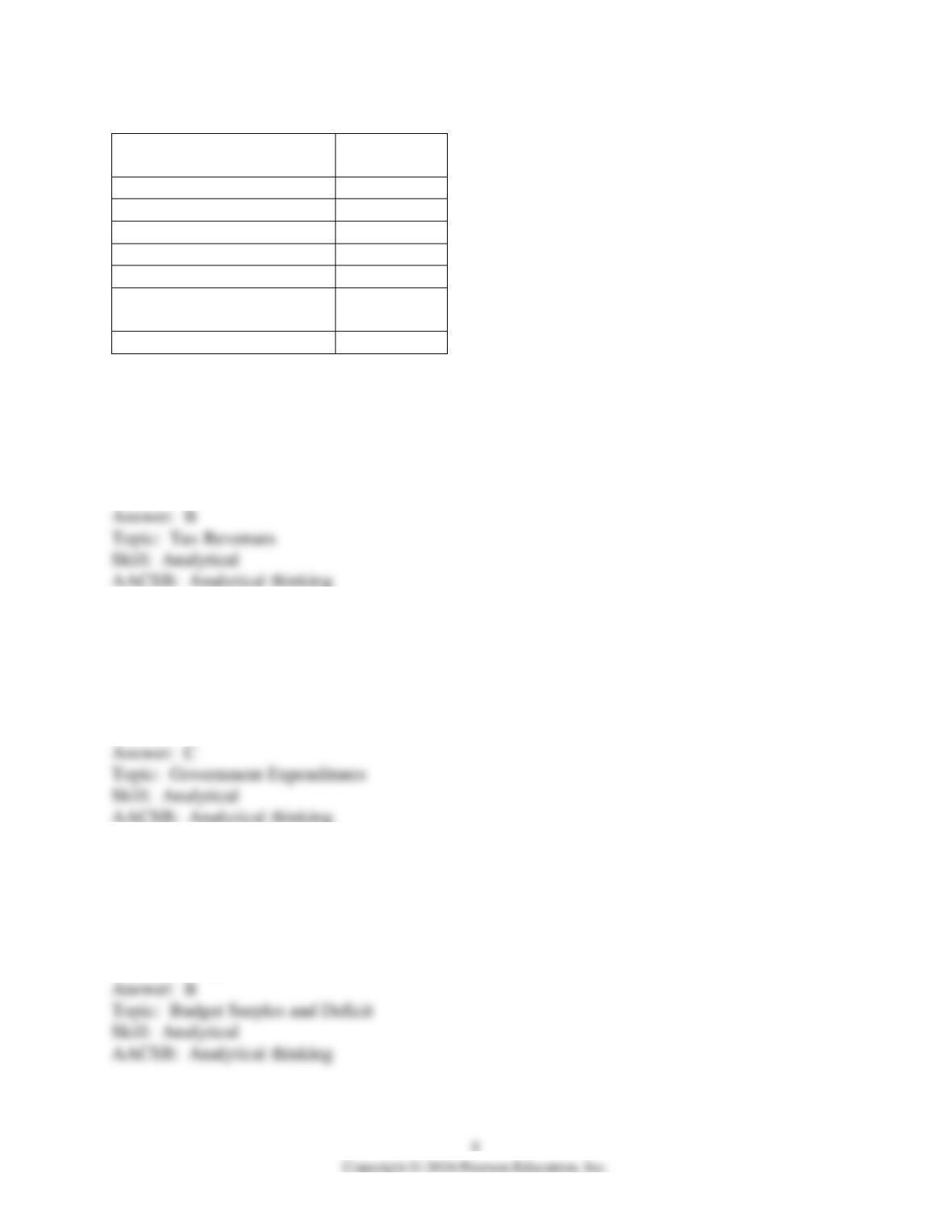
Component
Dollars
(billion)
Personal income taxes
500
Social Security taxes
400
Corporate income taxes
150
Indirect taxes
75
Transfer payments
1,200
Expenditure on goods and
services
225
Debt interest
75
29) The table above has data for a country’s government budget. The country has government
revenues of ________ billion.
A) $900
B) $1125
C) $725
D) $2100
30) The table above has data for a country’s government budget. Government outlays for the
economy equal ________ billion.
A) $1200
B) $1275
C) $1500
D) $1425
31) The table above has data for a country’s government budget. The data show the government
is running a ________ billion.
A) budget surplus of $300
B) budget deficit of $375
C) budget deficit of $550
D) budget surplus of $650
32) The largest source of revenue for the federal government is ________ and the largest outlay
is for ________.
A) corporate taxes; Social Security
B) personal income taxes; Medicare
C) personal income taxes; interest on national debt
D) personal income taxes; transfer payments
33) The government’s budget deficit or surplus equals the
A) change in outlays divided by change in revenue.
B) average outlay divided by average revenue.
C) change in revenue minus change in outlays.
D) total tax revenue minus total government outlays.
34) A budget surplus occurs when government
A) outlays exceeds tax revenues.
B) tax revenues exceeds outlays.
C) tax revenues equals outlays.
D) tax revenues equal Social Security expenditures.
35) Whenever the federal government spends more than it receives in tax revenue, then by
definition it
A) runs a budget surplus.
B) operates a balanced budget.
C) runs a budget deficit.
D) increases economic growth.
36) The budget deficit
A) is the total outstanding borrowing by the government.
B) is the difference between government outlays and tax revenues.
C) decreased during the Obama Administration.
D) reached its peak in the year 2000.
37) A government incurs a budget deficit when
A) taxes are greater than government outlays.
B) taxes are less than government outlays.
C) exports are greater than imports.
D) exports are less than imports.
38) In January 2013 certain tax rates increased, which were predicted to increase the federal
government’s tax revenue. An increase in tax revenue ________ the government’s budget deficit
and over time thereby ________ the amount of government debt.
A) increases; decreases
B) decreases; decreases
C) decreases; increases
D) increases; increases
39) If taxes exactly equaled government outlays the
A) federal government debt would be zero.
B) federal government debt would decrease.
C) budget deficit would not change.
D) budget deficit would be zero.
40) If the federal government’s tax revenues are greater than its outlays, then the federal budget
has a
A) deficit.
B) surplus.
C) transfer payment.
D) balanced budget.
41) By definition, a government budget deficit is the situation that occurs when the
A) government outlays exceed what it receives in taxes.
B) government receipts exceed government outlays.
C) government spends money on things which do not produce revenue, such as schools.
D) economy goes into a recession.
42) The U.S. government’s budget
A) must be balanced each year.
B) has mostly been in surplus during the past 30 years.
C) has mostly been in deficit during the past 30 years.
D) has always been in deficit during the past 30 years.
43) When tax revenues exceed outlays, the government has a ________, and when outlays
exceed tax revenues, the government has a ________.
A) budget surplus; budget debt
B) budget deficit; budget surplus
C) budget debt; budget surplus
D) budget surplus; budget deficit
44) A government that currently has a budget deficit can balance its budget by ________.
A) increasing tax revenues by more than it increases outlays
B) increasing both tax revenues and outlays by the same amount
C) decreasing tax revenues by more than it decreases outlays
D) decreasing tax revenues by more than it increases outlays
45) In 2013, the U.S. government budget had a deficit. By definition, it must have been the case
that
A) tax revenues were less than government outlays.
B) tax revenues were equal to government outlays.
C) tax revenues were greater than government outlays.
D) the government debt became negative.
46) Suppose the only revenue taken in by the government is in the form of income tax, and the
tax rate is 10 percent. If aggregate income is $800 billion, and government outlays are $100
billion, then the government budget has
A) a deficit of $20 billion.
B) a surplus of $20 billion.
C) neither a surplus nor a deficit.
D) a deficit of $80 billion.
47) In 2014, the federal government of Happy Isle had tax revenues of $1 million, and spent
$500,000 on transfer payments, $250,000 on goods and services and $300,000 on debt interest.
In 2014, the government of Happy Isle had a ________.
A) balanced budget
B) budget deficit of $50,000
C) budget surplus of $50,000
D) budget deficit of $1,050,000
48) The federal government debt is equal to the
A) obligations of benefits from federal taxes and expenditures.
B) sum of all annual federal government outlays.
C) sum of past budget deficits minus the sum of past budget surpluses.
D) annual difference between federal government tax revenues and outlays.
49) The sum of past budget deficits minus the sum of past budget surpluses refers to
A) the national debt.
B) the cyclically unbalanced budget.
C) the structural national debt.
D) the federal government net worth.
50) If the government has a balanced budget, the total amount of government debt is
A) increasing.
B) decreasing.
C) constant.
D) zero.
51) If the government runs a surplus, the total amount of government debt is
A) increasing.
B) decreasing.
C) constant.
D) zero.
52) If the government runs a deficit, the total amount of government debt is
A) increasing.
B) decreasing.
C) constant.
D) zero.
53) An increase in the government ________ reduces the government’s ________.
A) budget deficit; debt
B) budget surplus; debt
C) debt; budget deficit
D) None of the above answers is correct.
54) Suppose a country has been running a persistent government budget deficit. If the deficit is
reduced, but remains positive
A) government debt will increase.
B) government debt will decrease.
C) the country will experience a budget surplus.
D) interest payments on the debt immediately will decrease.
55) If the tax revenue equal $1.5 billion and government outlays equal $1.6 billion, then the
A) government budget has a deficit of $0.1 billion.
B) government budget has a surplus of $0.1 billion.
C) government debt is equal to $0.1 billion.
D) government debt declines by $0.1 billion.
56) The gross public debt was approximately $6 trillion in 2002 and approximately $16 trillion
in 2012. These numbers definitely indicate that in the 10 years between 2002 and 2012
A) the government had budget deficits that totaled about $10 trillion.
B) the government had budget deficits of about $10 trillion per year.
C) government outlays increased by about $1 trillion per year.
D) government receipts decreased by about $1 trillion per year.
57) A country has been in existence for only two years. In the first year, tax revenues were $1.0
million and outlays were $1.5 million. In the second year, tax revenues were $1.5 million and
outlays were $2.0 million. At the end of the second year, the total government debt was
________.
A) $0.5 million
B) $1 million
C) $2.5 million
D) $3.5 million
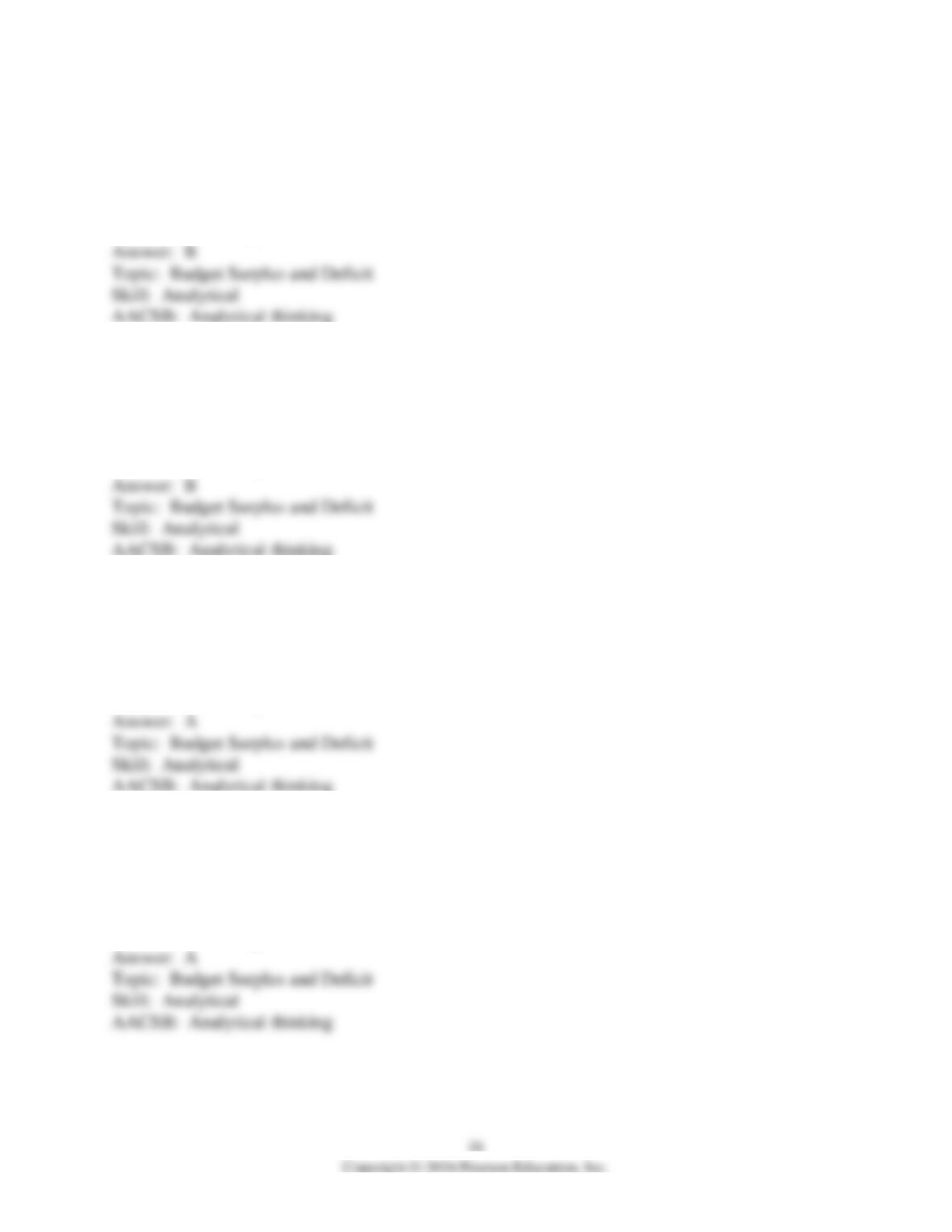
Year
Government
tax revenues
(billions of
dollars)
Government
expenditures
(billions of
dollars)
1
240
240
2
250
245
3
260
255
4
300
320
5
325
340
58) What is the amount of the surplus or deficit incurred in year 1 by the government shown in
the above table?
A) $0
B) $25 billion deficit
C) $25 billion surplus
D) $240 billion surplus
59) What is the amount of the surplus or deficit incurred in year 2 by the government shown in
the above table?
A) $0
B) $5 billion surplus
C) $5 billion deficit
D) $250 billion surplus
60) What is the amount of the surplus or deficit incurred in year 3 by the government shown in
the above table?
A) $0
B) $5 billion surplus
C) $5 billion deficit
D) $260 billion surplus
61) What is the amount of the surplus or deficit incurred in year 4 by the government shown in
the above table?
A) $20 billion deficit
B) $35 billion surplus
C) $5 billion surplus
D) $320 billion surplus
62) What is the amount of the surplus or deficit incurred in year 5 by the government shown in
the above table?
A) $15 billion deficit
B) $35 billion surplus
C) $5 billion surplus
D) $325 billion surplus
63) The government begins year 1 with $25 billion of debt. Based on the information in the
above table, what is the amount of debt following year 1?
A) $0
B) $25 billion
C) $240 billion
D) Not enough information is provided to answer the question.
64) The government begins year 1 with $25 billion of debt. Based on the information in the
above table, what is the amount of debt following year 2?
A) $245 billion
B) $5 billion
C) $250 billion
D) $20 billion
65) The government begins year 1 with $25 billion of debt. Based on the information in the
above table, what is the amount of debt following year 3?
A) $15 billion
B) $5 billion
C) $20 billion
D) $260 billion
66) The government begins year 1 with $25 billion of debt. Based on the information in the
above table, what is the amount of debt following year 4?
A) -$20 billion (The government has net saving rather than debt.)
B) $35 billion
C) $5 billion
D) $320 billion
67) The government begins year 1 with $25 billion of debt. Based on the information in the
above table, what is the amount of debt following year 5?
A) -$20 billion (The government has net saving rather than debt.)
B) $35 billion
C) $50 billion
D) $325 billion
68) The U.S. federal budget over the past 30 years has been
A) in balance most years.
B) in deficit most of the years.
C) in surplus most of the years.
D) in surplus about half the time and deficit the other half.
69) Comparing the U.S. budget position for 2014 to the rest of the world, we see that as a
percentage of GDP, the ________ than in most other countries.
A) U.S. budget deficit is smaller
B) U.S. budget deficit is larger
C) U.S. budget surplus is smaller
D) U.S. budget surplus is larger
70) If the government’s outlays are $1.5 trillion and its tax revenues are $2.2 trillion, the
government is running a budget
A) surplus of $0.7 trillion.
B) surplus of $3.7 trillion.
C) deficit of $0.7 trillion.
D) deficit of $3.7 trillion.
2 Supply-Side Effects of Fiscal Policy
1) Looking at the supply-side effects on aggregate supply shows that a tax hike on labor income
A) weakens the incentive to work.
B) decreases potential GDP.
C) increases potential GDP because people work more to pay the higher taxes.
D) Both answers A and B are correct.
2) Once supply side effects are taken into account, tax cuts for labor income can change
I. the supply of labor.
II. potential GDP.
A) I only
B) I and II
C) II only
D) neither I nor II
3) Taking account of the supply-side effects, a tax cut on labor income ________ employment
and ________ potential GDP.
A) increases; increases
B) increases; decreases
C) decreases; increases
D) decreases; decreases
4) If a tax cut increases people’s labor supply, then
A) tax cuts increase potential GDP.
B) tax cuts decrease aggregate demand.
C) tax cuts cannot affect aggregate demand.
D) Both answers A and B are correct.
5) The supply side effects of a change in taxes on labor income means that ________ in taxes on
labor income will shift the ________.
A) an increase; labor supply curve rightward
B) an increase; labor supply curve leftward
C) a decrease; labor demand curve rightward
D) a decrease; labor demand curve leftward
6) An increase in taxes on labor income ________ the labor supply curve and ________ the
labor demand curve.
A) shifts; does not shift
B) shifts; shifts
C) does not shift; does not shift
D) does not shift; shifts
7) An increase in taxes on labor income shifts the labor supply curve ________ and the
________.
A) leftward; after-tax wage rate falls
B) rightward; before-tax wage rate rises
C) leftward; after-tax wage rate rises
D) rightward; before-tax wage rate falls
8) An income tax ________ potential GDP by shifting the ________ curve ________.
A) increases; labor demand; rightward
B) decreases; labor demand; leftward
C) increases; labor supply; rightward
D) decreases; labor supply; leftward