Economics Today, 19e (Miller)
Chapter 13 Fiscal Policy
13.1 Discretionary Fiscal Policy
1) When the government deliberately alters its level of spending and/or taxes in order to achieve
specific national economic goals, it is exercising
A) monetary policy.
B) discretionary fiscal policy.
C) automatic government budgetary policy.
D) a laissez-faire policy.
2) Which of the following is an example of fiscal policy?
A) a reduction in the federal funds rate.
B) a reduction in the money supply.
C) a reduction in lump-sum taxes.
D) an increase in the government deficit due to more military spending in wartime.
3) Which of the following would shift the aggregate demand curve to the right?
A) an increase in government spending
B) an increase in taxes
C) an increase in interest rates
D) an increase in labor productivity
4) Which of the following fiscal policy actions would be appropriate if the economy is
experiencing an recessionary gap?
A) a decrease in government spending
B) a decrease in taxes
C) an increase in interest rates
D) a decrease in the money supply
5) A decrease in government spending would cause which of the following to happen?
A) The aggregate demand curve would shift to the left.
B) The aggregate demand curve would shift to the right.
C) The aggregate supply curve would shift to the right.
D) The aggregate supply curve would shift to the left.
6) Suppose the economy is experiencing an inflationary gap at the current level of GDP. Which
of the following fiscal policy actions would be most appropriate given this gap?
A) decreasing interest rates
B) decreasing the money supply
C) increasing taxes
D) a simultaneous and equal increase in taxes and increase in government spending
7) Fiscal policy refers to the
A) manipulation of the money supply in order to increase the amount of cash that the
government holds.
B) adjustment of government spending and taxes in order to achieve certain national economic
goals.
C) adjustment of national income data to account for price level changes.
D) government policy that aims at raising the market prices of certain goods.
8) Fiscal policy involves which of the following?
A) tax policy
B) interest rates
C) selling government bonds
D) all of the above
9) When television commentators refer to “tax and spend” policy, they are referring to
A) fiscal policy.
B) monetary policy.
C) command and control policy.
D) automatic stabilizers.
10) Which of the following is NOT a fiscal policy action?
A) increasing government expenditures on military hardware
B) decreasing government spending on social welfare
C) decreasing the quantity of money in circulation
D) lowering income tax rates
11) Fiscal policy is defined as
A) the design of a tax system to transfer income from large corporations to the poor.
B) the use of Congressional power to pursue social and political goals.
C) the discretionary changing of government expenditures or taxes to achieve macroeconomic
goals.
D) the use of the taxing power of the government to redistribute wealth in a socially acceptable
manner.
12) Which of the following is an example of a discretionary fiscal policy action?
A) an increase in government spending to deal with a recession
B) a decrease in tax revenues as taxpayers’ incomes decrease
C) increasing the minimum wage rate
D) raising regulations in the banking industry
13) Which of the following is a discretionary fiscal policy action?
A) an increase in the amount of unemployment compensation because more people become
unemployed
B) a progressive tax system that leads to an increase in income tax revenues from the rich
C) a deliberate tax increase when the economy experiences high inflation
D) an increase in Supplemental Security Income payments when more people become eligible
for the benefits
14) Typical goals for fiscal policy are
A) high employment and price stability.
B) high prices for consumers and low prices for businesses.
C) running high deficits and raising consumer prices.
D) increasing the money supply so the government can spend more.
15) Fiscal policy to solve short-run economic problems supports the Keynesian notion of
A) there being no government role in the economy.
B) an active government role in the economy.
C) achieving a command and control economy.
D) the long-run nature of the economy.
16) According to traditional Keynesian economics, contractionary fiscal policy initiated by the
federal government
A) is never appropriate.
B) is an appropriate way to prevent recessions and depressions.
C) is an appropriate way to slow down an over-heated economy.
D) will always fail due to crowding out effects.
17) Discretionary fiscal policy is
A) automatic changes in government expenditures and interest rates that achieve certain national
economic goals.
B) deliberate changes in government expenditures or taxes in order to achieve certain national
economic goals.
C) used to achieve full employment by changing monetary growth targets.
D) deliberate changes in government regulations in markets to achieve certain social goals.
18) All the following actions represent fiscal policy EXCEPT
A) an increase in the money supply.
B) a decrease in government spending.
C) a reduction in individual income tax rates.
D) an increase in corporate income tax rates.
19) Fiscal policy is implemented by
A) the central bank.
B) local government units.
C) the Internal Revenue Service.
D) the federal government.
20) Which of the following represents expansionary fiscal policy?
A) a reduction in government spending
B) a decrease in average individual income tax rates
C) an increase in corporate income tax rates
D) an increase in marginal individual income tax rates
21) The discretionary change of government expenditures or taxes to achieve national economic
goals is
A) crowding-out policy.
B) Ricardian-equivalence theorem.
C) supply-side economics.
D) fiscal policy.
22) Discretionary fiscal policy is best described as
A) a deliberate action to move the economy toward full employment and price stability more
quickly than it might otherwise.
B) a deliberate attempt to improve the functioning of free markets.
C) an automatic change in income transfer payments to keep the economy at full employment.
D) the design of a tax system that automatically stabilizes economic activity over time.
23) Keynes believed that the way to prevent recessions and depressions was to
A) reduce spending when there is a recessionary gap.
B) only change tax rates as a means of regulating the economy.
C) maximize the crowding out effect.
D) increase aggregate demand through expansionary fiscal policy.
24) Fiscal policy involves discretionary changes in
A) interest rates.
B) exchange rates.
C) lump-sum taxes.
D) the rate of growth of the money supply.
25) According to traditional Keynesian analysis, fiscal policy operates by
A) informing business people about its plans for the economy so they will know how to adjust
their behavior.
B) indirectly affecting aggregate demand through its effect on the money supply.
C) directly affecting aggregate demand.
D) directly affecting aggregate supply.
26) To close an inflationary gap through fiscal policy, the government should
A) decrease government spending in order to increase aggregate supply.
B) decrease government spending in order to reduce aggregate demand.
C) reduce taxes in order to stimulate investment, and thus increase aggregate supply.
D) increase government spending and taxes in order to both increase aggregate demand and
aggregate supply.
27) An example of fiscal policy is
A) an increase in government spending.
B) a reduction in investment spending by the private sector.
C) an increase in autonomous spending by consumers.
D) a cost-of-living adjustment in Social Security payments to the elderly.
28) Fiscal policy includes all of the following EXCEPT
A) changing taxes.
B) changing government spending.
C) policies that influence aggregate demand.
D) policies that influence the rate of growth of the money supply.
29) If the economy is operating on the long-run aggregate supply curve, then expansionary fiscal
policy will
A) generate higher prices in the short run, but will induce aggregate supply to increase in the
long run.
B) generate an increase in real GDP and higher prices in both the short run and the long run.
C) generate an increase in real GDP without higher prices in the short run, but then real GDP
will return to its long-run level, and the price level will increase.
D) generate an increase in real GDP and higher prices in the short run, but then real GDP will
decrease to its long-run level, and the price level will increase some more.
30) If the economy is experiencing a recessionary gap and the government wants to accelerate
the adjustment to the long-run equilibrium, it should
A) reduce aggregate demand by cutting government spending or raising taxes.
B) increase aggregate demand by increasing government spending or cutting taxes.
C) increase aggregate supply by cutting government spending or raising taxes.
D) increase aggregate supply by increasing government spending or lowering taxes.
31) Suppose the government decreases lump-sum taxes. This causes
A) disposable income to increase, which causes consumption spending to decrease and aggregate
demand to increase.
B) government spending to decrease, which causes aggregate demand to decrease.
C) consumption spending to decrease and spending on imports to increase. The effect on
aggregate demand depends on whether domestic spending or spending on imports decreased the
most.
D) disposable income to decrease, which causes aggregate supply to decrease.
32) Other things being equal, an increase in taxes will
A) lead to a reduction in the long run aggregate supply curve as businesses enjoy greater profits.
B) influence the short run aggregate supply curve but not the aggregate demand curve.
C) lead to a corresponding reduction in interest rates increasing the crowding out effect.
D) cause a decrease in aggregate demand due to decreases in consumption, investment, or net
exports.
33) Which of the following actions could be undertaken if the government wants to reduce a
recessionary gap?
A) Increase taxes and reduce government spending.
B) Reduce taxes and increase government spending.
C) Increase taxes and increase government spending.
D) Increase taxes more than the amount of reduction in government spending.
34) Which of the following actions could be undertaken if the government wants to close an
inflationary gap?
A) Increase taxes and reduce government spending.
B) Reduce taxes and increase government spending.
C) Increase taxes and increase government spending.
D) Reduce taxes and reduce government spending.
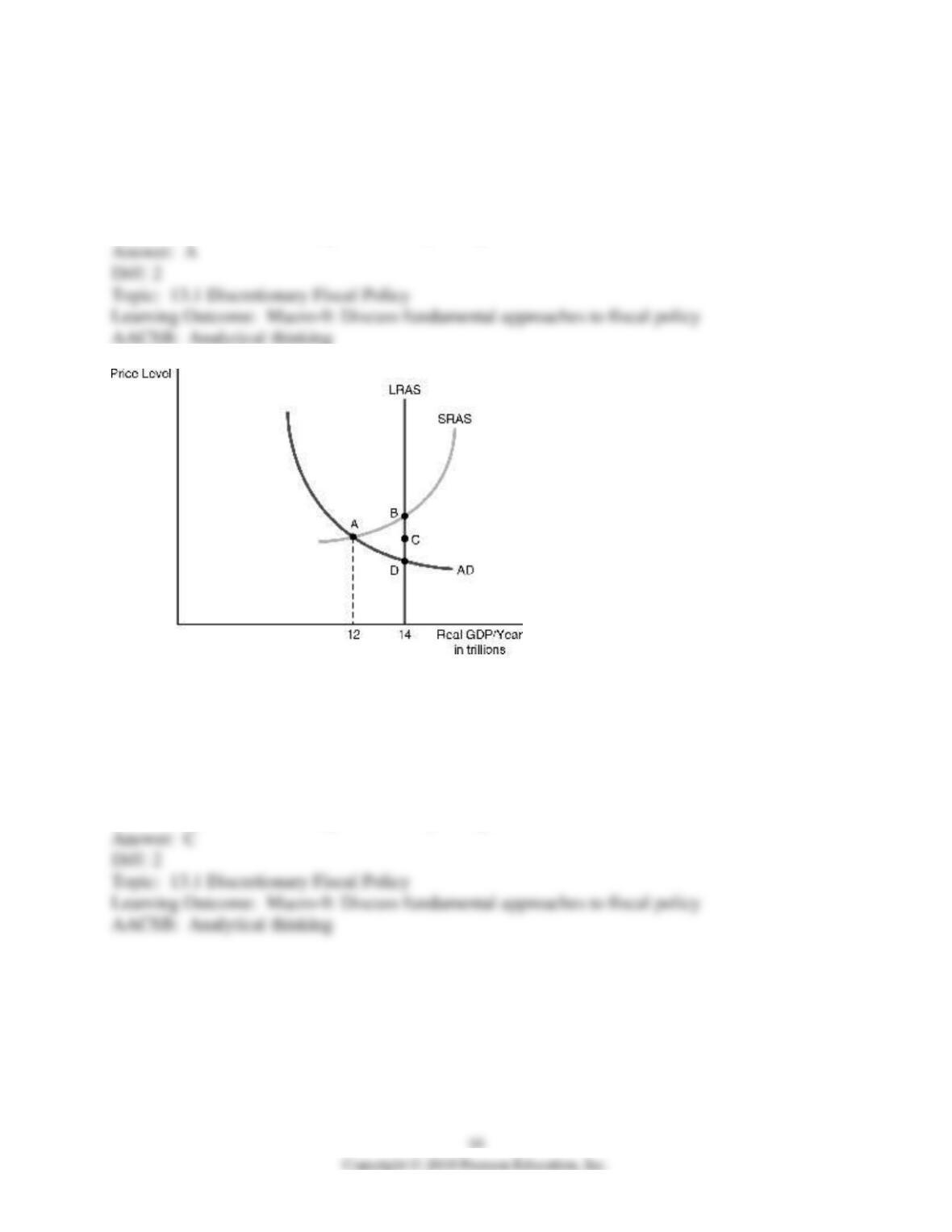
35) Refer to the above figure. Suppose the economy is operating at point A. There is a
recessionary gap of ________, which can be closed by ________.
A) $3 trillion; increasing government spending by $1 trillion
B) $1 trillion; expansionary fiscal policy that shifts the short-run aggregate supply curve through
point C
C) $2 trillion; expansionary fiscal policy that generates another $2 trillion in total spending
D) $2 trillion; an increase in government spending of $14 trillion
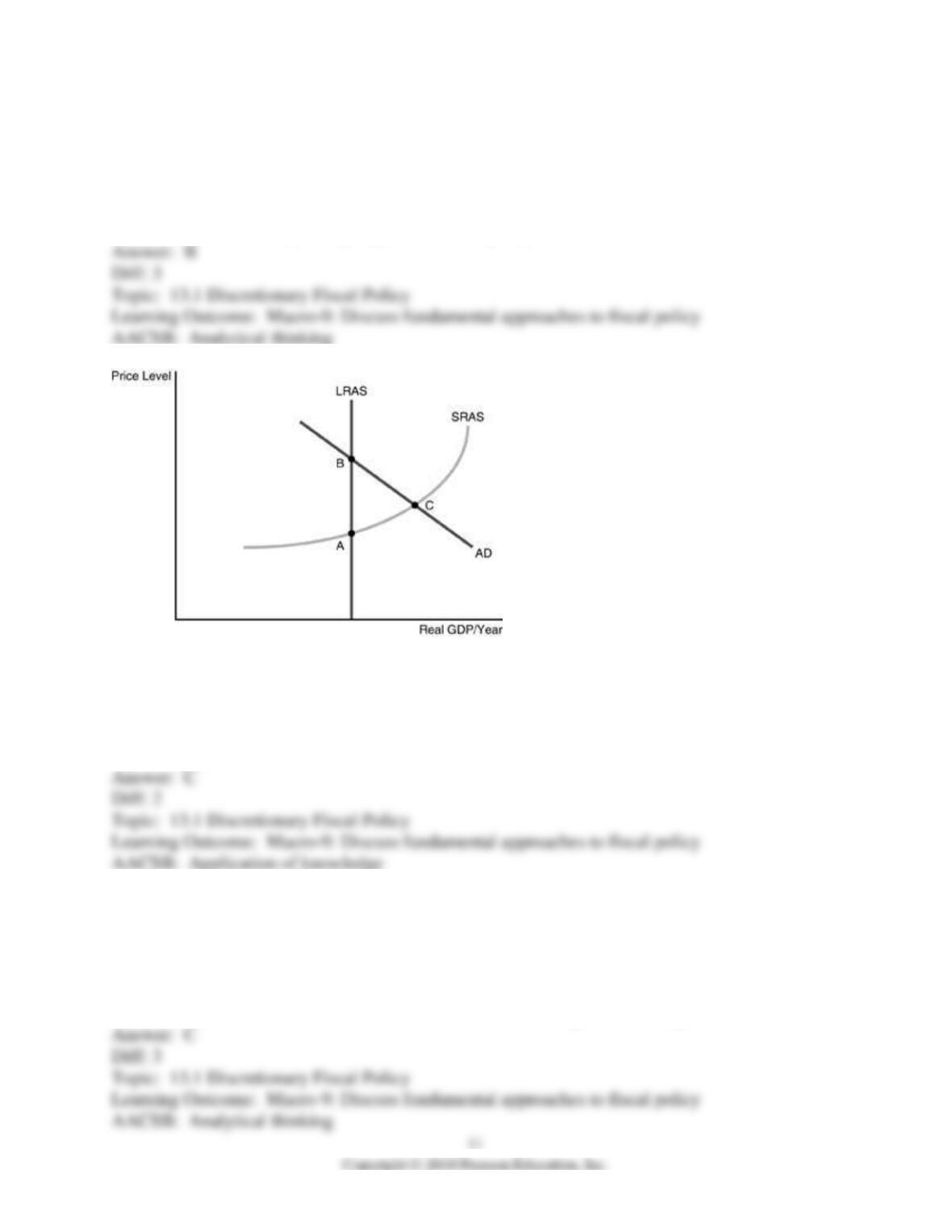
36) Refer to the above figure. Suppose the economy is at point A. By the proper use of fiscal
policy, the government can
A) boost taxes to shift LRAS through point A.
B) cut income tax rates to get the economy to point B.
C) raise income tax rates to get the economy to point C.
D) reduce government spending to get the economy to point D.
37) Refer to the above figure. If the economy is currently operating at point C, then there is
A) deflation.
B) a recessionary gap.
C) an inflationary gap.
D) unemployment.
38) Refer to the above figure. Suppose the U.S. economy is currently operating at point C.
Which of the following actions would you recommend to the president of the United States?
A) Raise government spending to stimulate investment, consumption and net exports.
B) Increase government spending while holding taxes constant.
C) Engage in contractionary fiscal policy by raising income taxes.
D) Reduce the interest rate to stimulate investment minimizing the crowding out effect.
39) Refer to the above figure. Suppose that the economy was originally at point A, and then it
reached point C by means of a fiscal policy action. Which of the following is correct?
A) Point C is a short-run equilibrium that could have been attained through a tax cut, but in the
long run the economy will end up at point B.
B) Point C is both a short-run equilibrium and a long-run equilibrium that could have been
attained through an increase in government spending.
C) Point C is a long-run equilibrium that could have been attained through a tax increase,
although reaching this point first required a short-run equilibrium at point B.
D) Point C is a short-run equilibrium that could have been attained through a reduction in
government spending, but in the long run the economy will end up at point B.
40) Refer to the above figure. If the economy is currently at point C, then an increase in taxes
will lead to
A) an increase in the price level and an increase in real GDP.
B) a decrease in real GDP and an increase in the price level.
C) a decrease in real GDP and a decrease in the price level.
D) a decrease in the price level and an increase in real GDP.
41) Suppose there currently is an inflationary gap. What could the government do to bring the
overall price level down?
A) nothing
B) Increase income taxes.
C) Increase government spending.
D) Reduce the nation’s aggregate supply.
42) An example of expansionary fiscal policy could be
A) to increase the nation’s money supply.
B) to reduce tax rates.
C) to reduce government spending.
D) to reduce interest rates.
43) In the short run, expansionary fiscal policy usually will
A) increase both real GDP and the price level.
B) increase real GDP and decrease the price level.
C) decrease the price level and increase real GDP.
D) decrease both real GDP and the price level.
44) Contractionary fiscal policy will most likely
A) raise real GDP more than the increase in the price level.
B) raise real GDP.
C) lower the price level.
D) raise inflation.
45) In the short run, if the government attempts to increase aggregate demand, it should
A) increase government spending and reduce taxes.
B) decrease government spending and increase taxes.
C) shift the long-run aggregate supply curve to the right.
D) shift the short-run aggregate supply curve to the right.
46) The government will conduct expansionary fiscal policy if it attempts to
A) reduce the price level.
B) reduce real GDP.
C) shift the aggregate demand curve to the left.
D) reduce the level of unemployment.
47) Suppose the economy has a low level of employment. This would imply
A) that the government should engage in expansionary fiscal policy and increase the tax rate.
B) that the economy is operating to the left of the LRAS curve and that government spending
could be increased to reduce unemployment.
C) that fiscal policy has been ineffective and should be abandoned.
D) that the economy is operating on the SRAS curve and that government spending could be
decreased to reduce unemployment.
48) Fiscal policy involves the actions of
A) taxation and spending in an effort to address inflation and unemployment.
B) business regulation to increase economic efficiency.
C) changing interest rates to stimulate private savings.
D) changing the exchange rate to discourage imports.
49) The changing of government expenditures to achieve national economic goals is
A) discretionary fiscal policy.
B) automatic fiscal policy.
C) budget deficit policy.
D) inflationary fiscal policy.
50) Discretionary fiscal policy in the United States
A) is undertaken at the order of the Federal Reserve.
B) occurs automatically as the nation’s level of GDP changes.
C) involves specific changes in taxes and government spending undertaken by Congress and the
president.
D) involves secret advice given by the Council of Economic Advisers to the president.
51) If there is a deliberate change in government taxes and spending, it is called
A) a recessionary gap.
B) an inflationary gap.
C) discretionary fiscal policy.
D) discretionary monetary policy.
52) Which of the following fiscal policy actions would definitely cause an increase in the size of
a recessionary gap?
A) cuts in government spending
B) cuts in taxes
C) increases in taxes and increases in government spending
D) cuts in taxes and increases in government spending
53) Which of the following fiscal policy actions would most likely cause a reduction in the size
of an inflationary gap?
A) cuts in taxes and increases in government spending
B) increases in government spending
C) increases in taxes
D) cuts in taxes
54) When the government cuts taxes,
A) the long-run aggregate supply curve shifts to the left.
B) the short-run aggregate supply curve shifts to the left.
C) the aggregate demand curve shifts to the left.
D) the aggregate demand curve shifts to the right.
55) Which of the following is NOT related to fiscal policy?
A) passage of a new regulation on a specific industry
B) decreasing marginal tax rates
C) reducing the budget deficit
D) increasing government expenditures
56) Which one of the following is TRUE about the effects of fiscal policy?
A) A decrease government spending will increase aggregate supply.
B) A tax change does not have any direct or indirect effects on aggregate demand.
C) An increase in government spending will increase aggregate demand.
D) An increase in government spending will reduce aggregate demand.
57) Which of the following conditions describes an inflationary gap?
A) The short-run equilibrium level of real GDP is above the long-run level of real GDP.
B) The short-run equilibrium level of real GDP is below the long-run level of real GDP.
C) The actual interest rate is above the equilibrium interest rate.
D) The actual interest rate is below the equilibrium interest rate.
58) How might fiscal policy be used to correct a recessionary gap?
A) The exchange rate would be adjusted to encourage imports.
B) The exchange rate would be adjusted to discourage imports.
C) The interest rate would be adjusted to encourage saving.
D) Taxes would be cut to stimulate aggregate demand.
59) How might fiscal policy be used to correct an inflationary gap?
A) The exchange rate would be adjusted to encourage imports.
B) The exchange rate would be adjusted to discourage imports.
C) Government spending would be adjusted to reduce consumer spending.
D) Business operations would be regulated by the government to become more efficient.
60) Expansionary fiscal policy is used to
A) flight inflation.
B) fight recessions.
C) encourage private saving.
D) make businesses more efficient.
61) In 2009, Congress passed a bill that involved government spending increases and tax cuts
with the purpose of stimulating the U.S. economy. This policy is an example of
A) an automatic stabilizer.
B) contractionary fiscal policy.
C) expansionary fiscal policy.
D) expansionary monetary policy.
62) Tax policy conducted for the purpose of achieving full employment, price stability, or
economic growth is an example of
A) monetary policy.
B) interest-rate policy.
C) exchange-rate policy.
D) discretionary fiscal policy.
63) Government spending conducted for the purpose of achieving full employment or price
stability is an example of
A) monetary policy.
B) interest-rate policy.
C) exchange-rate policy.
D) fiscal policy.
64) Discretionary fiscal policy
A) is the use of government spending and tax policies to influence economic growth and
inflation.
B) is the use of regulation to influence economic growth and inflation.
C) is the purchase and sale of Treasury securities to influence economic growth and inflation.
D) is the use of the money supply to maintain stable prices.
65) The fiscal policy of the United States is
A) summarized in the budget of the U.S. federal government.
B) the sum of the budgets of each state and municipality.
C) published in the Federal Reserve Bank’s Annual Report.
D) decided each year by the head of the U.S. Department of the Treasury.
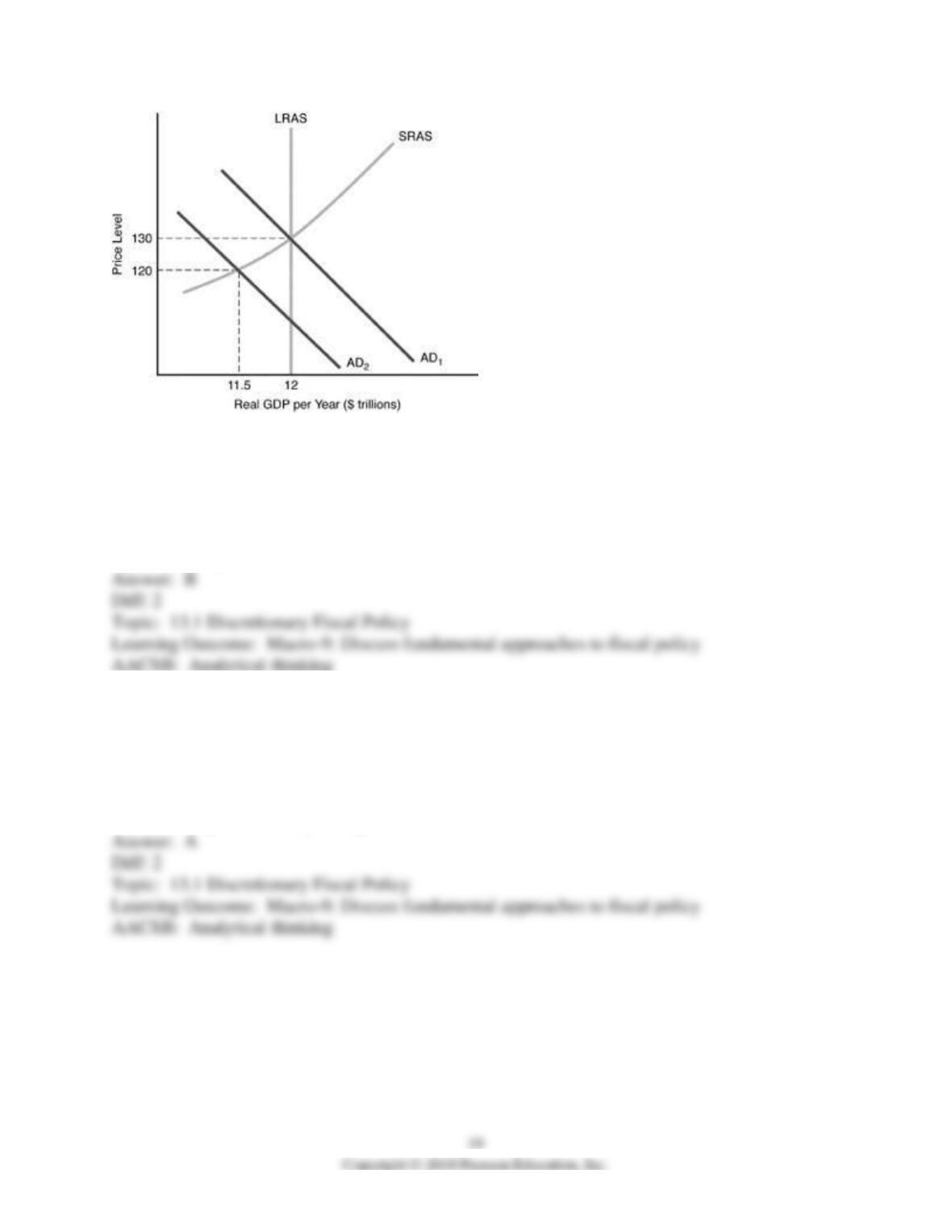
66) Refer to the above figure. If the relevant aggregate demand curve is AD2, what is the current
economic situation?
A) inflationary gap
B) recessionary gap
C) equilibrium
D) overemployment
67) Refer to the above figure. Suppose the relevant aggregate demand curve is AD2. If the
government wants to use discretionary fiscal policy to close the existing gap, it should
A) decrease taxes.
B) increase taxes.
C) increase the money supply.
D) decrease government spending.
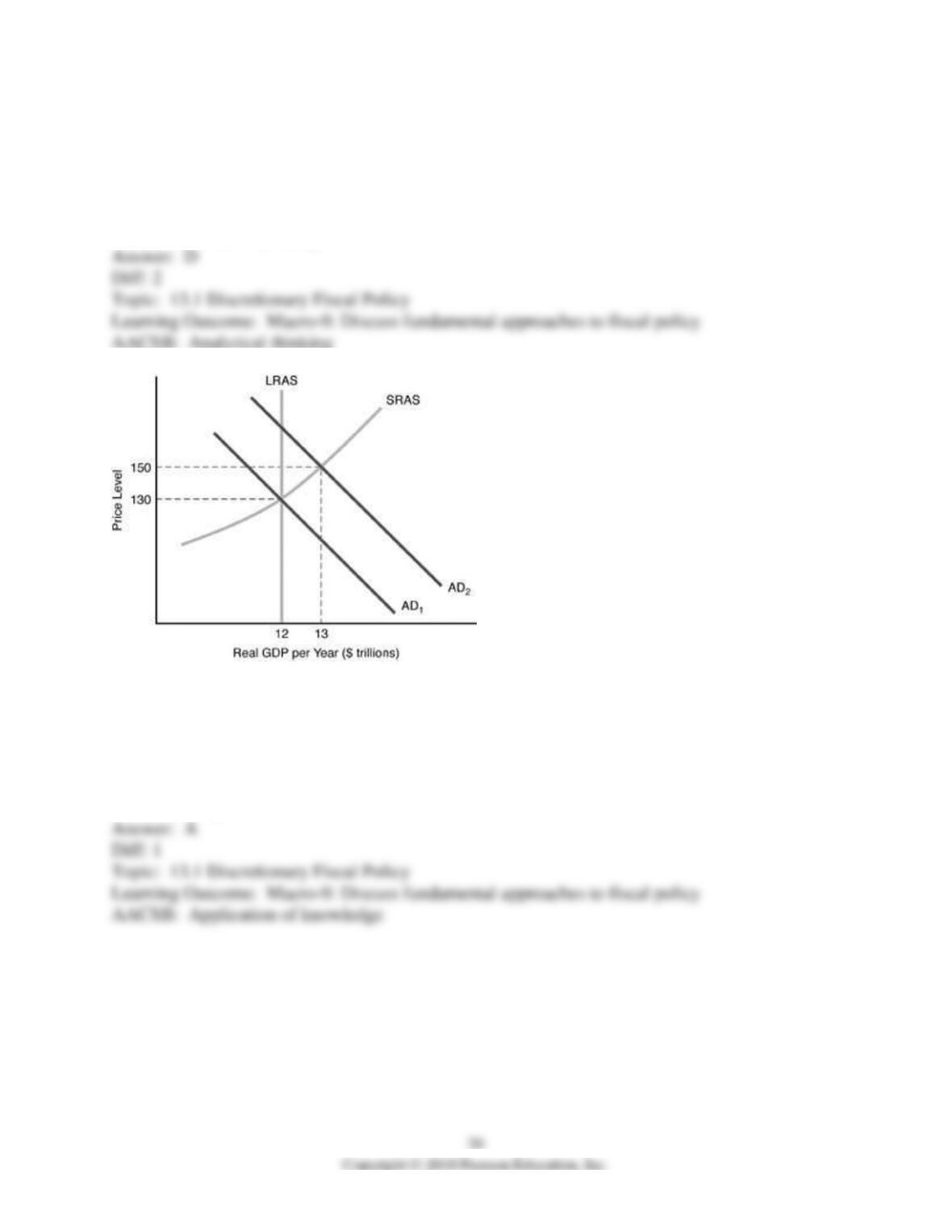
68) Refer to the above figure. If the relevant aggregate demand curve was AD2, the government
could do all of the following to close the existing gap EXCEPT
A) increase government spending on roads.
B) reduce marginal tax rates.
C) reduce corporate taxes.
D) reduce defense spending.
69) Refer to the above figure. If the relevant aggregate demand curve is AD2, what is the current
economic situation?
A) inflationary gap
B) recessionary gap
C) equilibrium
D) overemployment