37) There has been a decrease in investment. As a result, real GDP will ________ in the short run, and
________ in the long run.
A) increase; increase further
B) increase; decrease to its initial value
C) decrease; decrease further
D) decrease; increase to its initial level
38) An increase in investment causes the price level to ________ in the short run and ________ in the
long run.
A) increase; increase further
B) increase; decrease
C) decrease; decrease further
D) decrease; increase
39) A decrease in aggregate demand causes a decrease in ________ only in the short run, but causes a
decrease in ________ in both the short run and the long run.
A) the price level; real GDP
B) real GDP; real GDP
C) the price level; the price level
D) real GDP; the price level
40) Short-run macroeconomic equilibrium occurs when
A) aggregate demand and short-run aggregate supply intersect.
B) the equilibrium lies on the long-run aggregate supply curve.
C) structural and frictional unemployment equal zero.
D) A and B
41) Interest rates in the economy have risen. How will this affect aggregate demand and equilibrium in
the short run?
A) Aggregate demand will fall, the equilibrium price level will fall, and the equilibrium level of GDP
will fall.
B) Aggregate demand will fall, the equilibrium price level will rise, and the equilibrium level of GDP
will fall.
C) Aggregate demand will rise, the equilibrium price level will rise, and the equilibrium level of GDP
will rise.
D) Aggregate demand will rise, the equilibrium price level will fall, and the equilibrium level of GDP
will rise.
42) Declines in spending on residential construction are often due to increases in interest rates. The
collapse in residential construction prior to and during the recession of 2007-2009 was due more to
________ than to higher interest rates.
A) the financial crisis that began in 2007
B) the rapid inflation of the early 2000s
C) increases in the price of lumber
D) rising wages in the construction industry
43) An increase in aggregate demand in the economy will have what effect on macroeconomic
equilibrium in the long run?
A) The price level will fall, and the level of GDP will rise.
B) The price level will fall, and the level of GDP will fall.
C) The price level will rise, and the level of GDP will fall.
D) The price level will rise, and the level of GDP will be unaffected.
44) Which of the following correctly describes the automatic mechanism through which the economy
adjusts to long-run equilibrium?
A) the leftward shift of the short-run aggregate supply curve that occurs after a recession
B) the rightward shift of the short-run aggregate supply curve that occurs after a recession
C) the leftward shift of the aggregate demand curve that occurs after a recession
D) the rightward shift of the aggregate demand curve that occurs during a recession
45) Suppose the economy is at full employment and firms become more pessimistic about the future
profitability of new investment. Which of the following will happen in the short run?
A) Output will rise.
B) Prices will rise.
C) Unemployment will rise.
D) The aggregate demand curve will shift to the right.
46) Suppose the economy is at a short-run equilibrium GDP that lies above potential GDP. Which of the
following will occur because of the automatic mechanism adjusting the economy back to potential
GDP?
A) Output will increase.
B) Prices will decline.
C) Unemployment will decline.
D) Short-run aggregate supply will shift to the left.
47) Why does the short-run aggregate supply curve shift to the left in the long run, following an
increase in aggregate demand?
A) Workers and firms adjust their expectations of wages and prices downward and they accept lower
wages and prices.
B) Workers and firms adjust their expectations of wages and prices downward and they push for higher
wages and prices.
C) Workers and firms adjust their expectations of wages and prices upward and they push for higher
wages and prices.
D) Workers and firms adjust their expectations of wages and prices upward and they accept lower
wages and prices.
48) The automatic mechanism ________ the price level in the case of ________ and ________ the price
level in the case of ________.
A) raises; recession; lowers; expansion
B) lowers; expansion; lowers; recession
C) raises; expansion; raises; recession
D) lowers; recession; raises; expansion
49) ________ of unemployment during ________ make it easier for workers to ________ wages.
A) High levels; a recession; accept lower
B) Low levels; an expansion; accept lower
C) Low levels; a recession; negotiate higher
D) High levels; an expansion; negotiate higher
50) Ceteris paribus, in the long run, a negative supply shock causes
A) the long-run aggregate supply curve to shift to the left.
B) the price level to rise initially, and then return to its lower level.
C) unemployment to fall below its short-run level.
D) equilibrium real GDP to fall.
51) Which of the following is considered a negative supply shock?
A) increasing investment in the economy causes the capital stock to rise
B) an unexpected increase in the price of natural gas
C) a decline in wages
D) an improvement in technology
52) In the long run,
A) GDP = potential GDP.
B) unemployment is below its natural rate.
C) LRAS and SRAS lie on the same line.
D) unemployment is above its natural rate.
Article Summary
While sticking with a new strategy of letting market forces determine prices while producing more
to keep customers, OPEC has stated that oil prices will not be increasing for the remainder of 2015
due to increased supplies and falling demand in China. OPEC members had initially thought that
crude oil prices would rise to $70 – $80 a barrel by the end of 2015, but have revised their forecast
down to a price of $40 – $50 a barrel. Despite the drop in price, OPEC has decided to stick with its
new production strategy so new supplies from non-OPEC countries would not cut into OPEC’s share
of the market, even though the low prices are not bringing in enough revenue for the member
countries to balance their budgets. In a September 2015 report, the U.S. Energy Information
Administration reported that global oil output would exceed projected consumption by more than 2
million barrels a day in 2015.
Source: Summer Said and Benoit Faucon, “OPEC Sees Weak Oil Prices Through 2015,” Wall Street
Journal, September 10, 2015.
53) Refer to the Article Summary. The unexpected increase in the supply of oil mentioned in the article
summary resulted in a decrease in the price of oil. When the price of oil falls unexpectedly due to a
supply shock, the equilibrium price level ________ and the unemployment rate ________ in the short
run.
A) rises; falls
B) rises; rises
C) falls; falls
D) falls; rises
54) Refer to the Article Summary. The unexpected increase in the supply of oil mentioned in the article
summary resulted in a decrease in the price of oil. After an unexpected decrease in the price of oil, the
long-run adjustment ________ the price level and ________ the unemployment rate as they return to
their original levels.
A) increases; increases
B) increases; decreases
C) decreases; increases
D) decreases; decreases
55) A rapid increase in the price of oil will tend to
A) shift short-run aggregate supply to the left.
B) shift long-run aggregate supply to the left.
C) shift long-run aggregate supply to the right.
D) shift aggregate demand to the right.
56) If rapid increases in oil prices caused price levels to increase and real GDP to decrease in the short
run, the economy would experience
A) stagflation.
B) long-run economic decline.
C) hyperinflation.
D) an increase in the natural rate of unemployment.
57) Stagflation occurs when inflation ________ and GDP ________.
A) rises; rises
B) rises; falls
C) falls; rises
D) falls; falls
58) Suppose a recession occurs as a result of a supply shock, and instead of the economy naturally
working its way back to equilibrium, the government uses policy to shift the aggregate demand curve
to fight the recession. Using policy this way would
A) bring real GDP back to potential GDP more quickly but would result in a permanently higher price
level.
B) bring real GDP back to potential GDP more slowly but would bring the price level back to the
original price level more quickly.
C) quickly result in a new, higher level of real GDP and a permanently lower price level.
D) bring the price level back to its original level more quickly but would result in a permanently lower
level of potential GDP.
59) For the recession of 2007-2009, it took ________ for real GDP to return to its cyclical peak.
A) about 18 months
B) about 2 year
C) about 3.5 years
D) almost 5 years
60) For the recession of 2007-2009, it took ________ for employment to return to its cyclical peak.
A) about 18 months
B) about 2.5 years
C) about 3.5 years
D) more than 6 years
61) At a short-run macroeconomic equilibrium, real GDP is always equal to potential GDP.
62) Stagflation occurs when aggregate supply and aggregate demand both increase.
63) A decrease in government spending will result in a decrease in the price level and a decrease in real
GDP in the long run.
64) At a long-run macroeconomic equilibrium, real GDP is always equal to potential GDP.
65) Stagflation occurs when short-run aggregate supply decreases.
66) An increase in government spending will result in an increase in the price level and an increase in
real GDP in the long run.
67) Explain how the economy moves back to full employment from recession. Be sure to detail what
happens to short-run aggregate supply, unemployment, equilibrium GDP and the price level.
68) What is the relationship among the AD, SRAS and LRAS curves when the economy is in
macroeconomic equilibrium?
69) Using aggregate demand and aggregate supply, explain what happens in the short run if the Federal
Reserve raises interest rates in the economy. Be sure to detail what happens to aggregate demand, the
price level, the level of GDP, and unemployment. Assume that the economy is at full employment
before the interest rate increase.
71
70) What is a supply shock, and why might a supply shock lead to stagflation?
71) Why are the long-run effects of an increase in aggregate demand on price and output different from
the short-run effects?
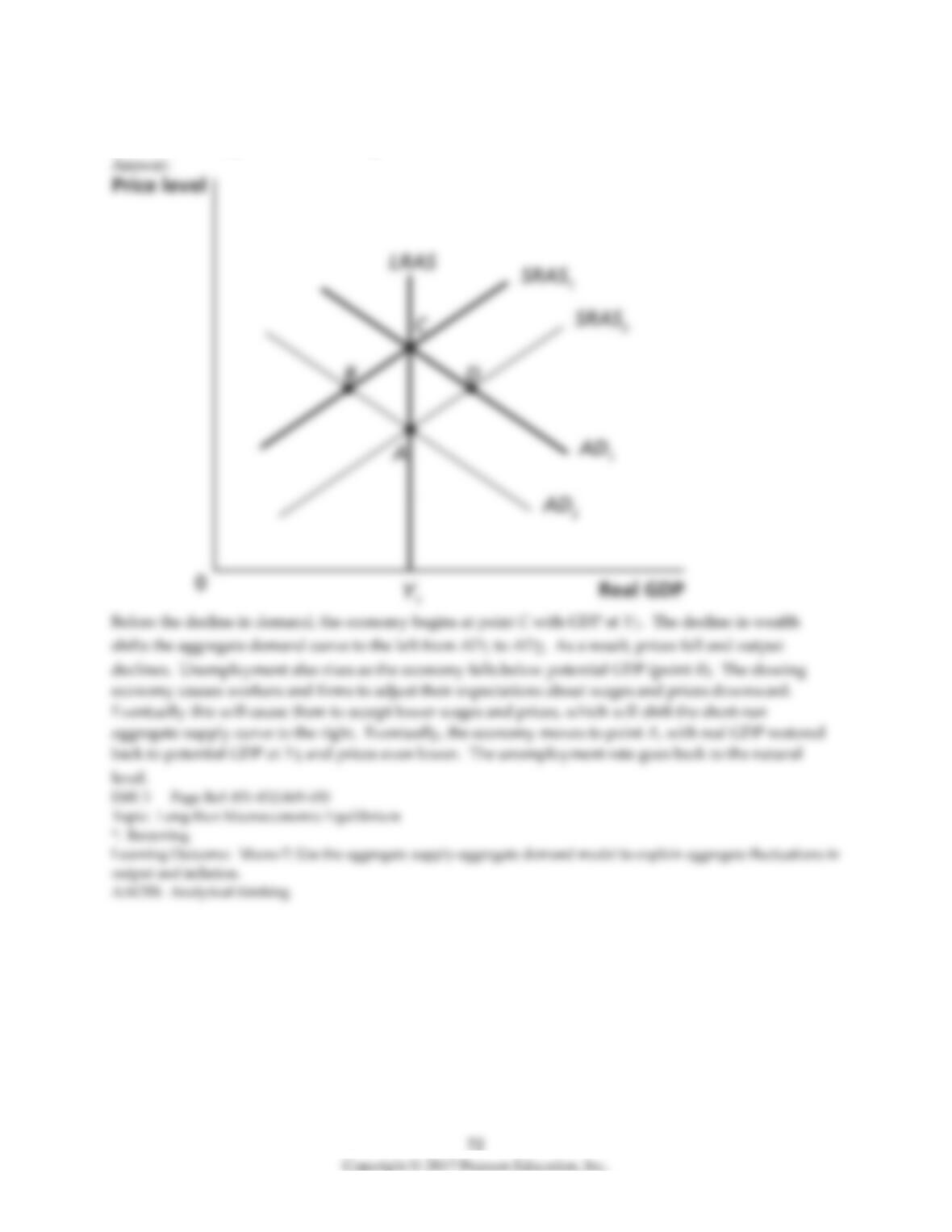
72) Starting from long-run equilibrium, use the basic aggregate demand and aggregate supply diagram
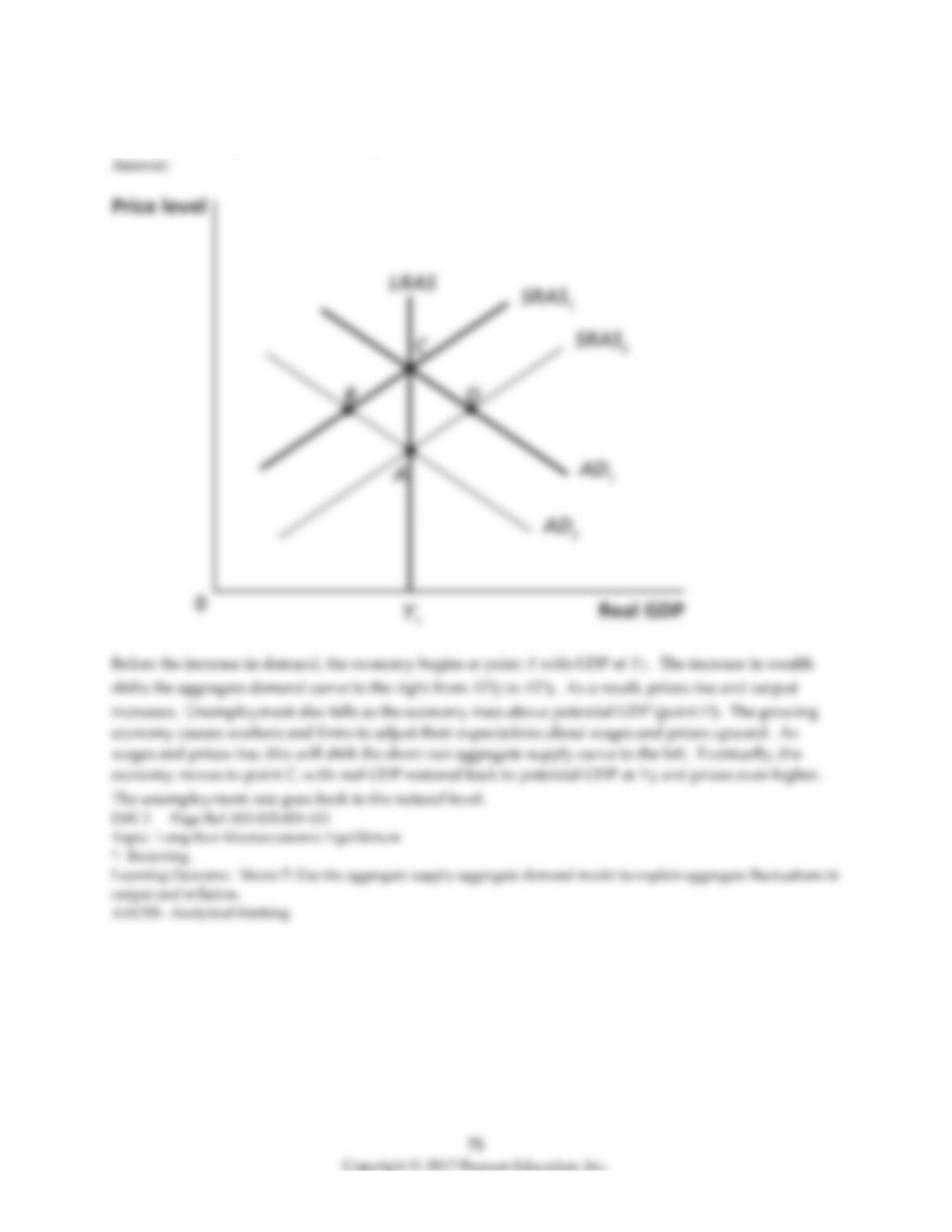
to show what happens in both the long run and the short run when there is a decline in wealth.
73) Beginning with long-run equilibrium, use the aggregate demand and aggregate supply model to
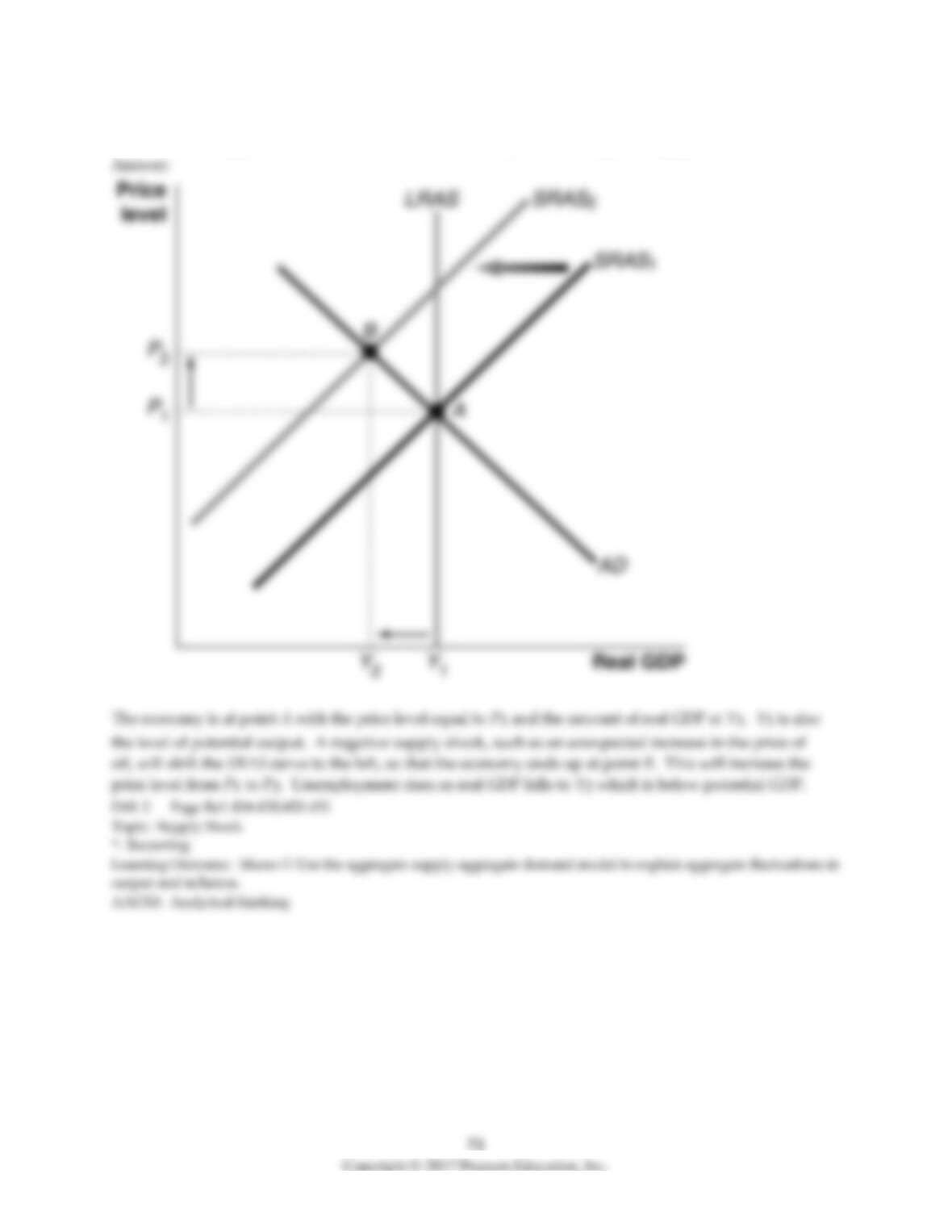
illustrate what happens in the short run when the economy suffers a negative supply shock.
74) Using the aggregate supply and demand model, illustrate what happens in the long run when the
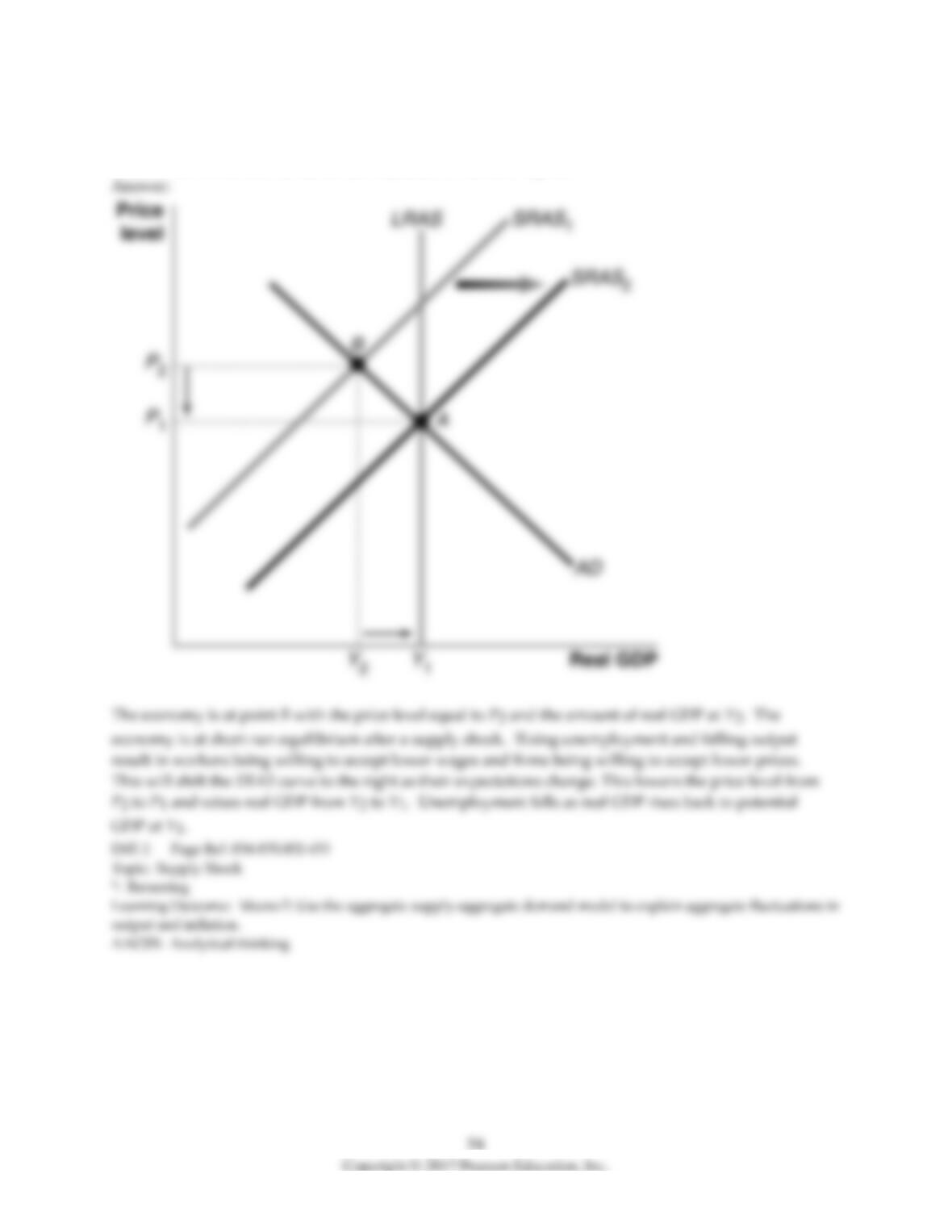
economy suffers a supply shock. Begin your analysis by assuming the economy has suffered the supply
shock in the short run, but has not yet adjusted to it in the long run.
75) Starting from long-run equilibrium, use the basic aggregate demand and aggregate supply diagram
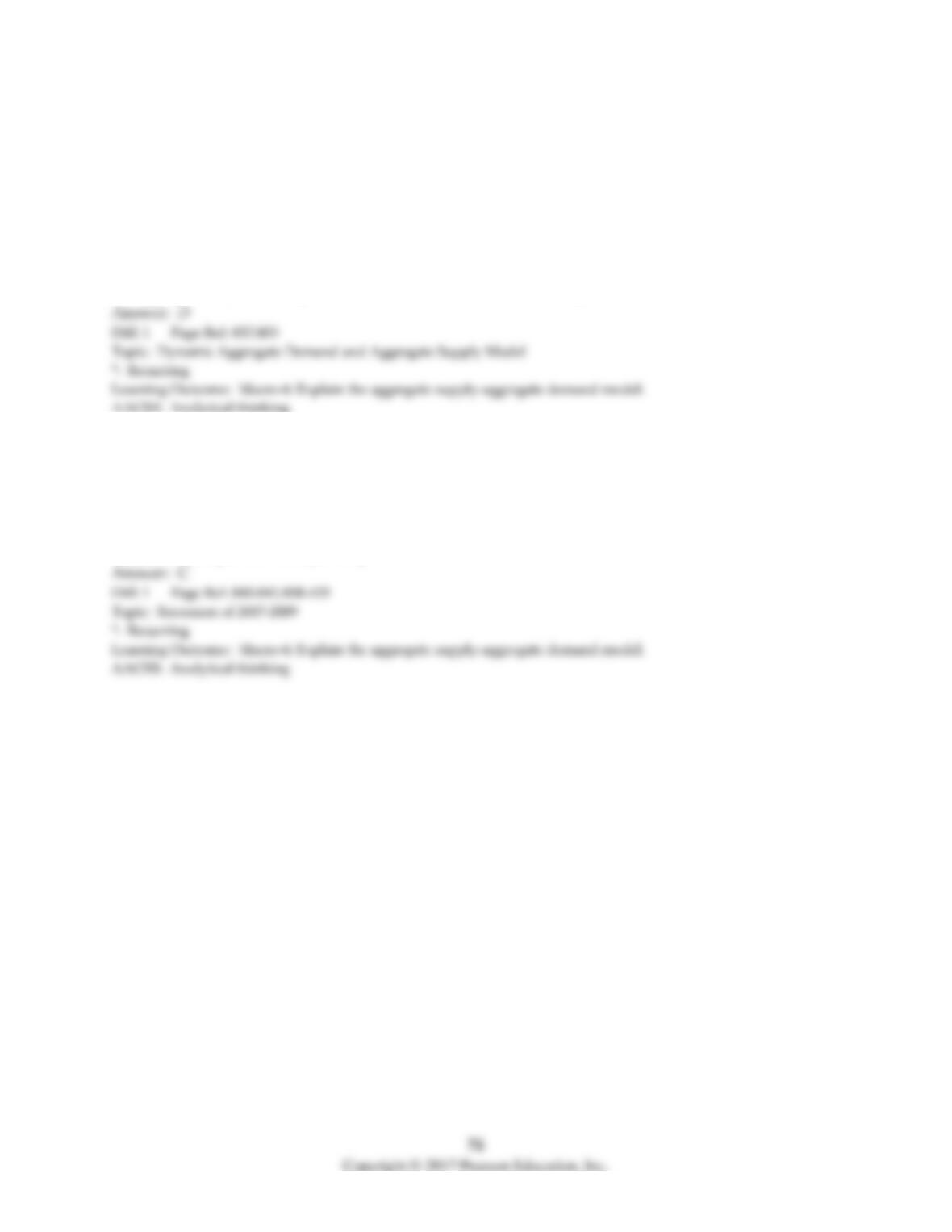
to show what happens in both the long run and the short run when there is an increase in wealth.
13.4 A Dynamic Aggregate Demand and Aggregate Supply Model
1) Which of the following is not an assumption made by the dynamic model of aggregate demand and
aggregate supply?
A) Potential real GDP increases continuously.
B) The aggregate demand curve shifts to the right during most periods.
C) The short-run aggregate supply curve shifts to the right except during periods when workers and
firms expect higher wages.
D) Aggregate demand and potential real GDP decrease continuously.
2) Which of the following is one reason for the decline in aggregate demand that led to the recession of
2007-2009?
A) falling oil prices
B) increases in housing prices
C) the financial crisis
D) a decline in government spending
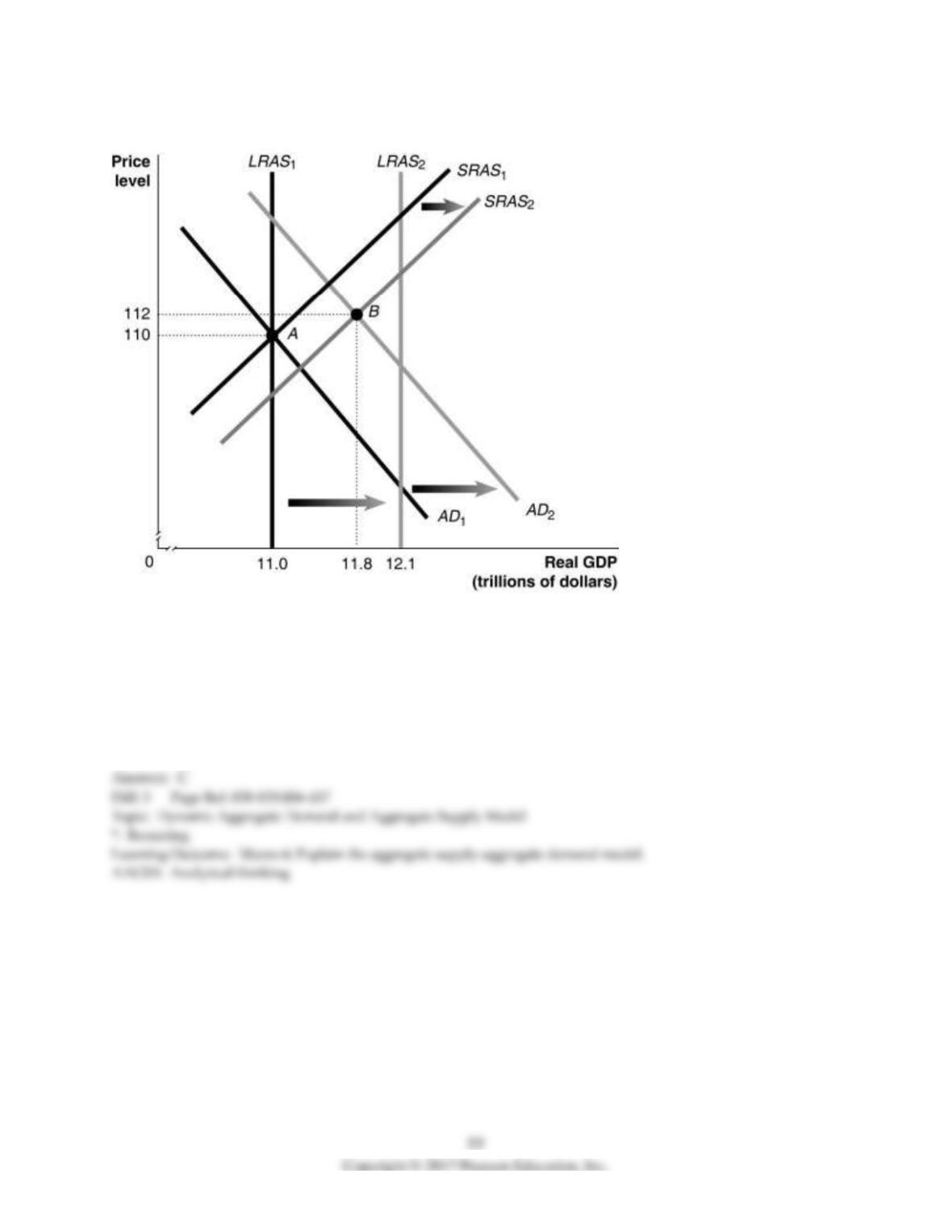
Figure 13-4
3) Refer to Figure 13-4. In the figure above, LRAS1 and SRAS1 denote LRAS and SRAS in year 1, while
LRAS2 and SRAS2 denote LRAS and SRAS in year 2. Given the economy is at point A in year 1, what is
the growth rate in potential GDP in year 2?
A) 8%
B) 9.1%
C) 10%
D) 12%