22) What does the deadweight loss from monopoly measure?
23) “A single-price monopolist charges a higher price and produces more output than a perfectly
competitive industry.” Is the previous statement correct or incorrect? Explain your answer.
24) Compare the outcome in a market with a single-price monopoly to that in a perfectly
competitive market.
25) Explain how a single-price monopoly determines its output and price. Compare this process
to how a perfectly competitive firm determines its output and price.
26) Which creates a larger deadweight loss, perfect competition or a single-price monopoly?
27) How do the price, output, consumer surplus, economic profit, and total surplus for a single-
price monopoly compare to that of a competitive industry?
28) “Compared to a competitive market, a single-price monopoly decreases the consumer surplus
and increases the economic profit.” Is the previous statement correct or incorrect? Explain your
answer.
29) Suppose the government breaks up a single-price monopoly and turns it into a perfectly
competitive industry. What will happen to price and the quantity produced? What will happen to
the monopoly’s economic profit and the deadweight loss associated with the monopoly?
30) What is rent seeking? How does rent seeking affect the deadweight loss from monopoly?
31) “Because of rent seeking, a monopoly may end up making zero economic profit.” Is the
previous statement correct or incorrect? Why?
32) Often to secure a monopoly, one must erect barriers to entry to obtain a monopoly. What is
this activity called in general and what does it entail specifically?
33) What is price discrimination? Give examples of price discrimination.
34) What is price discrimination? Can a perfectly competitive firm price discriminate? Explain
you answer.
35) What are the characteristics of a market that allow a monopolist to successfully price
discriminate between groups?
36) Define price discrimination. What factors must be present in order for a monopolist to price
discriminate? Why do firms price discriminate?
37) Give an example of price discrimination.
38) “Price discriminators lose money by being nice to their customers.” Is the previous statement
correct or incorrect?
39) “Price discrimination allows a monopolist to increase his or her economic profits by
capturing part of the consumer surplus and turning it into economic profit.” Is the previous
statement correct or incorrect? If the statement is correct, why is it important in understanding
firms’ behaviors? If it is incorrect, why is it incorrect?
40) Why do some firms practice price discrimination? Relate your answer to the common
practice of public colleges charging lower tuition to in-state students and higher tuition to out-of-
state students.
41) Compare the consumer surplus in a perfect competition with that of a single-price monopoly
and with a price-discriminating monopoly.
42) What is perfect price discrimination? Is perfect price discrimination efficient? Why or why
not?
43) Even though a perfect price discriminator can extract all of the consumer surplus, how can it
be efficient?
44) Compare and contrast the effect of perfect competition to the effect of perfect price
discrimination on:
a) efficiency.
b) consumer surplus.
c) economic profit in the long run.
45) Which produces more output: a perfectly price discriminating monopoly or a single-price
monopoly?
46) What is a natural monopoly and what problem does natural monopoly pose for regulators?
47) Why are water companies considered a natural monopoly?
48) “A single-price natural monopoly that is regulated to set price equal to marginal cost incurs
an economic loss.” True or false? Explain.
49) “If a natural monopoly is regulated using a marginal cost pricing rule, the firm makes zero
economic profit.” Is the previous statement correct or incorrect?
50) When a natural monopoly is regulated using a marginal cost pricing rule, what can you say
about the firm’s profit and the market’s efficiency?
51) If a natural monopoly is regulated using the marginal cost pricing rule, how does the
regulation affect prices, outputs, profits, and the distribution of surpluses? What are the pros and
cons to this method of regulation?
52) What is an average cost pricing rule? Why do regulatory agencies use it for natural
monopolies?
53) When a natural monopoly is regulated using an average cost pricing rule, what can you say
about the firm’s profit and the market’s efficiency?
54) Why do some utilities have an incentive to exaggerate their costs of production?
55) How can managers of natural monopolies exaggerate their costs?
56) What potential problem is there with rate of return pricing?
57) Describe the main problem with rate of return regulation and name an alternative regulatory
scheme that has been devised to deal with that problem.
58) What incentive does price cap regulation attempt to give the firm? How does it give the firm
this incentive?
59) Explain the difference between price cap regulation in a natural monopoly and the effect of a
price ceiling in a competitive market.
60) Briefly describe and discuss the different ways a natural monopoly can be regulated:
Marginal cost pricing, average cost pricing, rate of return regulation, and price cap regulation.
61) Compare and contrast the marginal cost and average cost pricing rules for regulating natural
monopolies.
62) Electric utilities are often considered natural monopolies and are regulated. When would the
price be highest: when the utility is not regulated, when it is regulated using an average cost
pricing rule, or when it is regulated using a marginal cost pricing rule? When would its price be
lowest?
171
8 Numeric and Graphing Questions
Quantity
(units)
Price
(dollars)
Total revenue
(dollars)
Marginal
revenue
(dollars)
15
0
____
____
13
1
____
____
11
2
____
____
9
3
____
____
7
4
____
____
5
5
____
____
3
6
____
____
1
7
____
____
0
8
____
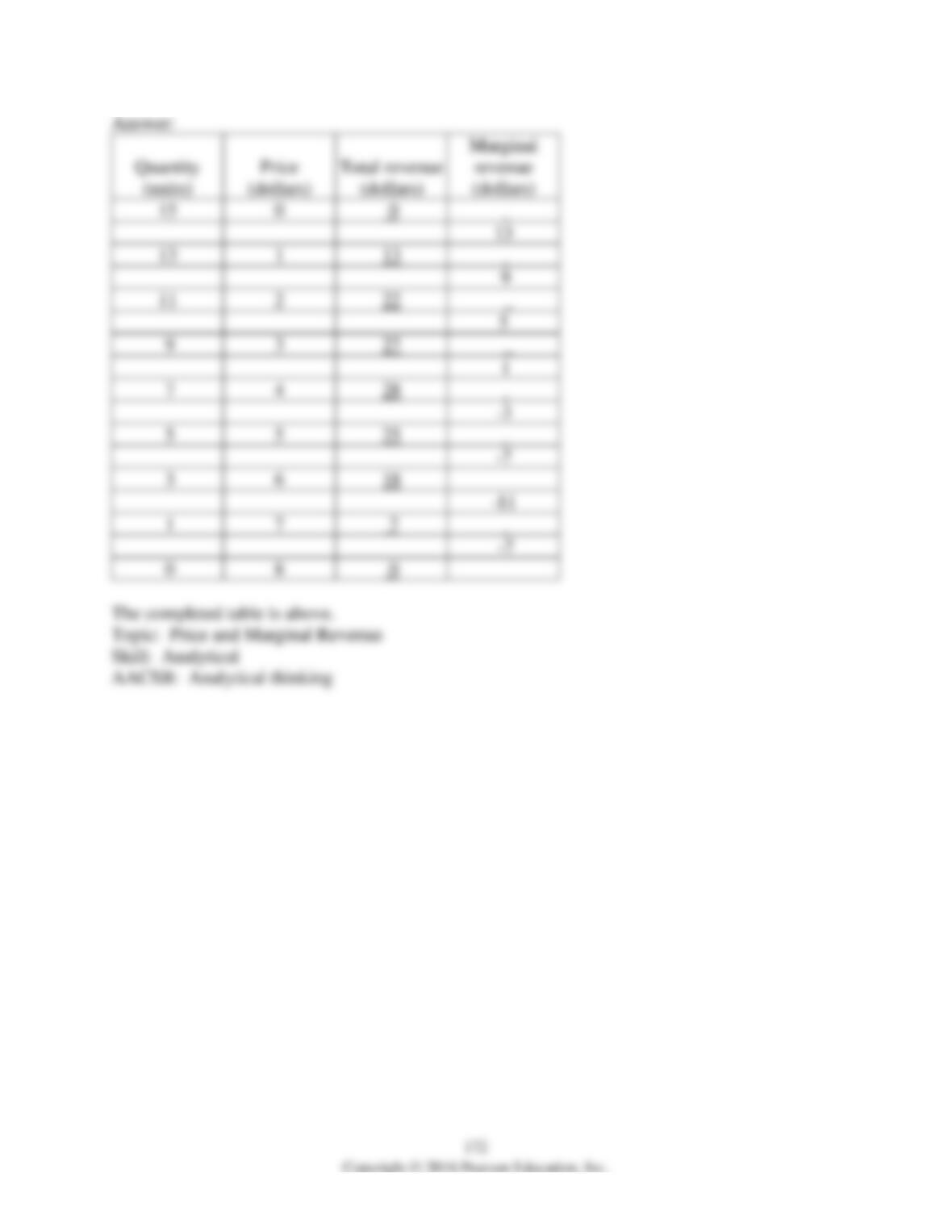
1) The above table gives a monopolist’s demand schedule. Complete the table by calculating the
total revenue and the marginal revenue.
Quantity
(units)
Price
(dollars)
Total revenue
(dollars)
Marginal
revenue
(dollars)
1
6
____
____
2
5
____
____
3
4
____
____
4
3
____
____
5
2
____
____
6
1
____
2) The above table gives a monopolist’s demand schedule. Complete the table by calculating the
total revenue and the marginal revenue.
Quantity
(units)
Price
(dollars)
Total revenue
(dollars)
Marginal
revenue
(dollars)
1
6
6
4
2
5
2
3
4
0
4
3
5
2
6
1
6
174
Quantity
(units)
Price
(dollars)
Marginal
revenue
(dollars)
0
22
____
1
24
____
2
20
____
3
18
____
4
16
____
5
14
____
6
12
____
7
10
____
8
8
3) The demand schedule for a monopolist is given in the above table. Calculate the marginal
revenue.
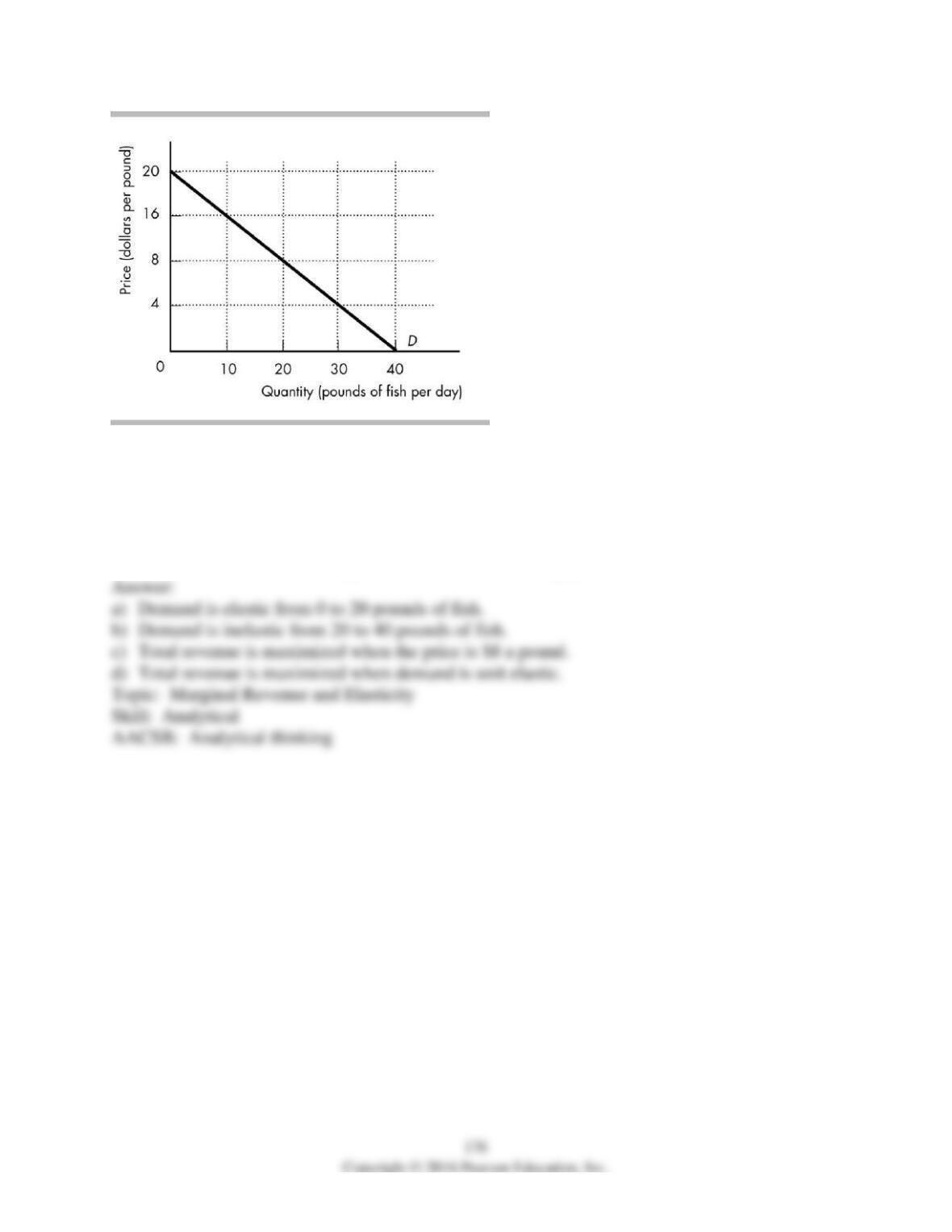
4) The above figure represents the demand and marginal revenue curves for Sue’s Seafood, a
seller of fresh fish.
a) Over what range of output is demand elastic?
b) Over what range of output is demand inelastic?
c) What price maximizes total revenue?
d) What is the demand elasticity at the revenue maximizing price?
Quantity
(units)
Price
(dollars)
Marginal
revenue
(dollars)
Marginal cost
(dollars)
1
22
20
6
2
20
16
8
3
18
12
12
4
16
8
18
5
14
4
28
6
12
0
40
7
10
-4
54
8
8
-8
70
5) A single-price monopolist has the demand and marginal cost schedules given in the above
table. What is the profit-maximizing level of output and price?
178
Price
(dollars per rutabaga)
Quantity demanded
(rutabagas per day)
1
100
2
80
3
60
4
40
5
20
6
0
6) Bob’s Country Bunker is the only restaurant in town that serves fried rutabaga. Bob faces the
demand schedule shown in the table above.
a) What is Bob’s marginal revenue from the 50th rutabaga?
Quantity
(rutabagas per day)
Total cost
(dollars per day)
0
80
20
100
40
120
60
180
80
280
100
420
b) Bob has the cost schedule shown in the table above. Draw the demand curve faced by Bob
and his marginal revenue curve. Draw Bob’s marginal cost curve. If Bob wants to maximize his
profit, how many fried rutabagas should he sell?
c) What price will Bob charge?
d) What is Bob’s economic profit?
e) Bob currently charges $3 per fried rutabaga. Is he maximizing his profit? Why or why not?
7) In the above figure, draw and label the demand and cost curves of a monopoly. Identify the
quantity a single-price monopoly will produce by labeling it Qm and identify the price by
labeling it Pm.