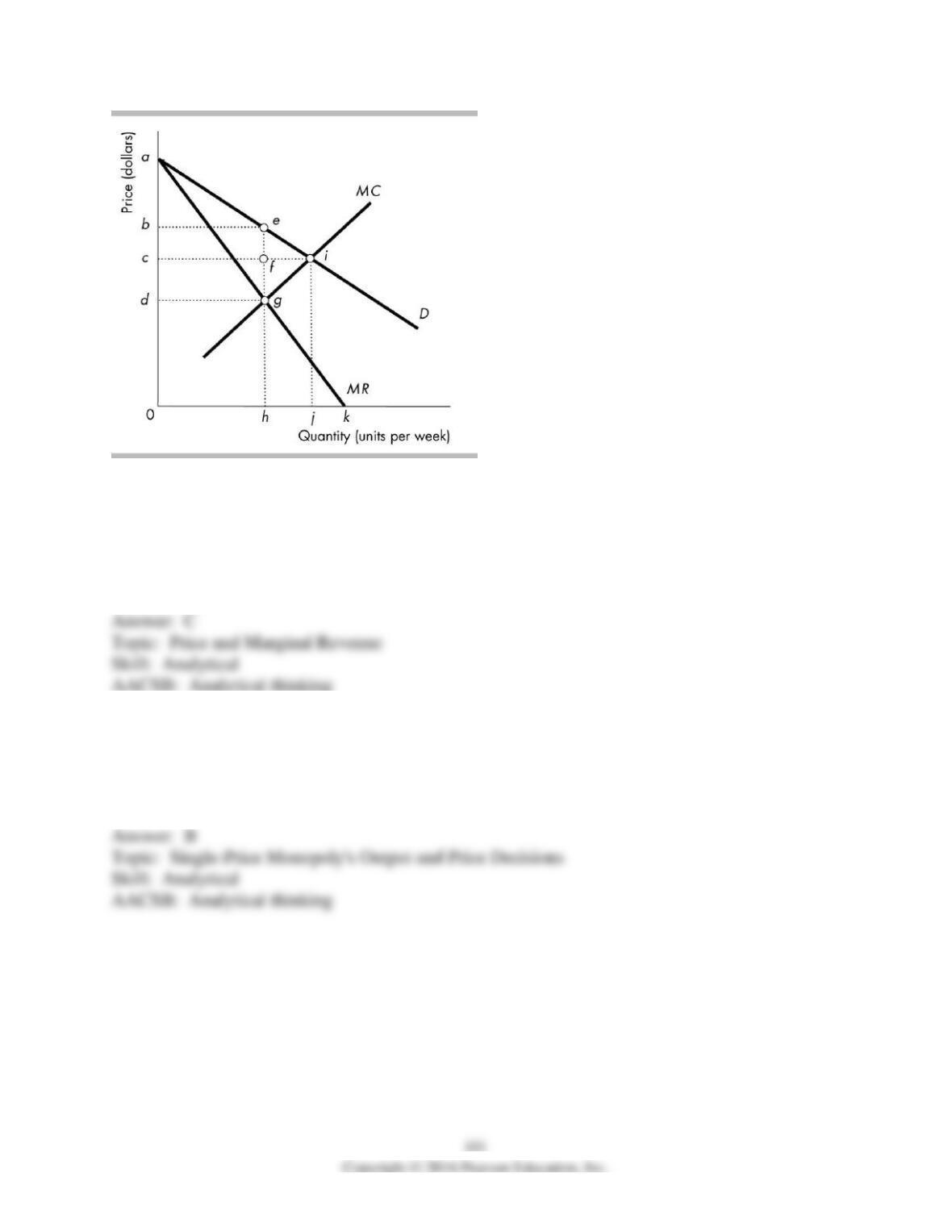
51) In the figure above, the elasticity of demand facing the monopoly equals one when it
produces ________ units of output.
A) h
B) j
C) k
D) none of the above
52) In the figure above, a single-price unregulated monopoly sets a price equal to
A) a.
B) b.
C) c.
D) d.
53) In the figure above, a single-price unregulated monopoly will produce an amount of output
equal to
A) h.
B) j.
C) k.
D) none of the above.
54) In the figure above, if the market is a single-price monopoly rather than a perfectly
competitive industry, the transfer of consumer surplus from consumers to the producer is the area
of
A) trapezoid beic.
B) triangle abe.
C) rectangle begd.
D) rectangle befc.
55) In the figure above, consumer surplus at the price that maximizes the profit for an
unregulated, single-price monopolist is the area of
A) rectangle 0heb.
B) triangle abe.
C) triangle eig.
D) rectangle 0hgd.
56) In the figure above, the deadweight loss when the market is a single-price monopoly rather
than perfectly competitive is the area of
A) triangle aeb.
B) triangle aic.
C) triangle eig.
D) triangle eif.
57) In the figure above, a perfectly price-discriminating monopoly will maximize profit by
producing at amount of output equal to
A) h.
B) j.
C) k.
D) none of the above.
58) In the figure above, the total revenue of a perfectly price-discriminating monopolist at the
profit-maximizing output is equal to the area of
A) 0aij.
B) 0dgh.
C) aci.
D) obeij.
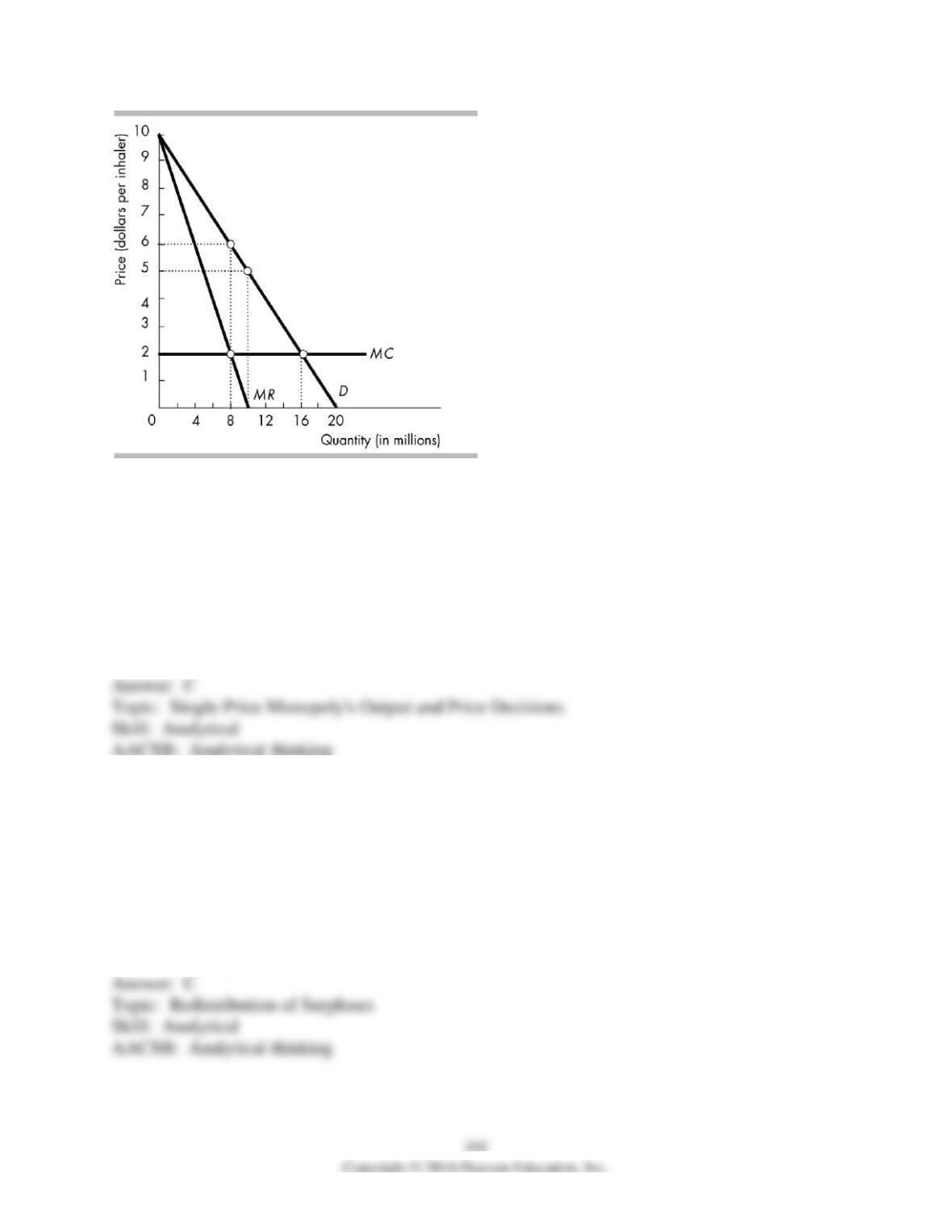
59) Prime Pharmaceuticals has developed a new asthma medicine, for it has a patent. An inhaler
can be produced at a constant marginal cost of $2/inhaler. The demand curve, marginal revenue
curve, and marginal cost curve for this new asthma inhaler are in the figure above. With its
patent giving it a monopoly for its new inhaler, if it is a single-price monopoly, Prime
Pharmaceuticals will produce ________ inhalers and set a price of ________ for each inhaler.
A) 16 million; $2
B) 10 million; $5
C) 8 million; $6
D) 8 million; $2
60) Prime Pharmaceuticals has developed a new asthma medicine, for which is has a patent. An
inhaler can be produced at a constant marginal cost of $2/inhaler. The demand curve, marginal
revenue curve, and marginal cost curve for this new asthma inhaler are in the figure above. With
its patent giving it a monopoly for its new inhaler, if Prime Pharmaceuticals operates as a single-
price monopoly, then consumer surplus is ________ and producer surplus is ________.
A) zero; $64 million
B) $32 million; $32 million
C) $16 million; $32 million
D) $16 million; $48 million.
61) Prime Pharmaceuticals has developed a new asthma medicine, for which it has a patent. An
inhaler can be produced at a constant marginal cost of $2/inhaler. The demand curve, marginal
revenue curve, and marginal cost curve for this new asthma inhaler are in the figure above. With
its patent giving it a monopoly for its new inhaler, if Prime Pharmaceuticals operates as a single-
price monopoly, then there will be a deadweight loss equal to
A) $24 million.
B) zero.
C) $16 million.
D) $32 million.
62) Prime Pharmaceuticals has developed a new asthma medicine, for which it has a patent. An
inhaler can be produced at a constant marginal cost of $2/inhaler. The demand curve, marginal
revenue curve, and marginal cost curve for this new asthma inhaler are in the figure above. With
its patent giving it a monopoly for its new inhaler, if Prime Pharmaceuticals could perfectly price
discriminate, then which of the following is TRUE?
A) It would produce and sell 16 million inhalers.
B) Inhalers would sell for $5 each.
C) Inhalers would sell for $2 each.
D) None of the above answers is correct.
63) Prime Pharmaceuticals has developed a new asthma medicine, for which it has a patent. An
inhaler can be produced at a constant marginal cost of $2/inhaler. The demand curve, marginal
revenue curve, and marginal cost curve for this new asthma inhaler are in the figure above. With
its patent giving it a monopoly for its new inhaler, if Prime Pharmaceuticals could perfectly price
discriminate, then consumer surplus would equal
A) $64 million.
B) $16 million.
C) $32 million.
D) zero.
64) Prime Pharmaceuticals has developed a new asthma medicine, for which it has a patent. An
inhaler can be produced at a constant marginal cost of $2/inhaler. The demand curve, marginal
revenue curve, and marginal cost curve for this new asthma inhaler are in the figure above. With
its patent giving it a monopoly for its new inhaler, if Prime Pharmaceuticals could perfectly price
discriminate, then producer surplus would equal
A) $64 million.
B) $16 million.
C) $32 million.
D) zero.
5 Monopoly Regulation
1) According to social interest theory, ________.
A) price regulations are unconstitutional
B) regulation helps markets achieve efficiency
C) monopoly practices last forever
D) unregulated firms try to avoid creating deadweight loss
2) The social interest theory of regulation assumes that
A) regulations favor voters over producers.
B) regulations promote the attainment of competitive output.
C) public officials seek to keep their jobs.
D) public officials favor consumers over producers.
3) The social interest theory of regulation assumes that
A) regulations promote the attainment of efficiency.
B) regulations promote the attainment of the maximum economic profit.
C) regulators will seek to maximize consumer surplus.
D) public officials seek their own gain through regulation.
4) The social interest theory of regulation predicts that the political process will seek to minimize
A) producer surplus.
B) consumer surplus.
C) total surplus.
D) deadweight loss.
5) The social interest theory of regulation assumes that
A) regulations maximize consumer surplus.
B) regulations set price equal to average total revenue.
C) public officials seek to minimize deadweight loss.
D) public officials seek gain through regulation for only their own constituents.
6) The capture theory holds that regulations are supplied to maximize ________.
A) total sales
B) economic profit
C) marginal product
D) consumer surplus
7) The capture theory of regulation implies that
A) regulations promote the attainment of efficiency.
B) regulations promote the attainment of economic profit.
C) public officials favor voters over producers.
D) the demand for regulation is less elastic than the supply.
8) The social interest theory of regulation suggests that the political process and regulations will
________ and the capture theory of regulation suggests that the political process and regulations
will ________.
A) seek to minimize deadweight loss; serve the interests of the producers
B) try to maximize the producers’ economic profits; seek to minimize deadweight loss
C) be unaffected by deadweight loss; increase the firms economic profits
D) ignore producers’ interests and concentrate on consumers’ interests; seek to minimize firms’
economic profits
9) A natural monopoly occurs when
A) one firm owns all the vital resources needed to produce a particular good.
B) economies of scale allow one firm to supply the entire market at the lowest possible cost.
C) a few firms collude to act as a single firm.
D) one firm captures all the consumer surplus.
10) Today, you might be buying from a regulated natural monopoly when you purchase
A) a car, a truck, or a bicycle.
B) a computer, a phone, or a camera.
C) natural gas or electricity.
D) a house, a condominium, or a plot of land.
11) Customers are most likely buying from a natural monopoly when they purchase
A) aspirin from a generic drug company.
B) a laptop computer from Sony.
C) a glass of water from the local water company.
D) all of the above.
12) Which of the following is definitely NOT an example of a natural monopoly?
A) local water distribution companies
B) urban rail services
C) local electric power and gas distribution companies
D) urban retail stores
13) Which of the following is an example of natural monopoly?
A) cellular phone companies in a large city
B) local water utility companies
C) major league sports franchises in the largest cities
D) All of the above are natural monopolies.
14) In Delaware County, Pennsylvania, all homes, businesses, and other organizations purchase
their water from one seller, Philadelphia Suburban Water Co. (PSWCo). Economists refer to
public utility companies like PSWCo as natural monopolies because their
A) marginal cost curves lie everywhere beneath their average fixed cost curves.
B) marginal cost curves lie everywhere beneath their demand curves.
C) average total cost curves lie everywhere above their demand curves.
D) None of the above answers is correct.
15) If a natural monopoly is broken up into many smaller firms then
A) the price will decrease.
B) the average total costs of production will increase.
C) efficiency will increase.
D) None of the above because it is illegal to break up a natural monopoly into smaller firms.
16) Suppose a firm is a natural monopoly. Then, until the long-run average cost curve crosses the
demand curve, as the quantity increases the long-run average costs
A) increase.
B) decrease.
C) decrease and then increase.
D) increase and then decrease.
17) Which of the following will result in the most deadweight loss?
A) a natural monopoly regulated with marginal cost pricing
B) an unregulated natural monopoly
C) a natural monopoly regulated with average cost pricing
D) All of the above result in the same deadweight loss.
18) A marginal cost pricing rule for a natural monopoly sets ________.
A) price equal to marginal cost and greater than average total cost
B) marginal revenue equal to marginal cost
C) marginal revenue equal to average total cost
D) price equal to marginal cost
19) A natural monopoly regulated with a marginal cost pricing rule results in
A) an economic loss for the regulated firm.
B) an economic profit for the regulated firm.
C) a normal profit for the regulated firm.
D) a deadweight loss.
20) A natural monopoly that is regulated to set its price equal to its marginal cost
A) incurs an economic loss.
B) makes zero economic profit.
C) makes an economic profit.
D) creates the maximum deadweight loss.
21) A natural monopoly that is regulated to set its price according to the marginal cost pricing
rule will
A) incur an economic loss.
B) maximize its profit.
C) produce a quantity of output such that price is above average total cost.
D) produce a quantity of output such that marginal cost is above average total cost.
22) If the regulator require a natural monopoly set its price equal to its marginal cost, that would
ensure
A) an economic profit for the firm.
B) zero economic profit for the firm.
C) an economic loss for the firm.
D) an accounting loss for the firms.
23) What is the drawback of forcing a natural monopolist to use a marginal cost pricing rule?
A) No deadweight loss is eliminated.
B) The firm will incur an economic loss.
C) The gain in consumer surplus will be less than the loss in producer surplus, thus creating
additional deadweight loss.
D) None of the above answers is correct.
24) Which of the following statements regarding a marginal-cost pricing rule for a natural
monopoly is WRONG?
A) It maximizes total surplus in a regulated industry.
B) The firm produces the efficient quantity.
C) The firm’s price equals its marginal cost.
D) The firm makes an economic profit.
25) The Public Service Company of Colorado is a natural monopoly in the transmission and
distribution of electric power. As such, it will incur an economic loss if it
A) goes out of business.
B) prices its services at average total cost.
C) prices its services at marginal cost.
D) all of the above
26) Under a marginal cost pricing rule, a regulated natural monopoly
A) makes a positive economic profit and there is a deadweight loss.
B) makes zero economic profit and there is no deadweight loss.
C) incurs an economic loss and there is a deadweight loss.
D) incurs an economic loss and there is no deadweight loss.
27) In a regulated natural monopoly, a marginal cost pricing rule maximizes
A) total costs.
B) producer surplus.
C) economic profit.
D) total surplus.
28) If the regulator wanted to maximize the total surplus in a natural monopoly market, the
regulator has the firm set its price equal to its
A) average fixed cost.
B) average total cost.
C) average variable cost.
D) marginal cost.
29) Regulation of a natural monopoly will maximize the sum of consumer surplus and producer
surplus if the firm is regulated with
A) an average cost pricing rule.
B) a marginal cost pricing rule.
C) rate of return regulation.
D) All of the above answers are correct.
30) If an industry is a natural monopoly and regulators decide that the firm must price at
marginal cost, then consumers will be ________ off than if the firm was unregulated and the
firm’s owners will be ________ off than if it was unregulated.
A) better; better
B) better; worse
C) worse; better
D) worse; worse
31) For a natural monopoly, if price is equal to marginal social cost, then
A) the deadweight loss is as large as possible.
B) the firm makes zero economic profit.
C) there is no deadweight loss.
D) there is no deadweight loss and the firm makes a positive economic profit.
32) There is no deadweight loss if the regulatory rule for a natural monopoly
A) is an average cost pricing rule.
B) sets price at a level that enables the regulated firm to earn a specified rate of return on its
capital.
C) is a marginal cost pricing rule.
D) prevents the firm from engaging in any form of price discrimination.
33) If the regulator wants to avoid any deadweight loss in a natural monopoly market, the
regulator has the firm set its price equal to its
A) average fixed cost.
B) average total cost.
C) average variable cost.
D) marginal cost.
34) A natural monopoly that charges the profit-maximizing price will produce ________ amount
of output than a ________.
A) a larger; natural monopoly regulated with an average cost pricing rule
B) a more efficient; perfectly competitive industry
C) the same; natural monopoly regulated with a marginal cost pricing rule
D) a smaller; natural monopoly regulated with a marginal cost pricing rule
35) If regulators of the local gas and water utility companies require those firms to price their
service at marginal cost
A) there would be a deadweight loss in their markets.
B) the firms might require a tax-financed subsidy to survive.
C) their customers would enjoy no consumer surplus.
D) None of the above answers are correct.
36) The use of a two-part price in a regulated natural monopoly
A) maximizes the deadweight loss.
B) allows the firm to maximize profits.
C) may make it possible for the firm to obey a marginal cost pricing rule and not go out of
business.
D) All of the above answers are correct.
37) Gene’s Car Wash is a natural monopoly. To wash 100 cars a week, if Gene is unregulated, he
would charge a price of $10. Gene’s long-run average cost for washing 100 cars is $8, his
average variable cost is $6, and his marginal cost is constant at $4. If Gene was regulated using a
marginal cost pricing rule, the price he would be allowed to charge to wash 100 cars is
A) $10.
B) $8.
C) $6.
D) $4.
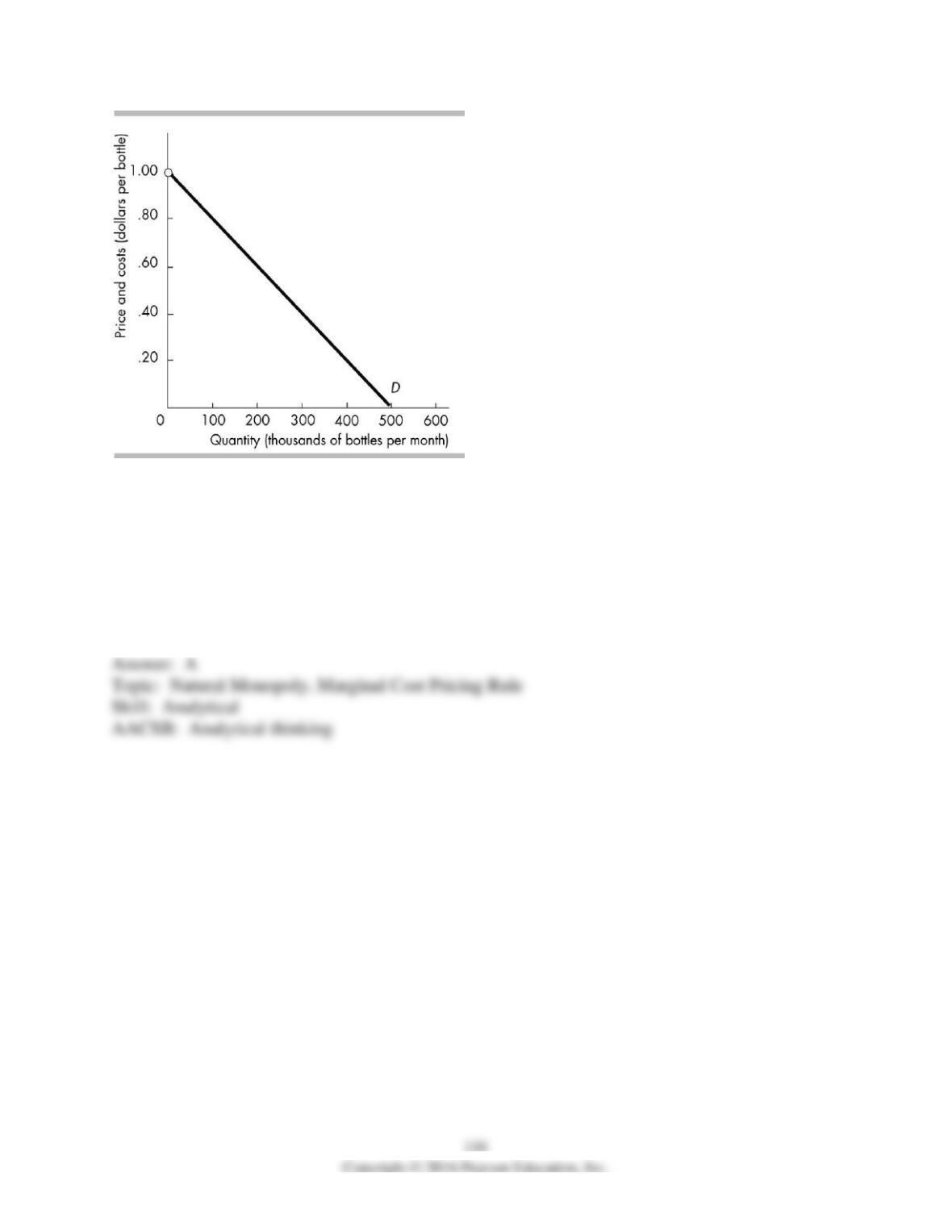
38) Mountain Water is a natural monopoly. The government decides to regulate Mountain Water
by imposing a marginal cost pricing rule. The figure above shows the demand for Mountain
Water. Marginal cost is $0.20 per bottle. The price of a bottle of Mountain Water is ________,
and ________ thousand bottles are sold per month.
A) $0.20; 400
B) $0.50; 250
C) $0.20; 500
D) $1.00; 500
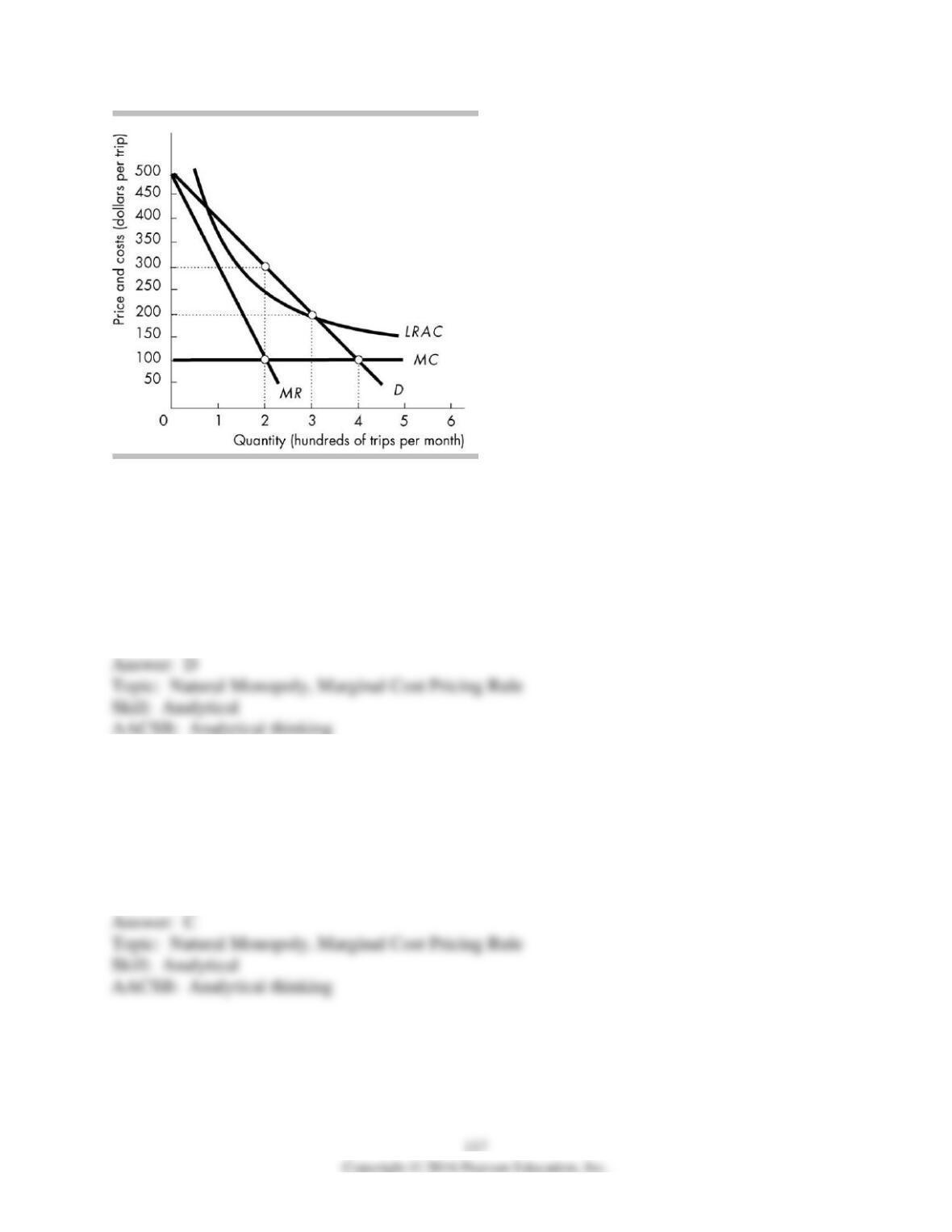
39) The figure above shows the marginal revenue, marginal cost, and demand curves for an
airline offering daily flights between Los Angeles and Toronto. If the airline is regulated using a
marginal cost pricing rule ________ flights will be offered each month at a price of ________
per flight.
A) 200; $300
B) 200; $100
C) 300; $200
D) 400; $100
40) The figure above shows the marginal revenue, marginal cost, and demand curves for an
airline offering daily flights between Los Angeles and Toronto. If the airline is regulated using a
marginal cost pricing rule total surplus will be ________.
A) $100,000
B) $60,000
C) $80,000
D) $20,000
41) For a regulated natural monopoly, an average cost pricing rule sets price equal to
A) average fixed cost.
B) average total cost.
C) average external cost.
D) average variable cost.
42) When an average total cost pricing rule is enforced, average total cost equals ________.
A) marginal revenue
B) total revenue
C) price
D) average total cost
43) When an average cost pricing rule is imposed on a natural monopoly, ________.
A) total surplus is maximized and the monopoly incurs an economic loss
B) the monopoly makes zero economic profit
C) the monopoly makes an economic profit
D) total surplus is maximized and the monopoly makes an economic profit
44) If a natural monopoly has an average cost pricing rule imposed, the rule will
A) maximize total surplus in the regulated industry.
B) generate an economic loss for the regulated firm.
C) reduce the consumer surplus and generate a deadweight loss when compared to a marginal
cost pricing rule.
D) set price below marginal cost.
45) An average cost pricing rule for a natural monopoly sets the price ________ the marginal
cost, thereby ________ a deadweight loss.
A) below; avoiding
B) below; creating
C) above; avoiding
D) above; creating
46) Under an average cost pricing rule, a regulated natural monopoly ________ and there is
________.
A) makes an economic profit; a deadweight loss
B) makes zero economic profit; no deadweight loss
C) makes zero economic profit; a deadweight loss.
D) incurs an economic loss; no deadweight loss
47) Which of the following statements regarding an average-cost pricing rule for a natural
monopoly is WRONG?
A) It sets price equal to average total cost.
B) It is efficient.
C) The firm makes zero economic profit.
D) More output is produced than if the firm maximized profit.
48) A natural monopoly regulated with an average cost pricing rule is ________.
A) efficient and incurs an economic loss
B) inefficient and makes zero economic profit
C) inefficient and makes an economic profit
D) efficient and makes zero economic profit
49) There is a deadweight loss if a natural monopoly is regulated to use
A) marginal cost pricing and if it is regulated to use average cost pricing.
B) average cost pricing and if it is allowed to be unregulated and maximize its profit.
C) marginal cost pricing and if it is allowed to be unregulated and maximize its profit.
D) None of the above answers is correct.
50) A regulated monopoly facing average cost pricing rule will make the same profit as a firm in
________ market does in the long run.
A) an unregulated monopoly
B) an oligopoly
C) a perfectly competitive
D) All of the above answers are correct.