75) Any attempt to capture a consumer surplus, a producer surplus, or an economic profit is
called
A) profit-maximizing.
B) rent-seeking.
C) price discriminating.
D) efficiency gain.
76) Efforts by a firm to obtain a monopoly
A) are called price discrimination.
B) increase consumer surplus.
C) are called rent seeking.
D) are called price taking.
77) Activity aimed at creating artificial barriers to entry into a particular market
A) is rent seeking.
B) has no social cost.
C) improves competition.
D) improves the economy’s efficiency.
78) An attempt by a firm to create a monopoly and gain the economic profit from the monopoly
is called
A) collusion.
B) intrusion.
C) profit seeking.
D) rent seeking.
79) ________ is defined as any attempt to capture consumer surplus, producer surplus or
economic profit.
A) Search
B) Rent seeking
C) Maximizing monopoly profits
D) Price discrimination
80) When a person lobbies Congress to grant the person the exclusive right to sell a particular
good, such lobbying activity is called
A) rent seeking.
B) revenue abatement.
C) profit recovery.
D) revenue seeking.
81) Rent seeking is best defined as attempts
A) by landlords to get tenants.
B) to achieve monopoly power and the resulting economic profit.
C) by individuals to avoid paying taxes.
D) by owners of a monopoly to sell the firm.
82) Methods of rent seeking include which of the following?
I. Buying a monopoly
II. Creating a monopoly
III. Price discrimination
A) I and II
B) I and III
C) II and III
D) III only
83) Rent seeking is devoted to the creation of
A) monopolies.
B) competitive industries.
C) human capital.
D) more elastic demand.
84) The attempt to capture consumer surplus, producer surplus, or economic profit is called
________.
A) a natural monopoly
B) price discrimination
C) rent seeking
D) gouging
85) Rent seeking
A) increases the social cost of monopoly.
B) frees scarce resources that could otherwise have been employed in the production of goods
and services.
C) cannot take the form of lobbying for government imposed import restrictions.
D) None of the above answers are correct.
86) Rent seeking
A) is an additional social cost of monopoly.
B) is only a problem in the commercial real estate market.
C) helps employ resources that would otherwise be unemployed.
D) is beneficial to society.
87) Rent seeking through lobbying
A) reduces deadweight loss.
B) uses up resources that result in additional costs to society.
C) results in perfect price discrimination.
D) results in perfectly competitive industries.
88) The maximum amount a rent seeker would pay for a monopoly is the ________.
A) market price
B) deadweight loss
C) monopoly’s economic profit
D) monopoly’s normal profit
89) Rent seeking ________.
A) increases consumer surplus
B) occurs only when the firm practices perfect price discrimination
C) increases deadweight loss
D) results in a larger output than a competitive industry would produce
90) With rent seeking by a monopoly
A) the monopolist’s average total costs will increase so that its average total cost curve is tangent
to the demand curve at the profit-maximizing price.
B) a monopoly uses all of what would be its economic profit to prevent other firms from taking
its economic rent.
C) the full deadweight loss of monopoly is larger than in the absence of rent seeking.
D) All of the above answers are correct.
91) Buying a monopoly from the existing owner does not ensure an economic profit because
A) the market for monopolies is a monopoly.
B) competition among buyers drives up the cost of buying the firm.
C) profits equal zero in the long run anyway.
D) of the deadweight loss triangle.
92) The value of resources devoted to rent seeking will
A) at most equal the monopoly’s economic profit.
B) reduce deadweight loss.
C) reduce consumer surplus.
D) raise output to an efficient level.
93) Because of a decrease in labor costs, a monopoly finds that its marginal cost and average
total cost have decreased. The monopoly ________ its price and ________ its quantity.
A) raises; increases
B) raises; decreases
C) lowers; increases
D) lowers; decreases
94) Compared to a single-price monopoly, the output of a perfectly competitive market with the
same costs
A) is more than the monopoly’s output.
B) is the same as the monopoly’s output.
C) is less than the monopoly’s output.
D) could be more than, less than, or equal to the monopoly’s output.
95) Compared to a single-price monopoly, the price charged by a perfectly competitive market
with the same costs
A) is higher than the monopoly’s price.
B) is the same as the monopoly’s price.
C) is lower than the monopoly’s price.
D) could be higher than, lower than, or the same as the monopoly’s price.
96) If a perfectly competitive market becomes a monopoly and the costs do not change, which of
the following allocations of costs and benefits applies?
A) The producer benefits, but consumers and society are harmed.
B) The producer and society are harmed, but consumers benefit.
C) The producer and society benefit, but consumers are harmed.
D) The producer is harmed, but consumers and society benefit.
97) Of the following, consumer surplus is largest for
A) a perfectly competitive industry.
B) a single-price monopoly.
C) any price-discriminating monopoly.
D) a perfectly price-discriminating monopoly.
4 Price Discrimination
1) Joe, a hair dresser, offers students a discount price on haircuts. This form of pricing is an
example of
A) a marginal cost pricing rule.
B) an average cost pricing rule.
C) price discrimination.
D) perfect price discrimination.
2) Price discrimination takes place when a firm
A) charges the same price for all the units of its product that it sells.
B) charges different prices for different units of its product.
C) is discriminated against by consumers.
D) None of the above answers is correct.
3) Which of the following is NOT necessary for a firm to engage in price discrimination?
A) The firm must be able to identify different types of buyers.
B) The firm must be able to separate buyers by preventing resales from one customer to another.
C) The firm must produce output for different buyers at different costs.
D) The firm must sell a product that cannot be resold.
4) A monopoly can price discriminate between two groups of consumers if each group has
________.
A) a large consumer surplus
B) a different willingness to pay
C) the same willingness to pay
D) the ability to resell the good to the other group
5) Which of the following is necessary for a monopolist to price discriminate between groups?
A) The groups are identifiable.
B) The groups have different willingness to pay.
C) A customer from one group cannot resell to a customer in another group.
D) All of the above conditions are necessary for the monopolist to price discriminate.
6) In order to be able to price discriminate and maximize profit, a monopolist must be able to do
all of the following EXCEPT
A) identify and separate different buyer types.
B) sell a product that cannot be resold.
C) identify competitors.
D) determine the output where marginal revenue equals marginal cost.
7) What condition must exist for a monopolist to effectively price discriminate?
A) The monopolist must face consumers with identical willingness to pay.
B) The monopolist must produce a good or service that can be resold.
C) The monopolist must produce a good that cannot be resold.
D) The monopolist must charge the highest price possible.
8) Price discrimination
A) is common in perfectly competitive markets.
B) is more likely for services than for goods that can be stored and resold.
C) is illegal because it always violates antitrust laws.
D) works only if all groups of demanders have the same price elasticity of demand for the
product.
9) Price discrimination by a monopolist is less effective if the
A) good can be resold.
B) good has no substitutes.
C) monopolist can identify buyers by willingness to pay.
D) good cannot be resold.
10) Price discrimination, where different units of a good are sold for different prices
A) is impossible because there can only be one market price.
B) can be effectively practiced by all monopolists.
C) maximizes consumer welfare because each consumer pays only the price he or she is willing
to pay.
D) is possible if the good cannot be resold.
11) It is easier for a monopolist to price discriminate between groups for a service than for a
good because
A) it is easier to calculate average willingness to pay for services.
B) it is easier to distinguish between groups of customers for services than customers for goods.
C) it is easier for consumers to resell goods than resell services.
D) customers for goods usually do not differ with respect to their average willingness to pay.
12) Price discrimination by a monopoly
A) increases consumer surplus.
B) decreases consumer surplus.
C) increases the firm’s profit.
D) Both answers B and C are correct.
13) Price discrimination
A) eliminates the producer surplus.
B) turns consumer surplus into producer surplus.
C) decreases output below the profit-maximizing level.
D) lowers a monopoly’s economic profit.
14) Price discrimination
A) converts consumer surplus into producer surplus.
B) converts producer surplus into economic profit.
C) maximizes the difference between consumer surplus and producer surplus.
D) converts deadweight loss into consumer surplus.
15) A price discriminating monopolist
A) produces more output than that produced by a single-price monopolist.
B) has a lower marginal cost than that incurred by a single-price monopolist.
C) makes a smaller economic profit than that earned by the single-price monopolist.
D) makes zero economic profit in the long run.
16) Compared to a single-price monopolist, a price-discriminating monopolist
A) produces more output.
B) produces the same amount of output but charges a higher price.
C) generates a larger deadweight loss.
D) produces less output but charges a lower price.
17) A price discriminating monopolist charges lower prices to customers with
A) lower supply elasticities.
B) higher supply elasticities.
C) lower willingness to pay.
D) higher willingness to pay.
18) Monopolists are able to price discriminate because
A) of differing willingness to pay among consumers.
B) of differing price elasticities of supply.
C) they have constant marginal cost.
D) they have constant average cost.
19) Donna owns the only dog grooming salon on Lonely Island. If Donna can price discriminate
between dog owners who are seniors and those who are not, her economic profit will be
________ than if she does not price discriminate and the number of dog groomings will be
________ than if she does not price discriminate.
A) greater; more
B) greater; less
C) less; more
D) less; less
20) The more perfectly a monopoly can price discriminate, the
A) smaller its output and the lower its profits.
B) smaller its output and the greater its profits.
C) larger its output and the lower its profits.
D) larger its output and the greater its profits.
21) Which of the following occurs with both perfectly price discriminating and single-price
monopolies?
A) The amount of output is inefficient.
B) All consumer surplus goes to the monopoly.
C) Deadweight loss is created.
D) There is a redistribution of consumer surplus to the monopoly.
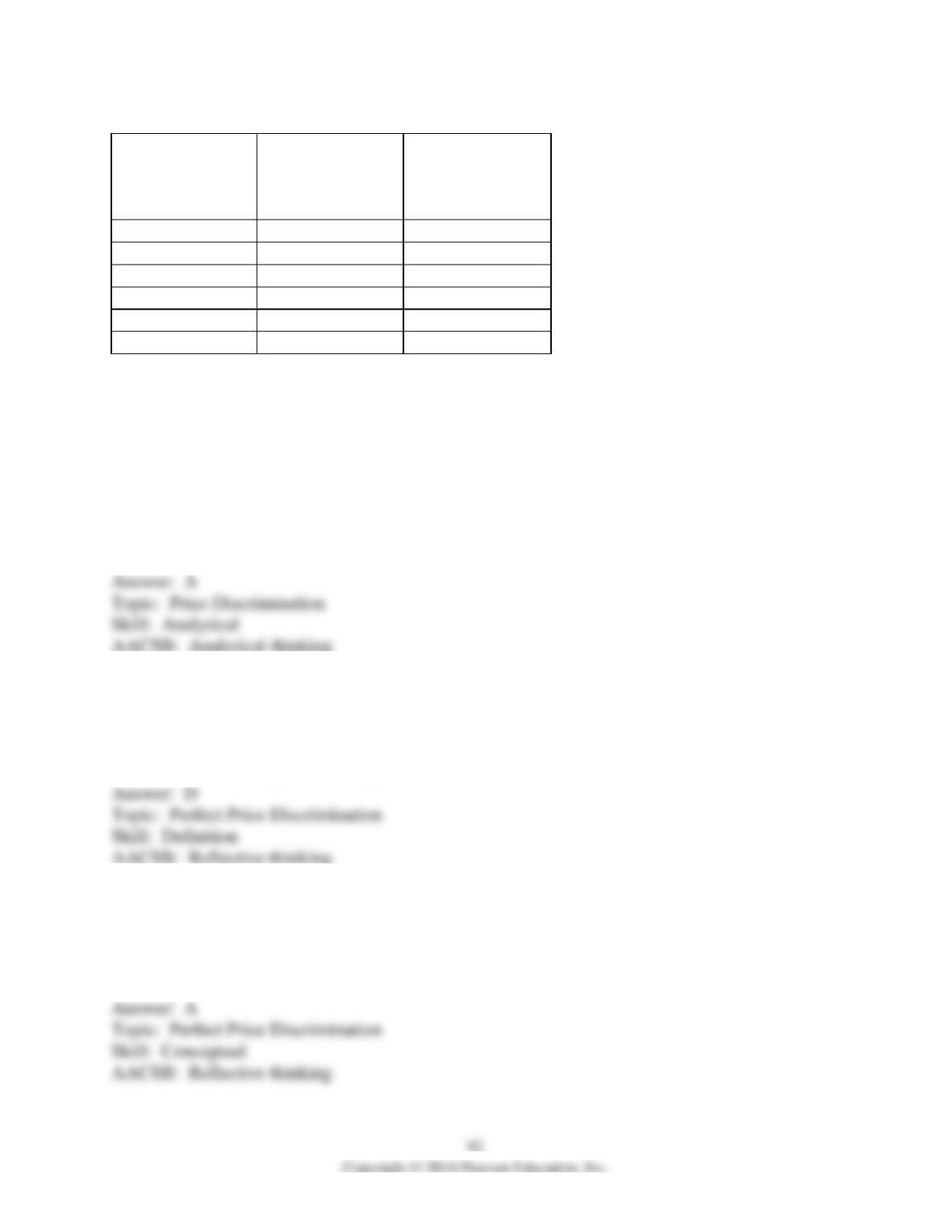
Price
(dollars per movie)
Quantity
demanded,
weekend
(movies per week)
Quantity
demanded,
weekday
(movies per week
18
0
0
15
100
0
12
200
0
9
300
100
6
400
200
3
500
300
22) Roxie’s Movie Theatre has a monopoly and discovers that at $12 a movie, no one is buying
movie tickets during weekdays. Roxie’s conducts a survey and the table above reveals the results
of the survey. Roxie decides to price discriminate between weekend and weekday moviegoers.
The marginal cost of a showing a movie is $6. Roxie’s charges ________ on weekdays and
________ on weekends.
A) $9; $12
B) $6; $15
C) $6; $18
D) $3; $12
23) If a monopolist can perfectly price discriminate, it will
A) charge the same price for each unit sold.
B) produce until price elasticity of demand equals one.
C) not be concerned with the market demand.
D) charge a different price for every unit sold.
24) A perfect price discriminator
A) charges the maximum price for each unit that consumers are willing to pay.
B) is able to convince consumers to pay more for each unit than they are willing to pay.
C) is unable to make an economic profit.
D) disregards the market demand curve.
25) Which of the following is TRUE for a perfect price-discriminating monopoly?
A) P = MR for each unit sold
B) P = ATC for each unit sold
C) P = MC for each unit sold
D) P > MC for each unit sold
26) If a monopolist can perfectly price discriminate, then
A) price equals average cost for each unit sold.
B) price equals marginal cost for each unit sold.
C) price equals marginal cost for the last unit sold.
D) the firm can ignore the marginal cost curve.
27) For a monopoly able to practice perfect price discrimination, the market
A) supply curve is the same as the marginal cost curve.
B) supply curve is the same as the marginal revenue curve.
C) demand curve is the same as the marginal cost curve.
D) demand curve is the same as the marginal revenue curve.
28) If a monopolist can perfectly price discriminate, then
A) it will charge just two different prices in two different markets.
B) it will not give a discount to those who buy in bulk.
C) the deadweight loss is larger than if it cannot price discriminate.
D) there will be no consumer surplus.
29) When a monopoly perfectly price discriminates, there is ________.
A) no producer surplus
B) an increase in supply
C) no consumer surplus
D) a large consumer surplus
30) Perfect price discrimination
A) turns all the producer surplus into consumer surplus.
B) turns all the consumer surplus into economic profit.
C) creates a deadweight loss.
D) cannot result in profit maximization.
31) Which of the following is TRUE about a perfect price discriminating monopolist?
A) There is inefficiency.
B) All consumers pay a price equal to marginal cost.
C) There is no consumer surplus.
D) There is zero economic profit.
32) Which of the following differs between a perfectly competitive market and a market with a
perfectly price discriminating monopoly?
A) The amount of producer surplus
B) The quantity produced
C) The total surplus
D) None of the above because they are all the same in a perfectly competitive market and in a
market with a perfectly price discriminating monopoly.
33) A perfect price discriminating monopoly produces the same quantity of output as a
________.
A) single-price monopoly but charges a higher price
B) perfectly competitive market
C) perfectly competitive firm
D) perfectly competitive market but charges a lower price
34) In the case of a perfectly price-discriminating monopoly, there is no
A) transfer of consumer surplus to the producer.
B) deadweight loss.
C) producer surplus.
D) economic profit.
35) Which of the following statements regarding perfect price discrimination is FALSE?
A) Only part of consumer surplus is captured by the firm as producer surplus.
B) For the firm, the market demand curve becomes the firm’s marginal revenue curve.
C) The monopoly produces the output at which the marginal revenue equals the marginal cost.
D) No deadweight loss is created.
36) An efficient use of resources occurs when
A) there is a deadweight loss.
B) the total social benefit of a good equals its total social cost.
C) there is perfect price discrimination by a monopoly.
D) there is no producer surplus.
37) Which of the following is TRUE about a perfect price discriminating monopolist?
A) Price is greater than marginal revenue.
B) Price always exceeds marginal cost.
C) The firm makes zero economic profit.
D) The firm produces the efficient level of output.
38) Which of the following statements is TRUE?
A) Perfectly competitive markets are efficient, but monopoly markets never are efficient.
B) Perfectly competitive markets always reach equilibrium but monopoly markets never reach
equilibrium.
C) Perfect price discriminating monopolists can eliminate all deadweight losses and achieve
efficiency.
D) All the above statements are true.
39) In the case of a perfectly price-discriminating monopoly, there is no
A) transfer of consumer surplus to the producer.
B) deadweight loss.
C) short-run economic profit.
D) long-run economic profit.
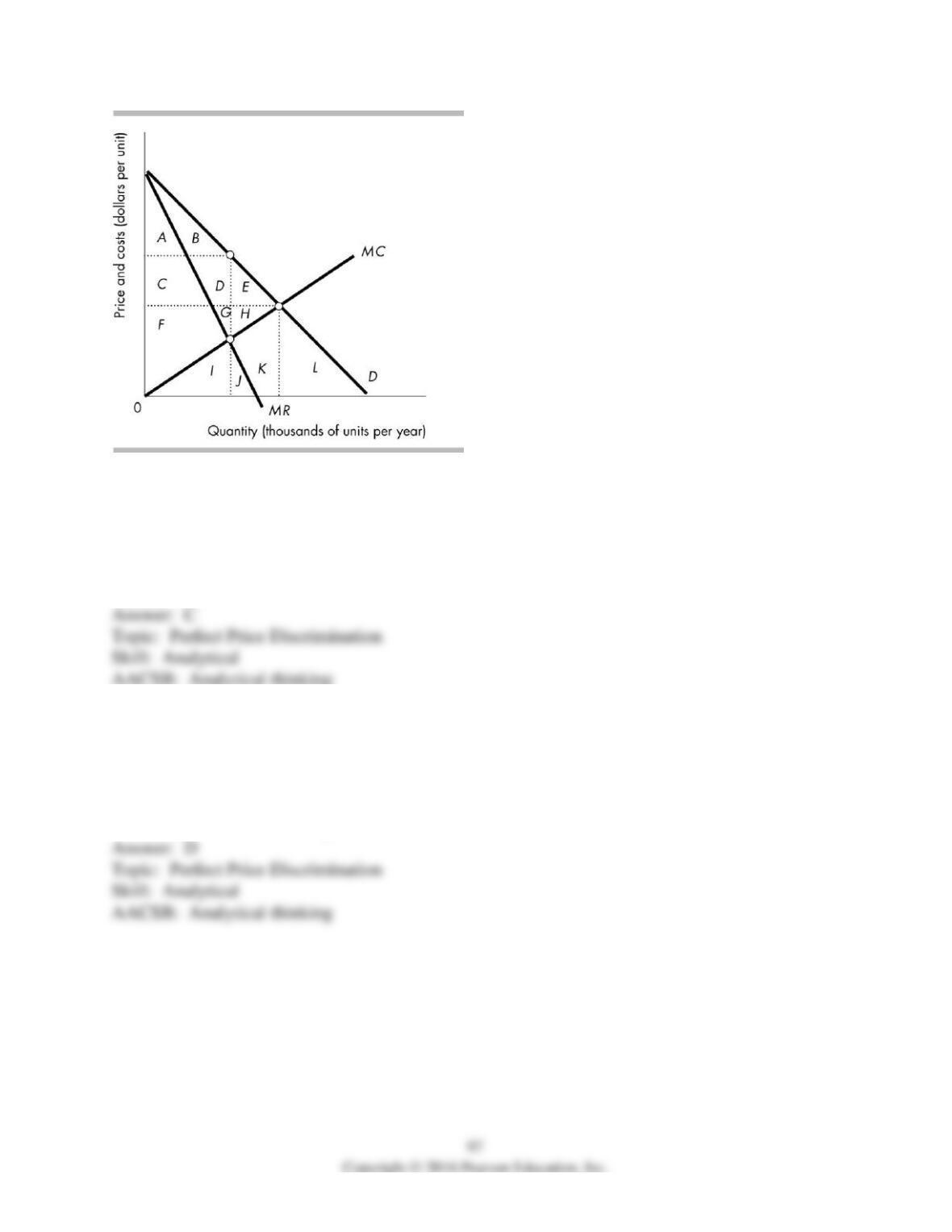
40) Which area in the above figure equals the producer surplus under perfect price
discrimination?
A) A + B + C + D + E + F + G + H + I + J + K + L
B) A + B + C + D + E + F + G + H + I + J + K
C) A + B + C + D + E + F + G + H
D) C + D + E + F + G + H
41) Which area in the above figure equals the consumer surplus under perfect price
discrimination?
A) A + B + C + D + E + F + G + H
B) A + B + C + D + E
C) A + B
D) There is no consumer surplus.
Demand Schedule Facing a
Perfectly Price Discriminating Firm
Price
(dollars)
Quantity Sold
8
0
7
1
6
2
5
3
4
4
3
5
2
6
1
7
42) Using the demand schedule in the above table, if the firm’s marginal cost is constant at $3.00,
output for a perfectly price discriminating monopolist is
A) 2 units.
B) 3 units.
C) 4 units.
D) 5 units.
43) Using the demand schedule in the above table, the marginal revenue for a perfectly price
discriminating monopolist from the sale of the third unit of output is
A) $3.
B) $4.
C) $5.
D) $6.
44) Using the demand schedule in the table above, the total revenue a perfectly price
discriminating monopolist receives from selling 5 units of output is
A) $5.
B) $15.
C) $18.
D) $25.
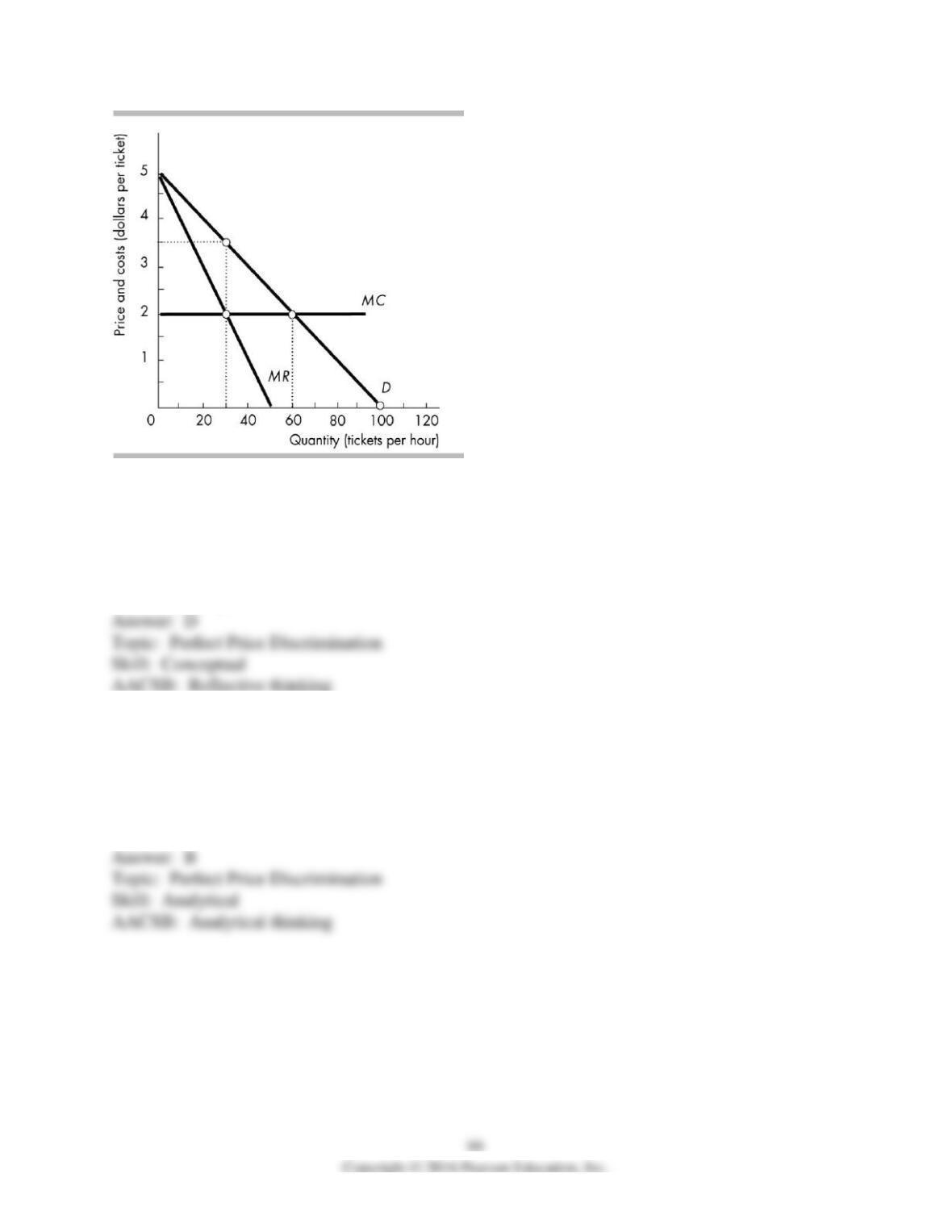
45) If the monopoly illustrated in the figure above could engage in perfect price discrimination,
then each buyer would pay
A) $2.00.
B) $3.00.
C) $3.50.
D) a different price.
46) If the monopoly illustrated in the figure above could engage in perfect price discrimination,
then the lowest ticket price would be
A) $1.00.
B) $2.00.
C) $3.00.
D) $3.50.
47) If the monopoly illustrated in the figure above could engage in perfect price discrimination,
then it would sell
A) 30 tickets.
B) 50 tickets.
C) 60 tickets.
D) 100 tickets.
48) If the monopoly illustrated in the figure above could engage in perfect price discrimination,
then when it maximizes its profit the total revenue collected by the firm would be
A) $110.
B) $120.
C) $210.
D) $310.
49) In the figure above, what is the loss of consumer surplus if the firm is a perfectly price-
discriminating monopoly instead of a perfectly competitive industry?
A) $0
B) $22.50
C) $45.00
D) $90.00
50) If the monopoly illustrated in the figure above could engage in perfect price discrimination,
the deadweight loss would be
A) $0.
B) $22.50.
C) $90.00.
D) $250.00.