15) A deadweight loss occurs whenever
A) the total benefit of a good does not equal its total cost.
B) the marginal social benefit of a good does not equal its marginal social cost.
C) there is perfect price discrimination.
D) there is no consumer surplus.
16) Which of the following markets will have the largest deadweight loss?
A) A market that consists of perfectly competitive firms.
B) A market that consists of a single-price monopoly.
C) A market that consists of a perfect price discriminating monopoly.
D) None of the above. There is no deadweight loss as long as firms produce at the level of output
where marginal revenue equals marginal cost.
17) A single-price monopolist is inefficient because
A) MR = MC.
B) P > ATC.
C) it creates a deadweight loss.
D) it increases producer surplus.
18) Economists are critical of monopoly because
A) monopolists can earn long-run economic profit.
B) monopolists can create a deadweight loss.
C) the demand for the monopolist’s product is the market demand curve.
D) economies of scope result in lower average costs.
19) Compared to a similar perfectly competitive industry, a single-price monopoly
A) creates a deadweight loss and decreases economic profit.
B) produces more output.
C) creates a deadweight loss and decreases consumer surplus.
D) is more efficient because there is no wasteful competition.
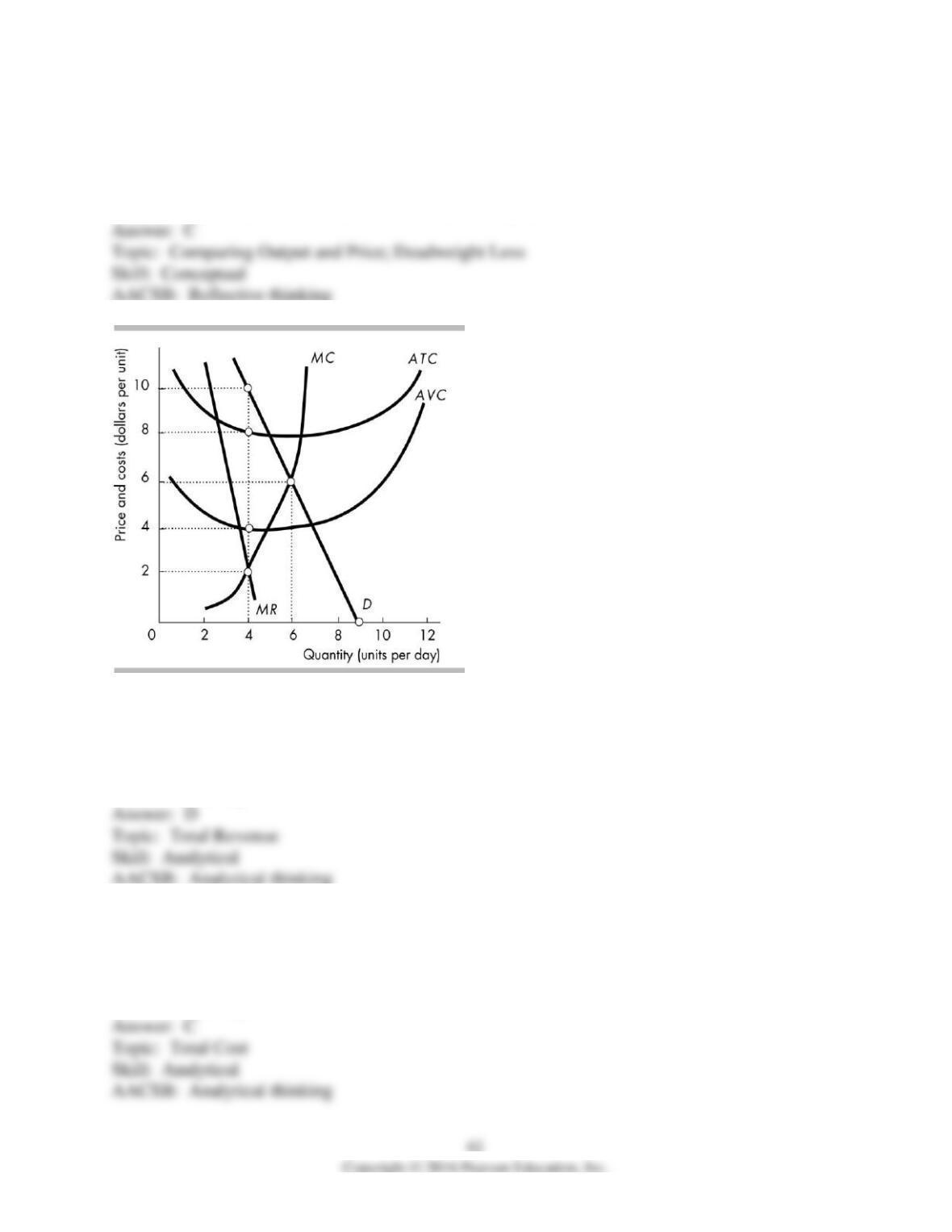
20) The unregulated, single-price monopolist illustrated in the figure above has a total revenue of
A) $8.00 per day.
B) $16.00 per day.
C) $36.00 per day.
D) $40.00 per day.
21) The unregulated, single-price monopolist illustrated in the figure above has a total cost of
A) $8.00 per day.
B) $16.00 per day.
C) $32.00 per day.
D) $40.00 per day.
22) The unregulated, single-price monopolist illustrated in the figure above makes an economic
profit of
A) zero.
B) $8.00 per day.
C) $10.00 per day.
D) $40.00 per day.
23) The unregulated, single-price monopolist illustrated in the figure above will produce
A) 0 units per day.
B) 4 units per day.
C) 6 units per day.
D) 9 units per day.
24) In the figure above, compared to a perfectly competitive industry with the same costs, a
single-price, unregulated monopoly will decrease production by
A) zero.
B) 2 units per day.
C) 4 units per day.
D) 6 units per day.
25) The unregulated, single-price monopolist illustrated in the figure above will set a price of
A) $2.00 per unit.
B) $6.00 per unit.
C) $8.00 per unit.
D) $10.00 per unit.
26) In the figure above, compared to a perfectly competitive industry with the same costs, a
single-price, unregulated monopoly will raise the price by
A) $2.00 per unit.
B) $4.00 per unit.
C) $6.00 per unit.
D) $8.00 per unit.
27) In the figure above, the deadweight loss created if the industry changes from perfectly
competitive to a single-price, unregulated monopoly is
A) zero.
B) $8.00 per day.
C) $24.00 per day.
D) $36.00 per day.
28) In the figure above, the redistribution from the consumers to the producer if the firm is a
single-price, unregulated monopoly rather than a perfectly competitive industry is
A) zero.
B) $8.00 per day.
C) $16.00 per day.
D) $32.00 per day.
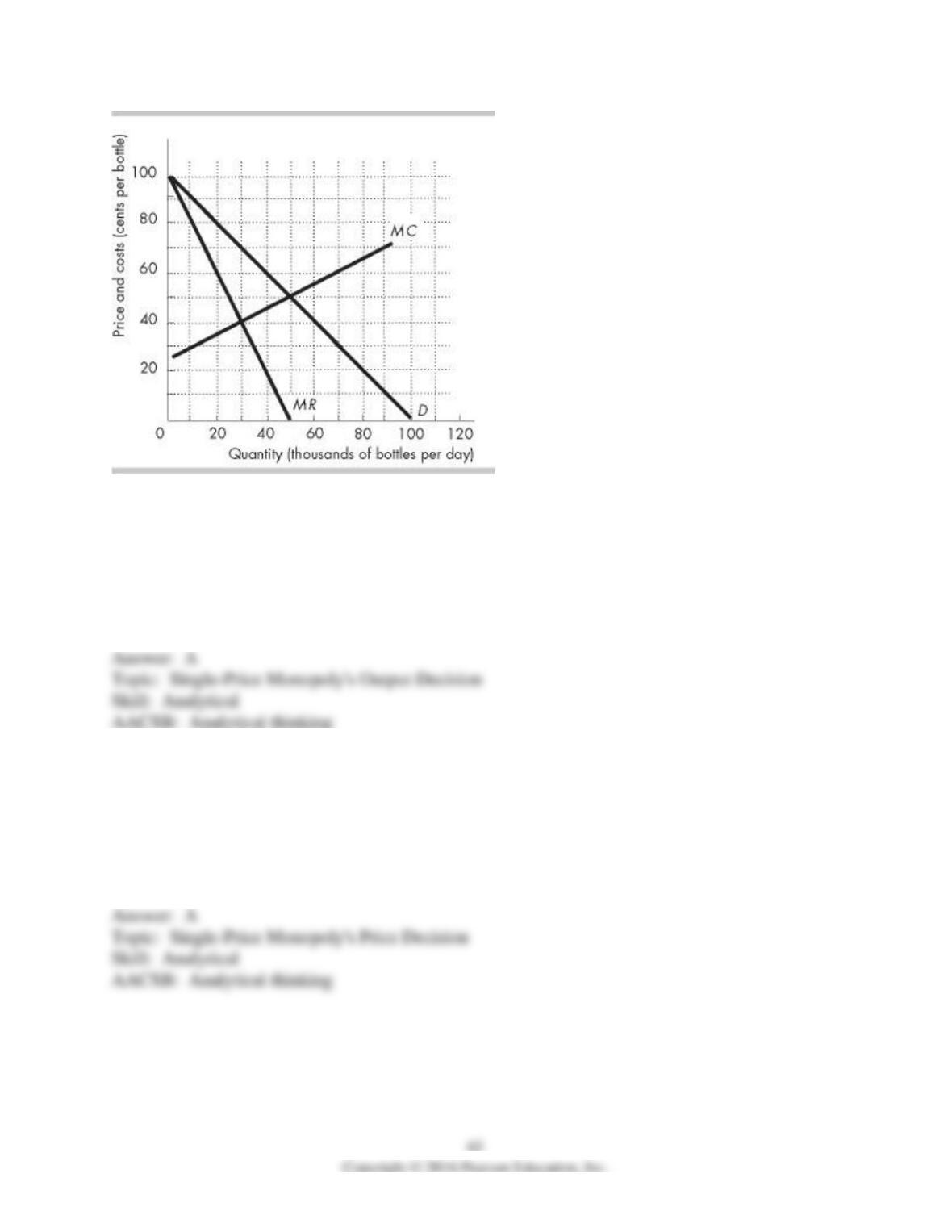
29) Interlace, Inc. produces and a unique soda. The company cannot price discriminate. The
figure above shows Interlace’s demand curve, marginal revenue curve, and marginal cost curve.
Interlace’s profit maximizing level of output is
A) 30,000 bottles.
B) 50,000 bottles
C) 100,000 bottles
D) 0; that is, the firm shuts down.
30) Interlace, Inc. produces and a unique soda. The company cannot price discriminate. The
figure above shows Interlace’s demand curve, marginal revenue curve, and marginal cost curve.
Interlace’s profit maximizing price is ________ per bottle.
A) 70 cents
B) 50 cents
C) 40 cents
D) 1 dollar
31) Interlace, Inc. produces and a unique soda. The company cannot price discriminate. The
figure above shows Interlace’s demand curve, marginal revenue curve, and marginal cost curve.
Interlace, Inc. is definitely
A) a perfectly competitive firm.
B) not a perfectly competitive firm.
C) a natural monopoly.
D) None of the above answers is correct.
32) Interlace, Inc. produces and a unique soda. The company cannot price discriminate. The
figure above shows Interlace’s demand curve, marginal revenue curve, and marginal cost curve.
The quantity of soda Interlace Inc. will choose to produce is ________ because when this
quantity is produced, ________.
A) efficient; marginal social benefit exceeds marginal social cost
B) efficient; marginal social benefit equals marginal social cost
C) not efficient; marginal social benefit exceeds marginal social cost
D) not efficient; marginal social benefit equals marginal social cost
33) Interlace, Inc. produces and a unique soda. The company cannot price discriminate. The
figure above shows Interlace’s demand curve, marginal revenue curve, and marginal cost curve.
When Interlace maximizes its profit, the deadweight loss is
A) zero.
B) $15,000.
C) $21,000.
D) $3,000.
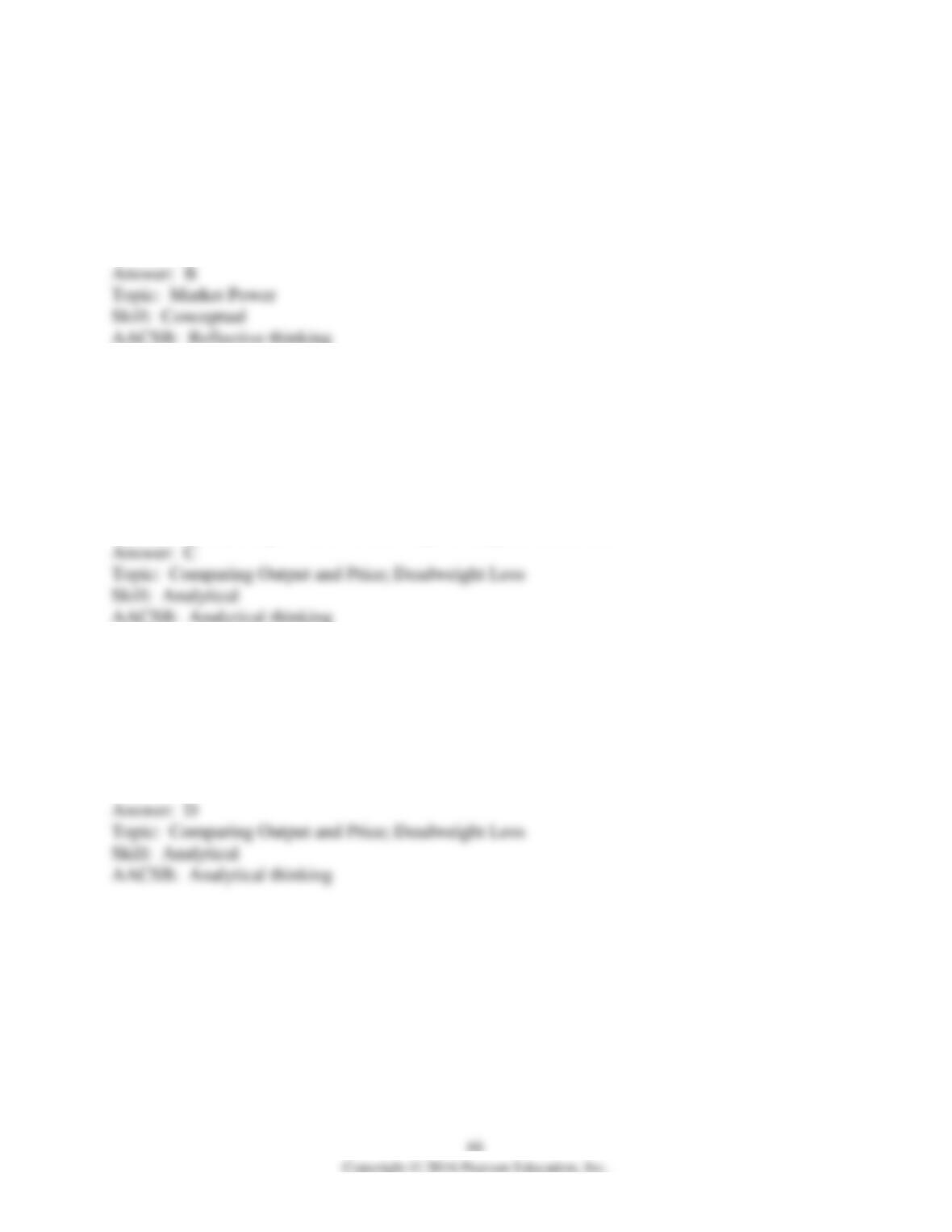
34) In the figure above, the single-price, unregulated monopoly produces
A) less than 19 units per day.
B) 20 units per day.
C) between 21 and 39 units per day.
D) 40 or more units per day.
35) If the industry in the above figure was perfectly competitive, the level of output would
A) be less than the single-price monopoly level of output.
B) be the same as the single-price monopoly level of output.
C) exceed the single-price monopoly level of output by 20 units per day.
D) exceed the single-price monopoly level of output by 60 units per day.
36) In the figure above, the efficient amount of output is
A) 20 units per day.
B) 40 units per day.
C) 60 units per day.
D) 80 units per day.
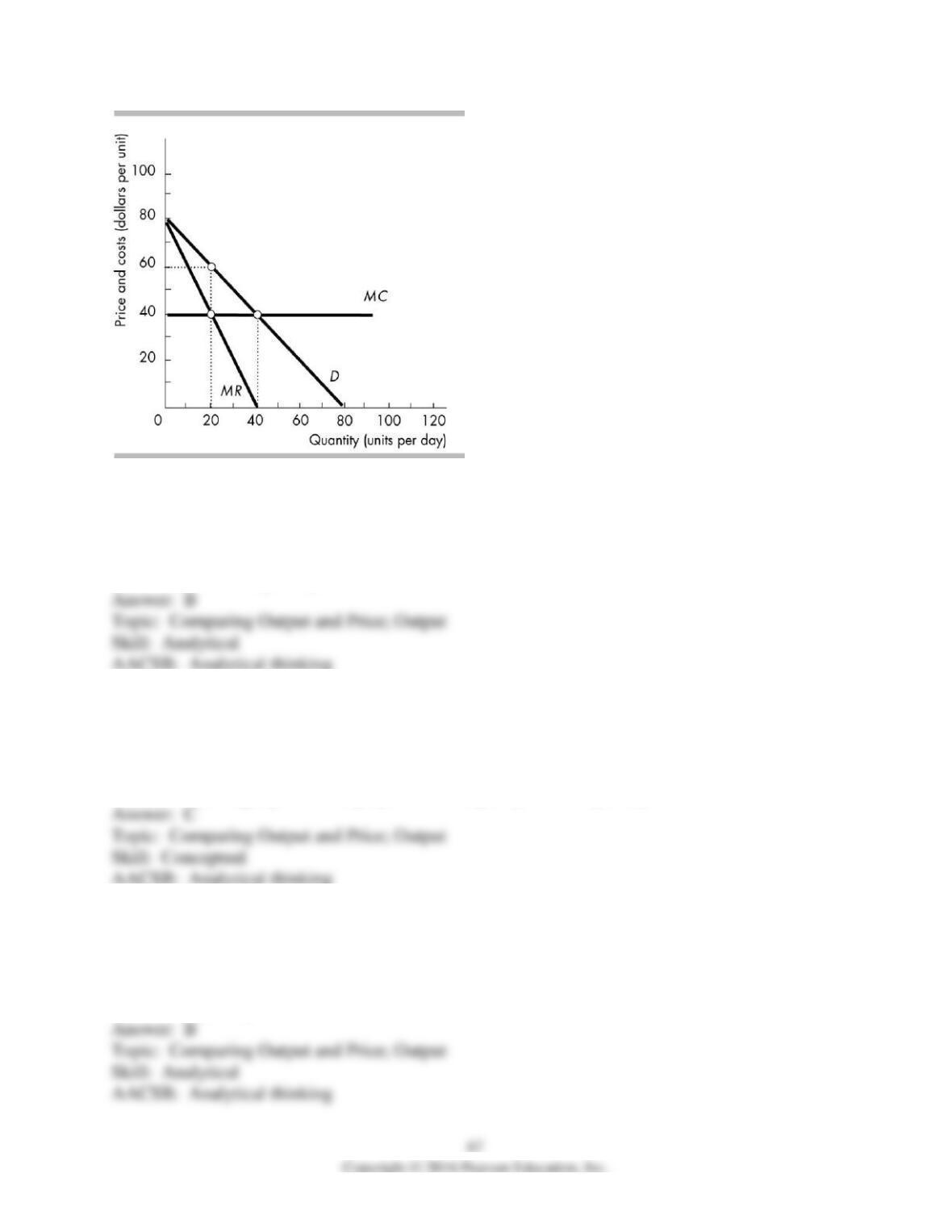
37) The output produced by the single-price, unregulated monopoly in the above figure is
A) efficient because profit is maximized.
B) inefficient because less than the efficient quantity is produced.
C) efficient because marginal costs equals marginal revenue.
D) inefficient because more than the efficient quantity is produced.
38) In the figure above, the single-price, unregulated monopoly sets a price of
A) $80 per unit.
B) $60 per unit.
C) $40 per unit.
D) $0 per unit.
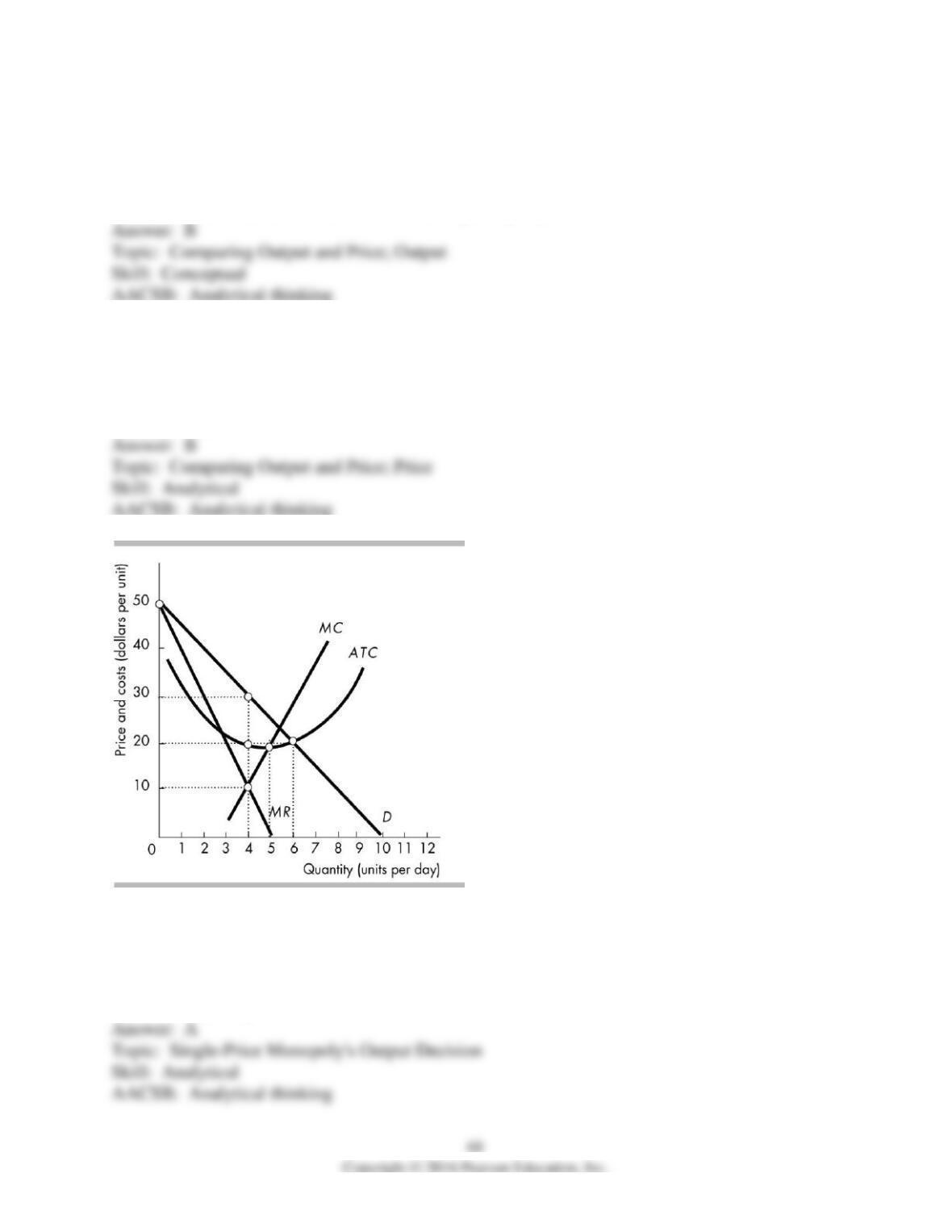
39) For the monopoly shown in the figure above, the profit maximizing output is
A) 4 units per day.
B) 5 units per day.
C) 6 units per day.
D) 10 units per day.
40) For the monopoly shown in the figure above, the profit maximizing price is ________ per
unit.
A) $10
B) $20
C) $30
D) $50
41) For the monopoly shown in the figure above, when it maximizes its profit the marginal cost
is ________ per unit and the price is ________ per unit.
A) $10; $30
B) $20; $20
C) $10; $20
D) $30; $20.
42) For the monopoly shown in the figure above, the economic profit is
A) $0.
B) $10.
C) $40.
D) $100.
43) For the single-price monopoly shown in the figure above, the deadweight loss is
A) zero.
B) between $0 and $10.
C) between $10.01 and $20.
D) more than $20.01.
44) Consumer surplus is
A) positive in the case of a monopolist practicing perfect price discrimination.
B) equal to the price minus the marginal cost.
C) less in the case of a single-price monopoly than in the case of a perfectly competitive
industry.
D) zero for a single-price monopolist.
45) The creation of a monopoly results in gains to
A) producers at no expense to consumers.
B) consumers at no expense to producers.
C) producers at the expense of consumers.
D) consumers at the expense of producers.
46) In comparison with a perfect competition, a single-price monopolist with the same costs
creates a ________ consumer surplus and makes a ________ economic profit.
A) smaller; larger
B) smaller; smaller
C) larger; larger
D) larger; smaller
47) Compared to a competitive industry, a monopoly transfers
A) deadweight loss away from producers to consumers.
B) deadweight loss away from consumers to producers.
C) producer surplus to consumers.
D) consumer surplus to producers.
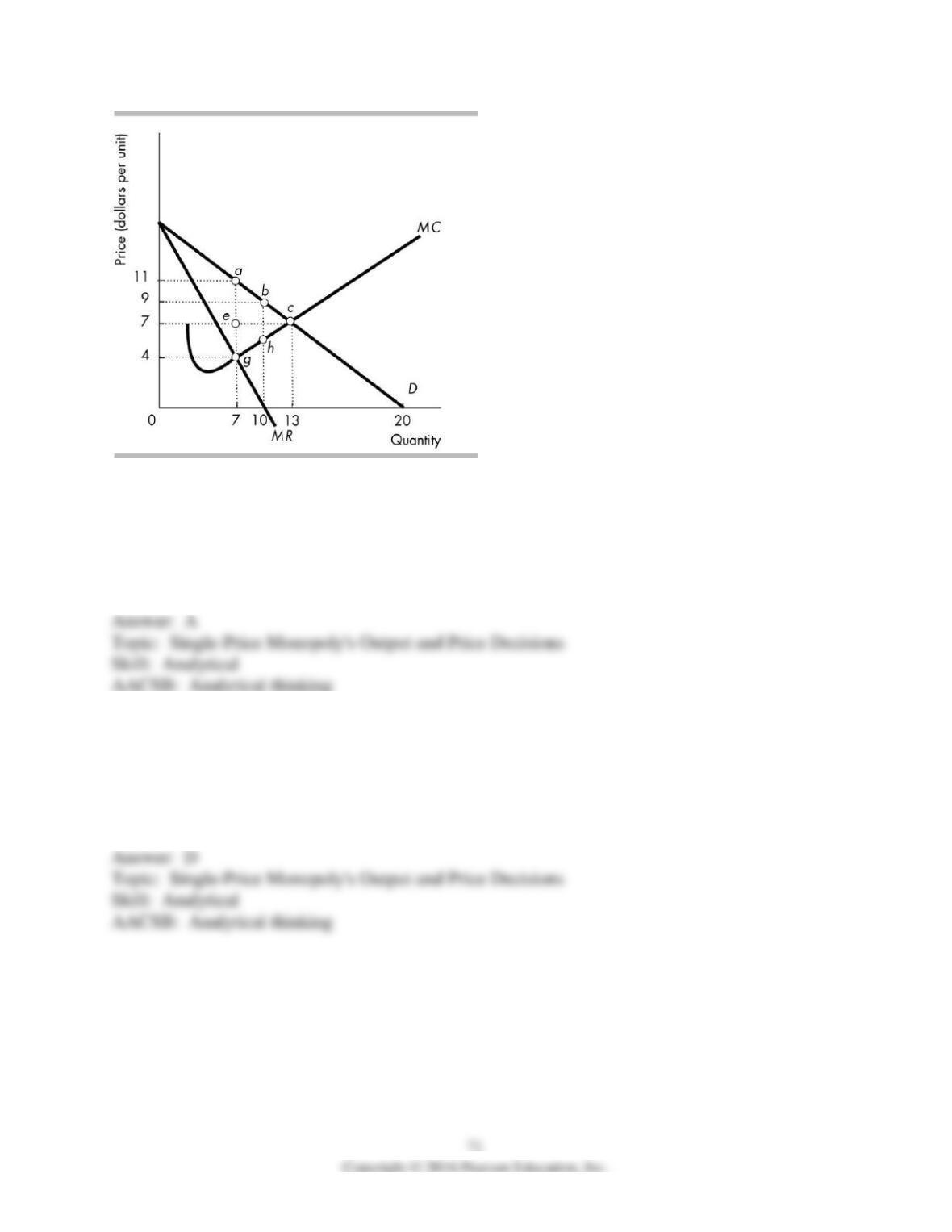
48) Consider the monopolist depicted in the figure above. The profit maximizing level of output
for a single-price monopolist is
A) 7.
B) 11.
C) 13.
D) 22.
49) Consider the monopolist depicted in the figure above. When it maximizes its profit, a single-
price monopolist sets a price of ________ per unit.
A) $4
B) $7
C) $9
D) $11
50) If the above figure illustrated a perfectly competitive industry, the equilibrium market output
would be equal to
A) 7.
B) 11.
C) 13.
D) 22.
51) If the above figure illustrated a perfectly competitive industry, the equilibrium market price
would be equal to
A) $4.
B) $7.
C) $9.
D) $11.
52) In the above figure, if a single-price monopolist maximized its profit, the deadweight loss in
the market is equal to the area
A) ace.
B) acg.
C) ecg.
D) bch.
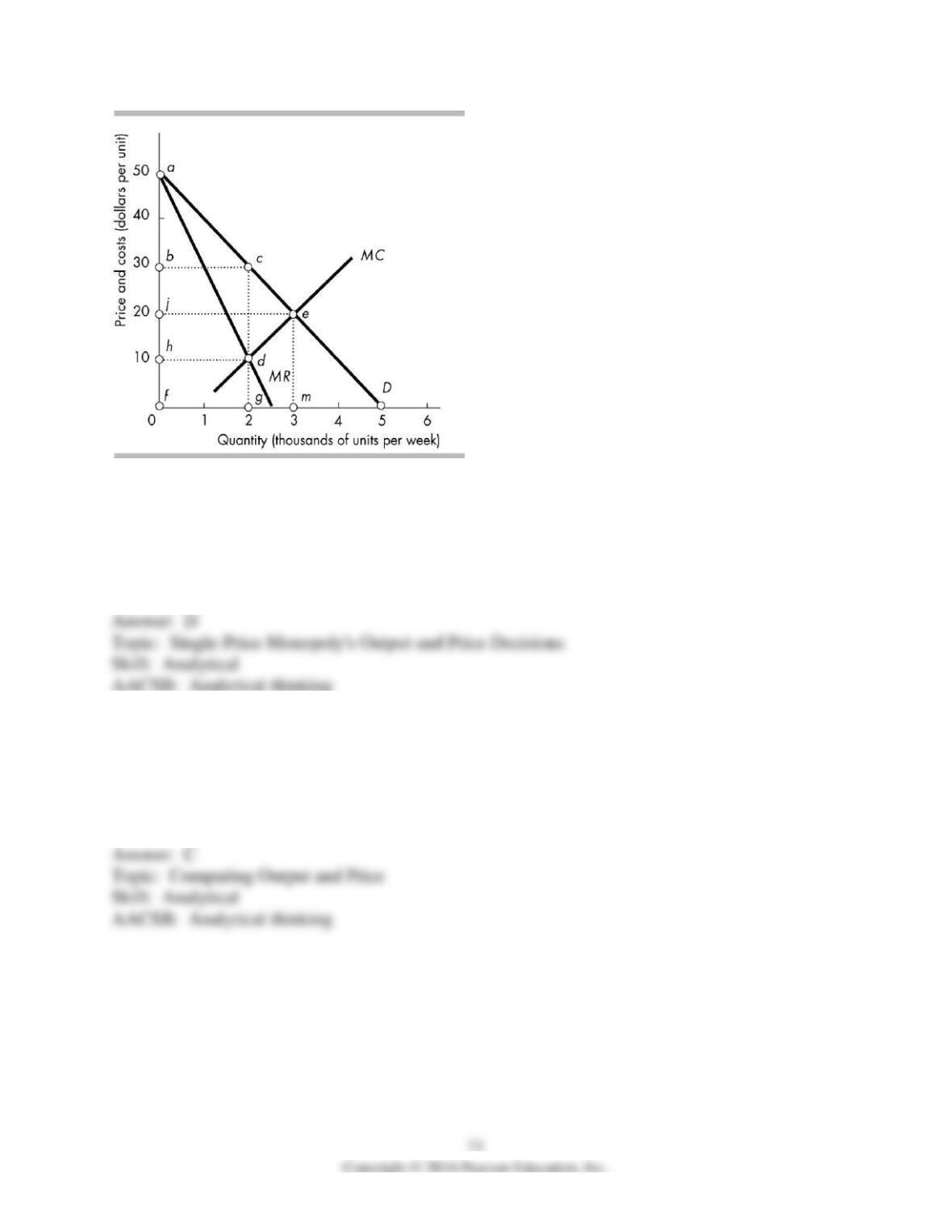
53) In the above figure, a single-price monopolist charges a price of ________, resulting in total
revenue equal to area ________.
A) $10; hbcd
B) $20; fjem
C) $10; fbcg
D) $30; fbcg
54) In the above figure, a single-price monopolist charges a price of ________ and the
equilibrium competitive price is ________.
A) $10; $20
B) $20; $30
C) $30; $20
D) $30; $10
55) In the above figure, if the single-price monopolist charges a price that maximizes its profits,
consumer surplus is
A) area hacd.
B) area bac.
C) area jae.
D) area jbce.
56) In the above figure, if a single-price monopolist charges the profit-maximizing price, the
triangle dce represents
A) consumer surplus.
B) producer surplus.
C) deadweight loss.
D) marginal revenue.
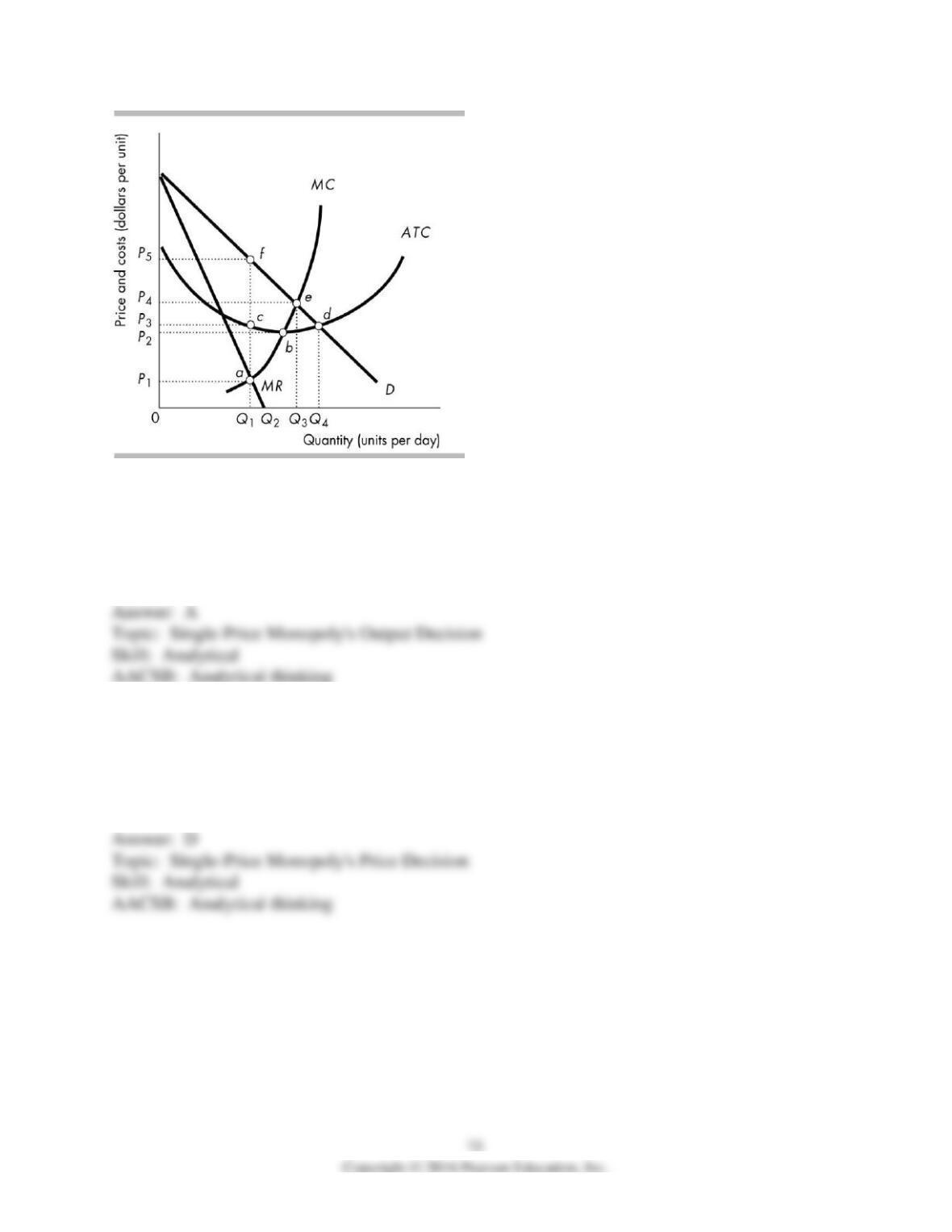
57) In the above figure, what quantity will a single-price monopolist produce?
A) Q1
B) Q2
C) Q3
D) Q4
58) In the above figure, what price will a single-price monopoly set?
A) P1
B) P2
C) P4
D) P5
59) In the above figure, for a single-price monopolist producing at its profit-maximizing
equilibrium price and quantity, the price elasticity of demand at this equilibrium will be
A) greater than 1 and the monopolist’s total revenue is maximized.
B) less than 1 and the monopolist’s economic profit could be larger.
C) equal to 1 and the monopolist’s total revenue is maximized.
D) greater than 1 and the economic profit is maximized but the total revenue is not.
60) In the above figure, the total revenue for a single-price monopolist is shown by the area
A) 0P5fQ1.
B) P2P4eb.
C) 0P3cQ1.
D) 0P4eQ3.
61) The area of economic profit shown in the above figure for the single-price monopolist is
A) bed.
B) P3P5fc.
C) 0P5fQ1.
D) 0P4eQ3.
62) If the market illustrated in the above figure was a perfectly competitive market with the MC
curve being the sum of all individual firms’ marginal costs, then the perfectly competitive price
and quantity would be
A) P3 and Q1.
B) P5 and Q1.
C) P1 and Q1.
D) P4 and Q3.
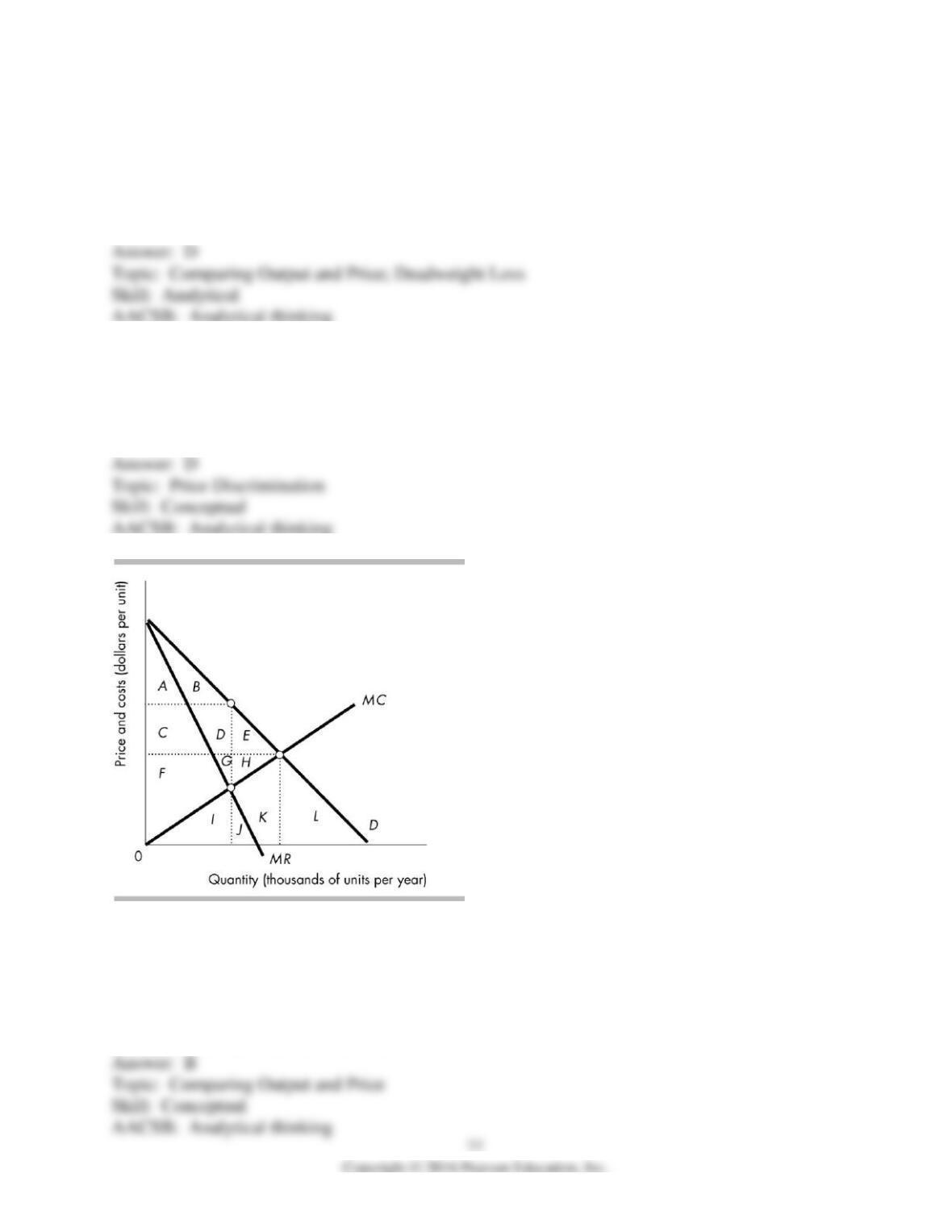
63) The deadweight loss incurred when the market in the above figure is a single-price monopoly
rather than perfectly competitive is the area
A) cab.
B) fcd.
C) bed.
D) fae.
64) The single-price monopolist shown in the above figure could increase its economic profit if
A) it became a price discriminator.
B) its costs of production decreased.
C) the demand for its good increased.
D) any or all the above were to occur.
65) Which area in the above figure shows the consumer surplus at the price and quantity that
would be attained if the industry were perfectly competitive?
A) A + B + C + D
B) A + B + C + D + E
C) F + G + H
D) A + B + C + D + E + F + G + H
66) Which area in the above figure shows the producer surplus at the price and quantity that
would be attained if the industry were perfectly competitive?
A) A + B + C + D + E
B) C + D + E + F + G + H
C) F + G + H
D) F + G + H + I + J + K
67) Which area in the above figure shows the consumer surplus at the price and quantity that
would be set by a single-price monopoly?
A) A + B
B) A + B + C + D + E
C) C + D
D) C + D + E + F + G + H
68) Which area in the above figure shows the producer surplus at the price and quantity that
would be set by a single-price monopoly?
A) C + D
B) C + D + E
C) C + D + F + G
D) C + D + F + G + I
69) In the above figure, if the market was a single-price monopoly rather than perfectly
competitive, which area shows the transfer of consumer surplus from consumers to producers?
A) A + B
B) C + D
C) C + D + E
D) E + H
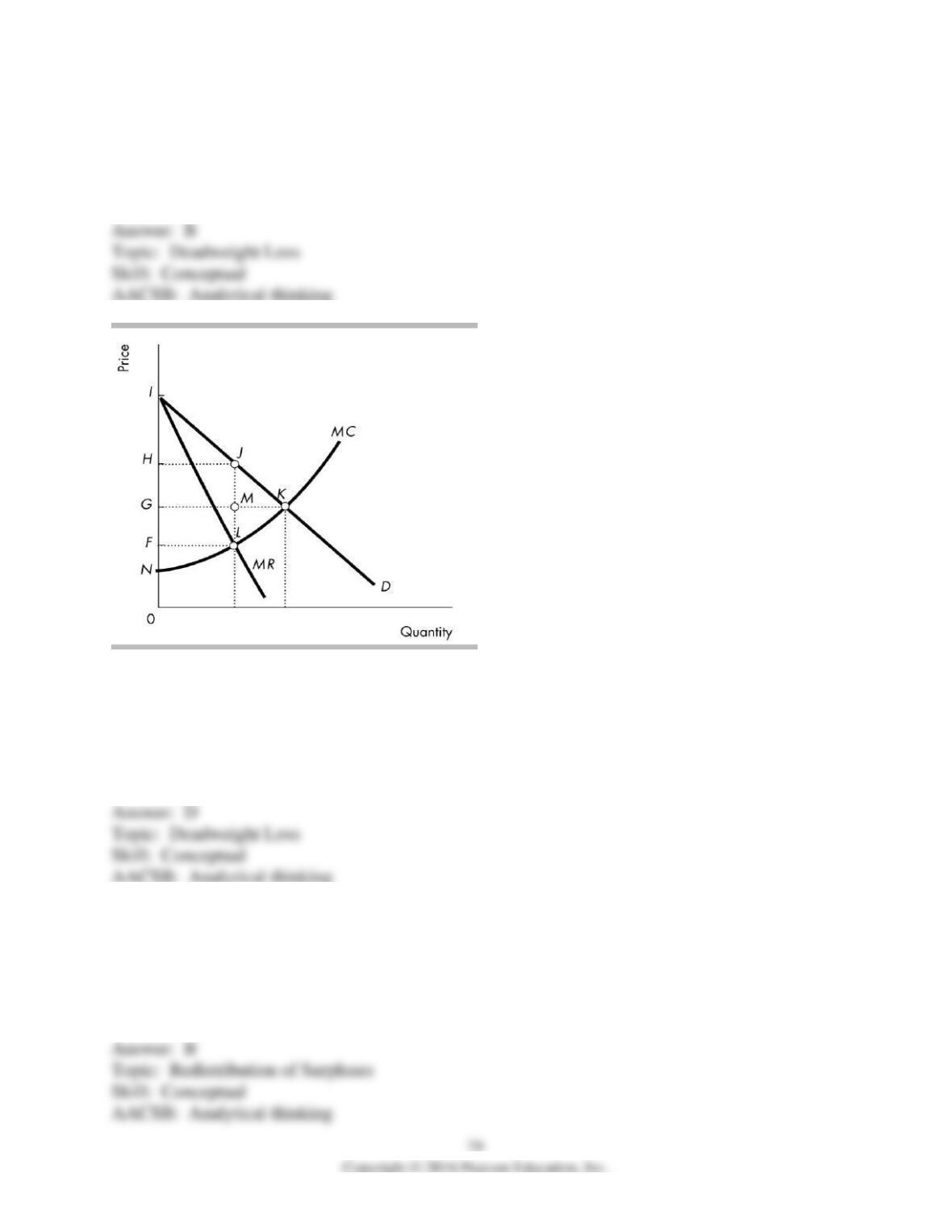
70) In the above figure, which area is the deadweight loss from a single-price monopoly?
A) E
B) E + H
C) E + H + K
D) E + H + K + J
71) In the market depicted in the above figure, if a single-price monopoly maximizes its profit,
which area shows the deadweight loss?
A) area FHIL
B) area GHJM
C) area IJH
D) area LJK
72) In the market depicted in the above figure, if a single-price monopoly maximizes its profit,
which area shows the consumer surplus?
A) area GHIL
B) area HIJ
C) area HJKG
D) area NFL
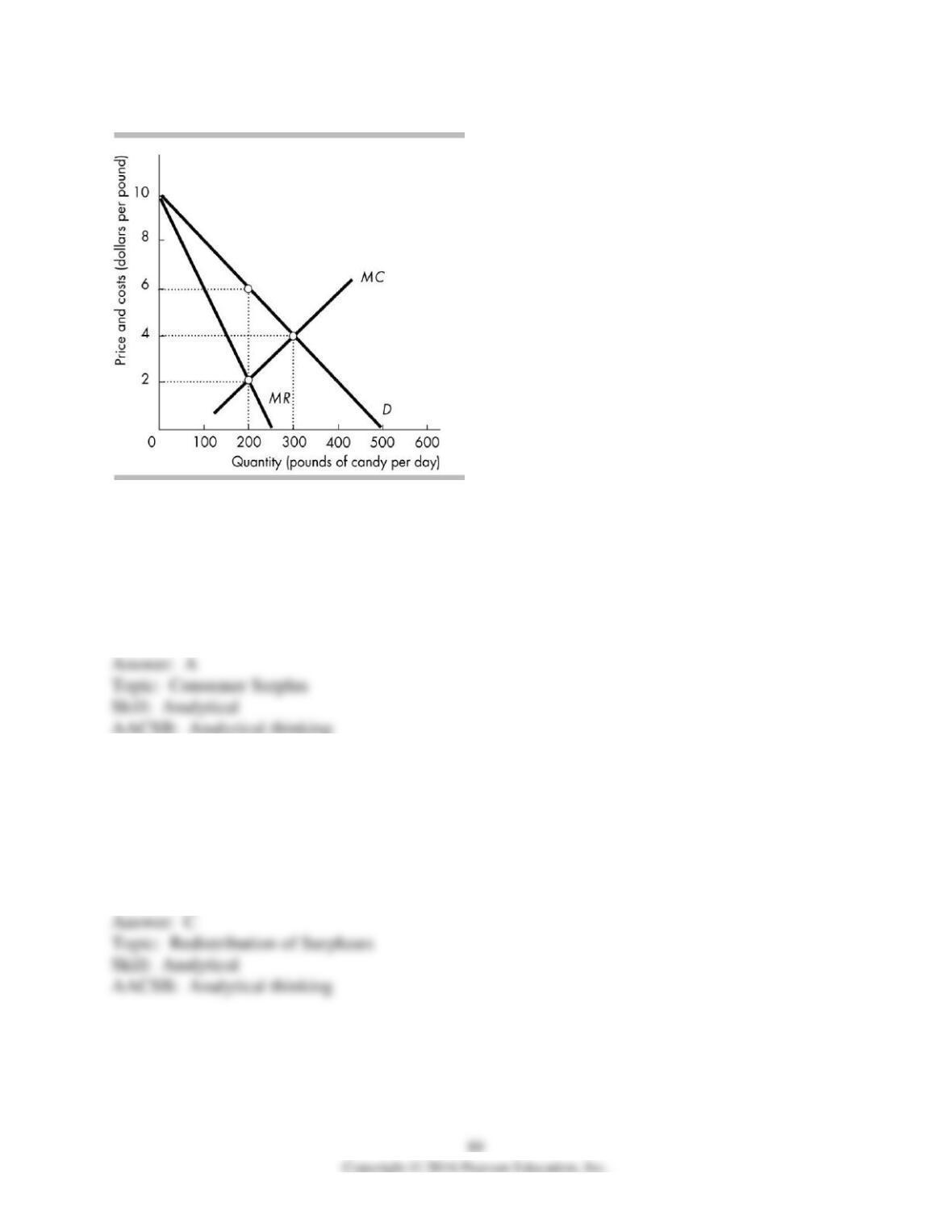
73) The figure shows the demand for and costs of producing Charlene’s Chocolates. If Charlene’s
Chocolates is a monopoly and charges one price to all customers, then the consumer surplus is
________.
A) $400
B) $900
C) $0
D) $200
74) The figure above shows the demand for and costs of producing Charlene’s Chocolates. If
Charlene’s Chocolates is a monopoly that charges one price to all customers, then consumer
surplus is ________ and it creates a deadweight loss of ________.
A) $800; $400
B) $200; $100
C) $400; $200
D) $0; $200