a. network d. staying
b. bandwagon e. marginal
c. switching
134. The presence of significant positive ________ externalities can drive small firms out of business or
force them to merge with larger competitors.
a. network d. public
b. negative e. size
c. production
135. When customers face significant switching costs, the
a. demand for the existing product becomes more inelastic.
b. supply for the existing product becomes more inelastic.
c. demand for the existing product is perfectly inelastic.
d. supply for the existing product is perfectly inelastic.
e. demand for the existing product becomes neither perfectly elastic nor perfectly inelastic.
136. The market for social-networking website services is characterized by network externalities
because
a. the less other people are using the website, the more any one person enjoys it.
b. the number of other people using the website has no effect on any one person’s enjoyment of
it.
c. the more other people are using the website, the more any one person enjoys it.
d. a person needs a computer network to access a social-networking website.
e. people are less likely to be hired by an employer if they use social-networking websites.
137. Firms with many customers that find it easier to attract new customers are most likely selling a
good that has a ________ externality.
a. consumption d. production
b. negative e. network
c. positive
138. In 2011, none of Roderick’s friends owned a North Face jacket and Roderick did not have a strong
preference for North Face jackets. In 2012, many of Roderick’s friends owned a North Face jacket,
and Roderick did have a strong preference for North Face jackets. The change in Roderick’s
preferences from 2011 to 2012 can be best explained by the ________ effect.
a. winter d. duopolist
b. network e. social
c. switching
139. The following table shows Quinton’s preference ranking for different brands of boots in both 2011
and 2012. His preferences are ranked from 1 to 4, where 4 is his most-preferred brand and 1 is his
least-preferred brand. In 2011, one of Quinton’s 10 close friends owned a pair of UGG boots. In
2012, six of Quinton’s 11 close friends owned a pair of UGG boots. Based on this information,
which effect would likely explain the change in Quinton’s preference ranking for UGG boots from
2011 to 2012?
Brand of Boots 2011 Preference Ranking 2012 Preference Ranking
Adidas 3 2
Clarks 4 3
ECCO 1 1
UGG 2 4
a. social norming d. friendship
b. superiority e. consumer preference
c. network
140. The following table shows Alexi’s preference ranking for different brands of jeans for 2011 and
2012. His preferences are ranked from 1 to 4, where 4 is his most-preferred brand and 1 is his
least-preferred brand. In 2011, 1,439 of the 28,000 men attending Alexi’s college owned a pair of
Joe’s Jeans. In 2012, a survey showed that 9,421 of the 28,560 men attending Alexi’s college
owned a pair of Joe’s Jeans. Based on this information, the change in Alexi’s preference ranking
for Joe’s Jeans from 2011 to 2012 can be best explained by the ________ effect.
Brand of Jeans 2011 Preference Ranking 2012 Preference Ranking
Citizens of Humanity 2 2
True Religion 1 1
Seven for All Mankind 4 3
Joe’s Jeans 3 4
a. jean stitching d. network
b. fashion inferiority complex e. sociological advocacy
c. oligopolistic pricing
141. Terrance’s cell phone carrier would charge him $250 to cancel his current contract. If Terrance
wants to change cell phone carriers, the $250 he would have to pay is considered a ________ cost.
a. switching d. contract
b. network e. staying
c. bandwagon
142. Marshal’s JPMorgan Chase credit card has a 15 percent interest rate and a rewards program that
gives him one point per $1 that he spends. The only option Marshal has for point redemption is a
$100 statement credit that would cost him 10,000 points. On January 7, 2012, Marshal noticed he
has 8,750 reward points accumulated on his JPMorgan Chase card. On that same day, he received
an offer from Bank of America for a credit card with an identical rewards program and an 8
percent interest rate. If Marshal cancels his JPMorgan Chase card and accepts the offer for the
Bank of America card, the accumulated 8,750 reward points that he will not be able to redeem are
an example of a ________ cost.
a. network d. credit
b. bandwagon e. switching
c. card
143. The ________ demand curve theory states that oligopolists tend to respond aggressively to the
price cuts of rivals, but largely ignore price increases.
a. downward-sloping d. upward-sloping
b. perfectly elastic e. jagged
c. kinked
144. According to the kinked demand curve theory, the behavior of firms in an oligopoly creates a
demand curve that is ________ at prices above the cartel price and ________ at prices below the
cartel price.
a. downward-sloping; upward-sloping
b. more inelastic; upward-sloping
c. perfectly inelastic; downward-sloping
d. more inelastic; more elastic
e. more elastic; more inelastic
145. According to the kinked demand curve theory, if Kit-N-Sit cuts prices, Kittysitters will
a. do nothing and leave prices unchanged.
b. sue Kit-N-Sit for monetary damages in court.
c. respond aggressively by increasing prices drastically.
d. respond aggressively by increasing prices moderately.
e. respond aggressively by cutting prices.
146. According to the kinked demand curve theory, if Kit-N-Sit increases prices, Kittysitters will
a. do nothing and leave prices unchanged.
b. sue Kit-N-Sit for monetary damages in court.
c. respond aggressively by increasing prices.
d. split the company into two different companies: Kit and Sit.
e. respond aggressively by cutting prices.
147. According to the kinked demand curve theory, if Kit-N-Sit cuts prices, Kittysitters will ________;
if Kit-N-Sit raises prices, Kittysitters will ________.
a. do nothing and leave prices unchanged; do nothing and leave prices unchanged
b. do nothing and leave prices unchanged; cut prices
c. do nothing and leave prices unchanged; raise prices
d. cut prices; do nothing and leave prices unchanged
e. raise prices; do nothing and leave prices unchanged
148. When firms in an oligopoly collude without an explicit agreement, economists say they are
involved in ________ collusion.
a. illegal d. predatory
b. tacit e. marginal
c. game theoretic
149. There are four ice cream shops on a small tourist island. The following table shows the quantity of
ice cream cones that each firm produces in a typical year and the price that each firm currently
charges for each ice cream cone it sells. An economist might suspect ________ collusion occurring
in this market where ________ is the price leader and all other firms set price to match the price
leader.
Firm Quantity Price
Black Bear Cones 1,383 $2.85
Frozen Treat 2,410 2.89
Cream Emporium 27,377 2.99
Royal Scoop 670 3.05
a. explicit; Royal Scoop d. tacit; Royal Scoop
b. explicit; Cream Emporium e. tacit; Cream Emporium
c. illegal; Cream Emporium
150. There are four Jet Ski rental companies on a small tourist island. The following table shows the
quantity of Jet Skis that each firm rents in a typical year and the per-hour price that each firm
currently charges for each Jet Ski it rents. If Nautical Jet Skis raised its price to $60.25 and all
other firms subsequently increased their prices by $10.00, all firms have
Firm Quantity Price
Wide Island Waves 50 $50.00
Nautical Jet Skis 1,200 51.25
Rapid Ocean Rentals 78 51.69
Ocean Rider Emporium 140 50.99
a. likely participated in explicit price collusion and they all have broken antitrust laws.
b. still broken antitrust laws, even if they might not have participated in explicit price collusion.
c. likely participated in tacit collusion and they all have broken antitrust laws.
d. likely participated in tacit collusion and they have not broken antitrust laws because tacit
collusion is not illegal.
e. likely participated in tacit collusion and the government can improve social welfare by banning
Jet Ski rentals on the island.
SHORT ANSWER
1. Compare the social efficiency of oligopolistic market outcomes to perfectly competitive market
outcomes and monopoly outcomes.
2. How does an oligopoly differ from other kinds of firms in terms of how price and output decisions
are made?
3. What can cause a high-concentration ratio in an industry like automobiles or tires?
4. How do economists measure and interpret the measurement of an oligopolistic industry’s market
concentration?
5. Why have most cartels failed despite the fact that firms in a cartel are able to achieve higher
profits?
6. Although antitrust laws exist in the United States, why would economic theory suggest that these
types of laws might be unnecessary or rarely need to be enforced?
7. The Organization of Petroleum Exporting Countries (OPEC) controls nearly 60 percent of the
world’s known oil reserves and one-third of crude oil production. How have the members of
OPEC benefited from this cartel?
8. Are duopolies always socially efficient? Why or why not?
9. Why is it more difficult to maintain a cartel when there are more than two firms?
10. Explain the difference between the price effect and the output effect when a new firm enters a
market.
11. Explain why the dominant strategy in a prisoner’s dilemma game is for each player to testify. In
your answer, also explain what a dominant strategy is.
12. Airline Manufacturer A and Airline Manufacturer B are duopolists in their industry. Explain how
the two firms could collectively benefit if they were to collude and form a cartel. Why might
collusion be difficult?
13. Google and Yahoo! are two large search engine companies. Combined, these companies control a
large market share in the search engine industry. Both companies currently advertise their search
engines on television, and each company earns a profit of $550 million. If both companies were to
stop advertising on television, each would earn a profit of $600 million. If only one company were
to stop advertising on television and the other company continued to do so, the company that
stopped advertising would earn a profit of $200 million and the company that continued to
advertise would earn a profit of $800 million.
Assume this is a simultaneous-move game where Google and Yahoo! choose to advertise or
choose not to advertise, and Google and Yahoo! cannot collude. Explain the process of finding
Google’s dominant strategy.
14. Matilda and Jack are playing a game that consists of several rounds of a simultaneous-move
prisoner’s dilemma. Neither Matilda nor Jack knows exactly when the game will end. Explain how
both players playing the tit-for-tat strategy can create cooperation in this game.
15. Why must a tit-for-tat strategy be a long-run strategy?
16. Why are decision trees useful for making business decisions?
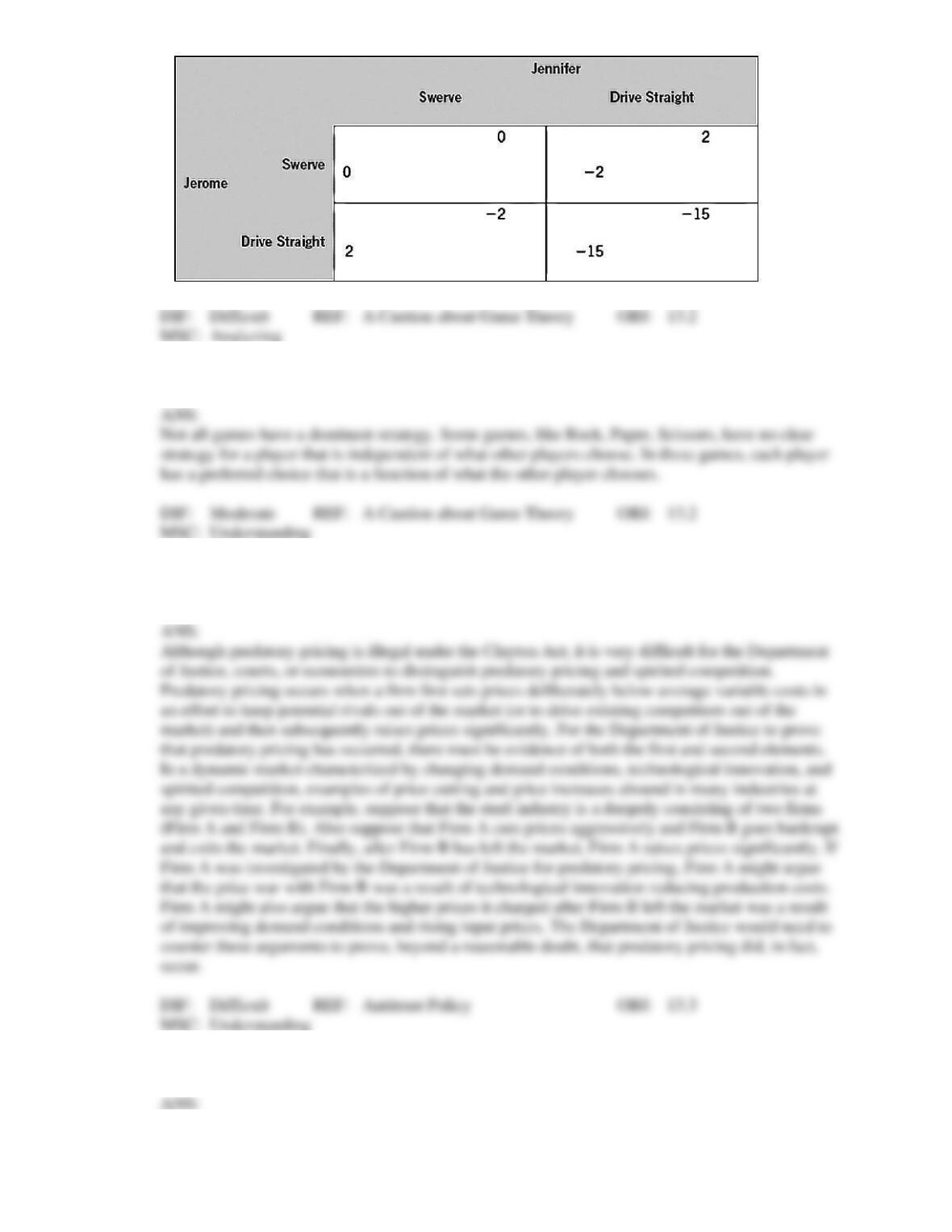
17. Do all two-player, simultaneous-move games have exactly one unique Nash equilibrium? If not,
support your answer by drawing a game tree and explaining the mechanics of a game that has
either no Nash equilibrium or more than one Nash equilibrium.
18. Do all games have a dominant strategy? Why or why not?
19. Explain why predatory pricing cases are difficult for government authorities to identify and
prosecute.
20. Explain the activities that the Clayton Act of 1914 deems socially detrimental.
21. What differentiates predatory pricing from a price war? Be sure to define each in your answer.
22. Is predatory pricing a long-term or short-term strategy? In your answer, define predatory pricing.
23. How do switching costs increase a firm’s market power?
24. In what way does e-mail exhibit a network externality? In your answer, be sure to define network
externality.
25. Facebook is by far the largest social-networking website in the world. Explain how network
externalities help Facebook maintain its position as market leader.