Chapter 13 – Wage Determination (+ Appendix)
21. What is the difference between an exclusive union and an inclusive union? What are the economic effects
of each type?
22. What are the three different union strategies pursued to increase wages?
23. Is there a trade-off between wage increases for union members and employment? Explain.
24. What is a bilateral monopoly? What is the economic outcome from a bilateral monopoly? Is a bilateral
monopoly a “bad” situation for society?
Chapter 13 – Wage Determination (+ Appendix)
13–13
25. Though wages under bilateral monopoly are logically indeterminate, some wage rate is actually established
in such market situations. Explain those economic and noneconomic factors that might be pertinent to the
establishment of this wage.
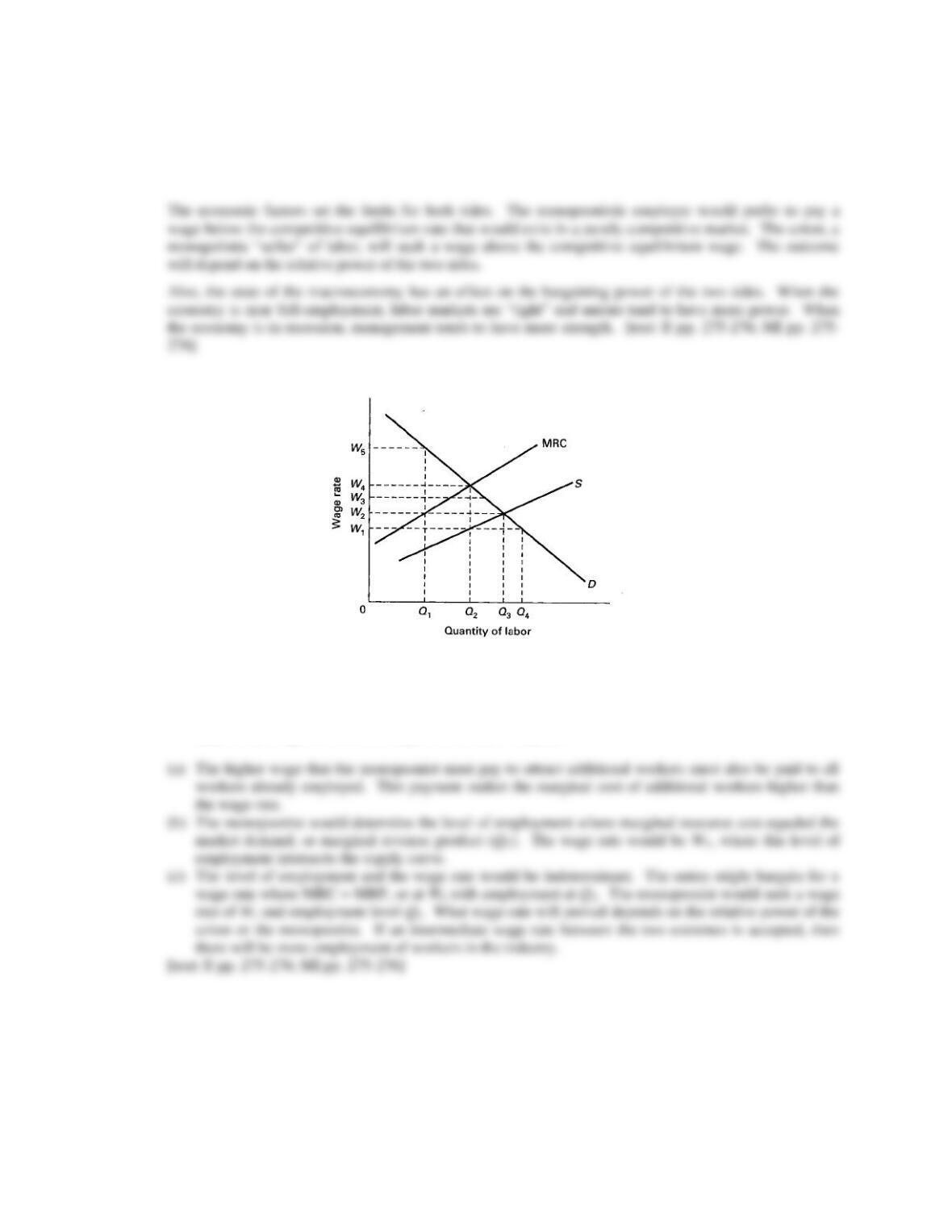
26. Use the below graph to answer the next three questions.
(a) Why does the MRC curve lie above the labor supply curve?
(b) What would be the equilibrium wage and level of employment in a monopsonist market without an
industrial union? Explain.
(c) What if an industrial union was formed to negotiate with the monopsonist? What would be the
equilibrium wage and level of output in this case? Explain.
Chapter 13 – Wage Determination (+ Appendix)
27. Illustrate the following by drawing a supply and demand graph in the appropriate graph spaces below: (a)
the economic effects of exclusive or craft unionism; (b) the economic effects of increasing the demand for
labor; (c) wage determination in a monopsonistic labor market; (d) wage determination in a bilateral
monopoly.
28. What are the case against and the case for the minimum wage? What does the evidence indicate?
Chapter 13 – Wage Determination (+ Appendix)
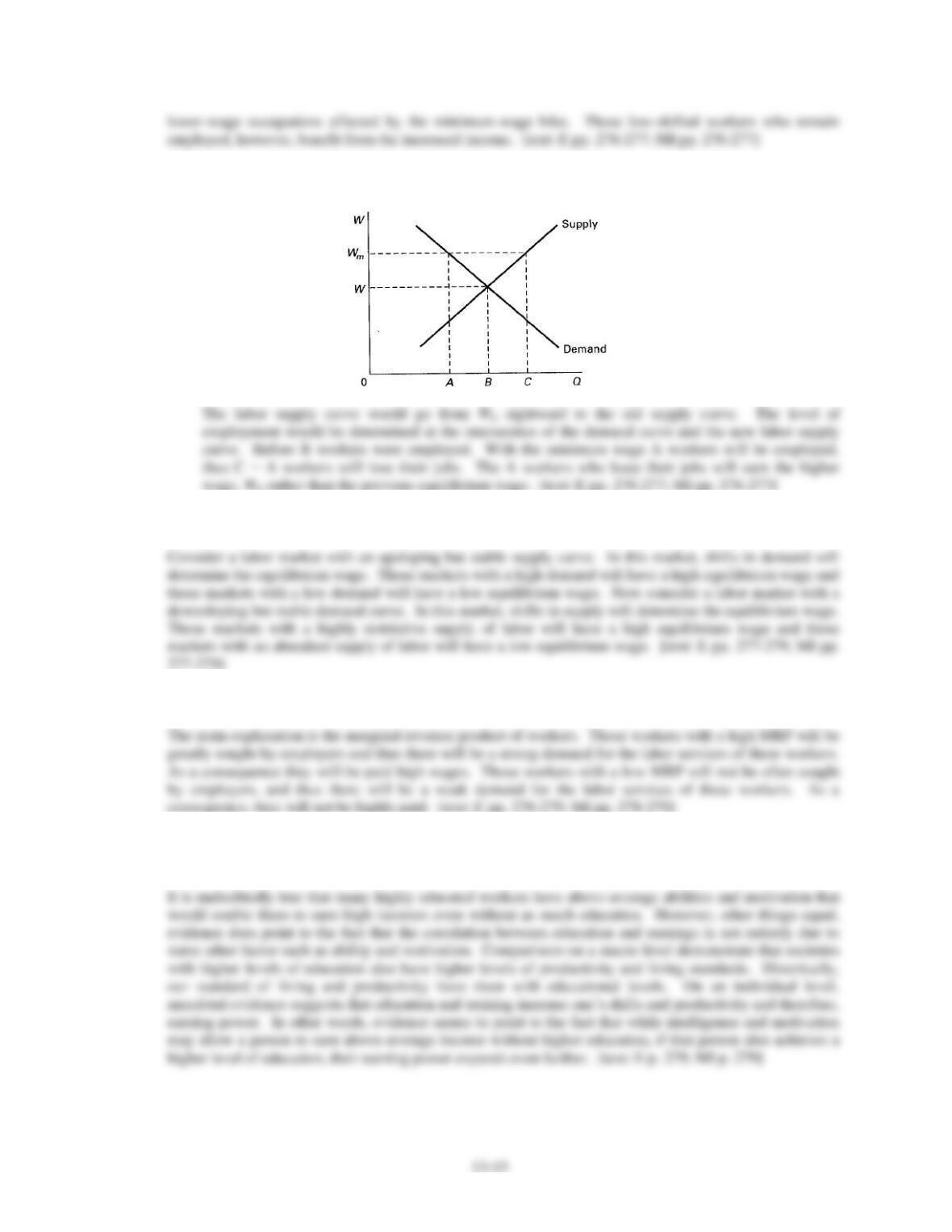
29. Use the graph below to illustrate and explain what would happen in the labor market if a minimum wage
was established at a level above the equilibrium wage.
30. What explains wage differentials in labor markets? Evaluate from a demand and supply perspective.
31. Why is there a difference in the strength of demand for labor?
32. “In all likelihood highly educated workers are the individuals who would earn high incomes even if they
did not have as much education.” Evaluate.
Chapter 13 – Wage Determination (+ Appendix)
13–16
33. Define and illustrate “noncompeting groups” and “compensating differences.”
Noncompeting groups refer to labor force groups whose members do not qualify for the same occupations
or jobs because of differences in inherent abilities or education and training or other obstacles that cannot
be easily, if ever, overcome. For example, the female kindergarten teacher will not be eligible to compete
for a job in professional football.
34. Why is there a significant difference in the pay of physicians and construction workers?
35. (Consider This) What is human capital? How is it related to labor markets?
36. What are four market imperfections that prevent workers from moving from their current jobs to take
higher-paying jobs?
Chapter 13 – Wage Determination (+ Appendix)
37. Explain the principal–agent problem in job performance and briefly describe actions that can be taken to
correct the problem.
38. What is the rationale for efficiency wages? How do efficiency wages help address the principal–agent
problem?
39. Why do solutions to the principal–agent problem sometimes produce problems? Give an example.
40. (Last Word) Evaluate from an economic perspective the issue of whether chief executive officers (CEOs)
of corporations are overpaid.
Chapter 13 – Wage Determination (+ Appendix)
13–18
C. Appendix Questions
41. Describe the current status of unions in the United States and the major union organization.
42. Who belongs to unions? Answer in terms of the types of industries and occupations, and the personal
characteristics of workers.
43. What two explanations are offered for why unions have declined?
44. Can you think of explanations beyond those discussed in the text for the relative decline of unionism in the
United States?
45. How does collective bargaining work? What are the major features of the process?
46. Is there a union wage advantage?
47. How can unions decrease productivity?
48. Do unions have a positive or negative effect on economic efficiency?
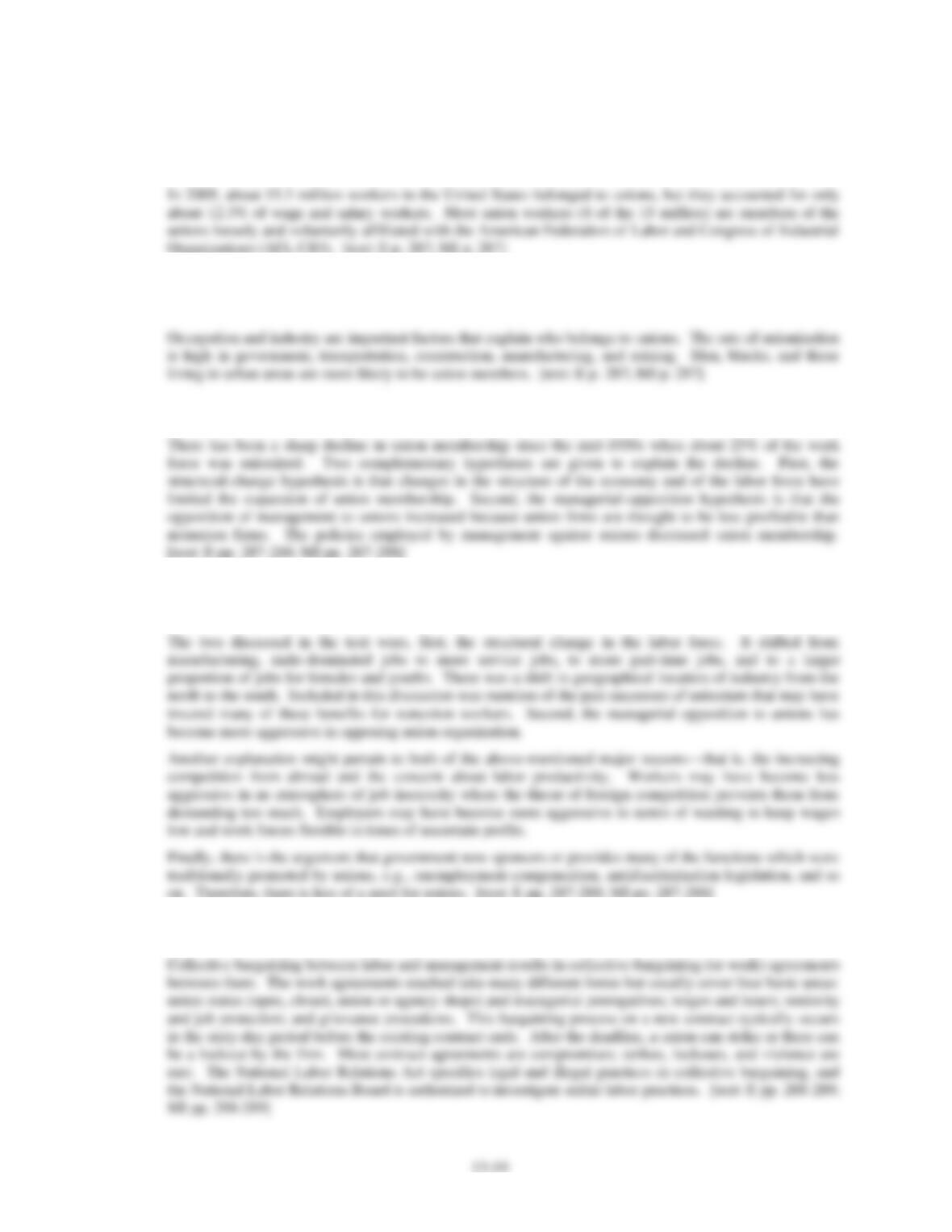
49. Answer the following question on the basis of the following diagram which shows the effects of a union–
negotiated wage level Wu on a portion of a labor market which now has two sectors: union and nonunion.
What is the loss of output that will occur as a result of the establishment of wage rate Wu in the union sector
and Ws in the nonunion sector? Explain. (At Wa the wage rates are the same in each sector.)
50. Suppose there are two identical labor markets in the economy. The supply of workers and the demand for
workers in each of these markets are shown in the table below. Answer the next three questions.
Quantity of labor demanded Wage rate (MRP of labor) Quantity of labor supplied
2500 $110 5500
3000 100 5000
3500 90 4500
4000 80 4000
4500 70 3500
5000 60 3000
5500 50 2500
(a) What would the equilibrium wage rate be if each of the two labor markets were a competitive labor
market? How many workers would be employed?
(b) If in one market a union was formed that imposed a $100 daily wage rate, what would happen to
employment in the unionized market and output produced by workers?
(c) If workers displaced by the union in the first market all entered the second market and found
employment in that competitive and nonunion market, what will happen to the wage rate, employment,
and output?
51. A representative for a business company stated at a recent press conference that, “Unions provide little
benefits to the economy, resulting in inefficiency and loss of productivity.” Can you counter his statement?
Chapter 13 – Wage Determination (+ Appendix)
D. Answers to Appendix Questions
41. Describe the current status of unions in the United States and the major union organization.
42. Who belongs to unions? Answer in terms of the types of industries and occupations, and the personal
characteristics of workers.
43. What two explanations are offered for why unions have declined?
44. Can you think of explanations beyond those discussed in the text for the relative decline of unionism in the
United States?
45. How does collective bargaining work? What are the major features of the process?
Chapter 13 – Wage Determination (+ Appendix)
13–20
46. Is there a union wage advantage?
47. How can unions decrease productivity?
48. Do unions have a positive or negative effect on economic efficiency?
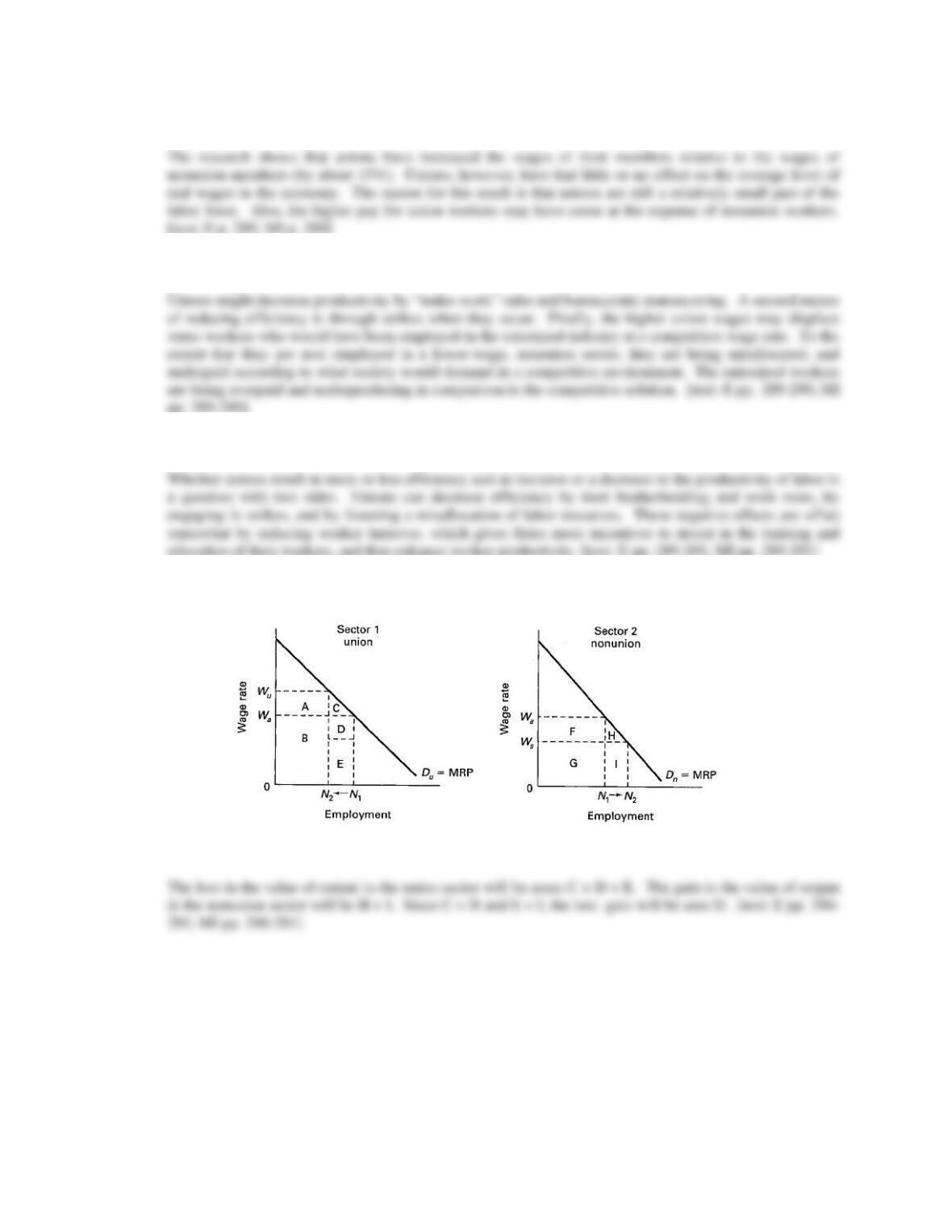
49. Answer the following question on the basis of the following diagram which shows the effects of a union–
negotiated wage level Wu on a portion of a labor market which now has two sectors: union and nonunion.
What is the loss of output that will occur as a result of the establishment of wage rate Wu in the union sector
and Ws in the nonunion sector? Explain. (At Wa the wage rates are the same in each sector.)
Chapter 13 – Wage Determination (+ Appendix)
50. Suppose there are two identical labor markets in the economy. The supply of workers and the demand for
workers in each of these markets are shown in the table below. Answer the next three questions.
Quantity of labor demanded Wage rate (MRP of labor) Quantity of labor supplied
2500 $110 5500
3000 100 5000
3500 90 4500
4000 80 4000
4500 70 3500
5000 60 3000
5500 50 2500
(a) What would the equilibrium wage rate be if each of the two labor markets were a competitive labor
market? How many workers would be employed?
(b) If in one market a union was formed that imposed a $100 daily wage rate, what would happen to
employment in the unionized market and output produced by workers?
(c) If workers displaced by the union in the first market all entered the second market and found
employment in that competitive and nonunion market, what will happen to the wage rate, employment,
and output?
51. A representative for a business company stated at a recent press conference that, “Unions provide little
benefits to the economy, resulting in inefficiency and loss of productivity.” Can you counter his statement?