c. cooperate in the first round and defect in all subsequent rounds.
d. cooperate in the first round and cooperate in all subsequent rounds.
e. cooperate in the first round and, in any subsequent round, do what his or her opponent did in
the last round.
79. Player A and Player B are playing a game involving several rounds of a prisoner’s dilemma where
their choices are to “cooperate” or “defect.” After each round ends, one player rolls a six-sided die.
If the die lands on 6, the game ends; however, if the die lands on any other number, the game
continues and players play another round. Prior to the game starting, the players formulate a
strategy that specifies what they will do in every possible round they might find themselves in. If
Player A is playing the tit-for-tat strategy, in the ________ round, Player A will definitely choose
________.
a. first; defect d. second; cooperate
b. second; defect e. third; cooperate
c. first; cooperate
80. In January, Home Depot offered a 10 percent–off coupon and Lowe’s did not. In February, Lowe’s
offered a 10 percent–off coupon and Home Depot did not. In March, Home Depot offered a 10
percent–off coupon and Lowe’s did not. It is likely that Home Depot and Lowe’s are both playing
the ________ strategy.
a. grim trigger d. tit-for-tat
b. tit-for-two-tats e. mutually assured destruction
c. deterrence
81. In January, Walmart offered a 10 percent–off coupon and Target did not. In February, Target
offered a 10 percent–off coupon and Walmart did not. In March, Walmart offered a 10 percent–off
coupon and Target did not. It is likely that Walmart and Target are both playing the ________
strategy.
a. grim trigger d. tit-for-tat
b. tit-for-two-tats e. mutually assured destruction
c. retail retaliation
82. Jaheim and Suzanna are playing a game involving repeated iterations of a simultaneous-move
prisoner’s dilemma. In each round, both players choose either “cooperate” or “defect.” Neither
Jaheim nor Suzanna knows when the game will end. If Jaheim believes that Suzanna will be
playing tit for tat, then
a. he will maximize his payoffs by defecting in every round.
b. cooperation will be impossible to maintain regardless of the strategy he plays.
c. cooperation might be possible if he also plays tit for tat.
d. cooperation might be possible if he plays a strategy where he defects in every round.
e. cooperation might be possible if he plays a strategy where he defects in the first round,
cooperates in the second round, and defects in every other round.
83. In the airline industry, it is common to see one airline changing the airfare (price) between two
cities and other airlines either matching the price or actively deciding not to change their prices.
What type of game can describe this situation?
a. nonbargaining d. sequential
b. nonsequential e. tit for tat
c. bargaining
84. Sequential games best understand a situation where
a. one firm acts and the other firm responds later.
b. one firm acts and the other firm responds at the same time.
c. the firms are in a cartel.
d. the firm is a monopoly.
e. there is a prisoner’s dilemma.
85. A business decision best understood with a sequential game is whether or not to
a. offer employees an early retirement package.
b. merge with a competing firm.
c. start an advertising campaign for a new product.
d. stop producing an unprofitable product.
e. shut down.
86. ________ have dominant strategies that make player decisions easy to predict.
a. All games d. Only games involving firms
b. Only prisoner’s dilemma games e. Not all games
c. Only two types of games
87. The following payoff matrix depicts the possible outcomes for two players involved in a game of
Rock, Paper, Scissors. If a player receives a payoff of 1, the player wins; if the player receives a
payoff of −1, the player loses; if both players receive 0 (zero), the players tie. If Evan chooses rock
and Lisbeth chooses paper, Evan’s payoff is ________ and Lisbeth’s payoff is ________.
Lisbeth
Rock Paper Scissors
Evan Rock 0, 0 −1, 1 1, −1
Paper 1, −1 0, 0 −1, 1
Scissors −1, 1 1, −1 0, 0
a. 0; 0 d. −1; 1
b. 1; 0 e. 1; 1
c. 2; 0
88. The following payoff matrix depicts the possible outcomes for two players involved in a game of
Rock, Paper, Scissors. If a player receives a payoff of 1, the player wins; if the player receives a
payoff of −1, the player loses; if both players receive 0 (zero), the players tie. If Marcus chooses
scissors and Gillian chooses paper, Marcus’s payoff is ________ and Gillian’s payoff is ________.
Marcus
Rock Paper Scissors
Gillian Rock 0, 0 −1, 1 1, −1
Paper 1, −1 0, 0 −1, 1
Scissors −1, 1 1, −1 0, 0
a. 0; 0 d. −1; 1
b. 1; 0 e. 1; −1
c. 2; 0
89. The following payoff matrix depicts the possible outcomes for two players involved in a game of
Rock, Paper, Scissors. If a player receives a payoff of 1, the player wins; if the player receives a
payoff of −1, the player loses; if both players receive 0 (zero), the players tie. If Stan chooses
scissors and Tyrell chooses rock, Stan’s payoff is ________ and Tyrell’s payoff is ________.
Tyrell
Rock Paper Scissors
Stan Rock 0, 0 −1, 1 1, −1
Paper 1, −1 0, 0 −1, 1
Scissors −1, 1 1, −1 0, 0
a. 0; 0 d. 0; 1
b. 1; 0 e. 1; 1
c. −1; 1
90. The accompanying payoff matrix depicts the possible outcomes for two players involved in a game
of Rock, Paper, Scissors. If a player receives a payoff of 1, the player wins; if the player receives a
payoff of −1, the player loses; if both players receive 0 (zero), the players tie. If Timothy chooses
paper and Ernesto chooses paper, Timothy’s payoff is ________ and Ernesto’s payoff is
________.
Timothy Ernesto
Rock Paper Scissors
Rock 0, 0 −1, 1 1, −1
Paper 1, −1 0, 0 −1, 1
Scissors −1, 1 1, −1 0, 0
a. 0; 0 d. 0; 1
b. 1; 0 e. 1; 1
c. 2; 0
91. The following payoff matrix depicts the possible outcomes for two players involved in a game of
Rock, Paper, Scissors. If a player receives a payoff of 1, the player wins; if the player receives a
payoff of −1, the player loses; if both players receive 0 (zero), the players tie. Edward’s optimal
strategy is to
Meg
Rock Paper Scissors
Edward Rock 0, 0 −1, 1 1, −1
Paper 1, −1 0, 0 −1, 1
Scissors −1, 1 1, −1 0, 0
a. always choose rock because Meg’s dominant strategy is to choose paper.
b. choose rock with probability 0.75 and paper with probability 0.25 because Meg will choose
paper with probability 0.50 and rock with probability 0.50.
c. always choose paper because Meg’s dominant strategy is to choose rock.
d. choose rock with probability 0.33, paper with probability 0.33, and scissors with probability
0.33 because Meg’s dominant strategy is to choose paper.
e. choose rock with probability 0.33, paper with probability 0.33, and scissors with probability
0.33 because neither he nor Meg has a dominant strategy.
92. The following payoff matrix depicts the possible outcomes for two players involved in a game of
Left, Center, Right. If a player receives a payoff of 1, the player wins; if the player receives a
payoff of −1, the player loses; if both players receive 0 (zero), the players tie. There is/are
________ Nash equilibrium(s) in this game.
Alisa
Left Center Right
Oscar Left 0, 0 −1, 1 1, −1
Center 1, −1 0, 0 −1, 1
Right −1, 1 1, −1 0, 0
a. zero d. three
b. one e. four
c. two
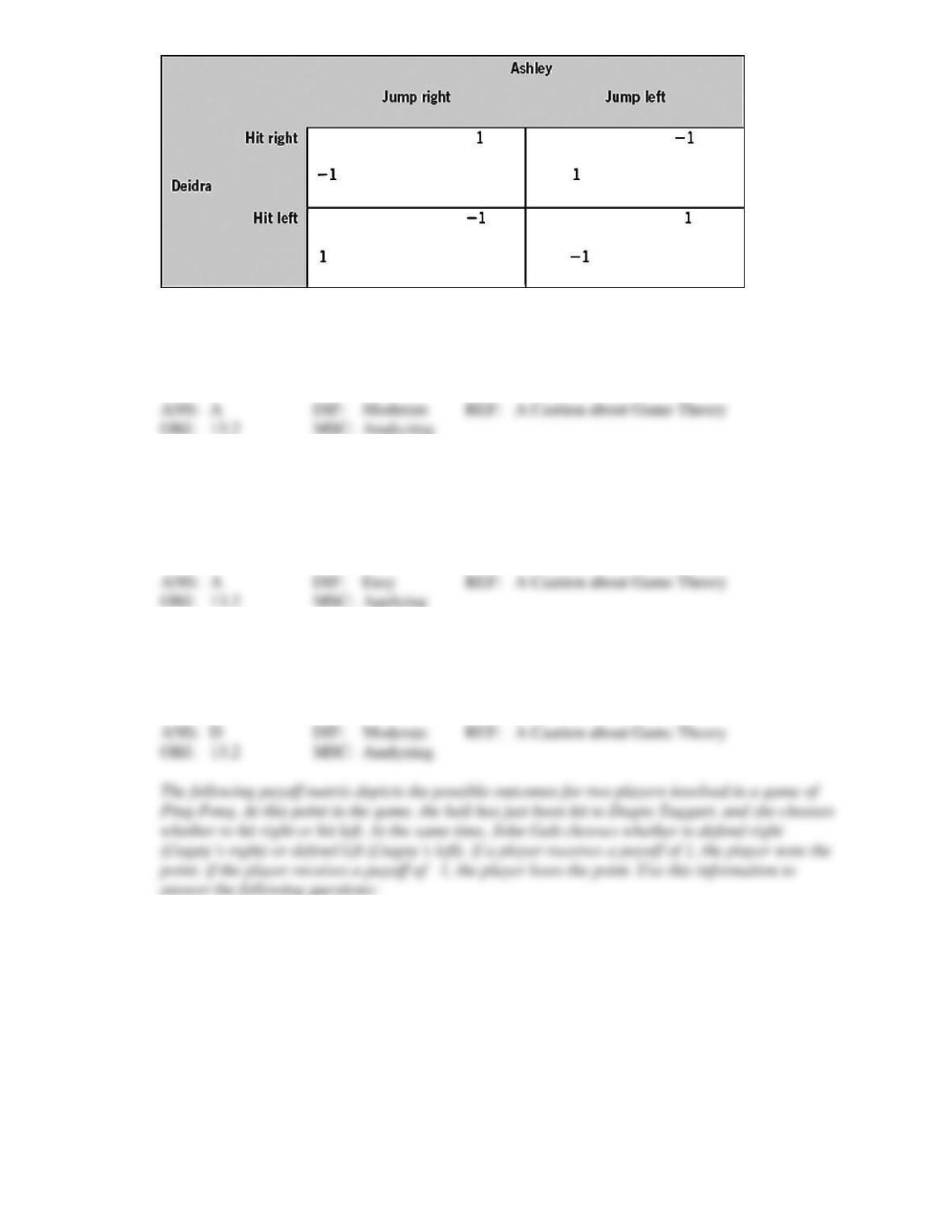
93. How many Nash equilibrium(s) exist in this game?
a. zero d. three
b. one e. four
c. two
94. If Deidra hits left and Ashley jumps right, Ashley receives a payoff of ________ and Deidra
receives a payoff of ________.
a. −1; 1 d. 1; −1
b. −1; −1 e. 0; 0
c. 1; 1
95. Deidra ________ a dominant strategy, and this game ________ a Nash equilibrium.
a. has; has d. does not have; does not have
b. has; does not have e. might have; might have
c. does not have; has
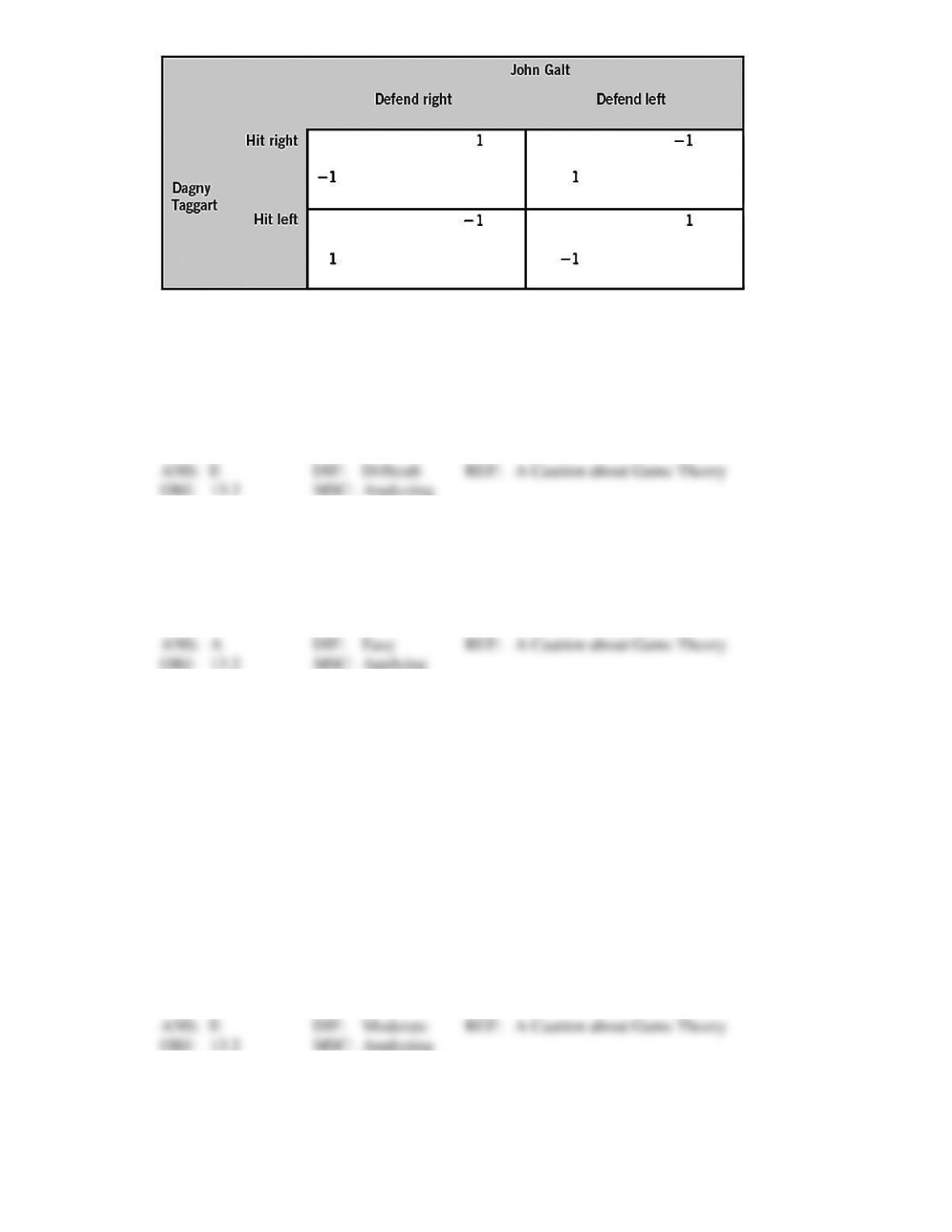
96. Dagny’s optimal strategy is to ________, and John’s optimal strategy is to ________.
a. hit right; defend right
b. hit left; defend left
c. hit left; defend left with probability 0.50 and defend right with probability 0.50.
d. hit left with probability 0.50 and hit right with probability 0.50; hit left.
e. hit left with probability 0.50 and hit right with probability 0.50; hit left with probability 0.50
and hit right with probability 0.50.
97. Assume that John defends left. Dagny’s payoff is ________ if she hits right and ________ if she
hits left.
a. 1; −1 d. −1; −1
b. 1; 1 e. 0.5; −0.5
c. −1; 1
98. The following payoff matrix depicts the possible outcomes for two players involved in a game of
Rock, Paper, Scissors. If a player receives a payoff of 1, the player wins; if the player receives a
payoff of −1, the player loses; if both players receive 0 (zero), the players tie. Which of the
following statements is true?
Grace
Rock Paper Scissors
Will Rock 0, 0 −1, 1 1, −1
Paper 1, −1 0, 0 −1, 1
Scissors −1, 1 1, −1 0, 0
a. Will’s dominant strategy is to play rock, and Grace’s dominant strategy is to play rock.
b. Will’s dominant strategy is to play paper, and Grace’s dominant strategy is to play rock.
c. Will’s dominant strategy is to play rock, and Grace’s dominant strategy is to play paper.
d. Will’s dominant strategy is to play scissors, and Grace does not have a dominant strategy.
e. Neither Will nor Grace has a dominant strategy.
99. One way to improve the social welfare of a society is to ________ competition and ________
monopoly practices through policy legislation.
a. limit; encourage d. ban; subsidize
b. limit; limit e. encourage; subsidize
c. encourage; limit
100. Legislative efforts to curtail the adverse consequences of oligopolistic cooperation began with the
________.
a. Clayton Act.
b. Sherman Antitrust Act.
c. McFadden Act.
d. Dodd–Frank Financial Reform Bill.
e. Competitive Reform Act.
101. The first federal law to place limits on cartels and monopolies was the
a. Federal Reserve Act.
b. Financial Institutions Reform, Recovery, and Enforcement Act.
c. Federal Trade Commission Act.
d. Clayton Act.
e. Sherman Antitrust Act.
102. The ________ Act was the first antitrust bill created in response to the increase in concentration
ratios in many leading U.S. industries, including steel, railroads, mining, textiles, and oil.
a. Sherman Antitrust d. Citigroup Relief
b. Fair Trade e. Sarbanes–Oxley
c. Steel Industry
103. Section 2 of the ________ Act reads: “Every person who shall monopolize, or attempt to
monopolize, or combine or conspire with any person who shall monopolize, or attempt to
monopolize, or combine or conspire with any other person or persons, to monopolize any part of
the trade or commerce among the several States, or with foreign nations, shall be deemed guilty of
a felony.”
a. Garn-St. Germain Depository Institutions
b. Securities and Exchange
c. Supply Demand
d. Clayton
e. Sherman Antitrust
104. According to Section 2 of the Sherman Antitrust Act, a person who attempts to monopolize
commerce among the several states is guilty of a(n)
a. minor misdemeanor. d. international misdemeanor.
b. misdemeanor of the first degree. e. felony.
c. misdemeanor of the second degree.
105. The ________ Act was passed in 1890, and the ________ Act was passed in 1914.
a. Clayton; Federal Trade Commission
b. Clayton; Sherman Antitrust
c. Sherman Antitrust; Federal Trade Commission
d. Sherman Antitrust; Clayton
e. Anticompetition; Sherman Antitrust
106. The two major pieces of antitrust legislation in the United States are the
a. Sherman Antitrust Act and the Federal Trade Commission Act.
b. Sherman Antitrust Act and the Clayton Act.
c. International Trade Act and the Clayton Act.
d. International Trade Act and the Sherman Antitrust Act.
e. Anticompetition Act and the Sherman Antitrust Act.
107. In general, antitrust laws are ________ to enforce.
a. complex and difficult d. irrelevant and easy
b. not complex and difficult e. complex and impossible
c. complex and easy
108. In 1974, the U.S. attorney general filed suit against which telecom company for violating antitrust
laws?
a. Sprint d. Pacific Bell
b. T-Mobile e. AT&T
c. Verizon
109. According to the Clayton Act, price discrimination is considered socially detrimental if it
a. increases competition in a market.
b. does not allow the dominant firm in the market to remain a monopolist.
c. lessens competition or creates monopoly.
d. involves the largest company in a respective industry.
e. involves small businesses being shut out of a market.
110. ________ restrict(s) the ability of the buyer to deal with competitors, and ________ require(s) the
buyer to purchase an additional product in order to buy the first.
a. Price discrimination; exclusive dealings
b. Exclusive dealings; price discrimination
c. Tying arrangements; exclusive dealings
d. Exclusive dealings; tying arrangements
e. Tying arrangements; price discrimination
111. According to the Clayton Act, persons are not allowed to serve as the director on more than
________ board(s) in the same industry.
a. one d. four
b. two e. five
c. three
112. Which federal agency is responsible for enforcing antitrust laws?
a. Federal Reserve Bank
b. Internal Revenue Service
c. Office of the Comptroller of Currency
d. Department of Justice
e. Congressional Budget Office
113. Suppose Lana lives in a small college town where, every weekend, 10 independent food cart
owners set up shop and sell hot dogs on the street. They are popular with students, and they
frequently locate where students hang out. One evening, Lana overhears the conversation of three
of the food cart owners as they conspire to raise the price of their hot dogs. That same night, she
reports the conversation to the Department of Justice via their antitrust complaint website. Why
might the Department of Justice NOT send an agent to investigate the collusion attempt that Lana
witnessed?
a. There is not a law that prohibits collusion among competitors.
b. Antitrust laws are applicable only to collusion attempts that occur on federal government
property and the collusion attempt occurred on private property.
c. Collusion among small competitors like street vendors is actually beneficial to consumers.
d. The Department of Justice lacks the resources to investigate every case of collusion reported.
e. To ensure small businesses a fair shot at competing with larger businesses, President Obama
issued an official executive order to the Department of Justice in 2012 to stop pursuing antitrust
violations involving small businesses only.
114. Why does the Department of Justice NOT investigate and block the many mergers of large firms
that have occurred recently in oligopolistic industries such as the cellular phone industry and the
airline industry that obviously lessen competition?
a. The Department of Justice has no authority to enforce antitrust violations because that
authority was given only to the Department of Labor under the Clayton Act.
b. The Economic Recovery and Reinvestment Act that was passed in 2009 repealed the Clayton
Act.
c. It is difficult for the Department of Justice to determine whether a firm has violated the law as
written because antitrust law is complex and cases are hard to prosecute.
d. In the past, every attempt by the Department of Justice to block a merger between two large
firms has failed, so the Department of Justice attempts to block only mergers between small firms.
e. In 1992, antitrust laws were amended so that they would not apply to nationally important
industries such as the cellular phone industry and the airline industry.
115. An example of a tying arrangement is
a. a restaurant offering both Pepsi and Coca-Cola products.
b. a car manufacturer installing expensive onboard GPS/navigation systems in all the cars it sells.
c. a landlord offering free rent for the first month when a tenant signs a one-year lease.
d. two companies competing on price.
e. a coffee shop offering customers the option of having cream with their coffee for an extra 25
cents.
116. Assume that two firms (Firm A and Firm B) operate in the U.S. steel industry. The owner of Firm
A writes the following letter to the owner of Firm B:
Dear Owner of Firm B,
I have concluded that if we both restrict output such that we each produce only 3 million tons of
steel per year, we can both charge a price that will allow us to effectively monopolize the steel
market and to maximize our joint profits. If you would like to enter into this agreement with me,
please draft a contract that specifies this agreement, and I will be more than willing to meet with
you and sign it.
Sincerely,
Owner of Firm A
If this letter were sent in the year 1850, the owner(s) of
a. Firm A would be guilty of violating antitrust laws.
b. Firm B would be guilty of violating antitrust laws.
c. both Firm A and Firm B would be guilty of violating antitrust laws.
d. Firm B would be guilty of violating antitrust laws only if he drafted and signed the agreement.
e. both Firm A and Firm B would not be guilty of anything because there were no antitrust laws
in existence in 1850.
117. Motorola and Apple are two large competitors in the cellular phone market. It is a violation of the
________ Act if Sanjay Jha serves on the board of directors for both Motorola and Apple.
a. Mergers and Acquisitions
b. Clayton
c. Telecommunications Board Restriction
d. Competition
e. Economic Efficiency
118. If attorneys can prove beyond a reasonable doubt that a merger between two major airlines lessens
competition, then the merger likely violates the ________ Act.
a. Mergers and Acquisitions d. Oligopoly Antitrust
b. Clayton e. Economic Efficiency
c. Airline
119. Assume that two firms (Firm A and Firm B) operate in the U.S. steel industry. The owner of Firm
A writes the following letter to the owner of Firm B:
Dear Owner of Firm B,
I have concluded that if we both restrict output such that we each produce only 3 million tons of
steel per year, we can both charge a price that will allow us to effectively monopolize the steel
market and to maximize our joint profits. If you would like to enter into this agreement with me,
please draft a contract that specifies this agreement and I will be more than willing to meet with
you and sign it.
Sincerely,
Owner of Firm A
If this letter were sent in the year 1944, the
a. owner of Firm A would be guilty of violating antitrust laws because he or she merely
attempted to monopolize the steel industry.
b. owner of Firm A would be guilty of violating antitrust laws only if he or she met with the
owner of Firm B and signed the contract, but the owner of Firm A would be not guilty if the
attempt to monopolize the market failed because the owner of Firm B never responded to the letter.
c. owners of both Firm A and Firm B would not be guilty of violating antitrust laws because
antitrust laws in 1944 applied only to industries made up of three or more firms.
d. owners of both Firm A and Firm B would not be guilty of violating antitrust laws because
antitrust laws in 1944 contained exceptions for certain nationally important industries like the steel
industry.
e. owners of both Firm A and Firm B would not be guilty of anything because there were no
antitrust laws in existence in 1944.
120. The practice of setting prices deliberately below average variable costs in order to put a rival out of
business is known as ________ pricing.
a. average variable d. predatory
b. collusion e. competitive
c. inversion
121. The practice of setting prices deliberately below ________ costs in an effort to drive a competitor
out of the market is known as predatory pricing.
a. marginal d. average fixed
b. average total e. explicit
c. average variable
122. It might be rational for a firm to price its products below ________ costs in order to drive potential
entrants from entering a market.
a. fixed d. implicit
b. average variable e. explicit
c. average fixed
123. Evidence of the intent to ________ is necessary to prove that a firm is engaged in predatory
pricing.
a. lower prices after others are driven out of business
b. raise prices after others are driven out of business
c. increase quantity after others are driven out of business
d. lower average fixed costs after others are driven out of business
e. subsidize competitors so they are not driven out of business
124. Suppose Firm A sets a price below average variable cost for two years. After the second year, Firm
A’s biggest rival goes bankrupt and exits the market. In the third year, Firm A raises prices
significantly. Firm A is practicing
a. average variable pricing. d. collusion pricing.
b. inversion pricing. e. predatory pricing.
c. competitive pricing.
125. If a firm sells only pharmaceutical grade aspirin (and no other products) and is currently pricing
the aspirin below average variable costs, the firm is currently making ________ economic profits.
a. negative d. abnormally high
b. 0 (zero) e. accounting
c. positive
126. Firm A prices its products so low that it drives competitors out of the market. After all of its
competitors have been driven out of the market, Firm A raises prices significantly. The fact that
Firm A ________ is sufficient evidence of anticompetitive behavior.
a. lowered prices
b. raised prices significantly
c. drove competitors out of the market
d. competed with other firms on price
e. lowered its price below average variable cost in an effort to drive competitors out of the
market and then subsequently increased price
127. Because Walmart has never systematically raised prices, there is no evidence that the company is
engaged in
a. illegal tying.
b. price discrimination that lessens competition.
c. excusive dealings that restrict the ability of the buyer to deal with competitors.
d. predatory pricing.
e. mergers and acquisitions that lessen competition.
128. Firm A and Firm B are the only two companies that sell mail-order DVD rental subscriptions. For
several years, Firm A priced its subscriptions below average variable cost. Firm B tried to compete
by also selling subscriptions below average variable cost, but went bankrupt and exited the market.
Several months after Firm B exited the market, Firm A raised prices by 40 percent and is currently
earning large, positive economic profits. Based only on this information, an argument can be made
that
a. Firm B must have made bad business decisions because it went bankrupt.
b. Firm A and Firm B must have had a collusive agreement.
c. the mail-order DVD rental subscription market is a monopolistically competitive market.
d. Firm B engaged in predatory pricing.
e. Firm A engaged in predatory pricing.
129. A ________ externality exists when the number of customers who purchase a good or use it
influences the quantity demanded.
a. network d. distribution
b. production e. regulation
c. consumption
130. A firm that produces a product that is characterized by ________ externalities finds it easier to
keep its customers from switching to rivals.
a. negative d. labor market
b. positive e. public good
c. network
131. If network externalities exist in an industry, the ________ firm to enter the market is often the one
that succeeds in dominating the industry.
a. first d. fourth
b. second e. fifth
c. third
132. A ________ effect occurs when a buyer’s preference for a product increases as the number of
people buying it increases.
a. oligopoly d. duopoly
b. switching e. competitive
c. network
133. When customers face significant ________ costs, the demand for the existing product becomes
more inelastic.