31) If the price elasticity of demand is greater than 1, a monopoly’s
A) total revenue increases when the firm lowers its price.
B) total revenue decreases when the firm lowers its price.
C) marginal revenue is negative.
D) marginal revenue is zero.
32) If the price elasticity of demand is less than 1, a monopoly’s
A) total revenue increases when the firm lowers its price.
B) total revenue decreases when the firm lowers its price.
C) marginal revenue is undefined.
D) marginal revenue is zero.
33) If the demand is ________, a fall in price ________ total revenue.
A) elastic; increases
B) elastic; decreases
C) inelastic; increases
D) inelastic; does not change
34) If a monopolist was operating in a price range where marginal revenue was negative, it
would be
A) in the inelastic range of the demand for its product.
B) in the unit elastic range of the demand for its product.
C) in the elastic range of the demand for its product.
D) maximizing revenue but not profits.
35) If a decrease in price decreases a monopolist’s total revenue, then
A) demand is elastic.
B) demand is inelastic.
C) demand is unit elastic.
D) the law of demand is violated.
36) If a monopolist lowers its price and its demand is inelastic, then its
A) total revenue increases.
B) total revenue decreases.
C) total revenue does not change.
D) total revenue is negative.
37) A monopolist that operates along the elastic range of its demand will find that
A) its total revenue increases when price decreases.
B) its total revenue decreases when price decreases.
C) its marginal revenue is negative.
D) it is more profitable to operate along the inelastic range of the demand curve.
38) If a monopoly is operating along the portion of its demand curve where marginal revenue is
positive, its
A) total revenue increases when price decreases.
B) total revenue decreases when price decreases.
C) total revenue remains the same when price decreases.
D) total revenue is zero.
39) Sue’s Surfboards is the sole renter of surfboards on Big Wave Island. If marginal revenue is
positive at the number of surfboard rentals made each hour, then Sue’s Surfboards
A) must face an elastic demand for surfboard rentals.
B) must face an inelastic demand for surfboard rentals.
C) can increase its total revenue by increasing the price of rentals.
D) must face a unit elastic demand for surfboard rentals.
40) For a monopoly, at the level of output where marginal revenue equals zero, then the
A) firm earns no revenue.
B) price elasticity of demand at this amount of output is zero.
C) firm has maximized total revenue.
D) firm is a price taker.
41) If marginal revenue equals zero, then demand at this level of output is
A) perfectly inelastic.
B) inelastic.
C) unit elastic.
D) elastic.
42) If marginal revenue is greater than zero, then demand at this level of output is
A) unit elastic.
B) elastic.
C) inelastic.
D) steeper than the marginal revenue curve.
43) If the demand for its product is elastic, a monopoly’s
A) total revenue is unchanged when the firm lowers its price.
B) total revenue decreases when the firm lowers its price.
C) marginal revenue is positive.
D) marginal revenue is zero.
44) If the demand for its product is inelastic, a monopoly’s
A) total revenue increases when the firm lowers its price.
B) total revenue is unchanged when the firm lowers its price.
C) marginal revenue is negative.
D) marginal revenue is equal to zero.
45) A monopoly firm expands its output and lowers its price. The firm finds that its total revenue
falls. Hence, the firm is producing in the
A) elastic range of its demand curve.
B) inelastic range of its demand curve.
C) elastic range of its supply curve.
D) inelastic range of its supply curve.
46) Tris owns the only auto repair shop on Lonely Island. Tris is a single-price monopoly, so
Tris operates on the ________ part of the ________ curve.
A) elastic; supply
B) inelastic; supply
C) inelastic; demand
D) elastic; demand
47) Which of the following is TRUE of a monopoly?
A) It can always increase its revenue by increasing the price to its customers.
B) It will always operate somewhere along the inelastic portion of the demand curve.
C) Its marginal cost curve is always downward sloping.
D) None of the above is correct.
48) A single-price monopolist will always produce where the elasticity of demand
A) is greater than 1.
B) is smaller than 1.
C) equals 1.
D) equals infinity.
49) Which of the following statements applies to a single-price monopolist?
A) In order to maximize profits, the monopolist will produce an amount of output that lies in the
elastic range of its demand.
B) In order to maximize profits, the monopolist will produce an amount of output that lies in the
inelastic range of its demand.
C) In order to maximize profits, the monopolist will produce where its demand is unit elastic.
D) In order to maximize profits, the monopolist will produce an amount of output in the inelastic
range of its supply.
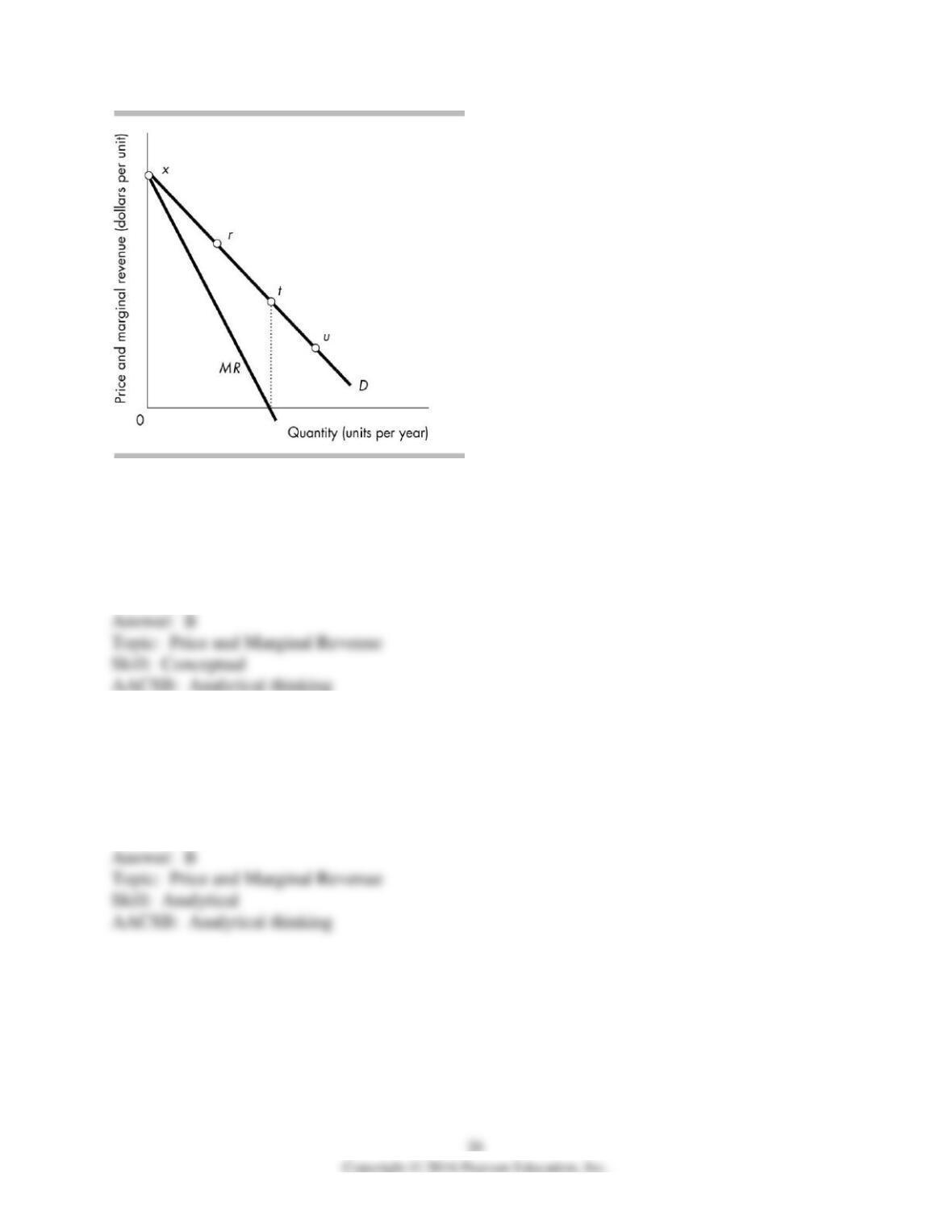
50) The figure above shows a monopoly firm’s demand curve. If the price and quantity of
haircuts move from point t to point r, the monopoly’s
A) total revenue will rise.
B) total revenue will fall.
C) total revenue will remain the same.
D) marginal revenue will decrease.
51) The figure above shows a monopoly firm’s demand curve. If the price and quantity of
haircuts move from point t to point u, the monopoly’s
A) total revenue will rise.
B) total revenue will fall.
C) total revenue will remain the same.
D) marginal revenue will increase.
52) The figure above shows a monopoly firm’s demand curve. At point t
A) demand is elastic.
B) demand is unit elastic.
C) demand is inelastic.
D) total revenue is at a minimum.
53) The figure above shows a monopoly firm’s demand curve. The monopoly’s total revenue is at
its maximum when the firm produces at point
A) x.
B) r.
C) t.
D) u.
54) The figure above shows a monopoly firm’s demand curve. The monopoly’s total revenue is
zero at point
A) x.
B) r.
C) t.
D) u.
55) The figure above shows a monopoly firm’s demand curve. At point u in the figure, the
demand facing the monopoly is
A) elastic.
B) unit elastic.
C) inelastic.
D) less than the supply.
56) An unregulated monopoly will
A) flood the market with goods to deter entry.
B) produce only where marginal revenue is zero.
C) produce in the inelastic range of its demand curve.
D) produce in the elastic range of its demand curve.
57) A single-price monopolist determines
A) its output but not its price.
B) its price but not its output.
C) both its output and its price.
D) neither its output nor its price.
58) To maximize profit, the monopolist produces on the ________ portion of its demand where
________.
A) elastic; P = MC
B) elastic; MR = MC
C) inelastic; P = MC
D) inelastic; MR = MC
59) A single-price monopolist maximizes profits by producing the output at which
A) price equals marginal cost.
B) price equals marginal revenue.
C) marginal revenue equals marginal cost.
D) marginal cost equals average cost.
60) A single-price monopolist will maximize profit by producing so that marginal revenue
A) exceeds marginal cost.
B) is less than marginal cost.
C) equals marginal cost.
D) equals price.
61) A monopolist maximizes its profit by producing the amount of output that sets
A) total revenue equals total cost.
B) marginal revenue equals marginal cost.
C) marginal revenue equals zero.
D) price equals marginal cost.
62) If a monopolist is maximizing profits, then it is producing an amount of output so that
A) MR = ATC.
B) MC = AVC.
C) MR = TC.
D) MR = MC.
63) A single-price monopolist will produce at the point where
A) MR = 0.
B) MR = P.
C) MR = MC.
D) P = MC.
64) Single-price monopolies maximize profit by producing the amount of output at which
A) total revenue is maximized.
B) price is equal to marginal cost.
C) price is equal to marginal revenue.
D) marginal revenue is equal to marginal cost.
65) A single-price monopolist will produce the output at which ________.
A) marginal revenue equals marginal cost
B) demand is perfectly inelastic
C) marginal revenue is zero
D) demand is inelastic but not perfectly inelastic
66) Which of the following is FALSE for a profit-maximizing single-price monopolist?
A) P = MC
B) MC = MR
C) P > MR
D) None of the above because they are all true.
67) Which of the following is ALWAYS true for a profit-maximizing single-price monopolist?
A) P > MC
B) P > MR
C) MR = MC
D) All of the above are always true.
68) Which of the following is ALWAYS true for a profit-maximizing single-price monopolist?
A) P = MC
B) P = MR
C) MR = MC
D) MC = ATC
69) Which of the following is not necessarily true for a profit-maximizing single-price
monopolist?
A) P > ATC
B) P > MC
C) P > MR
D) MR = MC
70) A single-price monopolist will find when it produces its profit-maximizing amount of output
that
A) price exceeds marginal revenue.
B) price exceeds marginal cost.
C) marginal revenue equals marginal cost.
D) All of the above occur at the profit-maximizing output level.
71) Suppose that a monopoly is currently producing the quantity at which marginal revenue is
less than marginal cost. The monopoly can increase its profit by ________.
A) shutting down
B) lowering its price and increasing its output
C) raising its price and decreasing its output
D) lowering its price and decreasing its output
72) A single-price monopoly will set its price according to which of the following rules?
A) P = MR and MR = MC
B) P = MC where the MC curve crosses the demand curve
C) P = MR where the MR curve crosses the demand curve
D) None of the above answers is correct.
73) A profit maximizing single-price monopolist charges a price equal to
A) average total cost.
B) marginal revenue.
C) the highest price consumers are willing to pay for the profit maximizing quantity.
D) the price necessary for the firm to earn a normal return on its investment.
74) For a single-price monopolist that is maximizing profit, the price is
A) less than marginal revenue.
B) equal to marginal revenue.
C) equal to marginal cost.
D) greater than marginal cost.
75) An unregulated monopoly finds that its marginal cost exceeds its marginal revenue. In order
to increase its profit, the firm will
A) raise its price and decrease its output.
B) lower its price and increase its output.
C) raise its price and increase its output.
D) continue to produce this level of output because any change will lower its profit.
Price
(dollars per movie)
Quantity demanded
(movies per week)
18
0
15
100
12
200
9
300
6
400
3
500
76) Roxie’s Movie Theatre is the only one in town. The table above gives the demand schedule
for movies. If Roxie’s is a single-price monopoly and the marginal cost of a movie is $6, Roxie’s
will charge ________ a movie and will sell ________ movie tickets a week.
A) $15; 100
B) $12; 200
C) $6; 400
D) $9; 300
77) Which of the following is TRUE for a profit maximizing monopolist?
A) Marginal cost is always less than average total cost.
B) In the long run, the firm’s economic profit equals zero.
C) In the short run, the firm will shut down if its marginal cost is less than its average variable
cost.
D) In the short run, the firm can make an economic profit even if its marginal cost is less than its
average variable cost.
78) Monopolies can make an economic profit in the long run because of
A) rent seeking by competitors.
B) the elastic demand for the monopoly’s product.
C) the cost-savings gained by the monopoly.
D) barriers to enter the monopoly’s market.
79) In the long run, a single-price monopolist will
A) make zero economic profit.
B) be able to continue to make an economic profit as long as there is a barrier to entry.
C) end up being regulated by the government because it is making short-run economic profits.
D) Both answers A and C are correct.
80) Unregulated monopolies can often make an economic profit in the long run because
A) they receive government subsidies.
B) they have high costs.
C) barriers to entry prevent competing firms from entering the market.
D) the risks of running a monopoly are high.
81) A monopolist can make an economic profit in the long run because of
A) the relatively elastic demand for its product.
B) the relatively inelastic demand for its product.
C) the firm’s price setting behavior.
D) barriers to entry.
82) Why can a monopoly make an economic profit in the long run?
A) because there are close substitutes for the firm’s product
B) because the firm is protected by barriers to entry
C) because the firm produces where MR = MC
D) All of the above are reasons why a monopoly can earn an economic profit in the long run.
83) Monopolies can make an economic profit in the long run because there
A) are close substitutes for the product.
B) is free entry and exit.
C) is inelastic demand from consumers.
D) is a barrier to entry.
84) The primary reason why a monopoly can make a long-run economic profit is the existence of
A) barriers to entry.
B) inelastic demand.
C) price discrimination.
D) many buyers.
85) Which of the following statements is TRUE?
A) All monopolists are perfect price discriminators.
B) All monopolists earn short-run economic profits.
C) A monopolist will leave the market if it incurs an economic loss in the long run.
D) A monopolist does not need barriers to entry to sustain a long-run economic profit.
86) Which of the following is a characteristic of monopoly in the long run?
A) The firm makes zero economic profit.
B) The firm can make an economic profit.
C) Price equals marginal cost.
D) Price equals marginal revenue.
Price
(dollars per
repair)
Quantity
demanded
(repairs per
week)
Total cost
(dollars)
100
0
400
90
10
800
80
20
1400
70
30
2200
60
40
3200
87) Dee’s TV Repair is the only TV repair shop in a small town. Dee is a single-price
monopolist. Based on the demand and cost information in the table above, what quantity of TV
repairs should Dee undertake?
A) 0 per week
B) 10 per week
C) 20 per week
D) 30 per week
88) Dee’s TV Repair is the only TV repair shop in a small town. Dee is a single-price
monopolist. Based on the demand and cost information in the table above, what is the amount of
economic profit made or loss incurred at the quantity of TV repairs that profits are maximized or
losses minimized?
A) -$400
B) $800
C) -$100
D) $200
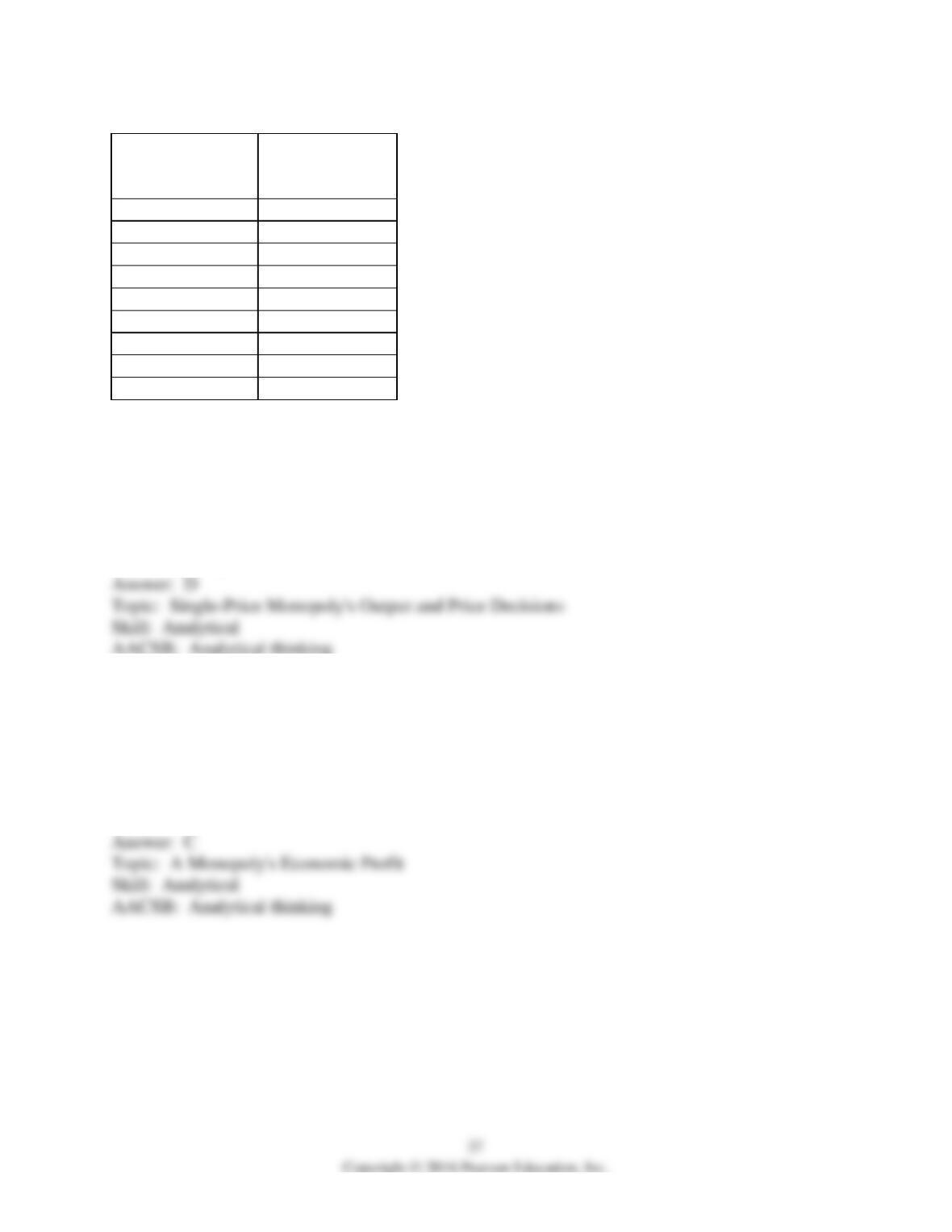
Price
(dollars per bottle)
Quantity
demanded
(bottles per day)
16
0
15
1
14
2
13
3
12
4
11
5
10
6
9
7
8
8
89) The table above gives the demand schedule for water bottled by Wanda’s Healthy Waters. If
the marginal cost is a constant $4 a bottle, Wanda’s will produce ________ a day and charge
________ a bottle.
A) 8 bottles; $8
B) 4 bottles; $12
C) 1 bottle; $15
D) 6 bottles; $10
90) The table above gives the demand schedule for water bottled by Wanda’s Healthy Waters.
Wanda’s marginal cost is a constant $4 a bottle and has no fixed cost. Wanda’s makes an
economic profit of ________ a day.
A) $0
B) $24
C) $36
D) $60
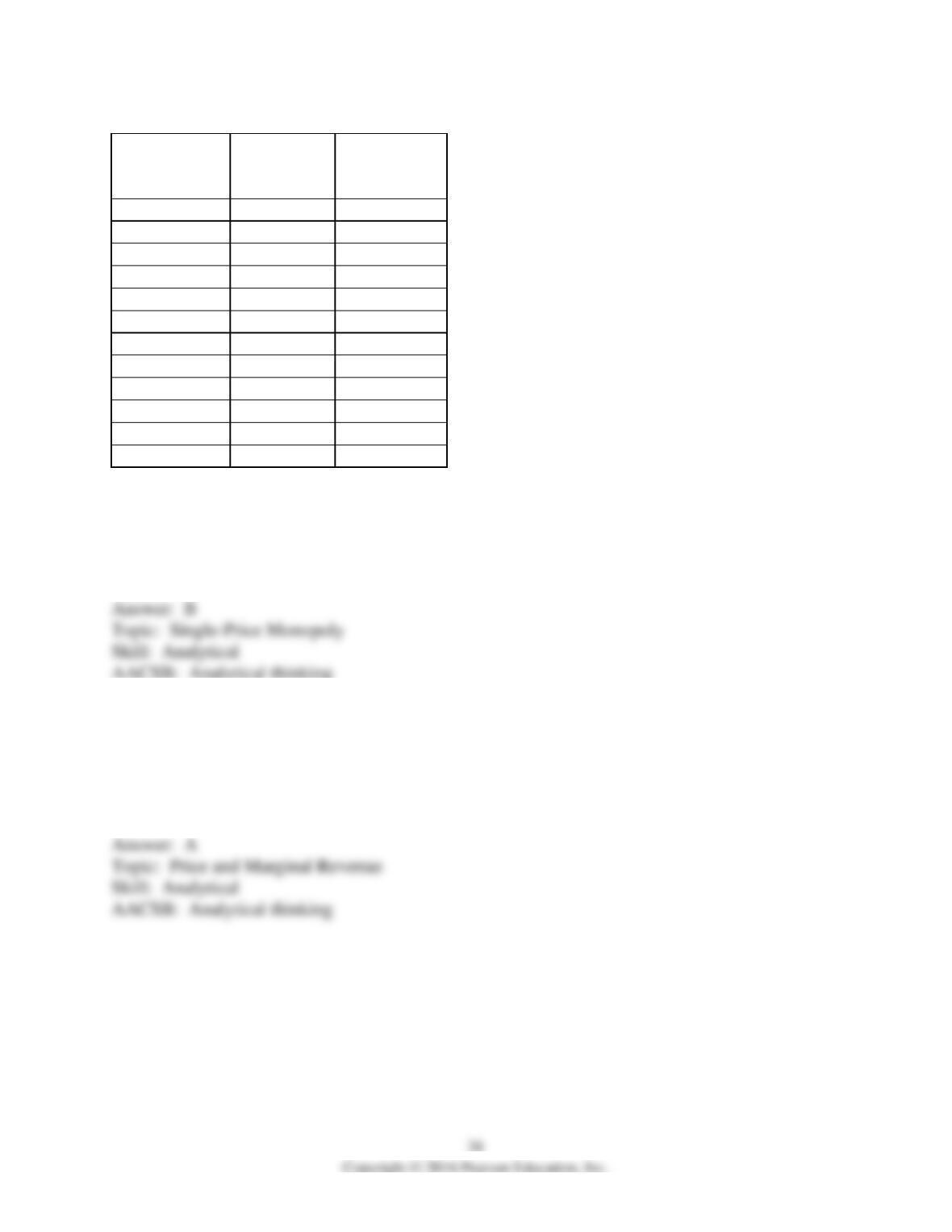
Rooms rented
monthly
Price
(dollars per
room)
Total cost
(dollars)
0
201
100
1
191
200
2
181
290
3
171
370
4
161
440
5
151
520
6
141
610
7
131
710
8
121
820
9
111
940
10
101
1090
11
91
1290
91) The motel whose costs are given in the table above has total fixed costs equal to
A) $0.
B) $100.
C) $200.
D) $201.
92) The table above shows the demand and total cost schedule for a monopolist hotel. What is
the marginal revenue from renting out the fifth room each night?
A) $111
B) $141
C) $151
D) $161
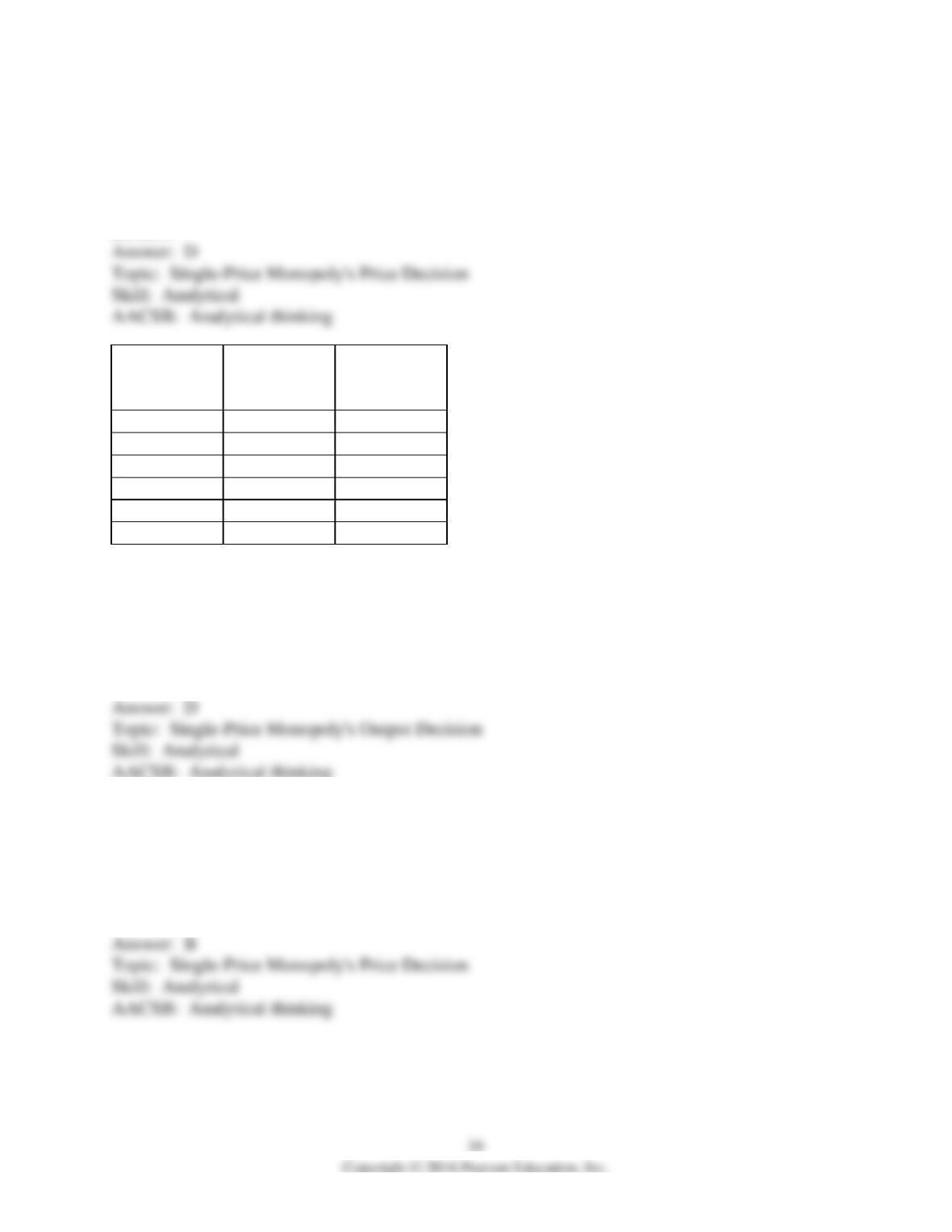
93) The table above shows the demand and total cost schedule for a monopolist hotel. What price
should the monopolist charge if it is a single-price monopoly that maximizes its profit?
A) $171
B) $161
C) $151
D) $141
Price
(dollars per
unit)
Quantity
(units per day)
Total cost
(dollars)
50
0
10
45
20
110
40
40
310
35
60
710
30
80
1210
25
100
1810
94) The table above shows the demand and costs for a single-price monopolist. The firm can
maximize its profit by selling
A) 0 units.
B) 20 units.
C) 40 units.
D) 60 units.
95) The table above shows the demand and costs for a single-price monopolist. The firm can
maximize its profit by setting its price at
A) $30 per unit.
B) $35 per unit.
C) $40 per unit.
D) $45 per unit.
96) The table above shows the demand and costs for a single-price monopolist. The maximum
economic profit this firm can make equals
A) $1,390.
B) $1,550.
C) $1,580.
D) $2,400.
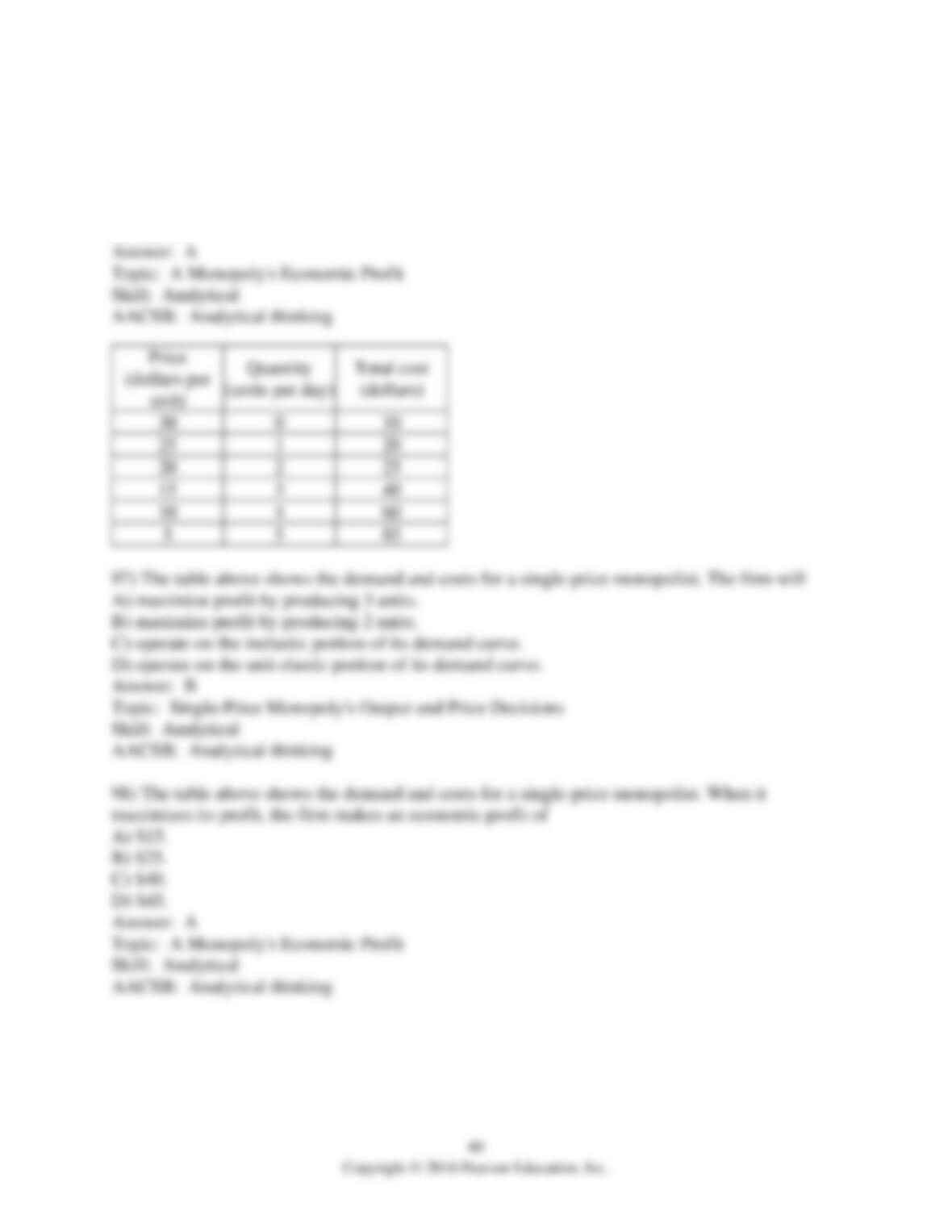
Price
(dollars per
unit)
Quantity
(units per day)
Total cost
(dollars)
30
0
10
25
1
20
20
2
25
15
3
40
10
4
60
5
5
85
97) The table above shows the demand and costs for a single-price monopolist. The firm will
A) maximize profit by producing 3 units.
B) maximize profit by producing 2 units.
C) operate on the inelastic portion of its demand curve.
D) operate on the unit elastic portion of its demand curve.
98) The table above shows the demand and costs for a single-price monopolist. When it
maximizes its profit, the firm makes an economic profit of
A) $15.
B) $25.
C) $40.
D) $45.