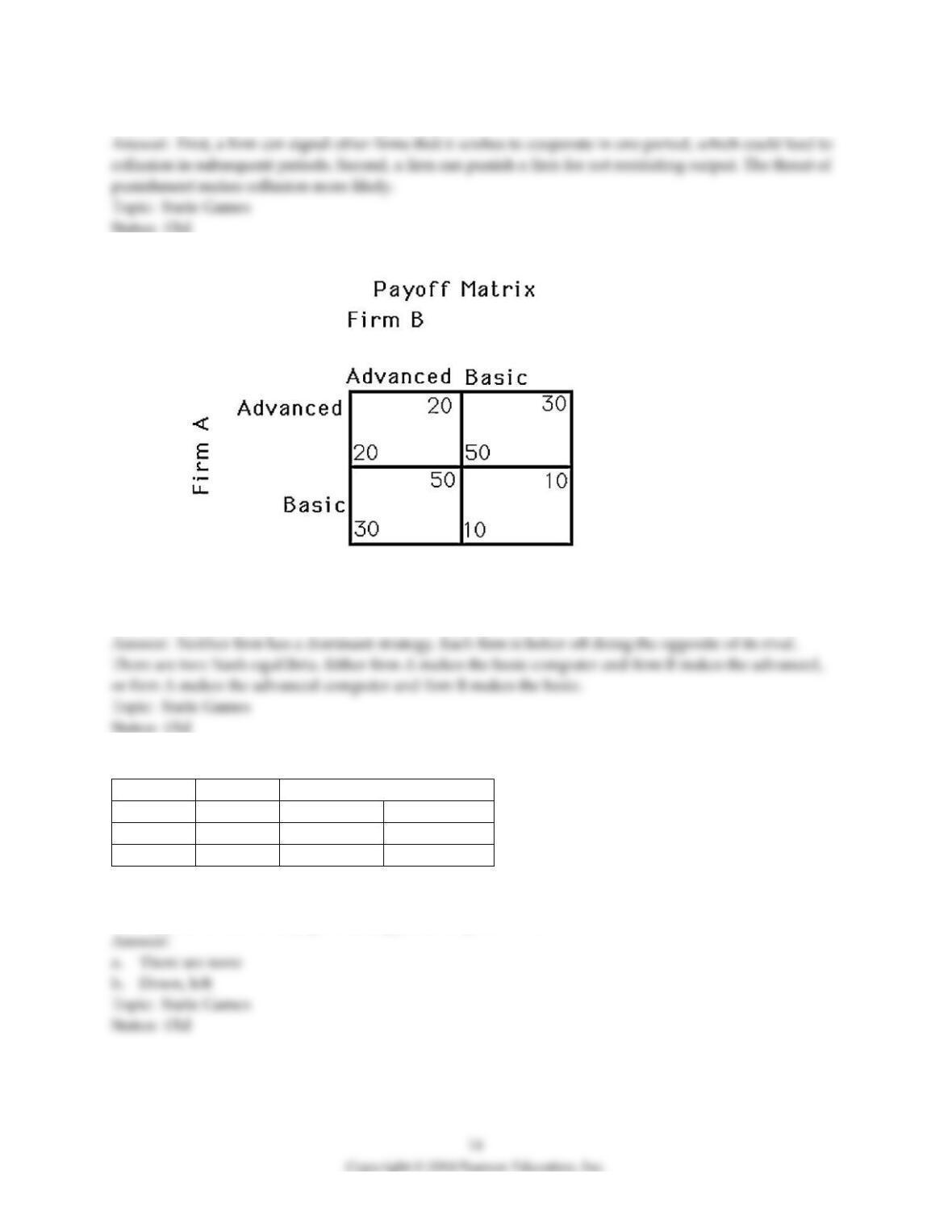
44) Why is collusion more likely in a repeated game?
45) The above figure shows the payoff for two firms, A and B, that must each choose to produce either an
advanced computer or a basic computer. Determine the dominant strategies for each firm (if any) and the
Nash equilibria (if any).
46)
Player 2
Left
Right
Player 1
Up
0, 1
1, 0
Down
1, c
0, 1
a. Suppose c = 0. Find any (pure strategy) Nash Equilibrium.
b. Suppose c = 2. Find any (pure strategy) Nash Equilibrium.
For the following, please answer “True” or “False” and explain why.
47) All Nash equilibria consist of Dominant Strategies
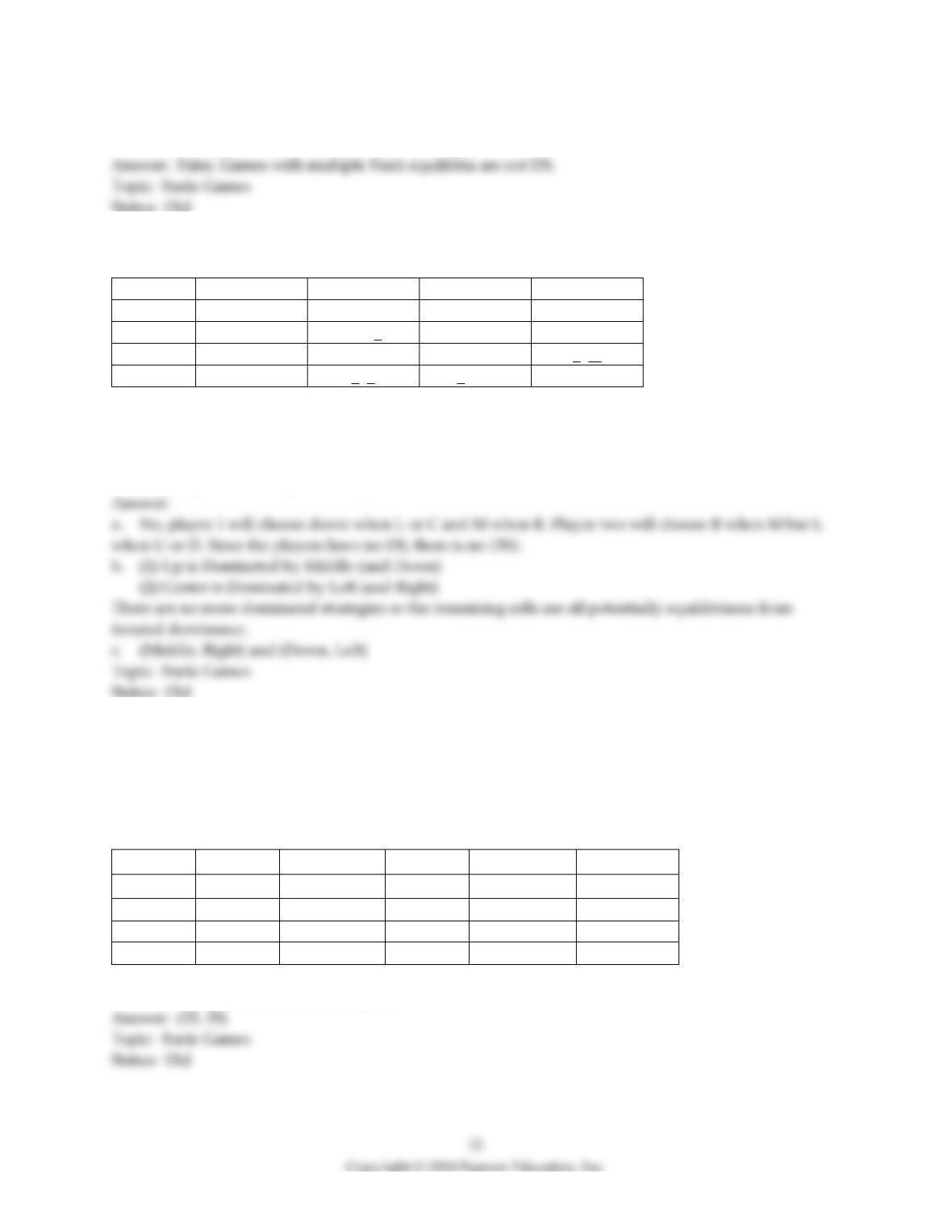
48) Consider the following game:
Player 2
Left
Center
Right
Up
-10, 0
-10, -1
-10, -1
Player 1
Middle
-8, -8
0, –10
2, -1
Down
4, 5
7, –10
1, 1
a. Does either player have a dominant strategy? Explain.
b. Use the process of iterated elimination of dominated strategies to reduce the possible outcomes for
the game.
c. Find all pure Nash Equilibrium(s).
49) The following is a simplified duopoly model of competition between two firms. Firms simultaneously
choose the quantity of outputs to produce, and then profits are realized. Each firm is restricted to
producing 25, 35, 50 or 100 units of output. The details of how the payoffs are derived are unimportant
because payoffs are all given in the table below.
Firm 2
Q2 = 25
35
50
100
Q1 = 25
125, 125
100, 140
63, 125
-63, –250
Firm 1
35
140, 100
105, 105
53, 75
-123, -350
50
125, 63
75, 53
0, 0
-250, -500
100
-250, –63
-350, -130
–500,-250
-900, -900
Find the Nash equilibrium(s) in the game.
For the following, please answer “True” or “False” and explain why.
50) All normal-form games have at least one dominant strategy.
51) If each player has a dominant strategy, then those strategies make up the Nash equilibrium.
52) A Nash equilibrium will always provide both players with their highest payoffs possible.
53) If a player has a dominant strategy in a simultaneous-move game, then she is sure to get her best
outcome.
54) Consider two agents simultaneously deciding whether to contribute to a public good – the good is
said to be public because, if it is made available, an agent who free-rides by paying nothing gets just as
much pleasure from its enjoyment as an agent who paid for it. If at least one agent contributes to the
construction of the public good, both agents will enjoy a payoff of four from the public good. To ensure
the public good is constructed, player one must pay c1 or player two must pay c2. Assume that c1 < 4 and
c2 < 4. If neither contributes, the good is not constructed and neither player gets enjoyment from the
project. If one or both players contribute, then the good is constructed and each player enjoys a payoff of
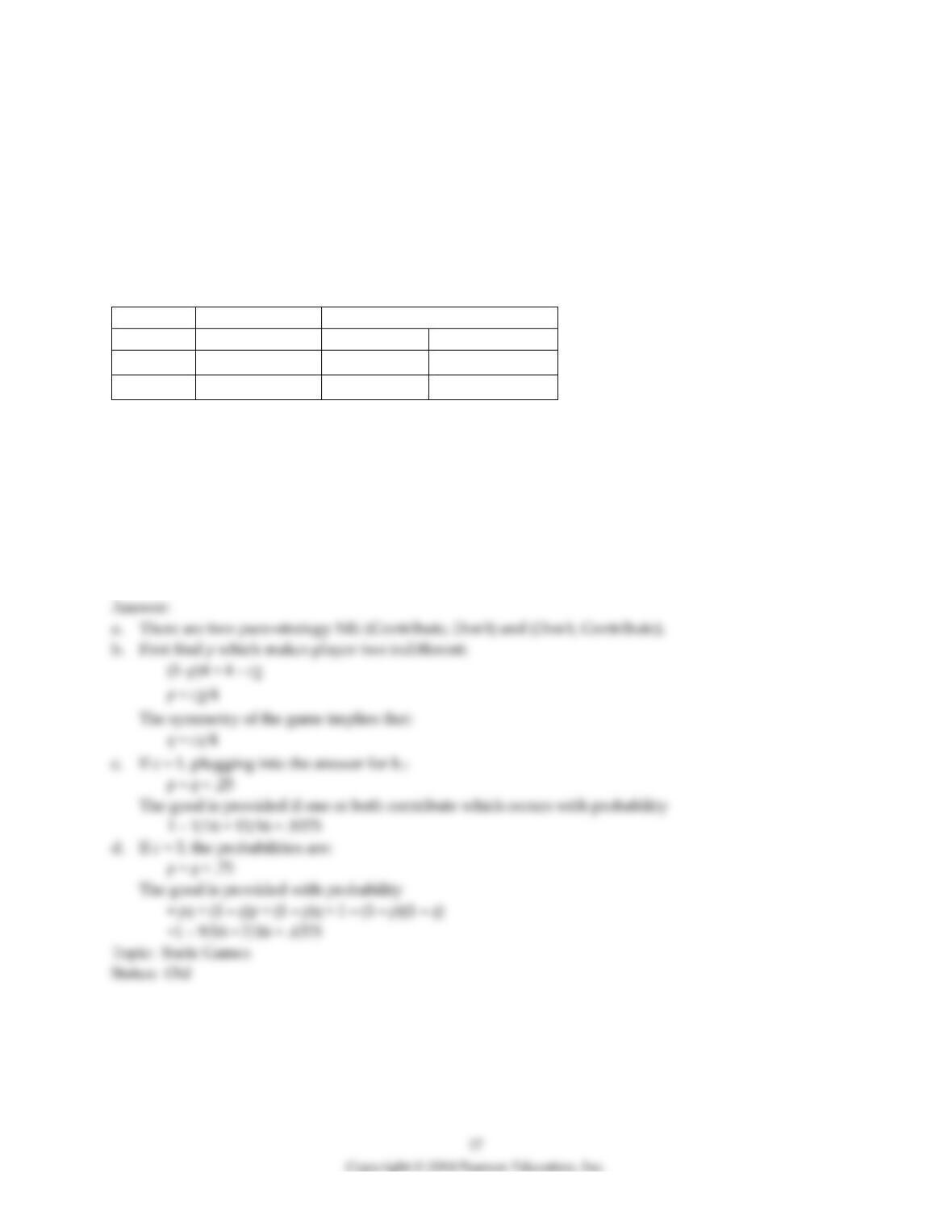
four minus the contribution cost if that player has contributed. The grid below shows this:
Agent 2
Free Ride
Contribute
Agent 1
Free Ride
0, 0
4, 4 – c2
Contribute
4 – c1, 4
4 – c1, 4 – c2
Assume that the costs are common knowledge to both players.
a. Find any pure-strategy Nash Equilibrium(s) to the game.
b. Find the Mixed Strategy Nash Equilibrium – the probabilities you find will be functions of the cost
parameters.
c. If c1 = c2 = 1, write out the mixed strategy NE and find the probability that the public good is
provided?
d. If c1 = c2 = 3, write out the mixed strategy NE and find the probability that the public good is
provided?
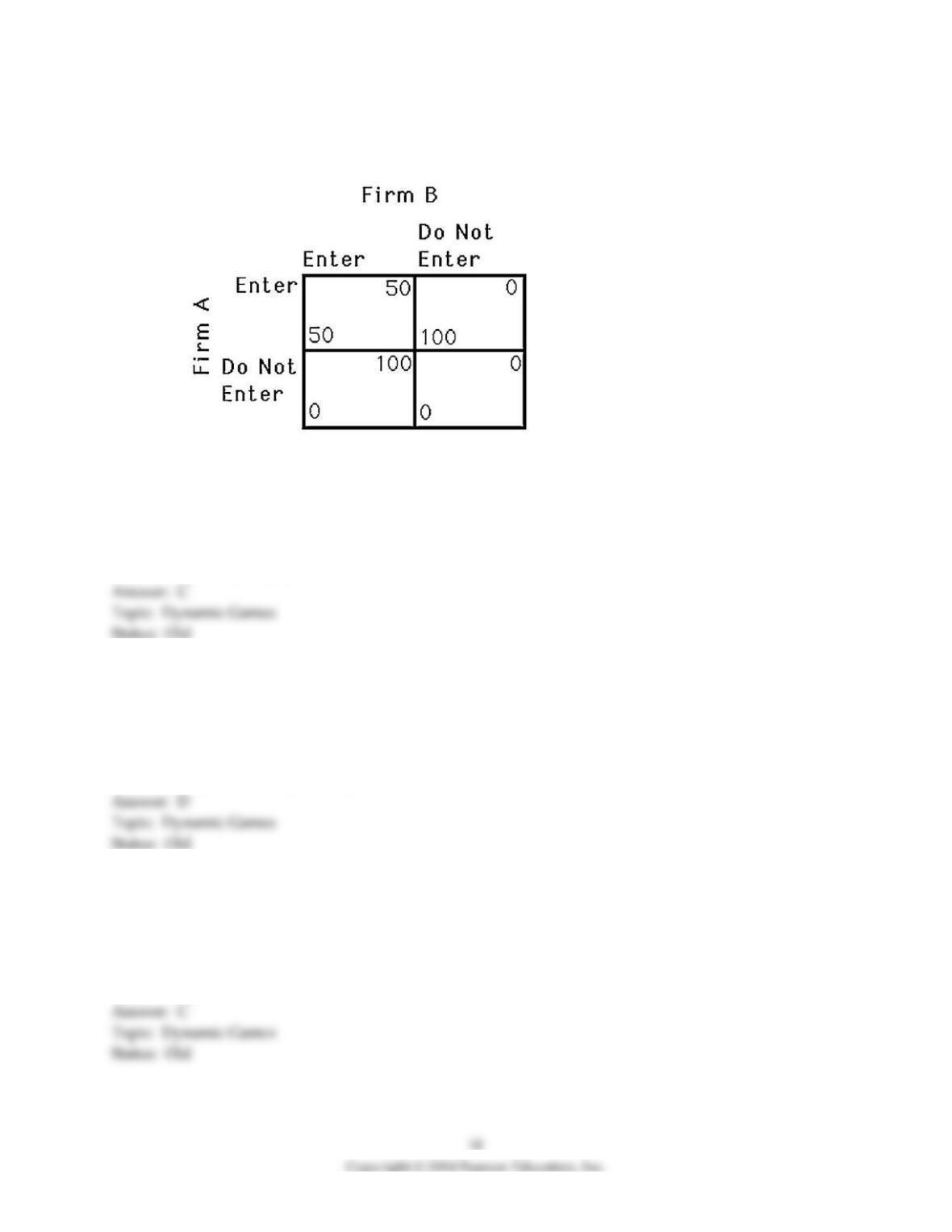
13.2 Dynamic Games
1) The above figure shows the payoff to two gasoline stations, A and B, deciding to operate in an isolated
town. If firm A chooses its strategy first, then
A) firm A will not enter.
B) firm B’s entry is blockaded.
C) both firms will enter.
D) firm A will enter and firm B will not.
2) The above figure shows the payoff to two gasoline stations, A and B, deciding to operate in an isolated
town. Suppose a $60 fee is required to enter the market. If firm A chooses its strategy first, then
A) firm A will not enter.
B) neither firm will enter.
C) both firms will enter.
D) firm A will enter and firm B will not.
3) The above figure shows the payoff to two gasoline stations, A and B, deciding to operate in an isolated
town. Suppose a $30 fee is required to enter the market. If firm A chooses its strategy first, then
A) firm A will not enter.
B) neither firm will enter.
C) both firms will enter.
D) firm A will enter and firm B will not.
4) If only one firm operates in a market, and a potential entrant is blockaded from entering the market,
then the incumbent firm must
A) have acted to prevent entry.
B) be pricing where price equals marginal cost.
C) be a natural monopoly.
D) be the Stackelberg leader.
5) An incumbent’s threat to retaliate after a potential competitor enters the market will be taken seriously
by potential competitors if
A) the incumbent can still earn a profit after carrying out the threat.
B) the incumbent earns greater profit carrying out the threat than by accommodating entry.
C) the potential entrant cannot earn a profit if the threat is carried out.
D) the potential entrant’s profit exceeds the incumbent’s if the threat is carried out.
6) With regard to preventing entry, if identical firms act simultaneously,
A) they cannot credibly threaten each other.
B) they will all incur losses.
C) only one firm will enter the market.
D) none of them will enter the market.
7) An incumbent announces it will significantly increase output in the next period, but only has contracts
for the amount produced this period. The announcement is a
A) credible threat.
B) non-credible threat.
C) commitment.
D) mixed strategy.
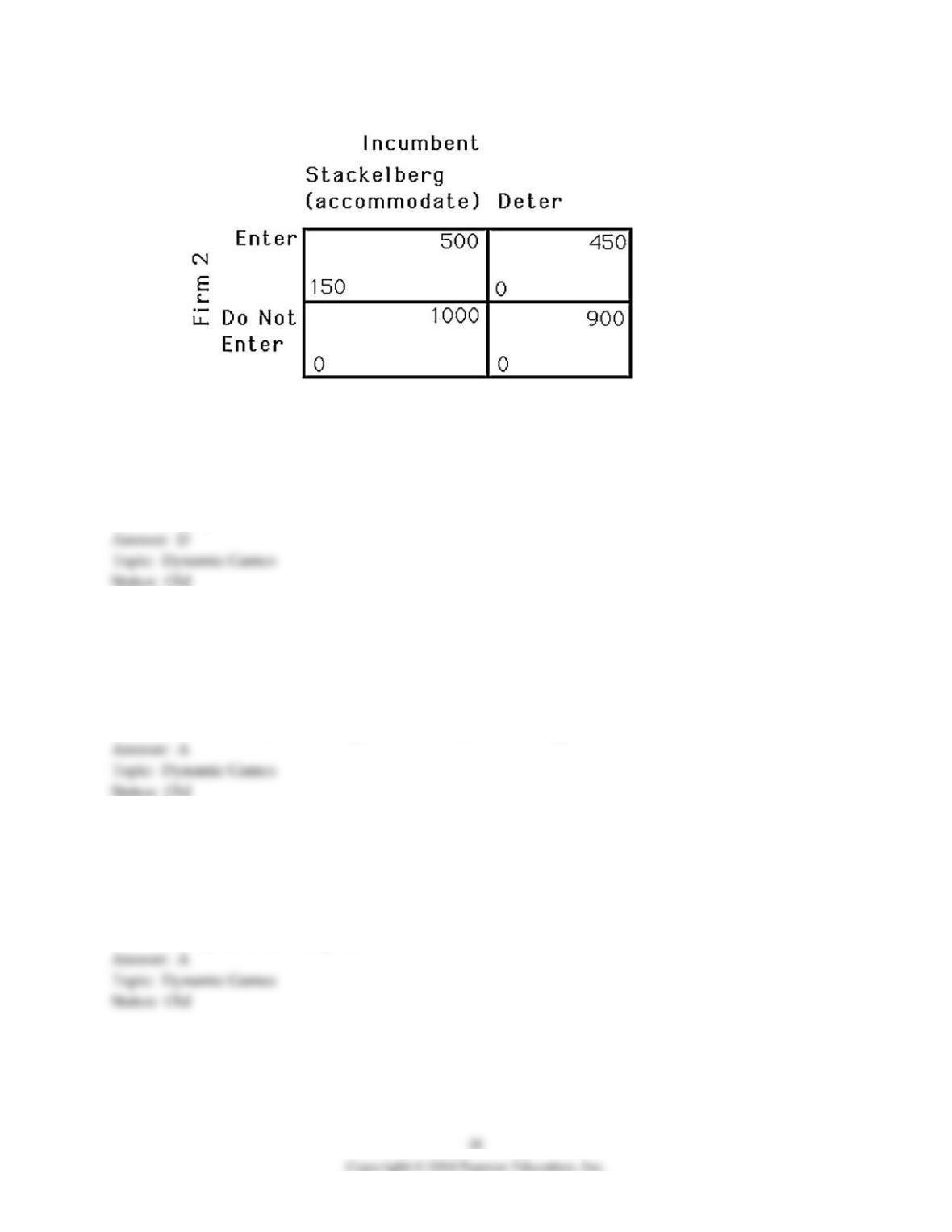
8) The above figure shows the payoff matrix facing an incumbent firm and a potential entrant. The
potential entrant cannot earn a profit if the incumbent
A) chooses the Cournot level of output.
B) chooses the Stackelberg leader level of output.
C) shuts down.
D) deters entry.
9) The above figure shows the payoff matrix facing an incumbent firm and a potential entrant. Assuming
a fixed cost of entry, the incumbent will deter entry because
A) it is more profitable than accommodating entry.
B) it increases consumer surplus.
C) the potential entrant winds up with zero profit.
D) the incumbent would earn zero profit if it accommodated entry.
10) The above figure shows the payoff matrix facing an incumbent firm and a potential entrant.
Assuming a fixed cost of entry, the outcome will be that the incumbent
A) deters entry.
B) chooses the Stackelberg leader level of output but the potential entrant does not enter anyway.
C) chooses the Stackelberg leader level of output and the potential entrant enters.
D) deters entry and earns zero profit.
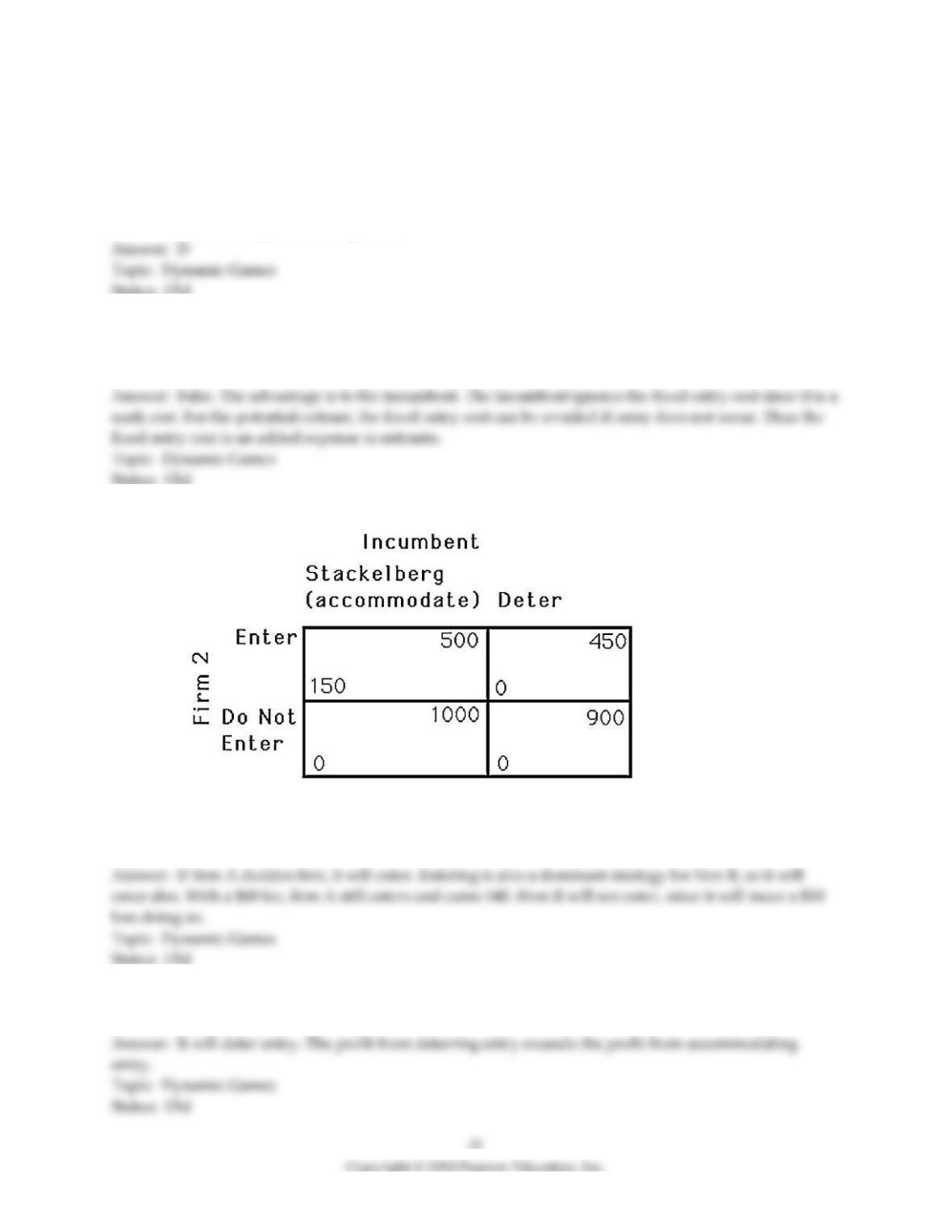
11) The above figure shows the payoff matrix facing an incumbent firm and a potential entrant. If the
fixed cost of entry were to increase, which of the following would occur?
A) The incumbent chooses the Cournot level of output.
B) The incumbent shuts down.
C) The entry-deterring level of output rises.
D) The entry-deterring level of output falls.
Status: Old
For the following, please answer “True” or “False” and explain why.
12) Fixed costs of entry create an advantage for potential entrants since incumbents have already made
these expenditures while potential entrants can avoid these costs.
13) The above figure shows the payoffs to two firms deciding to open a gasoline station in an isolated
town. If firm A decides first, what will happen? If there is a $60 fee to enter this market, what will
happen?
14) The above figure shows the payoff matrix facing an incumbent firm. Assuming a fixed cost of entry,
will the incumbent deter entry? Why?
15) How can a firm be made better off by limiting its options?
16) Suppose market demand is p = 10 – Q. Firms have a fixed cost of five and no marginal cost. If firm A is
the incumbent, can it deter the entry of its rival, firm B?
17) Suppose market demand is p = 10 – Q. Firms incur no cost of production. If firm A is the incumbent,
can it deter the entry of its rival, firm B?
18) Two identical firms are considering entering a new market that currently has no suppliers. The
demand is large enough for both firms to make a positive profit. There are no fixed costs to enter. Explain
how a simultaneous decision to enter on the part of the two firms will lead to a different outcome than a
sequential entry decision.
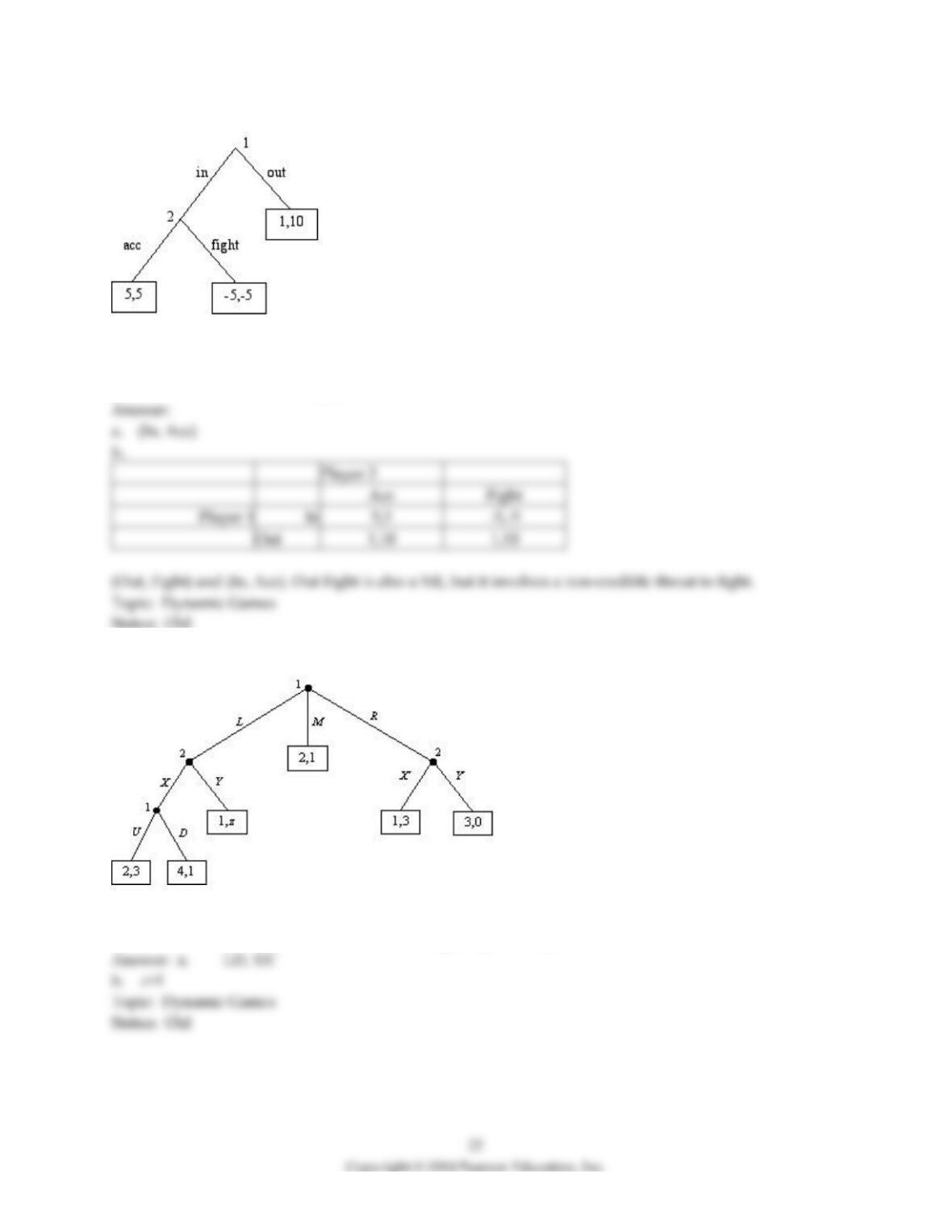
19) Consider the game below:
a. Use backward induction to find the subgame perfect Nash equilibrium to the game.
b. Model the game with a strategic grid. Find all Nash Equilibrium to the normal–form game. Why is
your answer different than in (a)?
20) Consider the following sequential move game:
a. If z=0, find any subgame perfect NE.
b. For what values of z will M occur in the subgame perfect equilibrium?
13.3 Auctions
1) A sale in which property or a service is sold to the highest bidder is called a(n)
A) auction.
B) bidder sale.
C) competitive market.
D) Austrian bundle.
2) An auction in which the price announced by the auctioneer DESCENDS is called a
A) Dutch Auction.
B) English Auction.
C) Sealed Bid Auction.
D) Descending Option Auction.
3) A private auction is an auction in which
A) individuals know their own value of the good and everyone else‘s valuation, too.
B) individuals have their own valuation of the good but don’t know everyone else’s.
C) many auctions are auctioned off at the same time.
D) only one good is auctioned off.
4) The individual with the highest valuation of the good will win in which of the following auctions?
A) English Auction
B) Dutch Auction
C) Sealed Bid Auction
D) All of the above.
5) The Internet auction site eBay is an example of a(n)
A) Sealed Bid Auction.
B) Second-Price Auction.
C) English Auction.
D) both A and B.
6) The result that different auction styles in which the good goes to the winner with the highest valuation
of the good generate the same amount of revenue is called
A) Revenue Equivalence Theorem.
B) Marginal Revenue Theory.
C) Auction Revenue Theory.
D) First Bid Revenue Theorem.
For the following, please answer “True” or “False” and explain why.
7) In auctions, the winner always pays a price equal to the highest (his) bid.
8) In Dutch or first-price sealed-bid auctions, participants will bid less than their highest valuation.
9) Explain why it is unwise to bid more than your valuation of the good in a sealed bid second–price
auction.
13.4 Behavioral Game Theory
1) In the ultimatum experiment, what are the usual outcomes?
A) Proposer proposes to give the minimum positive amount to the responder in all the rounds.
B) Proposer and responder are rational all the time.
C) Proposer proposes to give about 30~40% of total amount to the responders.
D) Proposer proposes to give 60~0% of total amount to the responders