
23) If the local cable TV company is a natural monopoly and required by regulators to set its
price equal to marginal cost, there is a deadweight loss in the market and the firm might need a
government subsidy to survive.
195
10 Extended Problems
Price
(dollars per
ounce)
Quantity
demanded
(ounces per day)
100
100
200
80
300
60
400
40
500
20
600
0
Quantity
produced
(ounces per
day)
Total cost
(dollars per day)
9
6,000
20
7,200
40
8,800
60
10,800
80
13,200
100
16,000
1) Anastasia’s Gold Mines, a single-price monopoly, faces the demand schedule shown in the
first table above and has the cost schedule shown in the second table above.
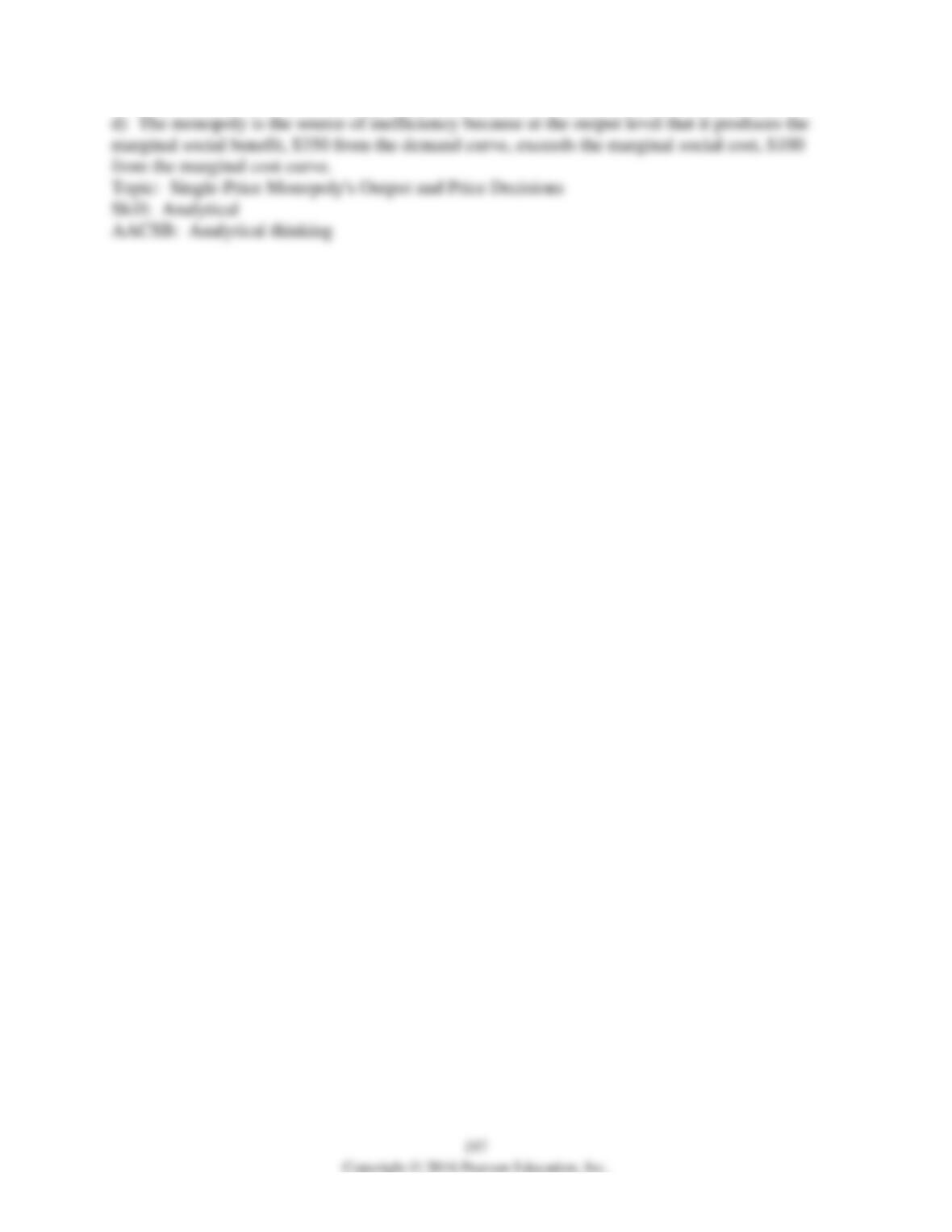
a) Calculate Anastasia’s marginal revenue schedule. In a figure, draw the demand curve and the
marginal revenue curve.
b) Calculate Anastasia’s marginal cost and average total cost schedules. In the same figure that
you drew the demand and marginal revenue curves, draw the marginal and the average total cost
curves.
c) What are Anastasia’s profit-maximizing output and price? What is Anastasia’s economic
profit? Explain your answer.
d) Does Anastasia’s Gold Mines use resources efficiently? Explain your answer.
198
Price
(dollars per bottle)
Quantity
demanded
(bottles per week)
1.50
250
2.00
200
2.50
150
3.00
100
3.50
50
4.00
0
Quantity
produced
(bottles per week)
Total cost
(dollars per week)
0
120.00
50
145.00
100
157.50
150
195.00
200
257.50
250
345.00
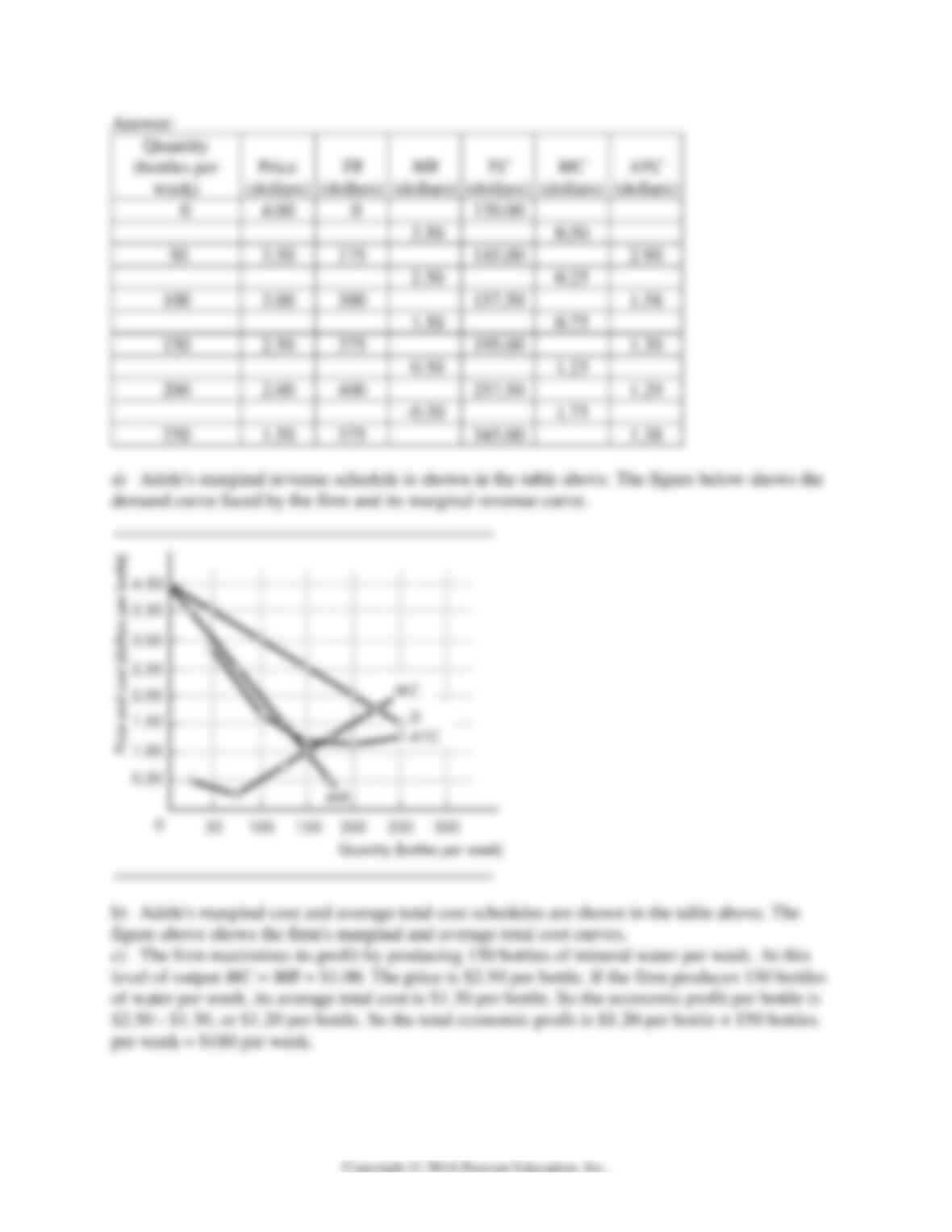
2) Adele’s Springs produces a unique mineral water. The firm faces the demand schedule shown
in the first table above and has the cost schedule shown in the second table above.
a) Calculate Adele’s marginal revenue schedule. In a figure, draw the demand curve and the
marginal revenue curve.
b) Calculate Adele’s marginal cost and average total cost schedules. In the same figure that you
drew the demand and marginal revenue curves, draw the marginal and the average total cost
curves.
c) What are Adele’s profit-maximizing output and price? What is Adele’s economic profit?
Explain your answer.
d) Does Adele’s Springs use resources efficiently? Explain your answer.
199
200
201
Price
(dollars per
copy)
Quantity
demanded
(copies per day)
0.40
500
0.50
400
0.60
300
0.70
200
0.80
100
0.90
0
Quantity
produced
(copies per day)
Total cost
(dollars per day)
0
100
100
105
200
120
300
145
400
180
500
225
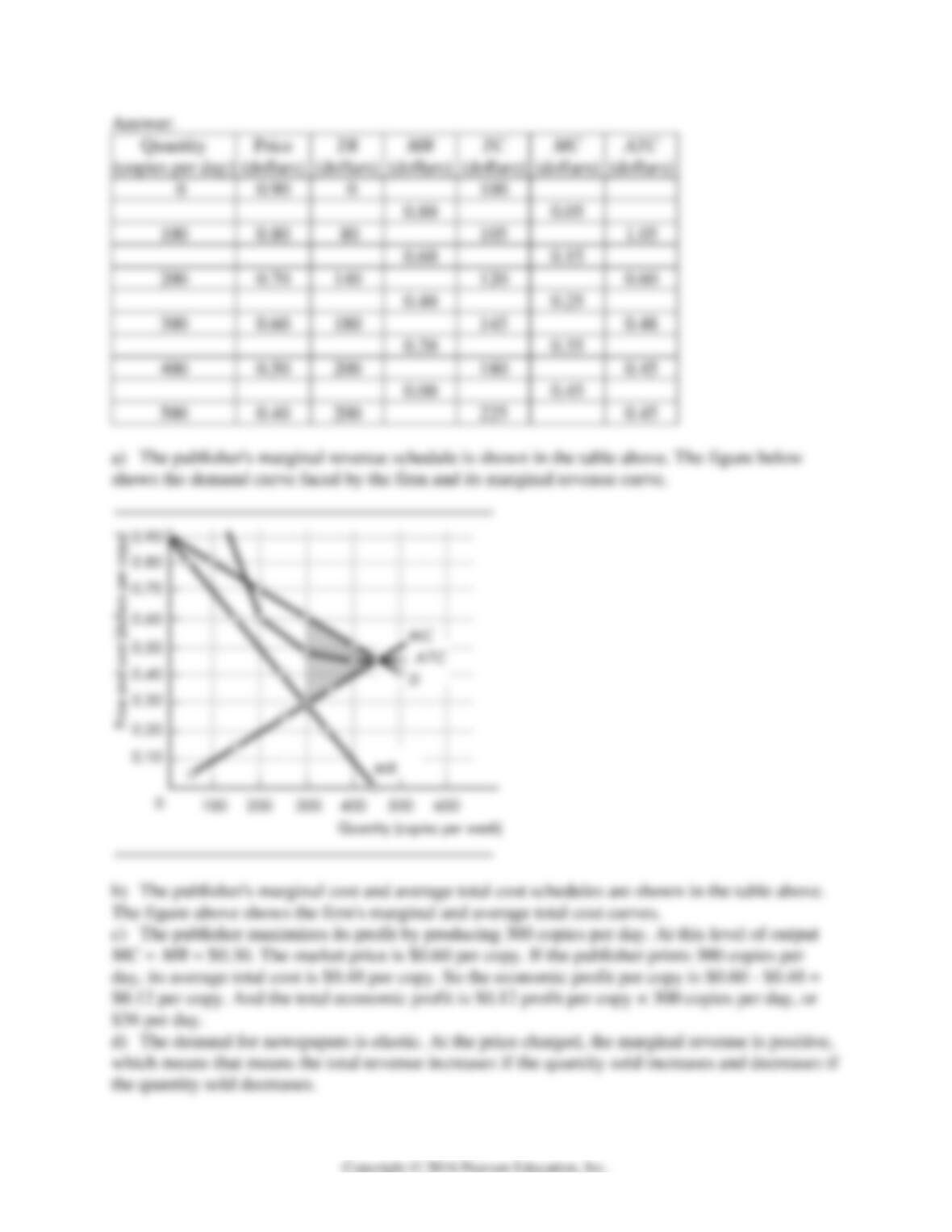
3) Pinesboro Herald is the only local newspaper in the city of Pinesboro. The publisher faces the
demand schedule shown in the first table above and has the cost schedule shown in the second
table above.
a) Calculate the marginal revenue schedule. In a figure, draw the demand curve and the
marginal revenue curve.
b) Calculate the publisher’s marginal cost and average total cost schedules. In the same figure
that you drew the demand and marginal revenue curves, draw the marginal and the average total
cost curves.
c) What are the publisher’s profit-maximizing output and price? What is the publisher’s
economic profit per day?
d) At the price charged, is the demand for newspapers elastic or inelastic? Explain your answer.
e) Does the publisher use resources efficiently? What is the deadweight loss? Explain your
answer.
f) Will the publisher try to price discriminate? Why or why not?
202
203
Price
(dollars per thousand
cubic feet)
Quantity demanded
(thousands of cubic
feet per day)
10
80
30
60
50
40
70
20
90
0
4) West Coast Gas, Inc., is a natural gas supplier. The firm faces the demand schedule shown in
the table above and cannot price discriminate. The company’s fixed cost is $1,000 per month and
its marginal cost is constant at $10 per thousand of cubic feet.
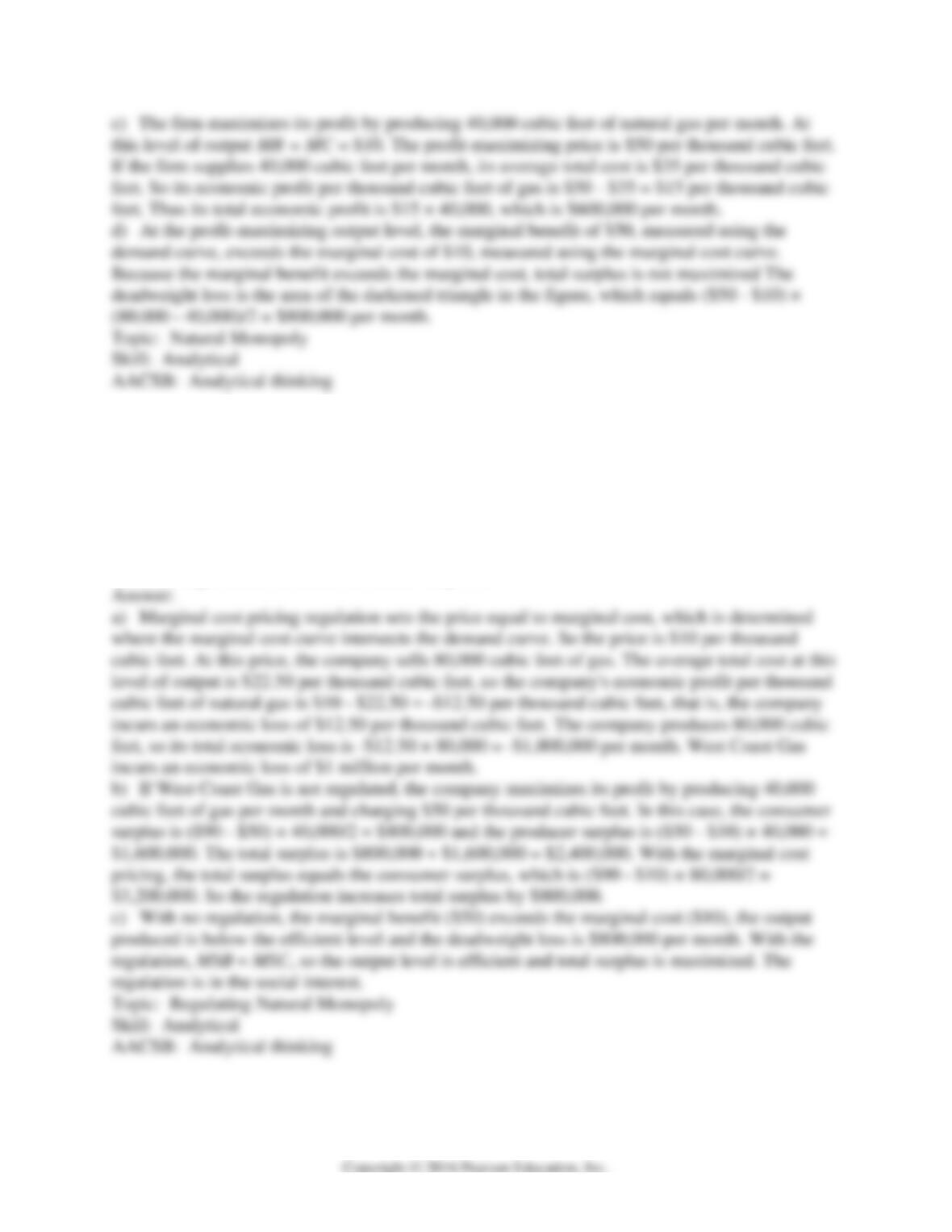
a) Draw the demand curve faced by West Coast Gas and the marginal revenue curve. Draw the
company’s marginal cost and average cost curves.
b) Is West Coast Gas a natural monopoly? Why or why not?
c) What are the firm’s profit-maximizing output and price? What is the firm’s economic profit
per month?
d) If West Coast Gas maximizes its profit, does it also maximize total surplus? Why or why not?
What is the deadweight loss (if any)?
205
5) West Coast Gas, Inc., is a natural gas supplier. The firm faces the demand schedule shown in
the table above and cannot price discriminate. The company’s fixed cost is $1,000 per month and
its marginal cost is constant at $10 per thousand of cubic feet. The government imposes a
marginal cost pricing rule on the company.
a) What is the price of natural gas supplied by West Coast Gas? How many cubic feet does the
company sell? What is the firm’s economic profit per month?
b) How does the regulation affect total surplus?
c) Is the regulation in the social interest? Explain.