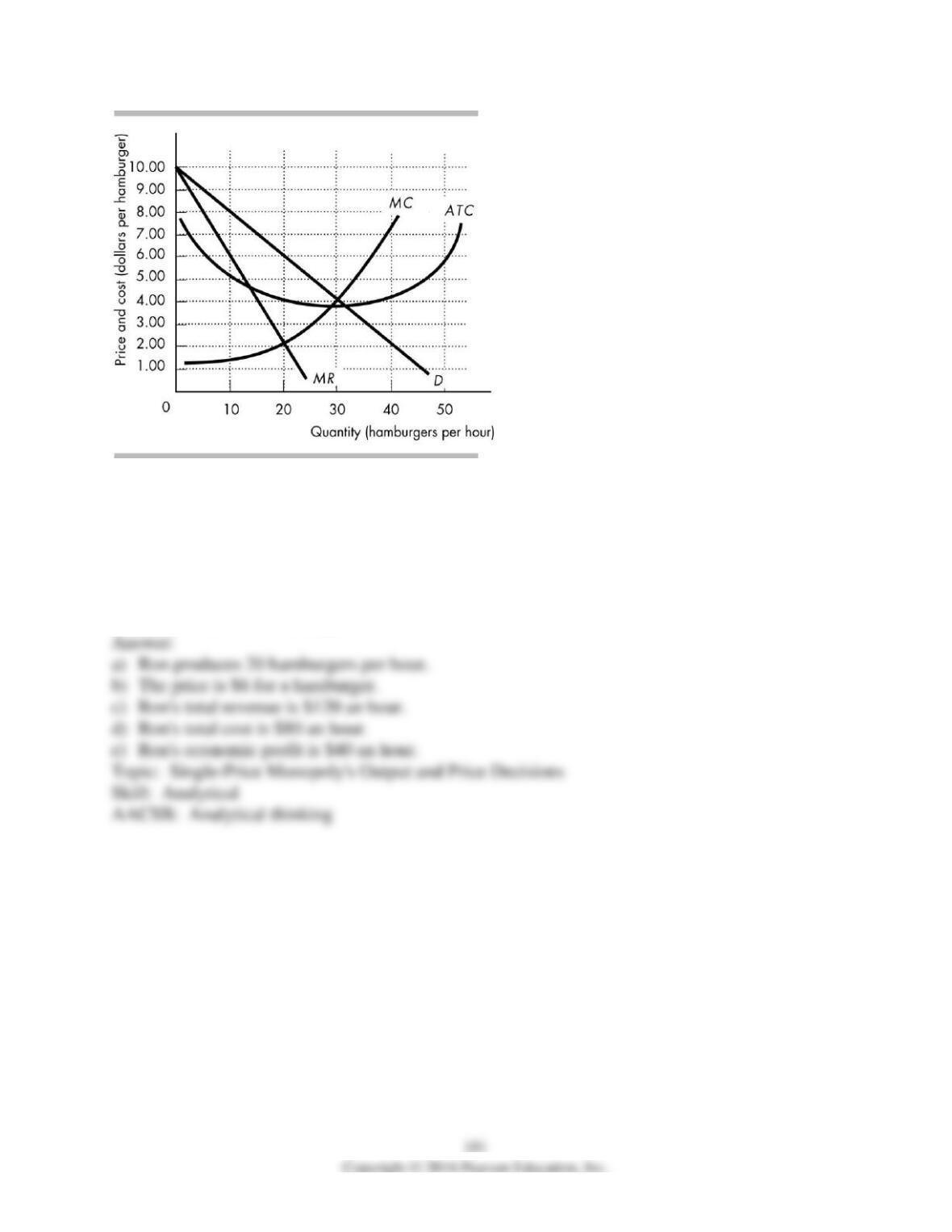
8) Ron’s Hamburger Joint is the only restaurant in town. The above figure represents Ron’s cost,
demand, and marginal revenue curves. Ron operates as a single-price monopoly.
a) How many hamburgers does Ron produce?
b) What price does Ron charge for a hamburger?
c) What is Ron’s total revenue?
d) What is his total cost?
e) What is Ron’s economic profit?
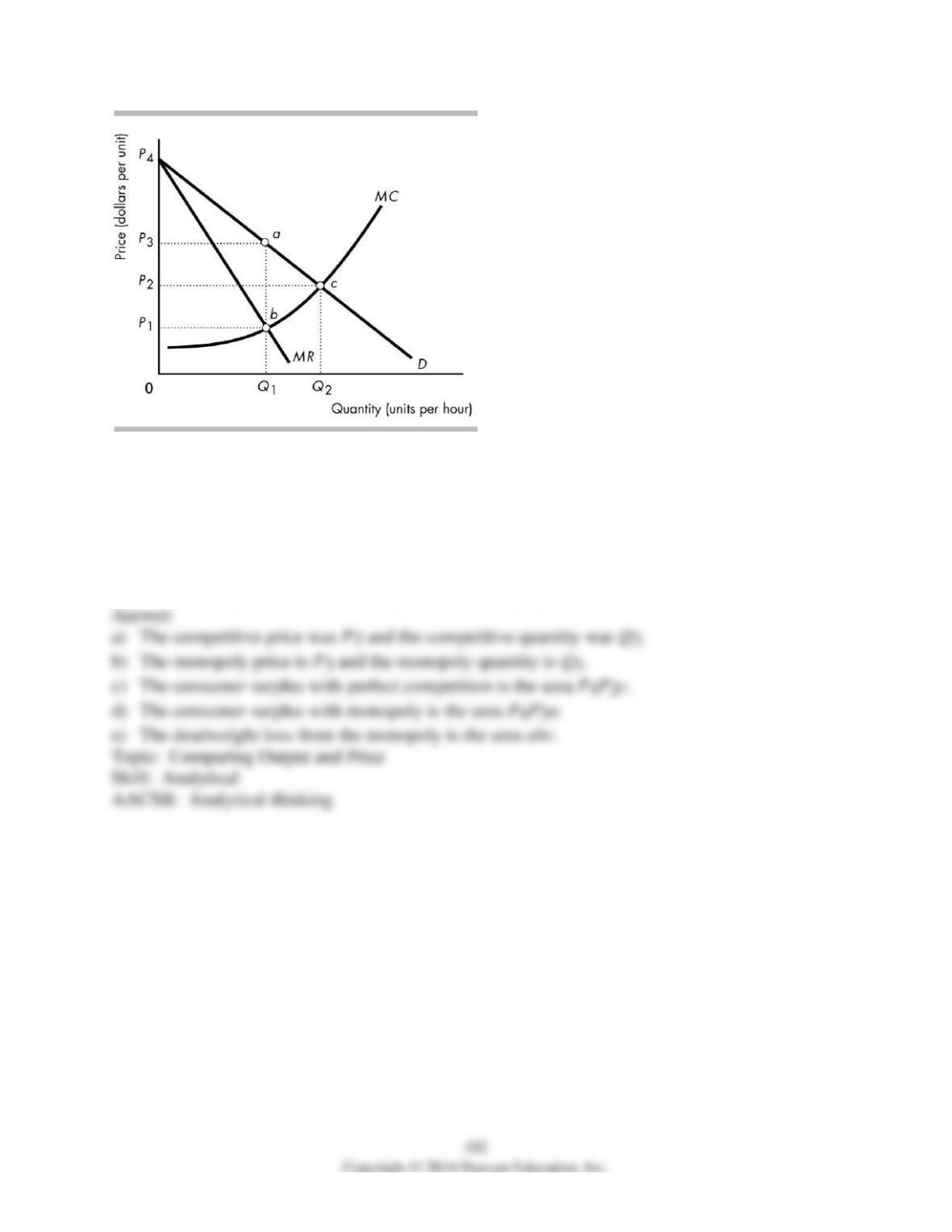
9) The above figure represents a perfectly competitive industry that is taken over by a single firm
and operated as a monopoly.
a) What was the competitive price and quantity?
b) What is the monopoly price and quantity?
c) What area represents consumer surplus under perfect competition?
d) What area represents consumer surplus under monopoly?
e) What area represents the deadweight loss of monopoly?
Quantity
(units)
Price
(dollars)
Marginal cost
(dollars)
1
22
9
2
20
10
3
18
12
4
16
16
5
14
22
6
12
30
7
10
40
8
8
52
10) A monopolist has the demand and marginal cost schedules given in the above table. If the
monopoly can perfectly price discriminate, what is the profit-maximizing level of output and
price?
184
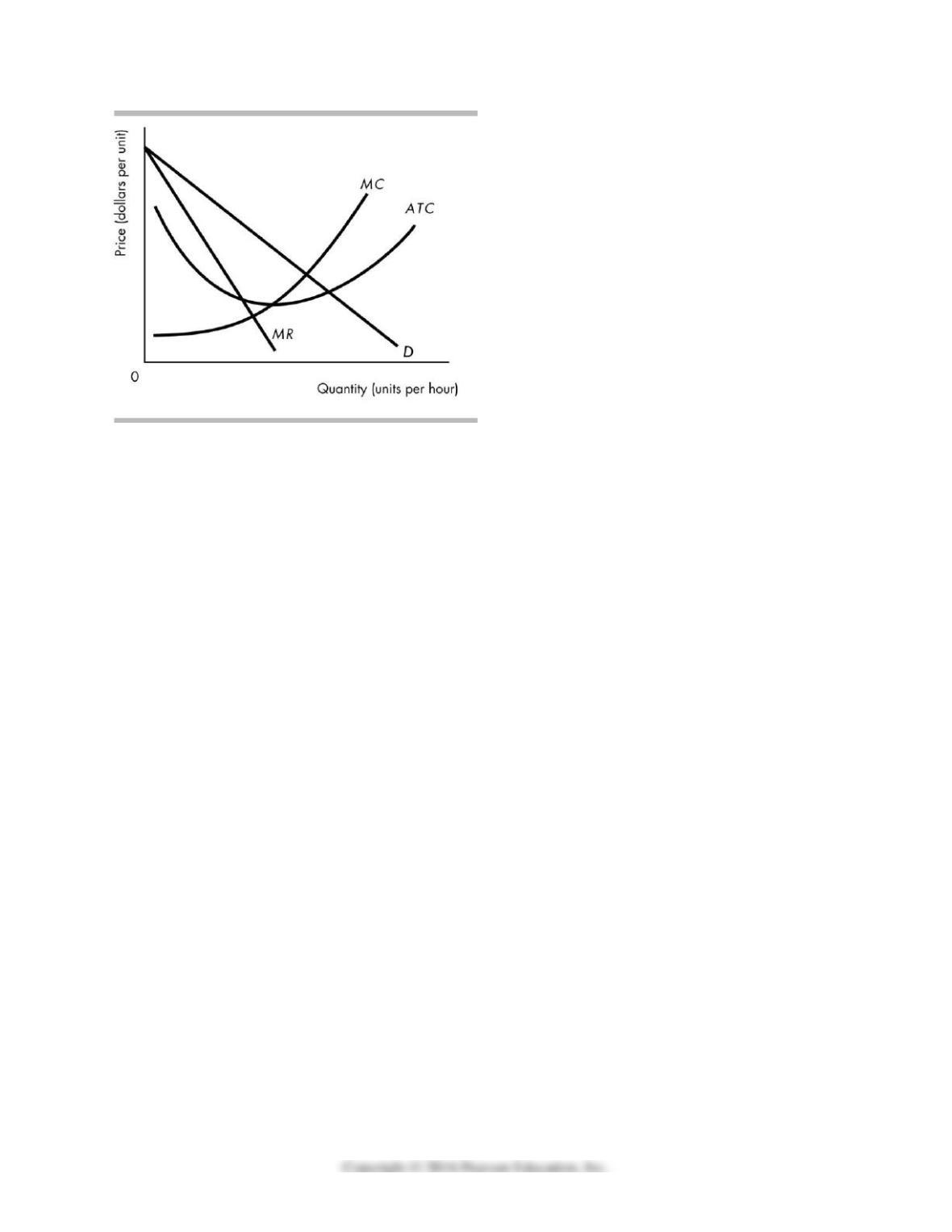
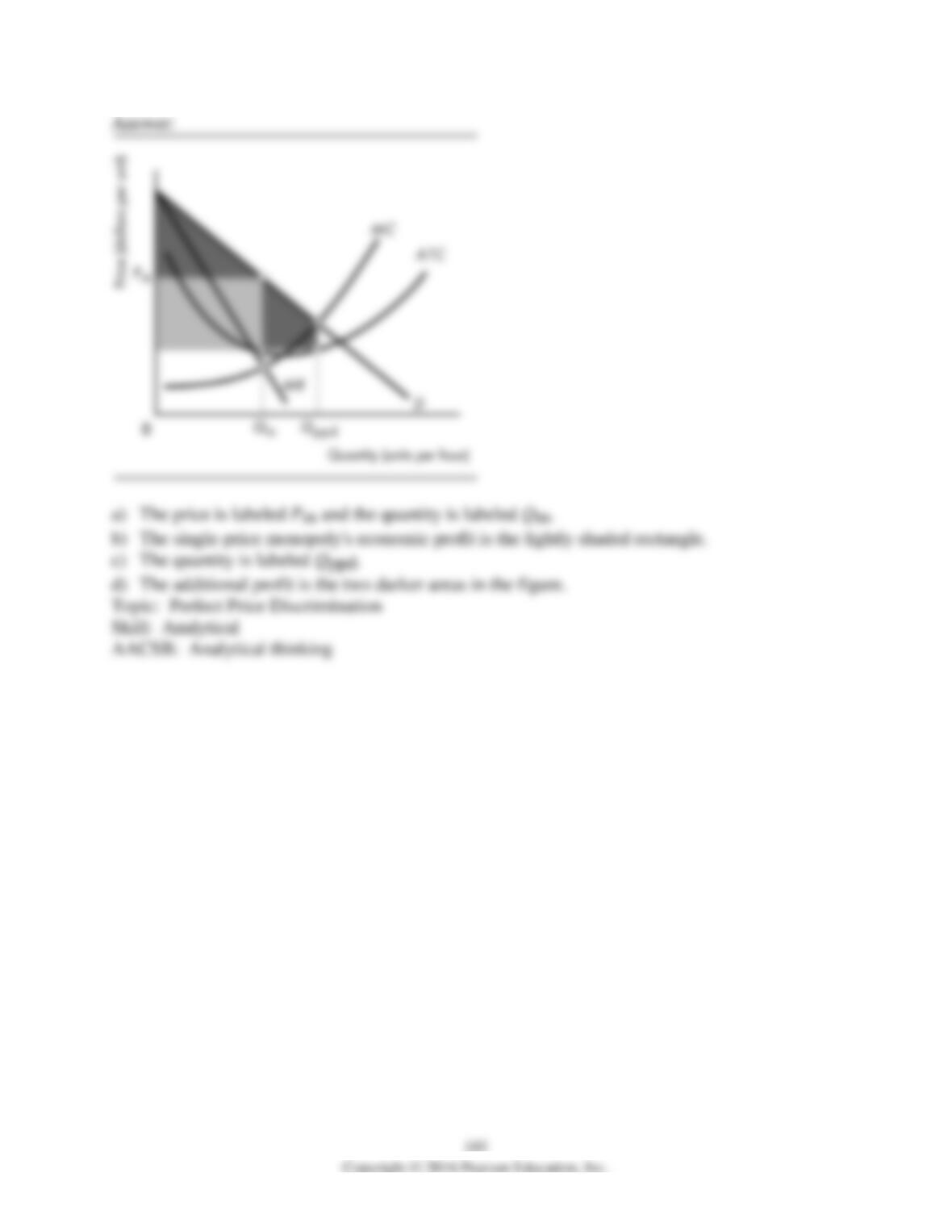
11) The above figure represents the cost, demand, and marginal revenue curves for a monopolist.
a) Indicate the price and quantity a single-price monopolist selects by labeling the price Pm and
the quantity Qm.
b) In the figure, lightly shade in the area that represents the single-price monopoly’s economic
profit.
c) Indicate the quantity a perfectly price-discriminating monopolist selects by labeling it Qppd.
d) In the figure, more darkly shade the area that represents the additional economic profit the
monopoly earns as a result of the perfect price discrimination.
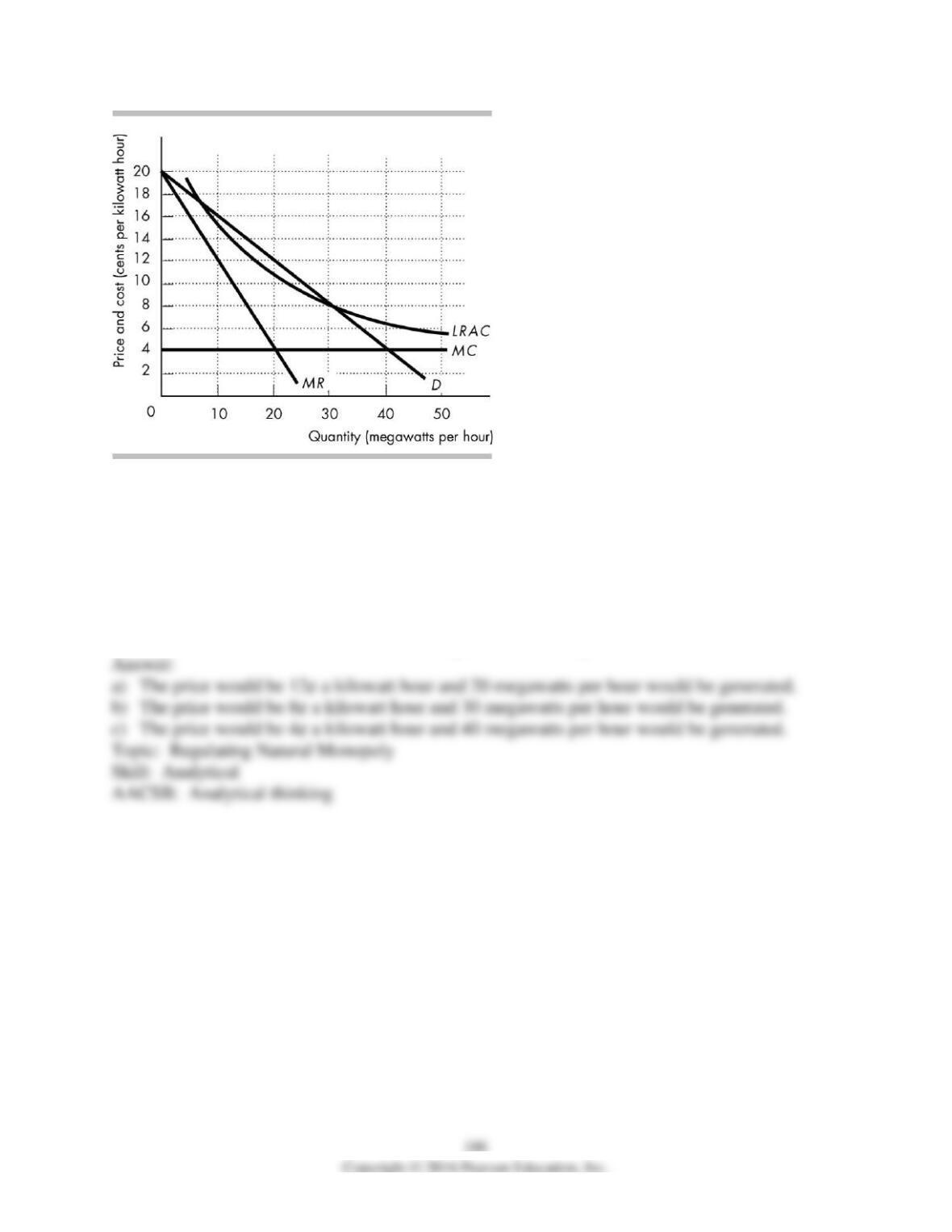
12) The above figure illustrates the market for electric power that is served by the one utility in
Alberta, Canada.
a) If the government did not regulate this utility, what would be the price of a kilowatt hour in
this region and how much power would be generated?
b) If the government regulates the utility and chooses an average cost pricing rule, what would
be the price of a kilowatt hour and how much power would be generated?
c) If the government regulates the utility and chooses a marginal cost pricing rule, what would
be the price of a kilowatt hour and how much power would be generated?
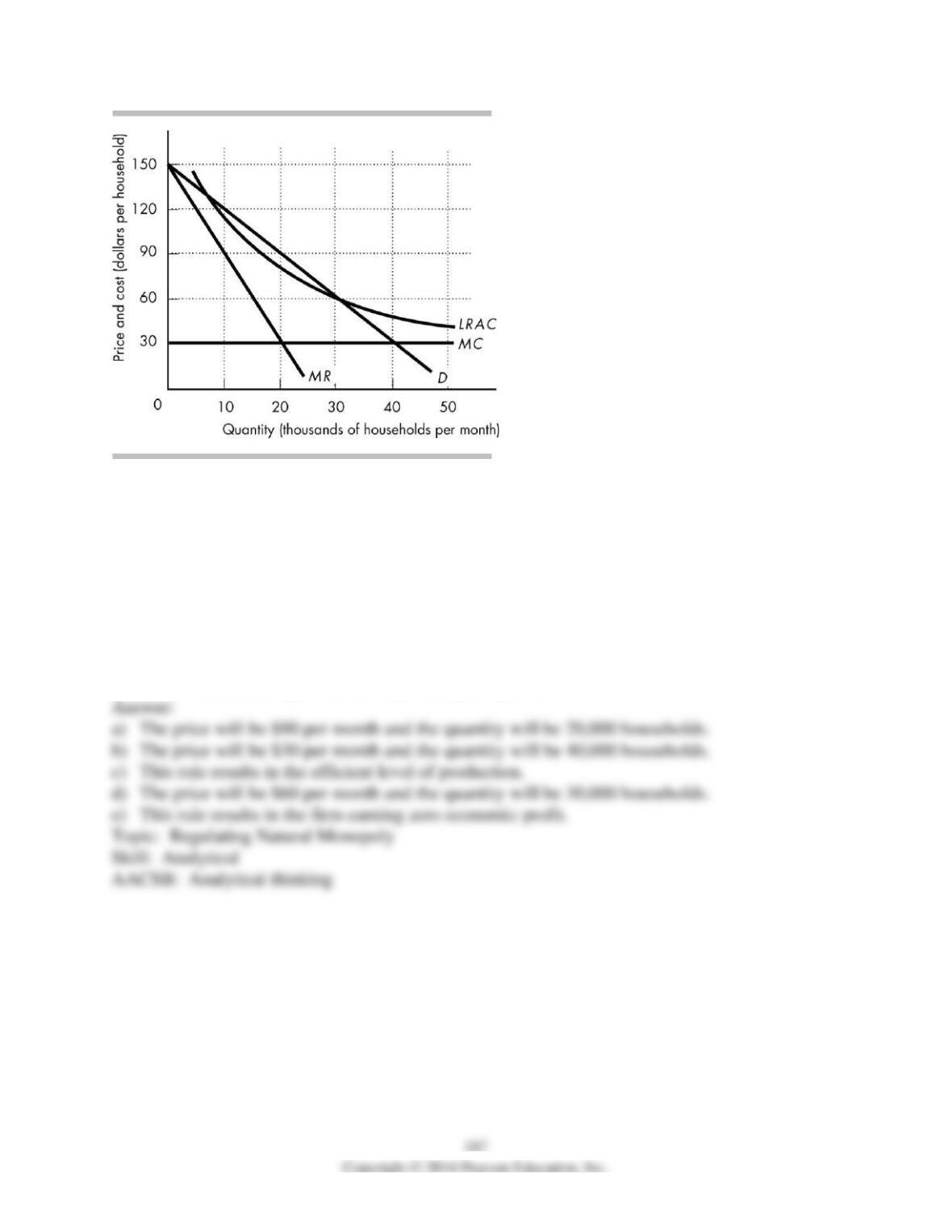
13) The above figure shows the demand for cable and the cable company’s cost of providing
cable.
a) What price and quantity will be produced if the company is unregulated and profit
maximizes?
b) What price and quantity will be produced if the company is regulated using the marginal cost
pricing rule?
c) What is the advantage of the marginal cost pricing rule?
d) What price and quantity will be produced if the company is regulated using the average cost
pricing rule?
e) What is the advantage of the average cost pricing rule?
188
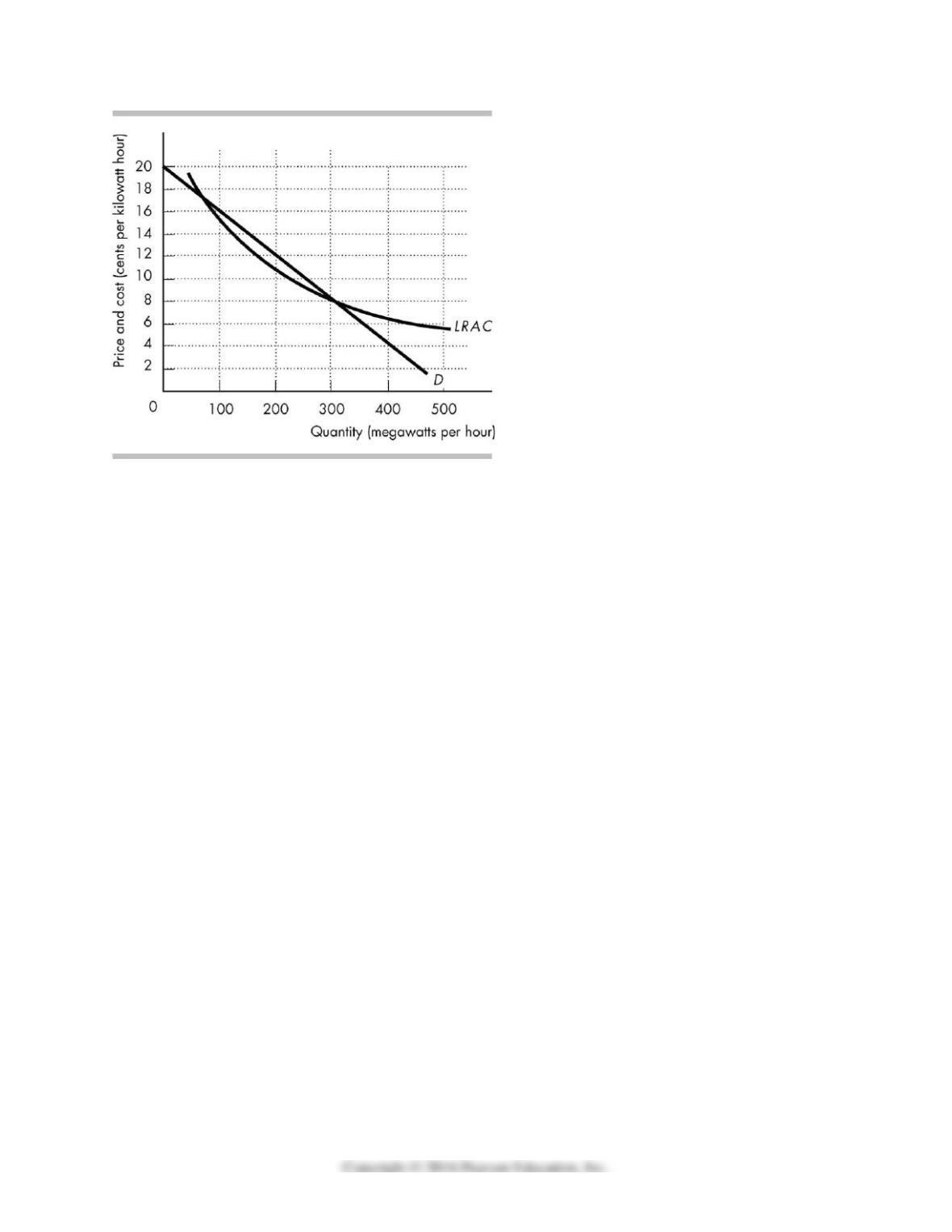
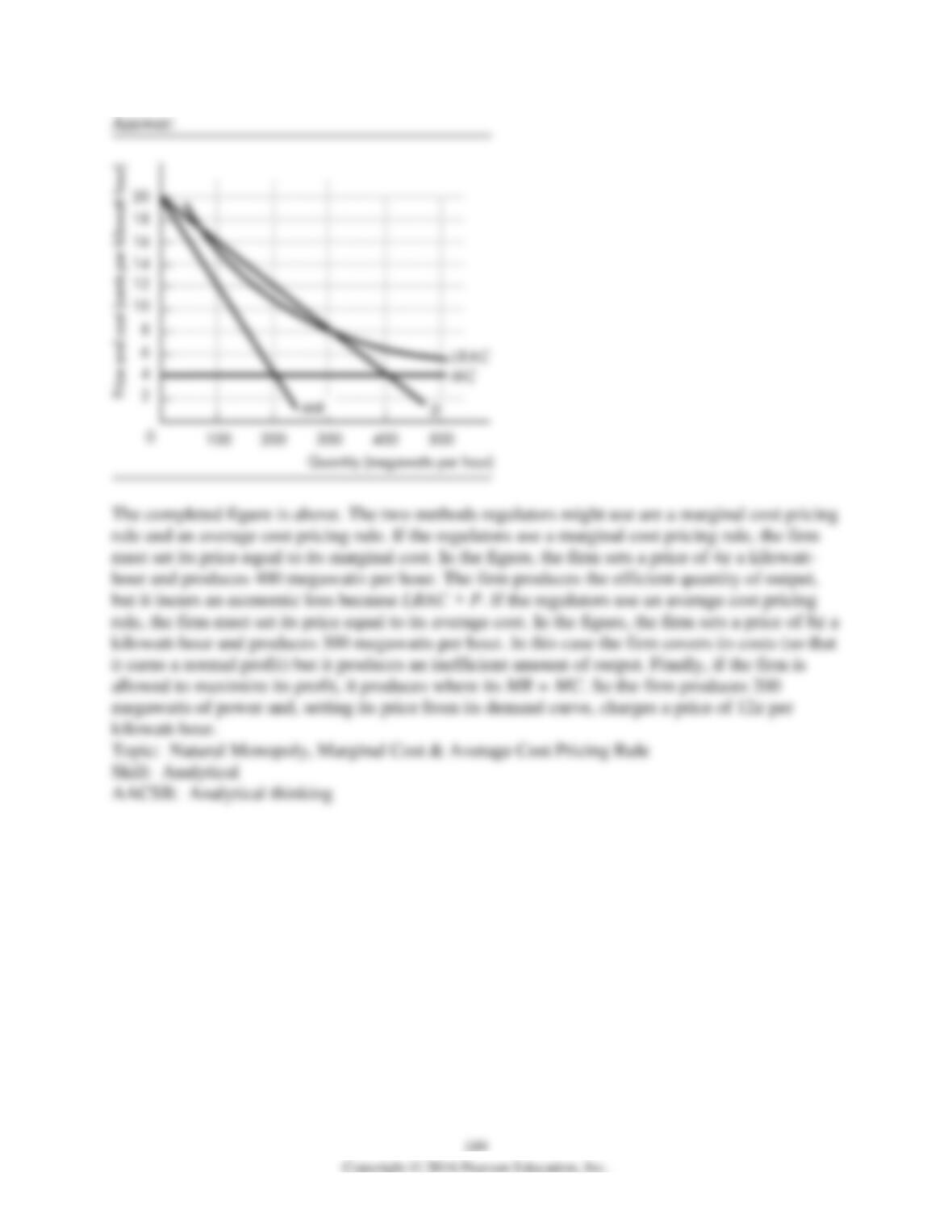
14) In the figure above, complete the graph of the electric utility company by adding the
marginal revenue and marginal cost curves. Assume the marginal cost is constant at 4¢ per
kilowatt-hour. Now discuss the two options regulators have in trying to regulate the firm. Be sure
to state the price and quantity that are selected for each option. Also, what price and quantity
does the firm select if it is not regulated?
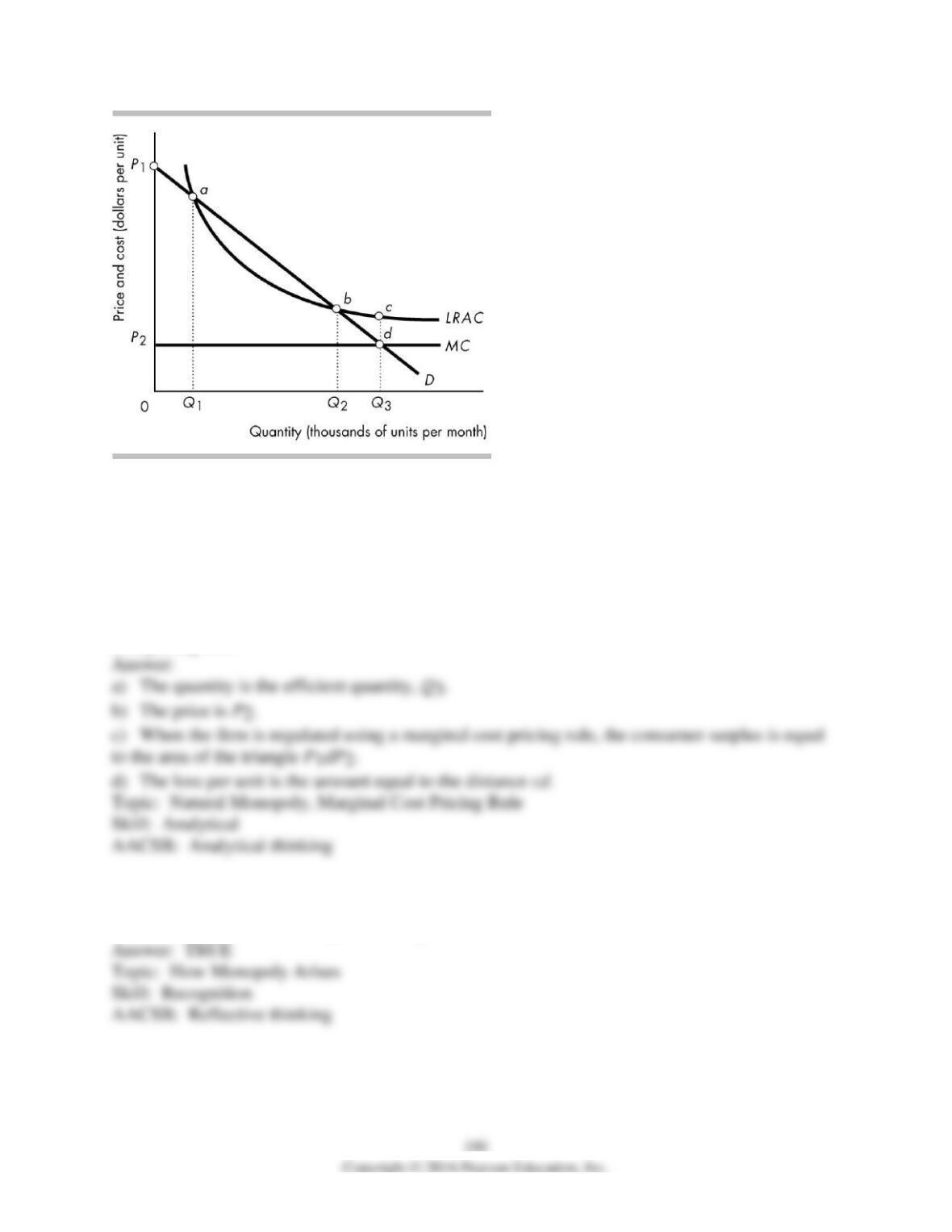
15) The above figure represents the cost and demand curves for a natural monopoly that is
regulated using a marginal cost pricing rule.
a) What is the quantity?
b) What price is charged?
c) What area represents the consumer surplus when the firm is regulated using a marginal cost
pricing rule?
d) What distance represents the firm’s loss per unit when the firm is regulated using a marginal
cost pricing rule?
9 True or False
1) A monopoly is a firm that produces a good or service for which no close substitute exists.
2) A monopolist is the sole supplier of a good or service for which there are no close substitutes.
3) For a monopoly, the demand for its product is perfectly elastic at the market price.
4) A natural monopoly is a firm that owns a key natural resource.
5) A natural monopoly is any market in which competition and entry are restricted by the
6) A natural monopoly is likely to experience diseconomies of scale.
7) A monopoly’s marginal revenue is equal to the market price of its product.
8) A monopoly always operates on the elastic portion of its demand curve.
9) In order to maximize its profit, a single-price monopoly always produces output in the
inelastic range of the demand for its product.
10) The monopolist always maximizes its profits by producing the amount of output that sets the
marginal revenue equal to zero.
11) A profit maximizing single-price monopolist sets price equal to marginal cost.
12) Monopolists can make an economic profit in the long-run because of barriers to entry.
13) A monopoly creates no deadweight when it maximizes its profit.
14) The deadweight loss from a monopoly loss measures the inefficiency created by monopoly.
15) A monopoly creates a deadweight loss because the monopoly produces less than the efficient
quantity.
16) Attempts to create a monopoly by having favorable laws passed are examples of rent
seeking.
17) For a monopoly able to perfectly price discriminate, the marginal revenue curve coincides
with the demand curve.
18) A monopoly that can perfectly price discriminate creates no deadweight loss.
19) The airline and trucking industries are two examples of industries that were regulated
because they were natural monopolies.
20) Using average cost pricing to regulate a natural monopoly creates a deadweight loss.
21) For a natural monopoly, if price is set equal to marginal cost then the firm incurs an
economic loss.
22) If the local cable TV company is a natural monopoly and required by regulators to set its
price equal to marginal cost, it makes zero profit and produces the efficient level of output.