Chapter 13 – Wage Determination (+ Appendix)
13-1
CHAPTER 13
Wage Determination (+ Appendix)
A. Short-Answer, Essays, and Problems
1. When economists refer to labor, what type of workers are they referring to?
2. What do “wages” and “wage rates” mean in economics? How do they differ from labor earnings?
3. What is the difference between nominal and real wages?
4. What factors explain the high level of level of productivity in the United States?
5. “The higher real wages earned by American workers primarily reflect the fact that Americans have a
greater inherent ability to produce goods and services than do foreign workers.” Evaluate.
6. Consider the following situations. Evaluate how they would affect the level of productivity of labor.
(a) The cost of health care skyrockets.
(b) Trade barriers with other countries are reduced.
(c) An energy shortage develops.
(d) Vast improvements are made in production technology.
7. Explain the long-run relationship between real hourly earning and productivity.
8. Evaluate the statement: “There is no difference between the labor supply curve for the single competitive
firm and the supply curve in a competitive market for labor.”
9. A firm’s labor input, total output of labor, and product price schedules are given below. If labor is the only
variable input, how much labor should the firm employ if the wage rate is $8 per day?
Units of labor Total output per day Price of good
2 10 $10
3 14 9
4 19 8
5 23 7
6 27 6
7 31 5
10. Suppose a single firm has the marginal revenue product schedule for a particular type of labor given in the
following table.
Number of units of labor MRP of labor
1 $12
2 11
3 10
4 9
5 8
6 7
7 6
8 5
Chapter 13 – Wage Determination (+ Appendix)
13-2
(a) Assume there are 150 firms with the same marginal-revenue-product schedules for this particular type
of labor. Compute the total or market demand for this labor by completing column 1 in the table
below.
(1)
Quantity of labor demanded (2)
Wage rate (3)
Quantity of
labor supplied
_____ $12 1350
_____ 11 1200
_____ 10 1050
_____ 9 900
_____ 8 750
_____ 7 600
_____ 6 450
_____ 5 300
(b) What will be the equilibrium wage rate and how many workers will be hired?
(c) What will be the marginal labor cost and wage rate for the individual firm? How many workers will
the firm employ?
(d) How would the imposition of a $9 minimum wage rate change the total amount of labor hired in this
market?
11. What is a monopsony? Explain its characteristics as applied to a labor market.
12. What, if any, is the relationship between the mobility of a particular type of labor and the supply of labor?
13. Why does the marginal resource cost exceed the wage rate in the case of a monopsonistic firm? Explain
and illustrate with an example.
14. In the table below, assume a monopsonist has the marginal-revenue-product schedule for a particular type
of labor given in columns 1 and 2 and that the supply schedule for labor is that given in columns 1 and 3.
(1)
Number of labor units (2)
MRP of labor (3)
Wage rate (4)
Total labor cost (5)
Marginal labor cost
0
1 $18 $ 6 $_____ $_____
2 16 7 _____ _____
3 14 8 _____ _____
4 12 9 _____ _____
5 10 10 _____ _____
6 8 11 _____ _____
7 6 12 _____ _____
8 4 13 _____ _____
(a) Compute the firm’s total labor costs at each level of employment and the marginal labor cost of each
unit of labor, and enter these figures in columns 4 and 5.
(b) How many units of labor will the firm hire? What will be the wage rate?
(c) If this firm hired labor in a competitive labor market, what would be the wage rate and number of
workers hired?
Chapter 13 – Wage Determination (+ Appendix)
13-3
15. In the table below, assume a monopsonist has the marginal-revenue-product schedule for a particular type
of labor given in columns 1 and 2 and that the supply schedule for labor is that given in columns 1 and 3.
(1)
Number of labor units (2)
MRP of labor (3)
Wage rate (4)
Total labor cost (5)
Marginal labor cost
0
1 $21 $ 9 $_____ $_____
2 19 10 _____ _____
3 17 11 _____ _____
4 15 12 _____ _____
5 13 13 _____ _____
6 11 14 _____ _____
7 9 15 _____ _____
8 7 16 _____ _____
(a) Compute the firm’s total labor costs at each level of employment and the marginal labor cost of each
unit of labor, and enter these figures in columns 4 and 5.
(b) How many units of labor will the firm hire? What will be the wage rate?
(c) If this firm hired labor in a competitive labor market, what would be the wage rate and number of
workers hired?
16. The following is a monopsonist’s employment schedule. What is the firm’s marginal resource cost when it
hires the eleventh worker?
Units of labor Wage
rate
9 $14
10 15
11 18
12 20
17. Use the following data to answer the question.
Demand and Supply of Labor Data
Employment Total output Product price
Wage rate
50 708 $1.27 $6
51 760 1.26 7
52 810 1.25 8
53 858 1.24 9
How many units of labor will this firm hire in maximizing its profits?
18. Use the following data to answer the question.
Demand and Supply of Labor Data
Employment Total output Product price
Wage rate
10 108 $1.05 $6
11 160 .95 7
12 210 .85 8
13 258 .75 9
How many units of labor will this firm hire in maximizing its profits?
19. What factors might increase the demand for carpenters in a medium-sized town? Be specific.
20. What are the economic effects of imposition of a new occupational license or examination on a labor
market?
21. What is the difference between an exclusive union and an inclusive union? What are the economic effects
of each type?
Chapter 13 – Wage Determination (+ Appendix)
13-4
22. What are the three different union strategies pursued to increase wages?
23. Is there a trade-off between wage increases for union members and employment? Explain
24. What is a bilateral monopoly? What is the economic outcome from a bilateral monopoly? Is a bilateral
monopoly a “bad” situation for society?
25. Though wages under bilateral monopoly are logically indeterminate, some wage rate is actually established
in such market situations. Explain those economic and noneconomic factors that might be pertinent to the
establishment of this wage.
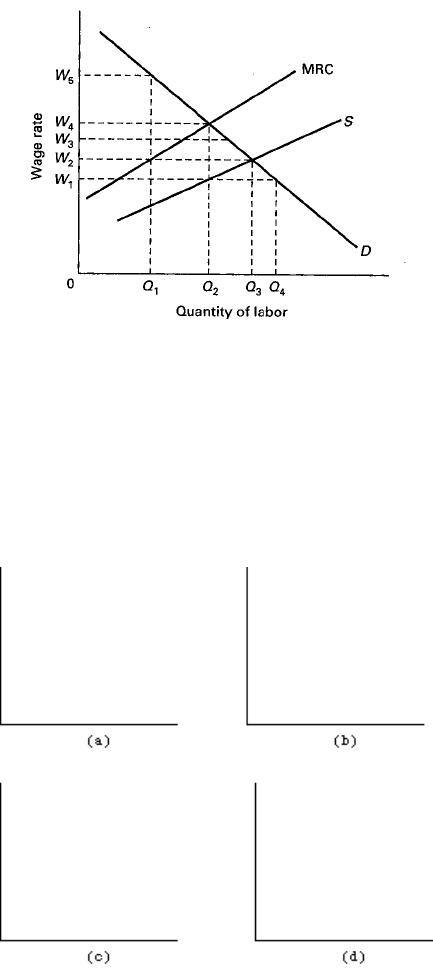
26. Use the below graph to answer the next three questions.
(a) Why does the MRC curve lie above the labor supply curve?
(b) What would be the equilibrium wage and level of employment in a monopsonist market without an
industrial union? Explain.
(c) What if an industrial union was formed to negotiate with the monopsonist? What would be the
equilibrium wage and level of output in this case? Explain.
27. Illustrate the following by drawing a supply and demand graph in the appropriate graph spaces below: (a)
the economic effects of exclusive or craft unionism; (b) the economic effects of increasing the demand for
labor; (c) wage determination in a monopsonistic labor market; (d) wage determination in a bilateral
monopoly.
28. What are the case against and the case for the minimum wage? What does the evidence indicate?
Chapter 13 – Wage Determination (+ Appendix)
13-5
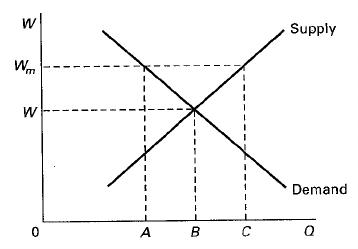
29. Use the graph below to illustrate and explain what would happen in the labor market if a minimum wage
was established at a level above the equilibrium wage.
30. What explains wage differentials in labor markets? Evaluate from a demand and supply perspective.
31. Why is there a difference in the strength of demand for labor?
32. “In all likelihood highly educated workers are the individuals who would earn high incomes even if they
did not have as much education.” Evaluate.
33. Define and illustrate “noncompeting groups” and “compensating differences.”
34. Why is there a significant difference in the pay of physicians and construction workers?
35. (Consider This) What is human capital? How is it related to labor markets?
36. What are four market imperfections that prevent workers from moving from their current jobs to take
higher-paying jobs?
37. Explain the principal–agent problem in job performance and briefly describe actions that can be taken to
correct the problem.
38. What is the rationale for efficiency wages? How do efficiency wages help address the principal–agent
problem?
39. Why do solutions to the principal–agent problem sometimes produce problems? Give an example.
40. (Last Word) Evaluate from an economic perspective the issue of whether chief executive officers (CEOs)
of corporations are overpaid.
Chapter 13 – Wage Determination (+ Appendix)
13-6
B. Answers to Short-Answer, Essays, and Problems
1. When economists refer to labor, what type of workers are they referring to?
2. What do “wages” and “wage rates” mean in economics? How do they differ from labor earnings?
3. What is the difference between nominal and real wages?
4. What factors explain the high level of level of productivity in the United States?
5. “The higher real wages earned by American workers primarily reflect the fact that Americans have a
greater inherent ability to produce goods and services than do foreign workers.” Evaluate.
6. Consider the following situations. Evaluate how they would affect the level of productivity of labor.
(a) The cost of health care skyrockets.
(b) Trade barriers with other countries are reduced.
(c) An energy shortage develops.
(d) Vast improvements are made in production technology.
Chapter 13 – Wage Determination (+ Appendix)
13-7
7. Explain the long-run relationship between real hourly earning and productivity.
8. Evaluate the statement: “There is no difference between the labor supply curve for the single competitive
firm and the supply curve in a competitive market for labor.”
9. A firm’s labor input, total output of labor, and product price schedules are given below. If labor is the only
variable input, how much labor should the firm employ if the wage rate is $8 per day?
10. Suppose a single firm has the marginal revenue product schedule for a particular type of labor given in the
following table.
Number of units of labor MRP of labor
1 $12
2 11
3 10
4 9
5 8
6 7
7 6
8 5
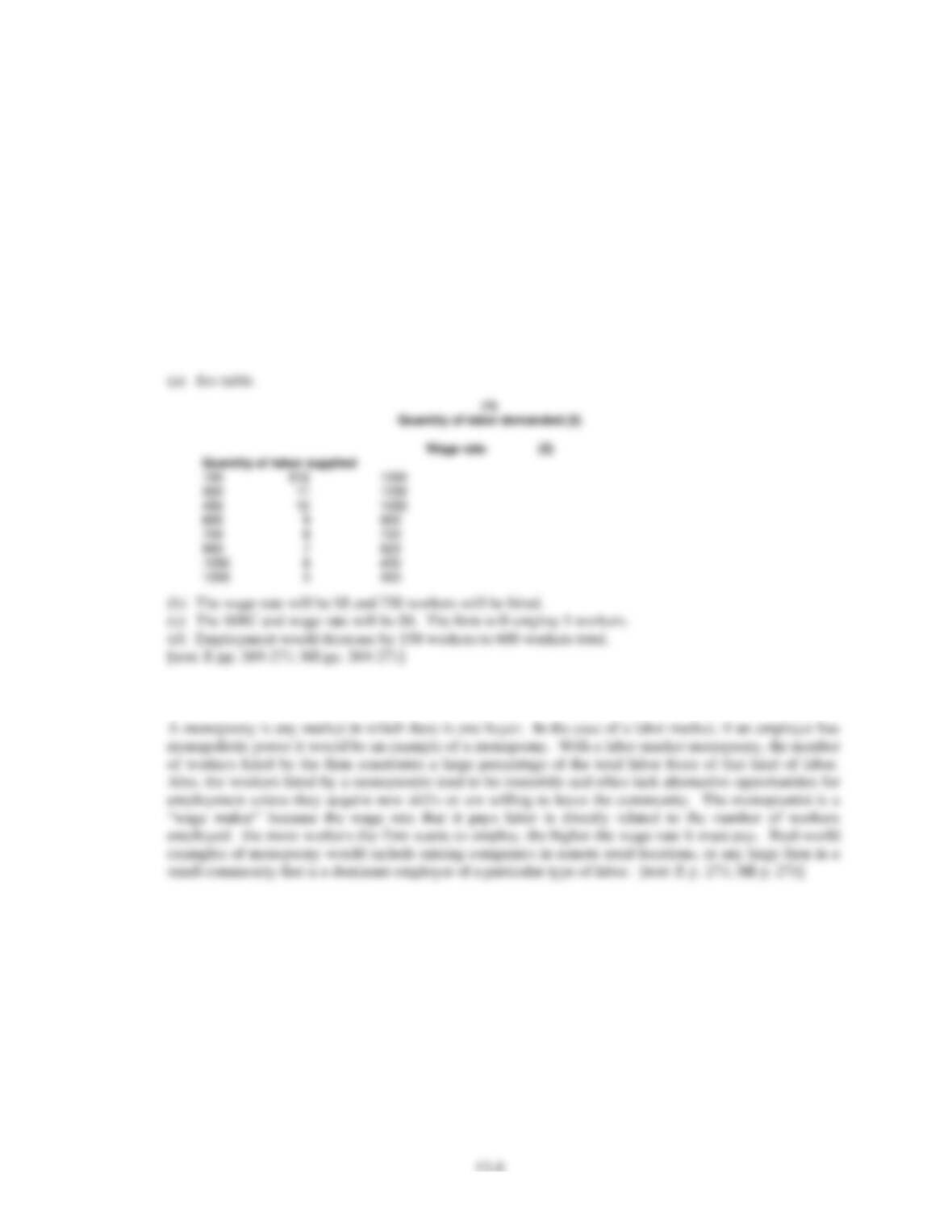
(a) Assume there are 150 firms with the same marginal-revenue-product schedules for this particular type
of labor. Compute the total or market demand for this labor by completing column 1 in the table
below.
(1)
Quantity of labor demanded (2)
Wage rate (3)
Chapter 13 – Wage Determination (+ Appendix)
Quantity of
labor supplied
_____ $12 1350
_____ 11 1200
_____ 10 1050
_____ 9 900
_____ 8 750
_____ 7 600
_____ 6 450
_____ 5 300
(b) What will be the equilibrium wage rate and how many workers will be hired?
(c) What will be the marginal labor cost and wage rate for the individual firm? How many workers will
the firm employ?
(d) How would the imposition of a $9 minimum wage rate change the total amount of labor hired in this
market?
11. What is a monopsony? Explain its characteristics as applied to a labor market.

Chapter 13 – Wage Determination (+ Appendix)
13-9
12. What, if any, is the relationship between the mobility of a particular type of labor and the supply of labor?
13. Why does the marginal resource cost exceed the wage rate in the case of a monopsonistic firm? Explain
and illustrate with an example.
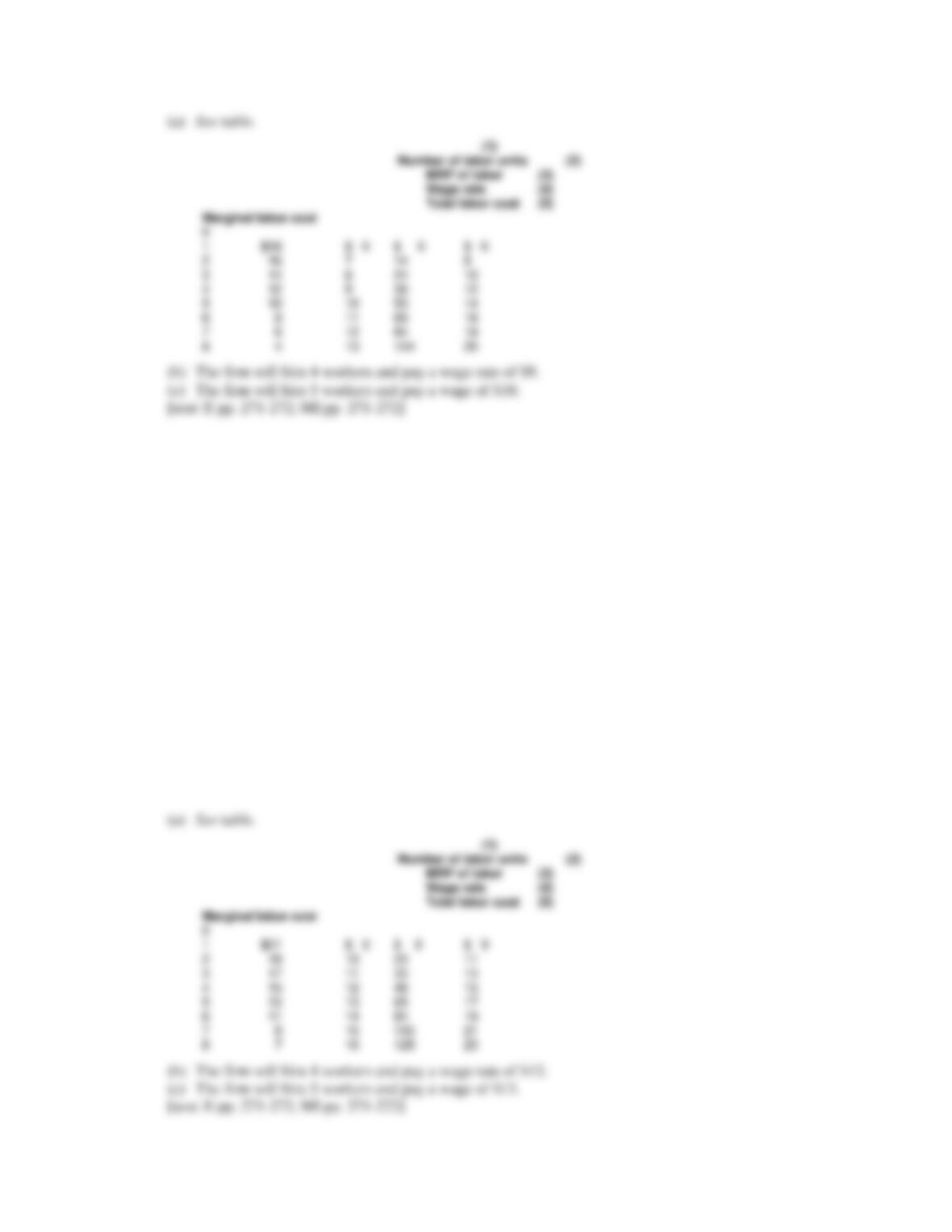
14. In the table below, assume a monopsonist has the marginal-revenue-product schedule for a particular type
of labor given in columns 1 and 2 and that the supply schedule for labor is that given in columns 1 and 3.
(1)
Number of labor units (2)
MRP of labor (3)
Wage rate (4)
Total labor cost (5)
Marginal labor cost
0
1 $18 $ 6 $_____ $_____
2 16 7 _____ _____
3 14 8 _____ _____
4 12 9 _____ _____
5 10 10 _____ _____
6 8 11 _____ _____
7 6 12 _____ _____
8 4 13 _____ _____
(a) Compute the firm’s total labor costs at each level of employment and the marginal labor cost of each
unit of labor, and enter these figures in columns 4 and 5.
(b) How many units of labor will the firm hire? What will be the wage rate?
(c) If this firm hired labor in a competitive labor market, what would be the wage rate and number of
workers hired?
Chapter 13 – Wage Determination (+ Appendix)
13–10
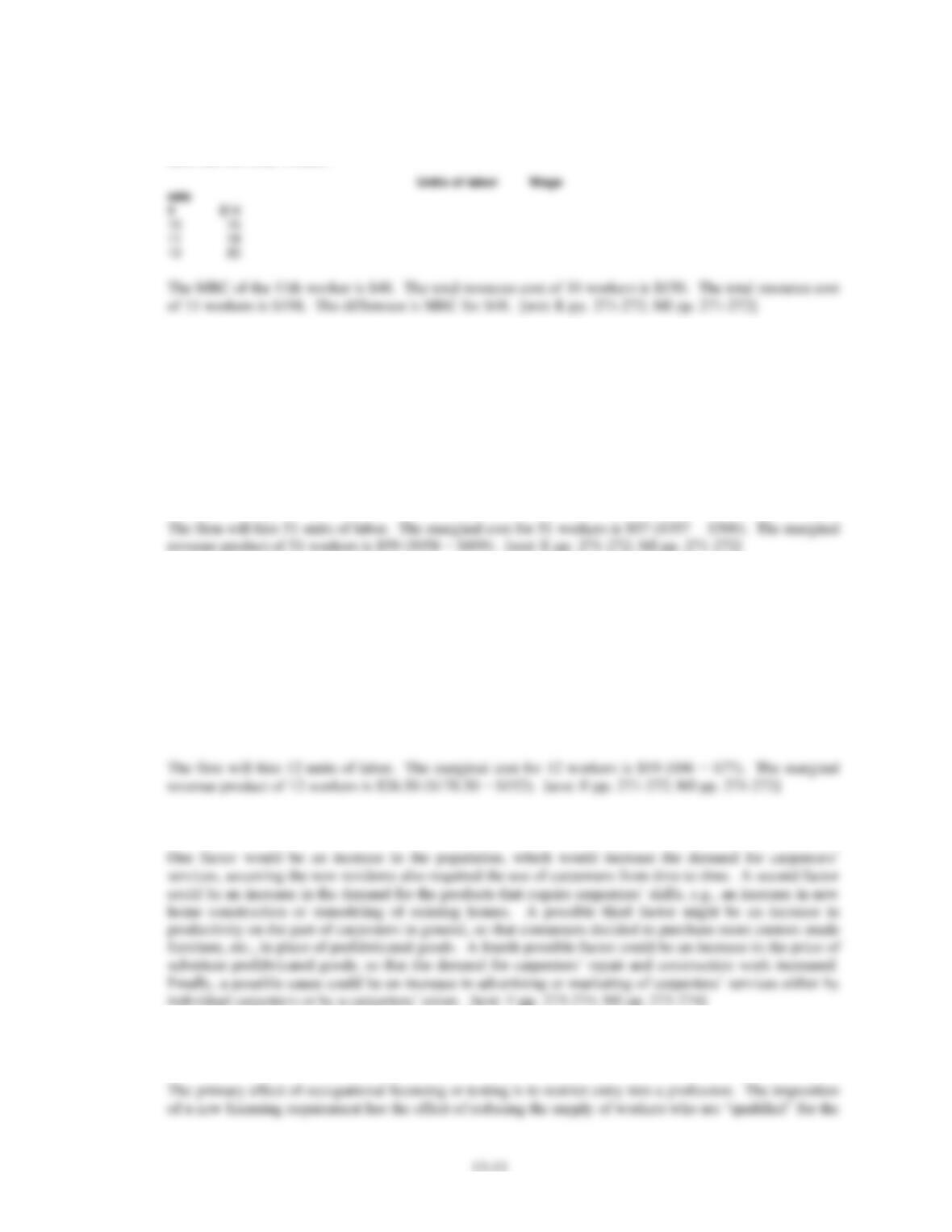
15. In the table below, assume a monopsonist has the marginal-revenue-product schedule for a particular type
of labor given in columns 1 and 2 and that the supply schedule for labor is that given in columns 1 and 3.
(1)
Number of labor units (2)
MRP of labor (3)
Wage rate (4)
Total labor cost (5)
Marginal labor cost
0
1 $21 $ 9 $_____ $_____
2 19 10 _____ _____
3 17 11 _____ _____
4 15 12 _____ _____
5 13 13 _____ _____
6 11 14 _____ _____
7 9 15 _____ _____
8 7 16 _____ _____
(a) Compute the firm’s total labor costs at each level of employment and the marginal labor cost of each
unit of labor, and enter these figures in columns 4 and 5.
(b) How many units of labor will the firm hire? What will be the wage rate?
(c) If this firm hired labor in a competitive labor market, what would be the wage rate and number of
workers hired?
Chapter 13 – Wage Determination (+ Appendix)
16. The following is a monopsonist’s employment schedule. What is the firm’s marginal resource cost when it
hires the eleventh worker?
17. Use the following data to answer the question.
Demand and Supply of Labor Data
Employment Total output Product price
Wage rate
50 708 $1.27 $6
51 760 1.26 7
52 810 1.25 8
53 858 1.24 9
How many units of labor will this firm hire in maximizing its profits?
18. Use the following data to answer the question.
Demand and Supply of Labor Data
Employment Total output Product price
Wage rate
10 108 $1.05 $6
11 160 .95 7
12 210 .85 8
13 258 .75 9
How many units of labor will this firm hire in maximizing its profits?
19. What factors might increase the demand for carpenters in a medium-sized town? Be specific.
20. What are the economic effects of imposition of a new occupational license or examination on a labor
market?