Microeconomics, 12e (Parkin)
Chapter 13 Monopoly
1 Monopoly and How It Arises
1) monopoly has two key features, which are ________.
A) barriers to entry and no close substitutes
B) franchises and barriers to entry
C) barriers to entry and close substitutes
D) close substitutes and no barriers to entry
2) A monopoly is best defined as a firm that
A) produces a good or service for which no close substitute exists and which is protected by a
barrier that prevents other firms from selling that good or service.
B) purchases its resources from only one supplier because of a barrier preventing it from buying
from other suppliers.
C) produces a good or service for which no close substitute exists and that sells all its output to
one buyer because there is barrier preventing other buyers from purchasing the good or service.
D) cannot control the price it sets for its good or service because there is barrier that prevents the
firm from changing the price.
3) Which of the following is NOT a characteristic of a monopoly?
A) a single firm
B) no close substitutes for the product produced
C) barriers to entry
D) easy entry and exit
4) Which of the following is a characteristic of monopoly?
A) The firm faces competition from a few other firms.
B) The firm produces a product that has many close substitutes.
C) There are barriers to enter the market.
D) The firm’s demand curve is perfectly elastic.
5) Which of the following statements about a monopoly is FALSE?
A) Monopolies have no barriers to entry or exit.
B) The good produced by a monopoly has no close substitutes.
C) A monopoly is the only producer of the good.
D) None of the above; that is, all of the above answers are true statements about a monopoly.
6) An example of a monopoly is
A) a big city restaurant.
B) the stock market.
C) the only veterinarian in an isolated farm community.
D) a large hospital in a big city.
7) Which of the following firms is most likely to be a monopoly?
A) a local restaurant
B) the local water company
C) a local drug store
D) a clothing store
8) This type of firm would likely operate as a monopoly
A) one of many U.S. wheat farmers.
B) one of the few U.S. auto makers.
C) AT&T long distance phone service.
D) the local water company.
9) Which of the following is LEAST likely to be a monopoly?
A) the holder of a public franchise
B) a pharmaceutical company with a patent on a drug
C) a store in a large shopping mall
D) an artist who owns a copyright for a painting
10) A barrier to entry is
A) a natural or legal impediment that makes it difficult for new firms to enter a market.
B) a necessary condition for perfect competition.
C) the result of highly elastic demand.
D) a brick wall that a firm places around its corporate headquarters.
11) When natural or legal forces work to protect a firm from potential competitors, the market is
said to have ________.
A) non-competitive supply
B) non-competitive entry
C) barriers to entry
D) restricted competition
12) Which of the following is a barrier to entry for a monopoly?
A) a patent
B) severe diseconomies of scale
C) close substitutes for the good or service exist
D) All of the above answers are correct.
13) Which of the following can create a monopoly?
I. high prices
II. public franchise
III. patent
IV. government license
A) I and II
B) I and III
C) I, II and III
D) II, III and IV
14) Which of the following is NOT a barrier to entry for a monopoly?
A) economies of scale for the relevant range of output
B) a patent on the product being sold
C) the ability to charge a price that is above marginal cost
D) receiving a public franchise
15) Which of the following cannot be an effective entry barrier?
A) a firm making very high economic profits
B) a firm being granted a patent for its product
C) a firm owning all of a vital resource needed to produce a good
D) when huge economies of scale exist
16) Which of the following is NOT a legal barrier to entry?
A) public franchise
B) government license
C) patent
D) innovation
17) A legal monopoly is defined as a market where
A) only one lawyer operates.
B) a legal barrier to entry exists.
C) only one firm could earn a profit.
D) entry and exit are legal.
18) A public franchise is
A) an exclusive right granted to a firm to supply a good or service.
B) a government issued license required to practice a profession.
C) an exclusive right granted to an inventor of a product.
D) a unique source of raw materials.
19) If the government grants a firm a public franchise to supply coal, a monopoly is created by
A) a natural barrier to entry.
B) a legal barrier to entry.
C) price discrimination.
D) All of the above answers are correct.
20) A market in which competition and entry are restricted by the granting of a public franchise,
government license, patent, or copyright is called a
A) legal monopoly.
B) natural monopoly.
C) single-price monopoly.
D) price-discriminating monopoly.
21) Public franchises create monopolies by restricting
A) demand.
B) prices.
C) entry.
D) profit.
22) A copyright creates a monopoly by restricting ________.
A) the prices that can be charged
B) demand for the product
C) entry into the market
D) the number of creators and inventors
23) A patent creates a monopoly by restricting ________.
A) demand for the product
B) the number of complements for the product
C) the amount of advertising that can be undertaken
D) entry into the market
24) Patents encourage invention by
A) offering subsidies to inventors.
B) offering tax breaks to inventors.
C) allowing patent owners to make an economic profit.
D) preventing inventors from working on the same project.
25) Suppose a new vaccine for Lyme disease is developed by Merck, a large drug company.
Which of the following is most likely to occur?
A) Merck will apply for a patent on the vaccine that grants it the monopoly rights to the vaccine
for many years.
B) Merck will have a monopoly on this vaccine because of economies of scale.
C) Other firms will quickly copy the formula making the market for the vaccine competitive.
D) Merck will not tell anyone about its discovery though it will sell the vaccine.
26) Patents encourage inventions because without a patent
A) other firms could enter the inventor’s market by producing the same product.
B) nobody would demand the inventor’s product.
C) the inventor would receive no tax breaks.
D) all markets would be public franchises.
27) A patent grants
A) a guarantee of quality to consumers.
B) the right to practice a profession.
C) an exclusive right to an inventor of a product.
D) control over a unique source or supply of raw materials.
28) Patents create monopolies by restricting
A) demand.
B) prices.
C) entry.
D) profit.
29) Patents are ________ barriers to entry and public franchises are ________ barriers to entry.
A) legal; legal
B) legal; natural
C) natural; legal
D) natural; natural
30) An industry in which economies of scale allow one firm to supply the entire market at the
lowest possible cost is called a
A) legal monopoly.
B) natural monopoly.
C) single-price monopoly.
D) one-firm monopoly.
31) The existence of economies of scale can create ________.
A) a natural monopoly
B) a government monopoly
C) a legal monopoly
D) a market in which many firms make identical products
32) Natural monopolies occur when there are
A) large diseconomies of scale.
B) external economies.
C) large economies of scale.
D) natural resources involved.
33) A natural monopoly is defined as
A) a market in which competition and entry are restricted by the granting of a government
license.
B) an industry in which economies of scale allow one firm to supply the entire market at the
lowest possible cost.
C) a market in which competition and entry are restricted by the granting of a patent.
D) any market where one firm constitutes the entire industry.
34) If economies of scale allow one cable TV firm to supply the entire market at the lowest
possible cost, then this company is
A) a natural monopoly.
B) not a monopoly.
C) a monopoly, but not a natural monopoly.
D) a legal monopoly.
35) A natural monopoly
A) is not protected by any barrier to entry.
B) exists because of legal barriers to entry.
C) is an industry in which economies of scale exist so that one firm can supply the market at the
lowest possible cost..
D) is an industry where two or more smaller firms can supply the market at a lower cost than one
big firm could.
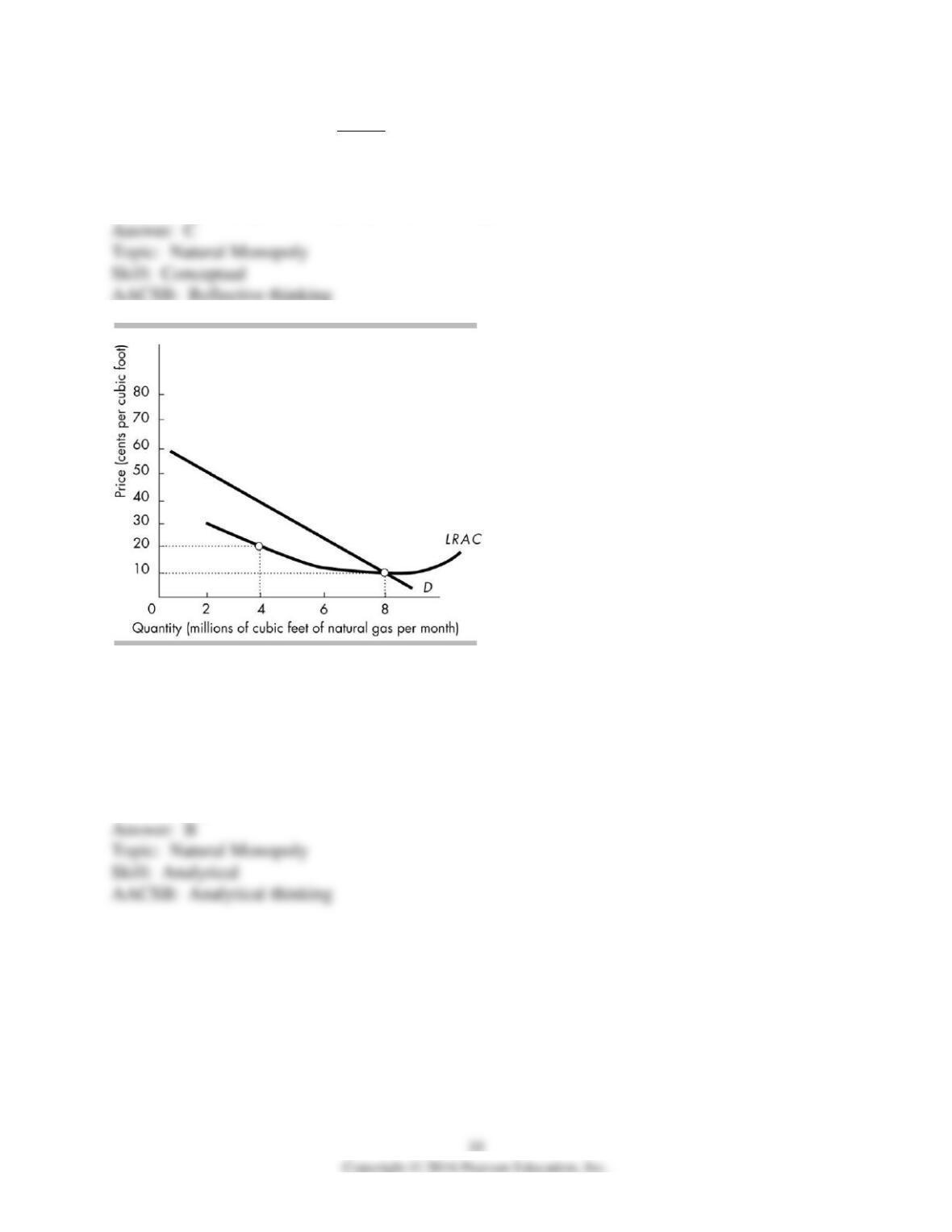
36) Which of the following is TRUE of a natural monopoly?
A) Its long-run average cost curve slopes upward as it intersects the demand curve.
B) Economies of scale exist to only a very low level of output.
C) Economies of scale allow one firm to supply the entire market at the lowest possible cost.
D) The firm is not protected by any barrier to entry.
37) Given the market demand and cost data in the above figure, the existence of two firms equal
sized firms producing a total of 8 million cubic feet of natural gas means that the long-run
average cost of producing natural gas is
A) 10 cents per cubic foot.
B) 20 cents per cubic foot.
C) 30 cents per cubic foot.
D) 40 cents per cubic foot.
38) Given the market demand and cost data in the above figure, the existence of a monopoly firm
producing 8 million cubic feet of natural gas makes it possible to produce natural gas at a long-
run average cost of
A) 10 cents per cubic foot.
B) 20 cents per cubic foot.
C) 30 cents per cubic foot.
D) 40 cents per cubic foot.
39) A single-price monopoly charges the same price
A) even if the demand curve shifts.
B) even if its cost curves shift.
C) to all customers for each unit of output they buy.
D) at all times, and that price equals the firm’s marginal revenue.
40) A monopoly that sells every unit of its output at the same price is a ________.
A) unit-price monopoly
B) legal monopoly
C) natural monopoly
D) single-price monopoly
41) All of the following are examples of price discrimination EXCEPT
A) buy-one-get-one-free offers.
B) “early bird specials” at a restaurant.
C) lower ticket prices for matinee performances.
D) “buy now, pay later” payment options.
42) When Dominant Pizza is willing to sell a pizza to a student who lives on-campus at a lower
price than it sells the identical pizza to a student who lives a block away from the campus, the
pizza firm is ________.
A) practicing price discrimination
B) unfair
C) incurring a loss on on-campus sales
D) eliminating all competition
43) Firms that can price discriminate between customers do so to ________.
A) increase consumer surplus
B) increase employment
C) increase their profit
D) decrease the quantity they produce
2 A Single-Price Monopoly’s Output and Price Decision
1) Total revenue equals
A) marginal revenue multiplied by quantity sold.
B) price multiplied by quantity sold.
C) total cost minus profit.
D) the area between the demand curve and the marginal revenue curve.
2) For a monopoly, the market demand curve is the firm’s
A) supply curve.
B) marginal revenue curve.
C) demand curve.
D) profit function.
3) The demand curve facing the monopolist is
A) the same as the market demand curve.
B) more elastic than the market demand curve.
C) less elastic than the market demand curve.
D) upward sloping.
4) Monopolists
A) maximize revenue, not profits.
B) have no short-run fixed costs.
C) face downward sloping demand curves.
D) are price takers.
5) A single-price monopoly’s demand curve lies
A) below its marginal revenue curve.
B) on top of its marginal revenue curve.
C) above its marginal revenue curve.
D) on top of its total revenue curve.
6) The marginal revenue curve for a single-price monopoly
A) lies below its demand curve.
B) coincides with its demand curve.
C) lies above its demand curve.
D) is horizontal.
7) The marginal revenue curve for a single-price monopoly
A) is horizontal.
B) is upward sloping.
C) lies above the market demand curve.
D) lies below the market demand curve.
8) A monopoly
A) faces a perfectly elastic demand curve.
B) does not need to take account of demand because it’s the only seller.
C) is able to raise the price it can charge for its product by increasing the quantity sold.
D) is able to raise the price it can charge for its product by decreasing the quantity sold.
9) For a single-price monopolist to sell one more unit of a good, it must
A) lower the price on just the last unit sold.
B) lower the price on all units sold.
C) raise the price on just the last unit sold.
D) raise the price on all units sold.
10) A single-price monopoly is characterized by a marginal revenue curve that is
A) upward sloping.
B) downward sloping.
C) horizontal.
D) vertical.
11) For a single-price monopolist, price is ________ marginal revenue.
A) less than
B) greater than
C) equal to
D) less than or equal to but never more than
12) Marginal revenue for a single-price monopolist is
A) less than the market price.
B) equal to the market price.
C) greater than the market price.
D) equal to zero for all levels of output.
13) A single-price monopolist
A) sets its price where its demand is inelastic.
B) can always increase its profits by increasing its price.
C) has its marginal revenue less than its price.
D) is guaranteed an economic profit.
14) Which of the following is a characteristic of a single-price monopoly?
A) The firm is a price taker.
B) Demand is perfectly elastic.
C) There are many close substitutes for the firm’s product.
D) The market price exceeds marginal revenue.
15) For a single-price monopolist, marginal revenue is less than price because
A) the revenue gain from the last unit sold is offset by a revenue loss on the units that previously
had been sold at a higher price.
B) the revenue gain from the last unit sold is offset by further gains in price on units not sold at
all.
C) total revenue always decreases as output increases.
D) the price does not have to be lowered on all previous units sold.
16) Which of the following is TRUE for a single-price monopolist?
A) P > MR
B) P < MR
C) P = MR
D) P = elasticity of demand
17) For a single-price monopolist,
A) MR = P.
B) MR < P.
C) MR first increases and then decreases with the quantity sold.
D) MR first decreases and then increases with the quantity sold.
18) A major difference between a single-price monopolist and a perfectly competitive firm is that
the
A) monopolist can maximize profit by setting the price of the output where demand is inelastic.
B) monopolist can always increase its profits by increasing the price of its output.
C) monopolist’s marginal revenue is less than price.
D) monopolist is guaranteed to earn an economic profit.
19) In the monopoly, the firm’s marginal revenue curve is ________, while in a perfectly
competitive market, each firm’s marginal revenue curve is ________.
A) downward sloping; horizontal
B) horizontal; downward sloping
C) upward sloping; horizontal
D) downward sloping; upward sloping
20) Sue’s Surfboards is the sole renter of surfboards on Big Wave Island. Sue does not price
discriminate. For Sue’s Surfboards, the change in total revenue from each additional surfboard
rented is her
A) marginal revenue and is equal to the rental price of a surfboard.
B) marginal cost and is greater than the rental price of a surfboard.
C) marginal revenue and is less than the rental price of a surfboard.
D) marginal cost and is constant regardless of how many surfboards are rented.
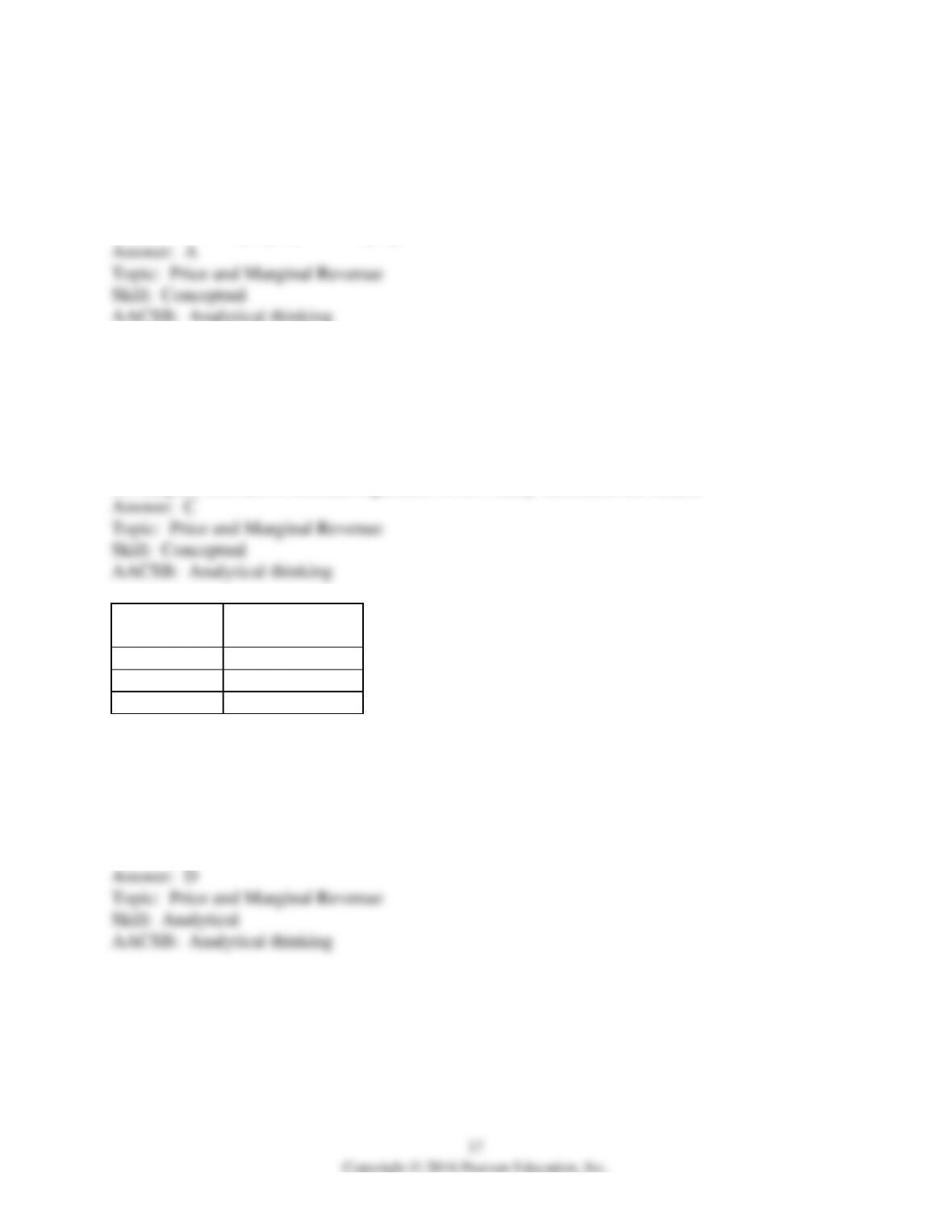
Quantity
(units)
Price
(dollars per unit)
4
16
5
14
6
12
21) The table above gives the demand for a monopolist’s output. What is the marginal revenue of
increasing production from 4 to 5 units?
A) $70
B) $16
C) $14
D) $6
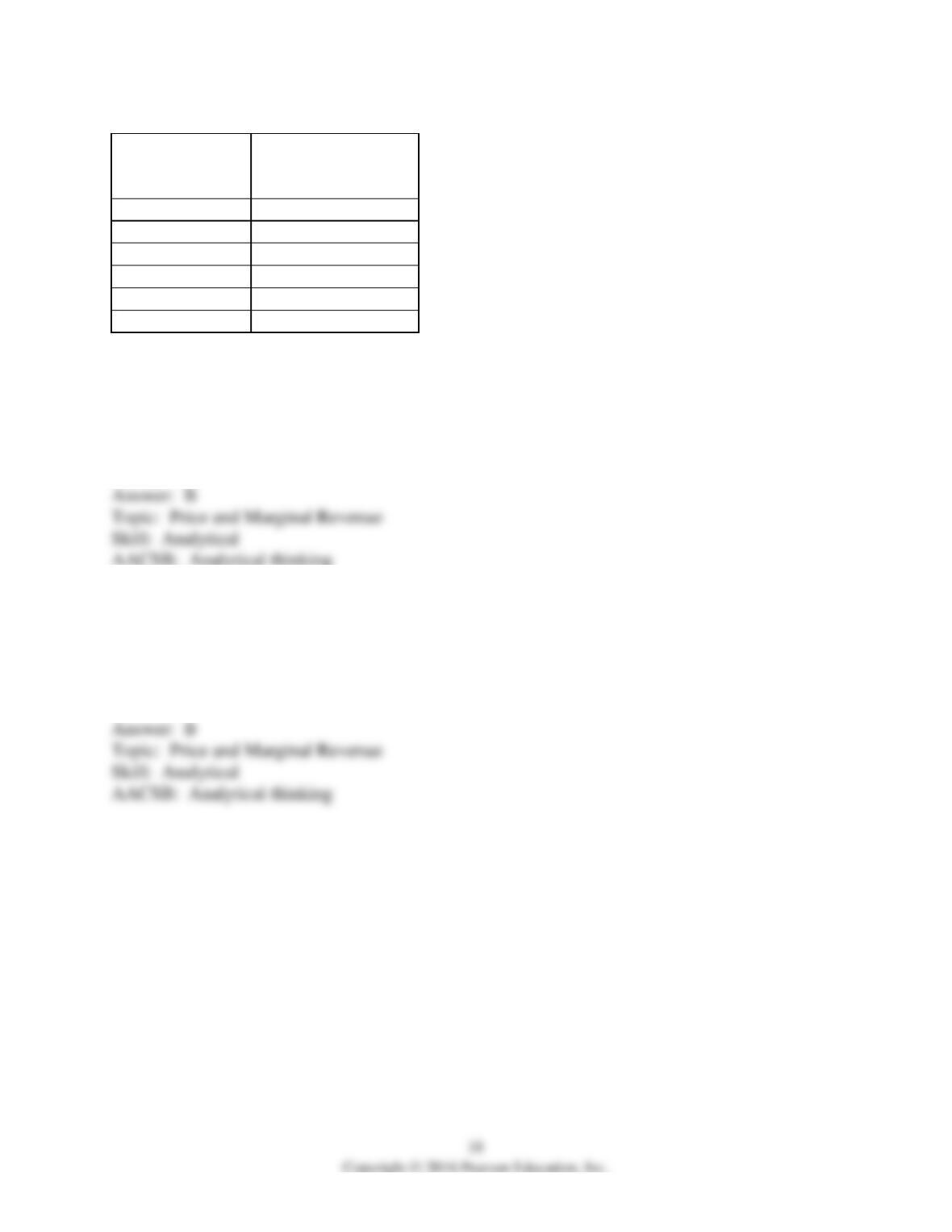
Price
(dollars per
haircut)
Quantity demanded
(haircuts per day)
5
50
10
40
15
30
20
20
25
10
30
0
22) Christy’s Haircuts, the sole supplier of haircuts in a small town, faces the demand schedule
shown in the table above. What is Christy’s marginal revenue from the 25th haircut?
A) zero
B) $5.00
C) $17.50
D) $50.00
23) Christy’s Haircuts, the sole supplier of haircuts in a small town, faces the demand schedule
shown in the table above. What is Christy’s marginal revenue from the 35th haircut?
A) zero
B) -$5.00
C) $5.00
D) $12.50
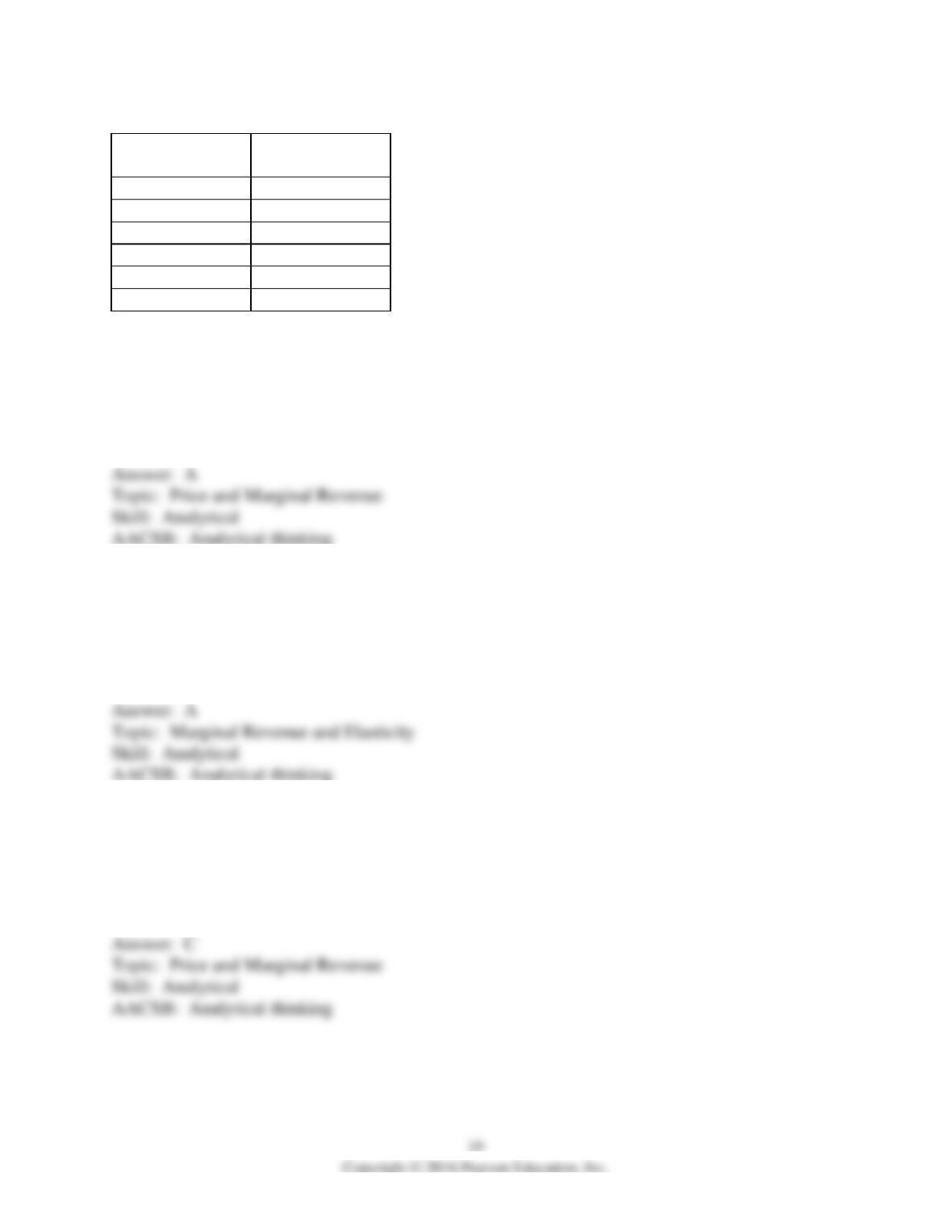
Quantity
(units)
Price
(dollars per unit)
1
8
2
7
3
6
4
5
5
4
6
3
24) The table above gives the demand for a monopolist’s output. Between which two quantities is
marginal revenue equal to 0?
A) 4 and 5
B) 3 and 4
C) 2 and 3
D) 1 and 2
25) The table above gives the demand for a monopolist’s output. Between which two quantities is
demand elastic?
A) 6 and 5
B) 5 and 4
C) 4 and 3
D) 3 and 2
26) The table above gives the demand for a monopolist’s output. What is the total revenue when
3 units of output are produced?
A) $21
B) $20
C) $18
D) $6
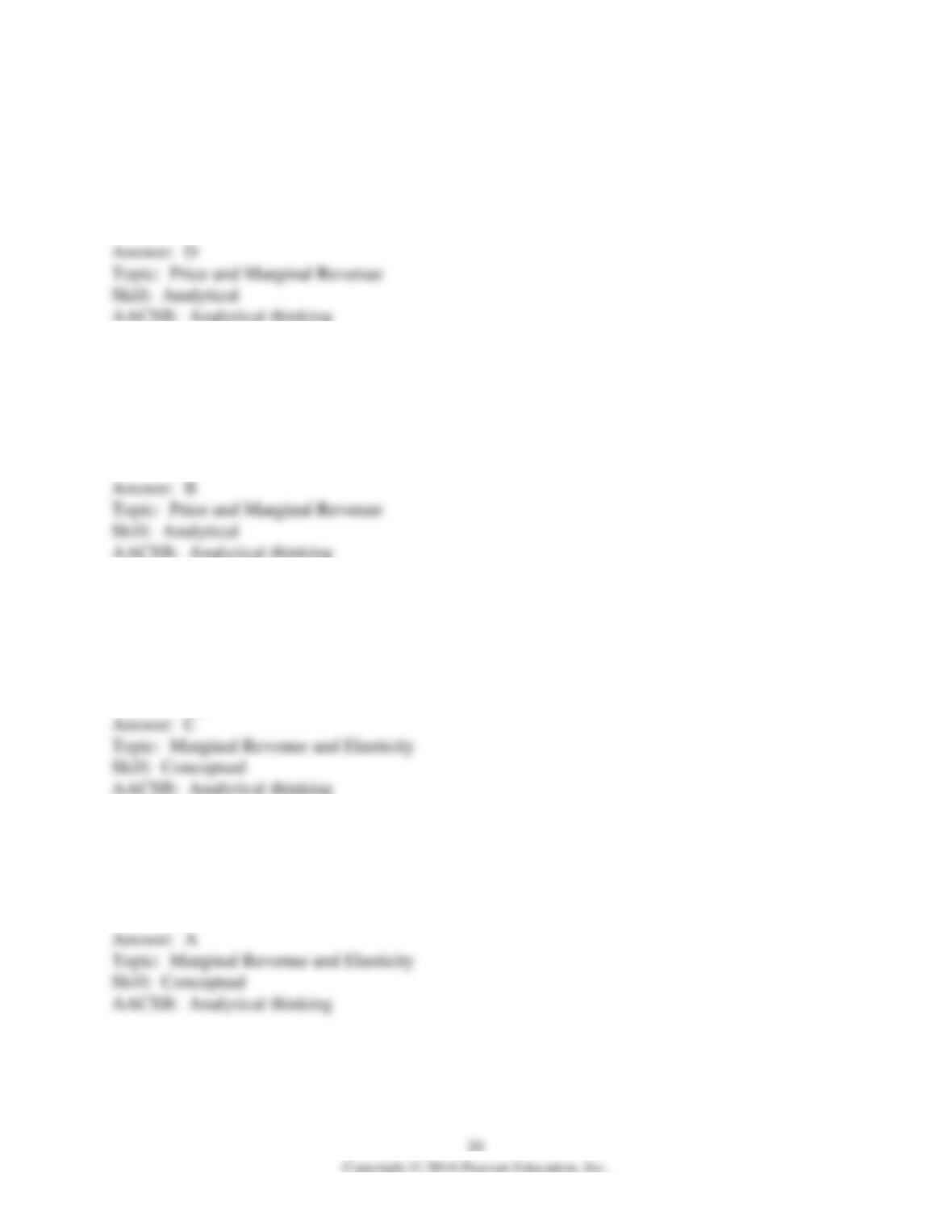
27) The table above gives the demand for a monopolist’s output. What is the marginal revenue
when output is increased from 5 to 6 units?
A) $18
B) $4
C) $3
D) -$2
28) The table above gives the demand for a monopolist’s output. What is the marginal revenue
when output is increased from 2 to 3 units?
A) $18
B) $4
C) $7
D) $6
29) For a single-price monopoly, marginal revenue is ________ when demand is elastic and is
________ when demand is inelastic.
A) negative; negative
B) negative; positive
C) positive; negative
D) positive; positive
30) For a monopolist, on the inelastic range of its demand
A) marginal revenue is negative.
B) marginal revenue is positive.
C) marginal revenue is equal to zero.
D) total revenue is maximized.